
· · · ALASKA · · ·
Seward appeared before the Committee and made a long explanation of the status of affairs in Alaska and the reasons which induced him to make the purchase.… The discussion which followed was decidedly spicy, and somewhat acrimonious.
—NEW YORK TIMES, MARCH 19, 1868
On a map, Alaska looks like it ought to be part of Canada. How and from whom did the United States obtain it? Not from the Canadians, since it never belonged to them, nor to their colonial predecessors, the British. Since the Battle of Sitka in 1804, it had essentially belonged to Russia (although indigenous peoples such as the Tlingits, Aleuts, and Yupiks would have begged to differ). In 1867 the United States acquired Alaska when Secretary of State William H. Seward negotiated a treaty with Russia for its purchase.
At the time, Alaska was popularly derided as “Seward’s folly” and “Seward’s icebox.” Even the New York Herald, which supported the purchase, couldn’t resist Alaska laughs. Its November 12, 1867, edition contained an abundance of what purported to be classified ads, among them:
Cash! Cash! Cash!—Cash paid for cast off territory. Best price given for old colonies, North or South. Any impoverished monarchs retiring from the colonization business may find a purchaser by addressing W.H.S., Post Office, Washington, D.C.
Aside from its coastline, Alaska was viewed by many as little more than a mammoth stretch of barren tundra and ice. It is indeed a lot of land—over twice the size of the nation’s second largest state, Texas. Virtually no public opinion was expressed leading up to the treaty’s signing, since only a select few knew that it was in the wind. The purchase of Alaska was not revealed, even to Congress, until the day the treaty was signed. At that point, it became headline news.
Typical of the initial press reports was that of the San Francisco Bulletin, whose March 30, 1867, front page story trumpeted:
Important Treaty With Russia
She Surrenders Sovereignty
to all Russian America
British Excluded From the Ocean
The President has communicated to the Senate a treaty with Russia. The latter surrenders to the United States sovereignty over all Russian America and adjacent islands, and especially includes a strip of 400 miles down the coast, excluding British America from the ocean. British diplomats are highly excited.
Britain was indeed “excited” but not, as first reported, excluded from the ocean. British Columbia, with its bustling port at Vancouver, remained between Alaska and the rest of the United States.
How could—and why would—such a huge purchase be pulled off so secretly? The answer can be summed up in two words: William Seward.
Seward had been raised in Orange County, New York, the son of a prosperous doctor. As a young lawyer, he became a protégé of Thurlow Weed, a political boss from whom he learned his way around back rooms. He was elected to the state senate in 1830 and later became New York’s governor and then senator. In 1860 he was the odds-on favorite to become the Republican nominee for president. But he lost out to a relative newcomer from Illinois named Abraham Lincoln. Lincoln chose Seward to be his secretary of state. It was a smart choice.
Though the purchase took place after the Civil War, Seward’s reasons for purchasing Alaska were rooted in that war’s underlying element. Before, during, and after the war, Seward’s greatest political fear was that the United States might disunite.
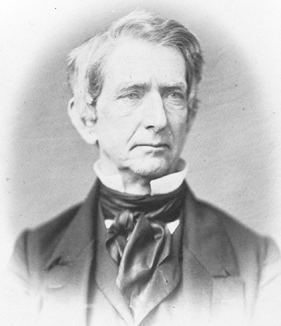
William H. Seward (1801-1872) (photo credit 37.1)
Seward first voiced this fear in 1849 when California sought statehood. That suddenly populated gold rush region presented Congress with proposed boundaries that were outrageously large. Many members of Congress sought to create two states—in effect, North and South California—and to push back the proposed eastern boundary to the crest of the Sierra Nevada range, thereby sharing its gold with the neighboring states yet to be created. Seward opposed these adjustments. Pointing out that the U.S. military had no direct access by rail or sea, if it were needed to prevent California from declaring itself a separate nation, he argued in the Senate, “Are we so moderate, and has the world become so just, that we have no rivals and no enemies to lend their sympathies and aid to compass the dismemberment of our empire?”
Seward’s remarks on California reflected his insight into foreign affairs, which he viewed as a multidimensional chess game. As secretary of state he demonstrated this view in the way he went about the purchase of Alaska and, prior to that, in the way he urged Lincoln to avert the Civil War. In April 1861, with Southern states seceding and war appearing inevitable, he sent Lincoln a memo entitled, “Some Thoughts for the President’s Consideration.” Among those thoughts were such notions as, “I would demand explanation from Spain and France [regarding intervention in Mexico to retrieve unpaid debts].… And if satisfactory explanations are not received from Spain and France, would convene Congress and declare war against them.” In a letter to governors of those states bordering the Great Lakes, Seward suggested going to war to acquire Canada. With the nation on the verge of Civil War, such actions were not the kind of recommendations one would expect from the nation’s premier diplomat.
But these were not actions, they were words, and the key to understanding Seward’s words is to ask what he was doing by saying them. In this instance, Seward was suggesting a “chess move” to create fear of an imminent war with outsiders, in the hope that it would rally enough Americans to forestall the crumbling of the Union. He had no intention of France or Spain mistakenly interpreting such saber rattling as a genuine threat.1
When it suited his purpose, Seward readily admitted that his words should not be taken at face value. Shortly before his appointment as secretary of state was made public, he told a British diplomat that he would soon be in a position that would require him to insult Great Britain. Years later it was discovered that, five weeks before Seward’s private memo to Lincoln, the British foreign secretary recorded in his diary that he’d received information indicating that the United States might create a quarrel with Britain in an effort to prevent the nation from dividing.2
Seward believed that Alaska was of vital importance to strengthening the bond securing the West Coast (whose residents relied on Alaska for imports of fish, timber, and fur) to the rest of the nation. Further securing that bond was also embedded in Seward’s other main reason for purchasing Alaska: to promote and protect American commerce with China and Japan.
Buying Alaska revealed Seward’s diplomatic skills; selling to the public the buying of Alaska required his political skills. He knew he was investing in a huge amount of territory about which most Americans knew nothing. Other than Americans on the West Coast, awareness of Alaska’s significance was limited primarily to a few intellectuals. But even these citizens did not know that diplomatic signals regarding Alaska’s potential sale to the United States were in the works, and had been for over a decade. In 1854 Russia, at war with Britain, offered the Americans a “treaty of purchase.” Being an act of diplomacy, the words did not necessarily mean what they said; the treaty was actually a fake. The Russians’ idea was to leak the treaty’s existence to avert a British attack on Alaska.3 As it turned out, Russia and the United States decided not to release the phony agreement. But Tsar Alexander II’s advisers increasingly viewed Alaska as more of a liability than an asset, and American political figures increasingly broached the purchase of Alaska with members of the cabinet and Russian ministers.
The Civil War slowed the frequency of these winks and nods but did not end them. Nor did the assassination of President Lincoln end Seward’s tenure as secretary. By 1867 he and Russian ambassador Eduard Stoeckl were exchanging offers and counteroffers. On the evening of March 29, Stoeckl called upon Seward at his home to inform him that his government had accepted the deal, and to ask for time the next day to begin drafting the actual treaty. Seward, wanting to keep the agreement under wraps, suggested they start now. The family’s dinner table was cleared, secretaries were summoned, and at four o’clock in the morning, a treaty was ready to take to the White House. President Andrew Johnson signed it the following day, sending word of his action to Congress.
The treaty now needed Senate ratification. That debate took place in executive session, away from public scrutiny. Nevertheless, the debate commenced immediately in the press. Most newspapers initially touted the purchase’s virtues in nearly identical language.4 Clearly, someone had prepared a public relations campaign timed to the release of the treaty. Given that the treaty had just been written the night before in Seward’s dining room, only Seward himself could have masterminded such a campaign.
The need for this public relations blitz quickly became evident. Opposition to the purchase commenced as soon as it was made public. On the East Coast, some papers such the New York Times supported the purchase while others such as the New York Tribuneopposed it. Midwestern newspapers were likewise divided.5 West Coast newspapers, not surprisingly, vigorously endorsed it. And Southern newspapers—hardly fans of the man whose diplomacy had helped prevent European aid to the Confederacy—urged the Senate to vote no.
The Senate, as it turned out, was less divided. Emerging from private deliberations, it voted thirty-seven to two in favor of ratification. Constitutionally, once the Senate ratifies a treaty, that’s that. In this instance, however, the treaty required the United States to pony up $7,200,000, and that appropriation required approval by the House of Representatives. In effect, it too would have to ratify the treaty.
The House debate was public, and so heated one might think the purchase of Alaska entailed some master plan for the future. In fact, it did. The New York Herald wrote in March 1867 that the purchase of Alaska was “an important step toward the absorption of the whole continent by the United States.” Seward himself believed that, with the purchase of Alaska, the United States would inevitably come to acquire the land separating Alaska from the lower forty-eight states: the Canadian province of British Columbia. Those opposed to the purchase worried that the United States would expand too far—geographically and racially.6 Ultimately, however, over a year after the signing of the treaty, the House of Representatives sent to the Senate a bill containing the funds for the purchase of Alaska.
William Seward, meanwhile, had continued his efforts to expand America both westward and eastward. He sought to purchase the Dominican Republic and the Virgin Islands. He sought to gain a privileged American connection with Hawaii. And he acquired another barely habitable territory: a tiny group of islands in the Pacific, mid-distance between the American West Coast and Asia, and thus named Midway. The strategic importance Seward foresaw in this forlorn little atoll was borne out in World War II, when it became the scene of a critical battle between the United States and Japan.