
· · · MONTANA, IDAHO · · ·
Gov. Edgerton was not a member of the Committee on Territories, and I never heard of his having anything to do, directly or indirectly, with the organization of the territory of Montana or with fixing its western boundary.
—JAMES M. ASHLEY
I had many interviews with Gov. Ashley, who was a strong supporter of the bill [to create Montana] and, as chairman of the Committee on Territories, had a great influence.
—SIDNEY EDGERTON1
Clearly, one of these men had a faulty memory. The fault line dividing their recollections can be seen on the map. It is the boundary between Montana and Idaho—a border that often raises questions, since Montana would be quite a large state even if it didn’t overflow its straight lines as it barrels into the Rockies, pushing Idaho every which way until only a thin panhandle remains.
Sidney Edgerton was an Ohio congressman from 1859 to 1863. James Ashley was an Ohio congressman from 1859 to 1869. Both were abolitionists who assisted escaped slaves via Ohio’s Underground Railroad. They were good men, but not perfect, as hinted in their divergent recollections regarding Montana’s western border.
Following Edgerton’s second term in Congress, President Lincoln appointed him to a judgeship in the newly formed Idaho Territory. This first territorial incarnation of Idaho was very different from today’s state. It encompassed present-day Idaho, Montana, and Wyoming. Edgerton and his family set off for the arduous journey to the territorial capital at Lewiston. But they stopped short of their destination. “It is difficult to understand what it meant in 1863 to undertake a journey from Ohio to Lewiston, the capital of Idaho,” Edgerton’s daughter later recollected. “News of the recent gold discoveries at Bannack, together with the fact that the [winter] season was somewhat advanced, brought about the decision to go [to Bannack].”2
Another reason for not continuing to Lewiston was the fact that it was not in Edgerton’s judicial district. Some historians believe that territorial governor William H. Wallace was demonstrating his well-known opposition to imported judges by assigning to this Ohioan a vast and sparsely populated district east of the Rockies. Others believe that Wallace’s insult motivated Edgerton’s efforts the following year to push the western border of the Montana Territory as far as he could into the original Idaho Territory. And others, such as eminent Idaho historian Merle W. Wells, maintain that, because of the gold discoveries at Bannack, “Edgerton’s district had far greater importance than the one containing the temporary capital, and because of his financial interests in the district to which he was assigned, Edgerton had no great desire to make the long, hard trip to Lewiston.”3
Financial interests? Perhaps Judge Edgerton would have recused himself from any cases in which he would have had a conflict of interest. At it happened, he never presided at any trials because, before the snows had melted, he had accepted the task of returning to Washington to represent this region in the creation of the Montana Territory.
Whatever his motive, time was of the essence. James Ashley, chairman of the House Committee on Territories, was about to set the boundary ball in motion. During the previous Congress, Ashley had proposed radically different—and far more equal—borders for Idaho and Montana. Ashley’s plan was to divide the region horizontally, with Montana occupying the southern half and Idaho occupying the north. The proposal was then sent to committee.
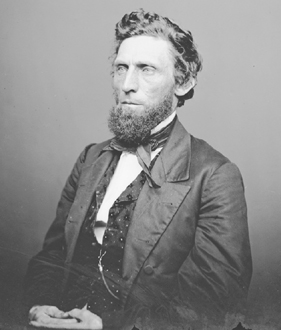
Sidney Edgerton (1818-1900) (photo credit 36.1)
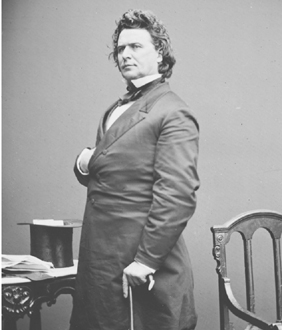
James Ashley (1824-1896) (photo credit 36.2)
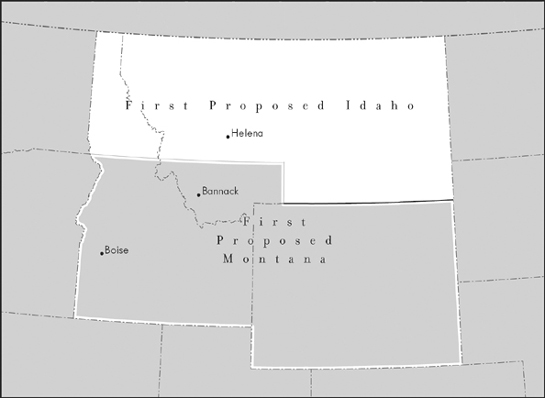
Ashley’s original proposal
Word arrived in Bannack shortly after Edgerton’s arrival that Ashley was now planning to bring the bill back to the House floor. To rank-and-file miners, the boundary made little difference. But to those with financial interests in the mines, Ashley’s horizontal division would dilute their political clout in their respective territories by dividing the mountainous mining region and combining it with soon-to-be agricultural and ranching regions. Mine owners in Idaho could maintain more clout with a vertical division, since it would result in an agricultural region limited to the Snake River Valley in what would then be its south. In Montana, however, limiting the vast agricultural regions was not an option, no matter how you sliced it. Consequently, it was imperative for the mine owners that they acquire a western border with as much of the gold-rich mountains as possible.
The logical choice to make the case for Montana was Edgerton. Not only had he served in Congress, but he had done so from the same state and political party (Republican) as Ashley, the territorial committee chairman. Moreover, Edgerton was personally acquainted with President Lincoln. And he knew what to wear and how to pack. “Ingots were quilted into the lining of my father’s overcoat,” his daughter recollected, “and he carried in his valise immense nuggets wherewith to dazzle the eyes of Congressmen and to impress upon their minds by means of an object lesson some adequate idea of the great mineral wealth of this section of the country.”
While members of Congress may have been familiar with the quantities of gold being mined in the region, Edgerton’s daughter was quite right that the object itself would have dazzled their eyes—and possibly ethics. “Arriving safely in Washington, the gold was exhibited, Congressmen interviewed, and at length the desired end was accomplished,” her recollection continued, concluding, “Judge Edgerton saved to Montana all of her rich territory lying west of the summit of the Rockies.”
Idaho’s representative, William H. Wallace (the man who, as territorial governor, had assigned Edgerton his judicial district) joined Edgerton in supporting the vertical division over Ashley’s horizontal proposal. Wallace, however, sought a vertical boundary along the Continental Divide, whereas Edgerton sought a boundary that shifted to the more westerly crest of the Bitterroot Range. Edgerton won (though the northernmost segment of the border departs from the Bitterroots, preserving the Kootenai River Valley for Idaho).
Who, among those congressmen Edgerton “interviewed,” as his daughter put it, might have been both persuaded by his “object lesson” and sufficiently influential to change Congressman Ashley’s proposed borders so radically? The ideal person, of course, would have been Congressman Ashley himself. But could a man so committed to the most progressive issues of his day (abolition of slavery, the right of women to vote) have been influenced by the sight of gold? It doesn’t seem unlikely; in April 1869 the New York Times devoted four articles to Ashley, detailing “abundant evidence of his public corruption.”
Edgerton left Washington not only with the boundary he had sought for Montana but also with the governorship of the new territory. He soon discovered, however, that the line he purchased failed to take into account other lines that divided the region, such as the interests of farmers and ranchers. He was unable to govern the various groups opposed to his personal interests. He left the territory before his term expired and was replaced by an interim governor until—small world—James Ashley was appointed.
Learning of Ashley’s appointment, Montana’s congressional delegate, James M. Cavanaugh, stated on the floor of the House that he “never solicited [Ashley] to come among us.” Cavanaugh (who, unlike a territorial governor, was elected, not appointed) characterized Ashley as “having been spewed out at the mouth” and protested that the territories were “being made receptacles for political convicts.”
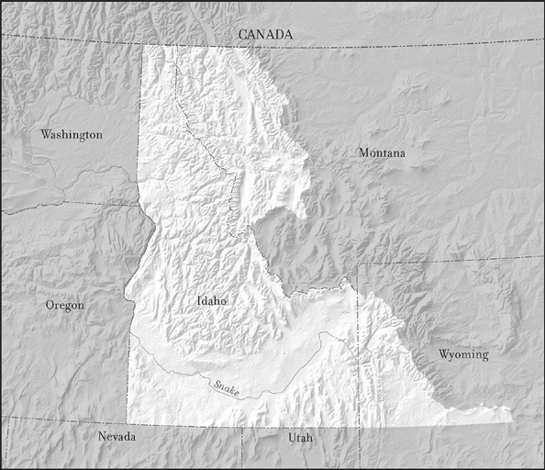
Idaho’s border proposal
Like Edgerton, Ashley proved unable to govern the tough, pugnacious people of Montana. He was dismissed by the president before his term expired. Together, Sidney Edgerton and James Ashley demonstrated that all that’s gold does not glitter.