
· · · DISTRICT OF COLUMBIA · · ·
Congress legislates in all cases directly on the local concerns of the District [of Columbia]. As this is a departure, for a special purpose, from the general principles of our system, it may merit consideration whether an arrangement better adapted to the principles of our Government and the particular interests of the people may not be devised, which will neither infringe the Constitution nor affect the object which the provision in question was intended to secure.
—PRESIDENT JAMES MONROE1
In 1990 Eleanor Holmes Norton was elected to the U.S. House of Representatives as a nonvoting delegate from the District of Columbia. She and others maintain that the status of the District, whose local laws can be repudiated or imposed by Congress, replicates that of the colonists for whom taxation without representation ignited the American Revolution. The similarity can be seen in a 1774 resolution of New Hampshire colonists, expressing support for the Boston Tea Party. “To send us their teas, subject to a duty [tax] on landing here,” the resolution stated, England “testified a disregard to the interests of Americans.… This town approves the general exertions and noble struggles … for preventing so fatal a catastrophe as is implied in taxation without representation.”2
Some Americans, however, disagree with this comparison. They maintain that the status of the District of Columbia is embedded in the Constitution. Among the powers given to Congress in Article I is the authority to “exercise exclusive Legislation in all Cases whatsoever, over such District (not exceeding ten Miles square) as may, by Cession of particular States, and the acceptance of Congress, become the Seat of the Government of the United States.” Implicit in this clause is the fact that the nation’s capital is not a state.
How did this predicament come to be? Its underlying cause was reported in the Philadelphia Gazetteer in 1783, prior to the existence of Washington, DC:
Several of the disbanded [Revolutionary War] soldiers have, for some days past, been clamorous for this pay.… On Saturday last, about two or three hundred of them hostilely appeared before the State-house [present-day Independence Hall] and handed in … their demands in writing, accompanied with a threat.… The Congress … hastily resolved to exchange their old sitting place for the more salubrious air of Princeton, in the State of New Jersey … having received no satisfactory assurances for expecting adequate and prompt exertion of the State [of Pennsylvania] for supporting the dignity of the federal government.
Five years later, when Congress replaced the Articles of Confederation with the Constitution, it penned Article I, Section 8, reserving for itself exclusive jurisdiction over the District of Columbia to assure it would never again be at the mercy of a state for its own protection.
Even at the time, however, the status of the District of Columbia was controversial. The record of the debate over the proposed Constitution states:
Mr. George Mason thought there were few clauses in the Constitution so dangerous as that which gave Congress exclusive power of legislation with ten miles square.… It is an incontrovertible axiom that, when the dangers that may arise from the abuse are greater than the benefits that may result from the use, the power ought to be withheld. I do not conceive that this power is at all necessary, though capable of being greatly abused.
No less a figure than James Madison disagreed:
How could the general government be guarded from undue influence of particular states, or from insults, without such exclusive power?… If this commonwealth depended, for the freedom of deliberation, on the laws of any state where it might be necessary to sit, would it not be liable to attacks of that nature, and with more indignity, which have already been offered to Congress?
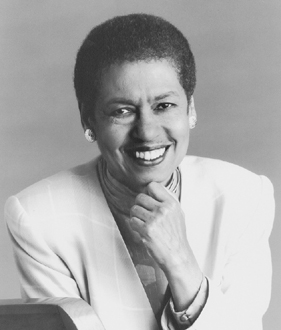
Eleanor Holmes Norton (1937-) (photo credit 44.1)
Patrick Henry—most remembered for declaring “Give me liberty or give me death!”—brought that same fervor to the debate over the status of the District:
Will not the members of Congress have the same passions which other rulers have had? They will not be superior to the frailties of human nature.… Show me an instance where a part of the community was independent of the whole.… This sweeping clause will fully enable them [members of Congress] to do what they please.… I have reason to suspect ambitious grasps at power.
To which James Madison replied:
Mr. Chairman, I am astonished that the honorable member should launch into such strong descriptions.… Were it possible to delineate on paper all those particular cases and circumstances in which legislation by the general legislature would be necessary, and leave to the states all the other powers, I imagine no gentleman would object to it. But this is not within the limits of human capacity.
Not by accident, then, or unaware of the risks, did the Founding Fathers create the dilemma faced by the citizens in the District of Columbia. From that time to the present, its residents and Congress have repeatedly struggled to untangle these issues. As of this writing, that effort is being led in Congress by DC delegate Eleanor Holmes Norton. Without a vote, however, what influence can she wield? After two hundred years of effort, what hope can she have? Norton has sought to use the influence of hope itself, much as had two of the nation’s most influential figures. “George Washington was the paradigm unifying figure, the first American of the new republic; [Martin Luther] King was a profoundly unsettling figure, who challenged the republic,” she wrote in a 1986 Washington Post column commemorating Martin Luther King Day. “Yet King and Washington are not odd fellows thrown together by the fickle if democratic process that produces national holidays. Different as the two men were, they have been honored for the same reason. They managed to draw out the best in the American character.”
Hope drove those who risked their lives to found the nation and has remained the nation’s most influential force. It has also defined Norton’s life. One such pivotal moment occurred in high school. “We heard the chime that told us there would be an announcement,” she later recollected. “I remember the voice of the principal, Mr. Charles Lofton, interrupting class to tell us news of major importance. We had the right to go to any school now. We were stunned, then elated. And I remember believing that the world had changed, literally had changed.”3
Norton graduated in the last segregated class of Dunbar High School in Washington. Among the city’s segregated schools, Dunbar was reserved for academically gifted “colored” students. Its graduates went on to the nation’s premier black colleges and universities, such as Fisk, Tuskegee, Howard, Morehouse, and Spelman. Norton, however, chose predominantly white Anti-och College, an Ohio school with a reputation for being politically left-wing.
Norton herself did not come from a politically radical family. Her father, a third-generation Washingtonian, was an attorney whom she described as a “died-in-the-wool” Democrat. Her mother, a teacher who had migrated from the South, brought with her the traditional customs of southern African Americans. But both parents embraced the spirit of Norton’s great-grandfather, Richard Holmes, who had been the first member of the family to move to Washington. He did so in the dead of night, escaping slavery in Virginia. The Washington into which he had arrived in the early 1850s was risky terrain for an escaped slave. While it had many free African Americans, it also had slaves, and under the Fugitive Slave Act, runaway slaves could be reclaimed at any time. Though the stakes were considerably less for young Eleanor, her venturing to Antioch echoed her great-grandfather’s spirit of risk.
In 1963 the soon-to-become Yale law student ventured into terrain every bit as dangerous as her great-grandfather’s. She traveled to Greenwood, Mississippi, to participate in that summer’s historic effort to register African American voters. Arriving in Jackson, she met with the field secretary for the state’s NAACP, Medgar Evers, who briefed her on the situation she would be encountering, then dropped her off at the bus station for her trip to Greenwood. That night Evers was shot and killed.
As a young lawyer, Norton worked for the American Civil Liberties Union, where she first began to get national attention. Ebony magazine wrote of her in 1969:
In her Afro hairstyle, her dangling earrings and her multi-colored striped dress … Eleanor Holmes Norton hardly looks like what she is—an astute constitutional lawyer who has argued controversial cases before the Supreme Court and won. But there is a certain irony in a number of her victories.… [S]he has … defended the free speech of George C. Wallace, the segregationist National States Rights Party, and individual klansmen.
For Norton, civil rights transcended race and political views. Rather, she saw them as inseparably connected to humanity’s inalienable rights. This deeply held conviction drew the attention of New York Mayor John V. Lindsay. “Eleanor Holmes Norton, a civil liberties lawyer, was appointed chairman of the city’s Commission on Human Rights yesterday,” the New York Times reported in 1970. “As head of the city’s principal antidiscrimination agency, Mrs. Norton, who is 32 years old, will also be the highest ranking Negro woman in Mr. Lindsay’s administration.” Norton’s achievements during her seven years in New York brought her to the attention of others as well. In 1977 President Jimmy Carter chose Norton to head the Equal Employment Opportunity Commission.
In 1990, when Washington, DC’s delegate to Congress retired, Norton (now a law professor at Georgetown University) sought and won election to the position. Once in office, she took up the torch that had been carried by a long line of predecessors: equal representation for the District of Columbia.
Following President Monroe’s 1818 call to rectify the status of the District, its residents had created a committee to propose solutions. “The Committee confesses that they can discover but two modes in which the desired relief can be afforded,” it reported back to Congress in 1822, continuing “either by the establishment of a territorial government … restoring them to equal rights enjoyed by the citizens of the other portions of the United States, or by a retrocession to the States of Virginia and Maryland of the respective parts of the District which were originally ceded by those States to form it.”4 Neither idea was new, ideal, or favorably received.
The problem then went dormant until 1841, when it was picked up again by President William Henry Harrison. “It is in this District only where American citizens are to be found who … are deprived of many important political privileges,” he declared in his inaugural address. “The people of the District of Columbia are not the subjects of the people of the States, but free American citizens. Being in the latter condition when the Constitution was formed, no words used in that instrument could have been intended to deprive them of that character.” Unfortunately for District residents, Harrison died one month later.
In 1846 the issue was resolved for those District residents living on the Virginia side of the Potomac. That year, Congress returned that portion of the city to Virginia (see “Robert M. T. Hunter” in this book).
In 1888 New Hampshire Senator Henry W. Blair proposed an amendment to the Constitution to provide voting representation for the District of Columbia. The Senate voted it down. He was followed in 1918 by Illinois Senator James Hamilton Lewis. “The United States is the only country in the world that exiles it own National Capital,” Lewis wrote in a Washington Post column proposing statehood for the District. “The federal government could reserve a sufficient area for all federal buildings and reserve governmental control over all the area, just as it does now over military posts.” Senator Lewis’s efforts went nowhere as well. His statehood proposal was followed by that of Texas Representative Hatton Sumners in 1940. Sumners’s was followed by that of another Texas congressman, Henry Gonzalez, in 1967. Gonzalez’s was followed by that of Iowa Senator Fred Schwengel in 1971; Schwengel’s by Massachusetts Senator Edward Kennedy’s in 1984, 1985, and 1987.5
This field of failures was the terrain into which Norton ventured in 1990. Over the years, the struggle had become further complicated by the terrain dividing into various battlefields: statehood, retrocession to Maryland, territorial status, and limited voting rights. But risky terrain for fundamental rights had always attracted her. Though a rookie in Congress and, as a nonvoting delegate, batting without a bat, she made her play within months of her election. The Washington Post reported:
Delegate Eleanor Holmes Norton … acknowledging that statehood faces an uphill battle, introduced legislation that would create the state of New Columbia.… Under Norton’s bill, the boundaries of the new state would be the same as the District’s, excluding the Mall and other federal landmarks such as the White House. These would be made part of a federal enclave that would remain under direct congressional control.… Critics have long contended that the Constitution would have to be amended to achieve statehood.
Over the years, neither the Republicans nor the Democrats have consistently opposed or supported DC statehood. During his 1991–92 presidential campaign, Democrat Bill Clinton supported DC statehood despite having opposed it as the governor of Arkansas.6 Likewise, among present-day Republicans there are some who maintain that Congress can extend voting representation to DC residents without having to amend the Constitution. Two of the most prominent of such Republicans are Utah Senator Orrin Hatch and Kenneth Starr, a former federal judge appointed to the bench by President Ronald Reagan, then appointed solicitor general by President George H. W. Bush, and later selected to be the independent counsel investigating misconduct by President Clinton.7 In his 2004 testimony before Congress, Starr pointed out:
The judiciary has rightly shown great deference where Congress announces its considered judgment that the District should be considered a “State” for specific legislative purposes.… In 1949, the Supreme Court’s Tidewater decision … confirmed what is now the law: the Constitution’s use of the word “State” in Article III cannot mean “and not of the District of Columbia.” Identical logic supports legislation to enfranchise the District’s voters: the use of the word “State” in Article I cannot bar Congress from exercising its plenary authority [over the District] to extend the franchise to the District’s voters.
Despite the fact that Starr and Hatch agreed that the Constitution need not be amended to provide voting representation to the District, politicians from both parties continued to invoke the need for a constitutional amendment in order to cloak other concerns. “Del. Eleanor Holmes Norton bristled several times when witnesses contended that the proposed statehood legislation is unconstitutional,” the Washington Post reported in March 1992, when her bill was under consideration by the House Committee on the District of Columbia. The following month, the committee sent Norton’s bill to the floor of the House. With every (nonretiring) member of the House having to face the voters in November, opponents of representation for the District now uncloaked their actual concerns. “President Bush recently criticized a District law expanding homosexual rights,” the Post reported in a May 1992 article headlined, “Statehood Stirs Up Opposition.” The article quoted a mass mailing by Senator Jesse Helms that told voters, “I’ve already got my hands full fighting the far-left, ultra-liberals in Congress. And the last thing I need is having to battle Jesse Jackson.” (At the time, African American leader Jesse Jackson lived in the District of Columbia.)
This opposition effort, which its backers ratcheted up as the November election approached, succeeded. “Citing recent overwhelming defeats for the District on issues such as the death penalty and gay rights, Del. Eleanor Holmes Norton said she will not ask lawmakers to vote on statehood before they adjourn,” the Post announced in October. “Norton said she remains upbeat about statehood’s chances for several reasons, including the chance that Bill Clinton might be elected President.”
Following the election of President Clinton, Norton again introduced a proposal for DC statehood. The bill’s supporters emphasized that the population of the District exceeded those of Alaska, Wyoming, and Vermont, that District residents paid taxes and served in the military just as other Americans did, and that the Constitution did not prevent Congress from granting voting rights to the District. Norton spoke to the issue’s core. “We are debating whether at last to grant full citizenship to a group of people on whom every duty of citizenship has been imposed,” she stressed on the House floor. “This nation was formed precisely because Americans paid taxes to a sovereign who afforded them no representation. The animating principle of American democracy has been no taxation without representation.”
Michigan Representative John Dingell, one of the most powerful Democrats in the House, spoke in opposition to DC statehood. “I have heard many, many complaints about people being denied constitutional rights,” he responded. “There is no constitutional right whatsoever that is being denied to the citizens here. If they do not like the way the government is run, they can pack up and move out.”
Dingell was not the only Democrat opposed to DC statehood. Though the Democrats constituted a majority of the House of Representatives, the measure failed 277 to 153.
This defeat was followed by another. The era’s political winds were propelling the Republican Party into increasingly conservative positions and, via those same winds, increasing popularity. In the 1995 congressional elections, the Republicans won a majority of the seats in the House and maintained that majority for the next twelve years. During this time, Norton knew she needed to adjust her tactics. Since a core belief of the Republicans was that the nation benefited from tax relief, Norton sought to persuade her Republican colleagues via that aspect of the District’s status. The Post reported this shift in February 1995:
Del. Eleanor Holmes Norton, the District’s representative on Capitol Hill, has long advocated D.C. statehood by arguing that the city’s situation constitutes “taxation without representation.”. Norton has come up with a new plan: no representation, no taxation. This week, she introduced legislation to exempt District residents from paying federal taxes.… Norton’s plan probably won’t become reality soon. The federal government … is not likely to give up $1.6 billion in revenue.
This effort failed, as the Post had predicted.
In addition to the challenges in Congress, Norton has also faced challenges from those residents in the District who believe she should pursue other avenues toward representation. “Eleanor Homes Norton is a 10-term delegate to the U.S. House of Representatives.… Douglass Sloan is a Ward 4 advisory neighborhood commissioner.… He wants her job,” a neighborhood newspaper reported in 2010, quoting her challenger: “She’s been there 20 years … and she hasn’t gotten anywhere.” Despite an energetic campaign, Sloan won only 9 percent of the vote in the 2010 Democratic primary, and Norton again triumphed in the general election.
Eleanor Holmes Norton may or may not eventually succeed in achieving statehood for the District of Columbia. What is certain, however, is that if she does not, others will take up the torch—for it is the same torch that has been carried by every individual in this book. It is a torch that illuminates the lines inside us, that define who we are. The lines on the American map are also our interior portraits. Americans don’t always find each other attractive, but each of us desires to be acknowledged, to count. In this nation, that desire is a right. The quest for that right is the torch carried by Eleanor Holmes Norton.