
CHAPTER 19
THE END IS NIGH. In most major cities, people walk around with placards calling upon us to repent. There are earthquakes, hurricanes, biblical predictions, fire-and-fury pronouncements from presidents and dictators. But when will the end come for us, as it most certainly will? It might be millions of years away, when our sun gets even hotter, or it might be some nasty germ that will wipe us all out. But one thing is for sure – there will be a time on Earth when we humans are no longer here.
Life on Earth is actually quite a fragile thing1. At least five times in history it nearly became extinct. Climate change, a meteorite strike, a gamma-ray burst from a distant star, all nearly did for life on Earth. Scientists call these ‘extinction events’, also known as ‘mass extinctions’ or a ‘biotic crisis’, ‘biotic’ being another word for life. Such an event is defined as a sharp and relatively rapid change in the diversity or abundance of life on Earth. But what are these extinction events that happened in Earth’s history?
The first big one happened around 2.45 billion years ago. It’s called the Great Oxygenation Event, and it happened because oxygen built up in the atmosphere. Oxygen is actually a very toxic molecule, as it can react with other chemicals and oxidise them. A good example is iron, which when oxidised becomes rust, which is less stable than iron. Oxidation usually means that something is broken down. Biological molecules like DNA and proteins are very prone to oxidation, so our cells have all kinds of ways to detoxify oxygen. We use oxygen to break down food, which is one way to keep oxygen under control. And our cells are packed full of molecules called antioxidants that keep it at bay.
So why did oxygen build up? Organisms called cyanobacteria evolved which could perform a marvellous trick, perhaps the greatest trick of all in biology. They could take carbon dioxide from the air and, using the energy in sunlight, combine it with water to make more of themselves – they could make carbohydrates. The evolution of cyanobacteria meant that life on Earth plugged into the cosmos. Imagine, air and water to make plants (which is what cyanobacteria are). This process is termed ‘photosynthesis’. And a by-product from this chemical reaction is oxygen.
Normally oxygen would be captured by iron or other dissolved chemicals, but it is thought that this became saturated, releasing oxygen into the atmosphere. This can be detected in rocks from that time. The oxygen was toxic to other organisms, which died off in their droves. The cyanobacteria themselves evolved protective measures, and other organisms called aerobic bacteria could also use the oxygen, most probably to get the most from food by oxidation.
And so life persisted on Earth, but in different forms than before. There was an adaptation to the new oxygen-rich conditions. It was a bit like being at a party, and someone turns the music up loud. Lots of people leave and only those with earplugs stay behind, procreate and give rise to more people with earphones. In this case, the loud music was oxygen.
These events had a very important role in the evolution of life on Earth. Some of the aerobic bacteria went inside an anaerobic bacterium (one that couldn’t use oxygen) and formed a special symbiotic relationship, as we saw in Chapter 1. This is called endosymbiosis, and was especially promulgated by the American biologist Lynn Margulis. Those aerobic bacteria subsequently became what we now know as mitochondria. Most of the oxygen consumption in our cells occurs in the mitochondria, which use oxygen to burn food and make the energy molecule ATP. These mitochondria are a relic of the early aerobic bacteria that could handle oxygen.
It’s spooky to think that every cell in your body has the descendant of a bacteria lurking there, using oxygen. At some point the cyanobacteria also went inside the new cells with the aerobic bacterium inside. They went on to form what we now call ‘chloroplasts’. This is what makes a plant. So the increase in oxygen, as well as causing the first great extinction on Earth, was the driving force that led to plant and animal cells evolving, since all plant cells have chloroplasts and mitochondria, and all animal cells have mitochondria. So the almost complete destruction of life on Earth had the fortunate spin-off of driving evolution forward all the way to us.
The reason this was so important was that it gave the ability to make the energy molecule ATP by using oxygen, which is what happens in mitochondria. This was a very effective way to make ATP, which provided the energy to feed the evolution of multicellular life. To evolve, an organism with lots of different cell types appears to have needed an effective way to make ATP, which was what the mitochondria did. Those multicellular organisms eventually evolved into us. As Nick Lane put it in his book The Vital Question, ‘the role of energy in Darwin has been neglected for too long’2.
The next big extinction, which happened 450–550 million years ago, goes by the catchy name the Ordovician-Silurian extinction event, during which up to 70 per cent of all life on Earth became extinct. Then there was the late Devonian extinction, between 375 and 360 million years ago, when again around 70 per cent of species became extinct. That one seemed to go on for 20 million years, with what are called ‘extinction pulses’ occurring in that period. Then there came the daddy of them all – the Permian-Triassic extinction event, which killed 96 per cent of marine life and 70 per cent of land species, including most insect species. The insects are especially noteworthy, as they are thought to be very robust, notoriously predicted to be able to survive a nuclear holocaust. But the Permian-Triassic extinction event nearly did for them.
Then, 201 million years ago, the Triassic-Jurassic extinction event occurred, and 75 per cent of species were wiped out. This included many species of amphibians, and the view is that this left the stage clear for the dinosaurs to evolve, as they were left with little competition. And so the age of dinosaurs begins. However, Mother Nature had it in for the dinosaurs too, because 66 million years ago they were all wiped out3. They must have gotten too cocky. This is the Cretaceous-Paleogene extinction event. Overall, 75 per cent of all species became extinct. All non-bird-like dinosaurs became extinct (the birds we see today are descended from dinosaurs), and the way was clear for mammals and birds to evolve. It’s a bit like if you hack away in a dense forest, the way is cleared for new plants to grow.
To summarise – a whole lot of extinctions going on. And an important consequence of the extinctions was that one species’ crisis is another species’ opportunity. For example, without oxygen building up, we would never have evolved, and without the dinosaurs being wiped out the jungle would have been too crowded for us to make our way in the world.
The cause of the Great Oxygen Event extinction is clear-cut: the evolution of organisms that could perform photosynthesis leading to oxygen building up. What was the cause of the other extinction events? The one that killed off the dinosaurs is perhaps the best known. It is now thought that it involved a large asteroid striking Earth just off the coast of the Yucatán peninsula in Mexico. The evidence for this is the presence of a large crater, and also a layer of iridium all over the world from that time, which came from dust thrown up by the asteroid that then settled back on Earth. The impact raised so much dust, both asteroid- and Earth-derived, that it blocked out the sun. It was like someone putting the lights out.
This meant that many plants could no longer photosynthesise, and so they died. This in turn led to the collapse of the food chain. It is also thought that sulphur-rich rocks were broken up, producing poisonous acid rain which further damaged the food chain. So in effect, Earth became dark and a hard rain fell, killing many plants. Clearly the big dinosaurs were especially susceptible. Our ancestors (which were a small, shrew-like creature) could scavenge and survive. There were no humans around at the time of the dinosaurs, unlike what has been depicted in movies and cartoons.
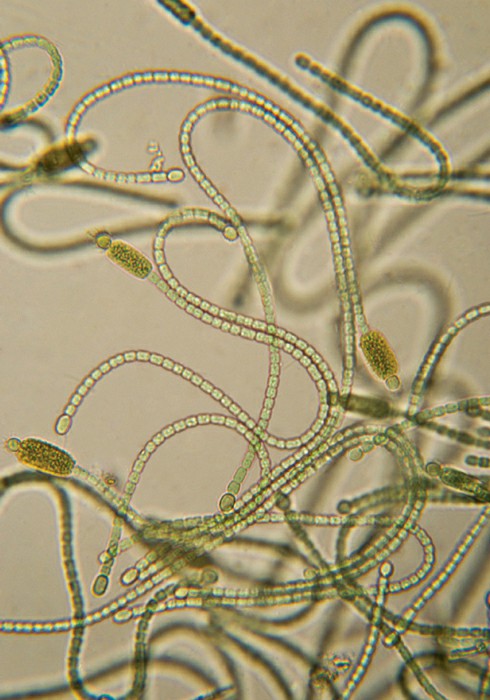
CYANOBACTERIA EVOLVED TO USE PHOTOSYNTHESIS, LEADING TO A MASS EXTINCTION BECAUSE OF THE BUILDUP OF OXYGEN WHICH MOST LIFE ON EARTH COULDN’T HANDLE.
Two of the extinctions – Ordivician and Late Devonian – are thought to have been caused by global cooling4. This made the Earth a dry place, as water got trapped in ice and snow. Plants became extinct because of the cold temperatures and dryness, again breaking the food chain. The Permian extinction is thought to have been caused by the opposite: global warming. This is something that is worrying us now, but back in the Permian era it was devastating. The Earth became much wetter and many plants got wiped out because they couldn’t tolerate the warmer climate.
Another consequence of global warming is the release of the greenhouse gas methane. This gas can be trapped in a type of chemical called a clathrate. Once the Earth’s temperature started to rise, these clathrates released methane, which then accelerated global warming even more. This is known as the ‘clathrate gun hypothesis’, since the release of methane is thought to be like a gun going off. What might have caused global cooling or warming isn’t fully known, but it could have been due to changes in the power of the sun, which is known to fluctuate. Life on Earth has such a dependency on the sun that it’s not surprising that great extinctions happen when the sun changes. This sets up a feed-forward loop which reaches some kind of maximum and then begins to relent, restoring things to some kind of normality.
Other events are also thought to have contributed to some of the mass extinctions. Oceanic overturn may have played a part in the late Devonian extinction event5. A good example of an oceanic overturn is when a so-called thermohaline circulation is disrupted. This kind of circulation is driven by deep water having more salt, as it doesn’t evaporate as much. If it overturns, the circulation will stop and more importantly oxygen-poor water from the deep moves to the top, killing a lot of life as it does so. Disruption can happen when too much fresh water (say, from glaciers melting) goes into the sea. The Gulf Stream is an example of an ocean current being driven by thermohaline circulation. If it were to overturn, the climate of Ireland would change radically, as the Gulf Stream keeps our climate temperate (meaning constant drizzle). This allows certain plants and animals to thrive, and so if it stopped there would be extinctions in Ireland.
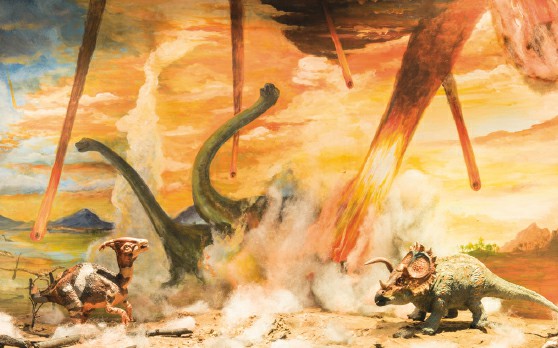
A GIANT METEORITE THAT CRASHED INTO THE YUCATÁN PENINSULA IS THOUGHT TO HAVE WIPED OUT THE DINOSAURS 66 MILLION YEARS AGO.
If a nearby nova or supernova were to give off a gamma-ray burst (which they are inclined to do), this could have a devastating effect. If it happens from a nova 6,000 light years away (which is not that far away on a cosmic scale, although it sounds like a lot) it would strip away the Earth’s ozone layer. This would leave life on Earth vulnerable to UV irradiation, which would be devastating. This is thought to have contributed to the Ordivician extinction event6. A zapping from a distant star might kill up to 70 per cent of life on Earth, then, including us. It would probably look spectacular, though.
So asteroids, gamma-ray bursts, the Earth heating up too much or cooling down too much, or the oceans going topsy-turvy have all nearly wiped out life on Earth. This begs the question, what are the chances of these things happening again? The chance of an asteroid hitting us or a gamma-ray burst are thought to be very, very small. They are random, once-in-a-blue-moon events, although you never know.
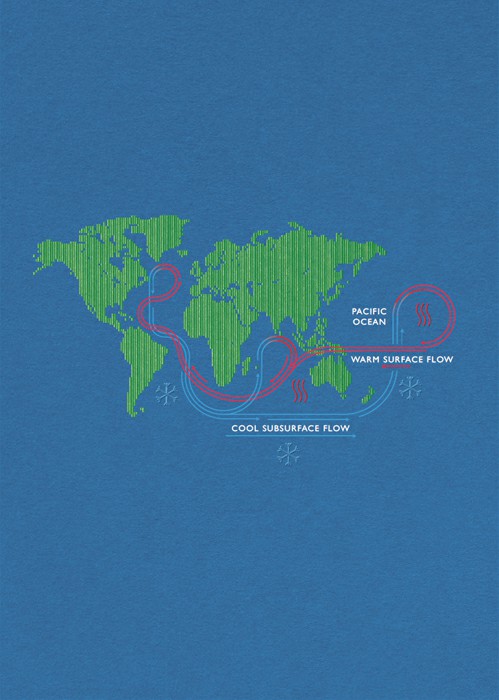
OCEAN CURRENTS ARE CRITICAL FOR MAINTAINING DIFFERENT CLIMATES. IF THEY SHOULD STOP BECAUSE OF CLIMATE CHANGE, THIS COULD SPELL THE END FOR MANY SPECIES.
The eventual warming and expanding of the sun, combined with the eventual drop in atmospheric carbon dioxide, could cause the biggest mass extinction event in Earth’s history and would spell the end of all life. As the sun expands (which will happen millions of years from now), it will boil away the oceans, increase the breakdown of rocks from weathering (which has the effect of lowering carbon dioxide) and kill plant life on Earth, since plants need carbon dioxide and water. With all photosynthetic life now gone, all aerobic life (which needs oxygen from the plants) will also die off. This will leave behind the ancestors of the first cells on Earth, which are anaerobic bacteria. These too will eventually die out, from the heat of the sun. Life on Earth will have been burnt away. Life’s journey will then be complete, starting with the first cell 4.2 billion years ago, going through all the trouble of evolving all those millions of species including us, only to end up back where it all started, with a single-celled anaerobic prokaryote, which itself will die. Cheery, isn’t it?
Those events, though, are very much in the future. Humans will in all likelihood have evolved into some other kind of species, which we may not even recognise. Predictions as to what we might evolve into include less muscle mass (since machines will do all the heavy lifting), weaker eyes (since visual aids will be commonly used) and perhaps less body hair. Maybe our genes will carry on in some other species, as we saw with the Neanderthals, some of whose genes continue in us. Our genes may end up in some strange human/computer hybrid, in the form of a cyborg, who may live on another planet.
There is still the possibility that, instead of an asteroid wiping us out, or the sun eventually killing us, other more immediate things might kill us off. This is known as anthropogenic extinction, or extinction caused by humans. What might the risks be of that? Nuclear annihilation has always hung over us. A hypothetical World War III could kill us all off. Surely we wouldn’t be that stupid, though. Right?

AN ARTIST’S IMPRESSION OF A GAMMA-RAY BURST. ONE SUCH BURST IS THOUGHT TO HAVE WIPED OUT 70% OF LIFE ON EARTH IN THE ORDIVICIAN EXTINCTION EVENT.

THE 1918 SPANISH FLU KILLED MORE PEOPLE THAN WORLD WAR I.
A more likely event (although still unlikely) is some kind of pandemic involving a virus, or maybe even an antibiotic-resistant bacteria. This has happened before, with the 1918 Spanish flu killing more people than World War I. A deadly pandemic restricted to humans would burn itself out, and isolated human populations would be OK. However, if other species were infected it might eventually spread to even the remote humans. Population decline due to a preference to have fewer children is another possibility, and some scientists have predicted that by the year 3000 we will have become extinct because of that. This seems unlikely, though, as some humans are bound to buck the trend and have plenty of children.
Human-driven damage to our habitat might also badly affect us. Greenhouse gases in our atmosphere not only cause global warming but can also damage our health by affecting our breathing. If that were to get more severe, it could decrease the Earth’s population. Overpopulation may get there first, though. No other large vertebrate has expanded as quickly as us. The Earth’s population was 1 billion in 1800 and is now at 7 billion and rising. One prediction, by the famous Swedish statistician Hans Rosling, was that we will top out at 12 billion and then either start to die off because of not enough resources, or self-correct by a decrease in birth rate.
Beyond these possibilities we enter the world of science fiction. There is a fear that we might create a superintelligent entity (or entities in the form of thousands of nanobots) that will take over the Earth and annihilate us. Or that in the course of high-energy physics experiments we’ll create a ‘micro black hole’ that will suck up the entire Earth. This was actually a fear during experiments into atom smashing at the Large Hadron Collider. Colliding protons at close to the speed of light in particular was somewhat feared, as it might have created a black hole. It didn’t.
All of these kinds of fears have given rise to big business in the US. Some people are getting ready for the coming apocalypse. Recent earthquakes or extreme weather have heightened people’s fears, and they are stocking up on freeze-dried foods, gas masks and other survival equipment. You can buy a $500 CBRN suit (which will protect against chemical, biological, radiological and nuclear attack) and a $200 gas mask. Every time Kim Jong-un implies that a nuclear bomb might be launched, sales of survival equipment go up. Maybe he has shares in the companies involved. I wonder does it ever occur to these people what kind of world they will enter after the apocalypse? Not a pleasant one I should think.
So where does that leave us? Well, our extinction as a species is likely to be a very long way off, so far off that we will no longer be Homo sapiens, but will have evolved into some other species. So we needn’t worry too much.
What should worry us though is not about us at all. Scientists think that we are now in the middle of the sixth great extinction event, which has been dubbed the ‘Holocene extinction’7. The trouble with this one is we are causing it. Since 1900, extinctions of animals or plants on Earth have been at over 1,000 times the background rate. This is a shocking number. Effectively human activities have been causing many plant and animal species to become extinct.

THE GREAT IRISH ELK (WHICH IS NEITHER GREAT, NOR IRISH, NOR AN ELK) BECAME EXTINCT 10,000 YEARS AGO, WIPED OUT BY HUMANS DIRECTLY FROM OVER-HUNTING OR INDIRECTLY FROM ENVIRONMENTAL CHANGE.
Apart from human-made climate change, we have also been over-hunting, over-fishing and introducing invasive species which then cause mayhem and destruction of habitats, all of which are combining to cause mass carnage. Well-known examples include the dodo, which we drove to extinction. We also got rid of the great Irish elk and the mammoth, again most likely from over-hunting them. Half of all animals that lived on Earth are now extinct. It may well be that when species become extinct, it gives rise to new species emerging, but that doesn’t take away from the fact that we are destroying many species.
Do we not owe it to our fellow life forms, who are our cousins in DNA, to keep them alive so that they can evolve and thrive? Furthermore, the complex web of life on Earth means that if it becomes disturbed, knock-on consequences will inevitably follow, including possibly our own extinction. And all because of our vanity and incompetence. So instead of being afraid, being very afraid, we should be very ashamed.