
CHAPTER 4
AS WE SAW IN THE LAST CHAPTER, the science of attraction is about all those signs and signals being transmitted and sensed in an attempt to draw us together. The purpose of this is simple: to get us to have sex and then look after the baby once it’s born. And from all the ins and outs (as it were) and what have yous, it’s clearly a highly complex process, without which our species would die out. All those trials and tribulations and worries and ruses to achieve one thing: to get the DNA from one tiny microscopic sperm to fuse with the DNA inside a tiny microscopic egg. And yet we’re here to tell the tale that this process has worked for us as a species for at least 200,000 years. That’s an awful lot of sperm and a lot of eggs stretching back over the millennia.
Some animals don’t have it so easy. Take the panda bear. As adults these lovable black-and-white creatures live on their own and rarely meet another panda. Even then, studies have shown they mightn’t even bother to have sex. And females are only in heat once a year in the spring for 12–25 days. But she’s only actually fertile for up to 24 hours in that period – 24 hours in a whole year. Who invented that? How have they survived as a species? So even if a lumbering, cute male panda meets a female, he might miss that 24-hour period1.

LING-LING AND HSING-HSING AT THE NATIONAL ZOO. FEMALE PANDAS ARE ONLY IN HEAT ONCE A YEAR AND EVEN THEN RARELY MEET A MALE, MAKING PROCREATION DIFFICULT.
This is one reason why only around 1,600 pandas are left in the wild. It also presents a problem in trying to breed them in captivity. Even if the zookeeper creates the perfect ambience – they do their best to recreate the natural habitat for pandas, the equivalent of a romantic dinner for two with the Walrus of Love playing in the background – they still may not, in the immortal words of Marvin Gaye, get it on. Zookeepers have noticed they don’t seem to have a clue how to do it. They’ve even tried Viagra to get them going, but to no avail. Two pandas were given to the National Zoo in Washington DC to mark Nixon’s visit to China in 1972, but didn’t have sex for 10 years.
Pandas’ main method for procreation now is artificial insemination. This is one reason why they aren’t a dominant species in the world today. A panda may well eat, shoot and leave, but it’s a perilously rare event, and might not result in a pregnancy. But if they do shoot, how likely is it that the sperm will make it to the egg and fertilise it? Again, this has a low probability, and likely much lower than us humans, who in our prime can expect a fertilisation to occur one in every four times2.
This is the moment, the purpose of all the choosing what clothes to wear, staying late at a party where the music is too loud, the endless text-messaging, second-guessing, hassle and joy of the mating game – the moment when a sperm finally gets to the egg. Once there it dies as it squirts its DNA into the egg, joining the DNA from the mother. The now fertilised egg, at first a single cell, divides, and then the two cells that result divide, and so on and so on, until they get to a fully developed foetus. What’s interesting about this is the fact that the cells begin to specialise. Some become cells in your brain, some become cells in your skin. Some become cells in your liver, some become cells in your blood. Finally all the cell types that make you are in place. Remember, every cell will have the entire DNA, since it gets copied in full every time a cell divides, starting with the fertilised egg.
What makes a specialised cell is that there is specific gene expression: a neuron turns on the genes that say ‘I’m a neuron’ but keep the genes that say ‘I’m a liver cell’ switched off. And vice versa. Trying to understand how this works is a very active area of research. It’s still not fully understood. But because every cell in your body has all of the DNA, each can in principle be coaxed into becoming another cell type. This is the basis for stem cells: trying to take, say, a skin cell and reprogram it back into a cell like the fertilised egg, and then getting that cell to divide into a neuron or whatever specialised cell you want. This hasn’t been fully achieved yet but is likely to be in the future when we might be able to grow a new liver to replace an old one, or grow neurons to repair a damaged spinal cord.
How the egg becomes fertilised has been a crucial area of research, mainly to help couples who have trouble conceiving. However, there is disturbing evidence that sperm numbers are dwindling in men in many countries, such as the USA. How does the sperm fertilise the egg, and what might happen to us if sperm numbers become too low to do the job?
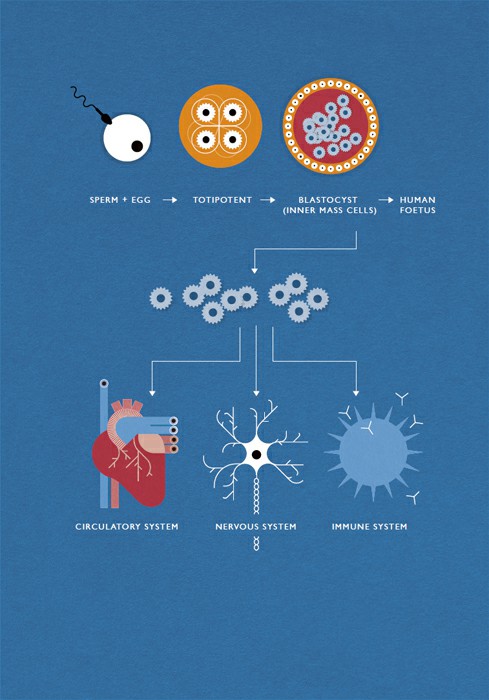
CELLS DIVIDING AND SPECIALISING. THE FERTILISED EGG IS A SINGLE CELL THAT DIVIDES AND HAS ALL THE INFORMATION NEEDED TO MAKE THE CELL TYPES THAT GO ON TO FORM THE ORGAN SYSTEMS.
Not many movies feature sperm, much less a man dressed as a sperm, but Woody Allen made a movie called Everything You Always Wanted to Know About Sex, and played a sperm about to be ejaculated. He’s waiting with all his fellow sperm, and in his usual neurotic way begins to worry. He’s heard stories of how sometimes guys (meaning sperm) get their heads slammed up against a wall of hard rubber. And then he gets even more worried: ‘What if he’s masturbating? I’ll end up on the ceiling.’ These are the kind of thoughts Woody thinks a sperm might have. Of course sperm don’t look like Woody Allen and can’t think, but if they did maybe Woody is right.
Each ejaculate in humans contains up to 300 million sperm in an average volume of 10 ml – 300 million of them, each around 50 millionths of a metre long, swimming away in that milky ejaculate, and all looking for an egg. This may be where the rock band 10cc got their name (cc being an old way to represent ml). The primary mission of sex is for one of those sperm to make it to the egg and fertilise it, thus injecting its DNA into the egg. Every sperm may well be sacred but only one counts.
The odds are heavily stacked against a sperm meeting and fusing with an egg. It has a one in 300 million chance of making it, having to outswim all the others3. The distance the sperm has to swim is remarkable. To relate this to a human (say Woody Allen), by some estimates it would be the equivalent of swimming from Los Angeles to Hawaii. There are a whole host of obstacles. First the fluid in the vagina is somewhat acidic, so it’s akin to swimming in vinegar. When a sperm reaches the cervix (the entrance to the womb), if it’s lucky it will find sticky secretions there to help it. This is called cervical mucus, and the sperm can get added purchase by slipping along it. The sperm then reaches the Fallopian tube. Many sperm will not have made it, either running out of energy or stupidly swimming off in the wrong direction. Like the man who has produced them, sperm do not ask for directions. Only one in five sperm swim in the right direction, sensing a chemical come-hither signal sent by the egg. Sperm actually burn fructose as a source of energy instead of glucose. This is a better fuel for them – a kind of energy drink. The seminal fluid is rich in it, giving it a somewhat bitter taste (apparently).

THERE WAS A TIME WHEN IT WAS THOUGHT THERE WAS A LITTLE MAN (HOMUNCULUS) INSIDE EVERY SPERM.
Some sperm also face being rejected. The woman sometimes has antibodies (immune molecules whose usual job is to latch onto microbes and help the immune system clear them) which bind to and neutralise the sperm. This type of rejection is happening without the man knowing. Having got to fourth base and not been rejected before having sex, a different type of rejection can happen when the sperm are finally released into the vagina. The man is oblivious to this (which equally applies to many aspects of male/female relations).
Having got within shooting distance, the sperm at the head of the pack now tries to find the egg. One piece of good news for that sperm is that there are unlikely to be sperm from another male coming up behind (so to speak). Many species have as part of their ejaculate a substance that plugs the vagina and prevents other males from injecting their sperm. Human sperm doesn’t have this, and as a species we have what’s termed low-to-intermediate levels of sperm competition. Primates with what are called multi-male breeding systems are more likely to have plugs or other chemicals in their sperm to kill off a subsequent ejaculate. This gives us evidence that humans are largely monogamous.
If the sperm that makes it is lucky, the woman will have ovulated. If not, the sperm can hang around, as sperm are hardy enough. The ambience in the cervical fluid is good for sperm and they can live for a few days. They take a brief vacation, probably view some of the sights, and wait for the egg to be delivered. When exposed to air outside the body they last only a few hours.
So now we get to the magic moment, when the sperm fuses with the egg. Even then there is a major obstacle called the zona pellucida, a tough skin around the egg. If the sperm manages to penetrate it, though, delivering its precious cargo of DNA, something interesting happens: the egg becomes impenetrable to other sperm. This means another sperm can’t get in and the zygote (as it’s called) will have the correct number of chromosomes. Despite the fact that sperm–egg fusion is critical for the whole process (and indeed for the survival of our species), the precise basis for this has only recently been worked out.
In 2005, a Japanese scientist called Okabe was studying the proteins that stud the surface of sperm4. These were likely to be the key to the process, as some proteins are very good at recognising other proteins – a bit like a key going inside a lock. This is because proteins have very complex and highly variable 3D shapes which allow them to do all kinds of interesting things. A bit like play dough, proteins can form into a huge number of shapes. A different shape might mean a different job, for example. Okabe discovered a protein that was critical for the fusion of the sperm with the egg. He had found the key on the surface of the sperm that seeks the lock on the surface of the egg. Sperm lacking this protein could not fuse, so this seemed to be the answer.
Proving that romance is alive and well in Japan, Okabe named the protein Izumo, after a Japanese shrine of marriage. Interestingly, Izumo only pops up on the surface of the sperm once it is in the acidic environment of the cervix. The sperm can sense the acid and then relay a signal to the gene for Izumo, which leads to its being made and going to the cell surface. This is an example of what is called in biochemistry ‘signal transduction’. The acid leads to a signal being transduced inside the sperm that then turns on the production of Izumo. This is obviously a very efficient way to do things – no need to express Izumo if it’s not needed.
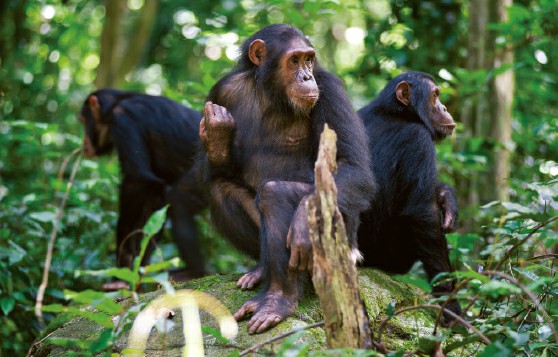
SOME PRIMATES HAVE A MULTI-MALE BREEDING SYSTEM. ONCE THEY EJACULATE, A PLUG CAN FORM TO PREVENT THE ENTRY OF SPERM FROM A COMPETING MALE, ENSURING THAT ONE OF THEIR SPERM FERTILISES THE EGG.
When Okabe deleted the gene for Izumo in mice (it has become relatively straightforward to delete genes and see what happens), the males were infertile but the females weren’t, confirming his overall discovery. The sperm that didn’t have Izumo still made it to the egg, but they couldn’t penetrate. They couldn’t insert the Izumo key into the lock of the egg to open the door and let the sperm DNA in. At last the specific protein needed for penetration had been found.
But what was it recognising and inserting into on the egg? What was the lock to the Izumo key? A team in the UK led by Gavin Wright had been looking for just that5. Unlike sperm (which are very easy to come by: most adolescent males have a lot going spare), human eggs are more difficult to isolate and more precious, making the job of finding the lock difficult. The interaction between Izumo and an egg protein would also be fleeting, and difficult to capture, as once the sperm hits the egg it gets inside very quickly. But with great perseverance and diligence they found it.
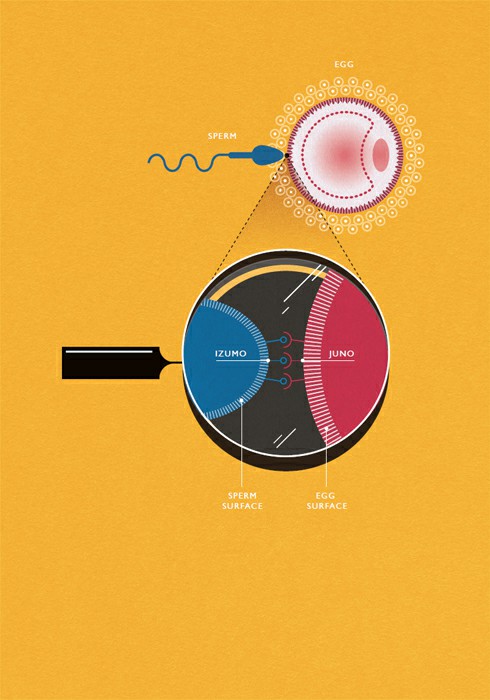
A SPERM FERTILISING AN EGG. FOR THE SPERM TO PENETRATE THE EGG IT HAS A ‘KEY’ CALLED IZUMO (NAMED AFTER A JAPANESE SHRINE OF MARRIAGE), WHICH INSERTS INTO JUNO (NAMED AFTER THE ROMAN GODDESS OF FERTILITY AND MARRIAGE). IT CAN THEN GAIN ACCESS AND RELEASE ITS DNA TO MERGE WITH THE DNA IN THE EGG: THE MAGICAL MOMENT OF FERTILISATION.
They used Izumo itself as a kind of bait to fish a possible lock out of a set of proteins. It was a protein that had been already reported 14 years earlier but in a totally different context, and with no known function. Once Wright realised its job was to interact with Izumo he gave it the name Juno, the Roman goddess of fertility and marriage. Scientists like to show off their knowledge. The name Juno may give a whole new meaning to that great Sean O’Casey play Juno and the Paycock.
Juno is only found on the surface of unfertilised eggs. Once a sperm inserts the Izumo key into the Juno lock it opens the door and goes inside, and all the other Juno locks rapidly disappear from the surface of the egg. This explains why other sperm can’t get in. Juno is the lock to open the door to allow the sperm in, and once a sperm is in, as if by magic, all the other locks disappear. The discovery of Izumo and Juno, perhaps the molecular Adam and Eve, is an important one. First, a defect in either may be one explanation for why some couples can’t conceive. And second, scientists are interested in developing ways to interfere with them as a new form of contraceptive which wouldn’t be hormonal. Such a contraceptive might be preferable to some women, and if the Izumo key is covered over or blocked in some way, this might provide a viable male contraceptive.
So now the sperm is inside the egg and the DNA of the sperm can fuse with the DNA of the egg. What is interesting here is that sperm and eggs are unique among all the cells in our body. Every other cell has the DNA arranged in 23 pairs of chromosomes. For sperm and egg, only a single set of 23 chromosomes occurs. When the 23 chromosomes from the egg fuse with the 23 chromosomes of the sperm, we’re back to 23 pairs. These are then copied, with one set of pairs going into one of the daughter cells, and another set of pairs going into the other daughter cell. When the developmental stage is reached to form sperm and egg, in those particular cells only one set of chromosomes occur. This is unique to sperm and egg, which have the attractive name of ‘germ’ cells, the word germ actually meaning ‘seed’.
The fertilised egg will be either male or female, depending on the sperm. Male means it has a special chromosome called the Y chromosome. This means that the egg has been fertilised by a male sperm – a sperm carrying the Y chromosome. If the fertilised egg is female, it has been fertilised by a sperm that is female (i.e. has an X chromosome) – bet you didn’t know there were female sperm. This means that in the male, there is an X (from the female egg) and a Y (from the male sperm) chromosome, whereas in the female, there are two X chromosomes, one from the female egg and one from the female sperm. That completely determines whether the baby will be male or female. This is laid down in the microscopically small fertilised egg, bursting with potential to develop into a fully fledged human being.
For largely unknown reasons, there are always slightly more boys than girls born, of the order of 51 per cent to 49 per cent. This may be because boys are slightly more expendable, whereas the mother is all important, as it is she who has to carry the foetus. There is however a disturbing recent trend. This ratio is changing. A study in Canada has revealed that, in communities which were exposed to pollution from oil refineries, metal smelters and pulp mills, the ratio shifts towards more females than males, a reversal of the normal sex ratio6. This is likely to be due to high levels of pollutants, possibly chemicals called dioxins, which have been shown to have such an effect on sex ratios. Studies in Russia and Italy have supported these findings. Whether the effect is due to a difference in ratio of male and female sperm or a lower ability of male sperm to fertilise the egg is not known. It could also be that miscarriages of male foetuses are slightly higher.
Another study, this one from Japan, has found that male foetuses are especially sensitive to the effects of climate change7. The researchers looked at monthly temperatures in Japan from 1968 to 2012, and in particular two extreme weather events: a very hot summer in 2010, and a very cold winter in 2011. Nine months after the hot summer there were clearly more females born than males. Similarly, nine months after the cold winter, there were more females born than males. Male foetuses appear to be more sensitive to extreme temperatures for as yet unknown reasons. This means that one unimagined consequence of global warming may be that more females than males will be born. Men may in fact become something of an endangered species – by not being born.
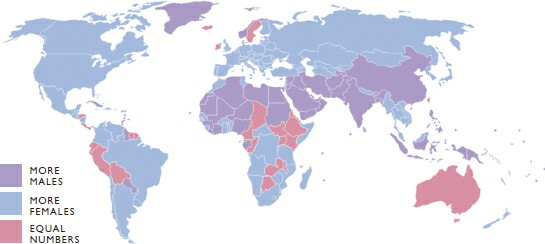
A MAP INDICATING MALE TO FEMALE SEX RATIOS IN DIFFERENT COUNTRIES.
A final threat is the current decrease in sperm count8. Researchers assessing 185 studies of sperm counts from men in North America, Europe, Australia and New Zealand between 1973 and 2011 have found a striking result – the number of sperm in an ejaculate seems to have halved in less than 40 years. And as the downward trend continues, this will be an increasing problem. In direct contrast, no decline was seen in South America, Asia or Africa. This allows for what is called an excellent control group.
Why are the numbers dropping in Western industrialised nations but not in poorer countries or countries in Asia? The decrease has been linked to exposure to chemicals used in pesticides, plastics, obesity and smoking. Some of these occur in countries not experiencing the decline, which suggests that it may be a combination of factors, or possibly certain genetic backgrounds are needed for the decrease to occur. One study suggested that it might be down to watching too much TV. Men who watched 20 hours or more of TV per week had lower sperm counts than men who did 15 hours or more of exercise. There is a consensus that this is a worrying trend, with a fear being expressed that we might become extinct.
Certain activities can transiently decrease sperm count, and couples trying to conceive are given guidelines on what the man should and shouldn’t do in order to improve the sperm9. Temperature plays a big part. Sperm prefer cool conditions, so it’s possible that sitting on the sofa doesn’t allow enough air to circulate to keep the testicles cool. Another offender is wearing tight underwear. Mind you, if this were true in every case the world should be full of kilt-wearing Scotsmen. Too much time riding a bike is also a no-no, although it’s not clear why. It appears that overall moderation in all things is your friend here. That might give you tiptop sperm in the right kind of quantities to go forth and multiply.
One projection from the falling sperm count is that Europeans and North Americans might be facing extinction. Or we will invite in Asian men to be the fathers of our children. One final possibility is to make sperm in a test tube. Crazy as it may sound, scientists have managed to do just that10. As above, this was all about stem cells, which, remember, have the capacity to become any cell in the body, provided we can programme them. Embryonic stem cells were the source of the sperm. The stem cells have the capacity to be turned into any cell type, provided they are coaxed in the right direction.
A team from Nanjing, China took embryonic stem cells and created what are called spermatids. These are immature sperm that, despite having no tail, are able to use their DNA to fertilise an egg. Researchers hadn’t previously been able to push cells through a complicated dividing process in order to get rid of one set of chromosomes. That has now been achieved, with a spermatid made in this way being used to fertilise an egg. Mouse eggs were used in the study and, importantly, healthy baby mice were born. Work on this approach will continue, as will the effort to turn adult stem cells back to humans. It may one day be possible to take a skin cell, reprogramme it all the way back to a sperm cell, and then use that to fertilise an egg.
But will the world really turn into a place where there is no need for sex with your partner? Just scrape some skin off his foot when he’s asleep, extract the cells, get them to revert to being a sperm cell, add it to one of your eggs in the dish, let Izumo insert into Juno, implant it into yourself and hey presto, nine months later a lovely baby? This may not be as much fun as the traditional method of getting sperm from him but hey, it might be an alternative.
However, if climate change and pollution aren’t curbed, sperm counts will continue to fall, and the ratio of female to male will increase further. We might live in a strange world where there are no males left and sex (most likely with a robot) is no longer used to make babies. A Cyber-Jiggy world. Even if men still exist in this future, the need for men to provide sperm may not – and perhaps the world would be a happier place. Let’s hope this doesn’t come to pass, though, as most women agree that having men around can be diverting and maybe even at times useful. Men and their sperm aren’t dead yet.