
CHAPTER 5
EVER SINCE HOMO SAPIENS evolved parents have worried about it. From the moment she knows that one of her eggs is fertilised, a mother worries about it. Teachers worry about it. Politicians worry about it. What is the best way to ensure our children have the best possible future? As a parent, what can I do to make sure I am sending the right signals and doing the right thing to turn my child into a successful adult? The shelves of bookshops are full of books to give you advice, preying on the vulnerable parents among us. Pet theories abound as to what should be done. Play Mozart. Play chess. Floss. But, as ever, what does science say? What do we know about the best way to make sure we are promoting well-being in our children such that they will grow up to live lives to the full?
Is it all about nature? Is the likelihood of success in life written in your genes? No matter what we do, can we overcome our preordained nature? Or does nurture play a more important role? Can we help any child to blossom? Can anyone succeed given a chance? These questions have been hotly debated by educationalists and pedagogists for decades, giving rise to all kinds of arguments and, often, bad science, with studies full of bias or not properly controlled. (For some reason I like the word ‘pedagogy’, which the Webster dictionary defines as ‘the art, science or practice of teaching’. I love teaching pedagogists.)
If, for example, we think that it is mainly genetic, why bother educating children who have the wrong genes? Providing equality in an education system might seem like a good idea, but if success is predicated on genetics, it is doomed to failure, as different children will have different needs, and so an education system should be tailored to the individual. This of course is very difficult to achieve, expensive and time-consuming. And yet increasing evidence suggests that this should be the goal of an education system. To allow each individual child to engage with education in their own way, based on their abilities. Why try drumming drumming into a child who has no sense of rhythm?
The likely truth is that it’s a combination of both nature and nurture – or, to be more precise, nature via nurture. You will reveal a person’s genetic make-up by nurturing that person in a particular environment. If you nurture drumming in the child who has the precise genetics (meaning nature) to be a drummer, you will succeed as a teacher and the child will be happy, fulfilled in their drumming, with resulting happy parents (provided you supply soundproofing for the child’s bedroom). The inherent skill that the child has for drumming only gets revealed by the teacher – hence nature via nurture. I would point out, however, that the precise genetic basis for being a good drummer (as with all complex traits) has yet to be uncovered. We should take DNA samples from Ringo Starr, Keith Moon (who could be exhumed for this purpose) and Larry Mullen to find out.
Another good analogy is cars. Let’s say we are all cars with different engines – some more efficient than others. All cars need petrol. Some cars will run better than others (the nature of the engine dictates this), on the same petrol (the nurture to make them run). Hence again, nature via nurture – the nature of the engine will reveal itself based on how you nurture it with petrol. The ‘environment’ is therefore critical for different cars. This might mean petrol, or the state of the roads. If the roads are bad, the car won’t go anywhere, no matter how souped-up the engine. The genes people have are therefore important. They are the things that make the brain (or in our analogy, the genes are the parts list for the engine). But the environment is also needed to get the car to perform. This means that we need to always think about the environment a child is brought up in, both at home and educationally, since there will be plenty of things that can be done to try to ensure that people have a chance.

ALFRED BINET (1857–1911), THE PSYCHOLOGIST WHO INVENTED THE FIRST PRACTICAL IQ TEST, DESIGNED TO REVEAL STUDENTS WHO NEEDED REMEDIAL HELP.
What, however, might the relative importance of nature versus nurture be? The debate about success has been fuelled (enough already with the petrol analogy) by a study on twins led by Robert Plomin of King’s College London1. Strikingly, this study found that differences in a child’s academic performance in UK schools are more down to heritable traits than the teaching environment. The study showed that genes account for 58 per cent of how intelligent we are, with schooling having a 42 per cent contribution. This is an important study, as it suggests that no matter how great a school is, the genetics of the child will have a more important role in that child’s academic performance.
Plomin is a world expert on the role of genetics in the variability in IQ, the measure of intelligence first devised by French psychologist Alfred Binet. Several studies have shown that if you’re adopted, your IQ will correlate with that of your biological parents rather than your adopted parents2. ‘Tiger mothering’ (or indeed ‘Irish Mammy-ing’) might not make a huge amount of difference for an adopted child, at least when it comes to IQ. There is a slight effect when the child is young, but as they get older, their IQ tracks more and more to those of the blood relatives. Genes therefore appear to have an even greater effect as you get older – as much as 80 per cent. This may be because your real intelligence emerges as you age, and you choose to hang out with like-minded people, say. So the parental influence wanes and your true ability based on your genes emerges.
How did Plomin do his study? This is an important question, as study design is everything in psychology. There are plenty of studies which turned out not to be correct, because of some anomaly in the study or the studies being too small, poorly controlled or biased in some way. Plomin went big, examining GCSE results in over 10,000 sets of twins. This was a sufficiently large number to allow an average response to be reported, which would reflect the true situation. Large numbers such as these iron out what are called confounding variables – things that certain people do that you might not know about. He was able to show that 58 per cent of success in GSCEs, was heritable. Schools were different, but whatever the school might be, twins performed remarkably similarly.
This study was very much at odds with opinion on education in the UK. Most educators are of the view that teaching the same curriculum to all children will iron out any heritable advantages. In fact, it only makes them more significant. Think about the car engine again; give all the cars the same petrol (like the same education) and you will reveal differences between the engines. Using success at GCSEs, however, mainly measures performance as opposed to IQ, and so doesn’t really capture the genetic basis of intelligence. This is important, because in truth the difference between us in intelligence is actually quite small. We know this by observing someone with genetically based mental retardation, who will show major differences in intelligence when compared to the general population. This makes the study of the heritability of intelligence difficult.
But this difficulty doesn’t stop scientists from trying to find the genes that predict intelligence or exam performance3, even though the difficulty is further compounded by the fact that intelligence is not easy to define. IQ tests can be performed, but they represent only one variety of test. For example, having a good memory is important for exam performance or appearing to be intelligent. Musical ability or the ability to read another person’s emotions are also seen by some as important indicators of intelligence. And then there are problem-solving skills, which appear to be largely genetic, as identical twins (which occur when one egg is fertilised but splits to form two babies which are genetically identical) tend to receive much more similar results to one another on problem-solving tests than do fraternal twins (which occur when two eggs are fertilised and therefore are like regular siblings). But these are difficult things to define and measure, and some psychologists have doubts about the tests used, which can be influenced by culture, education and experience. Most intelligence tests measure maths and verbal skills, as these are easy to measure.
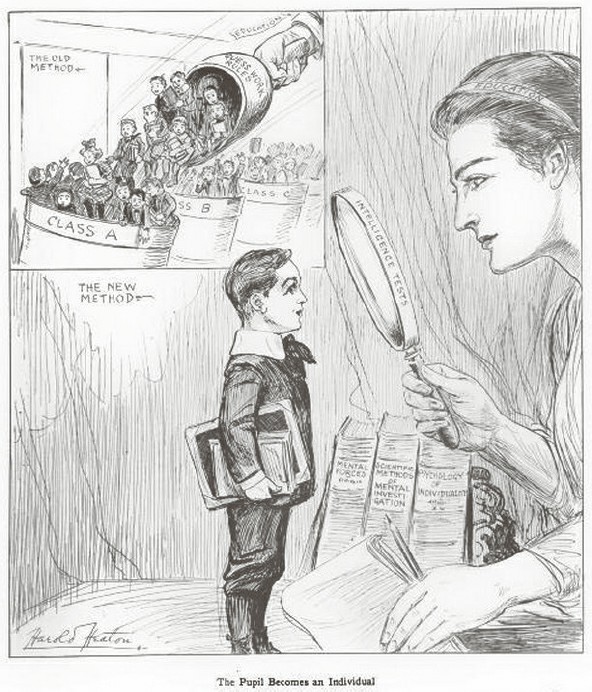
A CARTOON FROM THE AMERICAN SCHOOL BOARD IN 1922, ILLUSTRATING THE PROBLEMS WITH CLASSIFYING PUPILS BASED ON INTELLIGENCE TESTS.
If we ever find a clear genetic basis for variation in intelligence, this will create anxiety, as we then enter Aldous Huxley’s Brave New World of alphas at the top, and epsilon-minus semi-morons at the bottom. Who wants to have a child that’s an epsilon-minus semi-moron? It would allow us to tailor the teaching to help each child, however. This would mean that the true purpose of education – to allow a child to grow up and lead as full a life as possible – would be achievable for all. Scientists who favour this remind us of the awful harm done in the past when we didn’t know about the genetic basis for something. There was a time when bad parenting was blamed for autism, which is estimated at 90 per cent genetic4. Those parents not only had to deal with their child, but also with others blaming them. It was the same with attention deficit hyperactivity disorder (ADHD), which was blamed on bad parenting or letting children have too many sugary drinks. We now know that ADHD is highly heritable5.
The Plomin study however still shows an important environmental component – as much as 42 per cent. This means that the more equal the educational environment is, the more genes (as opposed to, say, how much money your parents have) matter. This presents a danger, since the same education given to everyone will result in the alphas, betas, gammas, deltas and epsilons of Huxley’s Brave New World emerging unscathed from the education system. An equal education system for all will actually promote differences based on genetics. Money still counts for education in Ireland, the UK and many countries. Parents want the best for their children, so if they can they will spend their money on education, and they shouldn’t be blamed for that. But in an ideal world, education should be free. It was Lenin who invented the phrase ‘Education, Education, Education’. The Soviets provided mass free education and valued teachers and professors greatly.
So can we predict how well a child will do when they grow up? Recent studies have shown that a high IQ doesn’t necessarily mean that a child will be a high achiever later in life. In a famous study, Lewis Terman, a psychologist at Stanford, recruited 1,528 children in California who had very high IQ scores6. He followed them, and found that many of them had indeed succeeded. They became known as ‘Termites’. Between them they had written 2,000 research papers, lodged 230 patents, written 33 novels and had a median income three times the average in the US. But it wasn’t all rosy. A quarter of them had less prestigious jobs that were often poorly paid, and none had matched the academic output of the intellectual elite in the US at that time. Also, no Termites went on to be entrepreneurs or ‘wealth creators’. This meant that high IQ wasn’t as good an indicator as people thought, and certainly wasn’t a good predictor for who would drive innovation and economic growth. To paraphrase the Irish economist David McWilliams, it’s the messers down the back of the class who are likely to be the entrepreneurs and businessmen.
The importance of environment can be seen in the overwhelming evidence that socio-economic status plays a key role in the future success of the child, however. In fact, the Terman study has been reanalysed, and the outcomes correlated with socio-economic status rather than IQ. Children with limited access to computers or books do worse in school7. Those who grow up in stimulating homes are much more likely to become entrepreneurs, leaders and artistic high achievers. It could be, though, that the parents of these high achievers have a genetic make-up which means the environment they establish is stimulating, and these genes pass on to their children. So ultimately, genetics remain a key aspect. But children under five who don’t receive regular affection and responsive communication from parents or caregivers have impaired social and emotional development.

AN EPSILON-SEMI-MORON IS BORN IN BRAVE NEW WORLD.
The acquisition of language skills is especially important, and if it is delayed it can have disastrous knock-on effects. Language development helps boost cognitive development, literacy and educational attainment. It helps other parts of the brain too, not just those involved in language. The importance of early educational intervention is therefore critical. We have to be careful though, as, returning to our car analogy, all cars need fuel and maintenance, whatever their age; this also applies to children. The good will get very good, and the very good will get excellent, given a supportive environment. All boats will rise together (oops, I’ve moved off the car analogy into boats … how stupid of me).
And there is more to all this, as you might expect. A child may well have innate potential and the best parents ever, but they also need what’s called ‘focused practice’. The elite in every walk of life practised constantly, and continue to do so. This brings us to the idea of 10,000 hours as proposed by Malcolm Gladwell – that successful people spend at least 10,000 hours practising before achieving success. The Beatles did it in Hamburg. Björn Borg did it in Sweden. Of course, if any of us played tennis for hours and hours each day we might become champion tennis players too (or at a minimum go crazy).
So the question then becomes, Why do some people practise more than others? Pushy parents play a part in this, but a key trait is grit. And what makes people gritty? Part of the answer is motivation. If people are offered a financial reward for performing an IQ test, they score higher. IQ tests therefore not only measure intelligence, but also motivation. Grit means having the willpower to see something through to the bitter end. It involves hard work and the ability to resist distraction.
This means self-control, which turns out to be a key trait for future success. A study in New Zealand of 1,000 people from birth to 32 years old revealed that those who had better self-control in childhood were emotionally more stable as adults and were better off financially8. I remember as a teenager going into my house to study on a warm June evening, leaving my friends outside playing football. I really wanted to play football but I had the willpower not to. I still don’t know why I had the willpower and blame my mother as a default. My friends all ended up in jail. I think.
The importance of self-control was superbly illustrated in a famous observation made by psychologist Walter Mischel. In the late 1960s, he offered young children a choice between eating a marshmallow immediately or holding off for 15 minutes and getting two marshmallows9. Years later, he found that those who had managed to wait did better in school, were more popular with their peers, were less likely to be overweight and earned higher salaries. This ability to resist temptation, to exhibit self-control, was a major predictor of future success. In the study around 30 per cent of the children resisted temptation. They did all kinds of things to distract themselves, from walking around the room to singing the theme tune to Sesame Street to putting their hands over their ears to hiding under the table.
There were 653 children who took part – again, a reasonable number for this kind of study. Fourteen years after the test, Mischel tracked down as many of those who took part as he could. He asked them about many traits, gauging their ability to cope with problems and their exam performance, using scores from the SATs (a standardised college admission test in the US). Those who went for the marshmallow early had more behavioural problems, lower SAT scores and trouble maintaining friendships. Those who could wait the 15 minutes had a SAT score on average 210 points higher (which is substantial) than those who couldn’t wait.
These results were striking, as all of these things were measured 14 years after the marshmallow test (which only took 15 minutes). So a 15-minute session with a child could predict all kinds of complex things later in life. Mischel correctly interpreted this as all coming down to delayed gratification. He concluded that intelligence is important, but is also at the mercy of self-control. In this case, the self-control wasn’t so much about not taking the marshmallow early as realising what was on offer (two marshmallows after 15 minutes) and coming up with strategies to make the situation work. All children want the second marshmallow, but some figure out a way to get it. (And, one might add, the test wouldn’t have worked on me – I hate marshmallows, so I would have waited and then annoyingly for the testers not eaten either marshmallow. If it had been a Twirl I would have eaten it immediately.)
The results also confirmed what psychologists have known for years – we can’t control the world, but we can try and control how we think about it. Mischel concluded that the key skill was ‘strategic allocation of attention’. They didn’t kill their desire for the marshmallow. Instead they defeated it. They were able to avoid thinking about the marshmallow. Psychologists call this metacognition: thinking about thinking. As Mischel famously said, this wasn’t about the marshmallows. It was about all kinds of skills – studying instead of playing football or saving money for your retirement. Smart moves.
What is also striking, and very important, is that a child can be taught self-control. There are T-shirts in the US stating ‘Don’t Eat the Marshmallow’. It’s not enough, though, to teach a child mental tricks. They also have to form the habit of metacognition. This requires practice and constant reminding. This is where parenting comes in. It turns out that the most tedious things we have to put up with as children – not having dessert until after you’ve eaten your greens, saving your pocket money to buy something later, waiting for your birthday for the thing you want – are all training us in this important skill.
A great example can be found at Christmas. Your dad will tell you that if you behave well, on Christmas morning you will get gifts. A great scam if ever there was one, and yet it teaches a life lesson. You need to be patient, to wait, to distract yourself, and good things will happen. Tolerating waiting is in fact a very human trait. People are waiting for the Messiah and perhaps this is another trick to develop metacognition. Christmas is a sly exercise in metacognitive training. As Dan Bern sings in the song ‘Jerusalem’: ‘Everybody is waiting for the Messiah. Christians are waiting. The Jews are waiting. Also the Muslims. It’s like everybody’s waiting. They’ve been waiting a long time … So I can just imagine, how darned impatient everybody must be getting.’

THE ‘MARSHMALLOW TEST’ DEVISED FOR CHILDREN BY PSYCHOLOGIST WALTER MISCHEL IS PREDICTIVE OF LATER EVENTS IN LIFE.
And of course we have Samuel Beckett’s Waiting for Godot, about two tramps who spend a whole play waiting for someone who never comes. This is a fitting depiction of the human condition. Meanwhile, Mischel wants marshmallows to be given out in every kindergarten with the instruction: ‘You see this marshmallow. You don’t have to eat it. You can wait. Here’s how.’ The smart kid listens, learns and gets two marshmallows (or the good, well-paying job).
Self-control, then, can be learnt. As ever, though, some people are better than others; but that may not have a genetic basis at all. Quick learners (which twin studies tell us is genetic) will out-compete slow ones. Self-control is also the key trait for focused practice. The child who will succeed most of all practises something they don’t enjoy. They don’t just go through the motions and drop out. They somehow know this will benefit them, and they learn the skill of metacognition, which they can apply to other aspects of their lives.
This all seems a bit too systematic, a bit too organised. To give us hope in our own humanity, we can turn to the last, perhaps surprising, trait that might predict future success: dreaming10. Another psychologist, Ellis Paul Torrance, studied several hundred creative high achievers, from secondary school to middle age. These people went on to be academics, writers, teachers, inventors and business executives, and one became a songwriter. And he noticed they all had one thing in common. It wasn’t exam results or technical skills. Instead they all had a strong purpose. They fell in love with a dream and then pursued it with intensity. How can a parent encourage that kind of thing? This is difficult, as it won’t be obvious where a child’s talents lie. The best approach is encouragement for whatever inclinations they might have. Praise effort and progress, not intelligence and talent. Their lives aren’t only set by their biology, but also by dreaming, dedication and practice.
A child might not be able to escape their genetics, but with support they might be able to learn impulse control, to practise and to be dedicated to something. They can dare to dream. Climb every mountain, wait 15 minutes for two marshmallows and dream the impossible dream. Sure, isn’t that what Irish mammies have been teaching their children for generations?