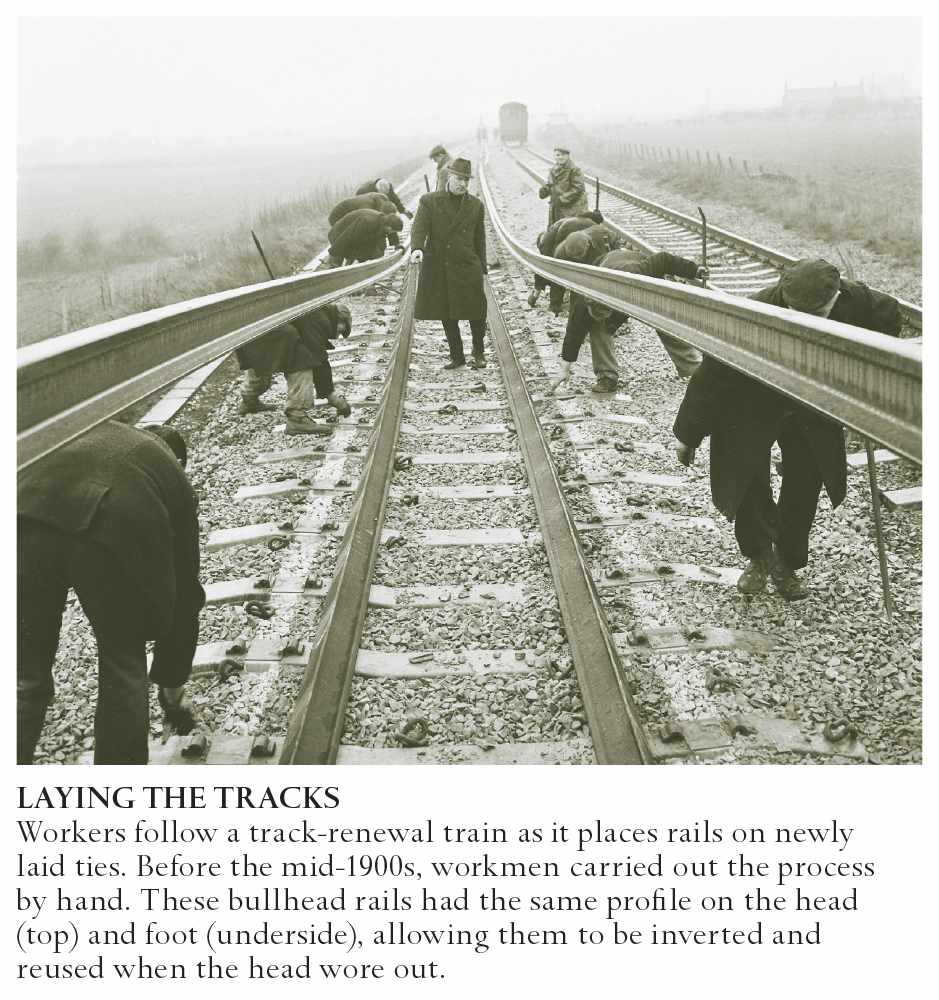
The track structure is comprised of track components (e.g., rail, ties, fasteners, and joint bars) and trackbed structural components (ballast, sub-ballast, and subgrade). In the early days of railroad construction, temporary track was laid first so materials could be transported quickly to the site. After the substructure was complete, the permanent track was laid. The substructure of a track is called the formation. Since a consistent grade is required in order for trains to run smoothly, the ground is first prepared to form the subgrade. The subgrade might also be covered by a layer of sand or stone called a blanket before overlaying it with ballast. The gauge (distance apart) and alignment of the rails are monitored to ensure that they remain constant throughout straight sections and curves in the line.
.
Track materials
Wooden rails were used for the pony-drawn wagonways of the 17th century, but a more lasting material was required to support 19th century steam engines. The cast-iron rails of the first railroads were succeeded by sturdier wrought-iron rails in the 1820s, while steel—which was stronger still—came into use in the 1850s. Crushed-stone ballast is still the most common foundation material, but concrete slabs, which are more stable and durable, are increasingly used.

.
Track gauges
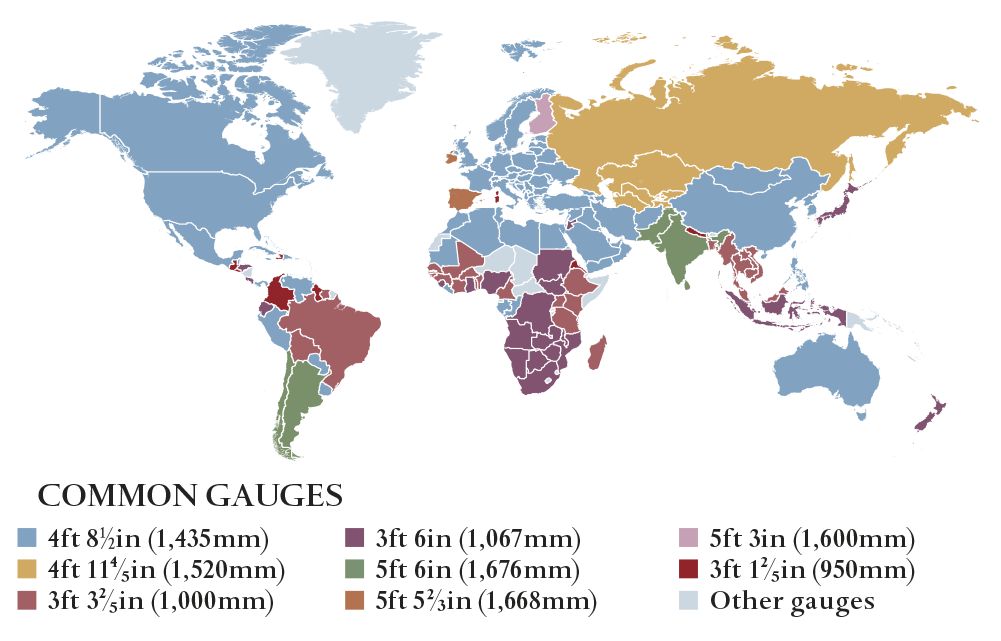
The gauge of a track is the horizontal distance between the inside faces of the two rails, and determines the axle width of trains that can run upon it. A range of gauges was used when the railroads were built in the 19th century, but standardization became necessary as individual lines were connected to form national and international networks. As such, standard or international gauge (4ft 8 ½in or 1,435mm) is used for around 60 percent of the world’s railroads.