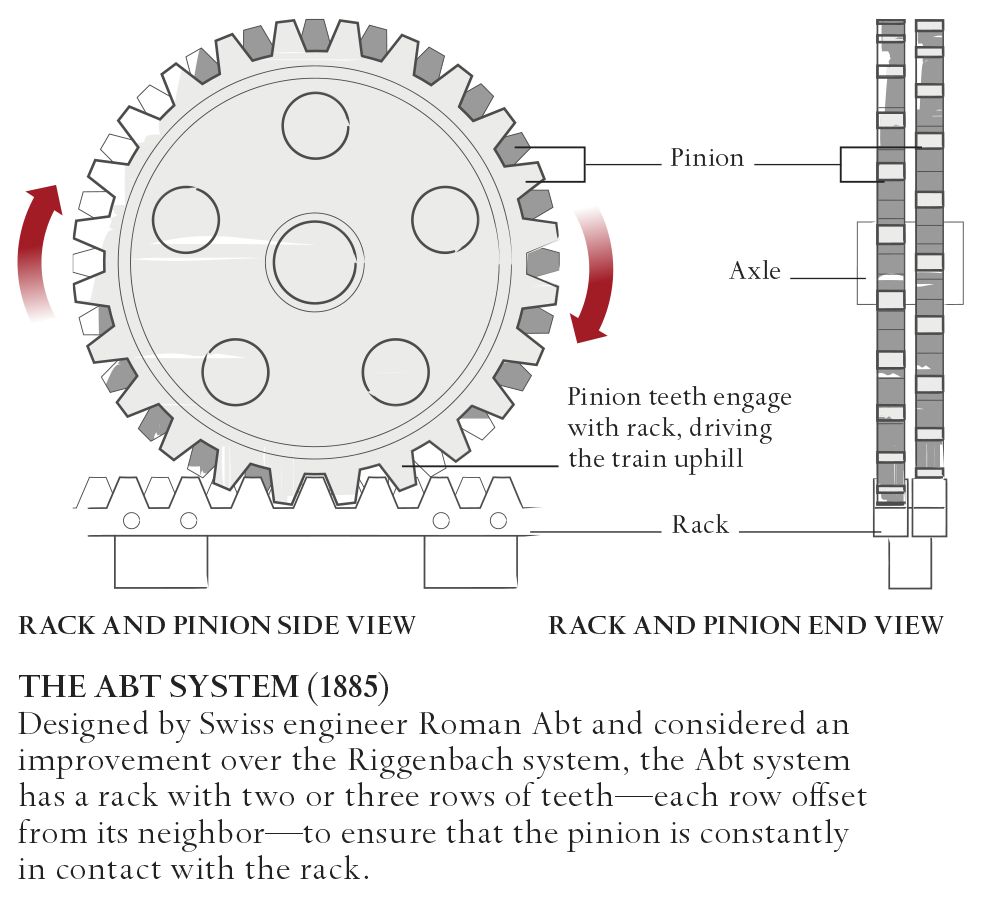
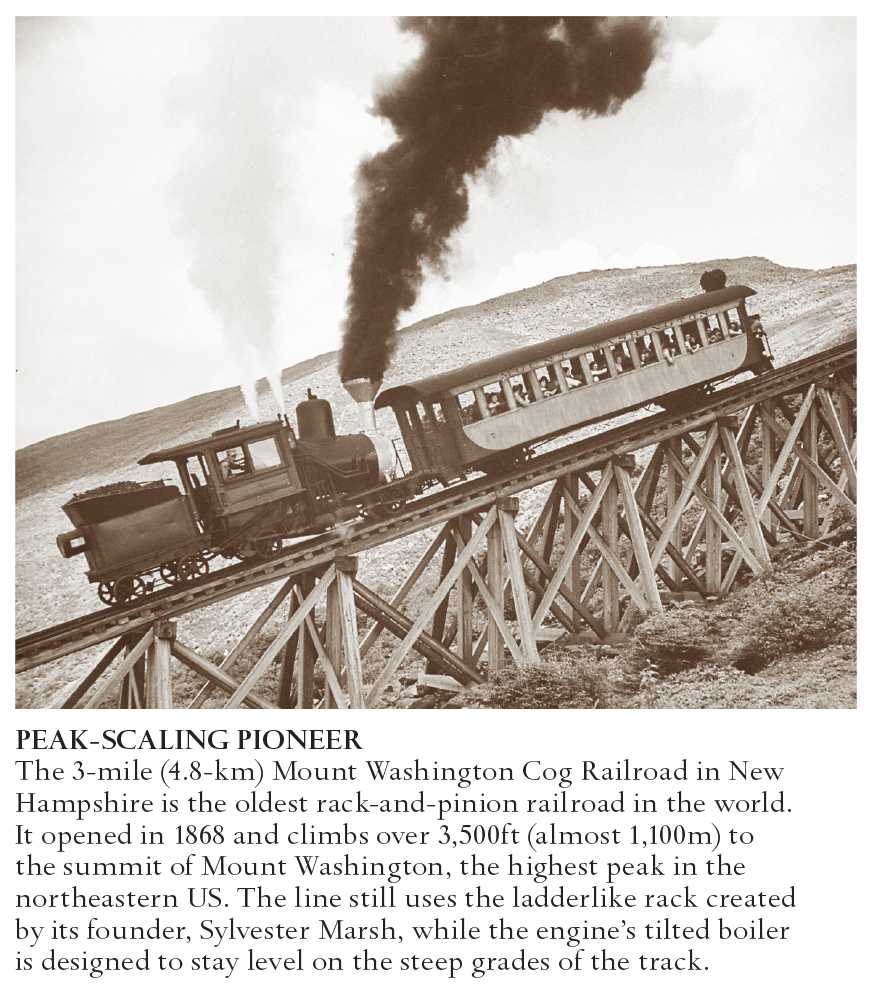
The technology that enables locomotives to ascend steep grades of track was invented in the early days of the railroads. John Blenkinsop’s 1811 patent for a steam railroad at the Middleton colliery, Britain, used an engine with a geared cogwheel, or “pinion,” that engaged with a line of teeth, or “rack,” located between the rails. However, it was not until the 1860s that the system was used on a mountain railroad. Rack-and-pinion tracks maintain traction on grades of up to 48 percent, whereas the steepest incline that conventional (“adhesion”) trains can climb is around 10 percent, even with assistance from extra locomotives. These specialized tracks also provide essential braking power to ensure that steep slopes can be safely descended.
.
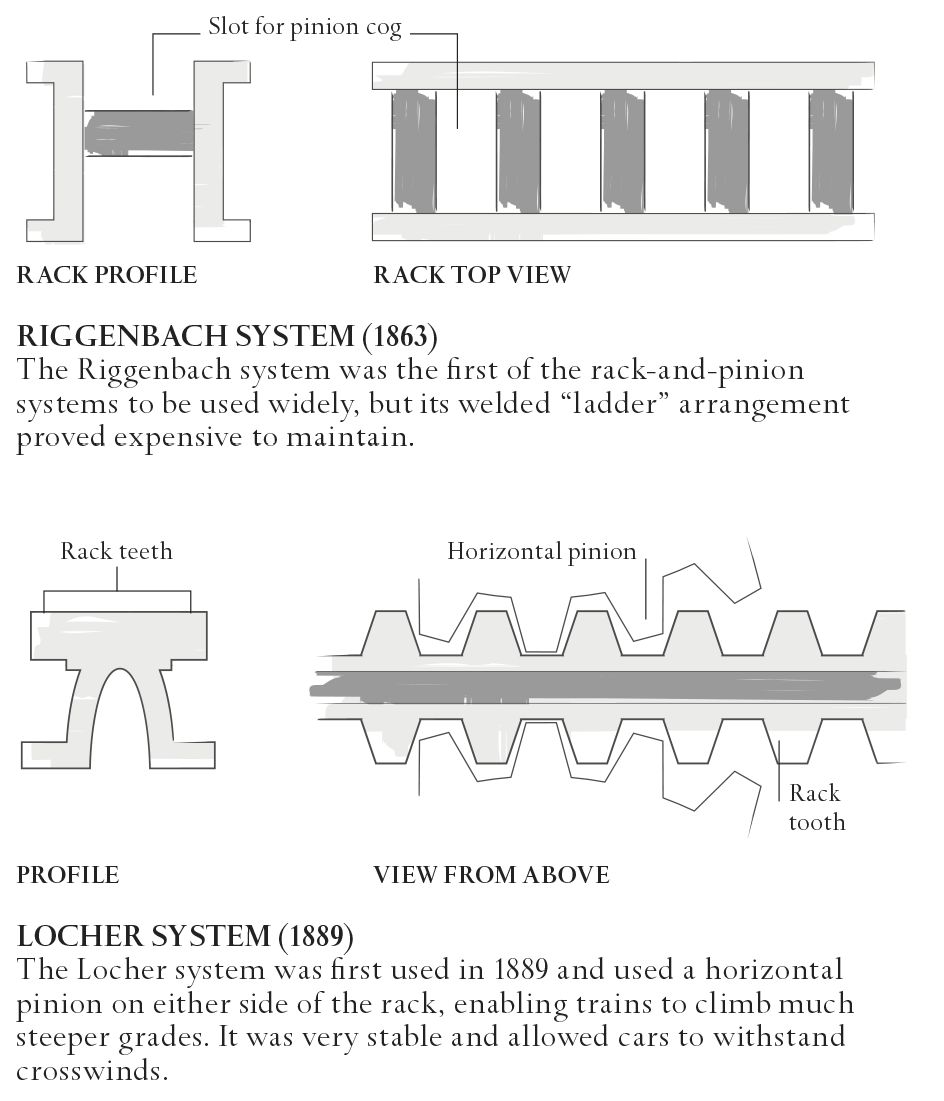
The Riggenbach and Locher systems
Various rack-and-pinion systems have been developed and adopted since Blenkinsop’s first design.
.
How it works
Rack-and-pinion steam engines have one or more pinions, which are powered by the cylinders via connecting rods. Some designs place the pinion centrally on the axle, between the train’s wheels, while others mount them on separate axles. Most rack-and-pinion trains have flanged running wheels, and so are capable of running on standard rails. Steam-powered trains pushed their cars uphill, then reversed back down the slope in order to maximize braking power. Today, most rack-and-pinion trains are powered by electric or diesel engines.