
ALTHOUGH THE PANAMA RAILROAD was less than 50 miles (80km) long, its construction was deadly: as many as 12,000 men may have died building it, from a fatal mix of harsh working conditions and tropical diseases. The railroad created a crucial link between the Atlantic and Pacific coasts of America, however, making it an essential element in the creation of the United States. It was also hugely profitable for its owners and shareholders.

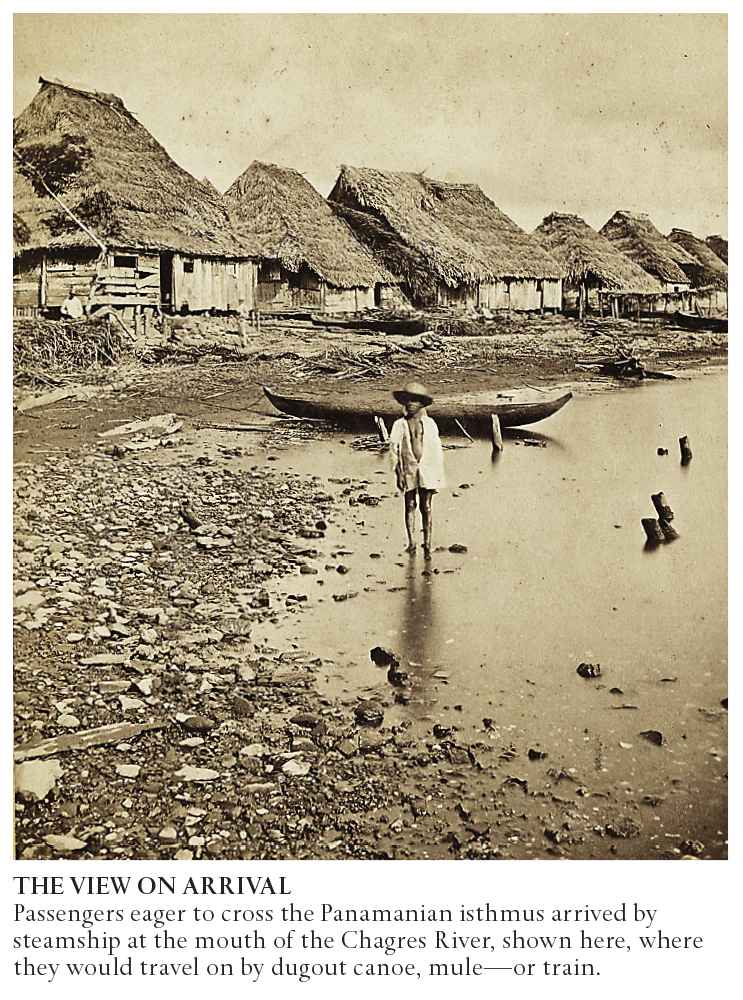
On January 24, 1848, demand for transportation across the Panama isthmus became pressing. On that day, James W. Marshall found gold at Sutter’s Mill in California, triggering the first Gold Rush. But reaching California from the east coast of America was a huge challenge. The gold prospectors had three options: to sail 15,000 miles (24,000km) around Cape Horn at the southernmost tip of America, a voyage that took at least 85 days across notoriously storm-ridden seas; to travel 2,000 miles (3,200km) overland across the US on wagon trails, a route that took at least six months and was also fraught with perils; or to sail to the mouth of the Chagres River in what is today Panama and cross the narrow isthmus by dugout canoe up the river and on mules over the hills, to Panama City and the Pacific, an 50-mile (80-km) journey that took up to eight days. By 1848, various canal and rail routes across the isthmus had already been proposed—and abandoned—by La Gran Colombia, the US, and France respectively; indeed, the Spanish had first considered building a canal in the 1520s, before settling for the Camino Real, the overland mule track that was still in use when the first gold-diggers arrived. In 1846, The US Government concluded a new treaty with the Republic of New Granada (Colombia and Panama), which guaranteed the republic’s sovereignty in exchange for US transit rights across the isthmus. This paved the way for a transcontinental route. A year later, the US Congress subsidized a mail and passenger steamship service up and down the Atlantic and Pacific coasts from New York to the Chagres River and from Panama City to Oregon, enabling people and goods to reach Panama easily.
New York entrepreneur William H. Aspinwall had won the bid to build and operate the Pacific mail steamships, and, with the onset of the Gold Rush, he set out to build a railroad across the Panamanian isthmus too. To assess the possibilities, Aspinwall traveled to Panama and Colombia with John L. Stephens, a lawyer and writer who had traveled in Central America. They established the Panama Railroad Company, which was granted an exclusive 49-year concession to build a railroad, highway, or canal across the isthmus, as well as 250,000 acres of public land. On the back of this, Aspinwall raised $1 million by selling stock in the company. An astute businessman, he also persuaded the US Congress to pay an annual fee of $250,000 to transport mail over the isthmus. Meanwhile, the demand for a passenger train had become increasingly evident: by the end of May 1849, 55 ships had landed more than 4,000 passengers at Chagres, all eager to reach California.
The route was first surveyed by US Army colonel George W. Hughes, who was misleadingly optimistic about the railroad’s construction. His survey indicated that the terrain would not be hard to traverse: it did not mention the deep swamps, thick jungle, and dangerous hills the route would have to cross. Aspinwall believed the railroad would need to be just 20 miles (32km) long, from the furthest navigable point on the Chagres River to the Pacific Ocean. He contracted experienced American civil engineers George Totten and John Trautwine to build the railroad, but they soon realized the disastrous errors of the survey—for a start, Hughes had overestimated the length of the navigable passage on the Chagres—and withdrew from the contract. However, both were eventually rehired as employees of the company, and the reserved 41-year-old Totten ultimately proved to be the hero of the venture.
Totten and Trautwine were all set to begin work on a route starting from the estuary of the Chagres River, when they found that George Law, the entrepreneur who had won the contract to convey the US mail along the east coast, had bought all the suitable land. They were forced to move the terminus, and found a new site further north at Manzanillo Island. This meant they had to start construction by building a causeway to the mainland, and then build on land known ominously as the Black Swamp. To lay rails over the swamp entailed shipping tons of limestone rock from an abandoned quarry at Bohio, way up the Chagres River, to build a solid base for the tracks. Once on firm land, at the aptly named Mount Hope, they were able to use their first rolling stock—a locomotive and string of wagons. However, less than 1 mile (2km) up the river they encountered further seemingly bottomless swamps and had to sink yet more tons of rocks. Another problem soon emerged: it was pointless building bridges from wood as they decayed within a few months in the tropical climate.

The railroad builders were also unprepared for the weather. Annual rainfall was around 11ft (3.5m), and it rained constantly from June to December. The Chagres River could rise 50ft (15m) in a couple of hours. Not only was this hazardous for men working semi-submerged in the water, it resulted in a climate teeming with tropical diseases and insect life. Tarantulas, scorpions, centipedes, wood ticks, and insects such as ants—white, red, and black—could be deadly, and malaria-carrying mosquitoes posed a permanent threat. The swamps were also infested with alligators.
The workers were a veritable foreign legion, turning up from all over the world and often known only by nicknames or numbers on a payroll. Few records were kept and it is not known exactly how many men died. However, it has been reckoned that at one point, one in five of the workers was dying every month. Another estimate suggests that one man died for every railroad tie along the route—around 74,000 men, although this number is implausibly high. Whatever the actual mortality rate, the railroad’s doctor, J.A. Totten (George’s brother), found it difficult to dispose of the bodies. His solution, wrote historian Joseph L. Schott in his book Rails across Panama, was to
pickle the bodies in large barrels, keep them for a decent interval to be claimed and then sell them in wholesale lots to medical schools all over the world… the bodies brought high prices, and the profits from the sale of the cadavers made the railway hospital self-sustaining during the construction years.
Relations among the international workforce were often fraught. One day, a gang of French laborers stopped work, hoisted the Tricolor, sang the Marseillaise, and refused to discuss their grievances except in their native tongue, which frustrated their Irish foreman. The company chairman, who spoke French, refused to negotiate except in English. He resolved the stalemate by cutting off their rations: the men went back to work, their grievances unknown to this day.
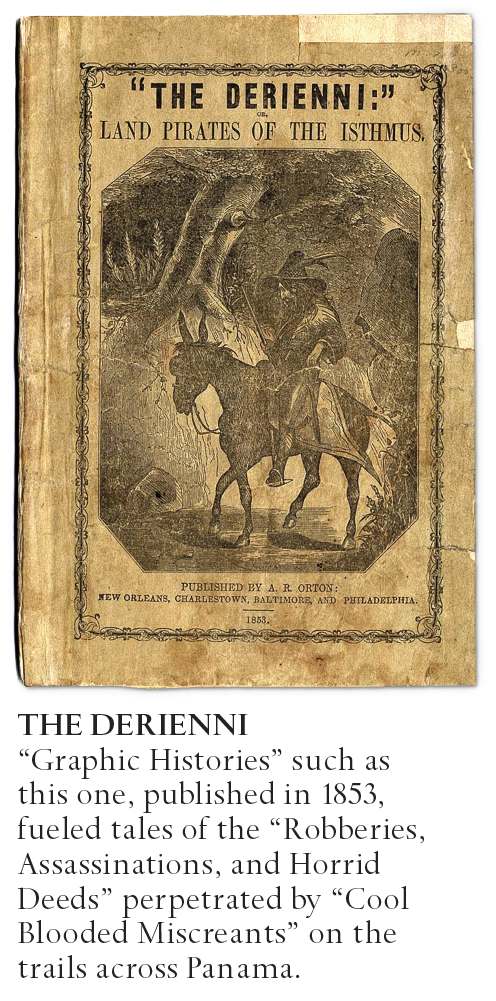
Moreover, the whole region was lawless and subject to banditry at the hands of the Derienni, land pirates who stole the gold transported from California and ruthlessly killed their victims. To combat the Derienni, Askinwall hired Randolph (Ran) Runnels, a famous Ranger who had hung up his guns after a religious conversion, but seen in a prophecy that he would be called upon to take up a mission in a “strange land… with a great river full of demons and monsters.” Panama fitted the description, and Runnels set up a mule express business as a front for a vigilante force, called the Isthmus Guard, capable of taking on the bandits. In early 1852, the Guard struck the Derienni while they were relaxing, dancing, and gambling, and hanged 37 of them by the seashore.
As if terrible conditions, disease, a restive workforce, and lawlessness were not trouble enough, the company ran out of funds when only 8 miles (13km) of track had been laid; its stock value fell, and construction ground to a halt. Meanwhile, shipping magnate Cornelius Vanderbilt had started work on a rival route through Nicaragua. Fortunately for the Panama Railroad Company, this route was as plagued by problems as their own.
The great turnaround in the railroad’s fortunes came in December 1851, when two steamships arrived at the mouth of the Chagres River carrying a thousand passengers desperate to reach California. Hearing the toot of the whistles on Totten’s locomotives, they demanded carriage over the existing section—anything to avoid the ghastly mule ride. To deter them, Totten asked an exorbitant fee of 50 cents per mile and $3 for each 100lb (45kg) of baggage. To his surprise, they accepted. Soon, so many people were queuing up to use the railroad that the income from fares enabled Totten and engineer James Baldwin to push rapidly ahead to a limestone quarry, enabling them to transport stone by rail to strengthen the line. The company was able to raise another $4 million in stock on the strength of the demand.
It was not all plain sailing even then, however. In the summer of 1852, many of the workers and their bosses died in a mysterious epidemic. At the same time, renewed banditry forced Runnels to carry out more mass hangings. Then Totten’s request to use iron instead of wood for the bridge over the Chagres triggered a dispute with a new company director in New York (Stephens’ death had deprived Totten of his major supporter). Totten was fired and the remaining 21 miles (34km) of the railroad entrusted to an engineer named Minor C. Story. Regarded as a boy wonder in the railroad construction business, Story had no idea of the conditions in Panama. He employed the materials he had used successfully in New England, but his wooden bridges collapsed in the tropical climate and he fled, in Schott’s words, “bankrupt financially, tarnished in reputation, and broken in spirit.” After a year, Totten was recalled and recruited more workers, from Europe, India, and China. Further disasters befell the project, among them a train hitting a bull on the tracks and toppling into a ravine. Nevertheless, by the end of 1853 Totten had completed the crucial iron bridge and the way was almost clear for the run to Panama City.
Around this time, a tragic episode took place among a group of Chinese laborers, who had proved hard and reliable workers, cleaner and more sober than the Irish, who mocked them for taking a daily bath. However, the Chinese relied on a regular supply of opium to maintain their morale. When an accountant in New York cut off the supply for being too expensive—and criminal—more than a hundred of the desperate Chinese committed suicide, hanging themselves from trees, walking into the water weighed down with stones, or asking Malay laborers to slay them with machetes.
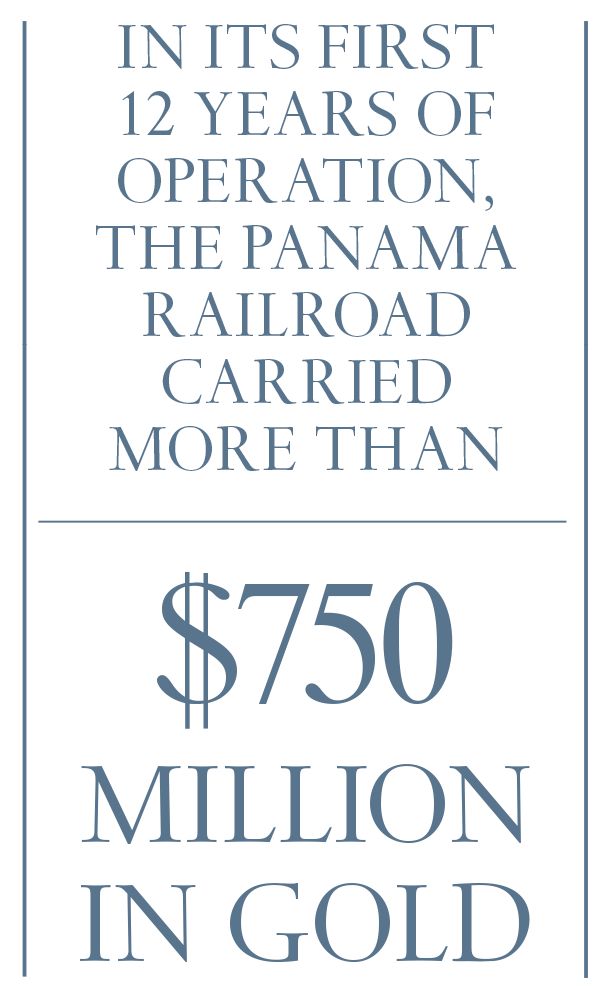
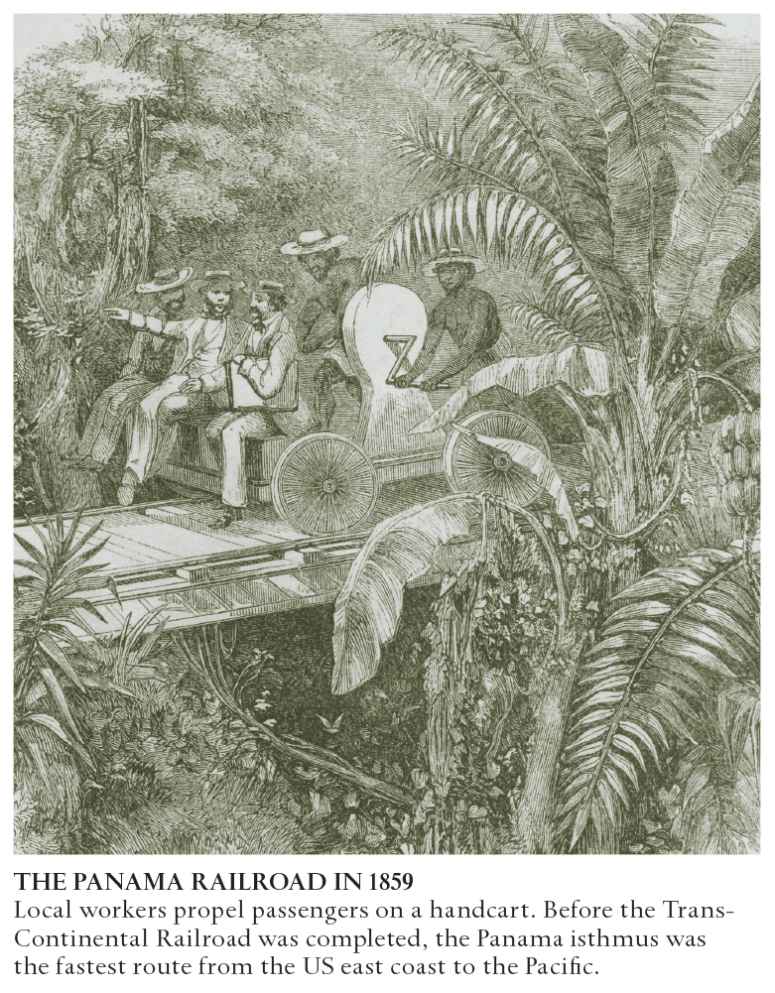
By now the railroad, although still incomplete, was profitable. In 1854, its 31 miles (50km) received over $1 million in fares from more than 30,000 passengers, and on January 27, 1855, the two gangs working from opposite ends of the line joined hands. For 15 years, the Panama Railroad’s monopoly of transit across the isthmus—and from the east to west coast of America—made it prodigiously profitable. It paid for its construction within four years on receipts boosted by a scale of charges set up by a group of tipsy clerks: once the railroad was complete, it charged $25 in gold for a first-class fare, making it by far the most expensive railroad journey in the world at the time, mile for mile. In its first 12 years, it transported over $700 million in California gold and more than 500,000 bags of mail without loss, although the cost of maintenance—including the replacement of rotting pine railroad ties with hardwood lignum vitae—dented profits. The Panama Railroad Company’s glory days continued until 1869, when the completion of the first transcontinental railroad across the US (see Crossing America) took business away from it, but 10 years later, the shareholders made a handsome profit when the directors of a French group with plans to dig a canal across the isthmus paid $20 million for the stock.
Totten stayed on as the railroad’s chief engineer until 1875, overseeing improvements and maintenance. Immediately after the railroad’s completion he had devised a plan for a canal with locks across the isthmus. When Ferdinand de Lesseps, the man behind the Suez Canal, embarked upon his project for such a canal, Totten was appointed chief engineer. Totten also found time to build a daunting mountain railroad in Venezuela. Yet his achievement is recognized only by a modest plaque at the station in Panama City. As Schott writes, “the brief obituary in the New York Times stated that he was a retired engineer. It failed to say that he was the man directly responsible for building the first transcontinental railroad the world had ever seen.”
