
THE DAWN MUEZZIN
THE URGENCY WITH WHICH the followers of the Prophet carried his teachings out of Arabia resulted in one of the campaigning wonders of world history. Within twenty years of his death in 632, Arab forces, although lacking in military pedigree and with no prior knowledge of siegecraft, had overrun much of the Byzantine empire in Syria and Egypt and all of the Sassanid empire in Iraq and Iran. Forty years later, with the addition of North Africa, Spain, most of Afghanistan, and vast areas of central Asia, the Arab domains spanned three continents in a broad swathe of conquest which stretched from the Atlantic to the Indus and from the upper Nile to the Aral Sea. Alexander had been upstaged, Caesar overshadowed. If Muslim authors celebrated this success with the chronicles, geographies and travelogues which now constitute important source materials for the period, it was hardly surprising; evidence of Islam’s triumph was proof of Islam’s truth. By 700 China and India shared uncertain borderlands with Islamic neighbours just as did the Frankish kingdom in western Europe and what remained of Byzantium’s empire in Anatolia.
This phenomenal rate of expansion could not be sustained. External resistance hardened, internal stresses led to the breakaway of peripheral provinces. When in 750 the Umayyad caliphate of Damascus was succeeded by the Abbasid caliphate of Baghdad a long period of consolidation and cultural distinction set in. In the east the Arabs had reached the Indus a hundred years earlier, yet only rarely had they ventured beyond it. Their Turkish successors in Afghanistan, reluctant rulers if less reticent raiders, would also for long be content merely to ravage India’s northern cities.
Islam’s Indian frontier would therefore come to assume a near permanence. Running roughly up the Indus from Sind in what is now Pakistan to Kabul in Afghanistan, it would scarcely advance for three centuries. Kanauj and India’s other front-line kingdoms had, like Constantinople, ample time to become acquainted with their new neighbours, with the faith they held so dear and with the tactics they used so well. None would seem invincible. Moreover, a catastrophe that takes centuries to materialise loses some of its menace. Illusions of successful resistance were nursed; prospects for co-existence were explored. The India which finally succumbed to Muslim dominion in the thirteenth century, though politically more divided than ever, would be both more resilient and more receptive than the brittle dynastic structures of the eighth century. Similarly the Islamic conquerors who would eventually hoist their standards over Delhi, though no more tolerant of idolatry than their Arab predecessors, had few illusions about the mass conversion of India’s multitudes, but real expectations of a fruitful and lasting Indian dominion.
Arab forces, possibly including a few grey-bearded disciples who had prayed with the Prophet himself, had first ventured onto Indian soil by crossing the Bolan pass (near Quetta in the Baluchistan province of Pakistan) in c663. The pass provides comparatively easy access from southern Afghanistan into valleys which thread their way down to the Indus in upper Sind. Much further south, on the coast of lower Sind, desultory naval raids had preceded this assault. Maritime objectives would remain important. In fact twenty years earlier the first Muslims to reach India had been newly converted Arab merchants trading across the Arabian Sea to India’s west coast. Their destinations included the port-cities of the Maitrakas in Saurashtra, of the Chalukyas in Maharashtra, the Cheras in Kerala, and even the kings of Sri Lanka. By the mid-seventh century there were sizeable communities of Muslims in most of these ports. Without provoking undue hostility amongst already cosmopolitan populations, the newcomers rapidly engrossed the valuable carrying trade in Arabian horses to India and in Indian and south-east Asian spices to Arabia. The protection of this route and those who sailed it was thus an early Arab priority; and it called for particular attention to the coastal regions of Sind, whose estuarine inlets provided a muddy sanctuary amidst the mangroves for scavenging sea tribes and hereditary pirates.
Whether it was also the Arabs’ intention to use Sind as a springboard for the invasion of India is less certain. The idea would surface in the eighth century, but in the seventh the more usual route to India via Kabul and the Khyber Pass seems to have been preferred and had already resulted in a succession of abortive Arab raids directed at the Kabul valley. Sind, on the other hand, was something of a dead-end as well as a backwater. This was because any eastward progress was largely barred by the Thar, otherwise the Great Indian Desert, where now runs the Indo–Pakistan border. Even history, as if aware that the lower Indus would have more than its fair share of exposure after the Harappan discoveries, has little to report of the region during the thousand years since Alexander and his men had come sailing downriver. That it was then already Aryanised is clear from the ferocious opposition which the Macedonians encountered even from brahman communities.
Subsequently Buddhism had also claimed many followers in Sind and seems to have become the predominant creed. Hsuan Tsang, writing only twenty years before the first Arab incursion, found innumerable stupas, amongst them perhaps those in the vicinity of Mohenjo-daro which thirteen centuries later would attract the first glimmer of archaeological interest in Harappan prehistory. He also reported on Sind’s ‘several hundred sangharamas occupied by about ten thousand monks’. Admittedly the monks, being of the Hinayana school of which the Chinese Mahayanist heartily disapproved, seemed somewhat ‘indolent and given to indulgence and debauchery’. But the people as a whole were ‘hardy and impulsive’ and their kingdom, then one of Harsha’s confederate states, was famed for its cereal production, its livestock and its export of salt.1
Unfortunately Hsuan Tsang’s generally reliable, if partisan, account says nothing about the political situation, only that Sind’s unnamed king was of sudra caste. He was also ‘an honest and sincere fellow’ who, not unexpectedly after such a character reference, ‘reverenced the law of the Buddha’. Presumably he was of the Rai dynasty, and probably the last of that dynasty for, according to Muslim sources, in c640 the throne of the Rais was usurped by a brahman named Chach. For an infidel, Chach would be rated highly by Muslim writers. In the Chach-nama, an Islamic history of Sind compiled in the thirteenth century but supposedly based on contemporary accounts, he is said to have immediately set out ‘to define the frontiers of his kingdom’.2
No charters of his reign survive, but it may be supposed that what Muslim historians saw as an exercise in border demarcation Chach intended as a traditional digvijaya. Nor, as ‘conquests of the four quarters’ go, was it inconsiderable. In the north, we learn, he reached ‘Kashmir’. Even if this meant not the Kashmir valley but Kashmir territory, which then extended down to the plains of the Panjab, he must at least have entered the Himalayan foothills, for he marked his frontier by planting a chenar, or plane tree, and a deodar, or Himalayan cedar; both are native to the hills. Heading west he laid claim to Makran, the coastal region of Baluchistan where he planted date palms, and heading south he reached the mouth of the Indus. Chach’s kingdom lacked only the erstwhile Gandhara in the north-west to qualify as a proto-Pakistan. Similarly, as a digvijaya, his conquests were incomplete only in respect of the mandala’s eastern quadrant where lay the fearful sands of Thar.
As if to make up for this omission, it was Chach, or his governor in upper Sind, who successfully saw off the Arab attack of 663 via the Bolan pass. No further assaults materialised, and in c674, after what was undoubtedly a glorious reign, Chach ‘died and went to hell’, this being the invariable fate of even the noblest infidel in Muslim histories. It was therefore his son, Dahar (Dahir), who in c708 faced the next and more determined Arab invasion.
This time the trouble is specifically attributed to a flagrant act of piracy. A ship from Sri Lanka, whose Basra-bound passengers included a bevy of maidens, had been waylaid off the port-city of Debal (in the vicinity of modern Karachi) by the dreaded Meds. The Meds were pirates while the maidens, all daughters of deceased Muslim merchants, had been intended as a courtesy from the king of Sri Lanka to al-Hajjaj ibn Yusuf, the Caliph’s governor of Iraq and viceroy for the eastern empire. In what reads like an early-eighth-century version of quarrels which would recur in the late eighteenth century over the policing of the Arabian Sea, al-Hajjaj demanded that King Dahar of Sind secure the release of the maidens. But Dahar, even if willing, was unable to oblige. As he explained, ‘They are pirates who have captured these women, and over them I have no authority.’3 Unsatisfied with this reply, al-Hajjaj despatched a naval force to Debal. It was defeated and its commander killed. Another armada met a similar fate. Whether or not Dahar took an active part in these skirmishes, he was clearly doing nothing to restrain his coastal subjects. Al-Hajjaj therefore continued to hold him responsible and resolved on the all-out amphibious offensive of c708.
Command of the caliph’s forces was given to Muhammad ibn Qasim, al-Hajjaj’s cousin and an able leader, who was to be supplied with siege engines by sea and with six thousand crack Syrian troops for the march through Makran. Nothing was left to chance; according to al-Biladuri, one of the earliest Muslim chroniclers, ibn Qasim ‘was provided with all he could require, without omitting even thread and needles’. Although apparently just a figure of speech, this reference to needlecraft would be of some significance for Muhammad ibn Qasim.
More immediately the siege engines came into their own. The land forces had effected a rendezvous with the seaborne reinforcements outside Debal, but they were unable to force entry to the city. Even the manjanik, a gigantic martinet, or calibrated catapult, which required five hundred men to operate it, was ineffective against Debal’s stout walls. But by shortening its chassis so that it aimed high, the manjanik was trained on a flagstaff whose bright red flag fluttered defiantly from the top of Debal’s temple tower. After no doubt several misses, the manjanik-master struck lucky and the flagstaff was shattered, ‘at which the idolaters were sore afflicted’. In fact, they threw caution to the wind and, issuing forth to avenge this sacrilege, were easily routed. ‘The town was thus taken by assault and the carnage endured for three days,’ says al-Biladuri. The temple was partly demolished, its ‘priests’ (who may have been Buddhists or brahmans) were massacred, and a mosque was laid out for the four-thousand-man garrison which was to remain in Debal.
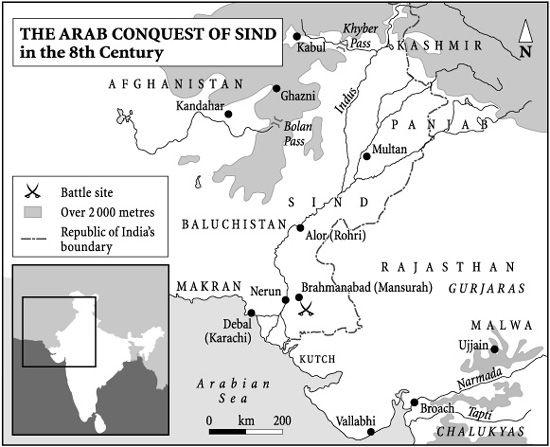
Meanwhile ibn Qasim moved inland, then up the west bank of the Indus. Some ‘Samanis’ (presumably sramanas, or Buddhist monks) of ‘Nerun’ (perhaps the Pakistani Hyderabad) were reminded of their vows of non-violence and came to terms with the invader. Thanks to these ‘Buddhist fifth-columnists’,4 as an eminent Indian historian mischievously calls them, Nerun capitulated. On the opposite bank of the river, a despondent Dahar was apparently safe since ibn Qasim seemed unable or unwilling to cross the flood. Eventually orders came from Governor al-Hajjaj in Baghdad to do just that. A bridge of roped boats was assembled on the west bank. With one end released into the current, it swung into place and the Arabs began crossing immediately.
‘The dreadful conflict which followed was such as had never been heard of,’ reports al-Biladuri. It does, though, bring to mind Alexander’s titanic struggle with Poros; for again the Indian forces displayed exceptional bravery and again the outcome hung in the balance until decided by the ungovernable behaviour of panic-stricken elephants. The beast ridden by Dahar himself, a rather conspicuous albino, was hit by a fire-arrow and plunged into the river. There Dahar made an easy target. He fought on with an arrow in his chest but, dismounting, was eventually struck by a skull-splitting sword blow. It was towards evening, according to al-Biladuri, and when Dahar ‘died and went to hell’, ‘the idolaters fled and the Mussulmans glutted themselves with massacre’.
Muhammad ibn Qasim then resumed his march upriver. Brahmanabad (the later Mansurah), then Alor (Rohri) and finally Multan, the three principal cities of Sind, were either captured or surrendered, probably during the years 710–13. Astronomical casualty figures are given, yet both al-Biladuri and the Chach-nama agree that ibn Qasim was a man of his word. When he offered, in return for a peaceful surrender, to spare lives and guarantee the safety of temples he was as good as his promise. Hindu and Buddhist establishments were respected ‘as if they were the churches of the Christians, the synagogues of the Jews or the fire temples of the Magians [Zoroastrians]’. The jizya, the standard poll-tax on all infidels, was imposed; yet brahmans and Buddhist monks were allowed to collect alms, and temples to receive donations. Ibn Qasim was no mindless butcher. When he was disgraced and removed following the death of his patron al-Hajjaj, it may well be that ‘the people of Hind wept’.
Al-Biladuri merely explains that Muhammad ibn Qasim was sent back to Iraq as a prisoner and there tortured to death because of a family feud with the new governor. The Chach-nama gives a different story and much more detail. Apparently ibn Qasim had previously captured two of Dahar’s virgin daughters and sent them to Baghdad as an adornment to Caliph Walid’s seraglio. There one of the young princesses, Suryadevi, caught the caliph’s eye; but when he deigned to draw her near, ‘she abruptly stood up’. As she very respectfully explained, she felt unworthy of the royal couch since both she and her sister had been similarly favoured in Sind during their detention by Muhammad ibn Qasim. The caliph was not pleased. ‘Overwhelmed with love and letting slip the reins of patience’, he immediately dictated a missive ordering the perpetrator to ‘suffer himself to be sewed up in a hide and sent to the capital’.
The order was obeyed to the letter; the needles and the thread were at last put to good use and ibn Qasim, trussed and labelled, was despatched to Baghdad. Two days into this long and excruciating journey ‘he delivered his soul to God and went to the eternal world’. When finally the unsavoury package was delivered to Walid, the princesses were invited to bear witness to the caliph’s awesomely impartial justice. Not without glee they surveyed the grisly cadaver and then bravely, if unwisely, revealed that Muhammad ibn Qasim had in fact behaved with perfect propriety.
But he had killed the king of Hind and Sind, destroyed the dominion of our forefathers, and degraded us from the dignity of royalty to a state of slavery. Therefore, to retaliate and revenge these injuries, we uttered a falsehood and our object has been fulfilled.
So Muhammad ibn Qasim had been stitched up in more ways than one. Again the Caliph was mightily displeased, ‘and from excess of regret he bit the back of his hand’. Then he consigned the princesses to lifelong incarceration.5
Like most good stories, this one has not always been endorsed by professional historians, although why a Muslim should have fabricated a tale so creditable to the infidel is not explained. It does, moreover, offer a plausible reason for the downfall of Sind’s respected and highly successful conqueror. His like would be hard to find. The next Arab governor of the province died on arrival, and his successor seems to have made little impact on a situation which had already declined, with Brahmanabad back under the control of Dahar’s son. The latter, in c720, accepted Baghdad’s offer of an amnesty whereby in return for adopting Islam he was granted immunity and the chance to participate in government. But this looks to have been a tactical move for, as a succession crisis engulfed the Umayyad caliphate, the Sindis happily discarded both their allegiance and their new faith.
Dahar’s son was eventually captured and killed by Junaid ibn Abdur Rahman al-Marri, who in the mid-720s seems to have recovered much of the province – and more besides. His successors fared less well, and there is evidence of the caliph’s governors being penned within fortified enclaves before again ‘seizing whatever came into their hands and subduing the neighbourhood whose inhabitants had rebelled’.6 This pattern continued to repeat itself during the early years of the Abbasid caliphate. Baghdad’s control of the entire province remained a rare phenomenon until, c870, the local governors, or amirs, gradually threw off their allegiance to the caliph and managed matters for themselves.
By the tenth century the province was divided between two Arab families, one ruling from Mansurah in the south and the other from Multan in the north. In Multan the resentment of the still largely non-Muslim population was curbed only by their Muslim masters threatening to vandalise the city’s most revered temple whenever trouble stirred or invasion threatened. If conquest had been difficult, conversion was proving even more so. Yet the obstinacy of the idolaters, if indulged, could be put to some advantage, and if condemned, always afforded an excellent justification for pillage and plunder. So it was in Sind and so it would be in Hind (i.e. India). In fact Sind’s governors had already had a foretaste of what lay ahead. Muhammad ibn Qasim may have pushed east towards Kanauj, Junaid certainly tried his luck in western India, and later governors may have followed suit.
Their experiences, in so far as they can be inferred from the scanty evidence, would not be encouraging. Al-Biladuri claims conquests for Junaid which extended to Broach in Gujarat and to Ujjain in Malwa. From a copper plate found at Nausari, south of Broach, it would appear that the Arabs had crossed Saurashtra and so must have squeezed through, or round, the Rann of Kutch. This was the incursion which put paid to the Maitrakas of Vallabhi, they of the dazzling toenails whose enemies’ rutting elephants had had their temples cleft. It was also the incursion which was finally halted by, amongst others, a vassal branch of the Chalukya dynasty. The date is thought to have been c736.
Ujjain and Malwa look to have been the target of a separate and probably subsequent offensive by way of Rajasthan.7 It too was defeated, in this instance by a rising clan of considerable later importance known as the Gurjaras. Clearly, when the subcontinent first faced the challenge of Islam, it was neither so irredeemably supine nor so hopelessly divided as British historians in the nineteenth century would suppose.
THE RISE OF THE RASHTRAKUTAS
In contemporary Indian sources these first marauding disciples of Islam are occasionally identified as Yavanas (Greeks),Turuskas (Turks) or Tajikas (Tajiks or Persians), but more usually as mlecchas. The latter term meant what it always had: foreigners who could not talk properly, outcastes with no place in Indian society and, above all, inferiors with no respect for dharma. Like all mlecchas the Muslims were seen as essentially marginal, negative and destructive, just like the Huns. There is no evidence of an Indian appreciation of the global threat which they represented; and the peculiar nature of their mission – to impose a new monotheist orthodoxy by military conquest and political dominion – was so alien to Indian tradition that it went uncomprehended.
No doubt a certain complacency contributed to this indifference. As al-Biruni (Alberuni), the great Islamic scholar of the eleventh century, would put it, ‘the Hindus believe that there is no country but theirs, no nation like theirs, no king like theirs, no religion like theirs, no science like theirs.’ He thought they should travel more and mix with other nations; ‘their antecedents were not as narrow-minded as the present generation,’ he added.8 While clearly disparaging eleventh-century attitudes, al-Biruni thus appears to confirm the impression given by earlier Muslim writers that in the eighth and ninth centuries India was considered anything but backward. Its scientific and mathematical discoveries, though buried amidst semantic dross and seldom released for practical application, were readily appreciated by Muslim scientists and then rapidly appropriated by them. Al-Biruni was a case in point: his scientific celebrity in the Arab world would owe much to his mastery of Sanskrit and access to Indian scholarship.
Aspects of eleventh-century India which al-Biruni omitted from his catalogue of criticism were its size and its wealth. Unlike Alexander’s Greeks, Muslim invaders were well aware of India’s immensity, and mightily excited by its resources. As well as exotic produce like spices, peacocks, pearls, diamonds, ivory and ebony, the ‘Hindu country’ was renowned for its skilled manufactures and its bustling commerce. India’s economy was probably one of the most sophisticated in the world. Guilds regulated production and provided credit; the roads were safe, ports and markets carefully supervised, and tariffs low. Moreover capital was both plentiful and conspicuous. Since at least Roman times the subcontinent seems to have enjoyed a favourable balance of payments. Gold and silver had been accumulating long before the ‘golden Guptas’, and they continued to do so. Figures in the Mamallapuram sculptures and the Ajanta frescoes are as strung about with jewellery as those in the Sanchi and Amaravati reliefs. Divine images of solid gold are well attested and royal temples were rapidly becoming royal treasuries as successful dynasts endowed them with the fruits of their conquests. The devout Muslim, although ostensibly bent on converting the infidel, would find his zeal handsomely rewarded.
Thanks to the peculiarities of the caste system, Indian society also seemed admirably stable, if excessively stratified. But although in theory the ritual-and-pollution-based varna, and in practice the professionbased jati, precluded social mobility, Muslim writers seldom correctly identified the four varnas or divined the variety of the innumerable jatis. It would seem, then, that the ‘system’ was not obviously systematic. Kings of sudra or brahman origin, like those of Sind, were as common as those whose forebears were, or pretended to be, of the supposedly royal and martial ksatriya varna.
Nor was caste wholly prohibitive and repressive. Indeed it has been argued that caste membership conferred important rights of participation in the economic and political processes as well as obligations of social conformity. In other words, it was as much about being a citizen as being a subject. Through various rural and, more obviously, urban assemblies like caste and guild councils, endorsement of a particular leadership was demonstrated by attendance in the myriad rituals of state. ‘Rather than being excluded from the life of Indian polities, [castes] actively participated in it. Indeed, by doing so, they partly constituted it.’9 Such participation in, for instance, the elaborate ceremonies involved in installing a new king or launching a digvijaya signified assent to the traditional fiscal and military expedients available to such a leader. But by caste councils, as by reluctant feudatories and vassals, such connivance in the political order might always be subtly withheld or transferred.
A further argument has it that caste assumed its passive and static connotations only after the Muslim conquest, when religious discrimination and oppressive taxation conspired to remove opportunities for political participation and economic advancement. Caste membership, shorn of its influence, then became primarily a distinguishing characteristic of orthodox Indianness, or ‘Hinduism’. The notion of karma – whereby one’s status was determined by one’s conduct in past lives and could in subsequent lives be improved by one’s conduct in this – provided a rational explanation for the system as well as a welcome solace for those most disadvantaged by it; their prospects now depended not on the exercise of caste rights but on resignation to caste obligations. The doctrine of karma, first scouted in the Upanisads, then elaborated in Buddhist teaching, thus came, like caste, to be perceived as fundamental to Hindu orthodoxy.
Politically, according to Muslim observers, India comprised many kingdoms, each with a formidable army that included elephants and cavalry as well as infantry. According to a Baghdad adage quoted by al-Biruni, the Turks were famous for their horses, Kandahar (for some reason) for its elephants, and India for its armies. One of India’s rulers, ‘the Balhara’, was reckoned as being amongst ‘the four great or principal kings of the world’ according to the much-travelled merchant known to us simply as Suleiman (the other great rulers were the kings of Baghdad, of Byzantium-Constantinople, and of China). Admittedly ‘the Balhara’s’ claim to be India’s king of kings was constantly under threat; but in the opinion of Suleiman, who made several trips to India during the first half of the ninth century, this did not necessarily occasion great upheaval. India had learned to contain conflict and to minimise its effects.
The Indians sometimes go to war for conquest, but the occasions are rare. I have never seen the people of one country submit to the authority of another, except in the case of that country which comes next to the country of pepper [i.e. the Malabar coast]. When a king subdues a neighbouring state, he places over it a man belonging to the family of the fallen prince who carries on the government in the name of the conqueror. The inhabitants would not suffer it to be otherwise.10
Once again one is reminded of Megasthenes’ description of agriculturalists ‘ploughing in perfect security’ while armies did battle in the next field. Although the ploughmen may have had a stake in the outcome of the battle or may have contributed to the equipage of one of the protagonists, they were not expected to get involved. Warriors fought with warriors; the ploughman’s dharma was to plough.
Bearing this peculiarity in mind – and not without a deep breath – one may return to the dynastic fray as it intensified during the eighth to eleventh centuries. In the Deccan the century and a half of glorious domination by the Chalukyas of Badami came to an end around 760. Distracted if not exhausted by their endless wars in the south with the Pallavas of Kanchi, the Chalukyas had allowed one of their northern officials to accumulate considerable territory on the upper Godavari river in Berar, a region as near the dead centre of India as anywhere and now dominated by the city of Nagpur. From c735–56 the senior member of this rising family was Dantidurga and, since his function within the Chalukyas’ empire was that of rastrakuta or ‘head of a region’, the dynasty he founded is known as that of the Rashtrakutas.
After loyally serving the Chalukya Vikramaditya II in his Pallava wars and possibly also against the Arabs of Sind, Dantidurga took the opportunity of Vikramaditya’s death in 747 to enlarge his territories. In a modest digvijaya which carefully avoided the Chalukyan heartland of Karnataka, he expanded his authority to include much of Madhya Pradesh and parts of southern Gujarat and northern Maharashtra. Additionally, according to a set of copper plates from Ellora (which place he seems to have adopted as his ceremonial capital), he assumed the title of prithvi-vallabha. Vallabha means ‘husband’ or ‘lover’, while prithvi means ‘the earth’ and is also the name of the earth goddess who was one of Lord Vishnu’s consorts. Dantidurga and his successors were therefore advancing an ambitious claim to be acknowledged as Lords of the Earth and emanations of Vishnu. Incidentally, it was also this title, abbreviated to vallabha, which registered with Muslim observers and reappeared in their writings as ‘the Balhara’.
Compared to the Byzantine emperors or any of the other ‘four great or principal kings of the world’, the Balhara’s rise to fame was rapid and comparatively painless. Dantidurga completed his digvijaya by belatedly confronting the Chalukyan king who, also belatedly, had just awoken to the danger of this rival on his northern frontier. Again it was the Rashtrakuta who triumphed, although in mysterious circumstances: ‘success seems to have been due to a stratagem, for his court poet tells us that he overthrew the Karnataka army by a mere frown of his brow, without any effort being made and without any weapons being raised or used.’ The fruits of this victory, if such it was, were proportionately modest. The Chalukyas were soon back in the field and Dantidurga would frown no more. He died prematurely in c756 ‘probably owing to the pressing requests [for his company] of the heavenly damsels’, suggests one record.11
Being childless, he was succeeded on the Rashtrakuta throne by his uncle Krishna I. Krishna it was who concluded matters with the Chalukyas. In what looks to have been a rather violent battle – and which could be that to which the merchant Suleiman would refer as involving ‘the country which comes next to the country of pepper’ – Krishna decisively disposed of his family’s erstwhile suzerains; ‘the ocean of the Chalukya army’ was well and truly ‘churned’, we are told, and from its waves arose the ‘Goddess of Royal Glory’. Badami fell and all Karnataka was added to the Rashtrakutas’ territories, while subsequent campaigns secured the submission of the Konkan coast and of the eternally hard-pressed Ganga dynasty (of the Mysore area). Additionally, in the east, one of Krishna’s sons triumphed over the Chalukyas of Vengi who were a satellite branch of the Badami family. These ‘Eastern Chalukyas’ were now wedded to the Rashtrakuta cause by a matrimonial alliance.
When Krishna I died in c773 the Rashtrakutas were undisputed masters of the entire Deccan. Further conquests could only be made at the expense of the kingdoms of the extreme south or by crossing the Vindhya hills into the Gangetic plains. No Deccan-based dynasty had yet tried its luck in the hallowed and hotly contested arya-varta but under Dhruva, who in c780 ended a short and chaotic reign by his brother, the Rashtrakutas did just that. Dhruva first secured his southern flank by again rubbishing the Gangas and rattling the Pallavas. Then in c786 he forded the Narmada, a veritable Rubicon, and led his best troops north. Malwa quickly submitted. Following the Chambal river along the well-worn trail once known as the Daksinapatha, Dhruva crossed into the Gangetic basin and headed for Kanauj.
THE KANAUJ TRIANGLE
Centrally sited and beside the holy Ganga, Kanauj had been acknowledged as the seat of northern empire ever since Harsha’s day. By the ninth century, though, it was a capital without much of a kingdom, its ruler being generally a puppet of one or other of the two great powers that were contesting the hegemony of the north. These were the Palas from eastern India and the Gurjara-Pratiharas from western India. With the eruption onto the scene in c786 of the Rashtrakutas from the Deccan this became a three-sided contest. It would last for two centuries and, though its details are anything but clear, the evidence suggests glorious interludes during which one or other of the contestants successfully performed a digvijaya, laid claim to Kanauj, and grandiloquently advertised his universal paramountcy. Hence the period is sometimes called the ‘Imperial Age of Kanauj’. But the chronology is too confused for anything but a conjectural narrative, and of the temples and fortifications of Kanauj itself too little remains to inspire even a hopeful reconstruction.
More interesting than the power struggle is the very different provenance of the participants. All three are noticed by Muslim writers who understandably have least to say about the remotest, namely ‘Rahma’, ‘Rahmi’ or ‘Ruhmi’. The word may derive from Dharmapala who ruled c775–810, and certainly it seems to refer to his dynasty, that of the Palas of Bengal. The Pala country, we learn, was on the coast but stretched well inland; it produced very fine cottons and aloe wood, and the king possessed fifty thousand elephants and more troops than either of his rivals. Dharmapala was the son of Gopala, who looks to have founded the dynasty in c750. Unusually, but not uniquely since similar claims are made for one of the Pallavas and for a king of Kashmir, Gopala’s elevation is said to have been the result of a selection, if not an election, process. Perhaps already a minor king of northern Bengal, he was invited to assume sovereignty over the whole of Vanga, or eastern Bengal, and then rapidly consolidated his rule throughout Bengal and Bihar.
Dharmapala continued his father’s expansionist policies. Excepting for Sasanka’s brief and uncertain challenge in Harsha’s day, this was the first Bengali bid for control of arya-varta, and it began badly. But eventually, taking full advantage of the disruption caused by the first Rashtrakuta incursion, Dharmapala reached Kanauj and there held a great ceremony at which his chosen candidate was installed as a tributary king. The loan of Dharmapala’s own golden pitcher for the sacred ablutions essential to this induction neatly demonstrated his primacy. Kings from all over north India, including an unexplained ‘Yavana’ (possibly a Muslim from Sind), witnessed the event and ‘paid homage with the bending down of their quavering diadems’.12
Through as many setbacks as triumphs, the Palas clung to their supremacist claims for the best part of a century. As with the Guptas, this was partly thanks to their longevity. Dharmapala reigned for forty years and Devapala, his son, seems to have lasted quite as long (c810–50). To their collection of ‘quavering diadems’ were briefly added those of the kings of Kamarupa (Assam), Utkala (an Orissan kingdom) and possibly other kings from lands as far-flung as the deep south and the extreme north-west. This, however, temporarily exhausted the Palas’ taste for earthly dominion. Although there would be a brief revival in the eleventh century, in the tenth their role was simply as a whipping boy for their rivals. ‘The Pala empire, shorn of its plume, lay tottered,’ writes an Indian historian.13 Seemingly it disintegrated under a succession of rulers of a ‘pacific and religious disposition’.14 One renounced the throne to become an ascetic, others attended to their spiritual advisers and to the welfare of the monastic establishments which still flourished in the Pala heartland of Bihar and Bengal.
For the Palas were Buddhists, indeed the last major Indian dynasty to espouse Buddhism. Their lavish endowments included the revival of Nalanda’s university and a colossal building programme at Somapura, now Paharpur in Bangladesh, where sprawling ruins and foundations, all of brick, attest ‘the largest Buddhist buildings south of the Himalayas’.15 They also founded an important new centre of learning at Vikramashila, which was somewhere on the Ganga in Bihar. The fame of all these places travelled widely and suggests that Pala patronage was crucial to the future of Buddhism as a world religion. To the Pala kingdom came students from Sind, Kashmir, Nepal, Tibet, China, Burma, Cambodia, Sri Lanka and Indonesia. Pala architecture probably influenced the final remodelling of Borobudur and would be echoed in the stupas and temples of Pagan (Burma) and Prambanam (Java). Pala images, often in highly polished stone and bronze, anticipated and inspired the distinctive iconography of Tibet and Nepal. And the Mahayanist Buddhism of both these countries developed its peculiar traits and doctrines under Pala patronage.
It was a Buddhism far removed from that preached by the Enlightened One, indeed as remote from it in both time and spirit as was medieval Christianity from the New Testament. Although originally a rationalisation of the human condition and a code of ethics, both of which largely ignored the deities and rituals associated with conventional religion, Buddhism had been steadily assuming the trappings of orthodox religious practice ever since the Buddha’s death. In the Boddhisattvas it had long since acquired a pantheon whose myths and attributes rivalled those of Shiva and Vishnu; now, in their numerous Taras, or spouses, it acquired glamorous female counterparts of Parvati and Lakshmi. Indeed Buddhist icons of the Pala period are so anatomically exaggerated and so generously provided with extra heads and arms that only a trained eye would identify them as Buddhist.
In eastern India the demarcation between Buddhists and non-Buddhists was further blurred by both countenancing the efficacy of mantras (repetitious formulae),yantras (mystical designs),mudras (finger postures) and the numerous other practices associated with Tantricism. Tantras were e soteric texts of uncertain origin and profoundly difficult import which offered initiates the chance of communing with the divinity and assuming supernatural powers and states. The rituals and disciplines involved were complex and secret. Some mimicked the sexual imagery of myths involving the union of the deity and his shakti, or female counterpart. Breaking the taboos of caste, diet, dress and sexual fidelity, practitioners might enjoy both a liberating debauch and an enhanced reputation, even if magical powers eluded them.
But it goes without saying that these mystic whisperings, obscurantist doctrines and orgiastic covens were far removed from the Buddha’s ‘Middle Way’. Worse still, compromise was proving counter-productive for Buddhism. In bidding for popular support and competing with other cults as a parallel religion, the sangha had been losing ground throughout India since the time of the Guptas. Populist devotional cults emanating from south India (the so-called bhakti movement) were pre-empting Buddhism’s traditional appeal as a refuge from brahman authority and caste prejudice. At the same time a reform movement started by Sankara (788–820), a brahman from Kerala, was reclaiming for a distilled essence of Vedic philosophy (vedanta) the high moral and doctrinal ground previously enjoyed by the Noble Eightfold Path. As a result Buddhism was already largely confined to the peripheral regions of Sind, Kashmir, Nepal, and of course the Pala heartland in eastern India.
Whether the Pala empire was in any sense a Buddhist state it is hard to say. But in that reference to the ‘election’ of Gopala, its founder, there could be an echo of the more contractual ideas underlying early Buddhist notions of kingship. His successors, while adopting conventional titles like maharajadhiraja and paramesvara, seem to have paid particular heed to their religious advisers, and it may not be fanciful to imagine the Palas reviving the mythology of their illustrious predecessors in Magadha – Ajatashatru, Bimbisara and Ashoka. Certainly Pala patronage of Buddhist institutions afforded to India’s greatest religio-cultural export a last climax under Dharmapala and Devapala and then a last refuge under their successors.
It is, however, their mortal rivals for supremacy in northern India who have attracted the closest scrutiny by Indian historians. Based in western India at the opposite extremity of arya-varta, the Gurjara-Pratiharas have been awarded an imperial sway greater even than Harsha’s and a national resolve worthy of the Congress Party. ‘They were of the people and did not stand away from their hopes, aspirations and traditions.’16 ‘The spearhead of a religio-cultural upsurge’, the Gurjara-Pratiharas were ‘bulwarks of defence against the vanguards of Islam’17 and ‘protectors of dharma’. Yet despite such confident statements, despite comparatively frequent references by Islamic writers, and despite a succession of well attested rulers, the Gurjara-Pratiharas remain as much an enigma as their composite title suggests.
‘The king of Jurz maintains numerous forces and no other Indian prince has so fine a cavalry,’ reported merchant Suleiman in the ninth century. There was also ‘no greater foe of the Muhammadan faith’. Moreover Jurz territory comprised ‘a tongue of land’, presumably Saurashtra in Gujarat, which if correct provides a clue to the identity of its king. For Jurz, sometimes spelled ‘Juzr’, is taken to be a variant of ‘Gurzara’ or ‘Gurjara’, a place or people visited by Hsuan Tsang and mentioned in several inscriptions, including that of the great Chalukya, Pulakesin II, at Aihole. The same word is today found in ‘Gujarat’, ‘Gujranwala’ and numerous other place-names as well as in ‘Gujars’, a ubiquitous community of pastoralists frequenting many parts of the Panjab from the north-west frontier to Uttar Pradesh. This trail of ‘Guj-’ words suggests that the Gurjaras, or Jurz people, had been on the move. Some suppose that they originated beyond the north-west frontier and moved into the Panjab and then western India in the wake of the Hun invasions. Others suppose that any such migration was more probably in reverse, that they originated in western India and then moved north.
Al-Masudi, writing in the early tenth century, has little to say of Jurz but makes much of ‘the Bauura, king of Kanauj’. His forces were reckoned at an incredible three million, and were divided into four armies, one to engage the Arabs of Multan, another to deal with the Balhara (i.e. the Rashtrakutas) and the other two ‘to meet enemies in any direction’. Such a description could only apply to the Pratiharas, a late-eighth-to tenth-century dynasty known to have wrested Kanauj from the Palas and to have been occasionally humbled by the Rashtrakutas. And since the Pratiharas are known to have originated in Rajasthan, whence one branch of the family had first set up in a kingdom in Gujarat, it is now generally accepted that Jurz and the Gurjaras refer to kingdoms and rulers closely related to the Bauura and the Pratiharas. In fact the Pratiharas are taken to be one of several Gurjara clans and are hence known as the ‘Gurjara-Pratiharas’.
The subject is of more than passing interest because the Pratiharas and their descendants are often numbered amongst those more famous clans known as rajputs. In the centuries immediately preceding and following the Muslim conquest of India, the rajputs were destined to play an often heroic and always pivotal role. Their territories would stretch way beyond Rajputana, or Rajasthan, and would eventually constitute the most numerous of the ‘princely states’ under British rule. In fact to the British the rajputs would come to represent the quintessence of all that was admirable in India’s martial traditions. ‘In a Rajpoot,’ wrote Colonel James Tod, their annalist and champion, ‘I always recognise a friend.’
Tod spent ten years amongst the still-independent rajputs as a political agent in the early nineteenth century. In his subsequent Annals and Antiquities of Rajasthan, one of the most substantial and sonorous works of British Indian scholarship, he would claim to have established ‘the common origin of the tribes of Rajasthan and those of ancient Europe’. Invoking ‘the Scythic tribes’ as the common link, this was simply a variation, albeit less remote, of the Indo-Aryan hypothesis advanced by philologists like Jones. Tod also delved deeply into the Puranic pedigrees whereby the various rajput houses claimed descent from heroes of the epics and Vedas. And he valiantly tried to trace each clan to its original homeland. But he failed to explain the greatest mystery of all: why the rajputs, so prominent in Indian history throughout the second millennium ad, had figured in it not once during the first millennium. Where, in short, had the rajputs sprung from?
The mystery is still unresolved. Even if rajput clans like the Pratiharas were really Gurjaras, they can still only be traced back to c500; and there remains the problem of where the Gurjaras sprang from. Legends common to some families of both Gurjaras and rajputs associate them with the region around Mount Abu. Upon the dewy downs of this vast upthrusted plateau in southern Rajasthan a great fire-sacrifice was reputedly held at which the progenitors of these clans were accorded ksatriya status and incorporated into royal lineages going back to Lords Rama and Krishna, themselves scions of descent groups from the Sun and the Moon. Clearly in the not too remote past the fortunes of these clans had improved substantially as a result of some dramatic transformation. But whether they were previously indigenous desert tribes who, like those of Arabia, were abruptly inspired to undertake martial exploits in more favoured lands, or whether they should be seen in the context of those republican and tribal entities, like the Yaudheyas, who from roughly the same regions of western India had once offered a stout resistance to Rudradaman of the Junagadh inscription and to Samudra-Gupta of the Allahabad inscription, and whether earlier still they had migrated from somewhere outside India – all such mysteries remain.
What is certain is that the Gurjara-Pratiharas represented a social and political grouping very different from those of their Pala and Rashtrakuta rivals for the imperial patrimony of Kanauj. When they first emerged it was as the most successful amongst several related Gurjara royal families; their extensive conquests were often made and subsequently controlled by feudatories who were often relations; and when their ‘empire’ disintegrated, it did so into powerful local kingdoms ruled by families who claim a similarksatriya status and a similar Gurjara-rajput provenance. This prevalence of loose, kin-based relationships suggests that tribe and clan were important to the Gurjara-Pratiharas. Unlike the Buddhist Palas, their religious allegiance was variable: some were devotees of Vishnu, others of Shiva, Bhagavati or the Sun-God. And unlike the Rashtrakutas, who were veritable sticklers for ritual refinement, they seem not to have gloried in the elaborate ceremonies of paramountcy. Theirs was a more informal, less rigid and perhaps more effective power structure which, breaking from the mandala conventions of the past, anticipated the more flexible relationships demanded by the dire centuries ahead.
Nevertheless, the Gurjara-Pratiharas observed the conventions and assumed the traditional epithets of paramountcy. Vatsaraja, who from Ujjain appears to have ruled over Malwa and much of Rajasthan in the 780s, had been the first to assume the titles ofmaharajadhiraja and paramesvara. Despite defeat by Dhruva, the Rashtrakuta king who first threatened Kanauj, Vatsaraja’s son would continue to use and to add to these titles. The son, Naghabhata II, was also the first of his line to seize Kanauj from its Pala puppet and to lay claim to extensive conquests in arya-varta. His success was short-lived, but Bhoja, his grandson, more than made amends. Ruling for at least fifty years (c836–886), Bhoja (and then his son Mahendrapala) accumulated by conquest and alliance more feudatory territories than any contemporary. As the Pala empire retracted under Devapala’s successors and as the Rashtrakutas entered a period of uncharacteristic quiescence, Bhoja looks to have commanded kings and kingdoms which stretched in a great arc from Saurashtra in Gujarat to Magadha and Bengal.
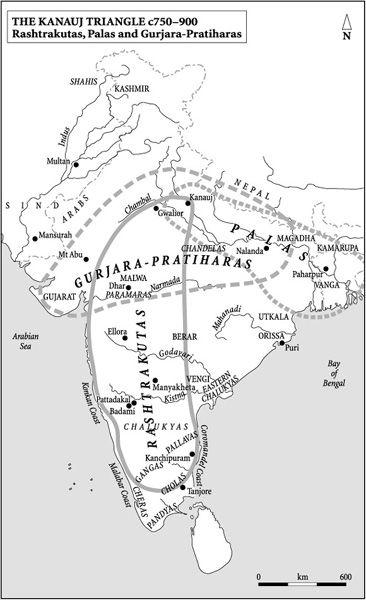
If Kanauj was Bhoja’s capital, Gwalior, a natural fortress of immense strategic value astride the Daksinapatha south of Agra, may have served as the fulcrum of his empire. Thereabouts was found the most important of the Pratihara inscriptions, and henceforth Gwalior’s bluff and increasingly fortified cliffs would loom large in the affairs of north India and provide something of a barometer of current dominion. Its loss in c950 to the Chandelas of Bundelkhand, soon to win immortality as the builders of Khajuraho, signalled the disintegration of Pratihara dominion. Thence Gwalior quickly passed to the Kacchwahas, later of Jaipur, and eventually to the Tomars, later of Delhi. It was one of the Tomars who would build atop Gwalior’s sun-drenched cliffs the unsurpassed Man Singh palace. Significantly all these dynasties, representing a veritable roll-call of rajput prowess, first emerge as feudatories and associates of the Pratiharas.
Only against the Rashtrakutas had Bhoja made little headway. Under Dhruva (c780–93), then Govinda III (c793–814) and much later Indra III (c914–28) the Rashtrakutas repeatedly intervened in the north. Not to be outdone by the parallels between Bhoja and Julius Caesar drawn by latter-day champions of the Gurjara-Pratiharas, Govinda III’s generalship has been likened to that of Alexander or Arjuna.18 After victories in the south, he conducted a dazzling digvijaya in the north, defeating the Gurjara-Pratiharas under Nagabhata II somewhere near Gwalior and securing the submission of both Kanauj and the Pala ruler. As was normal the kingdoms of the south took advantage of his absence, but they too were soon favoured with a return visit. By 805 Govinda had brought the Gangas, Cheras and Pandyas to heel and had stormed and occupied Kanchipuram. The drums of the Deccan were heard, we are told, from the Himalaya’s caves to the shores of Malabar, and truly Govinda appeared invincible. Yet neither he nor his successors showed much interest in developing their empire. Retaining anything more than the nominal allegiance of distant dynasties was not the Rashtrakuta way.
The Rashtrakuta objective, it has been argued, was much more subtle. Instead of dominating arya-varta, their ambition was to appropriate and relocate it; not content with making history, the Rashtrakutas were about to make geography by transposing the sacred Aryan heartland to the Deccan. Their capital was eventually settled at Manyakheta (Malkhed), a place where the frontiers of Maharashtra, Karnataka and Andhra Pradesh now meet. To the Rashtrakutas its significance seems to have lain in its being between the Godavari and the Kistna, the two great rivers of the Deccan. A counterpart to the land between the Jamuna and the Ganga where Kurus and Pandavas had once fought their Mahabharata war, this was to be the new aryavarta, the Doab of the Deccan. Likewise Manyakheta was to be the new Hastinapura, or a Kanauj of the Deccan. There, in an enormous hall, the Rashtrakutas would enact before a larger-than-life image of the deity, itself cast in gold, the bejewelled ceremonials of a universal dominion by which the world-ruler asserted the triumph of dharma.
Before adopting Manyakheta, the Rashtrakutas had patronised today’s much better known site at Ellora, above a tributary of the Godavari in northern Maharashtra. Here, where an exposed rock-face, two kilometres long, had already been perforated with the most ambitious of India’s cave temples, they took over and rededicated a just-completed Buddhist foundation. This was the vast and airy ‘Do Thal’ vihara, three storeys high and with halls and courtyards of suitably palatial proportions. An inscription also credits Dantidurga with patronage of the nearby Dasavatara cave. Both were evidently stopgaps, for further along the ‘street of rock’ a new and more conventional-looking temple was begun by Krishna I. Although architecturally very similar to the Chalukyas’ later temples at Pattadakal, this was not, however, architecture; it was sculpture. For the Krishnesvara, or Kailasa as it was also called, is a free-standing excavation, a temple of cathedral proportions complete with precinct, cells, shrines, gateway and pillars all hewn from the same rock stratum. Seeing it, according to a contemporary copper plate, even the gods were moved to favourable comment, and marvelled that human art could produce such beauty. Its creator was no less amazed. ‘Oh, how was it that I created this,’ he rather touchingly exclaimed.
Indisputably the most elaborate and imposing rock-cut monument in the world, the Kailasa still triumphantly confirms the Balhara’s status as ‘one of the four great or principal kings of the world’. It also provides a further illustration of the Rashtrakutas’ attempt to appropriate the sacred geography of arya-varta. Mount Kailasa in the Himalayas is the earthly abode of Lord Shiva. The new Kailasa temple at Ellora, also wrought of rock and also dedicated to Shiva, was designed to reposition Mount Kailasa in the Deccan and so, by implication, to make of the gentle Vindhya hills a Himalayas-in-the-Deccan which would be the northern frontier of the new arya-varta. Similarly and symbolically, to the new Kailasa was added a shrine with images of Ganga, Jamuna and Saraswati, the three river deities of arya-varta. King Dhruva, we learn, on his invasion of the north had ‘taken from his enemies their rivers’, a reference which could apply to the deities but seems more probably to mean that the Rashtrakutas actually ‘brought the waters of these streams back with them in large jars’. ‘So it seems clear that the Rashtrakutas, who had made Mount Kailasa appear in the mountain range north of their domains, also caused the rivers which had originated there, the rivers which defined the middle region of India, to appear in their empire in the Deccan.’19
All empires, even those which would refashion the earth as well as rule it, must pass. Assailed in the south by the rising power of the Cholas and in the north by the Paramaras, erstwhile feudatories of the Gurjara-Pratiharas, the Rashtrakutas dwindled into insignificance in the late tenth century. The dream of a Deccan aryavarta died with them, although much further south something similar would imminently be attempted by the Cholas of Tanjore. They too would reach the Ganga, and they too would then laboriously haul its waters home to their own arya-varta at the mouth of the Kaveri river.
But in the interim northern India had been ravaged by the first Muslim incursions. Any attempt to transpose its sacred geography now looked less like sincere imitation and more like a desperate act of preservation. The real arya-varta had been violated, and the Cholas’ boast to have watered their horses in the mighty Ganga would merely echo that of a more formidable foe who cared nothing for the gilded fantasies and rock-cut conventions of early India’s imperial formations.