
COPPER-PLATE FLOURISHES
GIVEN THE TASK of elucidating sixth-century politics for a volume of the monumental History and Culture of the Indian People, D.C. Sircar, an outstanding epigraphist and historian, writes at length on each of seventeen major dynasties. Numerous lesser dynasties also claim his attention; and the chapter in question covers only the Deccan. With the addition of western India, the Panjab, the north-west, Kashmir, Bengal, the south and the vast Gangetic arya-varta, the sixth century’s dynastic count could easily be doubled. All of which makes ‘happy hunting for professional historians’.1 The prospect of tracking three dozen royal houses at once may, however, discourage the non-specialist, who will not be reassured to learn that during the next five centuries the situation gets, if anything, worse. Dynasties multiply, territories (insofar as they can be determined) diminish, authority erodes. Hemachandra Ray’s Dynastic History of Northern India charts the rise and fall of a further thirty dynasties between 900 and 1100 – and that excludes those of the Deccan, south, and western India. In the history of what used to be called ‘medieval’ India, the key words are ‘fragmentation’ and ‘regionalisation’.
Whether or not this represented a new state of affairs is debatable, but that it becomes progressively evident is because of the proliferation of a new kind of evidence. So far the reconstruction of India’s past has depended on very grudging materials: some enigmatic archaeology, long mostly religious texts of uncertain antiquity, snippets of surviving tradition, the patchy accounts of European and Chinese visitors, coins, and a few mostly stone-engraved inscriptions. All these continue to be relevant, but to them must now be added a more generous corpus of official records, or charters, plus the occasional piece of biographical literature.
The former, the charters, are the more informative. They have been found all over India, and along with royal panegyrics like the Allahabad inscription they are largely responsible for the dynastic log-jam. Indeed many royal lineages, as also the kingdoms over which they ruled, are known only because one or more of their charters happens to have survived. These charters (sasanas) usually record grants of land. They were originally written on palm leaves, but as title-deeds they were of sufficient value subsequently to be engraved, sometimes on a cave wall or a temple but more usually on plates of copper which were then kept in a safe place or hidden somewhere. ‘A large number of copper plates have been found immured in walls or foundations of houses belonging to families of the donees, or hidden in small caches made of bricks or stone in the fields to which the grant refers.’2 Some of these plates were used more than once, a cancelled charter being over-struck with a new one; all originally included a royal seal, often of brass; yet forgeries were not uncommon; and many charters were long enough to run to several plates which were then held together, like a heavy set of keys, with a stout copper ring.
It seems likely that such records had been in use since the beginning of the Christian era. The earliest authentic plates to have survived come from south India and were issued by kings of the Pallava dynasty of Kanchipuram in the fourth century AD. Some of these charters seem to date from before Samudra-Gupta’s uprooting of his Pallava contemporary and are in Prakrit. Thereafter they switch to Sanskrit and provide limited information on no less than sixteen early Pallava kings between 350 and 375. The Pallavas, whose origins are uncertain, had established themselves in the region known as Tondaimandalam, west of the later city of Madras. They had already elevated Kanchipuram into an important religious and intellectual centre but, on the evidence of these plates, they were having severe difficulties holding their own. Only after 375 would the Pallavas emerge as the first great south Indian dynasty, and not till the seventh to eighth centuries would they endow Kanchi and Mamallapuram (Mahabalipuram) with the reliefs and temples now associated with their greatness.
In north India similar, but not always helpful, glimpses of dynastic activity are provided by rare copper plates of the Gupta period. Thereafter such plates become more numerous and remain a prime source for many centuries to come. Muslim chroniclers would notice them and they were still in use in the eighteenth century when newcomers, like the European trading companies, sometimes relied on them as title-deeds to their coastal settlements. At the same time the more historically-minded of the companies’ employees began to collect them for scholarly study.
Legal documents not being renowned for originality or innovative phrasing, the charters, although written in numerous regional languages as well as Sanskrit, all follow much the same formula. After an invocatory word or passage, the text identifies the royal donor with a string of those compound Sanskritic titles and a long panegyric on his forebears, his exploits and his personal qualities. There then follow details of the grant itself, its recipient(s), the occasion for it, and a stern command that posterity respect it. Hefty, if wishful, penalties are detailed for any transgressor of this last provision: the crime of overruling a sasana was commonly equated with that of killing ten thousand Varanasi cows – a sacrilege of unthinkable enormity in a city of unassailable sanctity for which the penalty was that of being reborn as a dung-worm with a lifespan of eighty-four thousand years.
Of all these standard components of a charter, that applauding the donor and his lineage has generally been found the most useful. As noted, entire dynasties and their histories have been reconstructed from the chance survival of a single such charter. Yet their extravagant language should in itself provide a warning. Whether on copper or stone, inscriptions can be misleading.
According to a neat two-plate charter issued in 571 at Vallabhi, which place had succeeded Rudradaman’s Junagadh as the capital of Saurashtra, the incumbent king was the son of a maharaja of truly spectacular memory. Maharaja Guhasena had ‘cleft the temples of the rutting elephants of his foes’; the toenails of his left foot emitted rays as dazzling as those of the jewels in the head-dresses of his enemies as they lay prostrate before him; in beauty he surpassed the God of Love, in lustre the Moon, in constancy the Lord of the Mountains, in profundity the Ocean, in wisdom the Protector of the Gods and in riches the Lord of Wealth. Carelessly showering his supporters with gifts, ‘he was, as it were, the personified happiness of the circumference of the whole earth’.3
The rulers of Vallabhi were indeed destined for some distinction, and their capital, misheard as ‘Balhara’, would be amongst the first to be noticed by Muslim chroniclers. But the ruler of all India whom these same chroniclers called ‘The Balhara’ was not the Maitraka king of Vallabhi but the ‘Valabha-raja’, a title used by the later and much more significant Rashtrakut adynasty. Moreover in 571 the Maitrakas had barely established themselves at Vallabhi; descendants of a Gupta general, they had only just ceased to acknowledge Gupta suzerainty. Although typical of many other successor dynasties within the region of direct Gupta rule, they had scarcely begun the mysterious business of cleaving rutting elephants’ temples and were not politically significant in India as a whole.
The year in question was more notable for an event outside India. Also in 571, but across the Arabian Sea and in obscure circumstances, the wife of an impoverished merchant of the Quraysh tribe gave birth to a son of less suspect lustre. To him, forty years later and now known as Muhammad, the divine word would be revealed; and by him the world would be irrevocably and very rapidly changed. But it would be over a century before the Prophet’s followers made any impact on India. And by then most of those sixth-century dynasts, although not the Maitrakas, had long since ceased to outshine the moon and personify all earthly happiness.
No excuse, therefore, is offered for ignoring most of the dynasties which are known to have succeeded the Guptas and which, from their charters, may appear even to have outdone the Guptas. Some will be noted later. Here it is sufficient to mention that several claim to have turned the tide of Hun incursion. It will be recalled that from Gandhara the Huns had been rampaging across the Panjab and as far as Malwa since c500. In the north-west the great Buddhist establishments at Taxila, Peshawar and Swat suffered severely from their iconoclasm. Where Fa Hian in the fifth century had found packed viharas and towering stupas, Hsuan Tsang, another Chinese visitor but in the mid-seventh century, found only devastation. Taxila’s monasteries were ‘ruinous and deserted, and there are very few priests; the royal family being extinct, the nobles contend for power by force’. In Swat some fourteen hundred Buddhist establishments were ‘now generally waste and desolate’, their eighteen thousand monks having dwindled to a handful.4Buddhism in the Indus basin would never recover from this blow; nor, until the advent of Islam, would the overland trade with China and the west. Although Hsuan Tsang found some commercial activity in Kabul, his omission of any mention of markets or trade in connection with Taxila and Peshawar is significant. The lifeblood of the region had dried up, and with it the all-important supply of equine blood-stock from central Asia to India. Henceforth horses reached India mainly by sea from Arabia, in a trade which would rapidly become a Muslim monopoly. Other frontier trails, like the pilgrim’s calvary that had been the Karakoram route, fell into disuse as Buddhist traffic shifted east to the Tibetan tableland.
The rest of India was spared from the Hun perhaps thanks to one Yasodharman of Malwa. Evidently a very successful adventurer if not a noted dynast, Yasodharman claims to have inflicted a defeat on the Huns in c530. Under their leader Mihirakula, the son of Toramana, the Huns then retired to Kashmir, there in a land of sad but incomparable beauty to burnish their reputation for persecution, vandalism and unspeakable atrocities for another generation.
Victories over the Huns are also claimed by Baladitya, a later Gupta, and by the Maukharis and the Vardhanas. The Maukharis, comprising one or more dynasties, had established themselves in central Uttar Pradesh with their capital at Kanauj on the upper Ganga (near Kanpur). Thereby dominating an important slice of the Guptas’ erstwhile arya-varta, they would provide a thread of legitimacy for the next and arguably the last north Indian cakravartin. This was the great Harsha of the Vardhana family from Thanesar near Delhi. The Vardhanas and the Maukharis were already closely allied and may have repelled the Huns in unison. Their territories, too, marched with one another; conjoined, they would soon form the nucleus of Harsha’s great empire.
But before returning to the dynastic fray, and lest the charters of the sixth century be dismissed simply as copper-red herrings, it is worth considering the information they provide not only about their royal donors but also about their beneficiaries and about the nature of the grants themselves. To the economic, as opposed to the dynastic, historian these are of great significance since they foreshadow a fragmentation and dispersal of resources far more ominous than what Kosambi calls the ‘nice but meaningless’ litany of dynasties.
Munificence was incumbent on any ruler and was an essential attribute of kingship; indeed a particularly generous sovereign is described as one who makes so many grants as to exhaust the supply of copper. Distributing land was a way of rewarding supporters and of gaining merit; it also had important economic connotations. In the Vallabhi charter of 571 already cited the beneficiary was a brahman called Rudrabhuti. Nearly all charters of the period are in favour of brahmans or religious establishments – notably temples, Jain communities and, now more rarely, Buddhist monasteries. In this case Rudrabhuti was granted the revenue and other rights in respect of certain lands, such proceeds to be used to finance in perpetuity various important sacrificial rituals. Where once the brahmans’ support and performance of rites might have been rewarded with a few hundred head of cattle, it was now prepaid with revenue.
Both the rights and the lands thus granted are specified in detail. Although the meaning of several technical terms is disputed,5 it seems that in this case the extensive lands were pastures belonging to certain named individuals. Rudrabhuti was to receive their yield in various dues and taxes, plus their mineral and other rights. He was exempted from royal exactions (as, for instance, for the support of the military establishment), and finally he was awarded rights to the forced labour of the incumbents. The lands themselves were not transferred; on the other hand their entire yield was irrevocably alienated so far as the royal exchequer was concerned.
Other grants often include the proceeds from fines for various crimes and the right to exclude royal troops and law-enforcers; even the administration of justice was being devolved. Rudrabhuti and his like were in effect becoming fief-holders. Although as yet grants were made largely to brahmans and for religious purposes, and although as yet they included no provision for the reciprocal military service associated with European feudalism, the basis of a quasi-feudal relationship was being laid. Soon state officials, who according to Fa Hian had been salaried even under the Guptas, were being remunerated with similar grants of lands, villages and even districts. Evidence of commendation (whereby villagers themselves sought the security and protection of a royally approved superior) and of sub-infeudation (when such a superior sub-leased parts of his feu to agents and supporters) would follow.
This ‘feudalism from below’ is sometimes contrasted with that ‘from above’, the latter being epitomised in the royal hierarchy of a maharajadhiraja surrounded by his proliferating feudatories or maha-samantas (literally ‘great neighbours’ but now signifying dependent dynasties and vassals). Both contributed to the process of fragmentation, ‘feudalism from above’ by regionalising authority even as the kings who exercised it shrilly proclaimed their universal sovereignty, and ‘feudalism from below’ by a more insidious erosion of the loyalties and resources on which all authority depended.
HARSHA-VARDHANA
As if to contradict such theorising, a new ‘king-of-kings’ was nevertheless about to shine forth in fleeting brilliance. A new chronological era, always a significant pointer, would be inaugurated; and another ‘victorious circuit of the four quarters of the earth’ (digvijaya) would be celebrated. In the early seventh century the rival dynasties, which like close-packed clouds had clustered over arya-varta ever since the great Guptas, began to thin. The monsoon, it seemed, had been delayed; northern India was about to experience a last searing glimpse of pre-Islamic empire.
Of the no doubt many sasana issued by Harsha-Vardhana of Thanesar (and later Kanauj) few survive. A single seal, once presumably attached to a copper plate, does however list Harsha’s immediate antecedents. Apparently he belonged to the fourth Vardhana generation; his father had been the first to assume the title maharajadhiraja and his brother the first to call himself a follower of the Buddha. Harsha seems to have adopted both styles, although his Buddhist sympathies would preclude neither aggressive designs nor the worship of orthodox deities. Sadly the seal in question has no room for further information, and were it, and his coins, the only evidence of Harsha, he would be but another shadowy dynast.
Mercifully, though, the somewhat sterile evidence provided by sasana is supplemented by two much more informative witnesses. One was Hsuan Tsang (Hiuen Tsiang, Hsuien-tsang, Yuan Chwang, Xuan Zang, etc. etc.), a Chinese monk and scholar who, inspired by Fa Hian’s pilgrimage to the Buddhist Holy Land two hundred years earlier, himself spent the years 630–44 visiting India. He returned to China with enough Buddhist relics, statuary and texts to load twenty horses, and subsequently wrote a long account of India which, except in the case of the extreme south, seems to have been based on personal observation.
The other and the more endearing witness was Bana, an outstanding writer and also, incidentally, a rakish brahman whose ill-spent youth and varied circle of friends ‘shows how lightly the rules of caste weighed on the educated man’.6 Of Bana’s two surviving works the most important is the Harsa-carita, a prose account of Harsha’s rise to power. Though more descriptive than explanatory, and though loaded with linguistic fancies and adjectival compounds of inordinate length, it rates as Sanskrit’s first historical biography as well as a masterpiece of literature. In it the hectic excitement of camp and court is conveyed with all the vivid incident of a crowded Mughal miniature. Forest and roadside teem with life as Bana minutely observes every detail of rural industry and identifies every species in the natural environment. No Kipling, no Rushdie better evokes India’s heaving vitality or the lifelong industry of its people.
Inevitably both Hsuan Tsang and Bana were interested parties. The former depended on Harsha’s protection and the latter on his patronage. In no sense is either of their works a critical appraisal. Hsuan Tsang was blinded by a Buddhist bigotry which he would fain hoist on Harsha, while Bana saw Harsha and history as combining to provide the material for a historical romance. Yet in a way each author complements the other, the Chinese monk providing the outline and the Indian author the detail, the Buddhist the libretto and the brahman the music.
They also complement one another chronologically. Hsuan Tsang would coincide with the climax of Harsha’s career while Bana records only his early years, from his birth in c590 to his accession in c606 and his first campaign soon after. This period is of particular interest since Harsha, as a second son, was not the obvious successor. His father,Maharajadhiraja Prabhakara-Vardhana, died when Harsha and his elder brother were away, the latter fighting the Huns while the teenage Harsha enjoyed a spot of hunting. Harsha got home first and alone saw the dying king, at which meeting, according to Bana, he named him as his heir. The brother then returned victorious from the battlefield with his troops. Harsha said nothing of their father’s last wish and the brother therefore remained heir presumptive.
At this point Bana introduces yet another reason for Harsha’s succession. Apparently Rajya-Vardhana, the brother, was so overcome with grief over their father’s death that he declined the throne and opted to retire to a hermitage. Improbably he too, therefore, insisted that Harsha succeed their father. Yet from other sources, including Hsuan Tsang, it is known that in fact it was Rajya-Vardhana who succeeded. Bana, in short, protests too much. Perhaps he simply wanted to bolster Harsha’s legitimacy by suggesting that he was the direct heir. Or perhaps he had a less creditable motive. As a recent biographer delicately puts it, ‘it is hard to escape the conclusion that the unusual twists in the story … were rendered inevitable because of some episode uncomplimentary to the author’s hero.’7 More specifically it may be that Bana was trying to lull suspicions, still current at the time he was writing, that Harsha had had a motive, if not a hand, in Rajya-Vardhana’s imminent removal.
This came about as a result of more ‘unusual twists’. Rajya-Sri, the princes’ sister, had been married to their neighbour and ally, the Maukhari king of Kanauj. In the midst of the succession crisis in Thanesar, this Maukhari king was suddenly attacked by the king of ‘Malava’ (presumably Malwa). The Maukhari king died in battle; Rajya-Sri was taken hostage; and the victorious ‘Malava’ now moved to attack Thanesar. In this desperate situation it was not Harsha but again his brother who took the initiative. Suddenly abandoning his idea of a quiet life of grief, he now insisted on his right to revenge. Harsha’s wish to accompany him was swept aside and, taking ten thousand cavalry, the righteous Rajya-Vardhana raced off to give battle.
Clearly an awesome campaigner, Rajya-Vardhana duly routed the men from Malwa. But then the real villain of the piece emerged. Sasanka, king of Gauda in Bengal, had been assisting the Malwa forces. The victorious Rajya-Vardhana met Sasanka under a safe-conduct, presumably to arrange a truce, and was treacherously murdered. At last the stage was clear for the young and hitherto somewhat subdued Harsha to explode upon it.
Instantly on hearing this [the news of his brother’s murder] his fiery spirit blazed forth in a storm of sorrow augmented by flaming flashes of furious wrath. His aspect became terrible in the extreme. As he fiercely shook his head, the loosened jewels from his crest looked like live coals of the angry fire which he vomited forth. Quivering without cessation, his wrathful curling lip seemed to drink the lives of all kings. His reddening eyes with their rolling gleam put forth, at it were, conflagrations in the heavenly spaces. Even the fire of anger, as though itself burned by the scorching power of his inborn valour’s unbearable heat, spread over him a rainy shower of sweat. His very limbs trembled as if in fright at such unexampled fury…
He represented the first revelation of valour, the frenzy of insolence, the delirium of pride, the youthful avatar of fury, the supreme effort of hauteur, the new age of manhood’s fire, the regal consecration of warlike passion, the camp-lustration day of reckoning.8
Understandably his supporters were impressed. Ably, and of course volubly, encouraged by his commander-in-chief and then by the commandant of his elephant corps, Harsha mobilised ‘for a world-wide conquest’. Meanwhile his enemies were beset by all manner of ill omens: jackals, swarming bees and swooping vultures terrorised their cities; their soldiers fell out with their mistresses while some, looking in the mirror, saw themselves headless; a naked woman wandered through the parks ‘shaking her forefinger as if to count the dead’.
Sasanka, ‘vilest of Gaudas’, would be Harsha’s main objective but, Gauda being thousands of kilometres to the east of Thanesar, many other kings would have to submit first. One, evidently a hereditary rival of the Gauda kings, quickly entered into a treaty of friendship and subordinate alliance with Harsha. This was Bhaskara-varman, king of Kumara-rupa (Assam) on Gauda’s northern border. Sasanka would therefore have to fight on two fronts. Additionally Harsha could count on the forces of the Maukharis and on the defeated Malwa army which was now put at his disposal by his late brother’s commander.
The latter also brought news of the escape from her confinement in Kanauj of Rajya-Sri (Harsha’s sister and the queen of the Maukharis). Unfortunately she had fled into hiding in the Vindhya hills where, as a widow, she was thought to be about to commit sati. Harsha had other plans. He saw both merit and, though unmentioned by Bana, advantage in rescuing her. Dousing his rage, therefore, he led a search party into the wild tracts of central India. A community of pioneers who were busily engaged in harvesting forest produce and clearing trees knew nothing of her whereabouts. But at another settlement, this time of assorted Buddhists, brahmans and other renunciates who were pooling their insights in an admirable spirit of ecumenism, he heard tell of a party of grief-stricken ladies hiding nearby. Rajya-Sri, horribly scratched and reduced to rags by her forest odyssey, was amongst them. In the nick of time she was duly plucked from her funeral pyre and reunited with her brother.
Rajya-Sri’s only wish now was to become a Buddhist nun. Harsha would not hear of it. He needed her active support and insisted on her accompanying him. As the Maukhari queen, she was vital to his plans since, through her, he in effect controlled the Maukhari kingdom. As a result of this identity of interest he would subsequently move his capital from Thanesar to the more central and significant city of Kanauj. Kanauj now became the rival of Pataliputra as the imperial capital of northern India and, through many vicissitudes and changes of ownership, would remain so until the twelfth century.
Meanwhile the campaign could be renewed. Accompanied by Rajya-Sri and a Buddhist sage who was to act as her confessor, Harsha hastened back to rejoin his army encamped by the Ganga. There, as he related the story of his successful rescue mission, the shadows lengthened and the sun went down in a blaze of gory omens, each of which presaged an imminent victory. The evening, says Bana, advanced as if ‘leaning on the clouds’ which were flecked and bright with the setting sun, like an ocean sunset. Then, with darkness closing in, the Spirit of Night respectfully presented Harsha with the moon; it was ‘as if the moon were a cup to slake his boundless thirst for fame’, says Bana, or even ‘a sasana of silver issued by king Manu himself entitling Harsha to conquer the seven heavens and restore the golden age’. And so, somewhat unexpectedly, amidst a welter of page-long adjectival compounds and with a well-flagged trail of conquest stretching into the distant future, Bana’s tale abruptly ends.
If there was more, it has not survived. Instead there is only the odd inscription plus the testimony of Hsuan Tsang, by the time of whose visit Harsha the teenage Galahad had become Harsha the middle-aged Arthur and his little kingdom on the Jamuna a universal dominion over the ‘Five Indies’. What this term actually comprehended is not clear. ‘He went from east to west,’ says Hsuan Tsang, ‘subduing all who were not obedient; the elephants were not unharnessed, nor the soldiers unbelted. After six years he had subdued the Five Indies.’9 The division of India into five parts – north (uttarapatha), south (daksinapatha), east, west and centre (madhyadesa or arya-varta ) – was fairly standard; but if this was what Hsuan Tsang meant by the ‘Five Indies’, he was grossly exaggerating. Harsha had indeed triumphed throughout much of north India, but his conquests were often tenuous and short-lived; they would take much longer than six years; and they certainly never included the Deccan or the south.
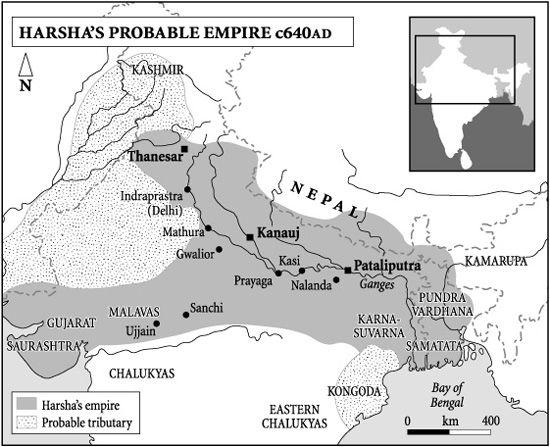
From his camp beside the Ganga, where Bana had left him basking in the prospect of bloody victories to come, Harsha seems to have continued east. Prayaga (Allahabad), Ayodhya, Sravasti, Magadha and a host of minor kingdoms in UP and Bihar, many of them previously under Sasanka’s sway, must have submitted before he sighted his quarry. According to a much later source, the great encounter with Sasanka of Gauda took place at Pundra in northern Bengal. Sasanka was apparently defeated, but not so decisively as to forfeit his kingdom, for he continued to rule Gauda itself and seems even to have reclaimed parts of Orissa and Magadha. Only after Sasanka’s death in c620–30 did Harsha successfully claim these kingdoms and apparently share them with his Assamese ally.
His other ‘campaigns’ and ‘conquests’ are no less vague. That he did indeed overrun all of north India from Kashmir to the Arabian Sea and the Bay of Bengal is well-attested. The Maitrakas of Vallabhi in far-off Gujarat were forced to flee their capital, Kashmir was obliged to part with a cherished relic of the Buddha, Sindh and Orissa look also to have been invaded. To reach these places, kingdoms which intervened or were adjacent to the probable line of march must also have submitted. Likewise those kingdoms which were subordinate to Harsha’s new vassals, including most of the Panjab hill states in the case of Kashmir. On this evidence, and on Hsuan Tsang’s failure to indicate that they were fully independent, numerous other kingdoms and tribes stretching from the eastern Panjab to Rajasthan and Madhya Pradesh are presumed to have formed part of Harsha’s empire. But whether he held all of them simultaneously, for how long, and on what terms is very uncertain. The Maitrakas of Saurashtra, for instance, soon returned to their capital of Vallabhi and, despite being united with Harsha’s family by a matrimonial alliance, seem to have pursued independent policies.
But perhaps the most persuasive argument for the ephemeral nature of Harsha’s empire rests on its sudden and total eclipse. An intimation of troubles ahead had been provided by Hsuan Tsang when he was witness to an attempt on Harsha’s life. Those responsible he identified as ‘heretics’, the Buddhist’s term for disaffected brahmans. Evidently by the seventh century not all religious rivalries were being resolved in friendly debate. Sasanka’s ‘vileness’ seems to have had a lot to do with his having allegedly harassed Buddhists and cut down the sacred Boddhi tree under which the Buddha received enlightenment. Elsewhere in arya-varta it was the other way round, with orthodox opinion being antagonised by Harsha’s growing preference for, and generosity to, the Buddhist sangha.
At a lavish ceremony organised by Harsha to celebrate his meeting with the king of Kamarupa, these dissidents attempted sabotage by setting fire to the tower in which the Buddha image was placed. Harsha, according to Hsuan Tsang, put out the flames not by blowing but, no less miraculously, by rushing headlong into them. Frustrated, the ‘heretic’ fanatics then persuaded one of their followers to make an attempt on Harsha’s life. The assassin lunged, knife in hand, but Harsha, still nimble on his feet despite advancing years, dodged the blow and then seized and disarmed his assailant. Hsuan Tsang makes much of the clemency later shown to those responsible. Only their leader was ‘punished’, which probably means that he was executed; the rest were pardoned. Nevertheless five hundred brahmans had to be packed off into exile. Obviously, if not a rebellion, this was much more than an intrigue.
How Harsha eventually died is not known. But when in 647 his long reign finally ended, so did his empire; it simply fell apart. No Chandra-Gupta II stepped forward to round off his conquests and no Ashoka arose to consolidate his dominions. Confederate kingdoms simply allowed their allegiance to lapse; subject dynasties simply resumed their old rivalries.
The throne itself was usurped by one of Harsha’s brahman ministers, who was then badly discredited by the mismanagement of a Chinese embassy. Harsha had cultivated good relations with the new T’ang empire and, thanks to his Buddhist sympathies and his generous treatment of visitors like Hsuan Tsang, several diplomatic missions had been exchanged. But, according to Chinese sources, a T’ang embassy which arrived immediately after his death found India in confusion. In what looks like an incident born more of sectarian than political rivalry, the Chinese were robbed and taken captive while the Celestial Emperor’s emissary barely escaped to Tibet with his life. Thence he organised reprisals which apparently culminated in a resounding Chinese victory, ‘whereupon India was overawed’.
Although there is no mention in Indian sources of this first trans-Himalayan incursion, and although it was probably no more than a raid into northern Bengal, it was indicative of the vacuum left by Harsha. Thanks to Bana, his personal fame would indeed last, and in that he also sponsored religious debate, championed scholarship, and himself wrote plays, he has often been compared with Akbar, greatest of the Mughals. But there would be no ‘House of Harsha’ to bestride India during succeeding generations, no ‘Vardhana Age’ to foster the memory of northern India’s last cakravartin, and no ‘Kanauj School’ to continue his patronage of Buddhist ‘universities’ like Nalanda (Bihar) and of scholars like Bana. The red-hot coals vomited so freely by the fiery Harsha were extinguished in a hiss of steam as the political monsoon finally broke over the arya-varta heartland of northern India.
ROUND AND ROUND THE MANDALA
It was not so elsewhere. Indeed there is ample evidence that the ideal of a universal, or pan-Indian, sovereignty simply shifted ground. With Harsha the hegemony so long assumed by northern India came to an end. Sixty years after his death, Arabs would establish a Muslim bridgehead in Sind, their task eased by his own incursions into that region. The north-west, or in other words most of what now comprises the rest of Pakistan, had been irrevocably humbled by the Huns and was now politically irrelevant. Into the Gangetic heartland itself, adventurous dynasts from Kashmir, Bengal and the Deccan were about to raid, indeed briefly rule, with impunity. And where Harsha had signally failed to make of the Gupta tradition of paramountcy any more than a fragile and fleeting confederacy, other great dynasties, especially those of the Deccan and the south, would so refine and substantiate the concept as to make it their own.
In the course of his wanderings round India, Hsuan Tsang traversed an area of the western Deccan which he calls ‘Mo-ho-la-ch’a’. The translation of proper names from Chinese back into Sanskrit often stretches credulity, but in this case there is little room for doubt: by ‘Mo-ho-la-ch’a’ Hsuan Tsang meant Maharashtra. This was the land either side of the Western Ghats, once the patrimony of the trading Shatavahanas whose cave temples pocked its rocky outcrops, then of the Vakatakas who so loyally served the Guptas, and nowadays more or less the modern state of Maharashtra centred on Bombay. Hsuan Tsang found the soil rich and fertile, which in parts it is; the people were honest but implacable, and they included ‘a band of champions’ who, when both they and their elephants were fired up on alcohol, proved irresistible in battle. ‘No enemy can stand before them,’ wrote the visitor, wherefore their king was able to ‘treat his neighbours with contempt’.10
The name of this contemptuous sovereign was given as ‘Pu-lo-ki-she’, otherwise Pulakesin II, and according to Hsuan Tsang his ambitions were extensive. At the time in question, c630, he was confidently defying even Harsha who, despite summoning all his troops plus the ablest commanders from his ‘five Indies’, and despite himself leading this horde in battle, had failed to impress Pulakesin II’s gladiators or to dent his roving ambitions.
Hsuan Tsang, and no doubt Harsha, saw this impasse as a stalemate; Pulakesin not unreasonably celebrated it as a victory. He belonged to a dynasty, the Chalukya, which because of its long-lasting consequence and numerous offshoots (whence it is often distinguished as the ‘Western Chalukya’) deserves special attention. The Chalukyas hailed from Karnataka to the south, and in the course of a couple of generations had soared to prominence at the expense of various neighbours, including the Kadambas, their erstwhile suzerains. Their capital, fortified by Pulakesin I, founder of the dynasty and the first to perform the horse-sacrifice (and also Pulakesin II’s grandfather), was situated at Vatapi, now Badami, a small town scrabbling up both sides of a cliff-stepped ravine in northern Karnataka.
There or thereabouts the Chalukyas would continue to celebrate their successes with a remarkable series of temples, at first cut into the rock but by the time of Pulakesin II already free-standing buildings. They were not the first structural temples, timber and brick having been used for such constructions since long before the time of Christ. Nor were they the first stone-built temples: at Sanchi, Nalanda, Buddh Gaya and several other sites in eastern Madhya Pradesh, UP and Bihar a dozen scattered temples from the Gupta period survive in various degrees of dilapidation or over-zealous restoration. But at Badami and its neighbouring sites (Aihole, Mahakuta and Pattadakal) the feast of architecture and sculpture heralds a new identity between dynasty and endowment in which temple-building becomes an expression and paradigm of a sovereign’s authority.
On one of these temples, a rather plain construction dedicated to a Jain saint at Aihole, the poet Ravikirti recorded Pulakesin II’s successes. Reminiscent of Samudra-Gupta’s great Allahabad inscription, this record has the bonus of a date, equivalent to 636 in the Christian calendar. It makes the shrine ‘one of the earliest dated temples in India’11 and, as noted earlier, has provided a benchmark for chronological calculations reaching back even to Manu and the Flood. Here too, in presumptuously comparing his literary talents with those of Kalidasa, Ravikirti provides the earliest dated reference to ‘Sanskrit’s Shakespeare’; whenever Kalidasa lived, he must have been well dead by 636.
Of more relevance to the Chalukyas is the detailed listing of Pulakesin II’s extensive conquests. Since he succeeded to the throne after a period of internal strife, he had first to consolidate his hold on the Badami region, his base, by again subduing the Kadambas, Gangas and other rival kings in Karnataka. It was probably after this feat that he assumed the titles of maharajadhiraja and paramesvara (‘lord of the others’). The west coast (Konkan) from Goa up to and beyond where Bombay now stands was also subjugated while several of its islands, probably including that of Elephanta, were assaulted by the Chalukyan navy. Further north the Malavas of Malwa and the Gurjaras of southern Rajasthan submitted; and a Chalukyan viceroyalty was established in Gujarat. Clearly Chalukyan forces had crossed both the Tapti and Narmada rivers and were therefore threatening Harsha and his confederates.
Next in the Aihole listing comes Harsha himself. His stature is acknowledged in a well-worn cliché about his lotus feet gleaming with the jewels of those who bowed to his sway. But in identifying this formidable challenger the poet also introduces a neat pun on the word harsa (‘harsha’). Harsa as a noun means ‘joy’, and thus Pulakesin’s victory is signified by a phrase about how ‘the harsa [of his enemy] was melted away by fear’. Another source has it simply that the lord of the Daksinapatha (the ‘South’) routed the Lord of the Uttarapatha (the ‘North’).
Pulakesin’s circuit of conquest then continued east, flattening more rivals and reaching the Bay of Bengal in Orissa. Most of the rich lands comprising the Kistna and Godavari deltas in what is now Andhra Pradesh were placed in the care of his younger brother, whose descendants would constitute the ‘Eastern Chalukyas’, a dynasty which would survive until the eleventh century when it merged with its Chola allies of Tamil Nadu. From Vengi, as the Eastern Chalukya kingdom would be called, Pulakesin II resumed his victorious progress down the east coast into Pallava territory. Again his champions and their punch-drunk elephants triumphed as the Pallava king was forced to seek safety within the walls of Kanchipuram. There, unwisely in view of the sequel, Pulakesin left the Pallava and continued south. He crossed the Kaveri and completed his circuit by accepting overtures of friendship from the ancient kingdoms of the extreme south – the Cholas of the Kaveri delta, the Pandyas of Madurai and the Cheras of the Kerala coast.
Now ‘lord of both the eastern and the western seas’ and indisputably master of all India south of the Vindhya hills, Pulakesin II returned to Badami. Hsuan Tsang calls him a ksatriya yet credits him with magnanimity and foresight, qualities rarely accorded to a ‘heretic’ by the devout Buddhist, let alone to an enemy of his beloved Harsha. He is not mentioned in any other Chinese sources but some authorities insist that an Indian mission received by Khusru II of Persia in 625 must have been from the Chalukyan king.
However far-flung his fame, Pulakesin II’s manoeuvres as listed in the Aihole inscription are of great interest as an illustration of the theory of Indian paramountcy. The assumption is usually made that his triumphs, like those of Samudra-Gupta as recorded on the Allahabad pillar, are organised in chronological sequence. It cannot be proved; but what here is self-evident is that, whether chronological or not, they were certainly logical. Pulakesin was doing the rounds of his neighbours. South, west, north, east, and back to the south, the Chalukyan was circling – or was seen to be circling – a universe of territory, riding its bounds as it were just like Raghu in Kalidasa’s Raghu-vamsa. Both kings were, in Indian terms, defining a raja-mandala, the diagram of concentric ‘circles of kings’ which is discussed at length in Kautilya’s Arthasastra and other works on political theory.
In Indian cosmology the mandala design commonly serves as a map. At the centre is the sacred Mount Meru, the axis of the world, outside which the innermost circle is divided into four lands (dvipa); one of these four, jambu-dvipa (‘ the land of the rose-apple’), is the earth. Outside this, the next circle is the sea, the next more land, then more sea and so on. The seas are filled with, or named after, familiar liquids – obviously salt-water in the case of the first, then treacle, wine, butter and other kitchen ingredients. To literal minds, like that of Thomas Babington Macaulay, minds which had been schooled on the scientific certainties and rational arguments of the European Enlightenment, these ‘seas of treacle and butter’ would seem contemptible absurdities; India’s only hope of advancement lay in forsaking such nonsense, and to this end Macaulay, in a famous minute on Indian education in the 1830s, would issue a damning and still resented indictment of Indian culture as he insisted that India’s schools forsake Sanskrit and adopt a Western-style curriculum.
A no less exasperated attitude is detectable in many nineteenth-century attempts to reconstruct India’s history. From inscriptions and sasana the flowery epithets about lotus-footed ancestors and star-bright toenails were ruthlessly discarded in an effort to extract some credible nugget of political or genealogical import. The raja-mandala as a useful symbol of political relations suffered the same fate. Crudely, it represented the idea that just as cosmic harmony depended on the hierarchy of gods and men actively participating in the triumph of dharma, so political harmony depended on the triumph of dharma through an ordered hierarchy of kings. But because this earthly hierarchy was constantly under threat from the matsya-nyaya (the ‘big fish eats little fish’ syndrome), it required frequent adjustments.
The raja-mandala, in which the maharajadhiraja took the place of Mount Meru at the centre or axis, demonstrated the basic principle of these adjustments. Thus the immediate neighbours of the axial ‘king of kings’, those therefore within the first circle, are to be regarded as his natural enemies; those beyond them in the next circle are his potential allies; those in the third circle are his enemies’ potential allies, those in the fourth his allies’ natural allies, and so on. According to Kautilya, this was the basis of all external relations and of any world order.
Additionally the raja-mandala, when represented as a diagram, was divided by vertical and horizontal radials into four quadrants or quarters. These were seen to correspond to the four dwipa, or lands, of a mandala map. Harsha’s digvijaya, or ‘conquest of the four quarters’, was therefore a bid for universal dominion. In the same way the maharajadhiraja who would be a cakravartin, a ‘wheel-turning’ world-ruler, must as it were weld the rims to the hub by spokes of conquest and alliance and so oblige the kings within each circle of the mandala-raja to acquiesce in and harmonise with his new and, of course, self-centring world order.
This geography, indeed geometry, of empire was crucial. It presupposed that ‘society of kings’ already mentioned and it necessitated frequent or, in the case of Harsha and Pulakesin, almost continual perambulation of one’s domains. But it also made conflict a largely dynastic affair which, though of great frequency, may have been of low intensity. The troops involved seem to have been professional warriors who, while dependent on local supplies and transport, otherwise left the agricultural classes alone, as in Megasthenes’ day. Acts symbolic of submission were highly prized; so was the acquisition of accumulated wealth, war elephants, musical instruments, jewels and other symbols of sovereignty. On the other hand the heavy casualties and widespread devastation implied by boasts of ‘annihilation’ cannot be substantiated, nor is there evidence of any consequent economic collapse. On the contrary, the ease with which ‘uprooted’ kings again took root suggests an almost ritualised form of warfare not unlike that which survived, even into the twentieth century, amongst another society of Hindu kings – namely that on the Indonesian island of Bali.
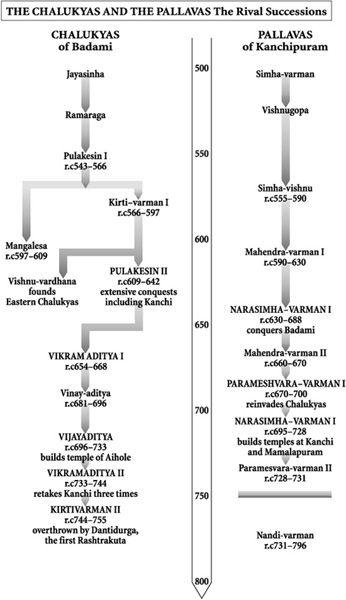
Back in the south India of the seventh century, while Pulakesin II was still celebrating his success in overrunning the rich Pallava country in Tamil Nadu, the Pallava king was ready to take the field again. At Polilur, a place near Kanchipuram where the British would suffer one of their worst defeats in India, the Pallava king claims to have ‘annihilated his enemies’, presumably the Chalukyas, and by 642 he was marching on their capital at Badami. Pallava records claim that Badami was then destroyed and that the Pallava king, Narasimha-varman I, made such a habit of defeating the great Pulakesin II that he fancied he could read the word ‘victory’ engraved on his adversary’s backside as he again took to flight. More certainly Narasimha-varman engraved a record of his success on a rock at Badami and thereafter assumed the title of Vatapi-konda, ‘conqueror of Vatapi [i.e. Badami]’.
The Chalukyas would return the compliment. Pulakesin seems to have died in the midst of these reverses and the Chalukyan kingdom to have remained in relapse during a succession crisis. But in 655 one of Pulakesin’s sons, Vikramaditya I, claimed the throne, quickly reasserted Chalukyan sovereignty, and was soon hammering again at the Pallavas. This time Kanchi was surrendered. Then once again the Pallavas struck back. With intermissions while the Pallavas dealt with the Pandyas of Madurai to the south or went to the aid of their allies in Sri Lanka, and while the Chalukyas saw off their own rivals, including the first Arab incursion into Gujarat, the ding-dong struggle between the paramount powers of the arid Deccan and lush Tamil coast continued for over a century. Not infrequently it well demonstrated the Kautilyan raja-mandala. The Pandyas, the southern neighbours and so natural enemies of the Pallavas, assisted the Chalukyas, while the Pandyas’ neighbours and natural enemies, the Cheras of Kerala and the kings of Sri Lanka, rendered support to the Pallavas.
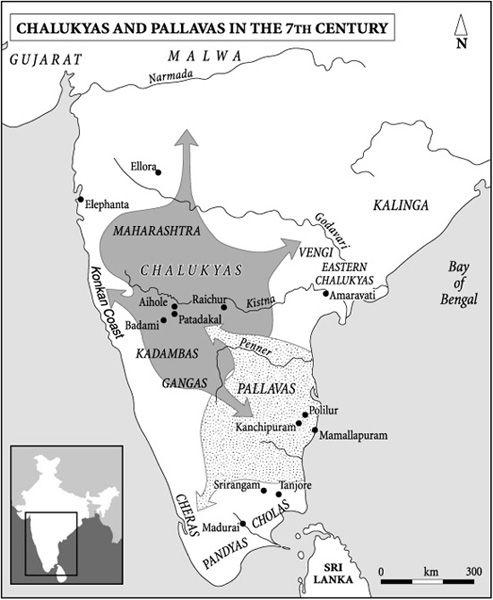
In c740 Vikramaditya II, a Chalukya, again captured Kanchi and this time took the opportunity to leave a record of his success. His inscription in the soft sandstone of one of the pillars of the Pallavas’ just-built Kailasanatha temple is still legible and boasts not only of his conquest but also of his generosity to the city, which he spared, and to the temple, to which he returned the gold that belonged to it. Significantly, as with the Pallava inscription at Badami, no attempt seems to have been made to erase this patronising record when the Pallavas duly recovered their capital.
Nor does this almost constant warfare with its frequent ‘annihilations’ seem to have inhibited either dynasty in the practice of kingship. The sasanas, from which our knowledge of their struggles is largely derived, continued to be issued; and the great temples, for which both dynasties are now best remembered, continued to be built. Narasimha-varman I, Pulakesin II’s eventual conqueror, was also known as Mahamalla or Mamalla (‘great wrestler’), and after him the Pallavas’ main port at Mamallapuram (Mahabalipuram) was named. There the famous stone-cut temples, or raths, each hewn from a single giant stone, were probably the work of Narasimha-varman II (also known as Rajasimha), who ‘assumed titles galore – about 250 of them’12 – and reigned from c695-c728. He also built the so-called Shore temple at Mamallapuram, and began the Kailasanatha at Kanchi.
His Chalukya contemporary was Vijayaditya, the grandson of Vikramaditya I and another man of many titles and many temples; most of the structures at Aihole belong to his reign. He also began, but never completed, the first temple at Pattadakal. A level site lying between the twin towns of Badami and Aihole, Pattadakal would under his successors usurp the ceremonial role of both places as the commemorative capital of the Chalukyas. Here during the first half of the eighth century the Chalukyan temples assumed a size and magnificence of ornamentation unsurpassed by anything in contemporary India and rivalled only by the temples of Kanchi. But whereas today the latter are scattered about a large city richly endowed with later architecture, at Pattadakal, always a site rather than a city, the temples now rear up amongst soggy fields of sugarcane where a mud village and a milky cup of tea is the height of modern magnificence.
Two of these temples, parked side by side like vehicles from another planet, were commissioned by two sisters who were the successive wives of Vikramaditya II, he who left his mark on Kanchi’s Kailasanatha temple. Celebrating this victory, the sisters’ twin temples closely resemble the Kailasanatha and so are indisputably of the so-called Dravida style (which climaxes with the great eleventh-century Chola temple of Tanjore). Others, however, both here and at Aihole, show features like the curvilinear sikhara(tower) which are distinctive of what used to be called the Nagara or northern style of temple (as famously represented by the later Khajuraho temples). There are also examples of the straight-sided pyramidal style of tower later associated with the Orissan temples, especially of Bhuvaneshwar. It seems unlikely that, as once thought, all these variations were developed by the Chalukyas’ architects. Sculpture and iconography show Gupta influences and imply rather that the far-ranging Chalukyas, in their architecture as in their empire, made of the great Deccan divide a bridge between north and south.
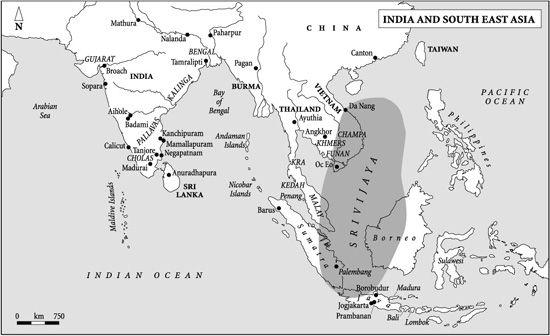
Culturally their Pallava rivals look to have performed the same bridging role between the Indian subcontinent and the Indic kingdoms of south-east Asia. No region or dynasty of India had a monopoly of south-east Asian contacts. We know that Bengal had regular contacts with both mainland south-east Asia and its archipelago; Fa Hian sailed for Indonesia or Malaya from the Bengali port of Tamralipti, and many Chinese and south-east Asian Buddhists reached the great university of Nalanda in Bihar via the same port. Orissan influences have also been traced in Burma and the Indies; failing any better explanation, it is quite possible that ‘Kling’, the name by which people of Indian origin are still known in Sumatra and parts of Malaysia, derives from ‘Kalinga’, the ancient Orissan kingdom. Likewise Kerala and Gujarat seem to have had regular contacts with south-east Asia, which with the entry of the Arabs into the carrying trade of the Indian Ocean would be greatly increased.
However, the most pervasive influence in south-east Asia during the fifth to seventh centuries seems to have been that exercised by the Pallavas of Kanchi. In mainland south-east Asia an important new kingdom had begun to emerge in the sixth century. Based in Cambodia, it would soon absorb Funan, the Indic kingdom on the lower Mekong from which it had probably broken away, and would eventually emerge as the great Khmer kingdom of Angkor. Its kings, like many of those of Funan and Champa (another Indic state in Vietnam), almost always bore names ending in ‘-varman’, just like the Pallavas. More significantly, they claimed descent from the union of a local princess with a certain Kambu whose descendants were known as ‘Kambujas’.
From this word came ‘Cambodia’ and ‘Khmer’. But the Kambujas, as both a people and a place, first occur in the epics and the Puranas where they are located in the extreme north-west of the Indian subcontinent, a good three thousand kilometres from Cambodia. It has already been suggested that the sacred geography of the Sanskrit classics tended to get replicated as new regions became Sanskritised (e.g. Mathura, Madurai, and Madura in Indonesia). Kambuja’s improbable removal from the upper Indus to the lower Mekong looks to be another case in point. Moreover the adoption of Kambu as a common ancestor would seem to show how such transpositions might have come about, with kings as far away as Indo-China laying claim to the legitimacy provided by an adopted Sanskritic forebear. But what is also significant is that this particular myth seems to have been a revision of the story of the brahman Kaundinya and ‘Willow-Leaf’, his ill-clad local queen. And that in its turn ‘shows a certain kinship with the genealogical myth of the Pallavas of Kanchi’,13 indeed ‘is strikingly similar’ to it.14
Indo-China apart, the Pallavas are known to have become involved in dynastic struggles in Sri Lanka, to have developed Mamallapuram as a long-distance trading station, and to have had diplomatic relations with China. No doubt commercial, religious and political factors all played their part in promoting a more direct, if still conjectural, Pallavan influence in the south-east Asian archipelago. An inscription found in Java uses the Pallava script and that island’s earliest surviving Hindu temples, small stone-built shrines scattered across the misty highlands of Dieng and Gedong Songo, show clear affinities with the architecture of Mamallapuram.
In Indonesia as in Indo-China important political developments were under way. The eighth century saw the emergence from obscurity of Srivijaya, a maritime power and possibly a dynasty, which would control a seaborne empire stretching from Sumatra to Malaya, Thailand, Cambodia and Vietnam. In terms of national psyche the watery imperium of Srivijaya is as important to modern Indonesia, itself ‘a pelagic state’, as is the continental empire of the Mauryas to Indian centralists. Like Champa and Cambodia, Srivijaya was nevertheless a decidedly Indianised polity, although apparently more Buddhist than brahmanical. Its capital, near Palembang in south-eastern Sumatra, looks to have been the place where in the late seventh century I-tsing (I-ching), another Chinese scholar, found a thriving monastic community. From its monks he received preliminary instruction before proceeding on to Bengal and Nalanda. Returning, he lived with the Srivijayan Buddhists for several years as he worked on the translation of texts acquired in India.
Also in the seventh and eighth centuries there arose in central Java the rival, but eventually joint, kingdoms of the Sailendra and Sanjaya. The origins of these dynasties and their relationship with Srivijaya, let alone India, are subjects of much debate; but to one or both of them must be ascribed the first glorious phase of Javanese temple-building which began c780. As in the Deccan and south India, the temples are all clustered within a small compass, here centred on the city of Jogjakarta. Moreover many conform in all but detail to the norms of layout and elevation found at the Pallavan and Chalukyan sites.
The one glowering exception is the sculptural colossus of Borobudur, much the most outstanding if enigmatic example of Indian cultural transference in south-east Asia. As a stepped stupa of unprecedented proportions, possible prototypes for it have been inferred from the descriptions offered by Hsuan Tsang of now vanished north Indian stupas and from archaeological evidence of massive ruins and plinths at sites like Nandangarh and Paharpur in Bengal. On the other hand, if the stupa was originally a hill which was then cut into terraces and clad with stone, local parallels with the elaborately terraced landscape of Java and its pre-Indic mountain deities may be more relevant.
The archaeology of the building does nothing to resolve these contradictions. Apparently begun about 775, it only assumed its final shape in 840, by which time it had been frequently redesigned and even reinterpreted. ‘The monument was built in at least four different stages … it was probably begun as a Hindu temple, and was transformed into a Buddhist place of worship after its second stage.’15 However this may be, there is universal consensus that the ground-plan of Borobudur, both as originally conceived and as finally realised, represents a classic mandala. Its four sides, each about as long as the touchline of a football pitch, are progressively indented so as to round, as it were, the corners, and render the four-square outline as near circular as rectangular masonry will allow. Succeeding tiers, the inner circles on the ground plan, follow the same pattern until the three topmost, or innermost, are in fact circular. Moreover each tier is accessible only by flights of steps located in the middle of each side and which, connecting, divide the monument into four quadrants.
A similar design can be detected in the base-plan of contemporary temples, as opposed to stupas, in both Java and India. Elevations add a further important dimension to this symbolism, as will appear from the soaring ambitions of the Chalukyas’ successors in the Deccan. Here it will suffice to note that building temples had now become a royal prerogative. All, except subsidiary shrines, were in part intended as expressions of royal paramountcy designed to impress subjects, remind vassals, and challenge rivals.
Hence ‘the construction of a temple, Buddhist or Hindu, was an important political act,’16 indeed ‘as much an act of war as it was an act of peace’.17 It could, though, be misconstrued. As new Islamic challengers ventured across the deserts of Sind and over the Hindu Kush, India’s dynasties appeared to be woefully indifferent as they lavished all available resources not on forts and horsemen but on flights of architectural fantasy. In fact they were meeting the new threat by a gloriously defiant assertion of self-belief in their superior sovereignty.