
FRIENDS, RAJPUTS AND CONQUERORS
THE WORD ‘RAJPUT’ (raja-putera) simply means ‘son of a raja’. Although it therefore implied ksatriya status and eventually came to mean just that, someone of ksatriya caste, it originally had no particular ethnic or regional connotations. To those ex-feudatories of the Gurjara-Pratihara kings of Kanauj to whom the term is so freely applied, and to other Indian opponents of Islam to whom it was occasionally extended, it was probably meaningless other than as one of many hackneyed, and usually much more grandiloquent, honorifics. Not until the Mughal period did the word come to be used of a particular class or tribe and, given the prejudices of Aurangzeb’s reign, its connotation soon became decidedly pejorative: ‘Rashboots’, as they sometimes appeared in English translation, were freebooters and trouble-makers, ‘a sort of Highway men, or Tories’ according to a seven-teenth-century travelogue by the German Albert de Mandelso.1 Always ‘gentiles’ (the contemporary designation for Hindus), they were encountered mainly in Gujarat and Rajasthan and were usually under arms, soldiering being their hereditary profession.
Colonel James Tod, who as the first British official to visit Rajasthan spent most of the 1820s exploring its political potential, formed a very different idea of the ‘Rashboots’. Not only was it his boast that ‘in a Rajpoot I always recognise a friend,’ but seemingly in a friend he always recognised a rajput. Their hospitality to one who was offering acknowledgement of their sovereignty plus protection from the then devastating attentions of the Marathas was overwhelming. Tod found rajputs all over Rajasthan; and the whole region thenceforth became, for the British, ‘Rajputana’. The word even achieved a retrospective authenticity when, in an 1829 translation of Ferishta’s history of early Islamic India, John Briggs discarded the phrase ‘Indian princes’, as rendered in Dow’s earlier version, and substituted ‘Rajpoot princes’. As Briggs freely admitted, he was ‘much indebted for the unreserved communications on all points connected with the history of Rajpootana … to my good friend Colonel Tod’.2
Nor, according to Tod, were these ubiquitous ‘Rajpoots’ outlaws – or even Tories. They were sovereign chiefs and princes, scions of a noble race amongst whom, opined Tod, ‘we may search for the germs of the constitutions of European states’. Although perjured and persecuted during centuries of Islamic supremacy, they were in fact the native aristocracy of India, an indomitable people whose ethnic origins could be traced back to a common ancestry with the earliest tribes of Europe and whose genealogies as recorded in the Puranas reached back to the epics and the Vedas.
Thanks to the rajputs’ naturally generous disposition and to the assistance of their royal archivists and bards, Tod had been privileged to attempt a reconstruction of their history; and what a glorious tale it was. In his majestic Annals and Antiquities of Rajast’han, published in 1829, he regaled his readers with examples of a chivalry to shame Camelot and of a resolve worthy of Canute. Frequent references to the rajputs’ clan organisation and aristocratic sense of noblesse oblige went down especially well with an audience steeped in British history; and in the feudal structure of rajput society Tod thought he saw an exact equivalent of that which had pertained nearer to home in Anglo-Norman times. For ‘the martial system peculiar to these Rajpoot states’ invariably and specifically made vassalage and land grants contingent on military service and the provision of fighting men.
Admittedly, for the rajput knights themselves feudalism seemed less about tenurial feus and more about the interminable feuds to which they often gave rise. Rivalry between the various rajput houses was intense and disastrous.
The closest attention to their history proves beyond contradiction that they were never capable of uniting, even for their own preservation: a breath, a scurrilous stanza of a bard, has severed their closest confederacies. No national head exists amongst them … and each chief being master of his own house and followers, they are individually too weak to cause us [i.e. the British] any alarm.3
They had, nevertheless, shown a bold front in the face of Muslim aggression. And for whatever that defiance had lacked in the way of coherence, they had amply compensated with a stalwart perseverance unequalled in the annals of mankind.
In support of this contention Tod adduced a litany of patriotic heroes and tales of martial romance from the twelfth to eighteenth centuries. The earliest was ‘the heroic history of Pirthi-raj by Chund’, a particularly instructive saga to which he devoted considerable space. For ‘Pirthi-raj’ was otherwise Prithviraj III of the Chahamana (Chauhan) dynasty, who ruled an extensive kingdom in northern Rajasthan and the eastern Panjab from c1177. It was he therefore whose territory marched with that of the Ghaznavids at Lahore and, when that city fell to Muhammad of Ghor in 1186, it was he who stood between the Ghorid kingdom and the rest of India. Tod was wrong in imagining that the bard ‘Chund’ was a contemporary eye-witness, let alone ‘his [i.e. Prithviraj’s] friend, his herald, his ambassador’. He was therefore mistaken in taking Chand’s ‘poetical histories’ as reliable evidence. But in rehabilitating Prithviraj, as also the ksatriya dynasties of Rajasthan whom he had so determinedly designated as ‘Rajpoots’, Tod did both history and Indian nationalism a useful service.
The Chahamanas, like the Pratiharas and Bhoj’s Paramaras, claimed (or would eventually claim) to have acquired their ksatriya status from the great fire-sacrifice once held on Mount Abu. More prosaically they look to have been a desert tribe from the region around lake Sambhar, west of modern Jaipur, who over the centuries, like countless other peoples in out-of-the-way places, had undergone a long process of ‘Aryanisation’. Hemachandra Ray’s Dynastic History of Northern India lists no fewer than eight Chahamana families of princely standing, one of which, the Sakambhari (i.e. Sambhar) branch, remained on home ground in the vicinity of lakes Sambhar and Pushkar. Inducted into the Gurjara-Pratihara empire by marriage, they had eventually broken away and, early in the twelfth century, one King Ajaya-raja established a new capital. He called it ‘Ajaya-meru’, or Ajmer.
In the mid-twelfth century Vigraha-raja, one of Ajaya-raja’s successors, greatly extended the dynasty’s sway by pushing northwards into what is now Haryana and what remained outside Ghaznavid rule of the eastern Panjab. Delhi, too, fell to Vigraha-raja, and to record this brilliant campaign he added his own inscriptions to those of Ashoka on one of the latter’s still-standing pillars. By a strange coincidence the pillar he chose was the one, then located higher up the Jamuna, which two centuries later would be so laboriously shipped downriver for re-erection in Delhi. There, fortuitously relocated in the heart of the city to which he had laid claim, it records Vigraha-raja’s conquest of the whole region up to the Himalayas and also mentions frequent exterminations of themlechhas, presumably a reference to conflicts with the declining Ghaznavids. Another inscription speaks of his having thereby made arya-varta ‘once more the abode of the arya’.
Vigraha-raja died c1165. The Chahamana succession then became convoluted until Prithviraj III ascended the throne of Ajmer twelve years later. Evidently a minor at the time, he seems to have celebrated his coming of age by eloping with the daughter of the king of Kanauj. This much-loved romance is told in some detail by the unreliable Chand. On the other hand the young Lochinvar’s ambitious digvijaya of c1182 is shrouded in uncertainty. It seems to have brought him into conflict with, amongst others, the Chandelas and their allies and also the Solanki rajputs of Gujarat. In all such encounters he is said to have fared well and, according to another popular narrative of the period, he waxed strong enough to vow next to extirpate his mlechha neighbours in the Panjab.
In this he was emboldened by the decline of the Ghaznavids and the rather unimpressive showing so far made by Muhammad of Ghor. From Ghazni the Ghorid had first turned his attentions to Sind, routing the restored Ismaili ruler of Multan and eventually pushing down the Indus to Mansurah and Debal. He had thence attempted to attack the Solankis of Gujarat by crossing the Thar desert in imitation of Mahmud’s raid on Somnath. He even invited the young Prithviraj to support him in this venture. Prithviraj declined and briefly considered joining his Solanki rival to eject the Turuskas. But in the event this proved unnecessary, for the Ghorids were roundly defeated in Gujarat. Muhammad thereupon abandoned the idea of a trans-Thar invasion and directed his attention north-east to Lahore. Having secured that place in 1186–7, he was ready to meet Prithviraj’s challenge. Along a Panjabi frontier not dissimilar to today’s Indo–Pakistan border, ‘the Ghorid and the Chahamana now stood face to face. The Muslim knew that the wealth of the rich cities and temples in the Jamuna-Ganga valley and beyond could only be secured by the destruction of the Hindu power which held the key to the Delhi gate.’4
Twentieth-century parallels with a situation in which Sind and Gujarat lay divided from one another by religion, and the Panjab in effect partitioned between Muslim and Hindu rulers, are hard to overlook. Pakistanis may take comfort from the fact that this division had already subsisted for nearly two hundred years in the case of the Panjab and for over four hundred in the case of Sind/Gujarat. Indians, on the other hand, take little note of the chronology and more of the outcome.
It should, though, be emphasised that during this long political stand-off there were contacts of an informal nature. Apart from commercial links, which continued much as under the Balhara’s even-handed patronage, Muslim immigrants and missionaries seem to have enjoyed the freedom of north India much as Hindus did that of Sind and the Panjab. Writing of the Varanasi region, Ibn Asir, a contemporary scholar, insists that ‘there were Mussalmans in that country since the days of Mahmud bin Sabuktigin [i.e. Mahmud of Ghazni], who continued faithful to the law of Islam, and constant in prayer and good work.’5 Numerous other examples of pre-Ghorid Muslim communities in India have been noticed;6 and so has the existence of a Turuska tax. This could have been a levy to meet tribute demands from the Ghaznavids, but seems more probably to have been a poll-tax on Muslims resident in India and so a Hindu equivalent of the Muslim jizya. But perhaps the most striking evidence of pre-Ghorid Muslim communities comes from Ajmer itself. There, if later tradition is to be believed, Shaikh Muin-ud-din Chishti founded the most famous of India’s Sufi movements in the months immediately preceding Muhammad of Ghor’s assault, and so under the very nose of Prithviraj III.
To what extent religion was uppermost in the mind of either Prithviraj or Muhammad of Ghor when first they met is therefore debatable. In 1191 Muhammad took the offensive by storming a fort in the Panjab which is thought to have been either that of Sirhind near Patiala or of Bhatinda near the current Indo–Pakistan frontier. The fort was taken; but Prithviraj hastened to its rescue and, at a place called Tarain near Thanesar (about 150 kilometres north of Delhi), he was intercepted by the main Ghorid army.
The ensuing battle is described as having been decided by a personal contest between Muhammad of Ghor and Govinda-raja of Delhi, who was Prithviraj’s vassal. Govinda lost his front teeth to the Ghorid’s lance but then took fearful revenge with a spear that struck the latter’s upper arm. Barely able to keep his seat, Muhammad was saved by ‘a lion-hearted warrior, a Khalji stripling’ who leapt up behind him in the saddle and piloted him from the battlefield. Seeing this, many of Muhammad’s troops feared the worst; they believed their leader to be dead and so broke off the encounter. Had the Chahamana forces taken advantage of the situation, it might have become a rout. But Prithviraj, fresh from the ritualistic manoeuvres of a conventional digvijaya, mistook retreat for an admission of defeat. Ignorant of the advice once given by ‘Bhimpal’, it was as though he rejoiced over the capture of a hill and bothered not with the rest of the range. The Muslim forces were allowed to withdraw in good order. Prithvi-raj then ordered his army forward to a laborious siege of the Sirhind/Bhatinda fort.
Muhammad withdrew to Ghazni to convalesce and assemble more troops. The Ghorid forces included Afghans, Persians and Arabs, but the most numerous and effective contingents were of Turkic stock. Meanwhile those who had fled the field at Tarain were obliged to don their horses’ nosebags and tread the thoroughfares of Ghazni munching on grain. By mid-1192 Muhammad was back in the Panjab at the head of 120,000 horse and with an uncompromising ultimatum for the king of Ajmer: apostasise or fight. Prithviraj returned ‘a haughty answer’: he would not capitulate nor would he embrace Islam but, if Muhammad was having second thoughts, he was willing to consider a truce.
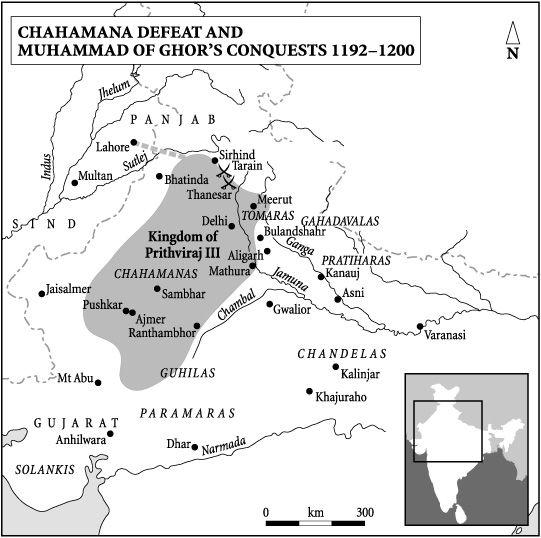
Endearingly susceptible to the perquisites of power, Prithviraj is said to have been enjoying himself since his earlier victory. He was still in his mid-twenties and, returning now to the fortunate field of Tarain at the head of an army said to have comprised 300,000 horse, he was in an even better position to dispose of the Ghorid challenge. If Ferishta was right about his 150 royal vassals – and translator Briggs about their being ‘Rajpoot princes’ – he headed the most formidable rajput confederacy on record. Tod, despite his insistence on the rajputs’ chronic disunity, seems to agree: ‘Pirthi-raj’ was now ‘the ruler of Rajasthan’; and amongst those ‘Rajpoot princes’ who supposedly flocked to his standard was Tod’s particular hero, the Guhila ruler of distant Mewar (later capital Udaipur) in southern Rajasthan.
From Ferishta’s much later and, it must be said, suspiciously detailed account there also comes evidence of trickery. Muhammad allegedly responded to Prithviraj’s suggestion of a truce with a letter couched in terms sufficiently ambiguous to give the Indians cause for celebration. ‘The letter produced the intended effect; for the enemy, conceiving that Muhammad was intimidated, spent the night in riot and revelry, while he was preparing to surprise them.’ When they awoke, late and in urgent need of ablutions, they found the Ghorid forces already entering their lines. The battle thus began amidst some confusion. Only Muhammad had a plan: like the great Mahmud he would launch wave after wave of mounted archers, but not try to force the Indian position, and in fact withdraw as the Indians’ elephant-phalanx advanced. Prithviraj, happy with this apparent success, duly advanced. But the buffeting assaults of the Turkish horse took their toll of the all-night revellers; sore rajput heads began to droop, and the scent of morning victory soured as the day wore on. By sunset Muhammad was ready to strike back.
Thinking he had sufficiently worn out the enemy and deluded them with a hope of victory, he put himself at the head of twelve thousand of his best horse, whose riders were covered with steel armour, and making one desperate charge, carried death and destruction through the Hindu ranks. The disorder increased everywhere until at length the panic became general. The Muslims, as if they only now began to be in earnest, committed such havoc that this [Prithviraj’s] prodigious army, once shaken, like a great building tottered to its fall and was lost in its ruins.7
Govinda-raja of Delhi, the hero of the first battle at Tarain, was slain; his body was recognised by its missing teeth. Slain too was the Guhila king Samatasimha, Tod’s ‘Ulysses of the Rajpoot host’. In all 100,000 are said to have been sent to their death. Prithviraj was taken prisoner and would soon join them.
The 1192 rout of the rajputs at Tarain is arguably the most decisive battle in the history of India. Prithviraj had succeeded in uniting at least some of the rajput princes and in cordoning off the Islamised Panjab. The blood-and-plunder raids had been stopped. But this interdiction had served only to increase the pressure for a more decisive encounter. The Ghorids rose to the challenge because for them, as for their Indian contemporaries, plunder was a necessity.
Prithviraj had upped the stakes, and he paid the price. When the Chahamana army succumbed, it became painfully clear that his earlier successes had only made his eventual failure all the more catastrophic. The ‘key to the Delhi gate’, indeed to the whole ofarya-varta, now belonged to Muhammad of Ghor and his victorious Turks.
Scenes of devastation, plunder, and massacre commenced, which lasted through the ages; during which nearly all that was sacred in religion or celebrated in art was destroyed by these ruthless and barbarous invaders.
Colonel Tod could have been writing of the fall of the Roman empire. Fresh from the study of Edward Gibbon’s epic, he relished another apocalypse and saw the decline and fall of Hindu empire as a history which was there for the telling. Not beset by niggling scruples about impartiality, he conjured up the heroes of his choice in a language rich in the exaggeration typical of their bardic traditions. His verdict on the years that followed, like his estimate of the ‘Rajpoots’ themselves, would enjoy a long if controversial currency.
The noble Rajpoot, with a spirit of constancy and enduring courage, seized every opportunity to turn upon his oppressor. By his perseverance and valour he wore out entire dynasties of foes, alternately yielding to his fate or restricting the circle of conquest. Every road in Rajast’han was moistened with torrents of blood of the spoiled and the spoiler. But all to no avail; fresh supplies were ever pouring in, and dynasty succeeded dynasty, heir to the same remorseless feeling which sanctified murder, legalised spoliation, and deified destruction. In these desperate conflicts entire tribes were swept away, whose names are the only memento of their former existence and celebrity. What nation on earth could have maintained the semblance of civilisation, the spirit or the customs of their forefathers, during so many centuries of overwhelming oppression, but one of such singular character as the Rajpoot?8
THE SLAVE KINGS
Within a year of the victory at Tarain, Muhammad of Ghor’s forces had taken Delhi, plus Meerut, Kol (Aligarh) and Baran (Bulandshahr), commanding the upper Ganga-Jamuna Doab. Ajmer was also under Ghorid control, and within another three years much ofarya-varta shared its fate. Of the three great natural fortresses screening Rajasthan and the routes south, Ranthambhor had been won, Gwalior assailed and Narwar targeted. To the east, after another decisive battle, Kanauj, Asni and Varanasi on the Ganga had also been overrun; and in the south-west, following victory at Mount Abu over a western rajput combination, the Gujarati capital of Anhilwara (Patan) had been sacked. The thirteenth century opened with even more sensational conquests as Muslim forces pushed further east into Bihar, Bengal and Assam; others moved into the Chandela country south of the Ganga and captured, amongst many, the stronghold of Kalinjar. On paper the Ghorid empire in India already exceeded that of Harsha.
Given, however, their predatory imperative, many of these conquests were temporary. Ajmer and Ranthambhor, for instance, changed hands several times; Gwalior and Kalinjar were lost shortly after they were won; Anhilwara was evacuated as soon as it was sacked. In some cases existing rulers were reinstated but then renounced their submission once the Turuskas had departed or further support had been recruited. In other instances, most notably in Bengal, the victorious Turuska generals would soon themselves renounce their allegiance to Delhi. It would be a characteristic of the Muslim advance that most major cities and forts were taken and then retaken, sometimes four or five times, before their fate was finally decided.
Nor can many of these early successes be attributed to Muhammad of Ghor himself. Soon after the second battle of Tarain he returned to Ghazni and, although he paid subsequent visits to India, it was the more pressing affairs of central Asia which commanded his attention. There, at the instigation of the Baghdad caliph, the Ghorids had by 1201 won another empire. Like that of the Ghaznavids it reached west to the Caspian, and as before, the wide-open spaces of Khorasan were soon proving harder to hold than to win. Within a matter of months the Ghorids had been ejected by the Turkic rulers of Khwarasm, or Khiva (on the lower Oxus), who were themselves soon to be ejected by an even more formidable horde, alien and infidel to boot, under Ghenghiz Khan.
Reeling from the heftiest of defeats in north-west Afghanistan, Muham-mad found Ghor itself in danger and his lines of communication from Ghazni to Lahore under threat from a Panjabi hill-tribe known as the Ghakkars. By 1206 he had suppressed this revolt, but during a dark and sultry night a party of vengeful Ghakkars somehow penetrated his camp on the banks of the Jhelum and ‘sheathed their daggers in the King’s body’. ‘Thus fell Sultan Moyiz-ood-Deen Muhammad Ghori after a reign of thirty-two years,’ notes Ferishta.
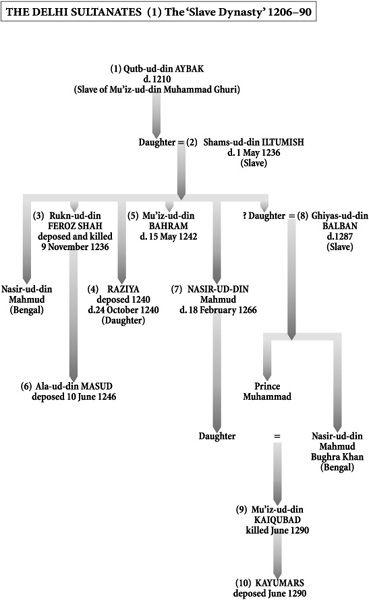
Rarely the work of Muhammad himself, his conquests in India had been principally achieved by his Turkish commanders, amongst whom the most successful was Qutb-ud-din Aybak (Aibak, Eibek). Aybak was also the most trusted and, since Muhammad had no sons, he looked to be his likeliest successor. Not without the bloody elimination of rivals which accompanied almost every succession of a Delhi sultan, Aybak eventually secured his position in India and would no doubt have made as great a sovereign as he had a viceroy. But in 1210, after just four years on the throne, he fell while playing polo, and his pony fell on top of him ‘so that the pommel of the saddle entered his chest and killed him’. He is remembered as the founder of what is sometimes called the ‘Slave Dynasty’ of Delhi, and as the creator of that city’s earliest surviving Islamic monuments, the so-called Qutb mosque and minar.
Like the nearly contemporary slave, or Mameluke, rulers of Egypt, the ‘Slave Kings’ of Delhi were anything but servile. The term simply indicates that, as one-time captives, they had once been slaves. In fact they may even have found this station to their advantage. In a court awash with intrigue and opportunity, India’s Turkish conquistadors regarded a slave’s loyalty as more dependable than that of their own kin. Purchased, rapidly promoted, eventually freed, and still highly trusted, the erstwhile slave of a royal patron was ideally placed to act as either power-broker or pretender. Aybak would be succeeded, after a brief interlude of confusion, by Shams-ud-din Iltumish, another ex-slave of Turkic extraction. That no stigma attached to either of them is clear from Aybak’s recognition as sultan by his titular superior in Ghazni, and from Iltumish’s yet grander recognition by the caliph himself.
Their elevated status is equally proclaimed by their monuments. The Qutb mosque in Delhi boasts a tower of victory which doubles as India’s, and perhaps Islam’s, most massive minar(et). Five balconied tiers tall, many of them fluted and the whole thing heavily tapered, it rears above the now outrageously-priced housing of south Delhi, its red sandstone reminding irreverent neighbours of a brick-built smokestack awaiting demolition. No doubt it made a braver showing until its topmost cupola was toppled by an earthquake in 1803. Down below, the mosque is properly that of Quwwattu’l Islam, the ‘Might of Islam’. Such triumphalism is well substantiated by its construction from the reassembled components – pillars, capitals, lintels – of what had previously been twenty-seven Hindu and Jain temples. Evidently the first sultans were more anxious to see their mosque open for worship than to gratify architectural purists. It stands, where the temples probably had, in what was Rai Pithaura, the Chahamana citadel named after Prithviraj. Renamed Lalkot, this ‘red fort’ area (not to be confused with the Shah Jahan’s ‘Red Fort’ in the Mughal city now known as Old Delhi) was also graced with a ‘white palace’ whence Iltumish and his successors reigned. The palace has gone, but the ruins of Iltumish’s tomb (Aybak was buried in Lahore) stand beside the Qutb mosque, the first in a long and sublime succession of Indo-Islamic mausolea. As if by way of a nod to the later glories of Humayun’s tomb and the Taj Mahal, white marble makes its Delhi debut in the interior of Iltumish’s resting place.
At Varanasi, according to Ferishta, Muhammad of Ghor and Qutb-ud-din Aybak demolished the idols in a thousand temples and then rededicated these shrines ‘to the worship of the true God’. They also carted away treasure by the camel-load – fourteen hundred camel-loads according to one estimate. Then, as indeed now, most of the Varanasi temples may have been small and airless cells unsuited to the Muslim ideal of the whole community worshipping in unison. Temples were designed for a more intimate kind of communion and did not readily lend themselves to congregational assemblies. If piety and plunder necessitated the destruction of idols, temples may more commonly have been dismantled for their already dressed stones. At Ajmer, where Qutb-ud-din Aybak caused another great mosque to be built, the requisite height for the prayer chamber was obtained by sticking as many as three squat temple pillars on top of one another.
The iconoclasm of the early sultans was not always so thorough. In the south-west, despite victory at Mount Abu and the destruction of nearby Anhilwara, the Muslim forces left untouched the magnificently decorated Jain temple of Adinatha at Dilwara on Mount Abu itself. Here white marble, and little else, has been fretted into a lacy membrane of intricate sculpture which, womb-like, lines the entire interior. The temple dates from 1032 and so belongs to that defiant period of construction immediately after Mahmud of Ghazni’s raids. It was commissioned by a minister of the Solanki rajput dynasty of Gujarat but is so unobtrusively sited and of such inconspicuous profile that it may simply have been overlooked by the invaders.
Just how disastrous the Muslim conquest was for India’s heritage, how heavily Muslim rule bore on the Hindu population, and how determinedly it was resisted are contentious subjects. ‘An analysis of the military operations of the period reveals the fact that never once were the Turkish armies called upon to deal with a hostile population,’ insists an eminent Muslim historian; ‘we do not come across a single revolt of the Hindu masses as such.’9 Yet, following Tod’s lead, a no less eminent Hindu authority writes of ‘ceaseless resistance offered with relentless heroism’ as warriors, ‘boys in their teens’, ‘men with one foot in the grave’ and ‘women in thousands’ fought and died ‘to break the volume and momentum of the onrushing tide of invasion’.10 Curiously neither makes mention of what sounds like a devastating revolt in Awadh (or ‘Oudh’ in Uttar Pradesh) of c1220 during which, according to a contemporary, ‘120,000 Muslims received martyrdom at the hands and sword of the accursed Bartuh’.11 It is clear that ‘Bartuh’ was a Hindu but his identity is otherwise uncertain. As with other mysterious ‘heroes of the resistance’, like the Ghakkars of the Panjab or the Mhers and Mewatis of Rajasthan, it would seem that some of the most determined opposition came from tribal, or at least non-rajput, peoples, about whose existence the Hindu dynastic records, and Tod, are silent.
Given that the Muslim conquest of India took several centuries, all generalisations must be suspect. The well-authenticated oppression of Muhammad bin Tughluq in the mid-fourteenth century cannot simply be presumed of his predecessors or his successors. Similarly a Hindu inscription of c1280 which lauds the security and bounty enjoyed under the rule of Sultan Balban should not be taken as a blanket endorsement of firm Islamic government. Not all temples were destroyed, although many were. The jizya tax on non-Muslims was not levied on brahmans until the reign of Feroz Shah Tughluq (1351–88),12 and may never have been very effectively collected. Idolatry was condemned yet Hindus were not prevented from practising their religion. And since the records often make no clear distinction between military and civilian casualties, it is hard to assess the extent of gratuitous violence.
Many would argue that the sultans, like other Indian dynasts, were more interested in power and plunder than in religion. Muslim chroniclers chose to portray the occupation of northern India as a religious offensive and to paint its principals as religious heroes; ‘but such a view cannot stand the test of historical scrutiny’.13 The more informative chroniclers in fact say surprisingly little about Muslim–Hindu relations. They are much more revealing about the power struggles amongst the conquistadors themselves; indeed these feuds, together with the chaos induced by the Mongol invasions, look to have slowed the pace of conquest quite as much as any resurgence of Hindu resistance. According to one authority the entire history of the ruling Turkish elite ‘can be summed up in these words;they united to destroy their enemies and disunited to destroy themselves’.14
During the twenty-six years of his reign Iltumish was almost continuously in the field, yet beyond raids into Malwa he brought little new territory within the Muslim ambit and was as often engaged against fellow Muslims as against Indian ‘idolaters’. In the west, Sind and the Panjab were in constant turmoil as Ghenghiz Khan neared and then crossed the Indus in 1222. The turmoil was caused not just by the Mongols themselves but by the tide of armies, princes, scholars and artisans from all over Turkestan, Khorasan and Afghanistan whom the Mongol invaders rolled before them. Figures are not available but it seems probable that far more Muslims entered India as refugees from the Mongol invasions than as warriors in the Ghaznavid and Ghorid armies combined.
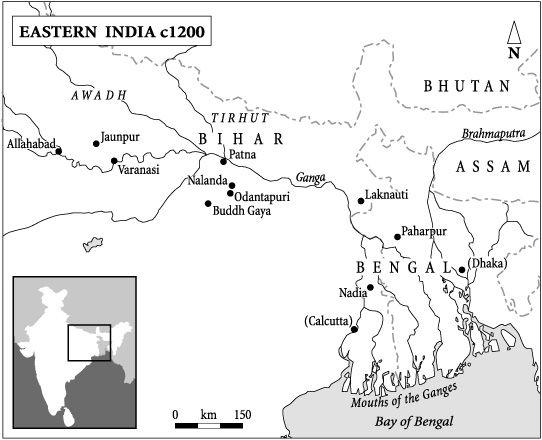
East of Delhi Iltumish had to reconquer much of what is now Uttar Pradesh and then face Muslim rivals in Bihar and Bengal. These were the Khaljis or Khiljis, originally tribal neighbours of the Ghorids in central Afghanistan, who had followed Muhammad of Ghor to India. Muhammad Bakhtiyar, the founder of Khalji rule, had been denied lucrative office in both Ghazni and Delhi before eventually securing what was then a frontier fief (iqta) near Varanasi. Thence he organised freelance raids into Bihar, one of which was rewarded with the unexpectedly easy capture of what the Khaljis thought was a fortified city. Here the inhabitants, all of whom seemed to have shaven heads, were indeed put to death and great plunder was made. Amongst the spoils were whole libraries of books but, since all the people had been killed, no one could tell what the books were about. Further investigation, however, clarified the situation. According to Minhaju-s Siraj, a distinguished scholar who after being flushed out of Afghanistan by the Mongols spent two years with the Khaljis, ‘it was then discovered that the whole fort and city was a place of study’;15 it was in fact the famous Buddhist monastery-cum-university of Odantapuri.
Such fearless feats of arms won the applause of Qutb-ud-din Aybak and brought followers flocking to the Khalji standard. Bakhtiyar had then ventured through south Bihar and, in another daring escapade, captured Nadia, the capital of the Senas, which dynasty had succeeded that of the Buddhist Palas as the most important in Bengal. With just eighteen followers Bakhtiyar is supposed to have gained entrance to the Sena palace and surprised King Lakshmanasena in the middle of lunch. The Senas’ other capital of Lakhnauti, otherwise Gaur on what is now the Indo– Bangladesh frontier, was also taken. With Lakhnauti as his headquarters, Bakhtiyar continued east into Assam and then ‘Tibet’ – which was probably not the country now so designated but perhaps Bhutan. Howsoever, the Himalayas were certainly too physically challenging for the Khalji forces, most of whom perished in a swollen river. Bakhtiyar made it back to the plains but, a broken man, he either died or was killed soon after.
This was in 1205, and from then onwards the governorship of Bengal and Bihar had been bitterly contested by various Khaljis who acknowledged Delhi’s supremacy only on the rare occasions when the sultan’s support was deemed personally advantageous. Iltumish endeavoured to rectify the situation by invading Bengal in 1225. Its incumbent Khalji was obliged ‘to place the yoke of servitude on the neck of submission’ and yield a hefty tribute; then he reverted to his bad old ways. A year later the sultan sent his son Nasir-ud-din to repeat the treatment. This time the Khaljis were routed, their ruler killed and their capital occupied; the problem looked to be solved. But such calculations took no account of Bengal’s notorious climate. Nasir-ud-din suddenly sickened and died. Again Bengal, that ‘hell full of good things’ as the Mughals would call it, slipped the leash and again (in 1229) Iltumish had to invade. His settlement barely lasted until his death, whereupon Bengal, Bihar and sometimes Awadh became again effectively independent. Although over the succeeding century this situation was occasionally threatened and briefly reversed, ‘between 1338 and 1538, for long two hundred years, Bengal remained independent without interruption.’16
Delhi’s chances of reasserting its authority there or anywhere else declined sharply after Iltumish. Before dying of natural causes, a feat which even contemporary writers found worthy of special note, Iltumish had wavered between nominating as his successor a remaining but ineffectual son and an inspirational but gender-handicapped daughter. The son, though liked, had his own handicaps, including a vindictive and detested mother and a predilection to ‘licentiousness and debauchery’. Mother and son duly indulged their respective passions during a seven-month period. It barely qualified as a reign, and they were both then toppled by the daughter, the redoubtable Raziya.
Sultan Raziya was a great monarch. She was wise, just and generous, a benefactor to her kingdom, a dispenser of justice, the protector of her subjects, and the leader of her armies. She was endowed with all the qualities befitting a king, but she was not born of the right sex, and so in the estimation of men all these virtues were worthless. (May God have mercy on her!)17
Nevertheless, continued Minhaju-s Siraj, ‘the country under Sultan Raziya enjoyed peace and the power of the state was manifest’; even Bengal made a grudging submission. This was short-lived, and the calm merely presaged a storm. Raziya’s reign lasted barely four years (1236–40). Perhaps her decision to dispense with the veil and, in mannish garb of coat and cap, to ‘show herself amongst the people’ was unnecessarily provocative to Muslim sensitivities. So too may have been the appointment as ‘personal attendant to her majesty’ of Jamal-ud-din Yakut, an ‘Abyssinian’ who was probably once a slave and very definitely an African. A liaison so conspicuous duly brought unfavourable comment from the historian Isami. Declaring that a woman’s place was ‘at her spinning wheel [charkha]’ and that high office would only derange her, he insisted that Raziya should have made ‘cotton her companion and grief her wine-cup’.
These lines, written in 1350, are of additional interest in that, according to Irfan Habib, India’s most distinguished economic historian, they contain ‘the earliest reference to the spinning wheel so far traced in India’. Since the device is known in Iran from a prior period, ‘the inference is almost inescapable that the spinning wheel came to India with the Muslims’.18 So did the paper on which Isami penned his patronising lines, palm leaves having previously served as a somewhat friable writing surface. Both introductions were of incalculable value. Governance and taxation would be expedited, and literature, scholarship and the graphic arts revolutionised by the availability of a uniform writing material which could be readily filed and bound. In fact it became so common that by the mid-fifteenth century Delhi’s confectioners were already wrapping their sticky halwa in recycled writing paper, a practice which would continue until the triumph of the polythene bag and then revive after polythene’s environmental disgrace.
Likewise, the charkha greatly boosted the production of yarn and no doubt provided employment for many more weavers. High-quality cotton textiles had long been an important export; but thanks to the spinning wheel and other innovations, India’s cottage-based cotton industry would in time become a barometer of national self-esteem. In adopting the charkha as the symbol of Indian independence, Mahatma Gandhi and the Congress Party were not, however, courting Muslim votes. The irony of predominantly Hindu India sporting a national icon of Islamic provenance went unnoticed.
Raziya was elbowed aside by a junta of Turkish, and of course male, chauvinists. While bravely dashing across the Panjab in high summer to douse a revolt at Bhatinda, she was isolated by the conspirators, her Abyssinian friend was killed, and she ended a prisoner in the fort she had come to redeem. There she managed to win the backing and affection of one of the conspirators. They were married and, gathering further support, marched on Delhi. Perhaps if the conduct of their forces had been left to the experienced Raziya, they might have prevailed. But, as a wife, she deferred to her husband and they were heavily defeated. Next day, while fleeing the battlefield, the newlyweds ‘fell into the hands of Hindus and were killed’.
Known as ‘The Forty’ or ‘The Family of Forty’, the Turkish military oligarchs who now dominated Delhi affairs intrigued both against one another and against a more amorphous grouping composed of Indian converts to Islam and eminent refugees from Afghanistan and beyond. At the whim of these cut-throat godfathers young and ineffectual sultans were casually summoned and quickly despatched, usually to the hereafter.
Raziya’s demise had been followed almost immediately by another Mongol eruption. In 1241 the invaders sacked Lahore, whose ruins were then picked over by the predatory Ghakkars. Unlike Delhi, Lahore thus lost all trace of its Ghaznavid and Ghorid past and has no monuments prior to those of the Mughals. That the Mongols did not then take advantage of Delhi’s strife-torn predicament is largely thanks to Ghiyas-ud-din Balban, another Turkish slave who, while loyally dictating policy for the ineffectual Sultan Nasir-ud-din, was briefly disgraced but, eventually and allegedly, poisoned the sultan to secure his own succession.
During forty years as the effective (1246–65) and then actual (1265–87) ruler, the stern and merciless Balban held the Mongols at bay with a skilful mixture of force and diplomacy. Ghenghiz Khan was now dead, but his successors readily championed the cause of one of Sultan Nasir-ud-din’s brothers plus other claimants to the Delhi throne; they frequently intervened in the tortuous affairs of Sind; and they advanced to the Beas river in the Panjab. This necessitated the diversion of the sultanate’s best troops and most reliable commanders to patrolling the new frontier. ‘If this anxiety … as guardian and protector of Mussulmans, were removed,’ Balban is supposed to have said, ‘I would not stay one day in my capital but would lead forth my army to capture treasures and valuables, elephants and horses, and would never allow the Rais and Ranas [i.e. the rajputs and other Hindus] to repose in quiet at a distance.’19 While the Mongols threatened the very existence of the sultanate, even plundering raids into Hindu India, let alone conquests, were in abeyance.
Several Mongol incursions were indeed frustrated, but in 1260 Balban fêted an embassy from Hulagu, grandson of Ghenghiz Khan. Despite Balban’s boast that up to fifteen ex-rulers of Turkestan, Khorasan, Iran and Iraq were enjoying asylum in Delhi, some sort of working relationship seems to have been established between the two neighbours. Balban could now concentrate on shoring up the status of the sultanate and securing his existing possessions. Perhaps influenced by all those royal refugees from the north-west, he introduced into his court an elaborate system of precedence and protocol modelled on Persian practice. The sultan being ‘the shadow of God’ and his vice-regent on earth, it was fitting that he be honoured as such. With drawn swords fearsome retainers now constantly attended the royal presence. Those who would approach the throne must abase themselves, performing zaminbos (‘kissing the ground’) and paibos (‘kissing the [royal] feet’) as they advanced. Any infringement of this rigid decorum brought instant and bloody punishment.
With an equally heavy hand, Balban’s forces put down insurrections in the Ganga-Jamuna Doab and cleared the region round Delhi of both the marauding Mewatis and the scrub jungle in which they found sanctuary. A major expedition into Bengal, whose governor was again in revolt, took three years and was distinguished by more ferocious reprisals. But on the sultan’s return, his most capable son and preferred successor was killed in a skirmish with the Mongols. Balban, now said to have been in his eighties, never recovered from this blow. When not presiding, grim-faced, over his terrified courtiers, he is said to have spent his nights howling with grief for the ‘martyr-prince’. In 1287 death brought relief to the tortured sultan. Not, however, to his kingdom, which plunged into another bloodstained succession crisis.
A grandson, who quickly replaced the one Balban had nominated as his successor, celebrated his succession by renouncing the austerities of the previous reign and embarking on a riot of indulgence. The young sultan, says Ferishta, ‘delighted in love and in the soft society of silver-bodied damsels with musky tresses’. Delhi welcomed the change; ‘every shade was filled with ladies of pleasure and every street rung with music and mirth.’20 But such was the young sultan’s abandon, such the heavy inebriants and the musky tresses, that within three years the handsome and affable prince was reduced to a gibbering wreck. Meanwhile Balban’s trusty lieutenants had been eliminated by the new sultan’s self-appointed keeper, an evil genius who was himself then poisoned by jealous opponents. ‘What little order had been maintained in the government was now entirely lost,’ according to Ziau-ud-din Barani, the author of an important history, who was a boy about Delhi at the time. The still young but now paralysed and imbecilic sultan was replaced by his son, a three-year-old toddler. In his name cradle-snatching rivals continued to manoeuvre and fight for office.
The dénouement of this 1290 crisis saw the remnants of the Turkish ‘Forty’ outwitted by rivals belonging to the same Khalji tribe who had earlier conquered Bihar and Bengal. Despatching two sultans in quick succession – both the paralytic father and his wretched child – the Khaljis ended the so-called ‘Slave dynasty’ and proclaimed one of their seniors, Jalal-ud-din Feroz Khalji, as the new sultan. A kicking toddler was thus replaced by a grey-bearded patriarch as the Khalji dynasty began its thirty-year tenure of the throne of Delhi.
Jalal-ud-din Feroz, sometimes called Feroz Shah I, was an unlikely instrument of revolution. A Turk, though not exactly a young one, he also displayed a clemency unheard of in the annals of the sultanate. It even won him a certain popularity. Conciliating rivals and forgiving enemies, he ‘weaned the citizens of Delhi from their attachment to the old family’, says Ferishta. Such policies melted even Mongol hearts. The trickle of defectors from the Mongol khanates who were embracing Islam and transferring their loyalties to the sultanate briefly became a flood. But such leniency also severely tested the loyalties of his Khalji supporters and offered much encouragement to potential opponents. Amongst the latter was the sultan’s nephew, who was also his son-in-law and a keen student of the earlier Khalji campaigns in Bengal.
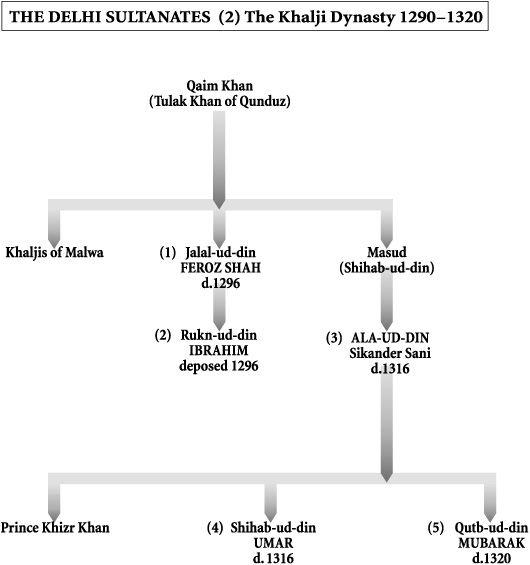
This man was Ala-ud-din Khalji, and the lesson he drew from his kinsmen’s experiences in Bengal was that plunder and conquests made at the expense of Hindu India could significantly enhance his challenge for the sultanate. After a lull of nearly a century during which the tide of ‘Muslim conquest’ in India had if anything receded, another giant surge was about to carry it deep into the peninsula.
ALADDIN’S CAVE
By now, the end of the thirteenth century, the still-Hindu Deccan and south had witnessed further dynastic change. Yet the pattern of struggle, modelled on the symmetry of the mandala and consummated in the compass-boxing digvijaya, remained the same. So too does our limited perception of it. Unenlivened by the gossipy narratives beloved of Muslim writers, the contemporary history of Hindu India has still to be laboriously extrapolated from the sterile phrasing and optimistic listings favoured by royal panegyrists and fortuitously preserved in a few literary compositions and numerous stone and copper-plate inscriptions. The formality of such sources drains their content of vitality and, without the labours lavished by the likes of Tod on the rajputs, the history of the Deccan is liable to appear as arid and confusing as its geography.
Lest this should prove to be the case, it must suffice to note that in the western Deccan the Western Chalukyas, those doughty opponents of the great Cholas of Tanjore, had succumbed, like their Rashtrakuta predecessors, to the rising power of two erstwhile feudatories, one of which now dominated Karnataka and the other Maharashtra. As Yadavas, both these new dynasties claimed descent from the Vedic Yadu lineage, once of Mathura and of Dwarka in Saurashtra. They were not ‘Rajpoots’ in the geographically-specific sense used by Tod, and not certainly even ksatriya, a caste that is practically unknown in peninsular India. Yet as befitted a lineage that could claim Lord Krishna as a Yadava, they too revered the martial ethic.
Of these two Yadava dynasties, the Hoysalas of Halebid are the more epigraphically articulate. Originally a hill-people from the Western Ghats just north of Coorg, they had carved out a small kingdom around Belur (two hundred kilometres west of modern Bangalore in southern Karnataka) in the tenth century. In the eleventh, as ‘the rod in the right hand of the Chalukya king’, Hoysala forces had served with distinction against both the Chola kings Rajaraja and Rajendra and against King Bhoj’s Paramara successor in Malwa. More territory had been acquired, more scholars and adventurers attracted to the Hoysala court and, with the establishment of a new capital at Dorasamudra (now Halebid), twelve kilometres from Belur, the usual clustering of dynastic sites was under way. ‘Striking hostile princes in a brilliant way as if they were balls in a game,’ says an eleventh-century panegyrist (who must by now have been reborn as a cricket commentator), ‘that famous [King] Vinayaditya ruled like Indra from the west as far as Talakad, until the circle of the Earth cried out “Well done, Sir!” in approval.’21
Imperial ambitions had first been entertained by the Hoysalas in the early twelfth century when the spectacularly ornate temples of Chenna Kesava at Belur and of Hoysalesvara at Dorasamudra-Halebid were designed to celebrate it. This bid for supremacy throughout Karnataka proved premature, but towards the end of the century, at about the same time as Prithviraj was succumbing to Muhammad of Ghor at Tarain, the Hoysalas successfully exploited a do-or-die struggle between the Western Chalukyas and the invading Kalachuris of Madhya Pradesh. Ballala II, the greatest of the Hoysala kings, thus added to his ancestral domains most of northern Karnataka and, by exploiting a similar conflict between the Chola and Pandya rulers in the Tamil country, also emerged with an important slice of the Kaveri plain around Srirangam (Trichy). A new chronological era was adopted by Ballala’s royal bards, and so were the usual imperial titles, plus many besides. Gloriously if briefly the Hoysalas were paramount through-out most of the Kannadaspeaking Deccan, and could pose as arbiters in the lusher lands below the Eastern Ghats.
There, in the Tamil country, their main rivals were the Pandyas of Madurai who in the 1250s under the great Sundara Pandya overthrew the Cholas and blunted the Hoysala thrust. The Pandyas also struck north deep into the Telugu-speaking Andhra country, where an important dynasty called the Kakatiyas had replaced the Eastern Chalukyas of Vengi. Thus it was the Pandyas from Madurai, the Hoysalas of Karnataka and these Kakatiyas of Warangal (their capital, near the later Hyderabad), together with their respective feudatories, who controlled most of the south when, as the thirteenth century drew to a close, Ala-ud-din Khalji began to formulate his plans.
North of the Hoysalas, and barring any access to the south via the western Deccan, there ruled those other beneficiaries of the Chalukyan decline who also claimed Yadava descent. Indeed they are often referred to as the ‘Yadavas of Devagiri’. Since Maharashtra was their homeland they are also described as Marathas, although the correct name of the dynasty is Seuna, or Sevuna. These Seunas, then, once feudatories of the Rashtrakutas and then of the Chalukyas, had taken the latter’s capital of Kalyana in c1190. Although boxed in on all sides – by the Hoysalas to the south, the Kakatiyas to the east, the Paramara rajputs of Malwa in the north and the Solanki rajputs of Gujarat in the west – they had yet carved out a substantial kingdom embracing most of what is now the state of Maharashtra. Very roughly, the Seuna kingdom therefore corresponded to the territory of the ancient Shatavahanas and the early Rashtrakutas.
Beset by so many aggressive neighbours, the Seunas had taken the sensible precaution of locating their capital at the base of the most impregnable citadel in western India. A fang of rock, mostly bare of vegetation, vertiginous, accessible only by a labyrinth of caves and shafts, and further strengthened by glowering fortifications plus a Stygian moat, the citadel rises three hundred metres above the plains at a place called Devagiri (Deogir), later Daulatabad, between the rock-city of Ellora and the gardencity of Aurangabad. Here the considerable fortune amassed by the Seunas from revenue, raiding and trade seemed secure. From his eyrie King Rama-chandra could survey the core of his kingdom on the upper Godavari river safe in the knowledge that, however his armies fared, his person and possessions were unlikely to be jeopardised.
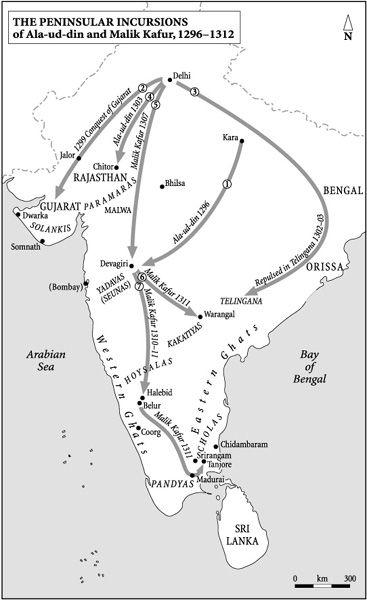
In 1296 a dry-season offensive against the Hoysalas in Karnataka was being conducted by his son. Devagiri was therefore sparsely defended. But Rama-chandra, nearing the end of a successful reign that had already lasted twenty-five years, was not unduly anxious. A few Muslim troops were already serving as mercenaries in the Deccan. The rigidity of Islam was familiar from centuries of contact, and the aggressive forays of the Delhi sultans north of the Narmada must long have been matter for comment. Three years previously the young Ala-ud-din Khalji had led a plundering expedition from his base at Kara, near Allahabad, and pushed as far south as Bhilsa, near Bhopal in Madhya Pradesh. High-value booty had been secured from this ancient capital and from the neighbouring Buddhist centre of Sanchi. But Bhilsa was not halfway from the Ganga to the Godavari; there were still over three hundred kilometres of the ruggedest country between it and Devagiri. To Rama-chandra such barely authorised escapades by some unknown nephew of the remote and unusually pacific Feroz Shah I were scarcely cause for alarm. He was therefore taken completely by surprise when in the spring of 1296 Ala-ud-din suddenly materialised on his precipitous doorstep.
In the event, Rama-chandra was not the only one surprised. Ala-ud-din’s eruption into the Deccan had been kept secret even from his uncle the sultan. In fact, surprising the latter was the higher priority; for as would soon appear, the real target was not Devagiri but Delhi. Ala-ud-din was acting without authority and with comparatively few troops. From Kara via Bhilsa he had stumbled on a secluded route to the rich kingdoms of the Deccan which avoided the still-defiant rajputs of Rajasthan and Malwa. But he needed to complete his mission before it was discovered and countermanded. Speed of movement was therefore essential; he had avoided towns, camping in the jungle and following previously reconnoitred routes. On what was essentially a quest for wealth and prestige, all that mattered was securing a quick submission plus a monumental ransom from the luckless Rama-chandra.
The Khalji’s troops therefore sacked and plundered the town of Devagiri as soon as they reached it. Rama-chandra retired to his citadel and, to the invaders’ distress, looked capable of holding out indefinitely. But after barely a week’s defiance it was found that provisions within the citadel were already running low. With almost indecent haste the adversaries then concluded a pact which even the unexpected return of the Seuna army failed to compromise. Thus, after days rather than weeks, Ala-ud-din and Rama-chandra parted on the best of terms, the invader with a Seuna bride and treasure beyond his wildest dreams, and the invaded with his kingdom intact, his army undefeated, his beliefs uncompromised, and a powerful new Turuska ally.
As planned, news of Ala-ud-din’s remarkable achievement reached the ears of his uncle in Delhi ahead of the reports about his original disobedience. All, if not forgiven, was now beyond reprehension. Ala-ud-din had rediscovered the predatory purpose behind Turkish rule in India; he had established himself as a resourceful and fortunate general; and he had acquired sufficient treasure, plus the possibility of more where that came from, to attract powerful support. Clearly he needed careful handling. The sultan therefore extended his congratulations and, ignoring advice to ambush his ambitious nephew en route, bade him return to Delhi with his plunder. In fact Ala-ud-din headed for the safety of his own fief at Kara on the Ganga. There he eventually inveigled his uncle into paying him a visit. Only a sultan as guileless as the aged Feroz would have accepted such an invitation and have then sailed downriver to the meeting with only a few unarmed attendants and no hope of escape. Needless to say, he had barely stepped ashore when he was cut down. ‘While the head of the murdered sovereign was yet dripping with blood, the ferocious conspirators brought the royal canopy and elevated it over the head of Ala-ud-din.’22
The usurper then made his way to Delhi, gathering supporters as he went by showering the roadsides with coins fired as grapeshot from a specially-designed manjanik. His fellow conspirators were quickly disposed of; such men were obviously not to be trusted. But during a reign of twenty years (1296–1316) Ala-ud-din would not otherwise disappoint the high expectations he had aroused amongst the sultanate’s supporters. Although an illiterate of unremarkable physique and unendearing presence, he combined the scruple-free instincts essential to survival with a paternal and even innovative concern for the welfare of his kingdom. Ala-ud-din’s memory would transcend the eventful years of his reign and become something of a benchmark for later rulers. Much the most successful as well as the most unforgiving of the Delhi sultans, it was he who now directed the victorious progress of Turkish arms throughout India.
Conquest to any lasting purpose it was not. With the exception of Gujarat and parts of Rajasthan and Malwa, very little new territory was brought under direct Khalji rule. No pan-Indian empire under a Turkish or an Islamic dispensation resulted. Mass conversions were almost unknown. Existing rulers were mostly reinstated and, despite promptly acknowledging Delhi’s suzerainty, they rarely fulfilled their tributary obligations unless compelled to do so by the threat of further armed intervention. Ala-ud-din’s victories certainly conjured up amongst his supporters a vision of Islamic dominion throughout India. Perhaps they also reminded his Hindu subjects of those indigenous traditions of universal sovereignty associated with the concept of the cakravartin. But it would be another two hundred years before these ideals were fused into an effective reality; and the credit would then belong neither to the Turkish Khaljis nor their Afghan successors, but to the descendants of those hordes who continued to threaten the very existence of the Delhi sultanate and whom, though known to Europe as ‘Mongols’, contemporary Persian and Indian sources always called ‘Mughals’.
From 1297 to 1303 Ala-ud-din faced almost annual Mongol onslaughts. Delhi itself was twice surrounded, the Doab was ravaged and what is now Pakistan suffered continual Mongol occupations. Whether even the stern Balban could have held the enemy at bay must be doubtful. But after a crushing victory in early 1300 and numerous other lesser triumphs, Ala-ud-din not only stemmed the tide but reversed it. Sind and the Panjab were regained and by the end of his reign Khalji forces were raiding Ghazni, Kabul and Kandahar in Afghanistan. It was by no means the end of the ‘Mughal’ threat. But Ala-ud-din’s successes served as a temporary deterrent and provided a convincing demonstration of the military effectiveness of manoeuvrable Turkish cavalry in combination with a solid Indian elephant-phalanx.
Further demonstrations of military might were witnessed in Gujarat, Rajasthan, Malwa, the Deccan and even the extreme south. Although glossed over in contemporary accounts, there were also setbacks, most notably in Bengal and initially in Andhra. It is clear, too, that Tod’s rajputs gave a good account of themselves, with the great hill-forts of Ranthambhor, Jalor and Chitor withstanding long sieges, occasioning heavy casualties, and inspiring posterity with their legendary jauhars. These hara-kiri rituals had been practised by other doughty patriots ever since Sind was first invaded in the eighth century, but the rajputs of Rajasthan now made them peculiarly their own. When all was lost, when the last scrap of food had been eaten, the last arrow fired, the last water-skin emptied, a pyre was lit and, as the womenfolk hurled themselves into the flames, the men rode out in a still brighter blaze of glory to kill until they were killed. Fanaticism was not an exclusively Islamic prerogative. The Khalji forces marvelled that principalities so agriculturally disadvantaged and forts so poorly endowed with treasure should occasion such passionate resistance.
Much less trouble and infinitely more rewarding were the conquests of Gujarat and then Malwa, from where the poet-king Bhoj’s Paramara successors were finally removed. Gujarat, besides being extremely fertile and renowned for both its textiles and its cattle, was further enriched by the maritime trade of Cambay, which had now superseded Broach as north India’s main port on the Arabian Sea. Prodigious spoils resulted from this campaign of 1298, including more gold and precious stones from the rebuilt, and now re-demolished, temple of Somnath; its replacement lingam was again hammered into fragments and reserved for trampling by the feet of the faithful, this time in Delhi. Amongst Cambay’s seized assets the most prized was a Hindu captive who would add particular lustre to the Khalji sultanate. A eunuch and a slave, he quickly espoused Islam but retained the nickname ‘Thousand-dinar Kafur’, presumably a reference to his original valuation. ‘His beauty,’ says Barani, ‘captivated Ala-ud-din’ who thereafter trusted him implicitly and appointed him a Malik-naib, or senior commander.23
The king of Gujarat, meanwhile, had found sanctuary in the fortress of Devagiri where Rama-chandra’s son, if not Rama-chandra himself, had been having second thoughts about the Seuna–Khalji alliance. In 1307, with the arrears of Seuna tribute mounting, Ala-ud-din sent an army to chastise the son and reoccupy the kingdom. Commanded by none other than ‘Thousand-dinar Kafur’ it quickly routed the Seuna forces and again ransacked the capital. Sangama, the Seuna heir, fled. Rama-chandra, however, was taken to Delhi and was there much fêted by the sultan, who reinstated him on his throne and showered him with favours in an unusually creditable display of magnanimity. As a result the Seuna king ‘not only stood firm in his loyalty to the sultan but rendered valuable assistance to the officers whom he sent to subdue the Hindu kingdoms of the south’.24
Pre-eminent amongst these officers was again the inspirational Maliknaib Kafur. In 1309 he headed south for the second time and from Devagiri mounted an assault on the Kakatiyas of Andhra. About eighteen years earlier Marco Polo, while visiting Tamil Nadu by sea from China, had noted the rich diamond finds made in the Andhra country which, he reported, was then ruled by a formidable queen of Seuna birth. She had lost her Kakatiya husband and was acting as regent for her grandson. The grandson was Pratapa-rudra who, coming of age, had since succeeded to the Kakatiya throne, and now withdrew within the fortifications of Warangal as Malik Kafur approached. The siege proved lengthy but Pratapa-rudra eventually succumbed and was relieved of horses, elephants and the usual trunkloads of treasure before being reinstated on the promise of an annual tribute.
Next year Kafur was back in the Deccan, and from Devagiri he this time continued south. The Seunas, relishing the prospect of their Hoysala rivals being the next to be humbled, provided supplies, guides and covering forces. With the distant outline of the Western Ghats tracking his progress, Kafur pressed on south into the interminable Deccan horizon. Halebid, nestling amongst greener pastures, was reached and duly besieged. But Ballala III, the Hoysala king, then opted for terms under which he was to perform much the same escort service in respect of Kafur’s onward march into the Pandya country. It did not mean that Halebid escaped the customary demands for treasure and elephants, but it did mean that Kafur’s troops had traversed the entire Deccan without once having had to fight a battle.
Directed by Kafur, himself born a Hindu under rajput rule, ‘the Muslim conquest of the south’ was partaking more of the digvijaya than the jihad. Claims by Ferishta and others that Malik Kafur built a mosque in Halebid and established Islam throughout Karnataka are deemed a wishful fabrication. ‘Though he served a master who bore the name of Ala-ud-din [i.e. Aladdin] he could not have worked, without the aid of the wonderful lamp, such miracles during a brief stay of less than two weeks.’25
From Halebid the Khalji forces, aided by the Hoysalas, descended into the Tamil country through elysian vales dotted with teak trees, their fallen leaves crackling underfoot like crisp papadums. They spent only a month amongst the rice fields of Tamil Nadu. Again no battles are recorded and the time seems to have been mainly spent in a fruitless pursuit of the elusive Pandyan ruler. It did, though, suffice to strip the temple cities of Madurai, Srirangam and Chidambaram of their solid-gold idols, to empty their gold-filled temple cavities, and to yield much other portable wealth. Such being the whole point of the exercise, ‘Thousand-dinar Kafur’ turned for home heavily laden and well satisfied.
Barani, who witnessed his ecstatic reception in Delhi, puts the campaign’s haul at 612 elephants, twenty thousand horses, ninety-six thousand man of gold and countless boxes of jewels and pearls. Although modern equivalencies are notoriously difficult to work out, ninety-six thousand man is said to correspond to 241 tonnes.26 ‘The old inhabitants of Delhi remarked that so much gold had never before been brought into Delhi. No one could remember anything like it, nor was there anything like it recorded in history.’27
Yet in a thoughtful retrospect of Ala-ud-din’s reign, Ziau-ud-din Barani would place ‘constant succession of victories’ no higher than second in his list of the sultan’s most notable achievements. ‘Rolling back the Mughals’ came third, ‘repairing mosques’ eighth, while ‘rooting out idolatry’ or ‘spreading the true religion’ are not mentioned at all. The sultan was no Islamic bigot: ‘there is no instance to show that Ala-ud-din oppressed some people simply because they were Hindus and favoured others just because they were Muslims.’28 Indeed, if one may judge by his reported interest in founding a new religion centred on his own illustrious person, his faith was decidedly unorthodox. He did extend Aybak’s Quwwat-ul-Islam mosque in Delhi, adding the great Alai Darwaza (Ala-ud-din’s Gateway). He also planned a prodigious minaret which, if completed, would have dwarfed that of the Qutb. In fact it never rose much above its current stump height, and should be seen as the aberration of a sultan occasionally deluded by his own success. Like his assumption of the title ‘The Second Alexander’ on his coinage, it was a case of the megalomaniac getting the better of the Muslim.
In Barani’s listing, the first and greatest of Ala-ud-din’s achievements was, somewhat surprisingly, ‘cheapness of grain, clothes and the necessaries of life’. Writing in an old age embittered by extreme poverty, Barani paid particular attention to such matters. His narrative, though coloured by an old-timer’s recollection of palmier days, thus provides the first detailed account of the management of an Indian economy. From it we learn of Ala-ud-din’s cancellation of all land grants and revenue assignments made by his predecessors and of his prohibition of the sale and consumption of alcohol. These measures affected mainly Muslim courtiers and were designed to cow dissent and quell conspiracy. The more draconian ordinances which followed – and which were designed to finance the vast armies required for his Mongol and Deccan campaigns, to eliminate profiteering and reduce the grievances of the Delhi populace – affected Hindus more directly. It is doubtful whether they were ever applied beyond the city of Delhi and its immediate environs. On the other hand, by concentrating on such a manageable entity, they could be enforced to dramatic effect.
Reasoning, apparently, that despite the expected yield of his ‘Aladdin’s cave’ in the south, new troops could not be as handsomely paid nor as well equipped as rising costs and unflinching loyalty demanded, the sultan had hit on the idea of lowering prices. That meant, first and foremost, controlling the grain market. All foodgrains were listed, their prices duly fixed, and markets carefully and ruthlessly supervised. To guard against fluctuations in supply, the yield of the royal lands (khalsa) was stockpiled in city granaries, all transport was so heavily regulated as to be effectively nationalised, and provincial officials were bound to strict procurement targets. For the middleman the avoidance of penalties, invariably of the most barbaric nature, now replaced the accumulation of profits as his main incentive. Hoarding, even by the cultivator, kept a network of spies and torturers busy. Although a policy on paper, it became a purge in practice. Yet the results, according to Barani, were truly amazing. Grain prices plummeted, and stayed both cheap and unchanged even in years of drought. ‘This was indeed the wonder of the age, and something which no other monarch was able to effect.’29
The success of this price-fixing policy resulted in its extension to just about every other commodity known to the Delhi bazaars. Textiles, groceries, slaves, whores, cattle, in fact everything ‘from caps to shoes and from combs to needles’ had its fixed price and its market regulators. It was not just one of the first recorded examples of planned economic management but also one of the most ambitious. And therein partly lay its undoing. ‘A camel could be had for a dang [a farthing],’ says Barani, ‘but wherefrom thedang ?’ Purchasing power seemed to decline just as fast as prices; and urban sufficiency brought only chronic rural depression. There was no incentive to increase yields. Nor was there any chance of so ambitious a system surviving the heavy-handed authority which alone had made its imposition possible.
When Ala-ud-din succumbed to sickness and then death, both markets and prices simply reverted to the usual free-for-all. Most of his reforms, like most of his conquests, were temporary expedients and anything but proof against the internecine succession crises which now again overtook the sultanate. In the space of four years two of his sons, plus a Hindu convert, occupied the throne and quickly paid the price – a price which, though not fixed, was invariably lethal. So did ‘Thousand-dinar Kafur’, who briefly acted as king-maker; half a dozen other pretenders were either blinded or murdered. Mubarak, the son of Ala-ud-din who occupied the throne for longest, turned out to be what Ferishta calls ‘a monster in the shape of a man’. Most of his indecencies were too gross to mention although not, strangely, his practice of ‘leading a gang of abominable prostitutes, stark naked, along the terraces of the royal palaces, and obliging them to make water upon the nobles as they entered the court’.30
The Khaljis thus ended much as had the Slave kings. In 1320 Ghiyas-ud-din Tughluq, the son of one of Balban’s slaves, emerged as the founder of a new dynasty. Briefly the Tughluqs would revive, and then fatally destroy, the fortunes of the sultanate, thereby surrendering Delhi’s presumed hegemony to a host of powerful new rivals. Far from uniting India, early Islam’s historic role would be to develop and entrench the subcontinent’s so-called ‘regional’ identities.