
THE TUGHLUQS
EAST OF THE QUTB MINAR, where the suburban sprawl of south Delhi picks its way into scrub, lie six square kilometres of monumental desolation. This wilderness of cyclopean ramparts and dungeons is Tughluqabad (Tughlakabad), the most far-flung of the dozen-odd citadels which, originally some sultan’s new Delhi, then his successors’ old Delhi, are now decidedly dead Delhis; the howling jackals by night, and by day the mewing kites, could be ghouls at large.
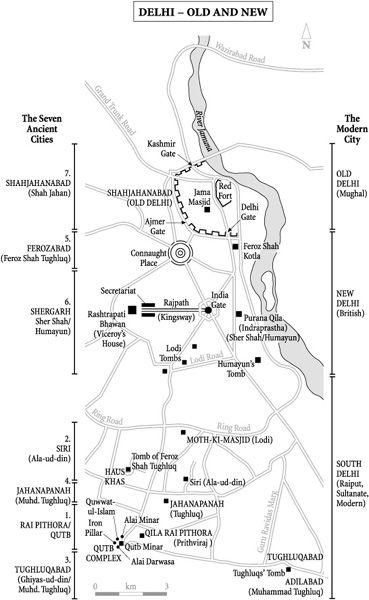
Built by Sultan Ghiyas-ud-din Tughluq (Tughlak) in the early 1320s, Tughluqabad’s parapeted walls and bastions march uncompromisingly along a low ridge which overlooks a wasteland of goat-grazed acacia and wind-borne litter. Jets scream low on a flightpath into the airport; in the distance isolated outcrops of many-storeyed housing rise from the ground-haze like the islands of an archipelago. Today’s Delhi is still heading south, colonising the scrub with random developments and upgrading the goat tracks to feeder roads. The modern metropolis may yet reclaim Tughluqabad just as it already has the mosque of Qutb-ud-din Aybak, Iltumish’s Lalkot and the Siri fort of the Khaljis.
Below the walls of his Tughluqabad, Sultan Ghiyas-ud-din Tughluq lies buried in a tomb of quite spectacular foreboding. Battlemented like the citadel, its steeply inward-sloping walls reminded James Fergusson, the nineteenth-century dilettante who first subjected India’s architecture to systematic study, of an Egyptian pyramid; he much admired the structure’s solidity, and memorably dubbed it ‘an unrivalled model of a warrior’s tomb’. But unlike the great grey citadel whose gigantic rough-cut stones fit so pleasingly in place, the squatly domed tomb is built with dressed precision from a rusty sandstone banded with off-white marble, both of them streaked and blackened by countless monsoons. The whole composition sits in a dusty bowl, sometimes a bog, which was once an artificial lake. It is reached across a causeway of many arches where a portcullis would not go amiss. ‘Tughluq’s Tomb’ looks more like a place of detention than of repose.
Shaikh Nizam-ud-din Auliya, the Sufi saint and mystic after whom another bit of Delhi is named, must have rejoiced at the ghost of the first Tughluq sultan being committed to such secure confinement. Taking exception to what he saw as Ghiyas-ud-din’s laxity in matters of religious observance, he had famously laid upon Tughluqabad the curse which still holds good:Ya base Gujar, ya rahe ujar (‘Let it either belong to the Gujar [i.e. the herdsman], or let it remain in desolation’). He it was, too, who when warned to seek safety as the sultan drew near to the city at the end of a long campaign, still more famously gave the cryptic response ‘Delhi is yet far off.’ This proved to be an accurate forecast: the sultan never did reach Delhi. To Shaikh Nizam-ud-din’s followers his premonition was proof of his exceptional powers. But such was the animosity between saint and sultan that more suspicious minds saw the prophecy as evidence of complicity. It all depended on whether the sultan’s arrival was forestalled by accident or by design; and on this historians are still bitterly divided.
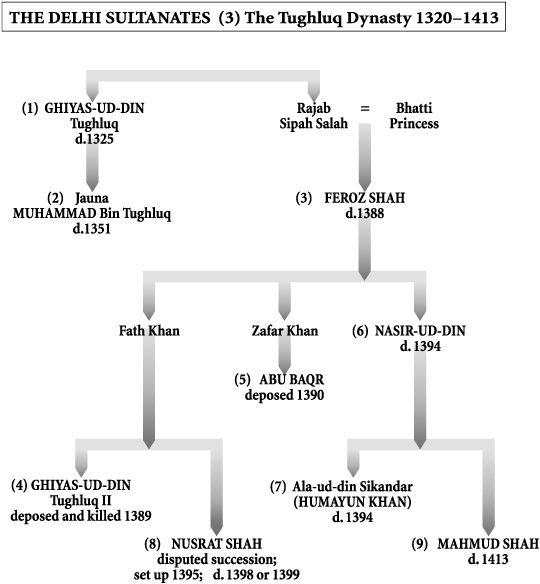
In 1320, emerging victorious from the five-year power struggle that followed Ala-ud-din Khalji’s death, Ghiyas-ud-din Tughluq had skilfully combined the conciliation of rivals with the usual generosity towards supporters and kin. Prominent amongst the latter was his eldest son and designated heir, the future Muhammad bin Tughluq, who was despatched to the Deccan to deal with the ever-rebellious Kakatiya king, Pratapa-rudra of Warangal. Successful at his second attempt in taking Warangal, Muhammad had been recalled to Delhi in 1323 to act as viceroy while Ghiyas-ud-din himself ventured east. Affairs in Bengal had unexpectedly offered an opportunity for reasserting the sultanate’s authority there, while recalcitrant Hindus in the Tirhut district of northern Bihar also required attention. Both these situations were addressed with remarkably little bloodshed during the course of 1324–5. It was only when nearing Delhi at the end of this highly successful campaign that Sultan Ghiyas-ud-din ran into trouble.
To prepare for his ceremonial entry into his new citadel of Tughluqabad, he had ordered his son Muhammad to construct a timbered pavilion by way of temporary accommodation at a place called Afghanpur, which was evidently nearby on the banks of the Jamuna. This was done, and there father and son were duly reunited. Barani says simply that they dined together and that when Muhammad and other notables had retired to wash their hands at the end of the meal ‘a thunderbolt from the sky descended upon the earth, and the roof under which the sultan was seated fell down, crushing him and five or six other persons so that they died.’1 It seems to have been July, a season of storms, and the pavilion was no doubt a conspicuous lightning conductor. But Barani is not usually so economical on affairs of magnitude. Perhaps, not having witnessed the disaster, he simply gave the official version; or perhaps the memory of those who stood by that version was not something he chose to ignore.
A very different account, though, was given by other writers, including Ibn Batuta, a distinguished Muslim scholar from Morocco whose twenty-eight years of adventure in three continents would make him not just ‘the traveller of the age’ but of most subsequent ages. Ibn Batuta began his long sojourn in India eight years after the Afghanpur tragedy, but his Travels would not be written until he was back in the safety of his native Fez, where neither fear nor favour can possibly have influenced him. Moreover, his version of the affair came from one who was actually present, in fact from another distinguished Delhi Sufi. Like Nizam-ud-din Auliya, this man had no love for the Tughluqs and may therefore have been happy to discredit them. On the other hand he offered a much more plausible account, insisting that the Afghanpur pavilion was meant to fall down, that Muhammad ordered up the ground-stamping elephants to make sure that it did fall down, that its collapse was carefully timed for the hour of prayer when the rest of the company would have moved outside, and that by design the shovels and pickaxes required to sift the rubble in the search for survivors did not arrive until too late. Additionally he thought it was no coincidence that amongst the other casualties was Mahmud, another of the sultan’s sons and in fact his favourite.
None of this would normally trouble historians. After all, premature death was an occupational hazard for any contemporary ruler and parricide a fairly common cause; even when a ruler died in his bed, poison was invariably suspected. The debate over Ghiyas-ud-din Tughluq’s untimely demise still rumbles on solely because of the light it supposedly throws on the character of the man who now automatically succeeded to the throne.
This was Muhammad bin Tughluq, the most complex and controversial figure ever to rule India. ‘Muhammad Khuni’ he is sometimes called, ‘Muhammad the Bloody’, Delhi’s own Nero, India’s Ivan the Terrible, the most autocratic, cold-blooded, power-crazed, and catastrophic of sultans who was yet also the most able, cultivated, philanthropic and even endearing. ‘Was he a genius or a lunatic? An idealist or a visionary? A blood-thirsty tyrant or a benevolent king? A heretic or a devout Muslim?’2 India’s historians being divided by religious as well as ideological allegiances, he remains an enigma. Those of Hindu sympathies find Muhammad’s excesses impossible to forgive and tend to accept Ibn Batuta’s version of his accession. Those of Islamic sympathies favour the Barani version and regard Muhammad as an ill-starred and misunderstood philosopher-king whose gravest error was to antagonise and controvert the Muslim religio-academic establishment, or ulema.
To this influential class Ibn Batuta belonged. Muhammad would appoint him chief justice of Delhi and then one of his ambassadors. In between, the sultan also disgraced him and gave him cause to fear for his life. Yet throughout, Ibn Batuta remained fascinated by his master’s personality, unable to decide between reverence and revulsion, seduced by the royal benevolence and appalled by the royal callousness. For Muhammad, he says, was pre-eminent for two things: ‘giving presents and shedding blood’.
At his gate there may always be seen some poor person becoming rich or some living one condemned to death. His generous and brave actions, and his cruel and violent deeds, have obtained notoriety amongst the people. In spite of this, he is the most humble of men, and the one who exhibits the greatest equity.3
For a tyrant Muhammad’s lifestyle was simple, his libido restrained. Unusually amongst the conscience-ridden sultans he neither succumbed to inebriants nor vigorously proscribed them. He was exceptionally well-educated and of formidable intelligence, outwitting advisers so easily that he soon dispensed with them. He composed verses of outstanding merit; he was an authority on both medicine and mathematics; his penmanship was the envy of Islam’s finest calligraphers; and as a patron of the arts he had no rival until the Great Mughals. ‘But his distinguishing characteristic,’ according to Ibn Batuta, ‘was … a liberality so marvellous that the like has never been reported of any predecessor.’
For this liberality, as for his excessive severity, there would be ample scope although, since the order of events during his reign is uncertain, it is not always easy to trace their logic. The sultan was a relentless campaigner and seems initially to have enjoyed some success in consolidating Muslim rule in areas, like the Deccan, which had previously merely accepted Delhi’s suzerainty. Arguably the sultanate more nearly approached the status of an Indian empire during the early years of his reign than it ever had under the Khaljis. This, however, only encouraged Muhammad to look further afield. A grandiose scheme to reverse Alexander the Great’s march by conquering all Khorasan (including Afghanistan, Iran and what is now Uzbekistan) plus Iraq had to be abandoned in the face of mounting costs. Barani says vast sums were spent on buying up support in these countries and that a cavalry of 370,000 was raised and then maintained for a whole year before the project was dropped.
Another scheme, supposedly designed to afford flanking support for the Khorasan venture, went ahead. This time, explains Barani, the object was to ‘bring under the dominion of Islam the mountain[s] which lie between the territories of Hind [India] and those of China’. An expedition of at least sixty thousand duly headed off into the western Himalayas. It probably got no further than the outer ranges in Kulu or Kumaon and was there heavily defeated by ‘Hindus who closed the passes and cut off its retreat’. ‘Only ten horsemen returned to Delhi to spread the news of its discomfiture.’4
Meanwhile revolts within India itself seem to have been more or less continuous but to have increased in both frequency and scale as Muhammad’s policies took disastrous effect. Suppressing dissent, whether amongst Muslims or Hindus, he regarded as one of the main tasks of any sultan. It demanded energy and involved considerable expense but, since preserving the integrity of the state was deemed the only way of preventing civil war, he embraced the challenge with stern impartiality plus that awesome sense of duty which characterised all his actions. Justice demanded that rebels must die, and the more disagreeable their death the greater its deterrent effect. One of the first malcontents to fall into his hands was flayed alive; his skin was then stuffed and put on exhibition while its contents were minced, cooked with rice, and served up to the deceased’s family. ‘This revolting cruelty gave a foretaste,’ says one of Muhammad’s sterner critics, ‘of the barbarous, if not fiendish, spirit which characterised the sultan, and it was not long before he displayed it on a massive scale.’5 Muslims suffered quite as much as Hindus, innocent participants as much as guilty instigators. The sultan made no exceptions. Increasingly, though, he saw dissent less as a political challenge and more as a personal affront. A note of puzzlement is detectable in his dialogues with Barani. He dismissed the notion that the severity of his actions might actually engender disaffection, yet was genuinely wounded by what he took to be the obstinacy and ingratitude of so many of the beneficiaries of his rule.
As with Ala-ud-din, the high level of military spending also necessitated draconian fiscal measures. Additional taxes on the cultivators of the Ganga-Jamuna Doab are said to have driven the rich into rebellion and the poor into the jungles. Ferocious reprisals only made matters worse. The land went uncultivated and, when the rains failed, a catastrophic famine beset the whole of upper India, including Delhi. ‘It continued for some years, and thousands upon thousands of people perished of want.’6
Following Barani, Muhammad’s critics place the blame squarely on the sultan. Others see his additional taxes as negligible and certainly no worse than Ala-ud-din’s exactions. The famine they attribute to drought; and the sultan’s efforts to alleviate it become the most notable aspect of the disaster. Both Barani and Ibn Batuta acknowledge the depth of royal concern and note the measures taken to relieve distress by distributing existing grain stocks and arranging imports from further afield. Subsequently vast sums were disbursed to agents who undertook to bring wasteland into cultivation in an attempt to pre-empt future famines. This admirable initiative failed utterly. As Muhammad’s reign degenerated into chaos, the agents simply pocketed the cash advances. His successor would be obliged to write them off.
Like Ala-ud-din, Muhammad bin Tughluq was attracted by more radical economic solutions. He did not resurrect the idea of managing the market, but instead conceived the yet more innovative expedient of bypassing the currency. The problem seems to have arisen not from the treasury’s depletion but from a shortage of silver. Gold, thanks to hoards like those from the ‘Aladdin’s cave’ in the south, was plentiful; but when it was released into circulation it strained the fixed monetary ratio between gold and silver. With a coinage that was ‘more efficiently controlled than any Middle Eastern or European currency of the period’,7 the sultan was obliged to introduce gold coins of new weights plus heavily adulterated silver ones. Apparently influenced by reports of China’s paper currency, he further introduced a token coinage of brass and copper to augment the silver coinage. ‘The scheme was on the whole quite good and statesmanlike.’8 It might even have worked had he been able to regulate the supply of these tokens and had the sultanate been reckoned credit-worthy. In the event the sultan’s excesses, rather than the state of his treasury, undermined confidence, while smiths and metalworkers found the new coins absurdly easy to forge. Within two years the sultan was obliged to withdraw the lot, buying back both the real and the counterfeit at great expense until mountains of coins had accumulated within the walls of Tughluqabad.
This disastrous experiment seems to have been undertaken in the early years of his reign and to have been quickly followed by another: the removal of the capital from Delhi. In its stead Muhammad decreed that Devagiri, the city in Maharashtra from whose fang-like fortress the Seuna king Rama-chandra had so dismally failed to defy Ala-ud-din, should henceforth be the hub of his realm. He knew the place well from having made it his headquarters while fighting against the Kakatiya king of Warangal during his father’s reign. Now renamed Daulatabad, it was well sited for controlling the rich but troublesome provinces of Gujarat and Malwa and for making the sultanate’s rule more effective in the peninsular kingdoms which had been overrun, but far from pacified, by Ala-ud-din, Malik Kafur and others.
But Devagiri/Daulatabad was all of fourteen hundred kilometres from Delhi, whose pampered citizens were disinclined to desert what Ibn Batuta judged ‘one of the greatest cities in the universe’. They evinced no gratitude for the generous compensation given for their Delhi properties, nor for the elaborate arrangements made for their journey, nor for the comfortable reception being organised for them in Daulatabad. Once again the sultan was obliged to resort to force.
As well as sound strategic reasons for relocating his capital – like Daulatabad’s greater security from Mongol attack – Ibn Batuta suggests that Muhammad had other reasons for evacuating Delhi. Its vulnerability to famine might have been one of them, but there was also a personal motive. In dealing severely even with Muslim miscreants, in refusing to heed the advice of established counsellors, and in promoting newcomers and Indian Muslims of low-caste origin, Muhammad had already alienated the city’s Islamic intellectual elite of Turks, Persians and Afghans. A stream of anonymous poison-pen letters now confirmed his suspicions of the ulema, whose hostility may also account for the adverse criticism of chroniclers like Barani. Removal from Delhi was a convenient way of disrupting this opposition and, when the move was resisted, of punishing it.
Tales of the city being demolished and burnt, of a nonagenarian being turfed out of his deathbed, of a blind man being ordered onto the road tied to a horse’s tail (‘only one of his legs reached Daulatabad’9), and of a cripple being fired south bymanjanik(catapult), sound like exaggerations. So may be the ‘many who perished on the road’. But that Delhi was indeed deserted is attested by all. It may have been speedily repopulated. Ibn Batuta writes of other provinces being ordered to send people to reoccupy it. Moreover the whole scheme was soon abandoned, so that many of those who had reached Daulatabad, or were strung out along the road, were soon trailing back. Certainly Delhi had made something of a recovery by 1333 when Ibn Batuta first saw it. He found it magnificently appointed, although still somewhat thinly inhabited for a city of its size. Despite this renaissance, the disruption would not easily be forgotten, let alone forgiven. With his second monumental miscalculation, Muhammad had forfeited the trust of even loyal supporters. The swell of disaffection now exhibited itself in a crescendo of often simultaneous revolts.
Despite this overwhelming evidence of his unpopularity Muhammad remained on the throne until 1351, a reign of twenty-six years. Bengal had been virtually written off; the rajput princes of Rajasthan were reasserting their autonomy; in both Andhra and the Tamil country Muslim commanders established independent dynasties. Elsewhere lesser officers, mostly of Mongol and Afghan origin, repeatedly mutinied; Malwa and Gujarat heaved with dissent; the southern Deccan was experiencing a Hindu revival; something similar was underway in coastal Andhra; Sind revolted; civil war continued to flare up in the Ganga-Jamuna Doab – in all, Barani lists some twenty-two major rebellions. If in the early years of his reign Muhammad had won the sultanate’s best chance of an Indian empire, in the latter years he lost it irrevocably.
Yet in Delhi his authority seems never to have been seriously challenged, and of the plots which dogged the reigns of other sultans little is heard. Far from incompetent, let alone insane, Muhammad bin Tughluq deserves credit less for his long-remembered experiments and more for his unquestioned ascendancy during a period of appalling turmoil, not all of it of his own making. An able commander who was rarely worsted in the field, and an effective administrator whose minor reforms and directives had genuine merit, he was also comparatively free of religious and ethnic bigotry. Perhaps he more than any of the sultans glimpsed the potential of an Indo– Islamic accommodation. Even his draconian severity seems to have had its desired effect. He died while pursuing rebels into the wastes of Sind. Although poison would later be suspected, from the contemporary accounts it seems certain that his labours were indeed crowned with that rare royal accolade of a natural death.
No less remarkable was the comparatively smooth succession which followed. Although a child, said to be his son, was briefly promoted as his successor, it was generally agreed that Muhammad bin Tughluq had no sons. The impostor was quickly retired to the nursery and Feroz Shah, Muhammad’s cousin and designated heir, quietly succeeded. Already into his forties, Feroz yet managed to occupy the throne for thirty-seven years (1351–88). No less quietly, and with all the caution of advancing years, he endeavoured to preserve and pacify what remained of the sultanate’s authority, proving to be a conservative in matters of religion and a consolidator in affairs of state. Although he received an exceptionally favourable press thanks to his deference to the ulema, even his eulogists fail to disguise the fact that he made no attempt to re-establish the sultanate’s authority in the Deccan or the south, that two expeditions into Bengal were largely fruitless, and a six-year campaign in Gujarat and Sind nearly disastrous.
Only his leisurely excursion into Orissa in 1361, supposedly in search of elephants, can be claimed a success. Hitherto largely ignored, what Feroz’s chronicler calls this ‘happy and prosperous country’10 received a rude awakening as the temple-building Ganga dynasty was routed and the great shrine of Lord Jagannath at Puri desecrated. Infidels received no favours from the orthodox Feroz, and there may be truth in the massacres allegedly inflicted on the local population. Yet in the end the country, now less happy, less prosperous, and less seventy-three elephants, was duly returned to its Hindu rulers. They, like others, soon neglected any tributary obligations to the Delhi invader.
Military manoeuvres apart, Feroz’s record bears gentle scrutiny. He forswore the cruel excesses of his predecessor, showed a genuine regard for the welfare of his people and won wide support. Land revenue in those areas still administered by the sultanate was set at what seems to have been an equable rate and the jizya tax was extended to all non-Muslims, including the hitherto-exempt brahmans. Budgetary strains were further eased by abolishing the cash payment of the military and reverting to the system of remuneration by revenue grants. Since these grants often became hereditary, instant popularity was being bought at the price of eventual disarray. Large numbers of slaves, on the other hand, most of whom were Hindu captives, were rescued from penury and either enrolled as bodyguards or given productive work in the cities’kharkhanas (workshops). Thirty-six of these establishments, some with a workforce of thousands, were maintained by Feroz, mainly to supply the court with high-quality weapons, gems, robes and perfumes and to serve the sultan’s ambitious building programmes.
Under the city-based dispensation of Islam, the buildings inevitably included another new Delhi. Erected several kilometres to the north of Tughluqabad, Feroz Shah’s city and kotla (citadel) has long since been engulfed by more recent Delhis; below its ramparts, where once refreshingly flowed the Jamuna, heavy traffic now eddies in a sluggish fog of exhaust. Yet on its skyline there still protrudes one of the two Ashoka pillars which on Feroz’s orders were so laboriously shipped downriver. Curious about their inscriptions, Feroz asked local brahmans for a translation; they expressed themselves mystified.
The sultan’s tomb, ‘an austere, plain block of grey sandstone’,11 stands in the urban oasis of Hauz Khas where, beside a reservoir built by Ala-ud-din Khalji, Feroz constructed gardens and one of many important madrasseh (colleges). Further afield he won acclaim for undertaking the first major irrigation projects with the construction of canals from both the Jamuna and the Sutlej. He also founded provincial cities, many of them called Ferozabad, including that which he later changed to Jaunpur. Jauna was the birth name of Muhammad bin Tughluq; Feroz, at least, continued to hold his predecessor in high regard.
Jaunpur, and the Awadh region of eastern Uttar Pradesh and Bihar which it commanded, was conferred on Malik Sowar, a eunuch-slave redeemed by Feroz and who, proving exceptionally able, was given the title of Sultan-ush Sharq. Taking advantage of the chaos which followed Feroz’s death, it was this man who founded the Sharqi kingdom of Jaunpur and whose successors – necessarily adopted and apparently of African origin – would soon defy and briefly eclipse the Delhi sultanate in the Gangetic plain.
Numerous other powers would wax brightly as the later Tughluqs presided over the contraction of the Delhi sultanate. In 1388 Feroz’s long-awaited demise produced another long and bloody succession crisis which overturned Delhi’s remaining authority. Ten years later, in 1398, the city itself was overturned when Mongol forces under Timur the Lame (Tamberlane), fresh from the conquests of Persia and Baghdad and now firm adherents of Islam, crossed the Jamuna just below Feroz’s kotla.
With little difficulty the Mongols defeated the incumbent sultan and then for three days indulged in an orgy of rapine and killing. According to Timur’s personal record, the gold, silver, jewels and precious brocades defied accounting. Exclusively Muslim quarters of the city were spared; everywhere else was sacked, and the entire Hindu population was either massacred or enslaved. ‘Although I was desirous of sparing them,’ wrote Timur in his unconvincing memoir, ‘I could not succeed, for it was the will of God that this calamity should befall the city.’12
KAFTAN AND LOINCLOTH
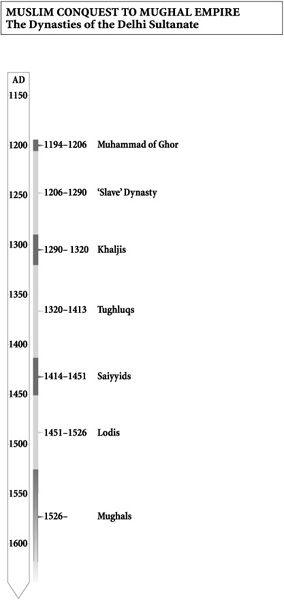
It was not the end of the sultanate or of Delhi. Timur soon withdrew; the Tughluq sultan duly returned to his devastated capital; and two subsequent dynasties, the Saiyyids from 1414 and the Lodis from 1451, both Afghan in origin, continued to rule amidst the ruins throughout the fifteenth century. But under the Saiyyids an authority which had once embraced most of the subcontinent was so reduced that it barely extended beyond the village of Palam, the site Delhi’s first international airport. The Lodis scarcely restored that authority, although they did restore some respectability by overcoming Jaunpur and overhauling the administration. Powerless to control erstwhile provinces and frequently under threat of invasion from them, Delhi was now just one of many, often more innovative and illustrious, power centres. If in pre-Islamic times the division of the subcontinent into strong independent states based on ancient identities of lineage, language, dynastic tradition and economic interest was the norm, then India was simply reverting to type.
Despite two centuries of dominance in most of northern and western India, the sultanate had failed to establish a pan-Indian supremacy, and had not even attempted an Indo–Islamic accommodation. True, in the cities the Hindu population had come to terms with their Muslim overlords: some enterprises, like the royal mints, remained exclusively in Hindu hands; many Muslims took Hindu wives; Indian captives often converted to Islam; and some converts had achieved high office. Yet in Delhi, as in the sultanate’s provincial capitals, the court remained largely a preserve of the Turkish, Persian and Afghan elites. The same was true of membership of the ulema, of senior posts in the administration, and of much of the military. Ethnic as much as religious exclusivity made the Delhi regime totally alien to most of India’s peoples.
Arriving at Multan, then the frontier city of Muhammad bin Tughluq’s kingdom, in 1333, Ibn Batuta had observed how other new arrivals from west and central Asia all sought recruitment into the sultan’s service. Most were mounted and, as sowars (troopers), they had to perform some equestrian manoeuvres before being enrolled in the armed forces. Others sought royal patronage as artisans, scholars, merchants or administrators. Very few looked beyond such patronage. Most trade, most industry and all financial services remained in Hindu hands. But as the English ‘nabobs’ of the eighteenth century would discover, this could be mutually advantageous. Ibn Batuta noted how Hindu banking houses in Multan grew wealthy by advancing to penniless hopefuls from central Asia such gifts as were suitable for presentation to the sultan –horses, slaves, brocades, jewels. The sultan invariably returned a far more valuable present from which the newcomer could repay with interest the Delhi agents of his Multani backer. It was official policy to encourage a stream of immigration; and such were the opportunities offered by India and such the turmoil elsewhere in Asia that the flood of adventurers from all over the Islamic world rarely dried up.
Ibn Batuta found that in Delhi most newcomers expected ‘to gain riches and then return to their countries’13 – again just like the eighteenth-century English ‘nabobs’. As Delhi’s authority declined, aggressive new sultanates on India’s Islamic frontier in Bengal, Gujarat, Malwa and the Deccan boosted the market for military personnel and offered even better prospects for plunder, promotion and remunerative revenue assignments. In fact these independent sultanates had by the fifteenth century become the real lands of opportunity. Scholars, jurists and artisans gravitated towards the more generous patronage on offer. Merchants readily took to supplying and servicing the lucrative Arabian Sea trade from the peninsula’s west coast ports. It was by way of sailings from the Red Sea that Gujarat acquired a large community of African Muslims. Meanwhile the influx of Persians and Afghans into the Deccan would give to the Bahmanid sultanate and its successors a strongly Persian and Shi’ite flavour. This would survive into the twentieth century in the case of Hyderabad, one of these successor states.
If, as Ibn Batuta says of Delhi in the fourteenth century, many Muslim fortune-seekers looked forward to a rich retirement in their original homelands, of elsewhere in the fifteenth century this seems not to have been the case. Most stayed, prospered, married and settled. With the substantial addition of Mongol recruits and Indian converts, the Muslim community was not only growing but constantly renewing itself; as with horses so with men – a steady stream of central Asian imports was seemingly vital to the virility of Muslim rule.
The Muslim elite demanded of India’s idolatrous natives no more than occasional collaboration and no less than total submission. Islamic jurists argued not over whether Hindus should be obliged to pay the jizya (the tax on non-Muslims), but whether they should be allowed to pay it. Death was the only penalty prescribed for idolaters by most Islamic schools of law; only the daringly indulgent adherents of the Hanafi school argued that the jizya was an acceptable alternative. Otherwise Hindus, although occasionally serviceable and often diverting, were beneath contempt. Like the white sahibs of European colonialism, the true believers of the sultanate saw India simply as a source of wealth, a scene of adventure, and a subject for moral indignation spiked with prurient fantasy. They too, indeed, were colonialists. Compromise with the natives was as unthinkable as it was preposterous.
For the tag of ‘the greatest medieval traveller’ Ibn Batuta’s only rival was Marco Polo. Arriving at India’s opposite extremity when he called at one of the Tamil ports en route from China in c1290, Marco Polo tells of trying to have a coat made. To his surprise he found that in peninsular India there were no tailors or seamstresses. In fact there was very little clothing at all, and what there was was neither cut nor sewn. A single length of cloth was simply tied or wrapped about the person, a custom which still survives in the wearing of the sari, the shawl, the lunghi and the dhoti. Bespoke apparel may not have been a Muslim innovation, but it came late and from the colder north. Indeed, in many parts of India tailoring remains a Muslim preserve.
Sailing on to Quilon in Kerala, a port which Ibn Batuta likened to Alexandria as one of the busiest in the world, Polo noted how Hindu kings were as scantily dressed as their poorest subjects; even soldiers, when riding into battle, wore next to nothing. ‘Men and women, they are all black, and go naked, all save a fine cloth worn about the middle.’ Even to one coming from the East, so many bared chests and unbodiced breasts were a novelty. Like the international set who in the 1930s would be so charmed by the topless fashions still prevailing in Bali, the last outpost of Hindu society in south-east Asia, Marco Polo drew his own questionable conclusion: ‘They look not on any sin of the flesh as a sin.’14
That Hindu society continued to challenge the austere morality of both Islam and Christendom well into the fifteenth century is clear from the account of a Russian merchant. Athanasius Nikitin, a native of Tver (Kalinin) on the Volga, reached India in c1470, so barely thirty years ahead of Vasco da Gama. He too arrived by sea, but from the Persian Gulf rather than round Africa, and like other Gulf traders he brought horses. According to Polo, the Pandyan ruler of Madurai imported two thousand horses a year ‘and so do his four brothers’. They needed so many because of fatalities caused by the climate and unsuitable feeding; even if they bred, they produced ‘nothing but wretched wry-legged weeds’. By land to the north and by sea to the south, the import of bloodstock was India’s main extravagance.
Nikitin came ashore at the port of Chaul, about fifty kilometres south of modern Bombay (Mumbai). ‘This is an Indian country,’ he announces in his scatty but endearing memoir.
People go about naked, with their heads uncovered and their breasts bare, the hair tressed into one tail, and thick bellies. They bring forth children every year and the children are many … When I go out many people follow me and stare at the white man. Women who know you willingly concede their favours for they like white men.15
Abdu-r Razzak, another fifteenth-century visitor to the Deccan, noted that only Muslims wore trousers and kaftans (long coats). Heading an embassy from Shah Rukh of Samarkand, who was Timur’s son and successor, Abdu-r Razzak found royal audiences in India a severe trial. The Zamorin of Calicut, another major port in Kerala, or the king of Vijayanagar would be coolly seated wearing little but pearls and a dazzling ensemble of gold jewellery while he, ‘in consequence of the heat and the great number of robes in which he was dressed, drowned in perspiration’.16 Whether admiring the intricate sculpture of the great Hoysala temple at Belur or ogling the courtesans of Vijayanagar, ambassador Razzak showed unusually catholic tastes. Such descriptions, though, merely point up the chasm of convention which separated Muslim and Hindu.
It was not just a question of ethnic or doctrinal differences. Two diametrically opposed codes of social behaviour had collided: one universal, inflexible, authoritarian and obligatory which upheld the equality of individual believers and theoretically promoted a strong sense of community; the other India-specific, sectional, discriminatory and hierarchical which denied equality and revelled in diversity. The social and cultural differences were as fundamental as they were obvious. To the Hindu the stiff brocade kaftan and the ankle-tight trouser must have seemed like some kind of confinement; to the Muslim the cotton loincloth – as finely woven, according to Polo, ‘as a spider’s web’ – was disgustingly indecent. The veil and the zenana concealed Islam’s womenfolk; the copious jewellery and the waist-level lunghi merely advertised Hindu femininity.
When that grim ‘warrior tomb’ of the Tughluqs was under construction below the ramparts of Tughluqabad in Delhi, a thousand kilometres away on the shore of the Bay of Bengal at Konarak the Ganga kings of Orissa had just completed one of the most elaborate and ambitious temples ever conceived. Dedicated to the sun-god Surya, it incorporated the idea, also associated with Apollo, of the sun being drawn by a chariot. Colossal stone wheels, each intricately carved, were positioned along its flanks and a team of massive draught horses, also stone-cut, reared seawards, apparently scuffing and snorting under the strain. Even in its partially reconstructed state, the conceptual scale of this temple is overwhelming, and so too the rich variety of its sculptural ornamentation which, as usual, includes many mithuna (intertwined couples) busy making ingenious love. To Muslims, for whom any representational art is anathema, it would have been the abomination of abominations. But then to Hindus the plain profile of the Tughluq tomb with its sloping sides and martial pretensions must have seemed pathetically primitive. Their aesthetics appeared irreconcilable. Mutual incomprehension seemingly precluded accommodation, let alone acculturation.
Nonetheless a gradual acceptance, which would eventually lead to a glorious synthesis, was underway. The process was not articulated. Muslim writers continued to tell of idolaters massacred and temples destroyed, Hindu eulogists of mleccha enemies humbled and arya heroes exalted. The evidence is often inferential, fragmentary and widely scattered. It is to be sought less amongst the literate elites – the largely foreign ulema and the staunchly orthodox brahmans – and more amongst artisans, cultivators and the commercial and secretarial classes, be they Indian Muslims or lesser-caste Hindus. At this level, wherever Hindu and Muslim lived and worked in close professional proximity, social exchange is evident. Hindus adopted a modified version of the Muslimpurdah(‘curtain’, i.e. the veil) to screen their women; Muslims adopted something approaching Hindu caste distinctions. Elements of ritual and popular devotion were also shared. Muslim shaikhs and pirs (Sufi saints) attracted Hindu followers; Hindu ascetics, dancers, musicians and craftsmen attracted Muslim patronage. In the arts and particularly architecture the results would soon be apparent.
But here again the evidence is diffuse and to be found not so much amongst the ruins of Delhi and in the chronicles of its sultans as in the records and remains of a dozen other capitals scattered across the subcontinent. From these places – Jaunpur, Ahmadabad, Mandu, Gulbarga, Chitor, Vijayanagar, Gaur – ruled the numerous sultans and kings who had succeeded in asserting their authority over particular regions – Awadh, Bengal, Gujarat, Malwa, the Deccan, Rajasthan, etc. – in the aftermath of the Tughluq decline and Timur’s invasion.
The regions themselves encouraged a social consolidation which transcended religious allegiance. Based on core territories, each with a long dynastic pedigree, an economically important hinterland and a now distinct language, they were ready-made for statehood, whether under Muslim rule or Hindu. Location and circumstance also conspired to favour local integration. Here Muslim rulers, mostly far removed from the Islamic world, often at war with the sultan of Delhi or other co-religionists, and always dependent on the loyalty of a largely non-Muslim population, had perforce to compromise. Likewise their Hindu counterparts, isolated on the margins of an increasingly Islamic India, yet obliged to co-operate with Muslim allies, and eager to recruit Muslim troops, could ill afford to indulge ideas of a dharma-led defiance or a Hindu renaissance.
STILLBORN STATES
The number of states which emerged from the collapse of the Delhi sultanate, not to mention the complexity of their mutual relations, could warrant a long narrational stride onto the terra firma of Mughal India. But it would be wrong to diminish the political importance of the fifteenth and early sixteenth centuries. In Europe the period witnessed the emergence of those strong, centralised and mostly monarchical states which would become the basic units of European history. Something very similar appeared to be underway in India: Bengal, Gujarat, Kashmir, Orissa, the south and various parts of central India began to forge the territorial, political and cultural identities associated with the concept of a nation-state. But whereas not even the most committed European federationist would dismiss Scotland or the Netherlands, let alone France or Spain, as ‘regional’ aberrations, such has been India’s subsequent experience of subcontinental hegemonies, and such today is Delhi’s and Islamabad’s paranoia about secessionist movements, that ‘regions’ is how these entities are designated. The recollection of their independent status is not much promoted. The nation-state in pre-colonial India would indeed be stillborn; yet the fact of its being born at all is significant.
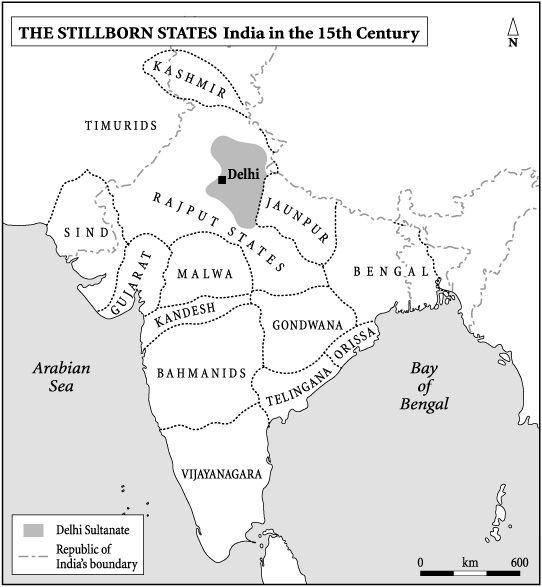
In the Deccan the Bahmanid kingdom and, further south, that of Vijayanagar, both emerged from the remains of the Khalji conquests in the peninsula. Vijayanagar was founded in the late 1330s, the Bahmanid kingdom about ten years later. The kings of Vijayanagar were Hindus and are often credited with spearheading Hindu resistance to the Islamisation of the peninsula. The Bahmanids, on the other hand, were Muslim sultans and their frequent wars with Vijayanagar are commonly seen as a continuation of the Islamising process begun by the Delhi sultanate. This, however, is certainly not the full story, and it may be no more than a gloss imparted by zealous writers, mostly of a later date.
Suspicions are aroused by legends which credit both states with highly ambiguous origins. The future founders of Vijayanagar, two brothers called Harihara and Bukka, were once feudatories of either the Hoysala king or the Kakatiya. In c1327 these brothers were supposedly captured by Muslim forces and taken to Delhi. There, legend has it, they adopted Islam before being allowed to return south as feudatories of Muhammad bin Tughluq. Only later, when a Hindu sage of high repute miraculously recognised them as embodiments of the god Virupaksha, was the sin of their apostasy cancelled and their right to erect a kingdom founded on dharma accepted. Whether this is true or not, the status of Vijayanagar’s founders was obviously such that only elaborate mythologising and divine intervention could validate it.
Likewise, according to Ferishta, the Bahmanid sultans of the Deccan sprang from an unlikely alliance in Delhi. Hasan, who as Bahman Shah would become the first Bahmanid sultan, was once apparently the servant of a Delhi brahman called Gungu. By chance, while ploughing his patch of land, Hasan unearthed a cache of gold coins whereupon Gungu, in his capacity as an astrologer, predicted a great future for him. He also made him promise not to forget his one-time master. Encouraged by such predictions and by his evident good fortune, Hasan headed for the land of opportunity in the Deccan. There he rose rapidly in the service of Muhammad bin Tughluq; and when, at the end of the latter’s reign, both Gujarat and the Deccan defied Delhi’s authority, Hasan emerged from the subsequent confusion as the choice of his fellow commanders to assume the sultanate of the breakaway Deccani kingdom. Enthroned at Daulatabad, and now known as Bahman Shah, he remembered his promise to his brahman patron and duly summoned Gungu south to become finance minster of the new kingdom.
To be fair, Ferishta seems painfully aware of the implausibility of this story. It is thought that Hasan was of Afghan birth, and it seems most unlikely that a Muslim Afghan would ever have served a brahman. Ferishta was also surely wrong in suggesting that ‘Gungu was the first brahman who accepted office in the service of a Muhammadan prince.’17 Yet he adds that, in honour of the brahman, Hasan adopted the name Gungu as one of his titles, and that it was then used ‘on all public documents and remained engraven on the royal seal of that dynasty until its extinction’. He further claims that the name ‘Bahman’ was of similar provenance, being an approximate rendering of ‘brahman’. Others insist that the name derived from the ancient Persian King Bahman from whom the Bahmanids pretended descent. Howsoever, the willingness of a distinguished Muslim historian, who was writing within a century of the Bahmanids’ demise, to credit such accounts is significant. In the eyes of the Delhi ulema the orthodoxy of the house of Hasan, alias Gungu Bahman Shah, was clearly compromised.
Ferishta’s account of the Bahmanids is initially one of almost continuous conflict with their Hindu neighbours, most notably various rulers in what is now Andhra Pradesh plus the kings of Vijayanagar. Major wars with Vijayanagar’s Bukka, who succeeded his brother Harihara, and then with Bukka’s successors, Harihara II and Deva Raya I and II, are seen as triumphs for the Bahmanid sultans who repeatedly threatened the city of Vijayanagar itself. They also carried off hoards of treasure and massacred wholly incredible numbers of idolaters; as a noted authority on the Bahmanids has calculated, ‘if we were to add together the casualties inflicted on the Hindus by the Muslims as given by our Indo-Persian chronicles, there would not have been a Hindu left alive in the Deccan.’18Rather fewer Muslim warriors ‘drank the sherbet of martyrdom’, as Ferishta puts it, but ‘without an influx from overseas it was the Muslims’, according to Professor Sherwani, ‘who were in danger of dying out.’ Mass conversions are not mentioned until the very end of Bahmanid rule, no doubt because Bahman Shah had rejected any idea of imposing the jizya on his Hindu subjects.
Significantly the great city of Vijayanagar (at Hampi in Karnataka), although repeatedly threatened, was never actually captured. No doubt its defences were as formidable as visitors reported and as its magnificent remains testify. Yet, according to Ferishta, it was in these wars of the fourteenth to fifteenth centuries that artillery was first deployed in India. The guns were operated by both Muslim and Christian mercenaries, the latter of whom also here make their Indian debut. Although this decidedly early instance of the new gunpowder technology might be attributed to peninsular India’s maritime links with the Middle East and the Mediterranean, the casting of cannon would have presented no difficulty to India’s highly skilled metalworkers.
If such firepower was indeed available, the destruction of Vijayanagar would have been possible. Annihilation, it seems, was not the object of the exercise. Nor, despite occasional mention of far-ranging ambitions, did either state entertain realistic expectations of bringing the other permanently under its sway. As with other warring neighbours of the period – Gujarat and Malwa, Malwa and the Bahmanids, Malwa and the rajputs of Chitor – victory invariably stopped short of conquest. Royal captives were released, defeated kings reinstated, and the victor’s spoils regarded more as a one-off indemnity than as an annual tribute.
Conflict amongst the ‘regional’ kingdoms of the fifteenth century looks to have been not about sovereignty, only partly about plunder, and mostly about frontier demarcation. At issue between the Bahmanids and Vijayanagar was a rich tract of land between the Kistna and Tunghabhadra rivers known as the Raichur Doab. To command this tract the Bahmanids, like the Rashtrakutas many centuries earlier, soon moved their capital from Daulatabad (near the Rashtrakutas’ Ellora) to Gulbarga and then Bidar (near the Rashtrakutas’ Manyakheta). It was the perfect base from which to create a transpeninsular kingdom and, as the Bahmanids duly expanded their domains to reach the west coast between Bombay and Goa and then the east coast between the Godavari and Madras, the importance of holding the Raichur Doab became immense. As if in recognition of such purely strategic imperatives, Ferishta reports that, despite the injunctions of religion, the two protagonists agreed to end the mindless slaughter of non-combatants and captives. And when in the late 1440s the issue of the Raichur Doab was settled by agreement, direct hostilities between the two neighbours ceased. Conflicting claims to the west coast ports, including Goa, continued, but elsewhere the protagonists avoided attacking one another and on one occasion actually collaborated against a common foe.
Territorial definition is fundamental to the formulation of a nation-state. A similar but shorter conflict between the Bahmanids and their northern rivals of the new sultanate of Malwa also revolved around a disputed frontier tract. When it was settled, this time not to the Bahmanids’ advantage, the two neighbours resumed friendly relations. Parallel instances of the scimitar being readily sheathed once an outstanding territorial grievance had been resolved abound amongst the other powers of the period. When in the 1490s the Bahmanid kingdom suddenly plummeted from power as result of factional in-fighting, Vjayanagar would take advantage of the situation, and war over the status of the Raichur Doab would revive. But although Vijayanagar was left as much the most powerful of the Deccan states, it would soon find that a strong and territorially secure Muslim neighbour was infinitely preferable to the smaller, weaker but territorially ambitious sultanates into which the Bahmanid kingdom dissolved. The glorious heyday of Vijayanagar’s supremacy would prove to be short-lived.
Thanks to the Russian Nikitin, who spent some months in Bidar and Gulbarga in 1470, a dazzling picture of Bahmanid power at its greatest has been preserved. Nikitin’s military estimates, amounting to close on a million cavalry and infantry, must be wild guesswork but his first-hand evidence of both ‘long muskets’ and ‘heavy guns’ cannot be gainsaid. Nor can the almost unimaginable display of opulence. Sultan Shams-ud-din Muhammad, ‘a little man, twenty years old, and in the power of the Khorasani [i.e. Afghano-Persian] nobles’, rode forth to celebrate Bairam ‘on a golden saddle, wearing a habit embroidered with sapphires and on his pointed head-dress a large diamond; he also carried a suit of gold armour inlaid with sapphires and three swords mounted in gold’. Ahead of him walked a huge elephant dressed in silk and brandishing from its trunk a heavy chain with which it cleared a path through the crowds. Behind followed the sultan’s brother on a bed of gold, covered with velvet set with precious stones and carried by twenty men. Then came Mahmud Gawan, the able chief minister and mentor of successive sultans; he too reclined on a bed of solid gold which in this case was drawn by four horses in gilded harness. Hordes of riders in full armour followed, together with several hundred female singers and dancers. Some were practically naked but all were armed with shield and sabre, sword, lance or bow. Three hundred elephants ‘clad in damask steel armour’ completed the procession. Each elephant bore a ‘citadel’ which held six ‘warriors with guns’, and each had massive swords attached to its tusks plus ‘large iron weights hanging from its trunk’. In Nikitin’s mind there was no doubt that he was attending a potentate who, ranking above all others like a latter-day ‘Balhara’, was ‘theMuhammadan sultan of India’.19
SWINGING IN THE WIND
Such Bahmanid pre-eminence would not have been conceded by the sultans of Gujarat and Malwa. A latecomer compared with Vijayanagar or the Bahmanids, Gujarat became independent when its governor, the son of a rajput convert to Islam, assumed sovereignty after Timur’s invasion in the early years of the fifteenth century. At about the same time Malwa followed suit under its erstwhile governor Dilawar Khan Ghori. Dilawar Khan was presumably a Turco-Afghan Ghorid but he quickly signified a more conciliatory attitude to idolaters by encouraging rajput settlement and creating what was in effect a Muslim–rajput condominium. Gujarat’s sultans too, although more orthodox and credited with imposing the jizya and demolishing Hindu temples, habitually married rajput princesses, patronised Indian artists and Sanskrit scholars, and employed Hindus in the highest offices of state. Also prominent in both sultanates, and especially in their respective revenue departments, were Jains, whose survival in western India belied their near-extinction in the rest of the subcontinent.
Both Dilawar Khan of Malwa (or Amid Shah Daud, as he had become) and Ahmad Shah of Gujarat (who succeeded as sultan in 1411) signified their new status by establishing new capitals. Islam had provided a powerful stimulus to urbanisation. Muslims in India, as an elite minority largely dependent on royal patronage and united by the communal duties of prayer and mosque-attendance, were naturally drawn to city life. From Allahabad and Faizabad to Hyderabad and Aurangabad the map of India still betrays hundreds of Islamic urban foundations. In Gujarat Ahmad Shah’s choice fell on a site beside the Sabarmati river. There he founded and heavily fortified the city of Ahmadabad which, rapidly populated by Gujarat’s skilled craftsmen and commercially favoured by its location close to the Gulf of Cambay, had by the end of the sixteenth century become one of the largest and wealthiest cities in India, indeed in the world according to European visitors. It is still the capital of Gujarat, and in the midst of chaotic innercity overcrowding there remain the many mosques, tombs and gateways of the Gujarati sultans and their usually rajput queens.
Were any proof needed of the eclectic Gujarati milieu, it is self-evident in the distinctive architectural style. Here elements and motifs from both Jain and Hindu tradition are incorporated not, as in the Delhi Quwwat-ul-Islam mosque, because dismembered temples were reassembled as mosques, but by gloriously intentional design. Gujarat’s strong tradition of temple-building, together with its skilled masons, simply transferred to the Islamic architectural canon and thereby transformed mihrab and minaret into splendidly ornate features. Clichés of the Mughal style like the perforated screen (jali) and the cupolaed pavilion (chattri) are anticipated. The Jami masjid of Ahmad Shah himself has been hailed as ‘perhaps the most aesthetically satisfying [mosque] in the whole of India.’20
Very different was the new capital of Malwa. As if to challenge the lushly-sited and commercially-favoured city of Gujarat’s sultans, Dilawar Khan and his successors of Malwa lit upon the rugged heights of Mandu. From nearby Dhar, the one-time capital of the good King Bhoj, a prodigious effort was directed to encircling with fortifications the already nigh-impregnable heights above the Narmada valley. At the same time they smothered the upland meadows not merely with the mosques and tombs of Islam but also with the airy palaces, the echoing courtyards and the lotus lakes so beloved of the rajputs and later of the Mughals. If one may judge by what neglect has so obligingly preserved, it was here at Mandu, and in the contemporary Man Singh palace at Gwalior, that India’s secular architecture began to stake its claim as a serious rival to the religious tradition of temple, tomb and mosque.
No metropolis has succeeded to the site of Mandu. Deserted in the seventeenth century, it has remained so ever since, one of India’s – or anywhere’s – most wildly romantic sites. Malwa being landlocked with no very certain frontiers and a host of covetous neighbours, its sultans had frequent cause to congratulate themselves on the effort expended on their capital. Although repeatedly besieged by the Gujarati army and occasionally by expeditions from the Bahmanid sultanate and the rajputs of Mewar, Mandu stood firm throughout the fifteenth century. Under Sultan Mahmud Khalji (reigned 1431–69) Malwa took the offensive, with its forces penetrating deep into Gujarat, the Deccan and Rajasthan and briefly marching on Delhi. Mandu consequently basked in the splendours of lavish patronage. According to Ferishta, Mahmud’s successor was able to assemble a harem of ten thousand maidens. To accommodate them, a self-contained ‘city of women’ was constituted whose inmates formed their own administration and militia, ran their own markets and set up their own manufactures.
What became of this feminist republic is not known. But in the early sixteenth century the Muslim–rajput balance on which the foundations of the Malwa state rested was overthrown. To offset the preponderance achieved by the rajputs, the incumbent sultan called in the forces of Gujarat, while the rajputs looked to their co-religionists in Mewar. In 1518 and then again in 1531 the Gujarati army would indeed take Mandu by storm, and its fall would presage that of the sultanate itself.
But if Malwa proved to be something of a failure in state-formation, Gujarat continued from strength to strength. In Mahmud Shah it enjoyed the services of an exceptionally able and long-reigning sultan (1459–1511) who completed the consolidation of the kingdom. Mercifully, given the innumerable other Mahmuds and Muhammads, he is usually remembered as Mahmud ‘Begarha’, a nickname which is variously explained. It may refer to his whiskers: according to European accounts his beard reached to below his waist, while his moustaches, long and grey like the horns of a buffalo (begara), were swept back to cross in a tie on the crown of his head. Alternatively it may refer to his capture of two vital fortresses (garh). One was Champaner near Baroda in eastern Gujarat, which became a subsidiary capital; the other was Girnar in Saurashtra, the great massif where Ashoka had left that famous rock inscription and where Rudradaman the satrap had once championed both irrigation and Sanskrit. ‘Mahmud Two-Forts’ in effect united mainland Gujarat with the Saurashtra peninsula to create a powerful maritime state enjoying a monopoly of those west coast ports which served upper India. It would prosper well into the seventeenth century and be finally overwhelmed only by a combination of Mughal might on land and Portuguese firepower at sea.
In the absence of obvious frontiers, fortifications were also the key to territorial aggrandisement in Rajasthan. The great plateau of Chitor, Mewar’s equivalent of the heights of Mandu, had been refortified by the Sesodia rajputs following its partial destruction by Ala-ud-din Khalji. Under Rana, or Maharana (variants of Raja and Maharaja) Kumbha, who reigned from 1433 to 1468, another towering stronghold was ringed with battlemented walls at Kumbhalgarh. From these twin eyries the Sesodias extended their sway over the lesser rajput houses of Rajasthan and adventured deep into Gujarat and Malwa. ‘Mewar was now in the middle path of her glory, and enjoying the legitimate triumph of seeing the foes of her religion captives on the rock of her power,’ pronounces Colonel Tod.
At the other extremity of Rajasthan, Raja Jodha (reigned 1438–89), a rajput of the Rathor clan who had been instrumental in securing Rana Kumbha’s throne, established his own hilltop stronghold at what became Jodhpur. ‘Never capable of uniting, even for their own preservation,’ as Colonel Tod put it, the rajputs scarcely constituted a state. They were, though, again about to give a good account of themselves. Famously if fortuitously it would be the boast of the Sesodias of Mewar that they alone never succumbed to the might of the Mughals.
In Orissa, Bengal and Awadh the same process of territorial definition and political consolidation might be traced. In Awadh (Oudh) the sultans of Jaunpur built Tughluq-esque mosques and fought with the Delhi sultans; in Orissa the Suryavamsha rajas built temples and warred with the rajas of Andhra and Vijayanagar. The success and liberality of the ruler, and the culture and language of the locality, created bonds which often transcended those of religion. In Bengal in 1418 a Hindu actually became sultan. This was too much for the Bengali ulema, who sought assistance from Jaunpur. Sultan Raja Ganesh was duly toppled, but only in favour of his son who, adopting Islam, changed his name from Jadusen to Jalal-ud-din and ruled under his father’s direction until 1431. A successor, Ala-ud-din Husain Shah (reigned 1493–1519), is revered as an outstanding patron of Bengali scholarship and, though a Muslim, indeed an Arab, is said to have honoured Chaitanya, the leader of the Vaishnavite bhakti movement in Bengal. In return the Hindus ‘went so far as to honour [the sultan] as an incarnation of Lord Krishna’.21
Husain’s tolerance had its limitations. Like the sultans of Gujarat and Malwa he stands accused of destroying temples in time of war, most notably during an attack on Orissa. But temples were seldom exclusively places of worship. They were also depositories of treasure, political statements which embodied the ambitions of their royal patrons and, on occasion, even military strongholds. Desecration was not necessarily prompted by bigotry.
In Kashmir, where Muslim immigration and conversion had resulted in the installation of a Muslim dynasty in 1339, the normally cordial pattern of Hindu–Muslim relations was interrupted in the early fifteenth century. The great Sun temple of Martand was destroyed and heavy penalties imposed on the mainly brahman Hindus. But the persecution proved short-lived. In a fifty-year reign (1420–70) Sultan Zayn-ul-Abidin reversed such discriminatory policies and, fostering both scholarship and a variety of new crafts, transformed his Himalayan kingdom into a stable and thriving state. Canals and irrigation works were also undertaken and, with a reassertion of its authority over Ladakh and Baltistan, Kashmir aspired to the sovereign status which its distinct history had long promised and which the finest natural frontiers in India seemingly guaranteed.
It was a different story in the neighbouring Panjab. Here evidence of nation-state-building is notably lacking. Timur’s Mongol descendants continued to nurse claims to the lands which he had traversed and conquered en route to Delhi in 1398. Meanwhile Afghan adventurers continued to migrate to and through the Panjab in large numbers. By the late fifteenth century the Afghan Lodis exercised desultory control from Delhi. But so heavily engaged was the Lodi sultan with rivals elsewhere that his governor in the Panjab enjoyed near independence. No obdurate dynasty like the Shahis stood between the undefended north-west frontier and the temptations of India. No champion like the later Ranjit Singh rose to rally Panjabi loyalty. The gates of Hind were swinging in the wind.