
AYUB PLUS ACOLYTE
AID WORKERS AND hippies criss-crossing the subcontinent in the 1960s often reported more favourably of Pakistan than of India. If travelling by land, they tackled the border formalities near Ferozepur in the Panjab, where a checkpoint of watchtowers and roadblocks had been improvised beneath a clump of gum trees in the middle of nowhere. It lacked the arresting contrasts of, say, the Brandenburg Gate but lesser differences soon struck the onward traveller and they were seldom to India’s advantage. On the Pakistan side the roads were neater and the traffic brisker. Billboards were not exclusively reserved for official injunctions and any available wall space was not entirely covered with the grimy collage of poster peelings and graffiti that is democracy’s downside. The phones worked and the shops were well stocked. There were fewer strikes, fewer beggars and many fewer unattended cows.
Confounding the Jeremiahs, Jinnah’s creation looked to be doing all right. A first decade notable for the breakdown of parliamentary politics had given way to a second of ill-disguised military dictatorship, but neither had been terminally disastrous. Save for Kashmir, the nation’s territory remained intact and its armed forces unbowed. Elections at the provincial level had been successfully conducted, a constitution had eventually emerged and, though quickly abrogated, some form of democracy remained the accepted ideal. After a slow start, manufacturing output had picked up and the economy was at last enjoying sustained growth. Some large landholdings had been broken up for redistribution; a more liberal family law was improving the lot of women; and reactionaries and zealots who objected to these reforms were being contained. Notwithstanding the dearth of meaningful representation, the 1960s would be remembered as Pakistan’s ‘golden decade’. Meanwhile good relations with the West and the Islamic world were being augmented by understandings with China and the Soviet Union. By 1965 few countries in the world had a wider circle of well-wishers. Comparing Pakistan with an India beset by austerities, humbled by the Chinese and now rudderless without Nehru, the cynic might reasonably have wondered whether democratic mandates were all they were cracked up to be.
Admittedly conditions were worse in East Pakistan, as East Bengal was now called. They always had been, though in the early 1950s the Korean War had given a brief fillip to the jute business by boosting the demand for hessian, especially as sacking for sandbags. Developing Pakistan’s otherwise negligible industrial capacity had been a high priority from the start. Only by staunching the flow of imports and generating more exports could foreign exchange be conserved and deficits reduced. In this connection much excitement had attended Pakistan’s refusal to follow the rest of the Commonwealth, including India, in a 1949 devaluation of sterling-based currencies against the dollar. Hailed at the time as a courageously defiant stance, non-devaluation of Pakistan’s rupee inflated the value of its exports, like jute to India, leaving a handsome surplus for imports, like munitions, which would be cheaper from the sterling area or unaffected from the USA. That was the theory. But since India was Pakistan’s main trading partner, New Delhi had taken non-devaluation as an irresponsible and decidedly hostile act – or non-act. It responded accordingly, slapping heavy duties on exports to Pakistan that ‘brought interdominion trade to a standstill’ and obliged Karachi to look elsewhere for essential items like textiles and coal.1 Developing new sources of supply obliged Pakistan to incur additional costs in tendering, transport and profiteering that defeated the whole purpose of non-devaluation. The import bill had risen, the trade gap had widened and inflation had hit the consumer hard.
Luckily, after two years of this tit-for-tat, sounder counsels had prevailed. India had changed its tune, removing the most offensive duties and so making it easier for Pakistan to stage a climbdown; in 1955 it belatedly embraced devaluation. Besides such high-risk expedients, five-year plans for industrial development had been trotted out, investment incentives devised and a major role reserved for the state. But in Pakistan, unlike in India, these initiatives had at first fallen on stony ground. Private investors proved reluctant to forsake the easier returns to be made from investing in trade, while state investment had proved no less problematic, principally because the state itself remained a highly contested arena.
Instead of a sovereign parliament, for nine years Pakistan’s only central legislature had been a Constituent Assembly. Pending adoption of the constitution which it laboured to produce, this body exercised interim powers under the 1935 Government of India Act and so was liable to that Act’s ample provision for intervention by the head of state (once the viceroy, then the governor-general, and by the 1960s the president). In effect the Constituent Assembly’s powers reflected those of a bygone colonial era in which representative bodies conferred a veneer of respectability on an essentially authoritarian regime. The composition of the Constituent Assembly was equally out of date. Members had been directly chosen not by the electorate but by the provincial assemblies, themselves elected on a very limited franchise back in 1946 when India was still undivided and ‘Pakistan’ no more than an exciting slogan. The Constituent Assembly could hardly be said, therefore, to enjoy either a popular mandate or a current one. It was no more representative than it was sovereign and was thus doubly vulnerable.
It might still have given a better account of itself had its majority party acted as a responsible unit. Pakistan’s Muslim League, like India’s Congress, had always comprised a spectrum of interests – provincial, linguistic, religious, ideological and economic. But lacking either a strong central organisation, a predetermined programme or, after the death of Liaquat Ali Khan, a respected leadership, it was much more at the mercy of these interests than in control of them. Itself faction-ridden and fragmented, the League in Karachi was in fact less troubled by rival parties than by its supposed associates in the provincial capitals. These provincial Muslim Leagues, though themselves at odds with one another and individually far from united, tended to exploit the central Muslim League’s divisions to promote their own provincial interests, often at the expense of national policies. Nor was this the worst of it; for they were also happy to oblige unelected interests, notably the military and the administrative bureaucracy, by representing their views and acting on their behalf. Parliamentary politics as conducted in the Constituent Assembly by its Muslim League ministry were thus as vulnerable to executive subversion from within (thanks to the League’s warring factions) as from above (through the head of state’s exercise of viceregal powers).
Theoretically the generals and the bureaucrats ought to have been at one with the Constituent Assembly in upholding the national interest against provincial lobbying. But because officers in both these services were drawn overwhelmingly from the provinces of West Pakistan – and predominantly from Panjab – this was not the case. Rather did they see the national interest as being synonymous with that of West Pakistan’s Panjabi heartland, which province could therefore count on the lion’s share of any investment incentives. On the other hand an East Bengal woefully under-represented among the mustachioed mandarins and generals could expect economic discrimination, social neglect and long periods of direct rule. According to politicians in Dhaka, Pakistan as a whole was being steadily ‘panjabised’ while East Bengal was being demoted to the status of a ‘colony’. The British high commissioner had expressed similar sentiments, reporting in 1950 that ‘West Pakistan is prepared to fight the “cold war” with India to the last Bengali.’2
Although the priorities of the military and the bureaucracy did not always coincide, they had done so in the matter of foreign aid. Without it, Pakistan could barely have survived, let alone have accommodated the influx of refugees and confronted India over Kashmir. The bureaucrats needed funds to disburse, the generals needed munitions to rearm, and initially Britain had looked the best bet for both. Some British officers and administrators were still serving in the country; the British considered Pakistan strategically crucial to what remained of their empire; Pakistan’s share of the sterling balances (monies accrued by undivided India during the Second World War) was held in London; and General Ayub Khan, the first non-British commander-in-chief of Pakistan’s armed forces, smoked a pipe, was comfortable in tweeds, played golf and had been a Sandhurst cadet. General Ayub was appointed, on British advice, in 1951. But in that same year Washington comprehensively trumped London’s dilatory drip-feed of military aid and development funds. Having identified Pakistan as a vital link in its geopolitical containment of communism, and having decided that the army was the country’s most stable and amenable institution, Washington was already in direct negotiations with the generals when, in October 1951, prime minister Liaquat Ali Khan was gunned down at a public meeting in Rawalpindi.
As is often the way, a hail of police bullets had instantly eliminated the assassin. An Afghan who had once been a British agent and latterly a Pakistani agent, this shadowy operative could have been hired by any number of interested parties, domestic or foreign. But it was no secret that prime minister Liaquat was ambivalent about alignment with Washington. He is thought to have sympathised with the resentment felt by Pakistani Muslims over the role of the West in Egypt and Iran, and he may have been contemplating a mobilisation of this resentment to challenge his rivals, both civil and military. His removal had, to say the least, been convenient for many.
Whoever was responsible, the losers had been open debate and political accountability. For, as of Liaquat’s death in late 1951, the institutional balance of power in Pakistan shifted decisively north, away from the political mud-slinging in Karachi to the shady swards of the military cantonments in Rawalpindi. The first in a procession of crusty bureaucrats with military connections took over as governor-general; with military approval, another civil servant, the ex-ambassador to the US, soon moved into the prime minister’s office.
The long road from Karachi’s debating chamber to Rawalpindi’s parade ground led through a veritable thicket of bureaucratic authoritarianism. But just as ‘the politicians were less than gifted democrats and the bureaucrats more than traditional autocrats’ so the military dictators were far from outright despots.3 The length of the transition from parliamentary practice to military diktat alone argues against the army’s appetite for government and in favour of its avowed preference for civilian rule, albeit as exercised by unelected and dependable bureaucrats. It would take three years (1951-4) of stop-start bargaining for the desperately needed US arms shipments to materialise under a Mutual Defence and Assistance Pact, and somewhat longer for Pakistan to fulfil its part of the bargain by joining the Baghdad Pact as well as SEATO. Another four years elapsed before the emasculation of Pakistan’s political process was formalised with the dissolution of a second Constituent Assembly and the declaration of martial law. By then (1958) the situation seemed to admit of no other solution.
Provincial elections in East Bengal in 1954 had started the ball rolling. Postponed since the anti-Urdu riots of 1952, East Bengal’s first elections duly confirmed the province’s rejection of the Muslim League and all it stood for in terms of a pro-West foreign policy as well as on constitutional and language issues. The Muslim League lost all but ten of the 300-plus seats it had contested, among them all those held by the Bengali contingent in the central Constituent Assembly in Karachi. The victors, a variety of left-leaning parties dominated by the Awami League and designated a United Front, demanded replacement of these Constituent Assembly members, a move which would probably have terminated the Muslim League’s tenure of power at the centre. But before any action could be taken, the Bengal election was effectively negated. Serious conflict in the jute mills had just left several hundred dead in what was more an ethnic bloodbath than an industrial dispute; then Fazl-ul-Haq, the United Front’s octogenarian leader, had indiscreetly told an Indian audience of his regrets over Partition and his hopes for East Bengal’s ‘independence’. This provided not just a pretext for intervention but an imperative. The governor-general despatched a new hardline governor to Dhaka who promptly declared Governor’s Rule, so suspending all political activity in the province.
The implications of the Bengali vote were serious. Approximately half of Pakistan’s citizens, all resident in its most productive and inaccessible province, were opposed to the priorities, policies and constitutional proposals being pursued by the central government. There was no longer a national consensus; Dhaka and Karachi were on a collision course. But just as serious were the implications of the dismissal of the offending United Front government. For if the governor’s action in Dhaka went unchallenged, so might similar action by the governor-general in Karachi. In other words, the Constituent Assembly, its unrepresentative character now exposed, could itself be next in the firing line.
With unaccustomed despatch the Constituent Assembly immediately began asserting its authority. But, in trying to declaw the governor-generalship, instead of pre-empting a mauling it provoked it. Hatched in a London hotel room, the decisive coup of 1954 got the go-ahead in the gubernatorial bedroom in Karachi. Apparently the ailing governor-general, who at the time was ‘wrapped in a white sheet and gesticulating wildly as he lay rolling on the floor’, whooped with approval. A state of emergency was duly declared on 24 October 1954. The Constituent Assembly was dissolved and its cabinet of ministers dismissed.4
With the prime minister hopelessly discredited in this affair and the governor-general clearly ‘not in control of his full senses’, the bureaucrats sallied out for another round of musical chairs. In 1955 Iskander Mirza, the no-nonsense governor of East Bengal, principal mover in the recent coup and another Sandhurst man, was installed as governor-general; meanwhile prime ministers came and went at the rate of one a year. Only the commander-in-chief stayed put. General Ayub Khan’s support had been essential to the coup, yet he hesitated to stand forth as its principal. Civilian government was to be given one more chance.
It nearly worked. Governor’s Rule was revoked in East Bengal, which now became East Pakistan; to negate that province’s demographic preponderance in national elections, all the other provinces were amalgamated into a ‘one-unit’ West Pakistan; and in 1956 a second Constituent Assembly, newly elected by the provincial legislatures, made quick work of at last providing the now bipartite and renamed Islamic Republic of Pakistan with its long-awaited constitution.
Not surprisingly, this document reserved extensive discretionary powers to the head of state. In effect the contested interventions of ‘Governor-General’ Iskander Mirza now became the constitutional prerogatives of ‘President’ Iskander Mirza. The first-ever elections to a Pakistan National Assembly were scheduled, the franchise being universal and the seats allocated so as to ensure parity between the new units of East and West. But whether members were to be elected by separate Muslim and non-Muslim electorates or by joint ones was left for further discussion. East Pakistan, with a substantial Hindu population, insisted on joint electorates, West Pakistan on the retention of separate electorates. Not without a sigh of relief from many quarters, this issue led to the elections being postponed.
For East and West were at loggerheads over much else. The appointment as prime minister of the veteran Bengali H. S. Suhrawardy (he who as undivided Bengal’s prime minister had presided over the Calcutta massacres exactly a decade earlier and who had since founded the Awami League) was meant to assuage Bengali opinion. It succeeded only in discrediting Suhrawardy. In bitter rows over the allocation of development funds and over Bengali enthusiasm for Egypt’s nationalisation of the Suez canal, ‘Mirza thwacked Suhrawardy back into line.’5 Another prime minister took his place in October 1957, then another in December. Their unwieldy coalitions meant that within a year ‘approximately one-third of [Constituent] Assembly members held cabinet positions’.6
This Karachi charade was overshadowed only by the pandemonium in Dhaka. There, exacerbated as much by the provincial assembly’s less than neutral speaker as by the official opposition, the reinstated United Front government took on both, literally. Fists flew, microphones served as truncheons, members wrestled in the aisles, and a pole flying the national flag did duty as a battering ram. In a repeat performance on 23 September 1958 the deputy speaker was felled when struck on the nose by a missile, reputedly a desk-top. He died two days later. Arrests followed, as did a report from military headquarters in East Pakistan to the effect that only armed intervention could restore order and prevent a breakaway.
It coincided with a similar report from the opposite extremity of the country. The Khan of Kelat in Baluchistan, giving vent to a disgust shared by many, had seized a fort and replaced the Pakistani flag with his ancestral standard. Against what looked to be a bid for autonomy the army finally rolled into action. On 6 October 1958 troops were deployed in Baluchistan. Next day they were everywhere. Throughout Pakistan, ports, airports and rail terminals were occupied, radio and telecom stations seized, the press muzzled, political parties banned, the constitution abrogated and martial law declared.
As military coups go, that of 1958 was a well-planned, smoothly executed and, despite the indefinite postponement of elections, not unpopular exercise. Evidently Mirza and Ayub, the latter now prominent as chief martial law administrator, had been considering the move for months. They had not, though, reached agreement on its aftermath. Mirza announced an early return to civilian rule while Ayub made it clear that martial law must remain in force for as long as it took to restore stability, devise a new political systemand push through a programme of major reforms. One man was thinking days, the other years. The years won. After an abortive counter-coup, Mirza was persuaded to resign in favour of early retirement on a handsome pension in London. Ayub gathered round him a coterie of associates that included the young Zulfiqar Ali Bhutto and assumed the presidency. Before boarding his plane Mirza reportedly wished the general ‘the best of luck’; it could have been a sporting gesture or just a sarcastic good-riddance.
Opinions of Ayub Khan’s personal rule over the next decade differ greatly. To all who cherish democratic freedoms, it remains the bleakest of interludes during which an authoritarian inheritance was so fostered and formalised as to provide both precedent and blueprint for all the military takeovers that followed. Zia-ur-Rahman and Mohamed Ershad in what became Bangladesh, no less than Zia-ul-Haq and Pervez Musharraf in what remained of Pakistan, would brazenly draw on this legacy. Intellectual life was stunted and the hopes of a young nation squandered. Political sycophancy became the norm. The prospects of responsible parliamentary rule ever thriving appeared to have been irretrievably blighted.
On the other hand, those who accord a high priority to economic development and national cohesion tend to be more indulgent. For all his sins, Ayub proved a surprisingly benign, even likeable, dictator. The purges conducted by his counterparts in China, Indonesia and Iraq were notably absent, as were the ideological and sectarian bigotries that informed them. His notions of stability and justice owed more to the rough-and-ready brand of paternalism associated with the Panjab’s British rulers. Thousands of venal politicians, corrupt bureaucrats and black-marketeers were immediately hauled before special tribunals where most were censured, some penalised, but few imprisoned. The object seems to have been to deter rather than to punish. Profiteering was outlawed, prices for essential foodstuffs fixed, probity and administrative efficiency applauded. An attempt to limit large landholdings and redistribute the surplus probably fared no better than in India; and like every government that Pakistan has ever known, the Ayub regime lavished funds on defence to the neglect of education, public health and other forms of social provision. But in Karachi, housing schemes were built for the refugees, while in rural parts of West Pakistan irrigation was extended and land reclaimed. Thanks to the availability of American technical support and investment, Pakistan was an early beneficiary of the ‘Green Revolution’ in the mid-to late 1960s. On both sides of the border agriculture also benefited from a solution to the vexed issue of water-sharing in the Panjab. An Indus Waters Agreement, unattainable so long as Karachi’s warring politicians had a say in the matter, was signed by Nehru and Ayub in 1960 and owed as much to Ayub’s pragmatism as to the World Bank’s intercession. It removed a source of conflict second only to Kashmir and set a rare example of Indo-Pakistani co-operation. Through two more wars and countless crises the signatories would honour its terms and respect the Commission that still oversees them.
On a political stage hitherto monopolised by the subtle wits and rhetorical skills of the legal fraternity – Jinnah, Liaquat and Bhutto, like Gandhi, Nehru and Patel, were all barristers – the bluff statements and simplistic remedies offered by Ayub carried conviction. Not since Wavell had a military mind grappled with the problems of South Asian governance. But, as then, good intentions proved no guarantee of acceptable solutions. Islamabad, Ayub’s designated new capital, was meant to signify a brave new start, like Kemal Atatürk’s Ankara. Yet it was also a monumental extravagance wildly at variance with his own injunctions about simple living and personal economy. The lavish lifestyle of those families, supposedly twenty-two in number, who benefited most from the regime’s free-market economic policies rankled still more. Yet without channelling funds, credit facilities and licences to the entrepreneurial interests best able to exploit them, the long-sought lift-off would hardly have been possible. In 1960-5 manufacturing output grew by over 11 per cent annually and the economy by over 5 per cent annually. They were major achievements. But per-capita incomes increased by only around 3 per cent a year, and this mostly because the rich got richer. The poor just got more. Pakistan’s ‘golden decade’ showered its favours on a few entrepreneurial and landowning interests from the country’s west wing, but almost none from the east wing, while the rest of society benefited scarcely at all.
It was much the same with Ayub’s painfully elaborate system of ‘basic democracy’. His big idea was to enlist support for the regime and encourage a more inclusive esprit by giving the people, 80 per cent of whom were illiterate, a crash course in responsible decision-making prior to the reintroduction of some more conventional form of democracy. To this end there was ordained a five-tier pyramid of ‘basic democracy’ councils, each level of which had its administrative responsibilities. The pyramid reached from the grass-roots ‘union councils’, with half their members being locally elected on a universal franchise, to the topmost provincial-level councils, a few of whose members were indirectly elected from the tiers below. The elective element thus tailed off up the tiers, or ranks, of what was more like a chain of command. Conversely, the unelected element of official nominees and office-bearers became progressively more dominant towards the top – like officers in the army. A product of the parade ground, the system was less ‘basic democracy’ than ‘basic training’ and, though heavily promoted, would be just as easily consigned to oblivion.
The promise of a more conventional exercise in democracy remained, as did the newly self-promoted Field Marshal Ayub’s appetite for national endorsement. Either way, a new constitution was required. With ample experience to draw on, a consultative body quickly cobbled together the necessary document, Ayub then blue-pencilled anything remotely offensive to his chances of controlling subsequent governments, and the constitution was duly promulgated in 1962. Martial law was lifted. National elections, of a sort, followed in 1964. Only the 120,000 ‘basic democrats’ (those who had secured election or appointment to one of the five tiers) could vote; but political parties now re-emerged and old faces – Nazimuddin’s and Suhrawardy’s among them – entered the fray. Joining the ranks of those he most despised, Ayub himself briefly relinquished the presidency to contest as the leader of a splinter group of the resuscitated Muslim League. He won comfortably, though not with the expected landslide and not without accusations of ballot-rigging. The election of a president followed in 1965. Again Ayub won, but this time only marginally. Clearly, to galvanise the nation in support of his reforms some new ingredient was needed.
In point of fact it had already been anticipated by his fiery young foreign minister, Z. A. Bhutto. The meteoric rise of Bhutto had owed much to Ayub’s infatuation with his acolyte’s personal brilliance but more to the latter’s uncompromising championship of the Kashmir issue. Bhutto’s coruscating attacks on the Indian government had won electoral support for the regime, especially among the young, while Ayub himself warmed to the old idea that Pakistan’s problems (and his own) stemmed from the fundamental betrayal of the two-nation theory that India’s retention of Kashmir constituted. There was also fury over Washington’s providing military aid to India in the wake of the Chinese incursion (it might be used to suppress Kashmiri dissent) and over Indian moves to reduce the special status of Kashmir to that of a constituent state within the Indian republic (so in effect annexing it).
In 1963 sectarian sentiment had erupted on both sides of the border when a relic of the Prophet had disappeared from a mosque in Kashmir, then miraculously reappeared. This ‘mysterious affair of the Prophet’s hair’ (it was a single hair, reputedly from His beard) provoked anti-Hindu violence even in East Pakistan, a province not normally very sympathetic to the supposed plight of the Kashmiris. As another Partition-style exodus of Bengali refugees streamed into India, the passion aroused by the affair was taken as proof of the potency of the Kashmir issue. Bhutto hastened to resurrect it at the United Nations; Beijing voiced support; and in what appeared to be a weakening of Indian resolve Sheikh Abdullah arrived in Pakistan on the mission that was aborted by Nehru’s death.
Through the winter of 1964-5 Bhutto kept up the pressure over Kashmir by promising the Pakistani people ‘retaliatory steps’ against India and ‘better results in the very near future’. As the presidential vote loomed, these threats needed substantiating. Accordingly, in March 1965 Pakistani tanks rolled into a disputed border sector in the Rann of Kutch (between Indian Gujarat and Pakistani Sind). Uninhabited and seasonally submerged, the target was almost irrelevant. The exercise was intended purely as a show of force to impress the electorate, test Indian reaction and boost military confidence. It succeeded to the extent that Ayub had to restrain his own generals and that, as part of a ceasefire agreement, the Indian government accepted international arbitration of the border (this being precisely what it had refused in the case of Kashmir). The Pakistani nation hailed a victory and the press succumbed to an orgy of jingoism.
Three months later a plan to infiltrate guerrillas into Indian Kashmir was activated. This time Ayub, who may not even have authorised the Rann attack, gave his approval; but it was Bhutto, backed by the intelligence services, who insisted. He was confident that the oppressed Kashmiris would now greet such intruders as liberators and then fight alongside them to eject the Indian presence. He was wrong; no such thing happened. As in 1947-8, the Kashmiri response was negligible and the Indian reaction swift. The infiltrators were rounded up and Indian troops advanced to the edge of Pakistan’s Azad Kashmir.
In what was proving to be ‘Bhutto’s war’, this setback called for his intended coup de grâce, a full-scale invasion of Kashmir by the might of the Pakistan army. Again Ayub himself seems to have been a reluctant aggressor. The attack was launched on 30 August 1965; Indian forces struck back on 6 September; and two weeks later it was all over. A victim as much of his own rhetoric as of his military inexperience, Bhutto had downplayed the numerical superiority of the Indian forces and grossly underrated their fighting qualities. He had assumed that India’s British tanks and Soviet fighters were no match for Pakistan’s superior American weaponry and that any Indian army without its traditional backbone of martial Muslims would quickly crumble. As the saying went, one Pakistani jawan was worth seven Indian jawans. He had also assumed that New Delhi would restrict hostilities to Kashmir and not gamble on an all-out escalation along the border in the Panjab. Again he was comprehensively mistaken. The Pakistani thrust into Kashmir was quickly blunted, then outflanked by an Indian counter-strike further south. In fact Indian tanks had reached the outer suburbs of Lahore when a ceasefire came into effect. Both sides had succumbed less to one another than to international censure, plus a desperate shortage of ammunition and weaponry occasioned by the inevitable Anglo-American arms embargo.
A new twist was now given to the contention that this 1965 conflict was peculiarly ‘Bhutto’s war’. He had contrived it and botched it; now he bedizened it and built on it. It was not he, the public were told, who had miscalculated; it was Ayub. Isolated among his unelected sycophants, the president had allowed himself to be betrayed by his American and British friends, then hoodwinked by the Indians and Russians into accepting humiliating terms at the Soviet-sponsored peace talks in Tashkent. But an even greater miscalculation had been Ayub’s earlier acceptance of the ceasefire. With the Chinese supposedly poised to resupply the Pakistan army and create a diversion on India’s eastern frontier, with the Indonesian navy steaming to the rescue and other Islamic states promising support, Ayub should have toughed it out. Instead, he had caved in to Anglo-American pressure and so betrayed both the army and the nation.
All of which, whether true or false, said much for Bhutto’s intellectual agility and spoke volumes for his political acuity. Frustration over the outcome of the war was already spilling onto the streets. Party leaders spoke out with near-unanimity about ‘unpardonable weakness’ and the ‘betrayal’ of Kashmir. Mujib-ur-Rahman and his Awami League in East Pakistan (Suhrawardy had died) even derived a certain satisfaction from what they saw as an essentially West Pakistani débâcle. In everyone’s eyes Ayub was fatally discredited. He would hang on for another three years but would never rid himself of the stigma of the war. Worst of all, the army, the nation’s premier institution, had suffered a major setback. In its hour of crisis, Pakistan badly needed a new narrative. Bhutto obliged, and not just once but twice.
PEOPLE POWER
By the mid-1960s the successor states in what was increasingly being called South Asia seemed set on quite contradictory paths: India’s was democratic, ‘secular’ and avowedly unaligned, Pakistan’s authoritarian, sectarian and mostly pro-West. Yet on closer acquaintance their respective policies showed much correspondence. Similar concerns and a shared environment were eliciting complementary responses. It was as if, moving in different directions, they yet marched in step. For two decades and with varying degrees of success, both had concentrated on nation-building, on grappling with divisive issues like language and ethnicity, developing a domestic productive capacity, adjusting to a treacherous world order and, pre-eminently, seeking to promote and entrench central authority. These priorities would remain, but with the addition at roughly twenty-year intervals of other formidable concerns. In the 1980s and 1990s, for instance, all the states of South Asia would be confronted with a resurgence of religious supremacism, Hindu, Sikh and Islamic; and in the 2000s it would be the challenge, as much political as economic, of globalisation.
First, though, in what would be dubbed ‘the people’s century’, the blare of a strident populism was heard across the region. It peaked in the early 1970s when in a configuration not seen again for twenty years all of the by then three successor states would be aligned beneath the banner of democracy. And its genesis may be traced back to the fall-out from Bhutto’s 1965 Indo-Pak war and more specifically to the year 1967. At the time, mobs of teenage Cultural Revolutionaries were already pillorying (‘struggling’) the Party’s bureaucrats in Beijing, Paris was bracing itself for the événements de ‘68, and Washington, then London, was convulsed by Vietnam War demonstrations. The streets were alive with the sound of protest. Lahore being no exception, there Z. A. Bhutto, having resigned from Ayub’s government in 1966, founded his Pakistan People’s Party (PPP) on a vote-catching platform of reclaiming Kashmir, ousting Ayub and redeeming the nation. Simultaneously Mrs Indira Gandhi, having succeeded Shastri as prime minister of India (he had died of a heart attack after signing the Tashkent agreement that ended the 1965 war), watched the Congress party’s majorities of her father’s era shrinking to wafer-thinness and resolved to look outside the organisational structure of the party for a more popular mandate.
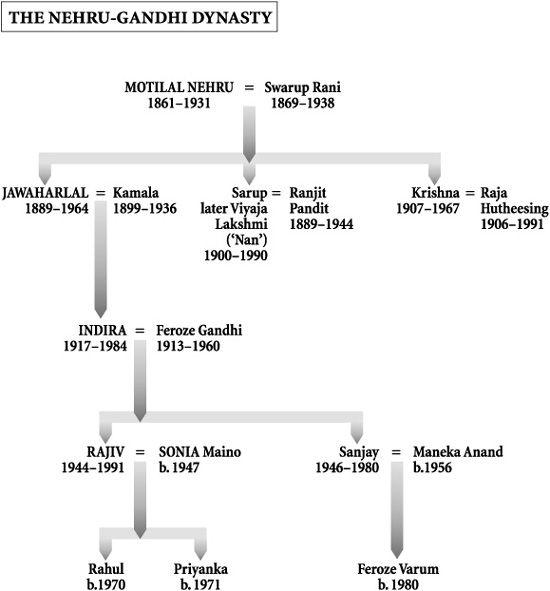
Notwithstanding assertions to the contrary, Mrs Gandhi could hardly be described as ungroomed for power. Born a Nehru, the daughter and granddaughter of Congress presidents, patriotically named Indira, married to a man called Gandhi (though he was unrelated to the Mahatma) and herself Congress president as early as 1959, the new prime minister seemed preordained. Yet she had not been a serious candidate to succeed her father in 1964, and when as a result of Shastri’s unexpected death the party did call on her in 1965, the prime ministership represented not so much her personal triumph as a bid for greater influence by a ‘syndicate’ of party bosses keen to take advantage of a youngish, gender-handicapped and not too intellectually formidable incumbent.
This perception began to change after Congress took a battering in the Indian national elections of 1967. Against a background of post-war Hindu-Muslim violence, secessionist movements in the far north-east and such widespread starvation in Bihar as to cast doubt on the contention that ‘major famines disappeared abruptly with the establishment of a multi-party democracy’, Congress won just over half the parliamentary seats but under half of the state assembly seats and only 40 per cent of the total vote (down from nearer 50 per cent in 1957).7 The communists were back in power in Kerala and were handsomely represented in a coalition government in West Bengal. Elsewhere, rightist parties had done well, including the Hindu nationalist Jan Sangh. And in Madras the Tamil DMK had swept the board. Not obviously a lurch to left or right, then, this was just a lurch away from Congress. Nehru had generally offered the electorate what he thought good for India as a state and nation. But in a novel departure, parties like the DMK were now offering what they thought a majority of their constituents actually wanted. Instead of socialism they provided jobs, instead of equality they demolished Brahmin privilege, instead of Hindi monolinguism they won concessions for Tamil, and instead of sour-faced politicians they fielded glitzy film stars.
Mrs Gandhi took note. Though not previously aligned with any ideological wing of the Congress party, she suddenly discovered a deep affinity for the poor and downtrodden, plus an unexpectedly dictatorial streak. Both traits were evident in a programme of radical reforms tabled in mid-1967 and which, in a nice mix of socialist orthodoxy and voter appeal, included a minimum wage, nationalisation of the banks and abolition of the ‘privy purses’ enjoyed by the ex-ruling families of the princely states. These measures were welcomed by youthful party activists as a direct challenge to the nation’s reactionary elements, but they were contested in the courts and met with opposition from the old-guard ‘syndicate’ of the party. The courts were temporarily bypassed when the banks were nationalised by ordinance. Differences within the party were less easily resolved.
They came to a head in 1969 when the prime minster put up a candidate for the vacant presidency of the republic in opposition to the party’s official candidate. In so far as her man was narrowly elected, the gamble paid off; but it seemed to backfire to the extent that she was now expelled from her own party. Relishing the fight, she blamed her opponents for dividing Congress and rallied her supporters under the banner of Congress (R) (for ‘Requisition’ – she had been denied the chance to requisition an emergency meeting of the party to endorse her presidential choice) and later of Congress (I) (for ‘Indira’). The political juggernaut inherited from her father had certainly been split, though she saw it more as purged. Progressive elements stayed loyal to her, and by forging an alliance with the Communist Party of India (CPI) she cobbled together a parliamentary majority. By default the old guard of party stalwarts found themselves sidelined as Congress (O) (for ‘Organisation’ and later just ‘Old’). With their regional followings intact and their power-broking experience invaluable, they licked their wounds and awaited the next elections with interest. Mrs Gandhi accepted the challenge – indeed she discomfited them and delighted her followers by inviting it. Still unable to shrug off legal challenges to her reforms, she appealed directly to the people by calling a snap election. The national poll due in 1972 would be held a year early.
Elections to the state assemblies were not brought forward, only elections to the national parliament. A first for India, this decoupling of the two electoral exercises promised greater prominence for all-India issues and less scope for the horse-trading at which Congress (O) excelled. That rump’s prospects were further damaged by its electoral overtures to parties of the right for a shared platform of ‘Indira hatao’ (‘Out with Indira’). Stigmatising a supposed tyrant was one thing; it had just worked for Bhutto and it would work against Mrs Gandhi herself seven years later. But against the neophyte leader of 1970 it seemed merely spiteful. She scoffed at the enemy’s opportunistic alliances and hit back with ‘Gharibi hatao’ (‘Outwith Poverty’), a mantra as memorable for its banality as for its ambition – but, above all, memorable. Electioneering on an unprecedented scale, in ten weeks ‘she travelled 36,000 miles … addressed 300 meetings and was heard or seen by an estimated 20 million people’.8 Planes, helicopters and cars whisked her from one lofty podium to the next. Instantly recognisable, she became the undoubted star of the show. But in her own constituency of Rae Bareli (in UP) her veteran opponent, a gnarled socialist with a police-inflicted limp called Raj Narain, noted her antics with care and was complaining about her misuse of government facilities even before the vote. Not a man to relinquish any bone of contention lightly, the dogged Narain would continue to pursue this matter through the courts for the next five years, ultimately to effect.
As the votes were counted in January 1971, an impressive turnout heralded a resounding victory. With 352 out of the 518 seats, Mrs Gandhi’s majority exceeded any of her father’s. In second place the Communist Party (Marxist) or CPM (which had broken from the CPI following the ideological split between Moscow and Beijing) took just twenty-five seats; and as for Congress (O), it fared so badly that the only appropriate explanation for its name was now Congress (Obliterated). The people had spoken; Mrs Gandhi was vindicated. The princes lost their purses, the banks stayed nationalised and a host of other state takeovers were initiated. With her personal authority unassailable, it seemed almost inconceivable that the prime minister’s star had not already reached its zenith. Yet within a year ‘India’s daughter’ was being hailed as India’s deity, in fact as an avatar of the warlike goddess Durga.
This apotheosis came courtesy of stirring developments across the border. For if appealing to the instincts of the people could overturn electoral preconceptions in India, then so it could in the erstwhile extremities of that country that constituted Pakistan. There the first ever national elections in which everyone got to vote produced such startling results that not even military intervention could save the day. A third Indo-Pak war would follow, leading to a third partition and a third successor state.
In declining health and universally condemned for his Tashkent ‘betrayal’ and his over-reliance on the Americans, Ayub Khan had clung to power until March 1969. The delay suited his eventual successor, the new commander-in-chief General Yahya Khan, who needed time to restore morale and consolidate support within the armed forces. It also suited Bhutto, who needed time to conjure up for his Pakistan People’s Party an organisational structure capable of converting the wave of student-led protests and civil disobedience into an effective mass movement.
With a state of Emergency still in force (it had been imposed during the 1965 war), Bhutto was one of many to endure a spell in gaol, as was Mujib-ur-Rahman of East Pakistan’s Awami League. The Awami League had distilled its demands for provincial autonomy into a six-point programme that included a separate currency for East Pakistan, a separate militia and the devolution of powers to tax, conduct foreign trade and generally manage its own economy. As Ayub surmised, the six points could be interpreted as heralding the fragmentation of the Pakistani state, a suspicion confirmed when it emerged that the Awami League had been holding clandestine talks with representatives of the Indian government. For this so-called Agarthala Conspiracy, Mujib, already in gaol, was arraigned for treason and given a state trial. But the evidence was flimsy, some of the accused had apparently been tortured, and the prisoner’s dock proved the perfect place from which to defy Ayub and incite Bengali opinion. Like Lahore and Karachi, Dhaka too was witnessing massive protests against military rule; but there it was military rule’s West Pakistan basis and its anti-Bengal bias that topped the agenda.
Ayub tried offering concessions: Mujib’s trial was halted, both he and Bhutto were released and elections were promised. But it was too late even for a humiliating retreat. Though he survived an assassination attempt in 1968, by 1969 Ayub’s authority was so impaired that his promises were worthless. Resignation was the only option. In defiance of the procedure contained in his own constitution, he simply handed the presidency to General Yahya Khan.
Yahya Khan was said to be a direct descendant of Nadir Shah, the Persian usurper who in 1739 had put late-Mughal Delhi to the sword and made off with the Peacock Throne and the Koh-i-Nur diamond. No such audacious ambitions coursed through his own veins. After the reimposition of martial rule and an initial crackdown, Yahya’s short presidency was notable for conciliar rule and conciliatory intent. Acting as the head of what was effectively an armed forces junta, he distributed departmental portfolios among his own. Home affairs went to a general, education and health to an air marshal and finance and industry to a vice-admiral. It was not quite as crazy as it seemed. During fifteen years of military rule, the army’s interests had diversified. It now had a finger in every pie, from hospitals and schools to farms and pharmaceuticals. In an individual capacity too, generals had found themselves well placed to secure the loans, licences and concessions needed for profitable investments. Expertise abounded, if not application. Civilian bureaucrats were soon appointed to the same ministries; and all these arrangements were to be considered temporary. Yahya himself had no intention of perpetuating military rule. Ayub’s edifice of ‘basic democracy’ and the enforced parity between East Pakistan and a one-unit West Pakistan were quietly abandoned. A new constitution – the third in just over a decade – was to be drawn up. Indeed this was to be the first task of a new national assembly, itself elected on a universal franchise from constituencies of roughly equal population. This meant that the East would at last be fairly represented and have more seats than the West. The provinces were reinstated, and elections to the provincial assemblies were to take place simultaneously. Political parties were free to campaign, new electoral rolls were prepared, the poll was set for late 1970.
Against a line-up of mainly religious, ethnic and personality-based parties, Bhutto’s Pakistan People’s Party lived up to its name, rallying support among the urban proletariat throughout the Sind and Panjab provinces of what had lately been West Pakistan. Bhutto himself kept a foot in both camps, demonising Ayub as a ‘chocolate Caesar’ and demanding civilian rule while consorting with the junta and cultivating Yahya. To galvanise the young and those hardest hit by falling wages and shortages, Bhutto promised ‘roti, kapra aur makan’ (‘bread, clothing and shelter’). Like ‘Gharibi hatao’, the pledge was impractical but memorable. He also railed against India, promised ‘a thousand-year war’ on behalf of the Kashmiris and castigated Ayub’s preference for the Americans over the Chinese. As a Sindhi landowner, he could count on the feudal and religious vote banks of that province; and like every Pakistani politician he cultivated the landowning interests of Panjab, which province’s eighty-five seats would constitute about a quarter of the total assembly.
The results confirmed both the appeal of his broad-based campaign and his stature as the election’s outstanding personality. The PPP won 81 of the 138 seats in the western provinces. It was a victory, albeit a sub-national one, scarcely exceeded by Mrs Gandhi’s triumph a few weeks later. Bhutto had repeatedly claimed to be the voice of the people; now he began to believe it. They became ‘my people’ and he their saviour. ‘I was born to make a nation … to bring emancipation to the people … [to] reverse the march toward self-annihilation …’ he would write.9 The democrat was turning into a demagogue if not a demi-god.
However remarkable Bhutto’s electoral triumph in the West, it was, though, as nothing compared to that of the Awami League in the East. There Mujib-ur-Rahman’s party pulled off one of the most unexpected and comprehensive triumphs ever recorded in a genuinely free multi-party election. The situation had been hard to read. After monsoon floods had led to the vote being postponed till December, the worst cyclone of the century had hit the coastal regions in November. The devastation, carried inland on a tidal bore, left millions homeless and may have killed as many people as Partition and the Indo-Pak wars of 1947-8 and 1965 combined. With the disruption still chronic, the poll had to wait till January in some constituencies. But mostly it went ahead as planned – though not regardless.
For to Mujib and his party the cyclone had been the last straw. As a metaphor for East Pakistan’s devastating submergence beneath the Panjab-dominated West it had some rhetorical value, but it was the relief effort, or rather the lack of it, that played a major part in the vote. Not only was central government aid woefully inadequate, but, according to Awami League propaganda, it was wilfully so. The military had supplied just one helicopter, India’s offers of help had been rebuffed and only international pressure had got the junta to acknowledge the seriousness of the crisis. A more timely illustration of West Pakistan’s callous indifference to the East could hardly have been contrived. Outraged, Maulana Bhashani, the leader of an ultra-leftist party which might have tested the Awami League’s popularity, boycotted the poll. The turnout was nevertheless large and gave Mujib’s Awami League 160 of the province’s 162 national seats plus a like majority in the provincial assembly. He thus had twice as many national assemblymen as Bhutto’s PPP, indeed a comfortable majority over all Pakistan’s other parties combined. Yahya himself now acknowledged Mujib as the next prime minister and conceded that the new assembly should convene in Dhaka.
Yet just as the PPP had won not a single seat in the East, so the Awami League had won not a single seat in the West. The flaw in the nation’s structure, imperfectly obscured by constitutional wallpapering and exacerbated by the military’s clumsy experiments, now gaped wide open. Pakistanis had finally got to choose a government of their liking and it was totally unworkable. Bengali supremacy was no more acceptable to Panjabis than Panjabi supremacy had been to Bengalis. Compromising on Mujib’s six points would trigger a revolution in the East; denying Bhutto a share of power would trigger a backlash in the West. Either way, the integrity of the nation was in the utmost peril. And since Bhutto’s only chance of office lay in having the rules of the game changed, the junta too was increasingly drawn into the fray as a player rather than a referee.
Three-way negotiations between Yahya, Mujib and Bhutto got nowhere. By delaying the inauguration of the new assembly, they merely heightened Bengali suspicions of the junta’s good faith and of Bhutto’s behind-the-scenes manoeuvring. An indefinite postponement of the assembly on 1 March 1971 brought a total strike throughout the East. Students and others clashed with troops, mutinous sentiments were rife among locally recruited units of the Pakistan army, and the Awami League began issuing quasi-governmental directives. It did so in the name of’Bangladesh’ (‘Bengal-land’) instead of ‘East Pakistan’; a new flag was being flown and a new anthem sung.
Yahya seemed to backtrack by announcing that the assembly would in fact assemble in three weeks’ time. Mujib demanded that the troops first return to barracks, that their indiscriminate shooting of civilian protesters be investigated and that power be immediately transferred to the Awami League. Ostensibly to defuse the crisis, Yahya flew to Dhaka; Bhutto followed, covertly to stoke it. But these last-minute exchanges had almost certainly been ‘programmed to fail’.10 A decision in favour of the armed suppression of what the military planners were now calling a ‘rebellion’ had already been taken. The axe would fall; it was just a matter of timing.
On 23 March, the anniversary of the 1940 Lahore Resolution when Pakistan celebrated its Independence Day, Dhaka rallied for ‘Resistance Day’. The new ensign with its golden Bangladesh outlined against a blood-red disk on a lush green background was everywhere. It even fluttered on the vehicles that bore the Awami League leaders to their last meeting with Yahya and Bhutto. Hours later Yahya flew home, then Bhutto. By the time Bhutto reached Karachi on the 26th, he felt confident enough to announce that ‘by the grace of God Pakistan has at last been saved’. He was referring to Operation Searchlight, the army’s genocidal repression of Bengali dissent which had indeed begun. And he was wrong of course.
Pakistan as it had existed since 1947 would not be saved. Rather were thousands, perhaps millions, of disaffected Bengali Pakistanis massacred and several million driven into exile by the state that claimed them. Then, eight months later, the fabric of Pakistan itself was sundered by India’s military intervention on behalf of these exiles and their self-proclaimed Bangladesh. There were thus two conflicts, the first an attritional civil war in which Pakistani forces secured control of the province’s urban centres, the second a brief Indo-Pak war involving hostilities elsewhere but fought mainly in East Bengal where the Indian army, assisted by Bangladeshi forces, secured a Pakistani surrender.
In Islamabad the Awami League’s defiance had come to be seen as treasonable and Mujib’s announcement of independence, issued on 26 March and broadcast soon after, as secession. Besides begging the question of whether, in a democratic context, a majority can secede from a minority (arguably it need only repudiate it), Islamabad’s reading had ignored Mujib’s overwhelming mandate for provincial autonomy. For, if accepted, it would have meant a similar autonomy for the provinces in the West, leading to a diminution of that strong central authority – military, bureaucratic and economic – on which the coherence of Jinnah’s nation depended just as much as religion. Operation Searchlight was indeed, then, all about ‘saving Pakistan’. Yet, by frustrating Mujib’s mandate, Yahya and Bhutto precipitated the catastrophic reaction that led to half of Pakistan being ‘lost’. To Mujib and those who now called themselves Bangladeshis, mere autonomy had ceased to be an option. ‘The struggle now is the struggle for our independence,’ he had told a mass rally on 7 March.’… Turn every house into a fort. Fight with whatever you have.’ The enemy was portrayed as a colonial-style oppressor and the war as a second phase of the liberationist struggle first waged against the British.
Like earlier freedom fighters, Mujib himself had quickly been arrested and consigned to a Panjabi prison cell. Other Awami League leaders had made good their escape to India and there formed a government-in-exile in April 1971. It set up home among mango trees at the renamed Mujibnagar, a border township north of Calcutta which, as part of the Meherpur district of Rajshahi, was technically in Bangladesh. India afforded some protection, although New Delhi’s attitude to developments in East Bengal initially displayed ambivalence. Condoning acts of secession could backfire, especially in a region where Delhi too faced secessionist demands from the disaffected Naga and Mizo peoples plus a strong political challenge from the ultra-leftist CPM.
On the other hand, Indira Gandhi’s handsomely mandated government could not but relish the discomfiture of the Pakistani regime and certainly did nothing to ease it. Rather conveniently, even suspiciously so, in February 1971 the hijacking by Kashmiri militants of a small Indian Airlines plane had provided India with the perfect excuse for a retaliatory suspension of all Pakistani overflights. Thus throughout the crisis, and for some years after, East Bengal was not 1500 kilometres from Karachi but 5000. Military supplies could reach the East’s port of Chittagong only by the sea route round India. Additional troops had either to accompany them or, like the shuttling Yayha and the rendited Mujib, to be flown circuitously via Colombo.
Indian caution gave way to active engagement only when the consequences of Operation Searchlight became apparent. The mass exodus -2 million according to Karachi, 8 million according to Delhi – of East Bengali refugees to the Indian states of West Bengal, Assam and Tripura posed a major humanitarian problem. It also reopened the wounds of Partition and presented India with an interesting opportunity. Of the refugees, many were either Awami League supporters or Bengalis who had defected from the Pakistani army, both groups being intent on continuing the war from Indian territory. As guerrilla fighters, they organised themselves into what became known as the Mukti Bahini (‘Liberation Force’) and, after being trained and armed by Indian regulars, mounted cross-border raids against the Pakistani army and its collaborators. Most of these fighters were Muslims, though by no means all; for it soon became apparent that the bulk of the refugees were in fact members of East Bengal’s substantial Hindu minority. Long regarded with suspicion by Karachi, these stay-put survivors of the 1947 Partition were seen by the Pakistani troops as Indian fifth-columnists and were obliged to flee for their lives. But once in refugee camps along the border, Delhi made little effort to resettle them elsewhere in India. Despite being Hindus, their plight and their rightful hopes of return represented too tempting a political asset. In a familiar twist to the Partition saga, the dispossessed were to be used for political advantage.
It would be much the same with those ex-Indian Muslims, mostly Biharis, who having left India for Muslim East Bengal in 1947 supplied Operation Searchlight with collaborators and who would therefore be exposed to horrific retribution when the Pakistani army surrendered. Themselves confined to refugee camps in the new Bangladesh (partly for their own safety), several hundred thousand of these Biharis would still be there at the turn of the century, awaiting an uncertain ‘repatriation’ to an alien and unenthusiastic (West) Pakistan.
The refugee crisis also served to internationalise the struggle. While Yahya and Bhutto blamed India for inflaming the situation and infringing Pakistan’s sovereignty by supporting the insurgents, Mrs Gandhi harped on the plight of the refugees and the impossibility of India hosting them indefinitely. Each side hastened to present its case to other world leaders and each quietly lobbied for the resources, military as well as financial, supposed necessary for a resolution. Despite Yahya and Bhutto having just facilitated US national security advisor Henry Kissinger’s ground-breaking visit to Beijing, US arms sales were still embargoed; but, thanks to Bhutto’s foreign overtures, Pakistan could count on munitions and diplomatic support from China, plus some more sophisticated weaponry from the Soviet Union. This latter source of supply troubled Mrs Gandhi. To cut it off, to trigger Indian trade and arms purchases from the Soviet bloc and to ensure Soviet support in the event of Indian action in East Bengal, in August 1971 Mrs Gandhi signed an Indo-Soviet Treaty of Peace, Friendship and Co-operation. Non-alignment had temporarily been ditched; sixteen years after accompanying her father to Bandung, Mrs Gandhi had cast India’s lot in with one of the despised superpower blocs.
As the 1971 monsoon ended, the struggle in East Bengal escalated. The Mukti Bahini intensified its operations and by November the Indian army was actively involved in cross-border shelling and forays into East Bengal in its support. By way of diversion, Islamabad responded on 3 December with a bombing raid on Indian installations in the Panjab. Citing this as an unprovoked act of aggresssion, India retaliated with overwhelming force. Air strikes into West Pakistan supported a naval advance on Karachi, a tank incursion in the Panjab and the inevitable exchanges along the Kashmir Ceasefire Line. But these were all by way of a smokescreen for the massive, well-planned and quickly executed advance on Dhaka. Outgunned, heavily outnumbered and hopelessly isolated, the Pakistani forces in East Bengal crumbled. Barely two weeks sufficed for Dhaka to fall and Pakistan’s General Niazi to accept an offer of unconditional surrender. His 90,000 troops laid down their arms and were ignominiously interned. In an eloquent display of the realities of the conflict, the actual surrender was taken in Dhaka by India’s top brass with a single Bangladeshi representative in doubtful attendance.
Unlike previous Indo-Pak wars, this one had been decisive. In the cricket parlance favoured by both sides, after a couple of drawn matches Pakistan had been ‘thrashed’. The series belonged to India. Even in Kashmir a modest advance had been made from the old Ceasefire Line to a new ‘Line of Control’. Moscow had stood firm in its support of India; Beijing had not intervened on behalf of its Pakistani ally; and though part of the US Seventh Fleet had made an unwelcome appearance in the Bay of Bengal, Washington could not be accused of having cheated the victor of victory. To historically minded Hindus it was as if all those countless incursions by Muslim foes from the north-west – from Mahmud of Ghazni to Babur the Mughal – had been avenged. The nation glowed in triumph, Mrs Gandhi bestrode the subcontinent, even her opponents smothered her in garlands.
Pakistan, on the other hand, had been humiliated. Islam had been embarrassed and Jinnah’s two-nation theory discredited. Yahya resigned immediately, leaving Bhutto to ‘pick up the pieces, the very little pieces’ (his own words) as the only civilian ever to have been a chief martial law administrator. By now as experienced in damage limitation as in evading responsibility, Bhutto still had his electoral majority in what remained of Pakistan and would use it to reinvent the nation in his own flawed self-image. Amid all the handwringing in Islamabad and the tub-thumping in Delhi it was easy to forget that in Dhaka, from the wreckage of Bengal’s impoverished heartland, a new nation had been born and a new government, nine months in exile among the mango trees of Mujibnagar, was about to take power.