
THE MIGHTY FALLEN
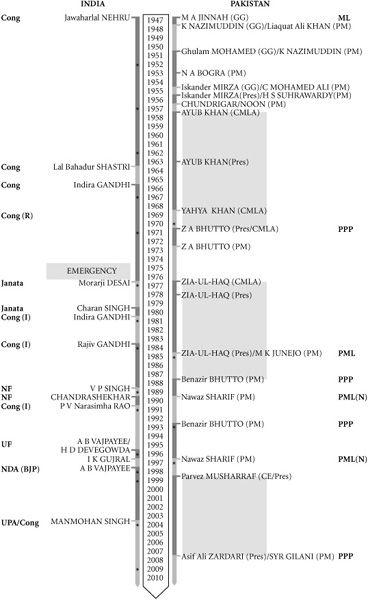
IN 1972, AS the now three successor states turned from the horrors of another partition to the conduct of domestic affairs, many observers detected cause for renewed optimism. A Pakistan relieved of its eastern responsibilities looked a much more compact and viable proposition. Its chastened military was back behind barracks and its civilian leadership, the first in fifteen years, was free to address the social injustices it had so loudly decried. Now that yanking the tail of the Indian tiger was discredited as a national pastime, Islamabad could face the other way and cultivate closer relations with its Muslim brethren in Afghanistan and the Gulf while looking to Beijing instead of Washington for weaponry. In short, a new twist was being given to the Pakistan narrative and it was courtesy, once again, of Bhutto.
Likewise India, having established its primacy in the regional pecking order, could afford to be less paranoid about its old adversary, more attentive to the pressing needs of its rapidly expanding population, and more insistent than ever on the deference due to its central institutions. Meanwhile Bangladesh, overcoming its victimisation complex and little troubled by the religious and ethnic particularisms that characterised the other two states, could begin the Herculean tasks of post-war reconstruction and nation-building. Mujib had been speedliy released from his Pakistani cell to make a triumphant return to Dhaka. International recognition of Bangladesh (including by Islamabad), plus admission to the United Nations, followed in exchange for releasing the 90,000 Pakistani prisoners of war and sparing them prosecution for war crimes. Seldom can a genocidal war, ‘the biggest human disaster in the world’ according to Mujib, have been laid to rest so hastily or left to fester so casually.
Elsewhere the Green Revolution was giving a timely boost to food production, more especially in the wheat-growing areas of northern India and northern Pakistan. Further north, the Kashmiris were doing what they did best, fleecing tourists. At a meeting in Simla in July 1972, Bhutto and Mrs Gandhi signed a Kashmir accord whereby Pakistan recognised the new Line of Control and agreed to pursue a Kashmir settlement by ‘peaceful means through bilateral negotiations’ – all without actually forswearing war, betraying the Kashmiris’ right of self-determination or doing anything until it (Pakistan) felt so inclined. In effect, the Kashmir issue was shelved but not resolved.
Despite India’s new Soviet treaty, no ideological barriers separated the three successor nations. All were united in varying degrees of commitment to ‘nationalism, democracy, socialism and secularism’ as per the four guiding principles adopted by Bangladesh’s constitution-makers. Best of all, in the latterday Durga that was Indira Gandhi, the self-styled Quaid-i-Awam (‘Leader of the People’) that was Bhutto and the undisputed Bangabandhu (‘Friend of Bengal’) that was Mujib, all had inspirational leaders commanding massive parliamentary majorities. Bhutto was still in his forties, the other two in their early fifties. They looked good for at least a decade in power. It seemed inconceivable that within five years all three would have lost the trust of the people and have been, or be about to be, assassinated.
One contributory factor in the disillusionment responsible for this turnaround was not of their making. Like the rest of the world, South Asia would be affected by the recession of the 1970s. Triggered by the 1973 Arab-Israeli war, hikes in oil prices brought world markets close to meltdown and ensured a decade of price instability that affected not just oil but almost all manufactured goods and commodities. Inflation in South Asia was nothing new. Complaints about higher prices, and especially the hoarding and profiteering that accompanied them, had figured in almost every protest movement to date. Nor were the effects of the crisis especially severe in South Asia. Mrs Gandhi had just nationalised oil and natural gas, and both Bhutto and Mujib would follow suit. Pump prices were subsidised and bank interest rates would be contained. Nevertheless basic commodities became more expensive; the poor suffered disproportionately; and, South Asia’s population being poorer than most, discontent would flare, though less over the global situation than over why governments pledged to ‘abolish poverty’ and provide ‘roti, roof and raiment’ were not doing more about it.
Blaming the government seemed a reasonable response to any crisis because the state was so keen to assume responsibility for everything. Of those four guiding principles adopted by Bangladesh and shared by India and Pakistan, socialism (in the sense of state-run economic development) was the one most in evidence in the early 1970s. Indeed Mujib, Bhutto and Mrs Gandhi seemed to be competing in the interventionist stakes. All had another stab at limiting the size of landholdings, redistributing the confiscated hectares among the landless and securing tenurial rights. Again, implementation fell short of intent. Bhutto was probably the most successful, Mujib the least so, having fewer estates to break up. But it helped that, courtesy of the Green Revolution’s new seeds, higher yields could now be expected from smaller holdings; and even in India lowering the land ceiling and circumventing the legal objections that bedevilled it began to have some cumulative effect. More dramatic was the pace of nationalisation. Having secured a source of cheap capital by nationalising the banks, Mrs Gandhi took over the insurance companies, oil and gas, and the coal industry. Bhutto went further, claiming iron and steel, petrochemicals and cement, heavy engineering and electricals, cotton ginning and flour mills, and various utilities. As for Mujib, by commandeering whatever could be construed as important for the state’s reconstruction, he nationalised just about everything.
Though seldom good for productivity, this expansion of the state sector furnished politicians and bureaucrats with substantial leverage in the form of an inexhaustible source of patronage. Socialism for Nehru had been a matter of deep conviction and lofty ideals. For his daughter, as for Bhutto, it was more a means of engrossing power. Isolated among prime-ministerial advisers, with bureaucratic Leviathans to do their bidding and a sycophantic assembly to endorse it, Bhutto surpassed Ayub in his dictatorial style, with Mrs Gandhi not far behind. Popularity being an addictive substance, both developed an applause-dependency that subverted the democratic machinery responsible for dispensing it in the first place. In India according to Sunil Khilnani, as in Pakistan, the meaning of democracy was being transformed. ‘[It] now signified, simply, elections … The drift was unmistakably towards a Jacobin conception of direct popular sovereignty … the mere capture of power rather than its responsible exercise became the exclusive aim of politicians.’1 Parliamentary procedures were circumvented and civil institutions ignored; office represented an opportunity for reward rather than service; scrutiny was deemed unnecessary, opposition intolerable.
Having seen off Congress (O) and then the Pakistani army, Mrs Gandhi’s appetite for political jousting seemed undiminished as she turned to the annexation of the Himalayan state of Sikkim and then to the detonation of India’s first nuclear device. Conducted in 1974, both actions were provocative – of the Chinese, who claimed a special relationship with Sikkim, and of the anti-proliferation community, including the Chinese, in the case of the bomb. Yet these achievements were rapturously received in nationalist circlesand well served their dual purpose of gratifying the prime minister and distracting attention from discontent elsewhere.
Like democracy itself, the documents that enshrined it could be a another barrier to the uninhibited exercise of popular sovereignty. Bhutto was spared embarrassment on this score by the need for a new constitution. Pakistan’s third in as many decades, it was approved in 1973 and reserved to the prime minister – as Bhutto now preferred to be – such extensive powers that he was effectively president as well. India, of course, already had an established and revered constitution. Mrs Gandhi could therefore only tinker with it. Seeing it ‘as a conservative obstacle to her radical ambitions’, she introduced several amendments, one of which prejudiced the independence of the judiciary.2 When in 1975 the courts still proved defiant, she would simply declare an Emergency, so suspending all rights guaranteed under the constitution and clearing the way for a string of further amendments.
But it was in Bangladesh that the constitution proved most contentious, indeed fatal. The four constitutional pillars of so-called ‘Mujibism’ had looked unexceptionable. Over the first, ‘nationalism’, only the state’s non-Bengalis, mostly Buddhist or Christian hill peoples, could quibble; by redefining it as Bangladeshi (rather than Bengali) nationalism, the semantic problem was solved – though not the social and cultural alienation of these groups. ‘Socialism’ was more tricky. Within the Awami League, as well as outside it, many shades of leftist opinion were represented from Maoist scarlet to Nehruvian pink. They had divided even the government-in-exile and they continued to do so after Mujib secured a new mandate in 1973. No less divisive was ‘secularism’. Its very mention in the constitution antagonised the orthodox and swelled the ranks of the religious opposition, while any gesture in their direction brought squeals from the liberal intelligentsia and outrage from Marxist intellectuals.
The pillar that cracked, though, was seemingly the most solid of all, namely ‘democracy’. For a politician whose career had been built on electoral arithmetic, and for a nation that owed its existence to democratic consensus, Mujib’s January 1975 amendment of the new Bangladeshi constitution to permit an authoritarian one-party state looked like utter madness. In the previous year an appalling famine might have been taken as a warning of trouble ahead, like the typhoon of 1970. Over a million are thought to have perished and, as in Bihar a decade earlier, multi-party democracy provided neither safeguard nor certainty of redress. The hoarding and black-marketeering that accountable government was supposed to prevent were all too evident. So too were corruption and preferential treatment in the distribution of relief. Dissension had overcome consensus, self-interest had subverted national cohesion. Three years of reconstruction seemed to have failed. To Mujib and his disciples this suggested not weak leadership but impeded leadership. ‘Democracy’ was sabotaging ‘nationalism’. The solution to such a conflict of principles was what Mujib dubbed his ‘second revolution’.
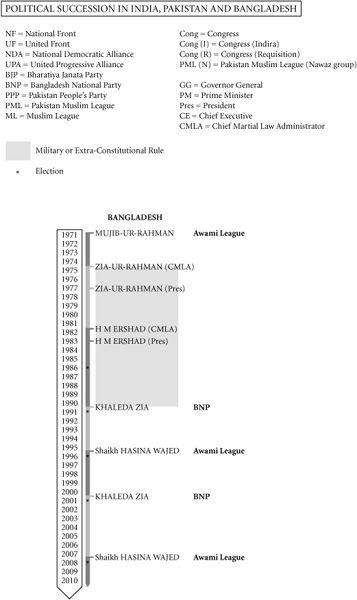
A single party (acronym BAKSAL) with Mujib as leader was authorised; all other parties were banned; and Mujib assumed the office of national president. Civil liberties were curtailed and summary arrests became common. Maoist tendencies were evident in the regime’s mobilisation of the masses into five popular ‘fronts’ – peasants, workers, women etc – and in the promotion of village co-operatives. On the other hand, a reorganised and devolved administrative system under presidentially appointed district governors smacked more of Ayub’s ‘basic democracy’. If the idea was to contain dissent by dispersing it, it was a tactic that would be pursued by subsequent regimes. Whether it would have worked under Mujib’s chaotic dispensation is unknown, for in August 1975 the Bangabandhu himself, his family and his whole experiment were consigned to history. Tanks commanded by a group of young officers in league with a rightist Awami League splinter group stormed the presidential residence and made sure there were no survivors. Only because they happened to be in London at the time would two of Mujib’s daughters live on to reclaim his reputation and in the case of one, Hasina Wajed, to resurrect the Awami League and lead it back to power in 1996, and then again in 2009.
Counter-coups and counter-counter-coups quickly followed Mujib’s death. In a scenario not unlike that which had brought Ayub to power in Pakistan, the man behind Bangladesh’s first martial-law administration in late 1975 did not actually take over as president until 1977. This was General Zia-ur-Rahman who, back in March 1971 as Operation Searchlight got under way, had been responsible for alerting the world to the birth of Bangladesh by broadcasting Mujib’s declaration of independence. No one doubted Zia’s nationalist credentials, but of his commitment to socialism, secularism and democracy there would be little sign. Rather would he, like his contemporary and namesake in Pakistan, free up the economy, pander to religious zealotry and make of democracy a ‘demockery’. Under his presidency, and then that of his former deputy General Ershad, Bangladesh would have to wait till the 1990s to renew its brief acquaintance with meaningful elections and popular accountability.
Next to be hoist on the petard of his own populism was Zulfiqar Ali Bhutto. Unlike Mujib’s fate, the downfall of Pakistan’s idol was a protracted process and allowed ample time for introspection. No one would deny Bhutto’s appeal, least of all himself. On a political stage unaccustomed to intellectual panache his speeches mesmerised the nation and his confidence knew no bounds. ‘Perhaps I have embedded myself too deep in the hearts of the poor of this land …’ he would write. ‘I am a household word in every home and under every roof that leaks in rain. I belong to the sweat and sorrow of this land. I have an eternal bond with the people which armies cannot break.’ Yet somehow this bond was never quite enough, the rain, sweat and sorrow insufficiently sustaining. As he noted of his military opponents, it was ‘the appetite for aggrandisement, the unquenchable thirst for naked power’ that were so addictive. ‘It can bring hallucinations…’3
Hallucinating or just high on his own esteem, Bhutto certainly made a better showing as ‘the People’s Leader’ than Mujib as ‘Bengal’s Friend’. Retrieving the nation after the 1965 war and then ‘picking up the very small pieces’ after the 1971 debacle should rate as his greatest achievements. Pakistanis prefer his response to India’s 1974 nuclear test and his repositioning of Pakistan on the international stage. ‘We will eat grass,’ he is supposed to have said when confronted with the Indian detonation, ‘but we too will make an atom bomb.’ With some help from the Chinese, he was as good as his word. Pakistan thus joined India in owing its eventual nuclear arsenal not to war-mongering generals or religious fanatics but to a vote-mongering democrat.
When billed as the ‘Islamic bomb’, Pakistan’s nuclear ambitions nevertheless lent credibility to Bhutto’s international ambitions. With India’s non-aligned status disqualified by Mrs Gandhi’s treaty with the Soviet bloc, Pakistan took its place. Rejecting the British Commonwealth and SEATO, Bhutto fraternised with Libya’s Qadaffi and North Korea’s Kim Il-sung in an attempt to breathe new life into a movement whose membership had degenerated from post-colonial peaceniks into mad-cap mavericks. He fared better with the Islamic world. In 1974 Lahore hosted the second summit of the Organisation of Islamic Countries. With the exception of the shah of Iran, everyone from Sadat of Egypt and King Faisal of Saudi Arabia to Arafat, Assad and Qadaffi attended. A magnanimous Bhutto even welcomed Mujib of Bangladesh. The spectacle dispelled any sense of Pakistani isolation and, coming hard on the heels of the 1973 Arab-Israeli war, reassured more than one wounded nation.
Unfortunately old wounds were being replaced by new ones. PPP support in the 1970 elections had come almost exclusively from Panjabis and Sindhis. Elsewhere other loyalties prevailed. In the NWFP a Pathan party led by the imposing Wali Khan, son of Abdul Ghaffar Khan, the pro-Congress ‘Frontier Gandhi’, sought greater provincial autonomy as per Mujib’s six points plus closer relations with its Pathan brethren in Afghanistan. It would be Wali Khan’s boast towards the end of his long career that he had been incarcerated by every regime in Pakistan’s history. That of the PPP was no exception. Plagued by assassination attempts and assaults on his party workers, often the work of the thugs in Bhutto’s paramilitary Federal Security Force (FSF), Wali Khan retaliated by characterising the PPP as fascist and referring to its leader as ‘Adolph Bhutto (with no disrespect to Mr Hitler)’.4 Others noted Bhutto’s borrowings from Mao. ‘Chairman Bhutto’ (of the PPP), as he was happy to be called, took to wearing high-collared tailoring, occasionally donning a forage cap and commissioning a handy little book of his pithier utterances.
The NWFP churned with rage throughout the 1970s. So did Sindh, where Karachi and Hyderabad (not be confused with the city of the same name in India) witnessed pitched battles between native Sindhi-speakers and Urdu-speaking mohajirs over jobs, development projects and the admission of more mohajir refugees from Bangladesh. In Baluchistan the situation was worse. There, within two years of the Bangladesh fiasco, the Pakistani army was again called into action in defence of the nation’s integrity. Although the so-called revolt was this time suppressed, it was at a heavy cost both to the province, which remained under military occupation, and to Bhutto, who acquired the new sobriquet of’Butcher of Baluchistan’. Even in Panjab there was widespread unrest as the lately nationalised industries floundered, the economy stalled and more and more of Bhutto’s PPP lieutenants grew disillusioned. By way of consolation the ‘chairman’ scanned the massed ranks of Pakistan’s top brass for a devoted, workaholic and politically unambitious general to take over as chief of staff. Just as Ayub had lit on Bhutto as his acolyte, Bhutto lit on the little-known Zia-ul-Haq. The appointment was confirmed in 1976.
In January 1977, more with the idea of boosting the PPP’s flagging popularity than testing it, Bhutto called for national elections, the first since 1970. This had the unexpected effect of energising and uniting the otherwise motley array of opposition parties. Despite the continued detention of Wali Khan, its potential leader, a Pakistan National Alliance of ethnic, Islamic and conservative groupings duly took the field. With only a matter of weeks in which to organise itself, it was defeated. The PPP captured more than two-thirds of the seats. On the other hand the Alliance, with 30 per cent of the votes cast, took heart, and thus the real campaign came not before the March ballot but after it.
Claiming that the PPP had managed the elections to its own advantage, engineered the elimination or disqualification of other contenders and rigged many of the results, the Alliance called for a nationwide strike. Bhutto offered talks and an inquiry, concessions that seemed to hint that electoral irregularities had indeed taken place. The near-total paralysis induced by the strikes and protests seemed to endorse the opposition’s demand for a re-run. Amid mounting violence and heavy casualties, especially in Karachi and Lahore, even Bhutto’s dreaded FSF proved unable to quell the ferment. That left only the army as the guarantor of public order. When Bhutto’s last-minute concession over a second ballot failed to convince the opposition that it would be any fairer than the first, the die was cast. In time-honoured tradition, a concerned group of junior army officers is said to have prevailed on a reluctant General Zia-ul-Haq to invoke martial law, suspend the constitution and detain all political leaders pending a quick resolution of the crisis.
So began the longest period of one-man military rule (1977-88) in Pakistan’s history. The army had again bailed out the politicians – just as the politicans had bailed out the army in 1971, just as the army had bailed out the politicians in 1958. A pattern was emerging. It would be easy, though, to misinterpret it as indicating some irreconcilable polarity. The army could no more do without the politicians than the politicians could do without the army. Each depended on the other. Bhutto, like Jinnah and Liaqat, had carefully cultivated the military. Zia, like Ayub and Yahya, would never relinquish the hope of engaging civilian support. ‘To survive and succeed, an elected prime minister in the Pakistani context has almost to play the role of a leader of the opposition upholding the cause of the political process against the pre-existing state structure,’ notes Ayesha Jalal.5 But to this ‘pre-existing state structure’ consisting of the largely Panjabi military-bureaucratic establishment, the politicians themselves subscribed and often belonged. Confrontation masked a subtle complicity. Coups tended to be gentlemanly affairs and not notably vindictive. Imprisonment often meant nothing worse than house arrest; the disgraced could expect a graceful retirement. Discounting unexplained and probably extraneous shootings like that of Liaqat Ali Khan, governmental heads rarely rolled.
But, in this as in much else, Bhutto would be the exception. Detained in July 1977, he was released in August but rearrested in September. Zia and his military supporters were either undecided on his future or unready for a trial of strength. Having promised elections ‘within ninety days’, they felt obliged either to let him contest them or to use his arraignment for electoral malpractice as a pretext for postponing them. His triumphal reception during his August release looks to have decided the matter. The elections were postponed and Bhutto cast back into gaol. It remained only to make a case against him, and in this members of his own FSF, who were themselves being interrogated and tried under martial law, proved suspiciously obliging. Charged, somewhat randomly, with ordering the murder of an opponent, Bhutto put up a spirited defence and challenged not only the dubious nature of the evidence but the competence of the court and the legality of the regime it served. It changed nothing. His conviction in March 1978 was a foregone conclusion, as was the death sentence.
A lengthy appeal process ensued. Pleas for clemency and offers of asylum came from all over the world, including from the US, which Bhutto had accused of supporting Zia. But, true to his conceit about being the embodiment of the nation, he refused to tone down his defiance or forswear his destiny. Only death could be guaranteed to silence his peculiar brand of self-centred populism (and not even that if allowance be made for its dynastic aftermath). Zia, busy with an agenda of his own by the time the final appeal was rejected in April 1979, had little choice. On the morning of 4 April, after fond farewells with his wife and his twenty-five-year-old daughter Benazir, Zulfiqar Ali Bhutto was led to the gallows and hanged as a common criminal.
In a parting shot from his death cell in late 1978, Bhutto had linked Zia’s recent self-appointment as president of Pakistan with the assassination of the Afghan royal family in a communist coup earlier in the year. Zia’s action and its ‘downright burial’ of the 1973 constitution had turned Pakistan into what Bhutto called an Orwellian ‘Animal Farm’. On the other hand, the communist bloodbath in Kabul seemed to Bhutto a ‘tonic’.6 The Great Game, that long-standing Anglo-Russian tussle for control of Afghanistan and beyond, was ‘over’. The Afghans had finally dispensed with their Western-backed monarchy and the imperialists had been sent packing. By implication there was hope for Pakistan yet.
But if Bhutto was looking to the day when Zia too would be overthrown by Marxist revolutionaries, he was whistling in the wind. The Kabul coup did lead, a year later, to Soviet troops being invited into Afghanistan as auxiliaries, then staying on as occupiers. But far from this occupation destabilising Zia’s neighbouring regime, it would prove its salvation. Overnight Pakistan was restored to front-line status in Washington’s frantic ring-fencing of the new communist breakout. Arms shipments to Pakistan were resumed, its nuclear transgressions were overlooked, so were its postponed elections, and the Great Game entered a new and more lethal phase. With the active involvement of a markedly more Islamic Islamabad, Washington would turn to the bearded exponents of an uncompromising Islamism for its proxy jihad against Afghanistan’s godless communists. The ‘tonic’ had turned out toxic. Bhutto had got it wrong again.
1984 AND ALL THAT
Ironically the one person who had unwittingly anticipated these developments was Indira Gandhi. For though the dangers of inflaming sectarian sentiments were nowhere better appreciated than in India itself, it was her government’s confrontation with India’s Sikhs, an emphatically non-Muslim community, that first introduced South Asia to the horrors of supranational terrorism. From 1977, by antagonising communal sentiment among the Sikhs and involving the army in its suppression, Mrs Gandhi set in motion a pendulum of violence and retaliation. As a sanctuary and source of arms, Pakistan became implicated in the Sikh conflict, and when in 1989 the pendulum’s deadly swing was extended to a still-contested Kashmir, Pakistan would prove an eager source of guerrilla support and training. Sectarian tensions throughout India and Pakistan would be excited and their bilateral relations further distorted. By the 1990s the baleful throb of bomb-for-bomb, bodies-for-bodies, would be echoed still further afield as the litany of state violence and terrorist outrage extended along the Afghan frontier in a jihadist arc from Kashmir to Baluchistan.
As early as 1984 sectarian butchery returned to the heart of the Indian capital, Mrs Gandhi herself being the first victim. The retaliatory carnage awakened memories of Partition; and the state’s complicity in it revived the explosive issue of India’s commitment to secularism. Then, in the following year, the deadliest ever terrorist attack on a civil airliner prolonged the cycle of violence. The downing by Canada-based Sikhs of Air India’s flight 182 over the eastern Atlantic killed all 329 on board, most of them South Asians of Canadian nationality – and it could have been worse. Had another suitcase-bomb not prematurely exploded at Tokyo airport, a second Air India jumbo would have been simultaneously blown to smithereens over the western Pacific. Concerted terrorist attacks, later regarded as the hallmark of the most ‘sophisticated’ Islamist cells, were being perpetrated by non-Muslim South Asians long before 9/11. In sum, Mrs Gandhi’s provocative interventions in Panjab in the 1980s anticipated, as to both their manner and their consequences, those of the US and its Pakistani surrogate a decade later in Afghanistan. And though of far greater consequence than her shortlived Emergency, in that failed experiment in extra-constitutional rule lay their genesis.
Back in 1975, when Bhutto still ruled supreme in Pakistan and Mujib headed a one-party state in Bangladesh, Mrs Gandhi had made her own lurch towards authoritarian rule. By declaring a state of ‘general emergency’ on 26 June that year she stunned the nation and sent shockwaves round the globe. As the beacons of personal freedom and liberal opinion went out all over the world’s largest democracy – quite literally so in the case of New Delhi’s newspapers where publication was halted by turning off the power supply – the murky extinction of Mujib-ur-Rahman amid the chaos in Dhaka passed almost unnoticed.
It was to India’s rebuff of democratic decorum that elected regimes everywhere took exception. For Nehru’s daughter, of all people, to be ordering the detention without trial of thousands – elected politicians, exmaharajas, respected academics, social workers, labour leaders, senior journalists, student activists, placard-waving workers – almost beggared belief. It was just like one of those British crackdowns during the freedom struggle. State governments were being toppled, while a cowed parliament rubber-stamped a host of constitutional amendments, among them one prolonging its own existence indefinitely (so cancelling the elections due in 1976) and others legitimising the prime minister’s quasi-dictatorial powers. Then came rumours of these powers being exercised for crude social engineering. To beautify the urban environment, entire slum colonies were being bulldozed, while to tackle the population growth fathers en masse were being forcibly sterilised. Not even Mao had done that. World leaders protested, leader writers pontificated and friends of India bombarded the prime minister with missives.
Yet, for all the outrage, the crackdown lacked coherence or conviction. Mrs Gandhi left it to others, most notably her impatient younger son Sanjay, to conduct the more draconian campaigns while she herself trundled out a programme of tired placebos and conducted a rearguard defence of the whole action. Not unreasonably she did so on the grounds of national expediency. Over the preceding months the country had descended into near-chaos. As in Bhutto’s Pakistan, price increases triggered by the oil crisis had ignited massive protests leading to police shoot-outs and strikes that brought major industries to a standstill. The national rail network closed down; students barricaded their colleges. In some of the states, Congress (I) governments bore the brunt of the attacks as opposition parties quickly jumped on the bandwagon. Hauled aboard in Bihar was the seventy-two-year-old Jayaprakash (‘J.P.’) Narayan, a figure from the Gandhian past, half socialist half saint, with impeccable credentials as a champion of worthy causes. Nehru had been devoted to J.P., the whole country revered him. The disparate protests acquired a focus and a moniker as the ‘J.P. Movement’.
Demanding the people’s swaraj (self-rule) and an end to the misgovernment and corruption supposedly responsible for the nation’s ills, J.P. took to the road. After invoking the hallowed traditions of satyagraha and the salt marches, his cavalcade headed for Delhi. Three-quarters of a million turned out to hear him; the capital was brought to a standstill. With counter-demonstrations by Mrs Gandhi’s supporters contributing to the chaos, the state elections pending in Gujarat came to be seen as a trial of strength. There, to the government’s chagrin, the ‘J.P. factor’ proved a vote-winner as well as a crowd-puller; and just as the Guj arat results were coming in, another skeleton limped from the cupboard of Mrs Gandhi’s past. With devastating timing, a long-awaited decision of the Uttar Pradesh High Court upheld the action brought against her for electoral malpractice back in the 1971 ballot. Five years on, Raj Narain, her doughty opponent for the Rae Bareli seat, had been vindicated. Albeit for minor infringements, her election was belatedly declared null and void.
She quickly lodged an appeal with the Supreme Court in Delhi. What had begun as a law-and-order crisis had now acquired a constitutional dimension. The stakes were rising. Across the city, opponents bayed for her resignation while supporters bellowed for her to stay. She could still have defused the situation by calling for national elections. With a good case based on her prompt constitutional compliance, with the southern states little affected and with all the advantages enjoyed by any incumbent administration, she might well have turned the tide. Instead she turned off the lights.
Over the next nineteen months India’s gaol population climbed by 100,000. Litigants found the courts unusually quick to convict, and the black market collapsed as profiteers joined the celebrities behind bars. The ferment of protest subsided. Strikers went back to work and the trains ran on time. But rumour fuelled as much fear as compliance. State governments protested at their peril, and the papers, resuming publication, did little to dispel it. Some advertised their censorship by leaving precious chunks of newsprint blank. Others merely parroted the government’s press releases and printed such news as the newly nationalised news agency released. A credibility gap opened. The prime minster and her advisers, lapping up their own optimistic reports, lost touch with reality; the public and her opponents, doubting every word they read, ignored her protestations of good faith.
For once it was India that was in the political doghouse, while in Pakistan Bhutto proudly upheld the banner of democratic freedom. Yet in India, though the police were everywhere, there was no sign of the army; it was not needed and Mrs Gandhi would scarcely have countenanced it. All along she had insisted that the Emergency was just that, a temporary suspension of civil and political rights while an outbreak of extra-constitutional protest was contained and the issues underlying it addressed. It was no more illegal, she maintained, than the imposition of President’s Rule at the state level; she was acting in defence of democratic freedoms, not in defiance of them. Yet, perhaps because this refrain echoed so closely those trotted out by Ayub, Yahya, Zia-ur-Rahman and imminently Zia-ul-Haq, few took her at her word.
There was thus general disbelief when in January 1977 she sounded the all-clear. Those still detained were released, censorship was ended, party politics reactivated and national elections announced for March. India was democratic again. Because it looked to her critics like a climbdown, they claimed victory; and because it looked to her supporters like the redemption of a pledge, they felt vindicated. Either way, self-congratulation was in order. The Emergency was now portrayed as a test less of Mrs Gandhi’s commitment to democracy than of the nation’s; ‘and there is no doubt that the Indian people passed the test with distinction if not full marks’, says a standard history of the period.7
The promised elections appeared to reinforce this confidence in the democratic process. Mrs Gandhi and her Congress (I) were opposed by all those party leaders who had been associated with the J.P. movement, who had been imprisoned for it and who now formed a kaleidoscopic grouping rather like the Pakistan National Alliance that was oppposing Bhutto. The two countries went to the polls almost simultaneously; but whereas Bhutto won and would be discredited for it, Mrs Gandhi lost and would be lauded for it. The manner of her defeat, the first ever for the mainstream Congress, was emphatic enough. Her party slumped to an all-time low of 154 seats out of 542. Sanjay Gandhi was routed. His mother was defeated in Rae Bareli, the litigious Raj Narain scampering to victory. Both mother and son blamed personal spite and unspecified conspiracies. They were not good losers.
But their opponents were worse winners. Ranging from West Bengal’s Marxist Communists to the Tamil DMK, the all-Sikh Akali party and a new rightist Janata party (itself an amalgam of diehards like the Hindu Jan Sangh and the Congress (O)), the victors had nothing in common other than their rejection of Mrs Gandhi and all that she stood for. J.P. had to arbitrate even their choice of leader. As the new prime minister, Morarji Desai, a desiccated octogenarian respected more for his long association with Nehru than for his tastes in traditional medicine, did his best to mollify all interests. But unity prevailed only when the government was hounding Mrs Gandhi through the courts, buttressing the constitution against any repeat of her Emergency or readjusting her foreign policy. Though good relations with the Soviet bloc remained a priority, as foreign minister Atul Bihari Vajpayee of the Jan Sangh signalled a more conciliatory attitude to traditional foes. Anticipating his later premiership, Vajpayee visited both Beijing and Islamabad, improved relations with the new military regime in Bangladesh and in 1978 was among those who welcomed US president Jimmy Carter to Delhi.
India appeared to be opening up just when, within, it was again imploding. A bad harvest and another round of double-digit inflation had excited the usual protests, to which the faction-fighting at the top lent a dangerous dimension. Caste, calling, confession and ideology being defining traits of nearly all the parties in the ruling coalition, civil disturbances turned increasingly communal and violent. Meanwhile the Gandhis, Indira and Sanjay, protested their concern, invoked the secularist traditions of Congress, purged the party once again and bided their time.
In 1979 defections within the ruling coalition cost Morarji Desai the prime ministership. A stopgap ministry took over. It claimed support from Mrs Gandhi and promptly collapsed when she withdrew it. Government defectors now outnumbered the yet-to-defect. New elections were inevitable. They were held in January 1980 amid a sense of relief not unlike that after the Emergency was lifted. In fact it was as if the Emergency had never happened. Promising nothing more sensational than ‘a government that works’, Mrs Gandhi and her Congress (I) romped home with a two-thirds majority. Better still, anything like a national opposition disintegrated. J.P. had died, and the Hindu nationalist Jan Sangh, the mainstay of the Janata Party, retired to lick its wounds and be reborn as the Bharatiya Janata Party (Indian People’s Party), or BJP. Mrs Gandhi reigned supreme.
As usual though, when opposition at the centre was at its weakest, opponents could always be found among the state governments. Ever since Mrs Gandhi had decoupled national and state elections in 1971, incoming governments in Delhi had invariably hastened to topple any state governments not of their own party or in alliance with it. This could be done informally (by wooing defectors with, for instance, promises of office) or constitutionally (by imposing President’s Rule). Nehru had shown restraint on this front; but under his daughter the frequency of President’s Rule had increased tenfold. Once a precaution of last resort, it had become a habit, even a ritual. It might be compared to the ancient digvijaya, that ‘conquest of the four quarters’ undertaken by newly installed rulers to proclaim their authority, define their dominion and exact fealty and tribute.
ARE WE NOT ALL SECULAR?
Mrs Gandhi’s 1980 post-electoral digvijaya was the most ambitious yet. Nine state governments, about a third of the total, were suspended under President’s Rule, all but one of them subsequently being claimed by Congress (I) in snap elections. Among those toppled and replaced was the Akali Dal ministry in Panjab state. The Akali Dal was the mainstream Sikh party and Panjab was a predominantly Sikh state. Trouble should have been expected.
Ever since Partition in 1947, India’s half of the old Panjab province had been more problematic than Pakistan’s. There had been the usual tensions over the state’s official language and script (principally Hindi/Devanagri versus Panjabi/Gurmukhi) and a much more serious conflict of interest over its confessional make-up. In some areas Hindus were in a clear majority, in others Sikhs were, many of them uprooted from Pakistan. Promises had been made at the time of Partition that in India Sikhs would enjoy the freedom to practise their own faith and manage their affairs in accordance with it. Many had interpreted this as a commitment to the creation of a Sikh state; and that was effectively what had happened, in that by the 1970s India’s half of the old Panjab province had been split into three separate states: Himachal Pradesh (consisting mainly of ex-princely states in the hills), Haryana (a predominantly Hindu and Hindi-speaking state west and north of Delhi) and Panjab (a Panjabi-speaking state with a Sikh majority, wedged between the other two plus Kashmir and Pakistan). This last was the small but richly endowed and strategically crucial state that Mrs Gandhi provoked in 1980.
Officially it was not a Sikh state, just a Panjabi-speaking state. Any concession to sectarianism being anathema to Indian secularism, its creation had been justified purely on the grounds of ‘linguistic reorganisation’. As Panjabi-speakers, most Sikhs had accepted this face-saving fiction but found little else to their taste in its denial of any overt reference to their faith. In 1973 the Akali Dal, meeting at a place called Anandpur Sahib, gave vent to Sikh grievances in a list of forty-five demands. Some were of national import, like a retraction of the central government’s interventions and a return to the qualified autonomy envisaged for all the constituent states in the 1950 constitution. Others were much more specific and included an insistence on the award to their truncated Panjab of Chandigarh, the Le Corbusier-designed city that had been the capital of the undivided state. Naturally Chandigarh was also claimed by the state of Haryana whose Hindu/Hindi majority had no intention of relinquishing such a prize without substantial territorialconcessions elsewhere. Yet no Sikh party could afford to make such concessions, and thus Chandigarh remained a bone of contention between the two states and between Sikhs and Hindus. Worse, the Anandpur Sahib resolution used an Urdu term to refer to the Sikh people that could be translated as ‘community’ – which was acceptable – or more mischievously as ‘nation’ – which was not. The resolution made no claim to an independent nation-state for the Sikhs, yet anyone keen to discredit the Akali Dal as a Sikh separatist party could here find grounds to support such a contention.
Mrs Gandhi, and more especially her son Sanjay, made just this accusation, and to discredit the Akalis (literally the ‘Immortals’, otherwise the Akali Dal leaders) with their supporters, began to cultivate divisions within the Sikh community. In 1980 some Sikh students, disillusioned with the gradualism of the Akalis and backed by co-religionists in North America and the UK, actually articulated the demand for a sovereign, independent state. A new partition and a Bangladesh-like breakaway were envisaged. The state was to be called Khalistan and as president-in-waiting a London-based politician was chosen.
Obviously no deal was possible with such outright secessionists. But there were other contenders. Already a radical young preacher of charismatic appeal was outbidding the Akali leaders in promoting a ‘fundamentalist’ version of Sikh doctrines without actually endorsing political independence. This was Jarnail Singh Bhindranwale, an Usama bin Laden prototype in both his apostolic appearance and his fierce dedication. Despite a reputation for inciting his followers to murder, it was he on whom Sanjay Gandhi and his henchmen in the central government allegedly pinned their hopes of denting the Akali Dal’s appeal and so shattering its hold on the body that controlled the Sikh places of worship and silencing its Anandpur Sahib demands.8
Though the Akali-run state government was toppled in Mrs Gandhi’s 1980 digvijaya, its leaders proved more formidable in opposition than in government. One of them took up residence in the Golden Temple at Amritsar, the Sikh Mecca, there to organise and incite a campaign of protest while enjoying virtual sanctuary. Bhindranwale followed suit, occupying another part of the temple complex and apparently enjoying a free hand as he pursued his own bloody agenda of terrorising a rival Sikh sect, eliminating his critics and out-Sikhing the Akali Dal. The untimely demise of Sanjay Gandhi – he crashed while performing aerial stunts over New Delhi – made no difference. If anything Sanjay’s Panjab ‘policy’ acquired a momentum of its own as his mother became increasingly isolated in her grief. Meanwhile Bhindranwale operated with impunity, even immunity, disposing of opponents, robbing banks and inciting communal hatred. Though it boosted his following, it dismayed both Sikhs and non-Sikhs and increasingly panicked the state’s large Hindu minority.
By 1984 Sanjay’s political stunt was judged to have stalled as spectacularly as his aerial acrobatics. Panjab was becoming ungovernable. Bhindranwale had thrown off New Delhi’s traces and was now warming to the idea of an independent Khalistan. Murders and other acts of intimidation attributable to his followers were becoming commonplace; his heavily armed guards infested a Golden Temple that was being brazenly fortified; and Hindus were being massacred just for being Hindus. Powerless and divided, the state government was replaced by President’s Rule, but to little effect. Of the ‘Million Mutinies Now’ chronicled in V. S. Naipaul’s 1980s Indian odyssey, the climactic one was that in the Panjab. Desperate to match Bhindranwale’s radical appeal, the Akali leaders upped the stakes by calling for mass strike action. They were duly arrested. But the bloodletting continued. With Bhindranwale designated a terrorist and the police unable to cope, Delhi’s only recourse was to tear a leaf from the manual of Pakistan’s politics and call in the army.
Any comparison between Operation Bluestar, as the Indian army’s June 1984 assault on the Golden Temple was called, and Operation Searchlight, the Pakistani army’s 1971 action in East Bengal/Bangladesh, would be grossly misleading. The objective of Bluestar was simply to take out Bhindranwale and his henchmen. It was not directed against Sikhs in general, most of whom were appalled by Bhindranwale’s antics and supported the intervention. Yet such was the clumsy conduct of the assault, such the damage inflicted on the Sikhs’ revered sanctum by the use of tanks and artillery, and such the heroic resistance put up by the martyred Bhindranwale and his men – such too the death toll (officially around 500, unofficially over 3000, many of them non-combatant pilgrims) and the brutality of the subsequent crackdown – that Bluestar, like Searchlight, precipitated a greater crisis than it resolved. Now ‘the anger spread far beyond the orthodox and the Akalis’, noted Tully and Jacob in their first-hand account of the affair. Distinguished Sikhs with nothing but contempt for Bhindranwale handed back their medals and, in ‘the most serious crisis of discipline the Indian army had faced since Independence’, entire Sikh battalions mutinied. One actually marched on Amritsar from its barracks in distant Bihar.9
While non-Sikhs largely applauded the action taken against terrorists who were mistakenly supposed to enjoy Pakistan’s backing, many Sikhs, not all of them Bhindranwale supporters, now saw his tirades against New Delhi and its anti-Sikh agenda as horribly prophetic. His martyrdom generated a cult of revenge and an atmosphere of intense suspicion. Yet, incredibly given the recent mutinies, Mrs Gandhi continued to entrust her safety to a heavily armed police detail that included Sikhs. When asked about the security risk, her dismissive ‘Are we not all secular?’ positively invited an emphatic response. It came on a bright October’s morning, four months after Bluestar, when Indira Gandhi, while crossing the garden of her New Delhi residence, was calmly greeted with raised weapons and a shower of bullets from the two Sikhs on guard duty. More executioners than assassins, both men then laid down their arms, claimed full responsibility for the murder and were themselves gunned down in custody. One survived to be later tried and hanged along with another accomplice. But in Panjab they were accounted martyrs to the Sikh cause, their dependants being fast-tracked to electoral success and parliamentary seats.
No less predictable was the hostile reaction among non-Sikhs, especially in the capital. Reports of Sikhs in Panjab rejoicing at the demise of Mrs Gandhi excited a sense of national outrage and brought Hindu mobs on to the streets. Baying for revenge, they torched Sikh homes, massacred their turban-wearing occupants and desecrated Sikh places of worship. Meanwhile the police stood idly by. Political figures offered the mob incitement and rewards, officials circulated the electoral rolls that helped identify Sikh premises, the media afforded irresponsible coverage, and the government sat on its hands.10 Seemingly, when it was a question of protecting Sikhs, the army waited in vain for a summons to intervene. The hospitals overflowed; bodies littered roadways. In the three days following Mrs Gandhi’s assassination 2000-3000 Sikh men, women and children are believed to have perished at the hands of their fellow citizens. Worse still, a quarter of a century later and despite interminable inquiries, those officials who were allegedly responsible had yet to be prosecuted. In the mayhem of 1984 it was not only the horrors of Partition that had been reawakened but the still greater crime of state connivance in officially orchestrated violence. Mrs Gandhi’s ‘Aren’t we all secular?’ rang hollow.
Sikh extremists would respond with more assassinations and with acts of indiscriminate slaughter like the suitcase bombing of the Air India jumbo. To his credit Rajiv Gandhi, himself a civil aviation pilot as well as Indira’s elder son and successor as prime minister, firmly rejected his brother Sanjay’s interventionism. Agreement was reached with a chastened Akali Dal, the Anandpur Sahib demands were watered down, the Khalistan advocates marginalised and, not without setbacks and a second occupation of the Golden Temple, peace eventually returned to Panjab. But the damage to India’s proud boast of not discriminating against any of its citizens on the grounds of religion remained. The nation’s secularism had been compromised. In an atmosphere of heightened communal tension, any incidents of religious conversion became headline news. Muslims closed ranks and increasingly looked to their co-religionists in the Gulf for reassurance, Sikhs and Christians likewise cultivated their overseas connections, and Hindu activists sensed a long-sought opportunity to assert their own conception of India as a Hindu nation. The floodgates of sectarian antipathy had been opened.