
FROM WEST TO EAST
WHILE TOILING in the two-thousand-kilometre patchwork of fields which is the Gangetic plain today, farmers have occasionally unearthed substantial hoards of copper implements and even copper bars. Associated with them at some sites are poorly fired and ‘unspeakably crude’1 bits of ochre-coloured pottery (OCP) which tend to disintegrate at the touch. Unworthy of the Late Harappans and distributed too widely and too far east to be credited to the arya of the Vedas, these copper hoards remain a mystery. They are assumed to have been the property of itinerant smiths or traders who, for reasons unknown, stashed away their wares some time before 1000 BC. But the trouble with copper, or indeed iron, which first appears soon after this date, is that one can never be sure that the form in which it survives is that in which it was first cast. The harpoons and axes of this ‘copper hoard culture’ could have been made from the melted-down pins and arrowheads of an earlier people, while the presence of copper bars strongly suggests that the metal was already being widely traded.
Like metals, myths too get recycled. Reworked and so richly embellished as to be almost unrecognisable, stories which may once have reflected genuine historical events are liable to be re-used by later generations in a totally different context and for purposes quite other than that for which they were originally intended. This is not the case with the corpus of Vedic literature; the form and content of its sacrificial formulae were, as has been noted, too ritually crucial to be tampered with. Less sacred compositions, like the two great Sanskrit epics, were a different matter.
Both the Mahabharata and the Ramayana survive in several versions, the earliest of which are at least five hundred years later than the Vedas. Yet their core narratives seem to relate to events from a period prior to all but the Rig Veda. As with the Greek epics attributed to Homer, this extraordinary antiquity justifies the attention accorded them in traditional histories. The wildly different dates adduced for the Mahabharata war – or for the Trojan war – scarcely matter if the events themselves can be verified. Sadly, though, in both cases so heavily have these tales been reworked for propaganda purposes, and so crammed and padded have they become with edifying sermons and other extraneous additions, that their original core stories are as hard to isolate as their dates.
Theoretically the Puranas, another group of Sanskrit texts, should be able to resolve this problem for the Indian historian. The most important collection of the Puranas, or ‘ancient legends’, is even later, dating only from c500 AD; yet it contains myths and genealogies which purport to go back to Manu (and beyond). Sure enough, here figure the names of protagonists from the epics as well as of Vedic chiefs and arya tribes. No doubt these lists were compiled from an ancient oral tradition which originated with thearya bards and would have been carefully memorised by their successors. But, like the epics, the Puranic compositions show signs of having been reworked. When finally they were written down, it was not in a spirit of disinterested scholarship but to elevate the pedigree of later dynasts and to enhance the repute of their brahmanical backers.
In their present form [the Puranas ] are only religious fables and cant, with whatever historical content the works once possessed heavily encrusted by myth, diluted with semi-religious legends, and effaced during successive redactions copied by innumerable careless scribes; so that one finds great difficulty in restoring as much as the kinglists.2
This does not mean that they are worthless. Despite what D.D. Kosambi, himself a brahman, called ‘the deplorable brahman habit’3 of organising and categorising unrelated traditions into a convenient pattern, large chunks of the Puranic genealogies may be as authentic as the central characters and events in the epics. Moreover, just as the copper hoards, whatever their original provenance, reveal something about the uses, smelting techniques and distribution of copper, so these literary hoards can reveal something about the changes at work within north Indian society. The period between the events they describe and their being finally written down, roughly the first millennium BC, is of crucial importance. It is ‘the real formative period of Indian civilisation … : henceforth we can trace the continuity of civilisation through the succeeding ages.’4 Thus scholars like Kosambi and Romila Thapar, anxious to understand how, for instance, tribal structures crumbled and states emerged, focus less on the stirring events described in the epics and more on the contexts – geographical, social, environmental and economic – in which they occurred.
Like a self-denying ordinance, this stern approach deprives the historian of many a gallant hero plus whole chapters of rip-roaring narrative. More agreeably, it also diverts attention from that nagging problem of Indian history being so light on dates.
Because of the difficulty in assigning an exact chronology to the sources [i.e. the epics] it is impossible to be precise or dogmatic as to when particular changes took place … Consequently the major significance of these sources lies more in their indication of the nature of the trend of change which they delineate rather than in the precise dating of the change.5
The historicity of a hero demands that his place and dates be established; no such figure graces Indian history until the Buddha illumines the scene after 500 BC. But ‘the nature of a trend of change’ can reasonably be assigned to an entire river basin and a timespan of centuries.
The ‘trends’ which emerge from such studies are numerous and important though seldom explicit. For instance, central to both of the great epics is the question of succession. The Pandava heroes of the Mahabharata (Yudhisthira, Bhima, Arjuna, Draupadi, etc.), like their counterparts in the Ramayana (Rama, Sita and Lakshmana), are initially denied ‘kingdoms’ which would seem to be theirs by birthright and are forced into exile. Primogeniture evidently influenced succession and there are hints about the divine sanction of kingship; both of these ideas would become cardinal features of later monarchies. Yet Puranic references can be highly ambiguous about kingship as an institution, although one should not perhaps read too much in its oft-repeated adage: ‘As bad as ten slaughter houses is one oil-presser’s wheel, as bad as ten oil-pressers’ wheels is one inn sign, as bad as ten inn signs is a harlot, and as bad as ten harlots is a king.’6
But it is also clear that society at the time, though now settled and familiar with agriculture, was still clan-based. Kingship was subordinate to kinship and probably amounted to no more than chieftainship-among-equals. Succession by primogeniture was thus heavily qualified; much depended on the physical and moral perfection of the candidate, on the approval of his peers, and on his successful avoidance of fortuitous mishaps and curses. Ideas of a kingship which transcended clan affiliation and of automatic succession by right of birth, though obviously important to those who reworked the original stories, would only become the norm towards the middle of the millennium and then only among certain tribes.
As for the retreat into exile, the other central theme in both epics, this is taken to indicate the process by which clan society resolved its conflicts and at the same time encroached ever deeper into the subcontinent. Eventually population pressures on land and other resources would encourage greater social specialisation and the assertion of a central authority, two of the prerequisites of a state. But during the first centuries of the first millennium BC, these same pressures seem merely to have encouraged a traditional solution whereby clans segmented and split away to explore new territories.
Exile meant withdrawing from settled society not into the desert (which even renunciates seem to have shunned) but into the aranya, the forest. Here life was challenging though full of possibilities; numerous venerable sages and barely-clad nymphs could even make it idyllic. Something of the later antithesis between the safely settled, caste-based society of the village and the dangerously peripatetic and egalitarian society associated with the forest is already apparent. But for every agreeable sylvan experience there also lurked amongst the trees a monstrous demon or some other species of hostile primitive. These creatures, even if recognisably human, possessed no houses and subsisted as hunter-gatherers. To exiles who prided themselves on being settled agriculturalists, the nomadic ways and uncouth habits of the forest were anathema. The monsters had therefore to be exterminated, while harmless savages, like the snake-worshipping ‘Nagas’, could be enlisted as allies or tributaries, usually through marriage and through inventing acceptable pedigrees for them. In effect the relationship between the epic heroes and their forest foes mirrored the presumed pattern of Aryan ‘colonisation’ and settlement.
‘The people move from west to east and conquer land,’ says the Satapatha Brahmana. By the time of the Mahabharata they had evidently reached the upper Ganga, for there stood Hastinapura, the story’s disputed capital. Forest exile in this geographical context could only mean that, in their eastward spread, the pioneers of Aryanisation were entering the main Gangetic basin. Decidedly different from today’s dusty chequerboard where tufts of trees survive only as shade for huddled villages, Uttar Pradesh and Bihar were then a moist green wilderness of forest and swamp, a tropical taiga of near-Siberian extent. Here, unlike in the drier Panjab, land clearance posed a formidable challenge. The soils were heavier and the jungle thicker; even fire-breathing Agni’s work must have been quickly undone as smoke-blackened stumps burst back into leaf. On the other hand the forest was rich in resources. The exiles invariably used their sojourn in the wilderness to re-arm with a formidable arsenal of new weapons. Though ascribed to divine provenance, these unbreakable swords, bows with un-erring arrows, and devastating missiles may more plausibly have been fashioned from the exotic timbers and minerals only to be found in the terra incognita beyond the then confines of the western settlements.
Although copper from Rajasthan had been used by the Harappans, the best-quality deposits lie much further east in what is now southern Bihar. Thence too came iron. Whether its use was first learned from indigenous smiths in peninsular India or whether through trade contacts with west Asia is uncertain. Likewise the revolution it eventually effected. After 500 BC iron axes and probably ploughshares were indeed helping to solve the problem of clearing the land and working heavier soils; but until that time the ‘black metal’ seems to have been reserved almost exclusively for weapons and knives. Access to the new metallurgy may not, then, have eased the settler’s lot, but it could at least have given the exiled Pandavas a military edge – literally – over their enemies. Adopted by the other clans, iron represented a major technological advantage, comparable to the horse-drawn chariots of their arya ancestors and perhaps of more utility in the closer confines of the new environment.
Unfortunately, charting the eastward progress of Sanskritic but still tribal intruders was not germane to the purposes of those who retold the epics for the edification of later generations. Indeed surviving versions of the Mahabharata would have us believe that the Pandavas and their Kaurava rivals were not only far from primitive but that they already monopolised the resources of the subcontinent. When not in exile, they are described as living in pillared pavilions and marble halls, their interiors opulently furnished and their floors so highly polished that visitors hitched up their robes in the belief that across such glimmering expanses they must needs wade. The Kuru ‘kingdom’, centred on Hastinapura, is projected as being of vast extent and untold wealth, its armies feared throughout the subcontinent and its potential allies extending from coast to coast.
Such descriptions served solely to legitimise the grandiose ambitions of later empire-builders. (And if one may judge by the television serialisations of the 1980s, they still serve to underpin conceits about a pan-Indian prehistory of spectacular sophistication.) In reality, though, the core geography of the Mahabharata is limited to a small area of the Ganga-Jamuna Doab which was the maximum extent of Kuru territory. This is self-evident from an early episode in the story when, the territory having been divided, the Pandavas set out to the ends of the ‘kingdom’ to found a new capital. They choose Indraprastra, just sixty kilometres away and still so named –indeed still fortified; its crumbling walls, although not those of the Pandavas, served the British designers of New Delhi as a suitable feature with which to terminate the vista from their own marbled halls of Viceroy’s House (now Rashtrapati Bhawan).
Further detail on the Indo-Aryan drang nach osten may be gleaned from the archaeological evidence for the first half of the first millennium BC. At Hastinapura and other sites that ‘unspeakably crude’ ochre-coloured pottery which is sometimes found with the copper hoards is succeeded by a very superior painted grey ware. ‘PGW’ was evidently produced on a wheel, and was confidently decorated with geometric and floral motifs. It is found principally throughout the Ganga-Jamuna Doab and in adjacent areas of the Panjab, Rajasthan and the western Gangetic valley, a distribution which tallies nicely with the geographical context of the Mahabharata. Often it occurs in quantities which imply a greater population density than previously, and thus ‘it marks an assertive society, richer than its immediate predecessors’.7 It was also a society which, judging by associated finds, worked the land as well as keeping both cattle and horses. Finally, the dating of this PGW also tallies well with that of the c950 BC date for the great war. If not the pottery from which Vedic chieftains once quaffed their psychedelic soma, it may well have been off PGW dishes that Bhima, trencherman par excellence amongst the Pandavas, prodigiously fed. In short, the PGW looks to have been the distinctive pottery style of the Kuru and associated clans on the north-west fringes of the Gangetic plain.
Another pottery style known as black and red ware (BRW) seems to have been contemporary with PGW but to have had a wider and patchier distribution which included much of western and central India. This has suggested an association with the Yadava clan, a sept or segment of which is said to have migrated south from its base at Mathura (between Delhi and Agra). In the process it seems to have established an important corridor of Aryanisation to Avanti (later called Malwa), where the city of Ujjain would soon arise, and further still into Gujarat and possibly down the west coast. The Yadava dimension has to be pieced together from scattered references in the Puranas, since it lacks the detailed documentation provided for the Kuru by the Mahabharata. Nevertheless into the latter epic as the Pandavas’ mentor and guardian is worked the legend of Lord Krishna, the scion and hero of the Yadava lineage. Krishna, although used as a mouthpiece for the revered but later Bhagavad Gita (and although later still to become the frolicsome toddler and pastoral heart-throb so dear to Indian sentiment), is here an aloof and awesome figure whose no-nonsense approach is partly an indictment of human frailty but also stems from an insistence on the centrality of clan loyalty and aryatradition. The Yadavas were evidently a conservative lot. In Gujarat as in Mathura pastoralism and dairy farming would retain their economic importance long after arable farming had become the mainstay of life and the source of surplus in the Gangetic basin. Likewise the western clans would cling to their traditional hierarchies long after their eastern cousins had adopted state formations.
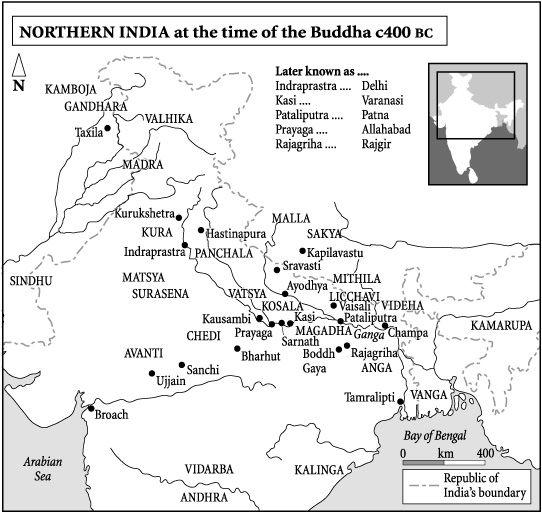
Another salient of black and red ware suggests a south-east movement from Mathura along the edge of the Vindhya hills. These form the southern perimeter of the Gangetic basin whence, in Bihar, the BRW descends again into the plain. It there re-meets the painted grey ware, a parallel arm of which is discernible extending east along the skirts of the Himalayas. The impression gained is therefore that of a pincer movement, possibly dictated by the problems of clearing the dense forest and draining the swamps which blocked progress along the banks of the Ganga itself. Instead the tide of migration and acculturation seems to have worked its way round the edges, and especially round the top edge. Thus the principal chain of janapada, or clan territories (literally ‘clan-feet’), lay well to the north of the main river, on the banks of the Ganga’s tributaries as they flow down from what is now Nepal. In the Satapatha Brahmana there is even a detailed description of Agni burning a trail eastwards and eventually leapfrogging what is thought to have been the Gandak river so as to ignite the forest beyond and clear its land for settlement and tillage by the Videha clan.
This northerly route of east–west transit and trade, extending from the Panjab and the upper Indus to Bihar and the lower Ganga, now became as much the main axis of Aryanisation as it would subsequently of Buddhist proselytisation and even Magadhan imperialism. It was known as the Uttarapatha, the Northern Route, as distinct from the Daksinapatha (whence the term ‘Deccan’) or Southern Route. The latter, largely the Yadava trail from the Gangetic settlements to Avanti (Malwa) and Gujarat, would also become a much-travelled link giving access to the ports of the west coast and the riches of the as yet un-Aryanised and historically inarticulate peninsula. But it was along the Uttarapatha that the Aryanised territories would first begin to assume the trappings of statehood. Initially those at the western end in the Panjab and the Doab tended to look down on those on the eastern frontier in Bihar and Bengal; the latter were mleccha, uncouth in their arya speech and negligent in their sacrificial observance. By mid-first millennium BC it would be the other way round. As the eastern settlements grew into a network of thriving proto-states, many laid claim to exalted pedigrees and, assuming the mantle of Aryanised orthodoxy, would be happy to disparage their Panjabi cousins asvratya or ‘degenerate’.
THE MAHABHARATA VERSUS THE RAMAYANA
The Ramayana, second of the great Sanskrit epics, has been subjected to the same sort of revision processes as the Mahabharata. So much so that attempting to tease India’s past from such doubtful material has been likened to trying to reconstruct the history of ancient Greece from the fables of Aesop, or that of the Baghdad caliphate from The Thousand and One Nights. The Ramayana’s story is, however, simpler than the Mahabharata’s and its purpose is clearer. No one under Lord Rama’s sway would swap a king for ten harlots, let alone for a thousand slaughterhouses. For in the form we now know it, the Ramayana may be seen as ‘an epic legitimising the monarchical state’.8
When it took this form is uncertain. A condensed version of the story is told in the Mahabharata, but it would appear to be an interpolation. It is certainly no proof that the characters in the Ramayana preceded those in the Mahabharata. The opposite seems more probable, in that Lord Rama’s capital of Ayodhya lay astride the Uttarapatha and five hundred kilometres east of the Kuru/Pandavas’ Hastinapura. That, in its final form, the Ramayana is definitely later than the Mahabharata is shown by the prominence given to regions which are unheard of in the latter. Indeed, while the main wanderings of the exiled Pandavas seem to have been restricted to the immediate neighbourhood of the Doab, those of Lord Rama and his associates are made to extend deep into central and southern India. No doubt much of this was a gloss by later redactors, but it is still precious evidence of the continuing spread of Aryanisation during the first millennium BC. If the Mahabharata hints at the pattern of settlement in the north and west, theRamayana continues the story eastwards.
Thus while the Mahabharata belongs to the Ganga-Jamuna Doab, the Ramayana is firmly rooted in the middle Ganga region. Rama’s Ayodhya was the capital of an important janapada called Koshala, roughly north-eastern Uttar Pradesh, which some time in mid-millennium would absorb its southern neighbour. The latter was Kashi, which is the old name for Varanasi (Benares). In a popular Buddhist version of the epic, Varanasi rather than Ayodhya actually becomes the locus of the story. And much later, in Lord Shiva’s city, in a quiet whitewashed house overlooking the Ganga and well away from the crowds thronging Dashashwamedh Ghat, the seventeenth-century poet Tulsi Das would pen for the delight of future generations the definitive Hindi version of the epic. Varanasi would make the Ramayana its own, and to this day slightly further upstream, on rolling parkland beside the ex-Maharaja of Varanasi’s palace, the annual week-long performance of the Ram Lila (a dramatised version of the epic) remains one of the greatest spectacles in India.
This suggests that whereas the Mahabharata survives in the popular imagination as a hoard of cherished but disjointed segments, like the scattered skeleton of a fossilised dinosaur, the Ramayana is still alive – indeed kicking, if one may judge by the events of the early 1990s. Casting about for an evocative issue around which to rally Hindu opinion, it was to the sanctity of Ayodhya and its supposed defilement by the presence of a mosque that fundamentalist Hindu opinion turned. Loudly invoking Lord Rama, in 1992 saffron-clad activists duly assailed the Ayodhya mosque and so plunged the proud secularism of post-Independence India into its deepest crisis of conscience.
That Ayodhya/Varanasi score higher in the sacral stakes than Hastinapura/Indraprastra may also have something to do with the different cosmic perspectives of the two epics. A clue is provided by the language of the Puranas, whose genealogies undergo an unexpected change of tense when they reach the Bharata war. From one of Sanskrit’s innumerable past tenses the verb suddenly switches to the future; in effect, subsequent generations as recorded in these genealogies are being prophesied. Given that the lists were not written down until centuries later, the succession of future descendants may be just as authentic as that of past antecedents, indeed rather more so since later names extend into historic times and can be verified from other sources. But the point that the authors of these lists were trying to register was that the great war marked a watershed in time. It was literally the end of an era. The Dvapara Yug, the ‘Third Age’ of Hindu cosmology, came to a close as Pandavas slew Kauravas in the great Bharata holocaust at Kurukshetra, ‘the field of the Kuru’; thereafter the dreaded Kali Yug, the still current ‘Black Age’, began.
Although the battle does not mark the end of the epic, the impression gained is that the Mahabharata is essentially retrospective. It celebrates a vanishing past and may be read as the swansong of an old order in which the primacy of clan kinship, and the martial ethic associated with it, is being slowly laid to rest. In the eighteen-day battle nearly all the Kauravas, plus a whole generation of Pandavas, are wiped out. Yudhisthira, ostensibly the principal victor, surveys the carnage and is overcome with remorse; the rivalry and conflicts endemic in the clan system are repudiated; with the intention of returning to the forest, Yudhisthira asks his followers to accept his abdication. Krishna will have none of it: the ruler must rule just as the warrior must fight; release depends on following one’s dharma, not indulging one’s grief. Reluctantly Yudhisthira concurs, performing the royal sacrifices of rajasuya and aswamedha. But regrets continue, and when Krishna himself dies, it is as if the last remaining pillar of the old order has been removed. All five Pandavas, plus their shared wife Draupadi, can then gratefully withdraw from public life to wander off into the Himalayas.
By way of contrast, the Ramayana may be considered as decidedly forward-looking. It opens new frontiers and it formulates a new ideal. Although nothing is said about a new era or a system of governance specifically designed for it, the implication is clear. When Rama eventually regains his capital, it is not to indulge in remorse or even to reafirm Vedic values but to usher in a dazzling utopia of order, justice and prosperity under his personal rule. The resultant Rama-rajya (or Ram-raj in Hindi, ‘the rule of Rama’) quickly became, and is still, the Indian political ideal, invoked by countless dynasts and pledged by countless politicians, secularist as well as Hindu nationalist. Likewise Ayodhya itself would come to represent the model of a royal capital and as such would feature in many subsequent Aryanised state systems. In this guise it would travel far, making landfalls in Thailand where Ayuthia, the pre-Bangkok capital of the Thai monarchs, supposedly replicated Rama’s city, and even in central Java where the most senior sultanate is still that of Jogjakarta, or Ngajodya-karta, the first part of which is a Javanese rendering of ‘Ayodhya’.
MONARCHIES AND REPUBLICS
Legitimising monarchical rule, in India as in south-east Asia, was the Ramayana’s prime function. But in both places its use for this purpose was dictated as much by current challenges as by residual loyalties to a past order. For in north India of the mid-first millennium BC other experiments in the organising of a state were already well underway. Monarchical authority was not, it seems, essential to state-formation. Nor was its absolutism, as heavily promoted by its brahman supporters, congenial to all. Other sources suggest dissent and bear copious testimony to alternative state systems with very different constitutions.
The textual sources concerned are all either Buddhist or Jain. Nataputta, otherwise Mahavira (‘Great Hero’), would formulate the Jain code of conduct in the sixth-to-fifth centuries BC, just when Siddhartha Gautama, otherwise the Buddha (‘Enlightened One’), was preaching the Middle Way. This was a coincidence of profound moment. It would make the history of the mid-Gangetic plain in the first millennium BC a subject of abiding and even international interest; more immediately, it directs the historian’s attention to aspects of contemporary Indian society that would otherwise be ignored. For the lives and teachings of the great founding fathers of Buddhism and Jainism quickly inspired a host of didactic and narrative compositions which supplement and sometimes contradict orthodox sources like the Puranas. Moreover, both men were born into distinguished clans which belonged not to kingdoms modelled on Rama’s Ayodhya but to one of these alternative, non-monarchical state systems. Jain and Buddhist versions of the Ramayanastory, or of episodes within it, thus show a rather different emphasis. They also incorporate significant information on places other than Ayodhya and on state systems other than monarchies.
These alternative state systems have been variously interpreted as oligarchical, republican or even democratic. The term now used for them is gana-sangha, evidently a compromise reached after some early-twentieth-century scholarly sniping, since we are told that ‘in the years 1914–16 a great controversy raged [presumably amongst blissfully bunkered academics] about the term gana.’9 A variant of jana, basically it means a ‘clan’ or ‘horde’ which, qualified by sangha, an ‘organisation’ or ‘government’, supposedly gives a meaning of ‘government by discussion’. Such ‘governments by discussion’, or more commonly ‘republics’, could of course take many forms. The extent to which all or only some of their constituents participated in decision-making, the institutions and assemblies through which they did so, and the degree to which they elected or merely endorsed a leadership are not clear. Nevertheless, all these matters are currently the subject of debate, partly because of obvious parallels with the contemporary republics and democracies of ancient Greece, and partly because modern India itself has a republican and democratic constitution whose pedigree occasionally generates some warmth.
That a clan-based society should opt for a constitution which was more egalitarian and less autocratic than monarchy seems perfectly logical. In a sense the republics merely institutionalised traditions of consultation amongst the leading clansmen which go back to Vedic times. These took the form of assemblages which ranged from the open samiti to the more restricted and specialised sabha and parisad. As consultative groups the latter would develop into ministerial councils in the monarchical states, while the former seems to have retained its sovereign status in the republics.
Most of the mid-millennium republics of Bihar and Uttar Pradesh (UP) – those of the Licchavis, Sakyas, Koliyas, Videhas, etc. – came into being as a result of the usual process of segmenting off from a parent clan. In due course the breakaways claimed their own janapada, their territory, and perhaps intentionally, perhaps through neglect or penury, they skimped on performing the full programme of Vedic sacrifices and paid scant attention to brahmanical authority. Surplus produce and booty, when they materialised, would not therefore have necessarily been ‘burned off’ in ritual orgies designed to impress the gods and enhance the sacrificer’s prestige. Instead they would have become available for other purposes, like administration, urbanisation, industry and trade.
This, however, is a simplistic explanation for the emergence of states, and would certainly not have encouraged the formation of monarchies. In brahmanic tradition kingship is said to have been pioneered by the gods. Facing defeat by their supernatural enemies, the gods put their heads together and decided to choose a leader; Indra got the job. A raja, in other words, should be chosen by his peers, his role was principally military, and his raj had the sanction of divine precedent. Other myths reformulated the concept. One, already noticed, promoted kingship as the only insurance against anarchy. In the evil times ushered in by the Kali Yug, men found themselves obliged to compete with one another for wealth, women and favour. Society was thus reduced to the free-for-all of matsya-nyaya (‘the law of the fishes’, i.e. of the jungle); and men were accordingly obliged to formulate rules of conduct and to seek a means of enforcing them. The gods, or Lord Vishnu in the shape of that rapidly growing fish, proposed a raja ; and they selected Manu. He agreed, but only on four nicely judged conditions – that he receive a tenth of his subjects’ harvest, one in every fifty of their cows, a quarter of all the merit they earned, and the pick of their choicest maidens. In other words, authority and law-enforcement were the now raja’s main responsibilities; he was chosen by the gods rather than men; and under an advantageous reciprocal arrangement he had a right to a substantial contribution of the good things his subjects produced.
Here, then, was a firm ideological basis for kingship. But while the element of contract implicit in the Manu myth was much emphasised by Buddhist sources, brahmanic sources focused on the element of divine sanction. Either way, a monarch was theoretically subject to constraints, human or divine, and should not be regarded as an outright despot. Conversely, all theories of kingship provided ample justification for the administrative and coercive structures which would constitute a state system.
But as with the more spontaneous evolution of the gana-sanghas (republics), state-formation was prompted not simply by the appeal or logic of a particular constitution. Just as important were the challenges and opportunities created by new technologies and new social and economic conditions. It seems fairly certain from the abundance of artefacts unearthed by archaeology that, by mid-millennium, population densities had increased, and that migration had slowed as the more easily worked tracts became settled. The population increase owed as much to the incorporation, or Aryanisation, of indigenous peoples as to a soaring birth-rate amongst the immigrants; and both processes would heighten social awareness and caste/class distinctions.
On the other hand, agricultural production seems to have more than kept pace with the growing population. The use of heavy ploughs drawn by eight oxen or more, the widespread adoption of rice and the development of irrigation are all well attested by 500 BC: ‘Buddhist texts describe rice and its varieties with as much detail as the Rig Vedic hymns refer to cows.’10 It has been suggested that the wetter soils of northern Bihar were so unsuitable for barley that only some understanding of wet rice-cultivation would have made them worth settling. The effort of clearing such lands and building embankments for water retention would still have been arduous; yet it paid off. By the sixth-fifth centuries BC the Lichhavi and other republics north of the Ganga would together represent a formidable power well capable of meeting a challenge from their monarchical neighbours, notably the Koshala/Kashi kingdom in the south-west and, south-east across the Ganga, the aggressive new dynasty of Magadha.
More intensive farming regimes also made for new attitudes towards the land. The grazier’s seasonal parameters had given way to the fixed dimensions of the ploughman’s field. Anchored to a dependable supply of water and labour, the grama grew into a village of mud-brick housing which was home both to families of clan descent and to a growing band of socially differentiated dependants and subordinates. From the village there now spread a quilt of carefully supervised plots within a network of ditchings. The common rights of ownership typical of a pastoral society were being edged out by local initiative and the use of subject labour. Quick to claim the fields which they had reclaimed, the grhpatis, or heads of households, pressed for title to land, labour and water as the best way to meet their obligation of supplying the livestock and, increasingly, the grain needed for the leadership’s ritual sacrifices. Imperceptibly terms like bali, which originally meant an offering intended for the clan-chief’s sacrificial disposal, came to denote a fixed and regular contribution which, when subject to record and assessment, duly became a tax. Similarly bhaga, originally a ‘share’ of the spoils of war exacted by the chief, came to signify a tax on produce, usually of one sixth.
As cultivable land came to be considered as familial property, so the wider but ill-defined janapada, the ancestral territory of a particular clan, assumed fixed boundaries. The Gangetic basin’s abundant rivers and river-beds made convenient frontiers for the newer janapada in the east. Buddhist texts list sixteen maha-janapada, or major janapada, as having been extant in the sixth century BC. They extended from Gandhara and Kamboja in the north-west of what is now Pakistan to Avanti and Chedi in central India and Anga and Kalinga in Bengal and Orissa. Soon to be known as rashtra, or ‘kingdoms’, many still retained their tribal names; Kuru was still the land of the Kuru, and Malla of the Malla. But allegiance was now dictated less by the horizontal bonds of kinship and more by the vertical ties of economic and social dependency. Instead of being focused on tribe or clan, loyalty was increasingly to the territory itself, to the individual or body which had sovereignty over it, and to the town or city where that power resided.
CITY AND CASTE
India’s second urbanisation (the first being that of the long-forgotten Har-appans) may be attributed partly to this process of state-formation and to the institutions it engendered, and partly to the surplus generated by the new agricultural regime pioneered in the east. The post-Vedic texts, of course, would have us believe that towns and cities had dotted the land for aeons. But it is only from c600 BC that archaeology lends any weight to their optimistic imagery. Earthen ramparts of about this period have been uncovered at Ujjain (in Malwa), Varanasi and Kaushambi (the post-Hastinapura capital of the Kuru, west of Allahabad). These ramparts have ‘civic dimensions and must have enclosed real cities’.11 Other sites like that of Sravasti, the post-Ayodhya capital of Koshala, and Rajgir, the Magadha capital, seem soon to have followed suit. In the west, Taxila and Charsadda may have preceded them; but that was under a different impetus if not a different dispensation. In the north-west, with stone plentiful, there is also evidence of monumental structures.
Nothing comparable is found in the city sites of the Gangetic basin; even kiln-fired brickwork, the Harappans’ speciality, does not reappear until the last centuries BC. Buildings, including state edifices and royal residences, were evidently of timber and mud. The first Buddhist stupas (commemorative mounds, often erected over relics of the Buddha) were of just such perishable materials, although it was precisely these sacred structures which would be amongst the earliest to be clad, then gloriously cloistered, in stone. Of architecture and sculpture, the signposts to so much of later Indian history, nothing remains.
Although unused, the technology for kiln-fired bricks was familiar enough, for what distinguishes this period of urbanisation is a new and invasive ceramic ware. Known as the northern black polished (NBP), it first appears after 500 BC, rapidly supersedes the earlier styles (PGW, BRW) in Bihar and UP, and eventually extends west across the Doab and deep into Panjab, east to Bengal and south to Maharashtra. Were there no other evidence for urbanisation, the concentrated finds of this high-quality ware would prompt the idea of city life. Similarly, were there no other evidence than its widespread distribution, one might yet guess that such standardisation amongst the numerous kingdoms and gana-sanghas of north India during the last half of the first millennium BCmust presage some major new integrational influence. Sure enough, within two centuries of the NBP ware’s first appearance, all of north India (plus much more besides) would be conspicuously linked by the first and the most extended of India’s home-grown empires.
Trade, of course, also played its part. The first coins are datable to the mid-millennium and are found mostly in an urban context. Of silver or copper, they were punch-marked (rather than minted) with symbols thought to be those of particular professional groups, markets and cities. They ‘were therefore a transitional form between traders’ tokens as units of value and legal tender issued by royalty’.12 The cash economy had evidently arrived, and with references to money-lending, banking and commodity speculation becoming commonplace in Buddhist literature it is clear that venture capital was readily available. Items traded included metals, fine textiles, salt, horses and pottery. Roads linked the major cities, although river transport seems to have been favoured for bulky consignments.
All of which presupposes the existence of specialised professions: artisans and cultivators, carters and boatmen, merchants and financiers. It was all a far cry from the clan communities of the Vedas. North Indian society had been undergoing structural changes every bit as radical as those affecting its agricultural base and its political organisation. These changes are usually interpreted in terms of the emerging caste system. They have to be extracted, with some difficulty, from the changing terms used to designate individuals and social groups in the different texts. And it would appear that the process of change was gradual, uneven and complex.
Basically the Vedas and the epics portray the concerns, and celebrate the exploits, of a society consisting almost entirely of well-born clansmen. Known as ksatriya and rajanya, these warrior families acknowledged a chief with whom they shared a common ancestor. The chief was their raja, a term rich in potential for misunderstanding in that it later came to mean a king in the monarchical states and an elector, or a participant in government, in the republics. Thus Vaisali, the capital of the Licchavi gana-sangha in northern Bihar,is said to have housed 7707 rajas, or in another account ‘twice 84,000 rajas’. As well as the leadership of their rajas, the ksatriya also acknowledged the ritual insights and sacerdotal authority of a non-ksatriya priesthood, the brahmans. The latter, their profession becoming hereditary and exclusive through emphasis on their descent from certain ancient risis or seers, assumed the status of a parallel caste with well advertised rights and taboos derived from their monopoly of sacrificial lore, of religious orthodoxy and of academic jargon.
To these two castes was appended a third, possibly to differentiate clansmen of less distinguished descent who had forsaken their warrior past for agriculture and other wealth-generating pursuits. Vaisya, the term used to describe this caste, derives from vis, which originally meant the entire tribal community. They were thus considered to be of arya descent and, like the brahman and ksatriya, were dvija or ‘twice born’ (once physically, a second time through initiation rituals). As the ksatriya, literally ‘the empowered ones’, assumed military, political and administrative powers within the new state structures, the unempowered remainder of the erstwhile vis, that is the vaisya, continued as gramini and grhpati, villagers and household heads. Their role was that of creating the wealth on which the ksatriya and brahman depended or, as the texts have it, on which ksatriya and brahman might ‘graze’. In pursuit of this productive ideal many vaisya accumulated land holdings while others invested in trade and industry. Much later, just as the ksatriya in recognition of their martial status would be equated with ‘rajputs’, so the vaisya would be identified with the essentially mercantile ‘bania’.
Beyond the pale of the arya were a variety of indigenous peoples like the despised dasa of the Vedas. All were, nevertheless, subject to varying degrees of Aryanisation. Some, perhaps in recognition of their numerical superiority in regions newly penetrated by the clans, were actually co-opted into the three dvija castes while their cults and deities were accommodated in the growing pantheon of what we now call Hinduism. Others obstinately retained forms of speech and conduct which disqualified them from co-option and, perhaps as a result of conquest, they were relegated to functional roles considered menial and impure. Dasa came to denote a household slave or rural helot and dasi a female domestic or slave-concubine. Slavery was not, however, practised on a scale comparable to that in Greece or Rome, perhaps because most of these indigenous peoples were in fact assigned an intermediate status as sudra. The term is of uncertain origin and seems also to have embraced those born of mixed-caste parentage. Its functional connotation is clear enough, however. Just as the vaisya was expected to furnish wealth, the sudra was expected to furnish labour.
These then were the four earliest castes, and a much-quoted passage from the latest mandala (X) of the Rig Veda clearly shows their relative status. When, in the course of a gory creation myth, the gods were carving up the sacrificial figure who represented mankind, they chose to chop him into four bits, each of which prefigured a caste. ‘The brahman was his mouth, of both arms was the rajanya (ksatriya) made, his thighs became the vaisya, from his feet the sudra was produced.’13 Thus organised into a stratified hierarchy, each caste was theoretically immutable and exclusive; the purity taboos which derived from sacrificial ritual provided barriers to physical contact, while the lineage obsessions of clan society provided barriers to intermarriage.
The term used for caste in the Vedas is varna, ‘colour’, which, in the context of the arya’s disparaging comments about the ‘black’dasa, is often taken to mean that the higher castes also considered themselves the fairer-skinned. This is now disputed. According to the Mahabharata the ‘colours’ associated with the four castes were white, red, yellow and black; they sound more like symbolic shades meted out by those category-conscious brahmanical minds than skin pigments. Similarly the excessive rigidity of the caste system should not be taken for granted. Then as now, caste was not necessarily an indicator of economic worth; even the four-tier hierarchy was variable, with ksatriya more dominant than brahmans in the republics; and entry into the system – indeed progression within it – was never impossible. It may be precisely because alien cults, tribes and professions could in time, if willing to conform, be slotted into its open-ended shelving that the system proved so pervasive and durable: ‘Varna was a mechanism for assimilation.’14 Though undoubtedly a form of systematised oppression, it should also be seen as an ingenious schema for harnessing the loyalties of a more numerous and possibly more skilled indigenous population. Certainly, like the NBP ware, its acceptance from one end of northern India to the other hinted at a social, cultural and linguistic cohesion which belied the multiplicity of states and could – indeed imminently would – transcend them.
In Buddhist texts, and in common parlance even today, the more usual word for caste is not varna but jati. Jati derives from a verb meaning ‘to be born’, the emphasis being less on the degree of ritual purity, as in the four-tier varna, and more on caste determination as a result of being born into a particular kinship group. If varna provided the theoretical framework, jati came to represent the practical reality. With society assuming a complexity undreamed of in Vedic times, caste formation was veering away from ritual status to take greater account of the proliferation of localised and specialised activities. Geographical, tribal, sectarian and, above all, economic and professional specialisations determined a group’s jati.
Specialisation plumbed the depths of the social hierarchy, with tasks like disposing of the dead keeping the lowly candala as outcastes, irredeemably degraded by the nature of their work. It also cleft the pinnacles of the system, with some brahman groups artfully deploying their expertise as kingmakers and dynastic-legitimisers, while others had to rest content with handling ritual requirements at domestic and village level.
In the monarchical states leading associates of the ruling lineage assumed quasi-bureaucratic functions within the royal retinue. As the ratnins, or ‘treasures’, of ancient ritual, their designations date back to Vedic times and include such functionaries as the charioteer, the huntsman and the bard. Out of their ranks arose the senapati, or senani, who became commander of the army, and the purohita, or high priest. The charioteer seems to have become a treasurer, and the messenger ‘an official who looked after the state horses and was responsible for the maintenance of dynastic tradition’.15 A similar process whereby household officials became officers of state would apply in Europe: in the Norman kingdoms the master of the royal stables (comes stabuli) became the ‘constable’ of the realm, and the keeper of the royal mares (mareschal) the ‘marshal’ of the realm.
But it is in trade and manufacturing that specialisation is most apparent. The carpenter, once one of the royal retinue, or ratnins, by reason of his skill in building chariots, was now joined by a host of other craftsmen – ironsmiths and goldsmiths, potters, weavers, herbalists, ivory-carvers. Some were tied to a particular locality or village by their source of raw materials; others were encouraged to settle in designated areas of the new cities and towns by their predominantly royal patrons. Physically segregated and learning their skills by hereditary association, such groups were readily accorded jati status which, in the context of their specialisation, bore a close affinity to a professional fraternity or guild. Besides being more numerous and capable of endless proliferation, each jatiwas firmly based on an economic community. They contained an element of mutual support, and they may be seen as extending caste organisation deep into the burgeoning economies of the new states.
Similar changes may have been underway in peninsular India. Since neither Mahavira nor the Buddha ventured south, their followers had little to record of the area and there are no textual sources for it before the end of the first millennium BC. But it is clear that by then proto-states were well established in the extreme south and that they were already engaged in maritime trade. How much they owed to Aryanising influences is debatable. Although the epics were evidently known and brahmans respected, social stratification took a rather un-Aryan form, with different taboos and no place for two of the four varnas. In fact to this day indigenous vaisya and ksatriya castes are practically unknown in peninsular India.