
INDUS AND INDIA
MAPS PRINTED AFTER 1947 sometimes show the republic of India not as ‘India’ but as ‘Bharat’. The word derives from Bharata-varsha, ‘the land of the Bharatas’, these Bharatas being the most prominent and distinguished of the early Vedic clans. By adopting this term the new republic in Delhi could, it was argued, lay claim to a revered arya heritage which was geographically vague enough not to provoke regional jealousies, and doctrinally vague enough not to jeopardise the republic’s avowed secularism.
In the first flush of independence ‘Bharat’ would seem preferable, because the word ‘India’ was too redolent of colonial disparagement. It also lacked a respectable indigenous pedigree. For although British claims to have incubated an ‘India consciousness’ were bitterly contested, there was no gainsaying the fact that in the whole colossal corpus of Sanskrit literature nowhere called ‘India’ is ever mentioned; nor does the term occur in Buddhist or Jain texts; nor was it current in any of South Asia’s numerous other languages. Worse still, if etymologically ‘India’ belonged anywhere, it was not to the republic proclaimed in Delhi by Jawaharlal Nehru but to its rival headed by Mohammed Ali Jinnah in Pakistan.
Partition would have a way of dividing the subcontinent’s spoils with scant reference to history. Pakistan inherited the majority of the main Harappan sites, so depriving India of the most tangible proof of its vaunted antiquity. Conversely, India inherited most of the subcontinent’s finest Islamic architecture, so depriving Muslim Pakistanis of what they regard as their own glorious heritage. No tussle over the word ‘India’ is reported because Jinnah preferred the newly coined and very Islamic-sounding acronym that is ‘Pakistan’ (see p. 496). Additionally, he was under the impression that neither state would want to adopt the British title of ‘India’. He only discovered his mistake after Lord Mountbatten, the last British viceroy, had already acceded to Nehru’s demand that his state remain ‘India’. Jinnah, according to Mountbatten, ‘was absolutely furious when he found out that they [Nehru and the Congress Party] were going to call themselves India’.1 The use of the word implied a subcontinental primacy which Pakistan would never accept. It also flew in the face of history, since ‘India’ originally referred exclusively to territory in the vicinity of the Indus river (with which the word is cognate). Hence it was largely outside the republic of India but largely within Pakistan.
The reservations about the word ‘India’, which had convinced Jinnah that neither side would use it, stemmed from its historical currency amongst outsiders, especially outsiders who had designs on the place. Something similar could, of course, be said about terms like ‘Britain’, ‘Germany’ or ‘America’; when first these words were recorded, all were objects of conquest. But in the case of ‘India’ this demeaning connotation had lasted until modern times. ‘Hindustan’, ‘India’ or ‘the Indies’ (its more generalised derivative) had come, as if by definition, to denote an acquisition rather than a territory. Geographically imprecise, indeed moveable if one took account of all the ‘Indians’ in the Americas, ‘India’ was yet conceptually concrete: it was somewhere to be coveted – as an intellectual curiosity, a military pushover and an economic bonanza. To Alexander the Great as to Mahmud of Ghazni, to Timur the Lame as to his Mughal descendants, and to Nadir Shah of Persia as to Robert Clive of Plassey, ‘India’ was a place worth the taking.
The first occurrence of the word sets the trend. It makes its debut in an inscription found at Persepolis in Iran, which was the capital of the Persian or Achaemenid empire of Darius I, he whose far-flung battles included defeat at Marathon by the Athenians in 490BC. Before this, Darius had evidently enjoyed greater success on his eastern frontier, for the Persepolis inscription, dated to c518 BC, lists amongst his numerous domains that of ‘Hi(n)du’.
The word for a ‘river’ in Sanskrit is sindhu. Hence sapta-sindhu meant ‘[the land of] the seven rivers’, which was what the Vedic arya called the Panjab. The Indus, to which most of these seven rivers were tributary, was the sindhu par excellence ; and in the language of ancient Persian, a near relative of Sanskrit, the initial ‘s’ of a Sanskrit word was invariably rendered as an aspirate – ‘h’. Soma, the mysterious hallucinogen distilled, deified and drunk to excess by the Vedic arya, is thus homa or haoma in old Persian; and sindhu is thus Hind[h]u. When, from Persian, the word found its way into Greek, the initial aspirate was dropped, and it started to appear as the route ‘Ind’ (as in ‘India’, ‘Indus’, etc.). In this form it reached Latin and most other European languages. However, in Arabic and related languages it retained the initial ‘h’, giving ‘Hindustan’ as the name by which Turks and Mughals would know India. That word also passed on to Europe to give ‘Hindu’ as the name of the country’s indigenous people and of what, by Muslims and Christians alike, was regarded as their infidel religion.
On the strength of a slightly earlier Iranian inscription which makes no mention of Hindu, it is assumed that the region was added to Darius’ Achaemenid empire in or soon after 520 BC. This earlier inscription does, however, refer to ‘Gadara’, which looks like Gandhara, a maha-janapada or ‘state’ mentioned in both Sanskrit and Buddhist sources and located in an arc reaching from the western Panjab through the north-west frontier to Kabul and perhaps into southern Afghanistan (where ‘Kandahar’ is the same word). According to Xenophon and Herodotus, Gandhara had been conquered by Cyrus, one of Darius’ predecessors. The first Achaemenid or Persian invasion may therefore have taken place as early as the mid-sixth century BC. That it was an invasion, rather than a migration or even perhaps a last belated influx of charioteering arya, seems likely from a reference to Cyrus dying of a wound inflicted by the enemy. The enemy were the ‘Derbikes’; they enjoyed the support of the Hindu people and were supplied by them with war-elephants. In Persian and Greek minds alike, the association of Hindu with elephants was thereafter almost as significant as its connection with the mighty Indus. To Alexander of Macedon, following in the Achaemenids’ footsteps two centuries later, the river would be a geographical curiosity, but the elephants were a military obsession.
If Gandhara was already under Achaemenid rule, Darius’Hindu must have lain beyond it, and so to the south or the east. Later Iranian records refer to Sindhu, presumably an adoption of the Sanskrit spelling, whence derives the word ‘Sind’, now Pakistan’s southernmost province. It seems unlikely, though, that Sindhu was Sind in the late sixth century BC, since Darius subsequently found it necessary to send a naval expedition to explore the Indus. Flowing through the middle of Sind, the river would surely have been familiar to any suzerain of the region. More probably, then,Hindu lay east of Gandhara, perhaps as a wedge of territory between it, the jana-padas of eastern Panjab, and the deserts of Rajasthan. It thus occupied much of what is now the Panjab province of Pakistan.
Under Xerxes, Darius’ successor, troops from what had become the Achaemenids’ combined ‘satrapy’ of Gandhara and Hindu reportedly served in the Achaemenid forces. These Indians were mostly archers, although cavalry and chariots are also mentioned; they fought as far afield as eastern Europe; and some were present at the Persians’ bloody victory over Leonidas and his Spartans at Thermopylae, and then at the decisive defeat by the Greeks at Plataea. Through these and other less fraught contacts between Greeks and Persians, Greek writers like Herodotus gleaned some idea of ‘India’. Compared to the intervening lands of Anatolia and Iran, it appeared a veritable paradise of exotic plenty. Herodotus told of an immense population and of the richest soil imaginable from which kindly ants, smaller than dogs but bigger than foxes, threw up hillocks of pure gold-dust. The ants may have intrigued entomologists, but the gold was what registered in political circles. With rivers to rival the Nile and behemoths from which to give battle, it was clearly a land of fantasy as well as wealth.
Herodotus, of course, knew only of the Indus region, and that by hearsay. Hence he did not report that the land of Hindu was of sensational extent, nor did he deny the popular belief that beyond its furthest desert, where in reality the Gangetic plain interminably spreads, lay the great ocean which supposedly encircled the world;Hindu or ‘India’ (but in fact Pakistan) was therefore believed to be the end of terra firma, a worthy culmination to any emperor’s ambitions as well as a fabulous addition to his portfolio of conquests. In abbreviated form, Herodotus’History circulated widely. A hundred years after his death it was still avidly read by northern Greeks in Macedonia, where a teenage Alexander ‘knew it well enough to quote and follow its stories’.2
The traffic that resulted from the Achaemenid incursion into India was not all one-way. It may well have been from contacts between Indian troops and the enemies of the Achaemenid empire that Sanskrit acquired a name for the Greeks. Long before Alexander’s arrival on the scene, they became known in India as Yona or Yavana, words derived from a Persian spelling of ‘Ionian’ but which would thereafter serve to designate almost any people belonging to the lands west of the Indus who were alien to India’s traditions. Such peoples were also by definition mleccha (foreign and unable to speak properly), and hence despicably casteless. But caste being assimilative as well as exclusive, they might, as overlords, aspire to the status of vratya ksatriya, or ‘degenerate’ksatriya. Macedonians, Bactrians, Kushans, Scythians and Arabs would all at some time be called Yavanas, and many would eventually be awarded vratya caste status.
WHERE WEST MEETS EAST
On the frontier of the Achaemenids’ Indian satrapy lay the city of Taxila (Takashila). Some thirty kilometres from what is now Pakistan’s capital of Islamabad, it was not agriculturally disadvantaged, although in the absence of major irrigation schemes the Panjab was scarcely the land of wheat, sugarcane and canals which it is today. Indeed, Taxila seems to have owed its early urbanisation more to its economically strategic location. Here, by way of rugged trails like that of the Khyber from Afghanistan, passed all trade – horses, gold, precious stones and luxury textiles – between the Achaemenid world and the emerging Gangetic states. The city prospered as did the satrapy. According to Herodotus, the latter yielded to the Achaemenids a tribute of ‘ant-gold’ which was nearly five times more than the tribute extracted from Babylon and seven times that from Egypt.
Such wealth attracted to Taxila artisans and scholars as well as merchants. Sir John Marshall, who excavated the site in the 1940s, found three cities, the oldest of which lay beneath the Bhir Mound. There rubble walls indicated several levels of occupation, beginning with one which certainly belonged to the Iron Age and probably to ‘the close of the sixth century BC’.
…it would follow that this, the earliest settlement on the Bhir Mound, was little, if at all earlier than the invasion of Darius I; and it may even be plausibly conjectured, though there is no tangible evidence to support the conjecture, that Taxila owed its foundation to the Persian conqueror.3
Amongst Taxila’s imports from the west came the Aramaic script, which may have been the first script to be used in India since that of the Harappans. Whether or not the city was founded by the Achaemenids, it began heavily in debt to its western contacts, and would later become something of a showcase for imported western and even Mediterranean ideas and artefacts.
Yet it was also revered as a citadel of orthodoxy by the janapadas in the east. In the Ramayana it is claimed that Taxila was founded by one of Lord Rama’s nephews; in the Mahabharata it is said that it was actually at Taxila that the story of the great Bharata war was first told. Clearly the place was highly regarded throughout northern India. Students went there to learn the purest Sanskrit. Kautilya, whose Arthasastra is the classic Indian treatise on statecraft, is said to have been born there in the third century BC. It was also in Taxila that, in the previous century, Panini compiled a grammar more comprehensive and scientific than any dreamed of by Greek grammarians. ‘One of the greatest intellectual achievements of any ancient civilisation’,4 it so refined the literary usage of the day that the language became permanently ‘frozen’ and was ever after known as Samskrta (‘perfected’, hence ‘Sanskrit’). Given the defining role of language in arya identity, ritual observance and social differentiation, the importance of Panini’s work and of Taxila’s patronage can scarcely be exaggerated.
From Panini’s examples of different grammatical forms some historical information may also be garnered. ‘Eastern Bharatas’, for instance, is Panini’s example of tautology and verbosity; the ‘eastern’, he implies, is a superfluous qualification since everyone knows that Bharatas live in the east. It follows that by the fourth century BC all clans claiming Bharata descent must long have been located to the east of Taxila – like the Kuru in the Doab. Incidentally, by this chance example Panini also hinted at a definition ofBharata-varsha which, as ‘Bharat’, would nicely serve the purposes of twentieth-century nationalists in a Pakistan-less India.
Legitimacy as conferred by descent from the Bharatas, or one of the other arya clans, was yet more critical to emerging dynasties of dubious origin in the late first millennium BC. It accounts for the emphasis on genealogy in the much-revised epics and for the manipulation of descent lines in the Puranas ; it may also account, along with trade, for the primacy accorded to Taxila located in the heartland of the arya’s original ‘land of the seven rivers’.
Nowhere was this need for legitimacy more acutely felt than amongst the thrusting new states and cities far away to the east in Bihar and Uttar Pradesh. By way of the uttarapatha, the ‘Northern Route’ along the base of the Himalayas, they maintained close contacts with Taxila and, judging by the punch-marked coins found in the Bhir Mound, were soon financing much of its trade. To them the city owed its prominence quite as much as to Achaemenid enterprise. For while Gandhara and ‘India’ remained under Achaemenid suzerainty well into the fourth century BC, another would-be imperium, India’s first and much its proudest, had begun flexing its muscles in the distant plains of southern Bihar.
Here, in the kingdom of Magadha, between the south bank of the sprawling Ganga and the rolling forests of Chota Nagpur, in a region today of the bleakest rural poverty with cities of almost unendurable squalor, the historian’s patience is finally rewarded. From a pre-historic dawn as shrouded in myth as any, the smoke of burnt offerings and ancient obscurities begins at last to lift. A sparsely featured but genuinely historical landscape is briefly revealed.
At the easternmost extremity of the uttarapatha, the kingdom of Magadha, with its capital at Rajagriha (Rajgir), occupied the region between today’s unlovely cities of Patna and Gaya. Its location coincided with that of the sacred trails trodden by the Buddha and Mahavira; and its rise coincided with their followers’ concern for an accurate record of the masters’ lives and teachings. In consequence, a succession of authentic historical figures, together with a chain of related events, at last looms dimly from the myth-smoke.
THE MARCH OF MAGADHA
Only the dates remain problematic. Buddhist sources show a healthy respect for chronology, and usually disdain the mathematical symmetries and astronomical exaggerations found in Vedic and Jain texts. Like Christians, they count the years to, and then from, a major event in the life of their founder. Thus, just as Christians measure time from the birth of Christ, so do Buddhists from the death, or parinirvana (achievement of nirvana ), of the Buddha. Neither of these benchmarks can be determined with absolute precision. But because the Christian BC/ad system has become something of an international convention, it matters little that Christ may in fact have been born, not in zero AD, but several years later. On the other hand, it matters much that, depending on the tradition endorsed, the Buddha may have died either 350 to 400, 483 to 486, or even 544 years ‘Before Christ’.
Obviously, if the Buddhist chronology had commanded international regard, an agreed date for the parinirvana would long since have emerged, and it would then be the uncertainties about when Christ was born in terms of the Buddhist reckoning which would be considered unsettling. Euro-centric, or Christo-centric, assumptions about the measurement of time should be viewed with caution. Like those map projections which give mid-sheet prominence to Europe or the Americas, they carry an inherent distortion.
Nevertheless, the widely divergent dates adduced for the Buddha’s parinirvana do pose serious problems. That of 544 BC derives from a much later Sri Lankan tradition and is usually discarded. As between the 486 BC of Indian tradition and the 483 BC of a Chinese record, the difference is slight and not too important. Indeed, it was the near congruence of these two dates which led the majority of scholars to accept their validity; one or other was used to deduce a date for the Buddha’s birth of c566–3 BC, which thus became ‘the earliest certain date in Indian history’. Recently, however, opinion has swung towards a much later dating for the parinirvana, in fact ‘about eighty to 130 years before Ashoka’s coronation [in 268 BC], i.e. not a very long time before Alexander’s Indian campaign [327–5BC], i.e. between c400 BC and c350 BC’.5 This reappraisal of the evidence, mainly by German scholars, shunts the Buddha forward by around a century. Besides promoting the Achaemenid conquest of Hindu in c520 BC to the status of India’s first (more or less) certain date, it carries potentially devastating consequences for the chronology of just about every development in India of the first millennium BC. The Vedic period may have to be extended into the sixth century, state-formation and urbanisation brought forward to the fifth century, and the chronology of Magadha before the appearance of Ashoka condensed into a hundred years.
Alternatively, it may be taken to suggest a much longer time-lapse between the India of later Vedic texts, like the Upanisads, and that of the earliest Buddhist and Jain texts. Even a cursory acquaintance with these sources leaves the reader wondering whether they can possibly refer to the same society. The Sanskrit texts evoke a mostly agrarian way of life in which states play a minor part and status is governed by lineage and ritual observance. Buddhist and Jain texts, on the other hand, portray a network of functioning states, each with an urban nucleus heavily engaged in trade and production. Here wealth as much as lineage confers status. Indeed, the Buddhist concept of ‘merit’ as something to be earned, accumulated, occasionally transferred and eventually realised seems inconceivable without a close acquaintance with the moneyed economy. By interleaving between these two societies a further century, Buddhism’s newly revised or ‘short chronology’ allows for a more gradual and credible evolution of state and city without unduly taxing the archaeological record.
Similarly, it allows room for the evolution of a tradition of heterodoxy and dissent. Buddhist texts in particular portray a society that was already in religious ferment when the Buddha was born. Rival holy-men swarm across the countryside performing feats of endurance, disputing one another’s spiritual credentials and vying with one another for followers and patronage. That this was not simply the impression of partisan hotheads is shown by the dispassionate Kautilya whose compendium on statecraft, theArthasastra, recognises such renunciates as an important constituent of any state; they are to be given legal protection and free passage; special forest areas are to be allotted to them for meditation, and special lodging-houses in the city. Saints or charlatans, they evidently mirrored a society to which the paranormal, the supernatural and the metaphysical had a strong appeal. Many of them went naked or unwashed and they cheerfully flouted the taboos of caste status. Defying social convention, they yet enjoyed society’s indulgence. Renunciation had become an accepted way of life in which asceticism was seen as a prerequisite to spiritual enlightenment.
The philosophies on offer from this rag-tag army of reformers ranged from mind-boggling mysticism to defiant nihilism and blank agnosticism, from the outright materialism of the Lokayats to the heavy determinism of the Ajivikas, and from the rationalism of the Buddha to the esotericism of Mahavira. Most, however, agreed in condemning the extravagance of Vedic sacrifice, in sidelining the Vedic pantheon, and in ignoring brahmanical authority. Moreover many, including the Jains, Buddhists and Ajivikas, recognised an assortment of antecedents whose teachings or experiences had in some sense anticipated their own. In other words, Mahavira, the Buddha, and Gosala of the Ajivikas acknowledged well established traditions of heterodoxy; and as one might infer from their own reception, they were able to capitalise on an already existing thirst for spiritual and moral guidance, as well as on an abiding credulity. Clearly the new sources of wealth and authority associated with state-formation and urbanisation had plunged society into a crisis which the rigidities of the varnasramadharma (the organisation of society into caste varnas and into social vocations based on age) could scarcely accommodate, and to which the ritual oblations of the Vedas seemed irrelevant as well as wildly extravagant.
Adopting, then, not the conventional 486–3bc for the parinirvana but some date between 400 and 350 BC, one may place the birth of Siddhartha Gautama, the ‘Buddha’, some time in the mid-fifth century. Like his contemporary, Mahavira Nataputta of the Jains, he was a ksatriya, the son of Suddhodana,raja of the Sakyas. The Sakya state being one of those republican gana-sanghas, it had many rajas. And since their chief was elected, the ‘Prince’ Siddhartha of later legend must be considered a fabrication. Moreover, Kapilavastu, the Sakya capital, was not a major political centre. Just within the southern border of present-day Nepal, it may have served as a staging post on the uttarapatha. Trade and craftsmanship were more the Buddha’s milieu than royal ceremonial. The affluence against which he eventually reacted by renouncing his wife and family to begin an enquiry into the human condition may have been real; equally it may have been the perceived luxury of more celebrated urban centres like Vaisali, capital of the Licchavis, or the Koshalan metropolis of Sravasti, or Rajagriha in Magadha.
In the course of his quest, Siddhartha visited all of these places and studied under a variety of distinguished but ultimately unconvincing teachers. On one occasion, while traversing Magadha, he met its king. His name was Bimbisara and the date (given the Buddhist ‘short chronology’) must have been around 400 BC. Bimbisara’s origins are uncertain, but he is said to have lived for over fifty years. He was now in the middle of his reign, and had already added to his domain the important kingdom of Anga.
Anga lay to the east, with its famed capital at Champa in west Bengal. Thence Magadha gained access by river to the Bay of Bengal, where Tamluk (Tamralipti, near Calcutta) would become a thriving port for trade with the peninsula, Burma and Sri Lanka. Having inherited access to the rich copper and iron deposits of southern Bihar, Bimbisara had thus in effect laid another of the foundations of Magadhan supremacy. Seemingly a just and practical ruler, he married much but not always wisely. Dealings with Koshala, Avanti (Malwa), Taxila and the Licchhavis are recorded and, with the exception of the last, they were generally amicable. A rudimentary administrative system is evident and, possessed of a ready source of both elephants and metals, it has been suggested that Magadha’s military establishment was well equipped and professionally organised. Whether Bimbisara worried about manpower being drained off by the ferment of heterodox sects is not recorded. But he did advise the wandering Siddhartha to return to his proper ksatriya station, and offered to provide him with a suitable establishment.
The advice was rejected. For the next few years Siddhartha remained in Magadha but was much on the move. Like those earlier exiles in the epics, he had forsaken the security of a settled, civilised life for the uncertainties of the vagrant and the outcaste. Austerities, whether unavoidable or selfimposed, cowed the appetites, cleared the mind, and let the spirit soar. After prolonged meditation beneath a tree at the place henceforth called Buddh Gaya, the now thirty-five-year-old Siddhartha Gautama at last isolated the nature of suffering and transience, formulated a scheme for over-coming it, and so attained Enlightenment. As the Buddha, the ‘Enlightened One’, he hastened to Varanasi, and in the Deer Park at nearby Sarnath, evidently one of those forest areas reserved for ascetics, he propounded his reasoning to five erstwhile companions in what is known as the First Sermon.
The imagery of the Buddha’s ‘Middle Way’ (between the extremes of indulgence and asceticism) with its ‘Noble Eightfold Path’, as also that of the ‘Wheel of Dharma’ and of the ‘Three Refuges’ (the Buddha, the dharma or teaching, and the sangha or monastic community), clearly reflected the itinerant’s experience. Buddhism began as a code for the road, a set of rationalised precepts designed to direct and smooth man’s progress along life’s unhappy highway. Suffering came from within, from desire and indulgence. By mastering desire, restraining indulgence and yet eschewing extreme asceticism, the human condition became bearable, and merit might be accumulated whereby release (nirvana) might eventually be attained. The notion of continuous rebirths and the challenge of escaping from their endless cycle were common to both orthodox teachings derived from the Upanisads and to the Buddha’s teaching. Buddhism was not a belief system, not a rival faith to the post-Vedic cults and practices which prevailed under brahmanical direction, but more a complementary discipline. About gods, worship, offerings, prayers, priests and ritual, the Buddha claimed no special knowledge. He offered merely heightened insight, not divine revelation. It was his followers in the generations to come who would elevate the Buddha and other semi-enlightened ones (Boddhisatvas) into deities, thus claiming for Buddhism the authority and the supernatural paraphernalia of a religion.
For the remaining forty-four years of his long life the Buddha continued as a wandering ascetic, criss-crossing the states bordering the middle Ganga. Teaching and elaborating his ideas to an ever-growing band of followers, especially merchants and artisans, he also won the support of kings, this being a prerequisite for the establishment of the communities of followers and the monastic institutions which would continue his mission after his parinirvana.
Amongst the kings who patronised the new teaching were Prasenajit, king of Koshala, and Magadha’s Bimbisara. In the Koshalan capital of Sravasti the Buddha delivered numerous discourses and, since his own Sakya republic had been overrun by Koshala and remained under its suzerainty, he may have felt some allegiance to Prasenajit. But it was Bimbisara’s patronage that would prove crucial. When the Buddha died (at Kushinara in the Malla republic), it was Bimbisara’s Magadha which made good its claim to most of his hotly contested relics and, immediately afterwards, it was in the Magadhan capital of Rajagriha that the first Buddhist council was convened. Magadha’s economic expansion provided a social ambience particularly favourable to Buddhism. In the wake of Magadha’s political expansion Buddhism would prevail over most of the other heterodox sects (although not brahmanical orthodoxy) and spread throughout the subcontinent.
Meanwhile, Bimbisara had predeceased the Buddha. His long reign came to an end when Ajatashatru, one of his sons, either seized the throne and starved his father to death or was nominated his successor so that the aged Bimbisara, having renounced the throne, could starve himself to death. Both practices appear to have been standard. But Ajatashatru’s elevation was not uncontested and his conduct not unchallenged. He was soon involved in warfare with both Koshala and a powerful coalition of republics headed by the Licchavis. Magadha was about to take another giant stride towards hegemony in the middle Ganga region.
The trouble with Koshala seems to have arisen over a piece of land in the vicinity of Varanasi. It had passed to Bimbisara as the dowry of his Koshalan bride. When she died of grief over Bimbisara’s death, Prasenajit of Koshala, her father, revoked the grant of this land and resumed control of it. Ajatashatru endeavoured to retake it but seems at first to have been defeated. His claim to the disputed enclave was, however, enhanced when the aged Prasenajit, falling prey to the usurpation of his own son, headed for Magadha as a supplicant. Alone but for a devoted servant, the old king reached the walls of Rajagriha and there, while waiting overnight for the gates to open, died of exhaustion and exposure. Despite their past differences, Ajatashatru of Magadha promptly honoured the memory of this Indian Lear and vowed to avenge his treatment by the Koshalans. But he bided his time, first dealing with another major threat to his kingdom and then benefiting from the chance annihilation of the Koshalan army; encamped in the dry bed of the river Rapti, it had been suddenly over-whelmed by a flash flood. Thereafter, although the sources are silent on the details, Ajatashatru seems to have overrun Koshala, which promptly disappears from the record.
This important conquest was made possible by a decisive Magadhan victory in the protracted struggle with its other principal neighbour, namely the Licchavi republic. The Licchavis, with their capital at Vaisali wherein lived those innumerable Licchavi rajas, headed a confederation of republics to the north of Magadha. As with the defeated Sakyas, their defiance has been seen as part of a last stand by the ‘knights-raja’ of the republican gana-sanghas of the east against the professional armies of the centralised monarchies of the Ganga valley. Here again, though, Magadha’s problem seems to have started back in the reign of Bimbisara and to have been greatly complicated by an affair of the heart.
As one might expect in a republic, the beautiful Amrapali (or Ambarapali) was not a princess. In fact she was a courtesan whose physical perfection and outstanding skills had secured her elevation to the status of a national asset. In other republics an elaborate beauty contest was held to select the principal courtesan, and this may also have been the case in Vaisali. But Amrapali, as befitted one of the Buddha’s most devoted future followers, was shrewd as well as comely. Though her favours were supposedly reserved exclusively for those 7707 (or ‘twice 84,000’) Licchavi ‘knights-raja’, she also wielded great political influence and became, in effect, Vaisali’s ‘first lady’. It was therefore a crushing blow to Licchavi self-esteem when it was discovered that, in the midst of desultory fighting with Magadha, the Magadhan king had entered Vaisali in disguise and, undetected, had there enjoyed a week’s dalliance in Amrapali’s delectable company. Bimbisara had to be made to pay for his indiscretion, and the Licchavis had duly multiplied their attacks on Magadhan territory.
Admittedly the detail of this story survives only in a later Tibetan source. Better known, it would surely have inspired poignant verse and operatic libretti. But from other Buddhist texts it is clear that Bimbisara did indeed incur the wrath of the Licchavis and that ‘something really harmful and injurious’6 provoked his son Ajatashatru to seek revenge. The subsequent war seems to have lasted on and off for at least twelve years. Initially it was compounded by a succession struggle between Ajatashatru and one of his brothers. The brother, who was domiciled in Anga (presumably as its governor), refused to surrender a priceless necklace. He also withheld an even more priceless elephant which had been trained to act as a shower-hose, sprinkling the ladies of the Magadhan household with a deliciously scented spray when they were bathing. No doubt both necklace and elephant were seen as in the nature of regalia. Ajatashatru’s acquisition of them was therefore essential to the legitimacy of his rule. But his brother remained defiant and, fearing attack, eventually fled to Vaisali where he secured the support of the hated Licchavis.
Another account makes the item of dispute a mountain from which oozed a highly prized, because highly scented, unguent; yet another seems to indicate a disputed island in, or port on, the Ganga, which formed the Magadha–Licchavi frontier. We know of such details because Ajatashatru saw fit to consult the Buddha about the impending hostilities and because later Buddhist commentators therefore saw fit to record them, albeit variously. Buddhist sculptors followed suit. In a relief panel from the secondcentury BCstupa at Bharhut (now in the Calcutta Museum) a demure and most unwarlike Ajatashatru is depicted arriving on elephant-back with a retinue of wives and then making obeisance before the throne of the Buddha. Well preserved in the hard russet sandstone of Bharhut, this eloquent scene may rate as the earliest depiction in Indian art of a genuine historical figure. Buddhist texts also mention that on his last journey north the Buddha, after his meeting with the king but before crossing the Ganga, passed a building site where a new Magadhan fort was being erected. The place was called Pataligrama. To it the Magadhan court would remove under Ajatashatru’s successor and, greatly extended and beautified, the city by the Ganga at what is now Patna would become, as Pataliputra, the metropolis of the Magadhan empire under the Mauryas.
In its infancy the fort at Pataligrama failed to overawe the Licchavis. Initially the war seems to have gone badly for Ajatashatru, who may even have been forced to seek terms. Further hostilities, as recorded in Jain sources, produced two epic battles with echoes of the great Bharata war, except that Ajatashatru eventually won both thanks to some precocious mechanisation. A new catapult capable of firing massive rocks was developed, and then a heavily armoured robot equipped with club-wielding arms and powered by some invisible means of propulsion – ‘It has been compared to the tanks used in the two great world wars.’7 Before this veritable blitzkrieg the Licchavis withdrew to their capital and prepared for a siege. Evidently even the tank made no impression on Vaisali’s fortifications. The siege dragged on, and Ajatashatru was obliged to try psychological warfare. Insinuating into the Licchavi counsels a particularly wily brahman, or suborning the city’s tutelary ascetic with an irresistible prostitute, he either reduced his enemies to discord or duped them into surrender. Magadhan forces occupied Vaisali unopposed, the Licchavi republic was finally reduced, and the 7707 rajas were dispersed, although not eliminated. When the Second Buddhist Council was convened in Vaisali some time in the latter half of the fourth century BC the city was under Magadhan control.
Thus, in the space of two reigns which conveniently straddled the long life of the Buddha, Magadha had emerged from comparative inconsequence to dominate the lower Ganga with a territorial reach that extended from the Bay of Bengal to the Nepal Himalayas. Further up the Ganga, the kingdom of Vatsya, possibly the successor state to that of the Kuru of Hastinapura, still flourished with its capital at Kaushambi (near Allahabad). So did the kingdom of Avanti, based on Ujjain (near Indore) far to the south on the banks of the Narmada river. Kaushambi and Ujjain were engaged in their own power struggle. Into it Magadha seems occasionally to have been drawn, and from it Ajatashatru’s successors were able to profit, although it is unclear when Magadhan supremacy was recognised in these distant regions.
In fact the grave uncertainty which surrounds the history of Magadha immediately after Ajatashatru extends even to the succession. Between Ajatashatru’s death some time between c380 BC and c330 BC (according to the ‘short chronology’) and the accession of Chandragupta Maurya in c320 BC the sources speak mainly of court intrigues and murders. Evidently the throne changed hands frequently, perhaps with more than one incumbent claiming to occupy it at the same time. Eventually it was secured by Mahapadma Nanda, the son of a barber and therefore not only a usurper but also a low-caste sudra. According to the orthodox Puranas, he invoked his caste status to conduct a vendetta against all ksatriyas. Since most existing kings were, or claimed to be,ksatriyas, this represented a declaration of war on the entire political order. Remarkable conquests resulted. By 326 BC the Nanda family was ruling over a greatly extended kingdom which included the whole of the Ganga valley plus Orissa and parts of central India.
Mahapadma Nanda himself may have been responsible for these conquests. He is the first to be described as a ‘one-umbrella sovereign’, a concept closely related to the Buddhist idea of a pan-Indian cakravartin or ‘world ruler’ and implying the association of all existing polities under a single sovereign. Patriotic Indian historians tend to pounce on this early evidence of national integration and to hail Mahapadma Nanda as ‘the first great historical emperor of Northern India’. The wealth of the Nandas also became legendary, and was supposedly buried in a cave in the bed of the Ganga. Their exactions and unpopularity were remembered too, although this may have been the result of failing to placate either brahmanical or Buddhist opinion with the munificence expected of royal patrons.
The Nanda family undeniably commanded the most formidable standing army yet seen in India. Military statistics readily lend themselves to exaggeration, especially when provided by a disappointed adversary. Yet the Nandas’ army of 200,000 infantry, twenty thousand cavalry, two thousand four-horse chariots and three to six thousand war-elephants would have represented a formidable force even if decimated by roll-call reality. It was certainly enough to strike alarm in stout Greek hearts, to awaken in them fond memories of Thracian wine and olive-rich homesteads beside the northern Aegean, and to send packing the age’s only other contender as a ‘one umbrella’ world ruler.
THE MACEDONIAN INTRUSION
Alexander the Great’s Indian adventure, though a subject of abiding interest to generations of classically-educated European historians, is not generally an episode on which historians of Indian nationality bother to dwell. They rightly note that it ‘made no impression historically or politically on India’, and that ‘not even a mention of Alexander is to be found in any [of the] older Indian sources.’8 ‘There was nothing to distinguish his raid in Indian history [except “perfidious massacres” and “wanton cruelty”] … and it can hardly be called a great military success as the only military achievements to his credit were the conquest of some petty tribes and states by instalment.’9
Alexander’s great achievement was not invading India but getting there. A military expedition against the Achaemenid empire, originally planned by his father, became more like a geographical exploration as the men from Macedonia triumphantly probed regions hitherto undreamed of. Anatolia, the modern Turkey, was overrun in 334–3 BC. To protect his southern flank before invading Persia, Alexander then swept down through Phoenicia (Syria and Palestine) to claim Egypt and Libya. That was in 333–2. In 331–0 the last Achaemenid ruler was chased from his homeland and Persepolis was sacked. The twenty-five-year-old Alexander was now master of all that had comprised the largest empire the world had yet seen – all, that is, except for its easternmost provinces, including Gandhara and ‘India’.
Although Indian troops still served in the Achaemenid forces, it seems that Gandhara and ‘India’ had probably slipped from direct Achaemenid rule some time in the mid-fourth century BC. For Alexander it was enough that once upon a time these provinces had indeed been Persian; to excel Darius and Xerxes, he must needs take them. First, though, another long detour was necessary, this time along his northern flank. In 329–8 he pushed north-east into Arachosia (Afghanistan) and then crossed in succession the snows of the Hindu Kush, the swirling Oxus river and the parched scrubland of Sogdia (Uzbekistan). He then laid claim to the Achaemenids’ central Asian frontier on the distant Jaxartes (Syr) beyond Samarkand. It was not till late 327 BC that, returned to the vicinity of Kabul, he was ready with a force of fifty thousand to cross India’s north-west frontier.
Determined now to upstage not only the empires of Darius and Xerxes but also the mythical conquests of Heracles and Dionysos, Alexander seems increasingly to have seen his progress in terms of a Grail-like quest for the supposedly unattainable. He sought the ‘ocean’, the ultimate limit of terrestrial empire. Through knowledge of this great ‘beyond’, he aspired to a kind of enlightenment which, although very different from that of the Buddha, would become a cliché of Western exploration. More crudely, he hankered after sheer bloody immortality. ‘His motives need a little imagination,’ writes the best of his biographers, who then quotes one of Alexander’s companions: ‘The truth was that Alexander was always straining after more.’10
More was precisely what India offered. Like a tidal wave, news of Alexander’s prowess had swept ahead of him, flattening resistance and sucking him forward. Indian defectors from the Achaemenid forces primed his interest and paved the way; local malcontents promised support and provided elephants; judicious potentates sought his friendship. Principal amongst the latter was a king known to the Greeks as ‘Omphis’ or ‘Taxiles’. As the latter name implied, he was the ruler of Taxila, reportedly the largest city between the Indus and the Jhelum; and from a chance mention in an appendix to Panini’s grammar he has since been identified as Ambhi, an otherwise enigmatic figure in Indian tradition.
‘The first recorded instance of an Indian king proving a traitor to his country’11 seems an over-harsh judgement on the ambiguous Ambhi of Taxila. Alexander had divided his forces so that half marched largely unopposed down the Kabul river and across the Khyber Pass, while he himself led the remainder by a northerly route through the wintry hills to Swat. There, up among the pine forests of the supposedly impregnable hill fort of Aornos (Pir-i-Sar), he inflicted one of several vicious and salutary defeats on the mountain tribes. By the spring of 326 BC, when back in the plains he crossed the Indus to join up with the rest of his forces, the Macedonian’s reputation stood high.
A city built on trade and scholarship with little in the way of natural defences stood no chance. Taxila had survived the Achaemenids, indeed was a part-Achaemenid city. It could manage the Greeks in the same way. When Alexander descended to the Indus he found thousands of cattle and sheep, as well as elephants and silver, awaiting him. Ambhi, with nought to gain by resistance except the annihilation of his illustrious city and the applause of a very remote posterity, was playing safe. Alexander confirmed him as his satrap and generously repaid his liberality.
At the time Taxilan territory extended modestly from the Indus to the Jhelum. Beyond, occupying the next sliver of the Panjab between the Jhelum and the Chenab, the kingdom of ‘Porus’ lay across the invaders’ line of march. In Greek as in Indian tradition, Porus is all that Ambhi is not. A giant of a man, proud, fearless and majestic, he may have owed his name to Paurava descent, the Pauravas being only slightly less distinguished than the Bharatas in the pecking order of Vedic clans. Alexander had summoned him, along with other local rulers, to meet him and render tribute. Porus welcomed a meeting, adding casually that an appropriate venue would be the field of battle.
As good as his word, and despite the fact that the monsoon had already broken, Porus massed his forces on the banks of the Jhelum. Normally the monsoon brought all campaigning in India to an end. Indian troops were ill-equipped to fight in the rain, and Porus probably trusted to the flooding Jhelum to halt the enemy. But Alexander, well used to river crossings, organised boats, duped the enemy as to his crossing place, and between torrential downpours gained the further bank. The battle that followed was anything but a formality. Porus’ chariots slithered uncontrollably in the mud and his archers could find no purchase for their massive bows, one end of which had to be planted in the ground. Yet the Indian forces, though outnumbered as more of the enemy crossed the river, fought valiantly. Abristle with spearsmen, the elephant corps trundled across the battlefield like towering bastions on the move. Their repeated charges drove all before them, the Greeks merely peppering them with missiles as they reformed. But Alexander now knew enough of elephants to bide his time. His tactical skills were unmatched, and his cavalry easily outmanoeuvred their rivals. As the battle wore on, the Indians found themselves penned into an ever smaller circumference. Enraged elephants now trampled friend and foe alike. Exhausted, ‘they then fell back like ships backing water, and merely kept trumpeting as they retreated with their face to the enemy’. With shields linked, the Macedonian phalanx then pressed in for the kill. ‘Upon this, all turned to flight wherever a gap could be found in the cordon of Alexander’s cavalry,’ according to the account compiled by Arrian.
Porus, wounded but still conspicuously fighting from the largest of the elephants, was captured. ‘How did he expect to be treated?’ asked Alexander. ‘As befits a king,’ he famously replied. To the Greeks it sounded, under the circumstances, like an extraordinarily noble and fearless request. Alexander responded magnanimously, reinstating him as king and subsequently augmenting his territories. But Porus’ words could as well have been those of Lord Krishna, whose advice to Arjuna in theMahabharatamade much the same point. Each must live according to his dharma ; it was the dharma of a ksatriya to fight and to embrace the consequences. Probably Porus was not boldly appealing to Alexander’s clemency, nor presuming on some brotherhood of sovereignty; he was simply stating his dharma.
After exceptionally elaborate celebrations, the Macedonians moved on, continuing east and south across the grain of the Panjab river system. The rains ended and the land blossomed. They crossed the Chenab, then the Ravi. Countless ‘cities’ capitulated, others, some evidently republican ganasanghas, offered a short-lived resistance. Even to Alexander it was becoming apparent that ‘there was no end to the war as long as an enemy remained to be encountered’. Rumours of the vast forces commanded by the Nandas of Magadha (the ‘Gangaridae’ and ‘Prasii’ to the Greeks) now began to infiltrate the ranks. ‘This information only whetted Alexander’s eagerness to advance further,’ says Arrian. The Ganga, mightier even than the Indus, must surely carry them to the ocean at the end of the world. Its plain was reported as exceedingly fertile, its peoples excellent farmers as well as doughty fighters, and its governments civilised and well organised. Alexander sniffed the prospect of an even more glorious dominion.
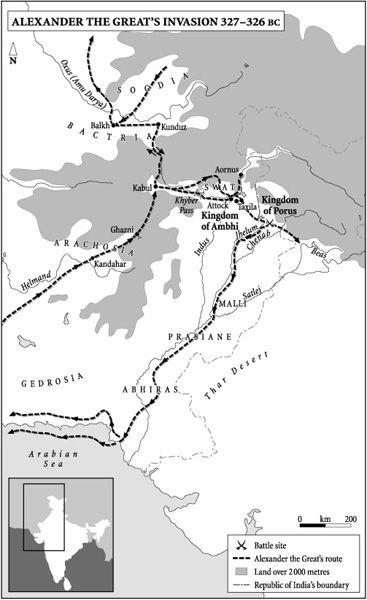
But his men were unimpressed. They crossed what is now the frontier between Pakistan and India somewhere in the vicinity of Lahore. Then, near Amritsar, they reached the Beas, fourth of the Panj-ab, the ‘five rivers’. In this weird and interminable land where the clothes were all white and the complexions all black, it was as good a place as any for a showdown with their commander.
Alexander sensed the mood of mutiny. In a lengthy appeal to his commanders he invoked their past loyalty and stressed the consequences of retreat. Extricating themselves would be difficult. Were the tide of conquests now to ebb, they would find the sands sucked from under their feet. New friends would review their allegiance and old enemies would take their chance. Trumpeting an empty defiance, the Greeks would find themselves backing away amidst a shower of missiles just like Porus’ exhausted elephants.
But to men who had been on the march for eight years, such arguments had little appeal. They had bathed in the Tigris and the Indus, the Nile and the Euphrates, the Oxus and the Jaxartes. Across desert, mountain, steppe and field they had trudged for over twenty-five thousand kilometres. Of victory, booty, glory and novelty they had had their fill. With respect and real affection, they listened to their leader, moved but unpersuaded.
Alexander withdrew to his tent like his hero Achilles. A three-day sulk made no greater impression on the men’s resolve, while a sacrifice for safe passage of the river produced only adverse omens. In the end Alexander had no choice but to announce a withdrawal. The banks of the Beas erupted with cheers of relief; many wept but all rejoiced. As Arrian noted, Alexander was vanquished only once – and that by his own men.
To round off his conquests, complete his explorations, and disguise his failure, Alexander opted to return by sailing down the Jhelum and the Indus to the ocean. Ships were readied and he sailed in late 326 BC. The voyage downriver took six months. Stern opposition came from numerous riverine peoples, some of whom have been tentatively identified, and from sizeable townships which clearly included well established brahman communities. Some of these townships no doubt occupied sites beneath which the Harappan cities had already lain, cocooned in alluvial oblivion, for 1500 years.
In an engagement with the ‘Malloi’ Alexander himself was seriously wounded. An arrow struck him in the chest and may have punctured his lung. He barely recovered. The wisdom of forgoing a contest with the Nandas’ multitudinous cohorts was amply demonstrated; so were the dangers of withdrawal. With few regrets, in September 325 BC the fleet sailed out of the Indus into the Arabian Sea. Meanwhile Alexander led the rest of his men west on what proved to be, for many, a death-march to Babylon along the desert coast of Gedrosia (Makran). There was still some talk of returning to India, of resuming the march with fresh troops, and of consummating the ultimate conquest. But other appetites proved Alexander’s undoing. Within two years he died from hepatoma following a massive banquet in Babylon.
With him from India had gone the wherewithal for a vastly enriched Western image of the land beyond the Indus. He had prised open a window on the East through which emissaries would pass, ideas would shine, and prying eyes would covet. With him too went all those Hellenised personae and places – Omphis, Aornos, Porus, the Malloi and countless others – never to be heard of again in India’s history. The ‘invasion’ had amounted to little more than a hasty intrusion, scuffing a corner of the carpet but neither baring its boards nor troubling its political furniture.
With Alexander there had also gone one ‘Calanus’, a figure worth remembering in that he seems to be the first Indian expatriate to whom a name and a date can confidently be given. One of a group of ascetics encamped near Taxila, Calanus had accepted Alexander’s invitation to join him in that city and subsequently accompanied him back to the west. There, in Persia shortly before his patron’s death, his own death would cause a sensation.
Calanus’ doctrinal persuasion is uncertain. As one of his companions at Taxila had put it, trying to explain one’s philosophy through a wall of interpreters was like ‘asking pure water to flow through mud’. In that Calanus and his friends went naked, a condition in which no Greek could be persuaded to join them, they may have been nigrantha or Jains. Jain nudity was dictated by that sect’s meticulous respect for life in all its forms. Clothes were taboo because the wearer might inadvertently crush any insect concealed in them; similarly death had to be so managed that only the dying would actually die. Jains bent on ending their life, therefore, usually starved themselves to death. Yet Calanus, a man of advanced years, chose to immolate himself on his own funeral pyre. Though an extraordinarily stoical sacrifice in Greek eyes, this was a decidedly careless move for one dedicated to avoiding casual insecticide. Evidently the Persian winter had induced a chill, if not pneumonia, and Calanus had decided it was better to die than be an encumbrance. No one, not even Alexander, could dissuade him from his purpose. He strode to his cremation at the head of an enormous procession and reclined upon the pyre with complete indifference. This composure he maintained even as the flames frazzled his flesh.
Visibly shaken by such an exhibition, the Greeks held a festival in his honour and drowned their sorrows in a Bacchanalian debauch. Calanus, though he had made no converts, had won many friends. He also left a profound impression well worthy of India’s first cultural emissary. ‘Gymnosophists’, or ‘naked philosophers’, henceforth became stock figures in the Western image of India. As ‘Pythagoreans’, they were also identified with Greek traditions of abstinence and the conjectures of Pythagoras about rebirth and the transmigration of the soul. Lucian, Cicero and Ambrose of Milan all wrote of Calanus and his naked companions. Much later, as the epitome of ascetic puritanism, India’s gymnosophists would be revered by, of all people, Cromwellian fundamentalists. And later still, as mystics, gurus and maharishis, they would come again to minister to another spiritually impoverished Western clientele.