
4
But there is, withal, as I have remarked, a great deal of mystery and secrecy observed in all this cult. It has its professors: men, but mostly women, who collect charms and spells, and teach them to one another, and hold meetings; that is, there is a kind of college of witches and wizards, which, for many good reasons, eludes observation.
Charles Leland
Etruscan Roman Remains, 1892
Witchcraft in Tuscany is unique among other types of Witchcraft in Italy. In Tuscany the roots of the Old Religion stretch back into Etruscan times, and contain less Roman influence than many other forms of Italian Witchcraft. In the Neolithic period of Italy there once existed the culture now referred to as the Cult of the Great Goddess. Archaeological discoveries dating from this period include an abundance of icons portraying a mother goddess and a male consort. Some archaeologists, such as Marija Gimbutas, believe that the Etruscans were the inheritors of surviving beliefs and practices from this ancient cult, and another known as the Cult of the Dead, both of which once thrived on the Italian peninsula. This area was part of what is now called Old Europe, a region inclusive of Italy, Greece, Czechoslovakia, southern Poland, and the western Ukraine.
Extremely archaic concepts flourished in the region of Old Europe long after the rise of Christianity. This was particularly true throughout the Italian peninsula. Hellenistic and Roman writers were often astonished to discover traces of primitive conceptions and practices within the old Etruscan lands that were quite unlike those commonly acknowledged in Greece and Rome. Among the most noteworthy were the suggestions of an animistic conception of the supernatural and the omnipresent importance of omens, signs, and the divinatory arts.
The ancient Etruscans embraced the high social and religious status of women, a remnant of the matrifocal religion that once flourished in Old Europe. Also worthy of mention is the belief in the material survival of the dead in their burial places. The Etruscans placed personal items, games, tools, and furnishings in their tombs. In archaic Roman religion we also find similar practices associated with burial sites. Archaeological evidence of such practices in the Neolithic burial mounds left by the indigenous Cult of the Dead is abundant. So great was the antiquity of Etruscan beliefs and practices that the ancient Romans themselves referred to Etruscan religion as "The Old Religion."
The Etruscan civilization rose to power in Italy sometime around 1000 B.C. Some scholars have theorized that the Etruscans were not indigenous to Italy, but were an Indo-European people. However, a linguistics study of the 10,000 inscriptions left by the Etruscans has convinced the majority of linguists that the Etruscans were a non-Indo- European people native to Italy who adopted many customs, crafts, and styles of eastern Mediterranean culture by way of trade.
The Etruscans believed in the ultimate power of supernatural forces. All acts of Nature were seen as initiated by a god or a spirit. Various signs and omens preceded the appearance or action of any supernatural being. This was the catalyst to the presentation of sacred offerings, an attempt to establish a beneficial relationship between spirits, deities, and humankind. Connected to the Etruscan belief in the power of omens and signs is the ancient myth of the animal guide or ancestor. This prehistoric concept was widespread throughout Italy and remained linked to pastoralism and transhumance as evidenced in the archeological studies of the Apennine Bronze Age.
Early nomadic tribes in Italy believed in an animal spirit that guided and protected them. The Piceni tribe, for example, believed their guide was a woodpecker, the Sabellians a bull, the Lucani a wolf, and the Ursenti a bear. The people of this era practiced a custom known as leer Sacrum, the sacred springtime. This required a selected portion of each tribe to leave and settle in another area each spring season. Therefore, the animal guide was extremely important to beliefs and practices of such a pastoral-nomadic people.
As humans evolved into an agrarian society, the spirits of meadows and forests were transformed into spirits of the plowed and seeded fields. These were the Lasa spirits, beings sharing an intimate ancestral relationship. Under Roman rule these spirits were called Lare, and were transformed into spirits of home and family. Making the Lare protectors of the family preserved the memory of their former ancestral nature.
The Etruscans further developed and refined many early Pagan beliefs, creating a mystical and magical tradition famous throughout the classical world. Centuries before the Romans came to power, the Etruscans worshipped the Great Mother Goddess Uni and her consort Tinia. These deities oversaw a host of spirits and demi-gods and displayed power over the forces of Nature and human destiny. The pantheon of the Etruscans was not unlike the Olympic gods of Greece, although they worshipped another set of gods who were above them. These deities were called the Involuti or gods of the mists.
The Witches of Tuscany are the descendants of the Etruscan race. For centuries they have kept their existence secret, whispering on moonlit nights to the ancient deities of their ancestors. Unbroken generations have passed on the Old Ways through family bloodlines, preserving the ritual and magical knowledge of ancient Italian Witchcraft. In the early seventeenth century, Francesco Guazzo (an Ambrosian monk) wrote of hereditary Italian witches in his book Compendium Maleficarum.
In chapter six Guazzo writes of the "inherited taint" of Witchcraft found in children born to Witches. Several chapters deal with ceremonies in which children are dedicated to the Witch Sect, and other ceremonies, including Witch weddings. Guazzo states that all of these are designed to "propagate the race of witches."

Etruscan Protective Spirit
In the nineteenth century, Charles Leland encountered Maddalena, an Italian Witch from Tuscany. Leland wrote in his Memoirs concerning Maddalena:
A young woman who would have been taken for a Gypsy in England, but in whose face, in Italy, I soon learned to know the antique Etruscan, with its strange mysteries, to which was added the indefinable glance of the Witch. She was from the Romagna Toscana, born in the heart of its unsurpassingly wild and romantic scenery, amid cliffs, headlong torrents, forests, and old legendary castles. I did not gather all the facts for a long time, but gradually found that she was of a Witch family, or one whose members had, from time to immemorial, told fortunes, repeated ancient legends, gathered incantations, and learned how to intone them, prepared enchanted medicines, philtres, or spells. As a girl, her Witch grandmother, aunt, and especially her stepmother brought her up to believe in her destiny as a sorceress, and taught her in the forests, afar from human ear, to chant in strange prescribed tones, incantations or evocations to the ancient gods of Italy, under names but little changed, who are now known asfolletti, spiriti, fate, or lari-the Lares or household goblins of the ancient Etruscans.
Maddalena supplied Leland with a great deal of Witchlore, much of which he later published in his books Legends of Florence and Legends of Virgil. Leland's book Etruscan Roman Remains was inspired by his contact with Maddalena, and is Leland's most complete work on Italian Witchcraft. Near the end of his life, Leland obtained some material from Maddalena that he published as Aradia; Gospel of the Witches. This text was quite different from anything Maddalena had taught Leland about Italian Witchcraft. When comparing this material with the bulk of what Maddalena earlier supplied to Leland, it becomes apparent that the Aradia material did not represent the type of Witchcraft actually practiced by Maddalena.
Leland's Legends of Florence and Legends of Virgil both present a fascinating glimpse into the Old Religion of Italy. Much of the material focuses on tales of an obscure matrifocal religion wherein goddesses have been reduced to Nature spirits over the course of time. These legends reflect themes of conflict between female and male entities, all resolving in victory for the former. The goddess Diana still retains her divine status in these old tales, and appears as the patroness and protector of all witches.
Agricultural themes are prominently featured in Maddalena's material. A spirit known as Bughin forms seeds. Another spirit named Palo presides over planting and Segetia guards the seed within the earth. Segesta protects the new plant sprout, Patana tends the plant as it grows, and Patelena opens the ear of grain. Patella prepares the grain for its first touch by sunlight and moonlight. Once the grain is exposed, spirits of the night come in the form of fireflies and impart their mystical powers to the grain. A spirit known as Talena (the spirit of the night) oversees this process.
Robigo is the spirit of the harvest and Remle is the spirit of mills. When the grain is harvested, Witches make ritual cakes from it to be used in a sacred meal beneath the Full Moon. In the mythos provided by Maddalena, the seeds (that later became the plants) extracted the secrets of the Underworld as they he within the dark warm soil. When the ears opened to reveal the new grain, spirits came to learn new secrets and to impart old ones. In this manner, the Witches receive all of these mystical secrets when they eat the ritual cakes. Leland speaks of this connection with the underground in Etruscan Roman Remains:
For there are in the earth deep mysteries; the earth-worm and mole are full of them because the foot of the sorcerer passes over them, and gives power, the salagrana or stalagmite, and different metallic ores are really holy, from being subterranean, and yet sparkling with hidden occult light when broken they meet the sun; and plants which send their roots deep down into the earth draw from it mystic forces which take varied magic forms according to their nature when brought up into light and air. Owing to the inability of my informant to express herself clearly, I had difficulty for a long time in understanding this properly chthonic theory; when I did master it, I was struck by its Paracelsian character-this belief in a "geomantic force" which Chinese recognise as Fengshui.
Plants, and particularly herbs, have been associated with Witches since classical times. In the writings of Homer, Witches dwell in forest glades. Ovid places Witches living among "herb-clad hills." By the Hellenistic period we find references to Witches dwelling in cities and procuring their herbs from urban settings and graveyards. Accounts from this era say that Witches performed their rituals at night upon rooftops.
It is interesting to note that the ancient Greek word for witch is pharmakis (herbalist) and it is from this word that the Modern English word pharmacy is derived. The Romans replaced the Greek with the Latin word venenum, a word referring specifically to poisonous herbs. From this was derived the word veneficium, the Latin word for Witchcraft. At this stage the Latin word for witch became venefica, where earlier it had been saga meaning "a wise woman" or "sorceress." It is clear from ancient accounts that Aegean/Mediterranean Witches knew how to heal and how to harm with herbs. In the Witchlore of this region each plant contained a spirit called a Numen, and it was this indwelling spirit that gave the plant its potency. The principle of the Numen later evolved into the concept of the fairy or Nature spirit.
In Tuscan Witchcraft there is a very intimate relationship between fairies and Witches. Both share in a stewardship of Nature and possess an understanding of the secret inner knowledge of magick. In Tuscany the Queen of the Fairies is known as Alba or Turanna, the latter being the oldest name and one of Etruscan origin. Aldeganno is a fairy spirit of ivy, and Turabug is the spirit of rue and the guardian of reeds or canes. Rue and ivy are among the most magickal of plants employed in Tuscan Witchcraft. In Tuscan Witchcraft, rue, ivy, salt, and wine are used to evoke the Goddess and to call upon spirits and fairies. In Etruscan Roman Remains, Leland writes of Etruscan beliefs still found among the Tuscan peasants:
There are also a few records of certain plants, showing how the belief that many herbs and flowers have an indwelling fairy, and are in fact fairies themselves, still survives, with a degree of personification which has long since disappeared in most other European countries.
Connected to the Tuscan belief in fairies are the three spirits of Fate known as Maratega, Rododesa, and Befana. They spin the lives of all humans, weaving the patterns of each indi- vidual's existence, and then cutting the thread of life when the design is completed. Divination is an important aspect of Tuscan Witchcraft, and is used to catch a glimpse of the pattern being woven by the Fates. Befana is also an ancestral spirit whose sacred symbol is the woven stocking, a symbol of spinning and weaving. Stockings are traditionally hung by the fireplace on the night of January 6th in anticipation of a visit from Befana. The fireplace is a symbol of family life and unity, as from ancient times it has been a place of gathering for food, warmth, and companionship. On her special night Befana fills the children's stockings with gifts, connecting her with the new generation each year.
Attilio is a spirit of the fireplace and is associated with Lare, the ancestral spirits dwelling in or near the hearth. Setlano is a spirit of fire evoked for divination. Traditionally, while a fire burns in the hearth, the pattern of the flames and the appearance of any sparks all combine into a divinatory observance. Elemental beings of fire known as Salamanders may appear in the dance of the flames as omens. Mena, a spirit of love and marriage, is said to manifest in the form of a serpent. Young men and women ask questions to the fire and observe any changes. Those hoping for love may call upon the spirit known as Marta. She is also known to ignite passion as suggested by her association with fire divination.
Primitive practices are a keystone of Tuscan Witchcraft and a sign of the great antiquity of this tradition. Many aspects of this old form of Witchcraft have been preserved in the records of the Inquisition in Italy. One case concerning a woman named Elena Draga is worthy of particular consideration. In 1571 she was brought before the Inquisition for using Witchcraft to heal people. One of her spells called for a piece of raw meat to be rubbed on a wart. Then the meat was to be buried in the soil so that as it rotted the wart would also waste away.
In another spell Elana washed a sick person with water, waited for the ebbing tide to occur in the third or fourth phase of the moon, and then poured the soiled water into the ocean tide. As the tide carried away the soiled water, so too was the disease believed to disappear. This observance of the phases of moon and the ocean tide was a common feature of healing practices in the coastal regions of Italy. Author Dino de' Antoni came across it in his research into Chioggian witchcraft and magick, and noted it as one of the few entirely non-Christian aspects of healing to survive into sixteenth century Italy. By this period it was common in popular folk magick to find spells that required gesturing the sign of the cross, sprinkling holy water, or saying the Lord's Prayer. However, in the case of Elena Draga we find that Tuscan Witches are still using the older pre-Christian forms of magick.
The preservation of traditions of any kind is central to the Italian way of thinking. Charles Leland noted this in his field research into Italian Witchcraft in the late nineteenth century. In his book Etruscan Roman Remains we read:
There is in Northern Italy a mountain district known as La Romagna Toscana, the inhabitants of which speak a rude form of the Bolognese dialect. These Romagnoli are manifestly a very ancient race, and appear to have preserved traditions and observances little changed from an incredibly early time. It has been a question of late years whether the Bolognese are of Etrurian origin, and it seems to have been generally decided that they are not. With this I have nothing whatever to do. They were probably there before the Etruscans. But the latter at one time held all Italy, and it is very likely that they left in remote districts those traces of their culture to which this book refers. The name Romagna is applied to their district because it once formed part of the Papal or Roman dominion, and it is not to be confounded with La Romagna proper Roughly speaking, the region to which I refer may be described as lying between Forli and Ravenna. Among these people, stregeria, or witchcraft-or, as I have heard it called, " la vecchia religione" (or "the old religion')-exists to a degree which would even astonish many Italians. This stregeria, or old religion, is something more than a sorcery, and something less than a faith. It consists in remains of a mythology of spirits, the principal of whom preserve the names and attributes of the old Etruscan gods, such as Tinia, orJupiter, Faflon, or Bacchus, and Teramo (in Etruscan Turms), or Mercury. With these there still exist, in a few memories, the most ancient Roman rural deities, such as Silvanus, Palus, Pan, and the Fauns. To all of these invocations or prayers in rude metrical form are still addressed, or are at least preserved, and there are many stories current regarding them.
Despite this nature to preserve traditions, Tuscan Witches are very protective of their ways, and rarely discuss anything with people who are not initiates or blood relatives. In Etruscan Roman Remains Leland writes of this:
But there is, withal, as I have remarked, a great deal of mystery and secrecy observed in all this cult. It has its professors: men, but mostly women, who collect charms and spells, and teach them to one another, and hold meetings; that is, there is a kind of college of witches and wizards, which, for many good reasons, eludes observation. It was my chance to become acquainted in Florence with the fortuneteller referred to, who was initiated in these secrets, and whose memory was stocked to an extraordinary and exceptional degree with not only magical formulas but songs and tales. Such familiarity with folk-lore and sorcery as I possess, resulted in confidence-the end being that I succeeded in penetrating this obscure and strange forest inhabited by witches and shadows, faded gods and forgotten goblins of the olden time, where folk-lore of every kind abounded to such excess that, as this book shows, I in time had more thereof than I could publish. To do this I went to strange places and made strange acquaintance, so that if the reader will kindly imagine something much out of common life, and often wild and really weird-i.e., prophetic-when fortune-telling was on the cards, as the dramatic accompaniment of every charm and legend in this book, he will but do it justice. To collect volumes of folk-lore among very reticent Red Indians, and reserved Romanys is not unknown to me, but the extracting witchcraft from Italian strege far surpasses it. I too was among the shadows.
The extraordinary tenacity with which the peasants of Tuscany have clung to their old faith is an inherited character passed on from their Etruscan ancestors. The ancient Roman historian Livy said of the Etruscans that they were "a race which excelled all in devotion to religious rites and in the art of cultivating them." Throughout all the wars and transformations that reshaped Italy, the peasants of Tuscany have remained essentially the same race. Again in Etruscan Roman Remains, Leland writes:
Englishmen and Frenchmen are the result of modern mixtures of peoples, but the Italians are absolutely ancient, if not prehistoric. There are families in Italy who find their family names in Etrurian monuments on their estates. And Cicero, Tacitus, Livy, Virgil, and many more testify that all their divination and religious observances were drawn from and based on Etruscan authority. "This, " says Muller, "was shared by the common people. There were in Italy schools, like those of the Jewish prophets and Gallic Druids, in which the system was thoroughly taught. "And there is the last relic of these still existing among the Tuscan witches.
ETRUSCAN ROOTS OF TUSCAN WITCHCRAFT
One of the reasons why so much of the Old Ways has survived in Tuscan Witchcraft lies within the people themselves. All of their patterns of thought and tradition are derived from thousands of years in which religious art and passionate faith influenced almost every facet of life. These patterns have imprinted what might be called a predisposition within the genetic memory of the Tuscan witches, a factor transmitted through heredity. The passion that once inspired religious and theological expression on Etruscan vases, mirror art, and in jewelry was the very same spirit that created the Etruscan concepts of deities, goblins, spirits, and elves, along with their myths and legends. From this spirit is derived the mentality that created all the mystical and magickal concepts that have evolved into Tuscan Witchcraft.
Even today we still find remnants of Etruscan religious beliefs in many cultures, and oddly enough the modern clown figure is one example, as we shall soon see. Many of these elements are rooted in the Neolithic Cult of the Dead. In this primitive sect it was believed that the souls of the dead lingered, awaiting a chance to be reborn into the physical world. These spirits had to be appeased, and therefore offerings were placed and various ceremonies were performed.
Crude mounds were constructed for the dead and in these primitive tombs were placed the personal items formerly the property of the buried person. A small passageway was left in the mound so that the spirit could come and go as it pleased.
The Cult of the Dead also produced spiral designs that marked its tombs. Spiral symbols are often employed in owl motifs because of the circular patterns of their feathers, especially around the eyes. The spiral itself symbolizes many things other than owls, including serpents, renewal, and mystical forces in general. But the owl is of particular interest to us in this chapter, and many of its connections to Witchcraft will be explored later as the chapter continues.
The simple clown figure, typically present at carnivals, dates back to Etruscan times. In Etruscan tomb art, we find depictions of entities wearing checked as well as dotted clothing, sporting large beak-like noses, and carrying something resembling a slapstick. In some images the clothing bears black and white checks and in other images their clothing is multicolored. These colors were also connected in Etruscan religion with ancestral spirits. Even today, the mythical figure known as Befana (in part an ancestral spirit) traditionally wears an apron of multicolor. See the appendix for more information related to Befana.
In Etruscan tomb art, the beings wearing this type of clothing represented spirits of the dead and death itself. Their appearance at carnivals and festivals once symbolized the brevity of life and served to remind people to enjoy it to the fullest. They also symbolized the attendance of one's ancestors at the festival, a mystical family reunion. In Tuscan Witchcraft, as in most forms of Italian Witchcraft, we find an emphasis upon family lineage and the honoring of one's ancestors. The belief that a person's soul can become a powerful spirit in the Afterlife is an old Etruscan concept, and is reflected in the Etruscan beliefs surrounding the Lasa spirits (the fairy folk of Old Italy). So to honor one's ancestors was to assure oneself of good rapport with the Lasa.
The beak-like noses appearing on the Etruscan characters, mentioned earlier, are remnants of Neolithic worship in ancient Italy. The earliest deity icons found in the Italian peninsula depict deities that are part bird and part human. Typically the birds are waterfowl, and symbols etched into the icons indicate a connection to the Moon and to rain and fertility. Over the following centuries, as this theme evolved in ancient Italy, we find the bird transformed into both a scavenger and a bird of prey. For example, Tulchulcha (an Etruscan deity of the dead) has the beak of a vulture, and instead of a slapstick he later carries a large hammer. By classical times the bird itself is no longer the deity at all, and simply accompanies one as its sacred animal. An example of this is Athena and the owl.
In Tuscan Witchcraft there are several obscure elements that suggest a connection between Athena and the Witch sect of Old Italy. First we find an Amazon cult in Athens that worshipped a statue of Artemis bearing a shield, spear, and helmet. These are the classic items associated with Athena. The Amazon's statue in Athens appears to be a composite image of Athena and Artemis, as opposed to the classical Greek image of Artemis as a maiden wearing a hunter's tunic and sandals. In ancient Rome Witches were identified with owls, also the sacred bird of Athena.
Charles Leland gives us an interesting related tale in Legends of Florence that he obtained from Maddalena. In this tale we find a Tuscan story about the rivalry between a god associated with water and a goddess. In Greek mythology there are tales of the rivalry between Athena and Poseidon. As we will discover there are several other elements found in both stories that may indicate a connection of great antiquity.
The olive tree was associated with Athena in Greek mythology, and she was said to have created it on the Acropolis during a competition with the sea god Poseidon for the mastery of Attica. Poseidon created the horse as his challenge to Athena. The gods of Olympus favored the olive tree and thereby Poseidon lost the contest. In Maddalena's tale, the god Biacone kills a magickal serpent sent by the goddess, as a demonstration of his claim to possess greater power. The goddess then resurrects the serpent by touching it with an olive twig, a sign of her claim to greater power. In the context of a competition it is interesting to see the olive twig appear in our tale of rivalry, yet another indication of the antiquity of Maddalena's themes. The horse also appears in Maddalena's legend, as Biacone rides in a chariot drawn by horses.
It is interesting to note that horses were forbidden in the sanctuary of the goddess Diana, patroness of Italian Witches. Here may lie another obscure connection between witches and Athena, perhaps an archaic memory of Poseidon as an adversary.
Also worthy of consideration are the Greek myths relating tales of animosity between the Centaurs and the Amazons who worshipped Artemis in Athens (as already noted). Perhaps the Centaurs are symbols of Poseidon, reminders of the conflict between Poseidon and Athena. Another cult creature shared by Athena and Artemis is the owl, one of the symbols of Italian Witchcraft in Tuscany.
The owl and its connection to Tuscan Witchcraft are shrouded in the distant past. Any unquestionable link between Athena and Witches, through the owl, is most likely lost now in time. Although if it, in fact, ever existed, I think it is not too great a leap in logic to associate the inner secrets of Witchcraft with the owl as a symbol of wisdom. We do know that the ancient Romans believed that Witches could transform into owls, and some scholars believe that the word Strega is derived from the Latin word strix, meaning owl. The word strix refers specifically to a screech owl, which was also the type of owl sacred to Athena.
The owl is, among other things, a symbol of death and darkness. In Etruscan religion the owl was an attribute of the deity of darkness and night. Archaeological excavations at Pyrgi and Santa Marinella have revealed altar carvings depicting Minerva (Athena) as a deity in Etruscan chthonic cults. This connects Minerva/Athena with themes related to classical Roman Witches who worshipped goddesses of the night and darkness such as Diana, Hecate, and Proserpina (Persephone).
Ancient Roman writers such as Horace, Lucan, and Ovid all portray Witches as members of a chthonic sect involved in the worship of Diana, Hecate, and Proserpina. In these ancient tales we find the moon as central to the magickal workings of Italian Witches. Even the modern Witches' theme of "drawing down the moon" appears in Horace's writings circa 30 B.c. Before Horace the concept was known in ancient Greece as kathairesis.
The earliest mention of a witch in Aegean/Mediterranean culture can be found in the tale of Circe, written by Homer circa 800 B.C. Some may argue, however, that Circe was a sorceress and not a Witch. In connection with Circe, Homer also lists three features commonly associated with Witchcraft. These features are streams, hills, and dog-like beasts. More important is the fact that these features consistently appear in the literature of Witchcraft spanning nine hundred years from the time of Homer to Lucan.
Also worthy of note is that the roots of Witchcraft lie in the shamanic practices that eventually evolved into magickal systems. Circe was depicted as one of the great magick users of ancient Greece. Magick is deeply connected to Witchcraft, and the merging of magick with shamanic practices and pre-Christian religion had certainly taken place by 800 B.c., as indicated in the ancient Mystery Cults of Greece and Egypt.
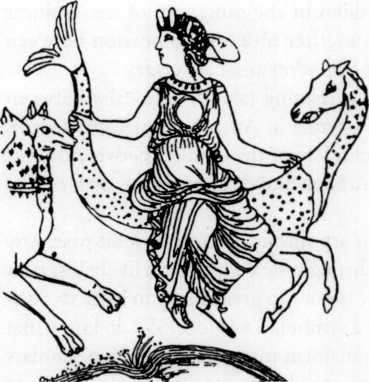
Proserpina
In ancient myths Proserpina is linked to the Underworld goddess Hecate Triformis, of whom Porphyry wrote: The moon is Hekate ... her power appears in three forms: Selene in heaven, Artemis on earth, Hekate in the Underworld. Hesiod wrote in the Theogony (circa 700 B.c.) that Hecate ruled over the three great mysteries: birth, death, and life. Diana also shared a three-fold nature as indicated by the writings of Horace (Songs, 3:22):
O maiden goddess, guardian of hill and grove, thou that, thrice invoked, givest ear to young mothers when in travail and res- cuest them from death, goddess of the triple form, thine be the pine that overhangs my dwelling ...
In the first century B.C., Catullus says of Diana in his Hymn to Diana:
... Diana whose name is Trivia-the crossroads her sacred places-nightgoddess, queen of underworld. Threefold Diana ...
And Ovid writes (Met. 7:94-95):
He swore he would be true by the sacred rites of the threefold goddess ...
The connection of Diana to Witches and Italian Witchcraft is a long-standing Mediterranean tradition. Beginning with Horace in the first century B.C., we find historical references to Diana as the Witches' goddess, references that continue even after the rise of Christianity. A sect known as the "Society of Diana" is mentioned in the records of the Inquisition as late as the eighteenth century A.D. Among the ancient Romans, Diana was connected to childbirth, and offerings were placed at her shrine near Lake Nemi to ensure an easy labor. In Roman mythology Diana was also the chaste maiden, and in the writings of Horace we see her as a hag goddess associated with Hecate. In these themes we find the traditional triformis aspect of the goddess: maiden, mother, and crone.
Some of the material recorded by the Inquisition, related to the Society of Diana, may contain remnants of the beliefs rooted in the Neolithic Cult of the Great Goddess. As noted earlier, humanoid bird deities were among the first icons produced during Neolithic times in what is now Italy. This leads us again to the owl, which in turn leads us to Italian Witches, the theme of flying, and festivals of the dead (related to the Cult of the Dead mentioned earlier).
The ancient Roman Witches, known as striges, were believed to possess the ability to appear as either an owl or a human. The tenth-century writings of Regino of Prum speak of processions of spirits of the dead accompanied by Witches. Regino calls this group the "Society of Diana" and says it is led by the goddess Diana. Here we see the Neolithic elements of primitive religion evolved into a structured sect.
In Witchcraft during the Middle Ages we see strong elements of the ancient chthonic religion of Old Europe. Many of the aspects of the ancient Mystery Cults of the Aegean/Mediterranean region are present in Witchcraft at this time and later. The gatherings for festivals, sacred meals, libations of wine, fertility rites, and the worship of a horned god and goddess consort are all features of the Greek and Roman cults. We see associations of this nature not only in the rites of Bacchus/Dionysus but also in the rites of Eleusis. In the latter we also find the theme of the Descent of the Goddess and the Lord of the Underworld, a common mythos in modern Wicca/Witchcraft.
By the time of the Middle Ages folklore and folk magick were well rooted in the worship or veneration of various Saints. The Church allowed this transfer of ancient pagan spirit worship to saint worship because it kept the peasants from reverting back to the Old Ways of their ancestors. Thus the needs of the peasants were fulfilled and the Church was satisfied to keep its flock by whatever means. Unfortunately this also included violence and death, as seen in the torture and execution of people accused of practicing Witchcraft.
By the fifth century Christianity had assimilated Mediterranean Paganism and as the power of the Church moved into northern Europe it readily absorbed the Celtic and Teutonic elements that closely resembled Mediterranean paganism. These new elements merged with the original aspects of classical Witchcraft and were mixed together into the earlier structure of ancient Greek and Roman Witchcraft.
Today Witchcraft is more often expressed in northern European rather than Mediterranean terms. This is due to the fact that most modern writers on Witchcraft are neither well versed in classical Witchcraft literature, nor fluent enough in Latin or Italian to study the southern European material. Most modern studies in Witchcraft/Wicca are written in English, and the majority of writers on the subject have nationality roots connected to the British Isles. This, together with the fact that most writers are primarily interested in their own cultural roots, has created a tendency to both perceive and present Witchcraft as being primarily Celtic in nature.
During the Renaissance period we find many of the Aegean/Mediterranean elements of classical Witchcraft appearing in the trial records of the Inquisition. In Guazzo's Compendium Maleficarum we discover many interesting aspects of the Witches' sect. According to Guazzo, a large black goat sits upon a throne during these rites. Ritual circles are traced upon the ground with beech twigs, and spirits of earth, air, fire, and water are called to the rituals. Present at the rites is a man in the vestments of a priest who reads from a black book. Guazzo notes that Witches hold religious ceremonies, and that some of their rites are expiatory in nature. He also focuses on hereditary Witches and their children who attend these ritual celebrations.
One of the primary aspects of Tuscan Witchcraft is the hereditary element. Charles Leland noted this in his nineteenth-century field studies into Italian Witchcraft. The portrayal of Tuscan Witches depicted by Leland confirms not only the antiquity of their beliefs and practices but also the tenacity for survival inherent in this ancient sect. Fortunately, Leland is not the only source of information we can turn to regarding the Witch sect in Italy circa 1896. In volume three of Folk-Lore; Transactions of the Folk-Lore Society (published March 1897) we find an interesting account of Neapolitan Witchcraft. The author, J. B. Andrews, tells us:
The Neapolitans have an occult religion and government in witchcraft, and the Camorra; some apply to them to obtain what official organizations cannot or will not do. As occasionally happens in similar cases, the Camorra fears and yields to the witches, the temporal to the spiritual.
Andrews goes on to say that the Witches of Naples are divided into "special departments of the art" and he lists two as "adepts" in the art of earth and sea magick. Andrews also implies that a third specialty may exist as adepts of star magick. Andrews tells us that Italian Witches perform knot magick, create medicinal herbal potions, construct protective amulets, and engage in the arts of healing.
Andrews concludes his article with information he collected while interviewing Italian Witches. During these interviews Andrews asked from what books these Witches gathered their information. They replied that their knowledge was entirely traditional, and is "given by the mother to the daughter." The Witches also informed Andrews that blood is exchanged from a vein in the arm, and the new member is given a mark under the left thigh. Although the Moon is not specifically mentioned, the Witches do report to Andrews that such ceremonies are performed at midnight.
Perhaps the most telling sign of the antiquity and survival of Tuscan Witchcraft lies in the fact that these Witches still wear a charm called the Cimaruta. Author Fredrick Elworthy, in his book The Evil Eye (John Murray, London, 1895), describes the Cimaruta and provides a drawing of it along with another depicting an ancient Etruscan charm of striking similarity. This Etruscan charm is now housed in the Bologna Museum. The word Cimaruta means "the top sprig of rue." The Etruscans incorporated the rue into the background designs engraved on the backs of polished mirrors. It more often than not accompanies mythical and magickal themes portrayed in Etruscan mirror art.
The symbols attached to the rue charm are all aspects of the Old Religion. Although the individual items vary from region to region in Italy, there are common ones appearing on most Cimaruta pieces: fish, Moon, key, blossom. The fish is a symbol of fertility and abundance, a remnant of the fertility rites of Old Europe. The Moon symbolizes the night and occult powers as well as allegiance to the Goddess and her consort.
The blossom (typically a vervain flower) is a sign of protection. The vervain is also sacred to the fairies, and in Italian folklore the goddess Diana is called the Queen of the Fairies. Therefore, this symbol displays a kindred nature between Witches and fairies.
In Tuscany, family Witches still gather beneath the Full Moon to honor the ancient ways. The solitary Witch, whether living in a town, village, or city still remains to read fortunes, dispense charms, or to brew the healing potions. This has been the way of Witches for countless centuries. It is comforting to know that the Old Guard is still there, and that the Old Ways have been preserved among the peasant Witches of Tuscany.