
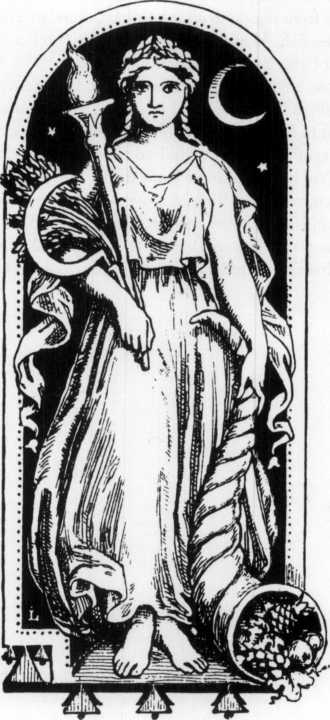
Ceres, with Horn of Plenty
5
TThe children gather wood, and the fathers kindle the fire, and the women knead their dough, to make cakes to the Queen of .-leaven ...
The Old Testament: Jeremiah 7, 18
In "The Teachings of the Holy Strega"' we find evidence that Aradia once taught her disciples that the souls of the "dead" dwelled upon the Moon. Although modern followers of her teachings now agree that Aradia used the Moon as a symbol for Astral Realms, this former concept was not unknown in many ancient cultures.
That the Moon is an abode of the "departed" has been believed for ages. In the Egyptian Book of Respiration (manuscript translated from the original in the Louvre, Paris), Isis breathes the wish for her brother Osiris "that His soul may rise to heaven in the disk of the Moon." Plutarch once wrote:
... of these soules the Moon is the element, because soules doe resolve into her, like as bodies of the dead into the earth.
Initiates of the Aridian System believe that Aradia used the Moon as a representation of the Astral Plane, and of its Lunar Realm in particular. The cycles of the Moon mark the Astral tides and cycles, and serve to indicate points in time through which the Astral spheres of influence may be tapped.
The phenomenon of the Moon that attracted early humankind was the sequence of its phases, waxing and waning. Many ancient cultures linked these phases to periods of loss and gain, to fertility, and to aging and dying. The origin of Moon worship is no doubt connected to the changing of its form each month, and to its lighting of the night sky. The Moon itself became the focal point of early lunar cults and was viewed as the Goddess Herself.
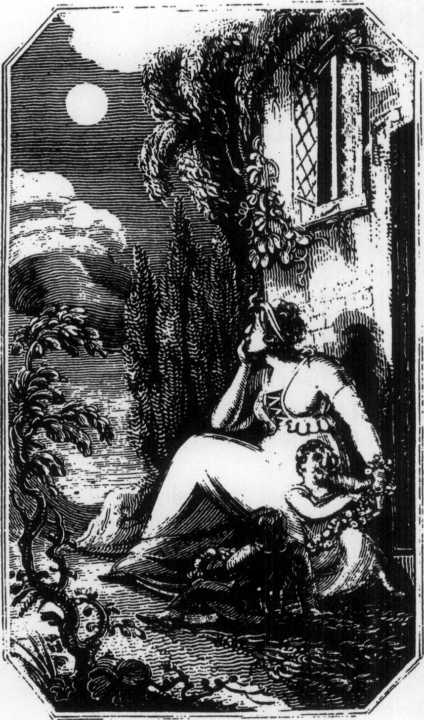
The Enchanting Moon
In the sanctuary of Diana, at Lake Nemi, the Moon was viewed as the dwelling place of the Goddess Diana and her company, as well as the resting place of those Witches who passed from the physical life on Earth. According to early lore of the Strega, the "shadow" areas of the Moon were believed to be the sacred groves of the Goddess Diana, where she hunted with her sacred hounds, and the bright areas were thought to be the plains.
The Janarra Witches, who are the descendants of those Witches who worshipped at Nemi, practice a form of lunar ritual that dates back to ancient times. The ancient theme of "becoming like the Moon" can be seen in the Janarric Rites of Initiation. Initiates who choose to become priests or priestesses are taken nude beneath the Moon and then "painted" white. This is usually done with a white powder (or ointment) which is applied over the entire body, including the hair.
The Rites of Initiation are linked to the phases of the Moon. The first degree is the New Moon, the second degree is the Half Moon, the third degree is the Full Moon, and physical death is the Waning Quarter, and is considered to be a ritual of Initiation into the Great Mystery. Thus there are four degrees of Initiation, in accordance with the lunar phases.
Ritual worship and religious consideration of the Moon varies in many parts of the world, depending upon the cultures that embrace Moon worship in a given place. Between the Tropic of Capricorn and the Tropic of Cancer, the Moon is considered to be feminine in nature. Remainders of ancient people such as the African Bushmen, Australian Aborigines, Congo Pygmies, Chaco Indians, and some Brazilian tribes view the Moon as male. Nearly all Moon-oriented cultures connected the phases of the Moon with the rhythm of Nature, the human cycles of fertility, and life and death.
As a heavenly being, the Moon was believed to encounter various situations with other celestial beings. Many cultures believed that the three dark days of the Moon were due to certain evil creatures who devoured, and later regurgitated, the Moon. The eclipse of the Moon was seen in many different ways. These run from the Moon Goddess periodically descending to earth, to the lore of Italian Witches who once believed that the Sun and Moon mated from time to time, in order to give birth to new stars in the heavens (to replace those which have fallen). It is apparent that even the ancient Hebrews once worshipped the Goddess of the Moon, as recorded in such Biblical scriptures as Jeremiah 7, 18:
The children gather wood, and the fathers kindle the fire, and the women knead their dough, to make cakes to the Queen of Heaven ...
Even Mount Sinai was linked to the worship of the Assyrian Moon God called Sin. The word Sinai meant "of Sin" or "place of Sin." The ancient Hebrews were known to have called Egypt Sinim (which means Moonland), and it was through their stay in Egypt that the Hebrews became knowledgeable in the ways of Moon worship.
Throughout the history of humankind, the Moon has played an important part in measuring time, and in signaling the planting and harvesting of various plants of both mundane and magickal nature. The beginnings and endings of various concerns became linked to the waxing and waning stages of the Moon. In Witches' herbal lore, the phases of the Moon are significant in the planting and picking of herbs. Magical herbs are often planted at the New Moon to ensure the waxing of their powers; then they are harvested at the Full Moon when they are most potent. Today we know that the Moon does indeed influence the growth of plants, and the phases of the Moon affect the pharmaceutical nature of plants. It is interesting to note that one of the definitions of the word "pharmaceutical"' is to practice Witchcraft.
Italian and Greek witches were said to have the power to draw the Moon down from the sky. Old tales abound of people trying to pay them to do so, in order to disrupt the month. The origin of this belief is unknown, but today it is said that these Witches drew down the etheric power of the Moon for magickal purposes.
During the time of Christian persecution of Witches, a superstition arose which said that having the light of the Full Moon fall upon you could lead to insanity. This was no doubt devised to keep people from joining in Pagan lunar rites at night. It is recorded in the Bible that to kiss your hand to the Moon is a sin against God. This act was originally a ritual salute to the Moon (the throwing of a kiss). The ancient Hebrew leaders apparently had a difficult time keeping their people from worshipping the Moon.
Weather lore is, of course, associated with the Moon in such ancient beliefs as a ring around the Moon meaning rain was imminent. Storms and winds were once linked to lunar phases, and Janarric Witches linked astrological associations to the phase of the Moon at a person's birth, along with the season in which it occurred, as well as the time of day or night. This is a complete system based entirely upon the Moon, and is similar to today's astrology, with its own signs and so on.
The earliest symbolic representation of the Moon deity is a stone, which appears in ancient art to be either a crude pillar or perhaps a cone of some sort. Early legends tell of this stone having fallen from the sky as though it had come from the gods themselves. It is interesting to find that both the symbol and the legend appear in early Greek, Assyrian, and Etruscan/Roman legends. In Chaldea, the Moon goddess known as Magna Dea was worshipped in the form of a black stone obelisk, as was the Arabian goddess, Al-Uzza. Goblet d'Alviella, in his book Migration of Symbols, shows a series of drawings in which the Moon stone is carved (maintaining the general form) into the goddess image of Diana of Ephesus.
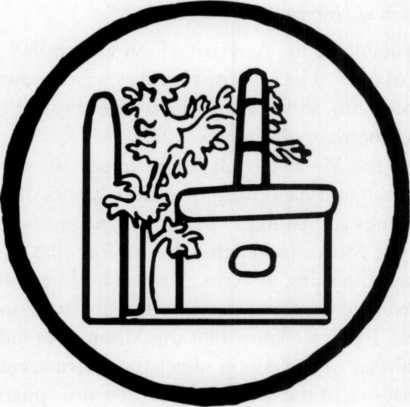
Figure 3 Ancient Italian Moon Tree
It is interesting to note that the ancient Ephesians claimed that the statue of Diana had fallen from the sky. It is likely that this story has preserved the ancient legend of the Moon stone itself. It appears that the original stone was carved over a period of time into a human image. An ancient Italian carving discovered at the site of the Barberini Palace in Rome (see Figure 3) pictures the Moon hidden in a secret place within an altar; the pillar of stone along with a Moon tree are included in the image.
The ancient glyph known as the Moon Tree appears in the Old Religion. Variations of this symbol can be found in ancient Etruscan, Assyrian, Greek, and Roman art. Trees have long been viewed as symbolic bridges to other worlds. In European folklore, doorways to the fairy kingdoms sometimes appear at the base of certain trees in various folk tales. In some mythologies, a tree becomes the vehicle for enlightenment, as in the case of the god Woden who hung on a tree for several days. This theme is recalled in the tarot card of The Hanged Man. Sometimes trees bear a forbidden fruit or in some way contain the key to a higher consciousness (as in the Judaic/Christian myth of the Garden of Eden). The association with the Moon in tree lore is quite ancient and is connected to the Moon deity itself, as well as to the themes of forbidden fruit and enlightenment.
A tree or wooden pillar frequently appears in ancient art as a symbol of the Moon. The Moon Tree symbol pictured in Figure 4, below, typical of Assyrian art design, is quite ancient and appears over and over again in religious art. At times the Moon Tree is depicted as an actual tree and other times it may appear as a truncated pole or a stylized pillar. In some ancient myths the Moon Tree was cut down and carved into a boat for a slain god or a coffin, as in the myth of Osiris.
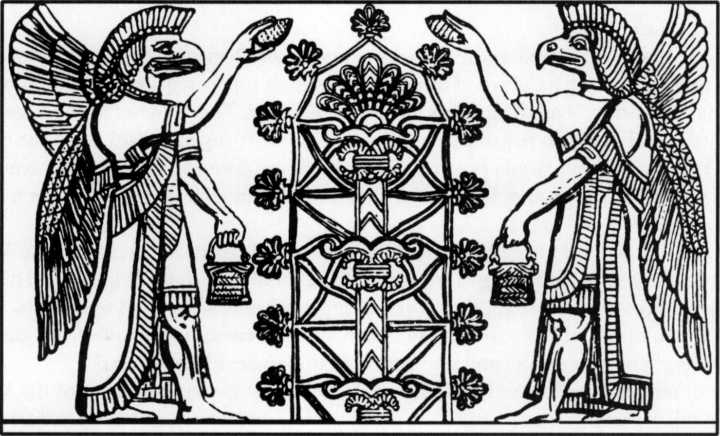
Figure 4 Ancient Assyrian Moon Tree
In art forms, the Moon Tree is often shown bearing thirteen blossoms or thirteen torches (there are always thirteen Moons in a year, being either Full Moons or New Moons). In Assyrian art, the Moon Tree sometimes appears bearing ribbons similar to the European Maypole. Images have been found which depict the Moon Tree enclosed in a shrine or trellis work, recalling the fact that the Moon goddess was first worshipped in a grotto or a grove of trees (which was the case in ancient Italy).
When Witches gathered at the site of the temple of Diana, at the sanctuary of Lake Nemi, two upright pillars of wood were erected which supported a cross beam of wood (forming a "doorway") on the northeast shore of the lake. The Witches would kneel and wait for the Full Moon to rise until it appeared (from their angle) to "sit" upon the crossbeam. At this point they would rise and pass through the doorway structure in a symbolic act of passing into the lunar realm. This structure was often referred to as the Moon Tree, or Moon Portal.
Lanterns or oil lamps were hung from the ends of the crossbeam and when the Moon "sat" upon the center of the beam a triangle of light could be seen (see Figure 5). This was the mystical sign of access to the Astral or Lunar Dimension, sometimes referred to as the magickal sign of the enterer. To this day Italian Witches enter and exit the ritual circle at the northeast point, and still employ a version of this ancient Moon portal.
The inner teachings of the Old Religion deal with the esoteric meaning of the Moon Tree. In this aspect it is seen to represent the Mysteries themselves, and in a practical sense the structure of the Old Ways. The Moon Tree bears a single white fruit which is the sacred food of enlightenment. In the Mythos, the tree is located in the center of the sacred grove of Diana at Nemi, guarded by the Hooded One. The Hooded One is a powerful warrior who is not easily vanquished. Symbolically, the Moon Tree represents our system of beliefs, and the fruit of the tree is the enlightenment that arises from its teachings.
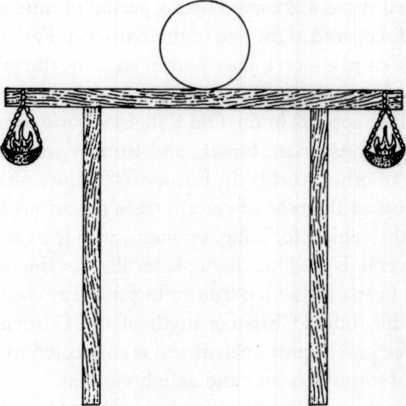
Figure 5 Moon Portal
The Guardian of the Grove represents our conscious mind, which keeps us from embracing the mystical vision by always questioning and discounting our "supernatural" experiences (or those of others). It is through the practice of magick, and through the experience of mystical encounter, that we form the mentality necessary to defeat the Guardian. Once the Guardian can be defeated, then the fruit of the Moon Tree is within reach. To taste of its essence is to receive initiation from the gods themselves.
ENDNOTES
1. See chapter 21 of this book, "The Teachings of the Holy Strega" for further information.
2. Webster's Dictionary, 1970.