
HOUSE OF REPRESENTATIVES
WASHINGTON, DC
APRIL 28, 1981
7:00 P.M.
The president who was nearly killed is bathed in applause. Members of Congress leap to their feet in bipartisan support of the man who was hit by an assassin’s bullet a little more than four weeks ago. Ronald Reagan is visibly thinner and frail but is walking easily under his own power.
The roar continues as Reagan strolls to the podium and shakes hands with Vice President George Bush, who also serves as president of the Senate. Reagan greets the rotund white-haired Speaker of the House, Massachusetts congressman Tip O’Neill. The president then turns to address the Congress.
But the ovation will not end.
Reagan grins. He is genuinely thrilled by the outpouring of warmth. His cheeks and forehead are red, thanks to hours spent enjoying the sun in the White House Solarium during his recovery. He wears a well-tailored dark blue suit with a gray-and-blue-striped tie.
Referring to the shooting, Reagan launches an unexpected joke: “You wouldn’t want to talk me into an encore.” Laughter erupts.
After three full minutes, the applause finally dies down, and Reagan begins his remarks. The purpose of the speech is to gain congressional approval for his economic recovery program. However, almost immediately, he detours from the details of that plan to speak from the heart.
“Mr. Speaker,” Reagan begins, “distinguished Members of the Congress, honored guests, and fellow citizens: I have no words to express my appreciation for that greeting.
“I’d like to say a few words directly to all of you and to those who are watching and listening tonight, because this is the only way I know to express to all of you on behalf of Nancy and myself our appreciation for your messages and flowers and, most of all, your prayers, not only for me but for those others who fell beside me.”
* * *
At the mention of her name, all eyes shift to Nancy Reagan. She sits in the front row of the congressional balcony, wearing a bright red dress. The murder attempt has rattled her so deeply that she has stricken the word assassination from her vocabulary. Her public approval rating is one of the worst a First Lady has ever experienced, for many consider her a controlling ice queen. But what the public does not know is that Nancy Reagan sobbed at the hospital after her husband was shot. Even now, there are moments when she completely breaks down emotionally.
Nancy knows the little things about her husband that every wife knows: that Ronald Reagan likes his eggs soft-boiled for precisely four minutes; that his favorite soup is a hardy combination of beef broth and lean ground hamburger served with a slice of French bread; and that the bumps on his left hand are caused by a hereditary disease that forces his pinky finger to curl permanently into his palm.1
Nancy Reagan is one of the few who saw how pale and feeble her husband was in the hours after the shooting. For the first time, with those great dark circles under his eyes and haggard wrinkles, he looked like an old man. She saw the same frailty when he returned to the White House, walking in small, hesitant steps, his arms punctured by intravenous injections. In those days, he slept on a hospital bed in the Lincoln Bedroom, reliant on pain pills to get through the day and night. Nancy has even given up her own nightly sleeping pill to make sure that she will hear her husband should he cry out.
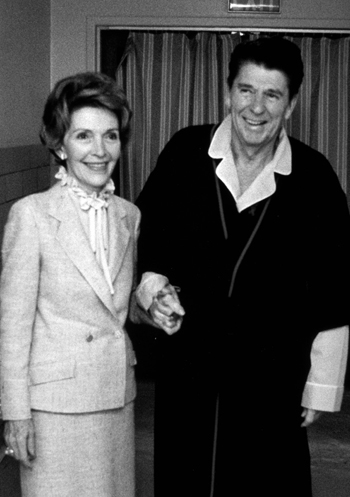
Ronald and Nancy Reagan at George Washington University Hospital during his recovery
The First Lady’s obsession with her husband’s well-being extends to the public arena. Nancy Reagan now works with Deputy Chief of Staff Michael Deaver to regulate the president’s schedule. Fearing that he will be overscheduled, Nancy decides whom Reagan will and will not see. This practice will continue throughout Reagan’s presidency. Nancy’s behavior is so hands-on that Deaver will one day state, “I always imagined that when I died there would be a phone in my coffin and at the other end of it would be Nancy Reagan.”
She also watched with trepidation on April 16 as Ronald Reagan made his first public appearance since the shooting—taking a stroll around the Rose Garden before photographers. The nation marveled at his vigor and quick recovery, but Nancy knows it was all a carefully orchestrated façade, designed to reassure Americans that their seventy-year-old president was still very capable of leading the country.
On this evening, Nancy supervises her husband’s meticulous prespeech preparation. It begins with Ronald Reagan styling his hair immediately after stepping out of the shower. Reagan combs his still-wet locks forward until they hang over his eyes in long bangs. Then he applies a dab of Brylcreem in order to hold his hair in place and maintain the “wet look.” Only then does the president sweep his hair back, deftly combing it into the trademark pompadour that takes years off his appearance.
“I never realized how much your face is changed when you comb your hair up in that pompadour,” Michael Deaver once said to Reagan, after witnessing the hairstyling ritual. At first, with the hair hanging down on Reagan’s face, Deaver was concerned that “Reagan looked eighty years old.”
But with each stroke of the comb, youth magically reappears.
“Oh, yes,” the president told Deaver. “It takes all the lines right out of my face.”
Nancy has seen the combing ritual many times, just as she has seen countless makeup artists try to coax her husband into their chair before a big television appearance or a speech under bright lights. But harkening back to his old Hollywood days, Ronald Reagan refuses to wear makeup. That red-rouged appearance he now displays on the congressional podium is all natural.
These are the peculiarities of a man who has long charted his own course, and after his near-death experience Nancy is thankful for the gift of being able to witness them at all. Not that the shooting is entirely behind the first couple. Nancy alone knows that even now, basking in the relieved applause of his political friends and rivals, Ronald Reagan is summoning all his strength and concealing a great deal of pain in order to give this address.
Nancy needs strength as well. She knows America does not like her. The press has been ruthless, disapproving of what they perceive to be her power over the president. The criticism nettles her, but Nancy endures it. She can be a vain, selfish, and even deluded woman, far too reliant on fortune-tellers. But she is also very clever. And her loyalty and love for Ronald Reagan are absolute.
* * *
The president feels Nancy’s approval as his speech transitions from the personal to the patriotic. “The warmth of your words, the expression of friendship and, yes, love, meant more to us than you can ever know,” Reagan tells America and the Congress. “You have given us a memory that we’ll treasure forever. And you’ve provided an answer to those few voices that were raised saying that what happened was evidence that ours is a sick society.”2
Reagan pauses for dramatic emphasis.
“Well, sick societies don’t produce men like the two who recently returned from outer space.”
The president is referring to astronauts John Young and Robert Crippen, who successfully piloted a new craft known as the Space Shuttle on its inaugural voyage into the heavens during Reagan’s convalescence. Columbia’s journey forever changes manned space flight. What Crippen and Young accomplished is, indeed, revolutionary.3 It seems that the entire world has undergone a major transition in the twenty-nine days since John Hinckley opened fire.
The days of Reagan’s recovery also marked the end of an era, when the last top American World War II general, Omar N. Bradley, died at the age of eighty-eight. Just one day later, on April 9, a frightening new epoch begins when the first confirmed diagnosis of a disease that will come to be known as AIDS takes place in San Francisco. And just four days previously, Reagan penned his long-delayed letter to Soviet premier Leonid Brezhnev, opening a new epoch of relations between the two nuclear superpowers.4
But the greatest changes to Reagan since the assassination attempt are more personal. In addition to allowing Nancy to assume control of his schedule, he surprised her one recent Sunday morning by suggesting they go to church. In the past, religion has been mostly politically expedient to the president. After the shooting, however, Ronald Reagan has become a man who understands his own mortality and is determined to draw closer to God.
* * *
“Sick societies,” Reagan continues, “don’t produce young men like Secret Service agent Tim McCarthy, who placed his body between mine and the man with the gun simply because he felt that’s what his duty called for him to do.”
* * *
Agent McCarthy, the recipient of John Hinckley’s fourth bullet, checked out of George Washington University Hospital on April 7. He will spend the rest of his life joking that the Devastator round ruined his new woolen suit. More important, the Secret Service will soon begin showing new agents videotape of the Reagan assassination attempt, pointing to the way McCarthy shifted his body into a linebacker crouch, with arms up and legs slightly wider than shoulder width, to protect the president. In doing so, Tim McCarthy exposed himself to the bullet. The round spun McCarthy as it entered the right side of his abdomen, knocking him to the ground. In a split second, the .22-caliber slug hit a rib, punctured a lung, passed through his diaphragm, and came to rest in his liver. The surgery at George Washington to remove the bullet lasted a little more than an hour.
As Ronald Reagan speaks to Congress, Tim McCarthy has no regrets about what transpired. The devout Catholic father of two young children is a product of his rigorous training and is already making plans to get back on the job.
In this way, McCarthy and Ronald Reagan are two very similar Irishmen.
* * *
Ronald Reagan continues his speech: “Sick societies don’t produce dedicated police officers like Tom Delahanty.”
* * *
Officer Delahanty is also of Irish descent. He is considered an “exemplary officer” by his superiors, having received more than thirty commendations during his seventeen years on the force. But the Washington Metropolitan cop earned instant retirement when John Hinckley’s second bullet struck him in the neck. His injuries make it impossible for him to stay on the job.
Delahanty wasn’t supposed to be at the Hilton on March 30. When the forty-five-year-old Pittsburgh native reported for work that fateful morning, he assumed that he would be doing his usual job with a canine division in Washington’s Third District.
But Delahanty’s dog was suffering from heartworms. Kirk, as the mixed-breed canine is known, lives with Delahanty and his wife, Jane, in suburban Maryland. Delahanty chose to leave him home for the day and then accepted an assignment from the department’s Special Services Division specifically to work the Hilton detail.
Secret Service protocol stipulates that an agent never turn his back on a crowd when a president is present. But Tom Delahanty and the other Metro police working the Hilton never received that training. This may have saved his life. The bullet that went into his neck as he turned to gawk at President Reagan would have hit him in the throat had he been facing the shooter.
That is small solace for Delahanty. The bullet lodged in the lower left neck, dangerously close to his spinal column. Doctors at Washington Hospital Center initially decided against removing it, and only upon learning that the unexploded Devastator might detonate at any minute did the surgeons reverse that decision. As a safety precaution, they performed the operation wearing bulletproof vests.
However, by the time Delahanty was released from the hospital on April 10, the Devastator had left its mark. Irreversible nerve damage to his left arm means he must retire from the force. The department is also retiring Kirk, who will live out his days with Tom and Jean Delahanty.
Even in retirement, though, the incident haunts Officer Delahanty. He clearly proved himself to be far better in the protection of President Reagan than John F. Parker, the Washington Metro policeman who went drinking before President Abraham Lincoln was shot in Ford’s Theater in 1865. Yet the Secret Service is now saying that Hinckley could have been stopped. All it would have taken was for Delahanty and the other Metro Police officers on the rope line to continue facing the crowd as Ronald Reagan departed the Hilton.
It is a question that will dog Thomas Delahanty the rest of his life.
* * *
Ronald Reagan pauses for emphasis. His eye contact with Congress is intense. He is firmly in control of the speech. “Sick societies don’t produce … able and devoted public servants like Jim Brady.”
* * *
As Ronald Reagan speaks his name, Press Secretary James Brady lies in a bed at George Washington University Hospital, his head resting at a twenty-degree angle to ease the pressure on his damaged brain.
Brady was pronounced dead by the media after John Hinckley shot him in the left side of the forehead. But those early reports were erroneous. Even as President Reagan speaks, Jim Brady is beginning a recovery process that will last a lifetime. The bullet that struck him was the only Devastator to explode on impact, sending shards of metal into his brain.
“The bear,” as Brady calls himself, was comatose when the Secret Service brought him into George Washington University Hospital. Parts of his skull were missing, and his brain was visible. His eyes were swollen shut, and his breathing was rapid and shallow. Nerves were severed by the passage of the bullet, and a blood clot was forming on his brain.
The trauma team cut off Brady’s blue business suit and stashed it in a plastic bag beneath the gurney. A catheter was installed, as were intravenous lines to replenish fluid and blood. But it appeared to be all for naught. James Brady’s brain was swelling dramatically, squeezing the brain stem out through the bottom of the skull.
But Brady was in luck. He is right-handed, and while the bullet destroyed those portions of the brain that govern left-handed function, it spared those areas specific to right-handed behavior. He was also shot at a time of day when the hospital was at full staff, including a brain surgeon, allowing him to receive immediate assistance.
Within ten minutes, the trauma team stabilized Brady’s condition.
But at 5:13 p.m., as word of Brady’s grave condition leaked, Dan Rather of CBS News told America, “It is now confirmed that Jim Brady has died.”
This was news to Sarah Brady, who was sitting with a social worker outside the emergency room.
It was also news to Dr. Arthur Kobrine, who was leading the surgical team then removing pieces of Brady’s skull to relieve pressure on the brain.
Remarkably, the operation was a success. And though James Brady was still suffering in the hospital, he was alive. Amazingly, he will eventually recover a great portion of his brain function.
James Brady, the fourth Irish American shot by Hinckley, is also now forcibly retired. For the rest of the Reagan administration, the person taking his place will always be known as “acting” press secretary, out of respect for Brady.
* * *
Ronald Reagan is almost finished. “Sick societies don’t make people like us so proud to be Americans and so very proud of our fellow citizens.”
With those words, Reagan publicly puts the assassination behind him.
“Now, let’s talk about getting spending and inflation under control and cutting your tax rates.”
* * *
Three months later, standing in the Rose Garden at 10:55 on a sultry Washington summer morning, Ronald Reagan shows that he has rebounded from the shooting—and is not a man to be taken lightly.
“This morning at 7 a.m.,” the president tells reporters, “the union representing those who man America’s air traffic control facilities called a strike. This was the culmination of seven months of negotiations between the Federal Aviation Administration and the union. At one point in these negotiations agreement was reached and signed by both sides, granting a $40 million increase in salaries and benefits. This is twice what other government employees can expect. It was granted in recognition of the difficulties inherent in the work these people perform. Now, however, the union demands are 17 times what had been agreed to—$681 million. This would impose a tax burden on their fellow citizens which is unacceptable.”
In Moscow, the Soviet leadership is watching this speech very carefully, even though it is a domestic matter. They are still unconvinced of Ronald Reagan’s toughness. They do not know what sort of man he truly is. He may have survived an assassination attempt, but until now his leadership has not been tested by political crisis.
Shortly after Reagan won the election, the leadership of the Professional Air Traffic Controllers Organization demanded a 100 percent pay increase. These federal employees are not just responsible for the safety of America’s skies but are also vital to national security, thanks to the military jets that rely on their guidance. PATCO was the rare union, along with the Teamsters, that supported Reagan during the election, and he sympathizes with their pay request. But it is too much. Such an enormous raise at a time when he is committed to cutting taxes is impossible.
So Reagan delivers an ultimatum: “If they do not report for work within 48 hours, they have forfeited their jobs and will be terminated.”
A total of thirteen thousand air traffic controllers are now on strike. Their goal is to bring America to its knees, forcing Reagan to surrender. The threat of a major air disaster looms, an event that could destroy public faith in the president.
This is what the Soviets are watching so closely. If Reagan backs down, they will know how to negotiate with him in the future.
Understanding he is being personally challenged, Reagan is furious at the union. It has crossed the line. He may appear affable and easygoing, but he has a long history of holding tight to his convictions. In his mind, there can be no backing down. As he tells Secretary of Transportation Drew Lewis, quoting the words of his presidential idol, Calvin Coolidge, “There is no right to strike against the public safety, by anybody, anywhere, at any time.”
In defiance of Reagan, more than eleven thousand air traffic controllers ignore his warning and continue to walk the picket lines. Forty-four hours later, Reagan makes good on his promise.
They are fired.
All of them.
“I’m sorry,” Reagan tells the press. “I’m sorry for them. I certainly take no joy out of this.”
Later, Reagan will reflect on this day with a sense of justification: “I think it convinced people who thought otherwise that I meant what I said.”
Especially the Soviets.
George Shultz, who will one day serve as Reagan’s secretary of state, will call this “the most important foreign policy decision Reagan has ever made.”
The brutal firings send a signal worldwide: Ronald Reagan is back, and he is just getting started.