
HOUSE OF COMMONS
LONDON, ENGLAND
APRIL 3, 1982
11:19 A.M.
Margaret Thatcher is terrified. Heart racing, but appearing calm on the outside, the British prime minister rises to speak. She is dressed immaculately, in a dark-blue suit accompanied by her trademark pearl necklace and earrings. Thatcher’s reddish-brown hair, held in place by copious amounts of hair spray, rises several inches off her forehead and rings her face like a lion’s mane. French president François Mitterrand likes to say that Thatcher has “the eyes of Caligula and the mouth of Marilyn Monroe,” in reference to her cunning and her offbeat look. Those traits are very much in evidence today.
Mrs. Thatcher leans forward, her weak chin and blue eyes on full display. For the first times in fifteen years, Parliament is meeting on Saturday. Both sides of the chamber are filled, the elected members sitting comfortably on benches padded in green leather. They have come to debate whether Britain will go to war. But there is another issue at stake today, one that few in this room will say out loud: Margaret Thatcher’s political career could be all but over.
“We are here,” Thatcher begins, “because for the first time in many years, British sovereign territory has been invaded by a foreign power.”
And it is all her fault.
Just yesterday, the Falklands, a collection of mountainous, windswept islands in the South Atlantic that Britain has controlled for nearly 150 years, were invaded by hundreds of Argentine commandos, infantry, and armored vehicles. Margaret Thatcher knew the Argentine military government had been rattling its sabers over the Falklands to deflect the public’s attention from the country’s wretched economy. But she did not take the threat seriously, believing the islands insignificant and of no military value.
“I thought that they would be so absurd and ridiculous to invade the Falklands that I did not think it would happen,” she will later tell a board of inquiry, adding that when she realized the invasion was imminent, “it was the worst, I think, moment of my life.”1
Eight thousand miles away from London, the British Union Jack no longer snaps in the South Atlantic wind. It has now been replaced by the blue-and-white Argentine triband. In response, patriotic outrage seethes on the streets of Britain, almost all of it directed at Thatcher. In desperation, the Iron Lady has reached out to Ronald Reagan, asking the United States to help Britain retake the Falklands. But her fellow world leader and ideological soul mate is refusing. In fact, Reagan even suggests that Great Britain relinquish its claims to the Falklands, seeing the islands as a vestige of Britain’s colonial past.
But Reagan is being shortsighted. This is about more than the Falkland Islands. This is about salvaging national pride at a time when Britain’s global status is sinking and when its “special relationship” with the United States is overwhelmingly lopsided in America’s favor. To allow a nation such as Argentina, and its arrogant military ruler, General Leopoldo Galtieri, to dictate terms is unthinkable to the British population.
No, this is a time for war, even if Margaret Thatcher and Great Britain must go it alone.
Thatcher has been prime minister for almost three years, and her conservative policies are fast losing popularity. The daughter of a grocer seems to have forgotten her humble beginnings.2 Her greatest success has been in cutting taxes for the rich while trimming services for the poor. Up until now she has shown little interest in foreign affairs and has been a lackluster leader on both the domestic and international stages. Her nation’s mood matches her dour performance. With unemployment hovering in double digits, the people of Britain are defeatist and cynical, a far cry from the plucky can-do spirit that buoyed Great Britain in World War II. Opinion polls show that if an election were held today, Margaret Thatcher would lose to her liberal opponents in a rout.
Yet Thatcher has no intention of altering her policies. “This lady’s not for turning,” she has publicly announced. “People are prepared to put up with sacrifices if they know those sacrifices are the foundation of future prosperity.”
British press secretary Bernard Ingham would later describe Thatcher as “macho in a man’s world, determined to work men under the table; fierce in argument, asking no quarter and giving none; in the back row when tact was handed out; impetuous; secretive; inspirational, and utterly dedicated, with a constitution as tough as old boots.”
Now that constitution will be sorely tested. On the surface, Margaret Thatcher appears ill suited to lead Great Britain into battle. But lead she must.
With little political opposition, the Iron Lady launches a most audacious scheme to get the Falklands back. She orders the head of the navy, Admiral of the Fleet Sir Henry Leach, to prepare an attack.3 Within a day, an armada of British warships will set sail for the Falklands.
* * *
Four days after Margaret Thatcher’s combat force sets sail from southern England, Ronald Reagan tiptoes into the Caribbean Sea. American warships are anchored offshore. The aquamarine ocean in Barbados is churning, with waves crashing onto the beach. Reagan begins to swim, though cautiously, knowing that he is not at full strength. It has been almost a year to the day since his release from the hospital after the assassination attempt. Part of Reagan’s fitness regime now includes weightlifting and stretching, and as he emerges from the surf after the brief swim, he is proud of the five pounds of muscle he has added to his upper body.
There are indications, however, that Ronald Reagan’s health is not what it used to be. Reporters noted earlier in the week that he was completely exhausted by just two days of meetings with Caribbean leaders. And while Reagan made a point of venturing into the water for his swim, aware that photographers down the beach were capturing the moment, his vigorous session of backstroke and freestyle alongside his Secret Service bodyguard was brief.
Ronald Reagan walks up the white sand to where Nancy sits with their hostess, former Hollywood actress Claudette Colbert.4 Nancy wears a strapless green-and-black bathing suit with a straw hat, while Colbert is clad in a white beach outfit. The actress did her own swim this morning, preferring thirty minutes of backstroke in the pool at the estate she has named Bellerive. National Review editor William F. Buckley Jr. and his wife, Pat, have joined Colbert and the Reagans for lunch.
Despite the state of world affairs, the president considers this a day off. He and Nancy flew to Barbados on official business, but the weekend is to be a time of sun and relaxation. Their get-together with Colbert and the Buckleys will stretch from just past noon until almost midnight. First, a cocktail hour, and then a dinner of curried chicken in Colbert’s turquoise-colored dining room. Later, the Reagans will return to a private residence six miles away to sleep.
Yet world matters do not simply vanish because Reagan is in the mood to relax. Those warships anchored within view of Colbert’s two-story villa are American navy communications ships, along with a hospital vessel standing by to treat Reagan should something once again go horribly wrong. Secretary of State Alexander Haig is currently in London, meeting with Margaret Thatcher about the Falklands, and Reagan is waiting on a report. While pretending to be neutral, the president is a firm backer of the British and has little sympathy for the Argentine dictator Galtieri, whom he considers a drunk. However, Reagan does believe the Argentine leader to be an ally in the war against communism. Evidence of this can be found in Argentina’s military and financial support for a group known as the Contras, who are currently fighting the Marxist regime in Nicaragua. Since 1979 the United States has also backed the Contras. It is a policy that will soon lead to the greatest scandal of Reagan’s presidency.
But there is another reason Reagan is adopting a tone of neutrality in the Falklands situation. The Soviet Union is courting Galtieri by threatening to join Argentina in the conflict against the British. Reagan does not want this to happen, so he is cautious in his public statements.
Secretary of State Haig’s report from London is flashed to the White House Situation Room shortly after the Reagans finish lunch in Barbados. “The Prime Minister has the bit in her teeth, owing to the politics of a unified nation and an angry parliament,” Haig reports. “She is clearly prepared to use force.”
Reagan spends part of the afternoon thinking of his response. He finally writes back to Haig just before dusk. The larger problem facing the president is not the Falklands crisis but that he is still in the process of formulating his own foreign policy. In his one year in office there have been stirrings of unrest in Poland, delicate communiqués with the Soviet leadership, and an escalating crisis between Israel and Lebanon that now threatens to blossom into full-scale war.
“The report of your discussions in London makes clear how difficult it will be to foster a compromise that gives Maggie enough to carry on, and at the same time meets the test of ‘equity’ with our Latin neighbors,” Reagan responds to Haig. “There isn’t much room for maneuver in the British position.”
Then, knowing his words mean war, Ronald Reagan gets dressed for happy hour.
* * *
On April 25, less than three weeks after sailing from England, British Special Forces and Royal Marines retake South Georgia Island.5 The weather is terrible, a combination of force-ten gales and driving snow. Two British helicopters crash while attempting to rescue a group of commandos stranded on a glacier in the severe weather, and initial reports back to London indicate the loss of seventeen British soldiers. Thatcher weeps at the news, only to be told hours later that all the men survived. South Georgia Island is taken without a single casualty. “Rejoice!” she urges the citizens of Great Britain as the news breaks. “Just rejoice!”
But the Argentines are resolute. They still hold the islands’ main city, Stanley, even as a full-scale British invasion looms. Argentine president Galtieri’s nation, like Great Britain, is engulfed in patriotic fervor. Galtieri, the silver-haired former combat engineer, refuses to back down. He’s been in office just four months, and this test of his administration will be either his greatest triumph or his political undoing.
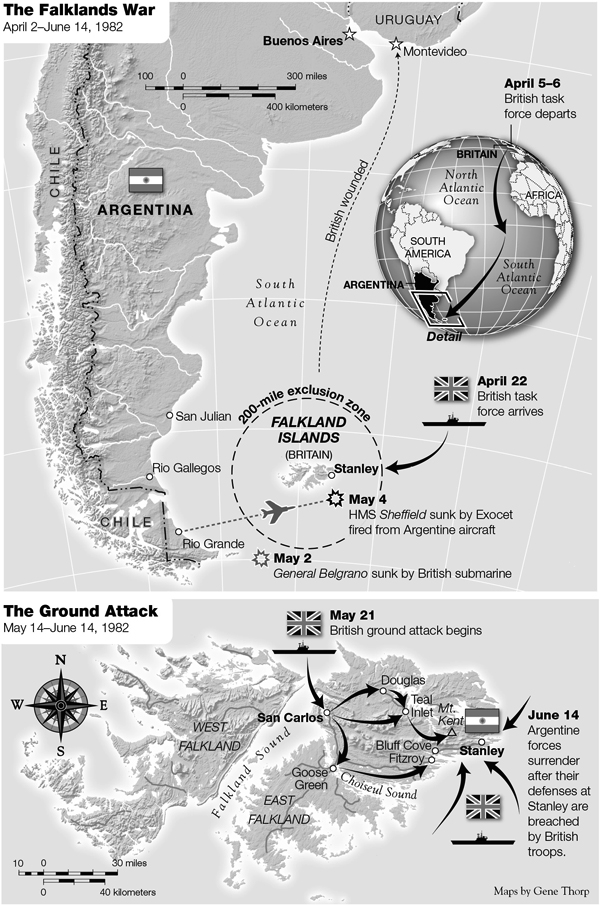
On April 30 the British declare a “total exclusion zone” around the Falklands. Any vessel found within a two-hundred-nautical-mile radius around the islands will be considered a ship of war and will be subject to immediate attack. Three days later, with Margaret Thatcher’s complete approval, the Argentine cruiser General Belgrano is sunk by a British torpedo. Its two escort vessels refuse to stay and rescue the survivors, cowardly fleeing back to the mainland. Three hundred twenty-three sailors are sent to their graves in the icy South Atlantic waters.
Two days after the Belgrano is sunk, Argentina gets its revenge. The HMS Sheffield is part of a British task force patrolling seventy miles off the Falklands. “Shiny Sheff,” as it is known for its highly polished stainless-steel fittings, is a state-of-the-art Type 42 destroyer.
At 7:50 a.m. on May 4, an Argentine patrol aircraft picks up the Sheffield on its radar. Two hours later, a pair of Super Etendard Argentine fighter jets take off from an air force base at the tip of South America. With French-made Exocet antiship missiles affixed to the bottom of their fuselages, the jets home in on the unsuspecting Sheffield.
Argentine pilots Lt. Armando Mayora and Lt. Cmdr. Augusto Bedacarratz use caution when approaching the ship, flying just a few feet above the ocean to avoid being detected.
Despite their stealth, radar operators on board the aircraft carrier HMS Invincible pick up the Etendards when the planes are 180 miles away. But the British fleet has undergone a number of false alarms in the past few days, thinking they see planes where none exists. The officer in charge ofInvincible’s electronics ignores the sighting, telling his radar operators that they are “chasing rabbits.” No warning is sent to Sheffield or any other British vessel in the vicinity.
On board the Sheffield, the mood is calm. The crew is not at battle stations, and the ship’s officers are chatting with their superiors in London via satellite phone. The electromagnetic effects of the phone interfere with the ship’s Type 965 radar, making it all but useless.
So it is that both Argentine planes fly within twelve miles of the Sheffield before launching their Exocets. Pilots Mayora and Bedacarratz fire their missiles and then split up to avoid detection. The Exocets’ rocket propellant ignites both missiles one second after launch. The missiles drop to just six feet above the Atlantic and race toward the unsuspecting ship at seven hundred miles per hour.
“The sea was very calm,” British sublieutenant Steve Iacovou will later remember. “We were looking out to sea and I thought it looked like a torpedo was on its way because the sea was shimmering and shaking.”
With no time to undertake defensive measures, the crew takes cover. “Missile attack. Hit the deck!” is quickly broadcast throughout the ship.
One Exocet lands harmlessly in the sea.
The other does not.
The missile pierces the Sheffield’s hull on the starboard side. Quickly, a fifteen-foot hole opens up and the seawater pours in. Luckily for the men of the Sheffield, the missile is a dud, and the 165-kilogram warhead does not explode. However, flames from the rocket propellant ignite everything in the Exocet’s path. Diesel fuel stored in the Forward Auxiliary Machine Room detonates, sending thick clouds of acrid black smoke throughout the vessel. The heat is so intense that all efforts to fight the fire are in vain. The blaze rages unabated, asphyxiating and burning all those trapped belowdecks. Amazingly, the Sheffield remains afloat, and the crew struggles to guide her into port. The order to abandon ship is given six days later, and the empty ship is towed into port. The Sheffield becomes the first British vessel sunk in combat since World War II.
“Twenty officers and ratings [enlisted men] died,” the official report will read. “Some personnel, in the Galley area, were killed on impact.”
This is the message that is read aloud to the House of Commons at 10:56 p.m. on May 4. Margaret Thatcher sits with her head bowed as British defense secretary John Nott tells the members of Parliament the sad news. The one thing she has feared more than any other was the loss of a ship. Now that has come to pass.
The prime minister does not reveal her emotions until she returns to 10 Downing Street, whereupon she breaks down. Margaret Thatcher weeps. Going to war was easy. But knowing that her decisions cost young men their lives, and that mothers throughout Great Britain are now learning the news that they have lost a son, is devastating. Her own boy, twenty-two-year-old Mark, and her husband, Denis, comfort Thatcher in the sitting room at 10 Downing Street as she sobs.6
“What are you making all this fuss for?” Denis asks bluntly as the prime minister’s crying continues. He is not always fond of being a politician’s spouse, having suffered a nervous breakdown and abandoned his wife for two months early in her career. Fond of a large drink and a laugh, Denis was unsure of whether to divorce Margaret Thatcher or remain married to this workaholic woman with the buckteeth and frizzy hair who talks politics nonstop. In the end, he came back home, but Denis Thatcher is not one to mince words. “When there’s a war on you’ve got to expect things to not go right all the time.”
* * *
The next morning, the Iron Lady is stunned to get a message from Ronald Reagan, who once again suggests that the British consider leaving the Falklands to the Argentines. Reagan believes the conflict is not worth the price.7
Margaret Thatcher’s mourning is replaced by rage. British soldiers and sailors are dying due to her decisions. Hundreds more are being wounded. In a scathing response, she makes one thing very clear: Great Britain is not backing down.
The men of the Sheffield will not have died in vain.
* * *
It is Memorial Day in Washington, DC. Ronald Reagan started his day at Arlington National Cemetery, in a moment of remembrance for the many Americans who lost their lives in war. Now he places a phone call to Margaret Thatcher.
“Margaret?”
“Yes, Ron?”
“Could you hear me all right?
“We could hear you very well. Can you hear me?”
“Yes, seems a little echo, but I guess that goes with the line we’re on.”
Ronald Reagan and Margaret Thatcher are speaking via the transatlantic hotline linking the White House with 10 Downing Street. It is 6:03 p.m. in Washington, close to midnight in London. Four more British ships have been sunk since the Sheffield went down, including her sister ship, the HMS Coventry. More than two hundred British servicemen have lost their lives on land and sea, but British troops have successfully retaken many parts of the Falklands. The war will not be over, however, until the British capture the capital city of Stanley.
“Could I impose and be presumptuous and give you some thoughts right now on the Falklands situation?” asks President Reagan.
“Yes, of course,” Thatcher replies with a curt tone.
“I want to congratulate you on what you and your young men are doing down there. You’ve taken major risks and you’ve shown that unprovoked aggression does not pay.”
Thatcher thanks the president and then listens in stony silence as Reagan puts forth a plan for a cease-fire to avoid “complete Argentinian humiliation.” He hopes for a withdrawal of British troops and for peace to be maintained by a United Nations peacekeeping force. Thatcher is having none of it.
“Just supposing Alaska was invaded,” she asks furiously.
“I have to say that I don’t think Alaska is a similar situation.”
“More or less so,” Thatcher replies, not backing down an inch.
“It was always my understanding or feeling that you had in the past been prepared to offer independence to the islands.”
With that, Reagan completes the last full sentence he will utter in this conversation. Despite the tone of civility, and the awareness that Great Britain is the weaker partner in their special relationship, Margaret Thatcher is uncowed by Ronald Reagan. Even as she speaks, British wounded are beginning the long journey back to Britain. Some maimed, some severely burned, they will bear the marks of the Falklands War the rest of their lives. Margaret Thatcher feels the emotional burden of their sacrifice and that of those who have fallen. She has slept little since the war began. The prime minister’s official study is a short, seventeen-step walk up a staircase from her private apartment. She ascends those steps each night to listen to the BBC World News with her personal assistant, Cynthia Crawford. For the workaholic Thatcher, this is the closest she comes to an actual friendship. Crawford will remember: “We used to sit on the bedroom floor—the heating would have gone off and there was a two-bar electric fire in the bedroom—kick off our shoes and relax.… She had practically no sleep for three months. Just catnapping. She was so incredibly strong and determined. Not once did she flag.”
After so many of these anxious nights, Margaret Thatcher has absolutely no intention of buckling under the suggestions of Ronald Reagan or any international peacekeeping body. She is not a woman fond of small talk, and her sense of humor is so dry that most people miss it. In a word, Margaret Thatcher is a serious woman.
So she lets the U.S. president know what’s on her mind.
“Ron, I’m not handing over the island,” Thatcher tells him. “I can’t lose the lives and blood of our soldiers to hand over the islands to a contact. It’s not possible.” She continues: “You are surely not asking me, Ron, after we’ve lost some of our finest young men, you are surely not saying, that after the Argentine withdrawal, that our forces, and our administration, become immediately idle? I had to go to immense distances and mobilize half my country. I just had to go.”
“Yes,” says Reagan before Thatcher can cut him off.
She then launches into a long rant about Britain’s territorial rights. Theirs is a friendship strong enough to endure this disagreement, so she plunges forward with abandon.8
“Margaret—” Reagan says, trying to get in a word during her tirade.
“Well—” He tries again.
“Yes—”
“Yes, well—”
“The point is this, Ron,” Thatcher concludes. She has never been one to bully, unlike many politicians. However, she is relentless in making her point. “We have borne the brunt of this alone … we have some of our best ships lost because for seven weeks the Argentines refused to negotiate reasonable terms.”
“Well, Margaret, I’m sorry I intruded,” Reagan says before hanging up.
“You haven’t intruded at all. And I’m glad you telephoned.”
Margaret Thatcher hangs up the hotline. Two weeks later, Stanley falls and Argentina surrenders. “She required guts to do it—her single greatest quality—and she deserved some cross-party support,” liberal British leader David Owen will comment of the war. “Thatcher’s personal resolve made all the difference between victory or defeat.” Owen continued: “Thatcher would not have remained prime minister if General Galtieri’s forces had not been thrown off the Falklands.”
In the process, the British prime minister has emerged as a global force.
Her nation, as she has suggested, rejoices.