
UNIVERSAL STUDIOS
HOLLYWOOD, CALIFORNIA
SEPTEMBER 1950
DAYTIME
The chimpanzee wears a white jumpsuit as she climbs high into the branches of a eucalyptus tree in the front yard of 712 Colonial Street.1 “Peggy” is five years old. She was born in the jungles of Liberia and lured into captivity with a bundle of bananas. Since coming to Hollywood, Peggy has been taught to understand 502 voice commands, ride a tricycle, do backflips on cue, and put on a necktie. She has become one of the motion picture industry’s top animal performers, commanding a thousand dollars per week in salary. Now, as the cameras roll, she is starring in her first title role. The film is a screwball comedy entitled Bedtime for Bonzo.
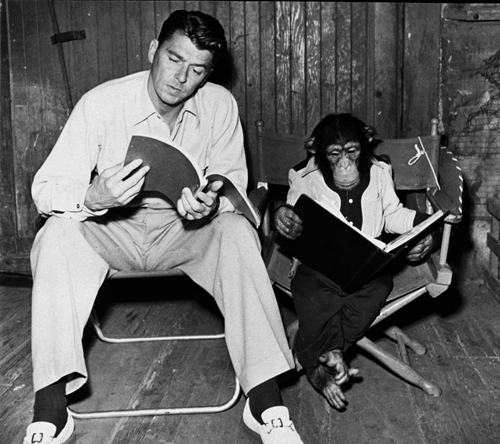
Ronald Reagan and Peggy the chimp on the set of Bedtime for Bonzo, 1950
“Action!” cries director Fred de Cordova.2 Peggy instantly obeys trainer Henry Craig’s instruction to do what comes naturally for her: climb a tree.
One would think the act will not be quite as easy for her costar. Thirty-nine-year-old Ronald Reagan balances precariously on the top step of an eight-foot ladder leaning against the tree trunk. In his slick-soled shoes, dress shirt, and tie, he is hardly dressed for climbing. His trademark pompadour, meantime, is carefully Brylcreem’d into place. There is no safety rope to halt his fall should Reagan lose his balance, but that is not a problem. Nearly twenty years after his college football career ended, the rugged actor is still lean and athletic. Reagan pulls himself up into the tree with ease, with not so much as a hair out of place.
Just a few years earlier, it would have been ludicrous to imagine Ronald Reagan acting opposite a chimpanzee. He was a star contract player for the Warner Bros. film studio, well on his way to becoming the sort of lead actor who could command any role he wished, like his friends Cary Grant and Errol Flynn.
In every way, Ronald Reagan’s life in the early 1940s could not have been better.
But that was then.
* * *
Ronald Reagan is twenty-six when he steps off the electric trolley at the Republic Pictures stop in Hollywood. The year is 1937. A torrential April rain drenches the young baseball announcer as he strides quickly along Radford Avenue to the studio gate. If Reagan were to lift his head, he would see the legendary “HOLLYWOODLAND” sign just miles above him in the hills, but he keeps his head low, the collar of his raincoat cinched tightly around his throat.
Dutch, as Reagan is known to family and friends, works for radio station WHO in Des Moines, Iowa, covering sports. He has come west to visit the Chicago Cubs spring training camp on nearby Catalina Island, twenty miles off the California coast.3 But the storm has shut down the ferries and seaplane service to Catalina, giving Reagan a free day in Los Angeles. Cowboy singing sensation Gene Autry is filming a new Western called Rootin’ Tootin’ Rhythm, and a few of Reagan’s friends from back home are playing the roles of Singing Cowhands.4 Reagan, who has long fantasized about being a movie star, has come to offer moral support to his pals.
Reagan will later write that “hundreds of young people—from Iowa, Illinois, and just about every other state”—shared his fantasy. They “stepped off a train at Union Station in Los Angeles … they got no closer to realizing it than a studio front gate.”
But thanks to his pals, Reagan makes it through the gate and hustles to Autry’s soundstage. He enters the cavernous building with klieg lights hanging from high wooden beams. He is immediately intoxicated by the sight of the actors, cameras, lights, and everything else that goes into making a movie. All is quiet as filming begins. Gene Autry himself, dressed in the knee-high boots and gun belt of a cowboy, strums a guitar and sings a lament about life on the prairie. The set is made to look like the parlor of an ornate home. Autry is surrounded by musicians and actors clutching fiddles and guitars, all dressed as cowboys.
“Cut,” yells director Mack Wright as the song winds down. Autry stops. Everyone relaxes on the set. A few minutes later, as Wright calls for “action,” the scene is repeated.
“I was starry-eyed,” Reagan admits to a friend that night. His friend’s name is Joy Hodges, and she and her band are performing at the stately Biltmore Hotel in downtown LA. Joy knew Reagan back in Des Moines, and they now enjoy a quiet dinner between sets. The walls are lined with oak, and a marble fountain gurgles in the background. Reagan tells her his dreams of becoming a movie star and how he wishes he could find a way to break into the business.
Joy Hodges, a pretty, raven-haired lady, finds Reagan intriguing.
“Take off your glasses,” she commands.
He removes them, and Joy instantly becomes a blur to Reagan.
Hodges, on the other hand, can see him quite clearly—and she likes what she sees. “Studios don’t make passes at actors who wear glasses,” she warns him before going back onstage for her second set.
Thus, the fairy tale begins. By ten the next morning, Reagan is meeting with Joy’s agent, who arranges a screen test for the handsome young man. The test eventually makes its way to Jack Warner, the powerful head of Warner Bros. Pictures. He also likes what he sees and offers Reagan a seven-year contract at two hundred dollars a week—almost three times what he makes at WHO. A hairstylist transforms Reagan’s center-parted look into the trademark pompadour he will wear the rest of his life. A tailor ingeniously alters the taper of his collar to create the optical illusion that Reagan’s neck is not so thick. Finally, after some deliberation, the publicity department declares that he can keep his real name on-screen.
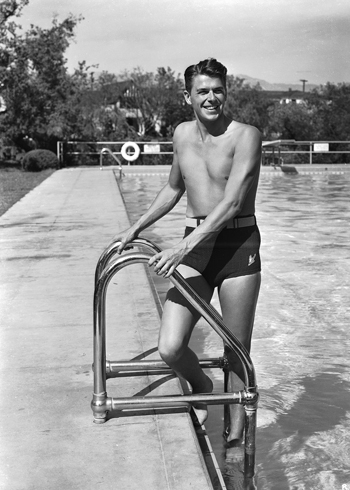
Up-and-coming movie star Ronald Reagan, 1939
So it is that by June 1937, just two months after stepping out of the rain at Republic Pictures, Ronald Reagan is acting in his first motion picture. The movie is called Love Is on the Air. Appropriately enough, Reagan plays a radio announcer.
* * *
Sarah Jane Mayfield—or Jane Wyman, as she is known in Hollywood—knows a thing or two about love. It is early in 1938 as she arrives on the set of the film Brother Rat. At the age of twenty-one, she is already married. Her current husband is dress manufacturer Myron Futterman, whom she wed in New Orleans six months ago. Small, with bangs worn high on her forehead and a husky voice that will one day become her trademark, Wyman has struggled to break into Hollywood since coming west from Missouri. But now she finally has gotten her foot in the door through a series of small roles in B movies and is determined to become a star. Her weakness is being impulsive when it comes to love, and she separates from Futterman almost as quickly as she married him.
As Ronald Reagan begins his tenth film in less than a year,5 there is no hiding the fact that his Brother Rat costar has quickly become infatuated with him. By December 1938, Jane Wyman officially divorces Myron Futterman and takes up with Reagan.
They soon become Hollywood’s golden couple, “wholesome and happy and utterly completely American,” in the words of gossip columnist Louella Parsons, who, knowing that nothing in Hollywood lasts forever, nevertheless predicts that their union will last thirty years. Wyman and Reagan are married in January 1940, shortly before Reagan begins filming Knute Rockne All American with Pat O’Brien. He plays the role of legendary Notre Dame running back George Gipp, uttering the immortal line “Ask ’em to go in there with all they’ve got, win just one for the Gipper,” before dying on-screen. It is his first A film and is soon followed by a costarring role alongside the swashbuckling womanizer Errol Flynn in Santa Fe Trail. Just four short years after breaking into Hollywood, Ronald Reagan is now a major star. He and Wyman are soon building a massive new house and spending their evenings at the best Hollywood nightclubs.
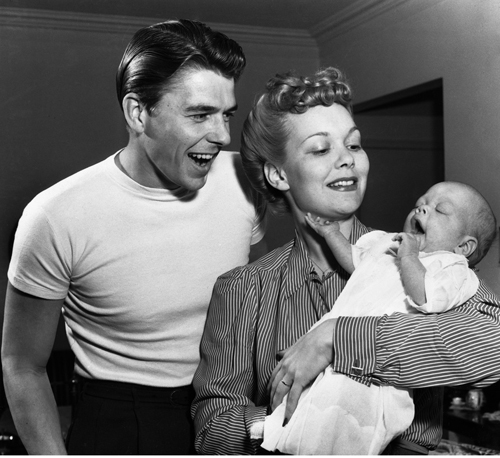
Ronald Reagan and Jane Wyman with baby Maureen
In 1941, Wyman gives birth to a beautiful daughter whom they name Maureen.
* * *
World War II is raging. But Ronald Reagan’s poor eyesight exempts him from fighting overseas. He stays in California but is eager to contribute to the war effort. Long before moving to Los Angeles, Reagan had joined Iowa’s Army Reserve, serving in the cavalry. In May 1937, before making his first motion picture, he was offered a commission as a second lieutenant in the U.S. Cavalry Officer Reserve Corps.
He begins active duty as a second lieutenant in the U.S. Army in April 1942, assigned to making training films and selling war bonds. He secures a top secret clearance, meaning he is often privy to classified information about upcoming American bombing raids. In the process, he learns how such attacks are planned and conducted. Reagan’s career up until now has seen him in a series of jobs that do not require leadership or organization. But the army teaches him about taking charge and motivating the men he commands. These are lessons he will use for the rest of his life.
The duties of Reagan’s U.S. Army First Motion Picture Unit shift in the waning days of the war. In June 1945, he sends a photographer to a local aircraft factory to take pictures of women working in war production. Pvt. David Conover shoots using color film, a rarity at the time, snapping the indelible image of an eighteen-year-old brunette holding a small propeller. The wife of a young merchant seaman, the fetching girl earns twenty dollars a week inspecting parachutes at a company named Radioplane, which also makes some of the world’s first drone aircraft.6 She has a wholesome smile, wears a modest green blouse, and has clipped her factory ID badge to the waistband of her pleated gray skirt. Her name is Norma Jeane Dougherty, and these photographs will soon open the doors of Hollywood to her. Eventually, Norma Jeane will divorce her sailor husband and change her name, as she becomes one of the most famous women in the world. As his own career is on the verge of combusting, Ronald Reagan is directly responsible for initiating the fame of Marilyn Monroe.
* * *
At war’s end, Reagan makes a triumphant return to Hollywood. Warner Bros. gives him a new long-term contract worth a million dollars, with a guarantee of fifty-two thousand dollars per movie. Reagan and the petite Wyman live in a five-thousand-square-foot custom home on a knoll overlooking Los Angeles. He spends his off time playing golf with comedians Jack Benny and George Burns, and enjoys steak dinners with Wyman at the exclusive Beverly Club. Also in 1945, Reagan and Jane Wyman adopt a baby boy, whom they name Michael.
Reagan’s first movie of the new contract is Stallion Road, in which he plays a horseback-riding veterinarian. Reagan’s on-screen mount is a midnight black thoroughbred mare named Tar Baby. Reagan likes “Baby” so much that he buys her before filming is completed. To give her a place to gallop, he fulfills a lifelong dream and buys a small ranch in the San Fernando Valley, which he will keep for a couple of years before buying a larger property in Malibu.
Then tragedy strikes. In June 1947, Jane Wyman gives birth prematurely to a young daughter. Reagan is ill in the hospital with pneumonia at the time and cannot be at Wyman’s side when Christine Reagan comes into the world. She lives just nine hours. The loss deeply affects his marriage to Wyman.7
Trying to put their lives back together, Ronald Reagan and Jane Wyman pour themselves into their work. Yet, despite all the trappings of success, Ronald Reagan’s glory days in Hollywood are numbered. Warner Bros. soon casts him in a series of forgettable pictures that make little money and are scorned by critics. Reagan is perplexed. His Hollywood fairy tale is in danger of coming to an end—and he is powerless to do anything about it.
Reagan is a hardworking, restless man who craves physical activity. He is the son of an all-too-often-drunk Irish shoe salesman and a Bible-thumping mother. Their parenting methods taught young Ron to avoid extremes in behavior, leading him, at times, to appear clueless and shut off. Also, it is true: Ronald Reagan is not a great intellect, having struggled to maintain a C average in college. Yet he can memorize paragraphs of script with ease and then recite them again and again on cue. Reagan also is a thinker, craving long periods of solitary meditation—preferably on horseback. He believes that “as you rock along a trail to the sound of the hooves and the squeak of the leather, with the sun on your head and the smell of the horse and the saddle and trees around you, things just begin to straighten themselves out.”
Reagan first learned to ride while working as a teenage lifeguard back at Lowell Park in Dixon, Illinois, and lives by the saying “Nothing is so good for the inside of a man as the outside of a horse.”
But no long gallop aboard Baby can hide the fact that Ronald Reagan’s personal and professional lives are now veering in new and disastrous directions.
* * *
Jane Wyman is growing bored with her husband, though he is oblivious to her dissatisfaction. Reagan can often be self-centered and callous. He has a habit of talking down to his wife because he possesses a college degree and she does not. He also likes to be the center of attention; sometimes screening his personal print of the 1942 movie Kings Row when guests come over for dinner.8
Jane Wyman is not impressed when friends suggest that Reagan, who is developing a fondness for political activism, run for Congress. “He’s very politically minded. I’m not very bright,” she answers coolly, when asked if she supports the idea.
Ronald Reagan has also become fond of lecturing. Any topic will do. “Don’t ask Ronnie what time it is,” Wyman warns fellow actress June Allyson, “because he will tell you how a watch is made.”
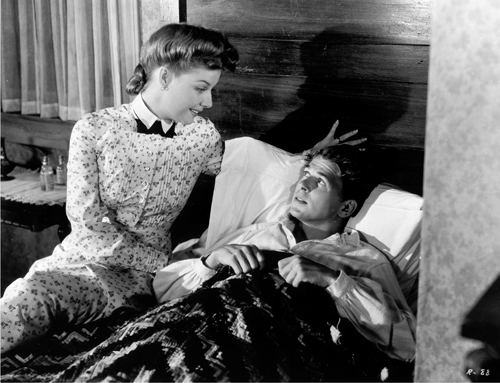
Ann Sheridan and Ronald Reagan in Kings Row, Reagan’s personal favorite of all his performances
When a baseball game comes on the radio, Reagan often ignores his wife and children, turning up the volume and drowning out their words by pretending to be the broadcaster and calling the game. In that way, he shuts out his family for hours.
To make matters worse, Reagan resents Wyman’s growing level of celebrity. Her movies, such as The Yearling, are earning money, critical praise, and Academy Award nominations. No longer the star when the two go out, Reagan must hover at his wife’s elbow as she basks in the public’s applause.
So it is that Ronald Reagan’s newfound political activism, his wife’s growing fame, and the death of their baby daughter combine to drive a wedge into their marriage. In 1947, Wyman cruelly mocks him during a lengthy speech he delivers before the Screen Actors Guild membership, foreshadowing the marital split that is soon to come. “Oh, for God’s sake, Ronnie,” she shouts to actress Rosemary DeCamp, “shut up and go shit in your hat.”
The end comes while Wyman is filming Johnny Belinda on location in Pebble Beach, California. She begins an affair with costar Lew Ayres. In May 1948, Jane Wyman files for divorce from Ronald Reagan, citing mental cruelty.
“I just couldn’t stand to watch that damn Kings Row one more time,” she explains when the marriage is finally over.
* * *
The divorce traumatizes Reagan. He is shattered and sometimes weeps openly, telling friends that the end of his marriage has left him “ashamed.” He clings to hope that the relationship can one day be salvaged and still drives the green Cadillac convertible Wyman gave him as a gift before the divorce. But when she publicly declares, “Lew Ayres is the love of my life,” it becomes clear that there will be no reconciliation.
Embittered, Reagan begins to behave in a callow fashion. He spends lavishly at Hollywood nightclubs such as Ciro’s, the Coconut Grove, and Slapsy Maxie’s, drinking too much and conducting a series of sexual affairs with women decades younger than he. His actions do not go unnoticed by the press. Silver Screen magazine writes, “Never thought we’d come right out and call Ronnie Reagan a wolf, but leave us face it. Suddenly every glamour gal considers him a super-sexy escort for the evening. Even he admits he’s missed a lot of fun and frolic and is out to make up for it.”
* * *
One of Reagan’s liaisons is with actress Penny Edwards, who is just twenty, and another is with the twenty-two-year-old actress Patricia Neal. During a memorable one-night stand in his apartment, Reagan takes the virginity of eighteen-year-old Piper Laurie after first barbecuing her a hamburger. Ironically, at the time of their liaison, Reagan was playing the role of Laurie’s father in Louisa. The actress will later remember Reagan as a “show-off” in the bedroom, a self-absorbed lover who bragged about his sexual stamina during the act and became impatient when she did not climax. “You should have had many orgasms by now,” Reagan scolded Laurie after what she claims was about forty minutes of sex. “You’ve got to see a doctor about your abnormality.”9
Reagan reaches bottom when he wakes up one morning at the Garden of Allah Hotel on Sunset Boulevard and does not know the name of the woman lying next to him. After that, he vows to rein in his behavior.
But he does not. Three years after his divorce, when he proposes marriage to twenty-six-year-old actress Christine Larson by offering her a diamond wristwatch, Reagan is also having relationships with six other women. Larson turns him down.10
* * *
Now living on his own in an apartment above the Sunset Strip, Ronald Reagan soon grows apart from his young son and daughter. Three-year-old Michael and seven-year-old Maureen Reagan will long remember their father as loving but also absent from their lives for long periods of time—as was their mother. Both children are sent away to boarding schools by the time they enter the second grade. “There’s a distinct difference between the care provided by a parent and the care provided by a paid caretaker,” Maureen will say years later. “It was simply one of the prices all of us had to pay for their success.”
During this playboy period, Reagan’s success has flatlined. He is no longer viewed as a bankable star by Hollywood standards. To add insult to injury, as his movie career is clearly in its death throes, Wyman wins her first Academy Award and arrives at the ceremony with Lew Ayres as her date, which only makes Reagan’s career seem more marginal.11 By 1949, Warner Bros. terminates his long-term contract, leaving him without income to pay the bills for the high-flying Hollywood lifestyle to which he has grown accustomed.
Desperate, Reagan accepts the offer to work on Bedtime for Bonzo. Animal movies are all the rage in Hollywood in 1950, thanks to the success of the February release Francis the Talking Mule. Jimmy Stewart has just finished Harvey, about a man and his invisible rabbit companion, on a set just one block down from where Reagan now films Bonzo. Harvey will open in October and earn Stewart his fourth Academy Award nomination.
As Ronald Reagan now clambers up into the tree after the chimp Peggy (Bonzo), he still believes his career will rebound. The film’s other star, Diana Lynn, awaits him in the branches, adding to the comedy’s madcap narrative. Meanwhile, Bonzo has jumped off a branch and is now inside the house, somehow managing to call the police. Soon there will be cop cars and fire trucks screaming down Colonial Street, all in a scripted attempt to get everyone down from the tree. This is a far cry from Reagan’s days making movies such as Dark Victory with major stars such as Humphrey Bogart and Bette Davis, or Sante Fe Trail with Errol Flynn. In that movie, Reagan played General George Armstrong Custer, whom he considers a great American hero.
Still, Reagan is a professional. He shows up each morning on time, knows his lines, and is pleasant to his coworkers. There are times, however, when he seems distracted. For there are pressing concerns on his mind.
Ronald Reagan is nearly forty years old. His profession is acting, but politics has set a new fire burning in his belly. The newspapers are full of the amazing events going on in the global fight against communism, as President Harry Truman sends U.S. troops into Korea to stop the Communist advance. Reagan is an ardent supporter of the Democratic president and campaigned for him in 1948. With Truman’s time in office due to end if he doesn’t run for reelection, Reagan is hoping former army general and World War II hero Dwight Eisenhower will run for president as a Democrat. Even as he deals with Peggy the chimp, Reagan is planning an article for Fortnight magazine in which he will explain how to fight communism worldwide. His determination to end the Communist threat is steadfast.
“The real fight with this totalitarianism belongs properly to the forces of liberal democracy, just as did the battle with Hitler’s totalitarianism. There really is no difference except in the cast of characters,” Reagan will write.
But that is a few months off. For now, Reagan is engaged in far less intellectual fare.
“Cut,” director Fred de Cordova yells.
Ronald Reagan climbs down from the tree.