
YEARLING ROW RANCH
SANTA MONICA MOUNTAINS, CALIFORNIA
DECEMBER 22, 1951
MORNING
Forty-year-old Ronald Reagan gallops Tar Baby over the rolling countryside of his new 270-acre Malibu ranch. He rides English style, wearing skintight jodhpurs and knee-high Dehner riding boots. Christmas is just days away. The air is crisp on this winter morning, the skies clear and blue. Reagan’s two children, home on break from Chadwick boarding school, are spending the weekend in the small shingled ranch house back near the barn.
But this weekend is not just a time for a father and his kids. Reagan’s latest girlfriend, a thirty-year-old actress named Nancy Davis, has joined them. Though she works very hard to endear herself to his son and daughter, and Maureen and Michael like her very much, Reagan is unsure about this blossoming relationship. He is not ready to be monogamous and is still seeing other women.
Yet Davis is determined to win his heart—by any means necessary. Recently, Davis confessed to Reagan that she might be pregnant. Yet rather than encouraging Reagan to propose marriage, the announcement has the opposite effect. He flees to the home of Christine Larson, the starlet who spurned his offer of marriage earlier this year. Reagan complains to her that he feels trapped by Davis and wonders aloud if she is trying to trick him into marrying her.
But on this day, Reagan does not feel confined. He rides tall and easy in the saddle, feeling the black mare moving beneath him. His connection with Baby is so strong that Reagan now insists upon riding her during on-screen horseback shots. This time last year they were in Tucson, Arizona, filming the Western The Last Outpost, which has become a minor success at the box office. The film’s horse wranglers warned Reagan that the desert location’s heat and dust might prove fatal to the mare. But the actor knows his horse well. Tar Baby survived the grueling shoot without a single problem.
Now, riding on a dirt path lined with sycamores and scrub oak, past Malibou Lake, where he plans to swim in the summer, and the hayfield that parallels distant Mulholland Drive, Reagan finds himself at a curious career crossroads. Bedtime for Bonzo was such a box office success that a sequel is in the works. Reagan received mixed notices for his comedic performance, with most reviewers preferring to focus their praise on Peggy the chimp. The New York Times called Bonzo “a minor bit of fun yielding a respectable amount of laughs, but nothing, actually, over which to wax ecstatic.”
Reagan was barely mentioned in the review.
Despite Bonzo’s success, he is not offered a role in the sequel.1 On top of that, Reagan’s tenure as president of the Screen Actors Guild will soon come to an end. It is a time of upheaval and change in Hollywood, and Reagan has been in the thick of the pitched battle between the studios and an emerging Communist presence in the show business community.
His “double life,” as he calls his now-intersecting twin passions of acting and politics, has consumed him. The ranch has been a tonic in these tough times, his Saturday getaway to clear his head from the strife.
Reagan has been the head of SAG for five years. But no year has been more intense than 1951. In addition to acting in three films and attending the Monday night SAG board meetings, he has also traveled around the country speaking on behalf of an anticommunist group known as Crusade for Freedom. The purpose: to raise money for Radio Free Europe. And though Reagan is still very much a Hollywood actor, the words he scripts for himself are those of a seasoned international politician.
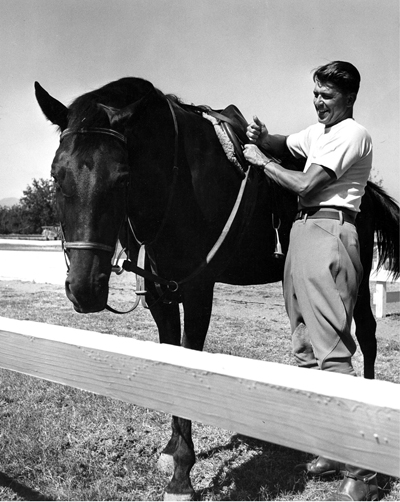
Reagan with Tar Baby
“The battleground of peace today is that strip of strategically located countries stretching from the Baltic to the Black Sea,” Reagan says in a recorded speech that is replayed to small groups around America. “They are not big countries geographically, but they contain several million freedom-loving people, our kind of people, who share our culture and have sent millions of their sons and daughters to become part of these United States. Some call these countries the satellite nations. More accurately, they’re the captive nations of Europe.”
Reagan is unaware that Crusade for Freedom is secretly backed by the Central Intelligence Agency, although he would likely be delighted if he knew.
* * *
Ronald Reagan actually considered joining the Communist Party back in 1938. Many in Hollywood were romanced by the Communists, as Adolf Hitler and his fascist ideology were becoming a threat not just to Europe but to the entire world. The Communists, with their avowed mission of helping the poor and disenfranchised, seemed poised to thwart Hitler’s ambitions. But there was more to Reagan’s attraction than mere ideology: as a newcomer to Hollywood, just one year into his studio contract, he saw becoming a Communist as a good way to expand his social circle.
“Reagan got carried away by stories of the Communist Party helping the dispossessed, the unemployed and the homeless,” screenwriter Howard Fast will claim years later. “Some of his friends, people he respected, were party members, so he turned to them. Said he wanted to be a Communist … said he was determined to join.”
But actor Eddie Albert, a costar in Brother Rat, was just as determined to talk Reagan out of turning red. Albert’s motives were deceptive. He leaned far to the left politically and secretly undertook the discussion at the behest of the American Communist Party leadership, who believed the talkative Reagan was a “flake” and did not want him joining their group.
Albert was successful. Reagan’s brief flirtation with communism came to an end.
His interest in politics, however, did not cease.
* * *
It is August 11, 1941, when Ronald Reagan attends his first meeting of the Screen Actors Guild at the union’s headquarters on Hollywood Boulevard. He has been invited to serve as an alternate for actress Heather Angel. The Guild is just eight years old at the time, founded to improve working conditions for actors. Reagan’s first meeting is more of a social excursion, as he has little knowledge of the Guild’s inner workings. Even when Jane Wyman is elected to the board a year later, Reagan remains distant from SAG, involved as he is with the war effort. But he resumes attending meetings in February 1946 as an alternate for horror-movie actor Boris Karloff. In September of that year he is elected third vice president.
By the end of World War II, with Hitler and the German Third Reich defeated, it is clear that Joseph Stalin and the Communists are just as ruthless and just as intent on global domination as the führer was. The Soviet Union, headquarters of global communism, displaces millions of people across Eastern Europe in order to build an empire even bigger than Hitler’s. It is also sending spies out around the world to infiltrate other nations and spread propaganda. Reagan soon sees this played out quite clearly in Hollywood. The actor’s union is slowly dividing itself into those, like Reagan, who now consider communism a scourge and those who believe that the political system embraced by the Soviet Union is intellectual and fashionable.
“[T]he important thing is that you should not argue with them. Communism has become an intensely dogmatic and almost mystical religion, and whatever you say, they have ways of twisting it into shapes which put you in some lower category of mankind,” wrote novelist and screenwriter F. Scott Fitzgerald, describing the ideological tension in Hollywood.
The illusion that communism is a harmless ideology is shattered on September 27, 1946, when the Confederation of Studio Unions goes on strike. The head of the union is Herb Sorrell, a rough-and-tumble former boxer who is also a longtime member of the Communist Party. The strike is funded by the National Executive Council of the Communist Party. “When it ends up,” Sorrell predicted, “there’ll be only one man running labor in Hollywood—and that man will be me.”
This is not a peaceful protest but a violent and militant attempt by the Communists to begin taking control of every major union in Hollywood—and, by proxy, the motion picture industry itself. In addition to the striking union members, Sorrell has enlisted hired thugs from the San Francisco area to provide menace. Cars are overturned in the streets. Police fire tear gas at the picket lines blocking the entrance to the Warner Bros. studio. Great mobs of strikers attack those attempting to cross the picket lines. Actor Kirk Douglas describes a scene of men armed with “knives, clubs, battery cables, brass knuckles, and chains.”
Despite the violence, studio head Jack Warner refuses to buckle. He continues making movies. Actors and employees do not cross picket lines to get to work. Instead, they are smuggled into the studio through a Los Angeles River storm drain. For those preferring not to endure the smells and slime of the subterranean entrance, the other option is riding a bus driven straight through the picket lines at Warner’s front gate. Scores of police officers are called in to line the route but cannot prevent the strikers from pelting the vehicles with rocks and bricks. Everyone on board the bus is instructed to lie down on the floor to avoid being hit in the head by broken glass and projectiles.
Ronald Reagan, as vice president of the Screen Actors Guild, considers the storm drain a coward’s entrance and refuses to lie down on the floor of the bus. No matter that he has two young children and a pregnant wife at home, Reagan puts himself at risk in order to make a statement: he is not afraid.
Each day, arriving for work on a new film called Night unto Night, Reagan is the lone person on the studio bus sitting upright, for all to see. When the strikers later escalate their campaign by forcing the Screen Actors Guild to support the strike, an anonymous caller to Reagan’s home threatens that he will be attacked and his face burned with acid if he tries to block SAG’s pro-strike involvement.
Furious, Reagan refuses to back down. Instead, he buys a pistol and carries it in a shoulder holster wherever he goes. For the rest of his life, Ronald Reagan will be vehemently anticommunist. For him, it is very personal: he will never forget the threats.
Four weeks into the confrontation, on October 24, 1946, Reagan and strike organizer Herb Sorrell sit down at Hollywood’s Knickerbocker Hotel. Sorrell is a powerfully built man, fond of using physical intimidation to achieve his goals. But Reagan is no less strong and is uncowed by Sorrell. He angrily accuses the union boss of being responsible for the threats.
“I have to have guards for my kids because I got telephone calls warning what would happen to me,” he seethes, before adding, “You do not want peace in the motion picture industry.”
Actor Gene Kelly is also at the meeting as a member of SAG’s board of directors. He quickly steps in with a joke to keep the peace: “If Mr. Reagan hits Mr. Sorrell I want it understood that this is not the official feeling of this body.”2
Kelly’s words have their desired effect. The meeting calms until it ends at one thirty the following morning, but nothing is resolved.
By December, with the strike in its third month, Reagan is calling a special meeting of SAG’s 350 most elite members. Among them is actor Edward G. Robinson, a man known for playing gangsters on-screen. Robinson is also one of Hollywood’s most ardent Communists. In a speech that those in attendance will remember for years to come, Reagan assures the membership of his solid standing as a New Deal Democrat and argues that the Guild should maintain a united stand against the strike. Even Robinson marvels “at Reagan’s clear and sequential presentation.”
Still, the strike drags on.
The duration of the strike angers Reagan. He is appalled by the Communist union leader’s zealous desire to take control of Hollywood. What began as a battle of ideologies has now become Reagan’s personal mission. He vows to fight communism, wherever it may be.
* * *
With Ronald Reagan gaining political confidence, Gene Kelly nominates him for president of the Screen Actors Guild. Veteran actors James Cagney, Robert Montgomery, Harpo Marx, and John Garfield have just stepped down from SAG leadership. Reagan is not present at the time of his nomination, arriving halfway through the meeting to find out that he has won. He is stunned.
The term of office is one year, beginning in 1947. Almost immediately, Reagan is tested by Communist sympathizers attempting to undermine his leadership. “At a mass meeting,” Reagan will later write, “I watched rather helplessly as they filibustered, waiting for our majority to leave so they could take control.”
A voice in the crowd cries out that the meeting should be adjourned. “I seized on this as a means of ending the attempted takeover. But the other side demanded I identify the one who moved for adjournment.”
Reagan is in a bind. While many in the Screen Actors Guild are against the Communists, it is also a career liability to speak out publicly against them. The momentum of the Communist movement is too great, and the possibility of being personally and professionally ostracized from the Hollywood community is very real. Reagan scans the crowd, searching for at least one individual with the backbone to be his ally in this heated moment.
He sees his man. “Why, I believe John Wayne made the motion,” Reagan tells the crowd. Wayne is one of Hollywood’s best-known tough guys, a former college football player whose starring roles in Westerns and war movies have made him one of the most bankable box office stars in the world. And unlike many Hollywood heroes, who look tall on the screen but are actually diminutive in real life, the gruff Wayne stands at a rugged six foot four.
“I sure as hell did,” Wayne roars from the crowd.
The meeting is adjourned.
* * *
Finally, after thirteen long months, the strike ends. Yet even as the studios emerge victorious, Hollywood’s growing embrace of communism continues unabated, drawing the attention of the feared FBI chief J. Edgar Hoover.
In the waning days of their marriage, Ronald Reagan and Jane Wyman are approached by FBI agents Richard Auerbach and Fred Dupuis, who come to their home uninvited on April 10, 1947. The agents ask the couple to “report secretly to the FBI about people suspected of Communist activity.”
Wyman and Reagan quickly offer up six names. This will be the end of Wyman’s involvement with the FBI, but Ronald Reagan begins meeting frequently with the bureau to provide more names and information. He is given a code name: T-10. Two of the people he names, actresses Karen Morley and Anne Revere, will not work in Hollywood for the next twenty years.3
Ronald Reagan believes this banishment is just, for he knows the women to be Communists—and thinks the Communist Party is an agent of a foreign power.
Reagan will be damned if he will allow the motion picture industry to undermine the moral fabric of the United States of America.
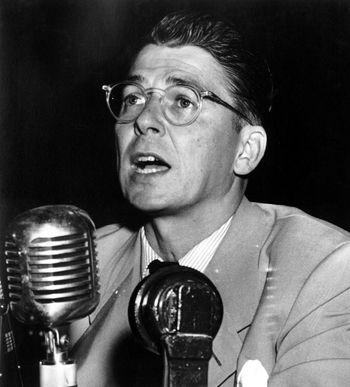
Reagan testifies before the House Un-American Activities Committee, 1947.
Ronald Reagan will never waver from the belief that informing for the FBI was the right thing to do; nor will he suffer any repercussions for it. “I talked to Ronnie since,” Jack Dales, executive secretary of SAG at that time, will comment years from now. “And he has no doubts about the propriety of what we did.”
* * *
On October 23, 1947, Reagan travels to Washington to appear before the House Un-American Activities Committee, a congressional group trying to root our subversive individuals and practices.4 “I believe that, as Thomas Jefferson put it, if all the American people know all of the facts they will never make a mistake,” said Reagan, responding to questions from HUAC chief investigator Robert Stripling. “Whether the [Communist] party should be outlawed, that is a matter for the government to decide. As a citizen, I would hesitate to see any political party outlawed on the basis of its political ideology. However, if it is proven that an organization is an agent of a foreign power, or in any way not a legitimate political party—and I think the government is capable of proving that—then that is another matter.”
Reagan’s appearance before the committee is his first visit to Capitol Hill.
It makes a lasting impression on him.
* * *
Nearly four years after testifying before Congress, Ronald Reagan guides Tar Baby back to the barn. He hopes soon to add “thoroughbred horse breeder” to the many job titles that currently keep him busy and plans to expand the simple barn into something more elaborate for that purpose.
Reagan leads the mare into her stall and removes her bridle and saddle. Whistling softly to himself, he brushes her torso and flanks. The repetitive movement allows Reagan a contemplative moment.
It is clear that Ronald Reagan needs to make some hard decisions about his future. He gets little respect for his roles as an actor, but he is held in such high esteem for his political activism that when the Friars Club recently honored him they refrained from derogatory jokes and putdowns. Instead, the six hundred members in attendance spent the evening lauding him with sincere speeches about his “stature and dignity,” with the legendary singer Al Jolson even going so far as to say that he wished his son would “grow up to be the kind of man Ronnie is.”
But with his Guild presidency coming to an end, it seems that Reagan’s political days will also cease. All the respect in the world from his Hollywood peers won’t pay the bills. He must find a way to revive his career. The mortgage on his ranch alone is eighty-five thousand dollars. Politics doesn’t offer that kind of money.
As Reagan steps out of the barn, walking to where Nancy Davis and his children wait inside the small ranch house, he faces a midlife crisis. Reagan well knows the truth: he is a forty-year-old Hollywood has-been on the verge of losing everything. As he enjoys a brief time of quiet and solitude on this cool December morning, he is unsure of what 1952 has in store for him—hardly aware that it is the year in which he will remarry, father a new child, and vote Republican for the first time in his life.5