
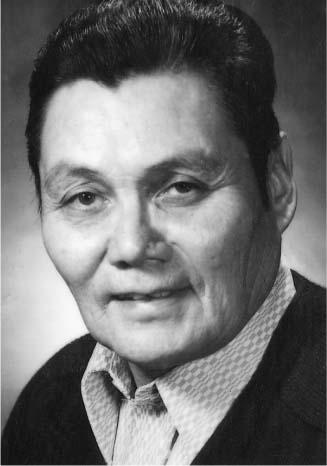
JOE AUGINAUSH (1922–2000), whose Anishinaabe name was Giniwaanakwad, was a man of remarkable wisdom. He both watched and participated in incredible changes for Ojibwe people during his years on earth. Those experiences, his intelligence, and time combined to develop his inspiring world view.
Joe Maude, as friends often called him, was one of the last Anishinaabe from the White Earth Reservation to have been born in a wiigiwaam or nisawa’ogaan. His family followed the seasonal rounds of traditional Ojibwe life at the large and vibrant Ojibwe village called Gaa-jiikajiwegamaag on the south shore of Roy Lake, where Joe spent the first several years of his life, in the wiigiwaam his parents maintained for their entire family. They built a nisawa’ogaan near Gaaniizhogamaag (Naytahwaush, Minnesota) for maple sugaring in the spring and a new wiigiwaam for ricing at Manoominiganzhikaaning (Rice Lake, Minnesota) in the fall, but Gaa-jiikajiwegamaag was home.
The seasonal lifestyle was a happy one for Joe, who remembered with special fondness the now-deserted village at Gaa-jiikajiwegamaag and the large rice camps at Manoominiganzhikaaning, where people from all over White Earth and even the neighboring reservations came for the harvest. It is widely believed that Manoominiganzhikaaning offered one of the largest and finest wild rice beds in the state of Minnesota. Soil erosion, flooding, and chemical run-off from nearby chicken farms and cattle ranches have recently damaged the rice beds there, but during Joe’s childhood the site was truly remarkable, with hundreds of Ojibwe camped out, harvesting and processing wild rice all day and singing and playing moccasin games all night. Joe Maude once remarked to me that he couldn’t understand how so many people got by with so little sleep, as the camp was buzzing day and night.
Joe Maude’s father eventually built a log house on Auginaush Creek, not far from the main village at Gaa-jiikajiiwegamaag, where the family lived for several more years. However, as the tribal housing project at Rice Lake expanded, the village was abandoned, and most families moved to Rice Lake or Naytahwaush for the luxury of modern homes and easier access to developed roads and the towns of Bagley, Detroit Lakes, and Bemidji.
Adolescence was difficult for Joe Maude, as he was taken away from his family and sent to a Bureau of Indian Affairs residential boarding school at Wahpeton, North Dakota. The school was strictly regimented, and Joe remembered with great anger that he was beaten for speaking the only language he knew—Ojibwe. He recalled that he and other children would gather to secretly converse in Ojibwe and sing pow-wow songs. He got his share of beatings, but he never forgot who he was, socially, culturally, and linguistically.
His parents and grandparents weren’t any happier with Joe’s boarding school experience than he was. They stubbornly fought for permission for him to attend the local day school in Bagley. They eventually succeeded; however, day school in Bagley wasn’t much better, as Joe felt isolated from and unsupported by both staff and students. At the age of seventeen, he left the reservation and traveled around the United States and Canada, working in Montana and elsewhere, earning enough money to eat and to travel to pow-wows.
In 1942, he enlisted in the United States Army and spent the next three years in the European theater. After World War II, he returned to the United States and again traveled to look for work. For several years he migrated from job to job, but he eventually returned to White Earth. There he lived out the remainder of his life, together with his wife Gertrude, raising their children and making himself available as a community resource. He traveled frequently to speak at schools, pow-wows, and educational forums, always using Ojibwe and speaking about the importance of the language and bicultural living.
He impressed upon me the nature of the struggle for the Ojibwe language—how the language survives and remains intact but is losing speakers. He also inspired many with his wise words about the importance of language. Joe was dedicated to his family, people, and language. He was a true leader—not by command, position, or power, but by his peerless example of genuine goodness.
Gaawiin Giwanitoosiimin Gidinwewininaan
[1] “Haa ganabaj giwanitoomin,” ikidong. “Anishininaabe-izhichigeng giwanitoomin.” Gaawiin ganabaj—i’iw anishinaabemowin geyaabi ayaamagad. Mii go giinawind eta go; giwanishinimin, akina gegoo giwanitoomin. Anishinaabe-izhichigewinan miinawaa go anishinaabe gaa-pi-izhichigewaad mewinzha, geyaabi imaa ayaamagad. Like I heard one old gentleman say, “We’re not losing our language, the language is losing us.”
Gaa-jiikajiwegamaag Ingii-tazhi-ondaadiz Wiigiwaaming
[1] Ahaaw sa naa ingii-odaapinaa sa go asemaa, iidog wa’aw isa inini gaa-miizhid iidog, nawaj igo wii-kikenimid miinawaa go ezhichigeyaan omaa sa gaye niin akiing ayaayaan. Nashke o’ow, gimanidoominaan ingagwejimaa gaye niin ji-wiidookawid omaa sa noongom waa-ani-ayikidoyaan.
[2] Nashke ojibwe-izhinikaazoyaan, Giniw-aanakwad indizhinikaaz. Miinawaa dash o’ow chimookomaanikaazoyaan Joe Auginaush, indizhi-gikenimigoo.
[3] Owidi dash gii-ondaadiziyaan, mii go omaa besho zhaawanong omaa Gaa-jiikajiwegamaag ezhinikaadeg, agaamiing iwidi Gaa-jiikajiwegamaag ezhinikaadeg. Mii iwidi gaa-tazhi-ondaadiziyaan. Iskigamiziganing ingii-tazhi-ondaadiz; 1922 ingii-ondaadiz. Mii dash igo eko-gikendamaan; mii go gii-ayaayaang omaa sa iskigamiziganing. Idash indede iidog gii-ozhige owidi Auginaush Creek ezhinikaadeg, mii iwidi ozhiged.
[4] Mii dash igo apane gii-ayaayaang maagizhaa go ingoji go. Gaawiin ingikendanziin aapiji agindaasoyaan sa ojibwemowining, ingoding gii-inaakonigewaad inga-zhaaganaashiim. Maagizhaa go ingoji go ishwaaso-biboonagiziyaan ingii-apiitiz apii gikendamaan i’iw isa gikendamaan sa akina gegoo gaa-pi-izhiwebak miinawaa go gaa-pi-izhiwebiziyaang. Apane ko ingii-wiijiwaag sa ingitiziimag miinawaa go nookomisag anooj gii-izhaayaang gii-paa-niimi’idiiyaang, miinawaa midewining gii-izhaayaang.
[5] Biinish igo apii ingoji go midaaso-biboonagiziyaan gii-apiitiziyaan; mii apii gaa-maajaayaan gikinoo’amaadii-wigamigong, gii-izhaayaan. Gaawiin ingii-kikendanziin i’iw zhaaganaashiimowin apii gaa-maajaayaan. Iwidi dash Wahpeton, North Dakota ingii-izhiwinigoomin gikinoo’amaagooyaang. Owidi apii gaa-izhi-dagoshinaang, aanish naa gaawiin ingii-kikendanziin i’iw zhaaganaashiimowin. Ingii-kagwaadagitoo ko ingoji go; ingo-biboon ingii-kagwaadagitoon zhaaganaashiimoyaan.
[6] Inashke iwidi gaa-izhaayaang, gaawiin igo ingii-pagidinigoosiimin ji-ojibwemoyaang. Gaawiin gaye ingii-pagidinigoosiimin gegoo ji-nagamoyaang waa-ani-niimi’idiiyaang. Booch dash igo ingii-izhichigemin. Imaa dash Wahpeton ingoji go ingii-ayaa, 1937ishkwaaj imaa gii-ayaayaan. Ishkwe go weweni gii-shaaganaashiimoyaan, miinawaa gaye eighth grade ingii-kiizhiitaa.
[7] Mii dash gaa-pi-izhi-giiweyaan, omaa dash indaa-ani-wiiji’izhinizhaawigoo owidi Mashkimodaang ezhinikaadeg, miinawaa go ji-gikinoo’amaagooyaan. Gaawiin dash ingii-minwendanziin, miinawaa gegaa go ingii-inendam, “Imaa niin eta, imaa indayaa.” Noongom ezhi-gikendamaan ganabaj niin eta ingii-anishinaabew imaa. Gaawesh, gaawiin dash ingii-inendanziin gii-izhaayaan baanimaa sa wayaabishkiiwed akeyaa ginwaabamaawizod. Inashke dash, gaawiin ingii-izhaasii. Ingii-izhi-naanaagadawendam i’iw biboon i’iw endaayaang gii-ayaayaan. Inashke ingitiziimag imaa go nookomisag miinawaa ganabaj igo gii-izhichigewaad anishinaabewin, booch gaye niin daniziyaan. Anooj gegoo indani-gikinoo’amaagoog.
[8] Mii dash gegapii gaa-izhi-ayaayaan ji-maadanokiiyaan imaa gichimookomaaning akeyaa. Naa booch iidog gii-anokiiyaan, mii dash gii-maadanokiiyaan, 1939 ingii-maajaa. Anooj dash igo ingii-paa-izhaa ji-baa-anokiiyaan. Montana gaye ingii-paa-izhaa gii-paa-anokiiyaan, anooj igo i’iw gii-izhichigeyaan biinish igo apii gaa-nandamigooyaan ji-o-miigaazoyaan iwidi sa chi-agaamiing gii-kichi-miigaadiing.
[9] World War Two gii-izhinikaade. Mii dash apii gaa-maajaayaan gaye niin; ingoji go imaa 1942 ingii-maajaa. Sa naa chi-agaamiing ingii-paa-ayaa iwidi akeyaa Europe ezhinikaadeg. Mii iwidi gaa-paa-izhaayaan gii-miigaazoyaan gaye niin wiidookaazoyaan. Ingoji go niso-biboon ashi aabita ingii-ayaa imaa miigaadiing.
[10] Inashke dash miinawaa owidi gii-pi-azhegiiweyaan, gaawiin igo omaa gaa-tanakiiyaan, ingii-pi-izhaasii igo. Ingii-paa-ayaa miinawaa owidi Montana miinawaa ingii-paa-izhaa. Ingoji go, oon ingoji go gegaa midaaso-biboon gaawiin omaa ingii-ayaasii, omaa gaa-onji-ondaadiziyaan omaa.
[11] Mii dash gaa-pi-azhegiiweyaan. Mii dash miinawaa gii-maajiitaayaan dash indanishinaabewin, anishinaabewin—niimi’idiing miinawaa go anooj ingii-izhaa ji-baa-giigidoyaan. Miinawaa go ingii-naaniim. Miinawaa ingii-nagam.
[12] Inashke gaye gaa-ishkwaa-miigaazoyaan, ingii-nagishkawaa sa niitaa, Scott Headbird. Miish igo apane besho ingii-ayaamin. Besho ingii-wiiji’idimin, biinish igo apii gaa-ishkwaa-ayaad.
[13] Inashke gaye anooj igo ingii-izhichige. Ingiw chimookomaanag gaye ingii-kagwejimigoo gaye wiinawaa iidog ji-wiidookawagwaa miinawaa go eyaabojiiwaad sa gaye wiinawaa izhichigewaad. Haa anooj gegoo ingii-izhichige imaa akeyaa chimookomaaning.
[14] Gaawiin dash go wiikaa ingii-nagadoosiin i’iw isa anishinaabewin. Inashke dash omaa noongom, aanish naa, mii azhigwa gaa-ako-niizhwaasimidana-ashi-nisobiboonagak indapiitiz. Gegaa go imbwaana’ow. Mii dash noongom eta go izhichigeyaan anooj izhaayaan niimi’idiing gaye niin baa-wiidookaazoyaan sa ojibwemoyaan gaagiigidoyaan sa dibishkoo go wiidookawagwaa niijanishinaabemag. Inashke gaye, anooj gaye indizhaa baa-wiidookaazoyaan o’ow isa anishinaabe-nagamong, miinawaa go anishinaabe-anami’aang. Gaawiin awenen igo midewin-sh geyaabi indizhitwaasiin. Mii eta go apane dibaajimag a’aw isa gimanidoominaan miinawaa go akina iniw aadizookaanan.
[15] Inashke gaye noongom anooj indizhaa gaye imaa gikinoo’amaadiiwigamigong ganoonigooyaan sa iidog gaye niin ji-wiindamawagwaa sa ongow oshki-anishinaabeg miinawaa oshki-chimookomaanag mewinzha gaa-pi-izhichiged sa a’aw anishinaabe. Naaniibowa niwiindamaagoog sa ji-ojibwemoyaan. Gaawiin dash onisidotanziinaawaa. Booch igo indizhichige.
[16] Inashke gaye owe noongom akina chi-anishinaabe geyaabi eyaad, indigoo. Niizhobimaadizi go indawaaj, indaa-ikid. Gegaa go, aanish naa zanagad wii-anishinaabewi miinawaa wii-gichimookomaaniwiwag gaye wiinawaa. Booch gaye ji-gii-izhichigeyan chimookomaan-izhichigeyan gaye niinawind dash ji-anishinaabewiyaang akeyaa ji-izhitwaayaang. Haa ingod geget sa zanagad, maagizhaa go indaa-ikid miinawaa zhaaganaashiimong, “You try to lead a double lifestyle.”
[17] Inashke go, ingoji go inashke go naa niin. Haa mewinzha ingii-maajiitaa naaniimiyaan. Owidi go ingoji go gaa-ishwaasobiboonagiziyaan, mii gaa-maajiitaayaan niimiyaan, biinish igo 1968 ishkwaaj gii-niimiyaan. Mii dash apii gaa-ani-bwaana’owiyaan miinawaa ji-niimiyaan niin.
[18] Haa namanj iidog geyaabi ge-ikidowaambaanen. Haaw iidog i’iw ganabaj minik.
Gii-pakitejii’iged Wenabozho
[1] Ahaaw akawe bangii niwii-tibaajimaa a’aw isa Wenabozho. Inashke Wenabozho iidog anooj gii-izhichige. Anooj gegoo ogii-kashkitoon. Akina gegoo ogii-kikendaan iidog.
[2] Inashke dash aabiding iidog, inamadabid imaa—imaa sa endaad iidog. Mii sa gaa-chi-inendang, “Haa ganabaj apane inga-babaamose.” Mii iidog maajaad babaamosed. Maagizhaa imaa aandi eyaad iidog wa haa bakitejii’igewag. Miish iidog omaa ezhi-biindiged imaa bakitejii’igewaad. Miish imaa bezhig iidog gaa-izhi-nandomigod, “Hey Wenabozh! Giwii-pakitejii’ige na?” “Haaw isa geget.” Wa, mii sa iidog odaminod bakitejii’iged.
[3] Maagizhaa mii sa iidog wiin nitam iwidi obakite’aan i’iw bikwaakwad. Wa, hay’ niibawid aazhaa gaa-izhi-bakite’ang. Wa apane iidog i’iw bikwaakwad iwidi chi-waasa iwidi ogii-ani-ganaandaan. Miish iidog imaa gii-ipitood imaa ji-gizhiibatood iidog anishinaabeg gaa-izhi-noondaagoziwaad aaniin igo anishinaabeg, “Haa Wenabozh! Home run. Home run,” inaa iidog. Haa mii sa go Wenabozho iidog, mii sa go apane gii-kiiwebatood.” Haa mii sa i’iw.
We’re Not Losing Our Language
[1] “Well, maybe we are losing it,” they say. “We are losing the Indian culture.” But maybe not—the Indian language is still here. It is only us: we are lost, and [therefore] losing everything. Indian traditions and what the Indian came to do long ago, it’s still there. Like I heard one old gentleman say, “We’re not losing our language, the language is losing us.”
I Was Born in a Wiigiwaam at Gaa-jiikajiwegamaag
[1] All right, I’ve accepted the tobacco given to me by this man who wants to know me better as well as the things I do while I am here on earth myself. See this, I am asking myself for our Great Spirit to help me here today in what I am going to say.
[2] As for my Ojibwe name, I am called Giniw-aanakwad. But then again this white man’s name, Joe Auginaush, is how I am known.
[3] And I was born over here, that’s here near the south end of Roy Lake as it’s called, over there on the other side of Roy Lake as it’s called. It’s over there that I was born. I was born in the sugar bush; I was born in 1922. And that’s what I’ve come to know of it; we were here in the sugar camp. And my dad he built a house over here at Auginaush Creek as it’s called, he built the house over there.
[4] Then we were always someplace [around there]. I don’t know the extent to which I studied in Ojibwe, but one time they decided I’m going to speak English. Maybe when I was somewhere around eight years old; I was that age when I knew everything I know of what happened and how things were with us. I always accompanied my parents and grandmothers wherever we went to pow-wow together and when we went to the medicine dance.
[5] That was until I was around ten years of age; then at that time I left, departing for the boarding school. I didn’t know English when I left. And we were taken over there to Wahpeton, North Dakota, as students. When we arrived over there, well I didn’t know that English language. We had a hard time; for one year I had a hard time speaking English.
[6] You see over there where we went, we were not permitted to speak the Ojibwe language. And we were not permitted to sing anything when we wanted to pow-wow. But we certainly did that anyway. And I was somewhere around Wahpeton, after 1937 that’s where I was. And after a while I spoke English very well, and in the eighth grade I was done.
[7] Then I came home, and here we were sent along over to Bagley as it’s called, and again I was a student. But I didn’t like it, and I almost thought, “It’s just me, I am the only one there.” Now I know I was perhaps the only one who was Indian there. But no, no I didn’t think about it that way when I went later on, the way the white man looks at himself. In fact I didn’t even go. I was there at our home in the winter reflecting. You see, my parents and maybe my grandmothers, they did things the Indian way, and that’s right where I belonged. They could teach me all kinds of things.
[8] Then around the time I was there [at home] I started to work in the white man’s way. I must have worked hard, when I started working. I left in 1939. And I went all over the place to work. And I went around Montana working, doing all kinds of things up until the time I was enlisted to go over and fight in Europe during the big war.
[9] It was called World War Two. And then I left there myself; sometime in 1942 I left. I was overseas over there in Europe as it’s called. Over there I went all over the place, fighting and helping out. I was in the war there for three and a half years.
[10] And when I returned over here again, I didn’t come back here to live. I was all over the place again, going over to Montana again. Just about, oh, nearly ten years I wasn’t here, here where I was born.
[11] Then I returned home. Then once again I started my Indian ways, the Indian way—pow-wow and again going around speaking. Once again I danced. And I sang.
[12] And after I fought, I met my brother-in-law, Scott Headbird. And we were always close. We were good friends up until the time he was no longer here.
[13] You see I did all kinds of things. I was asked by those white men themselves to help them out and advance their understanding too in what they did. I did all kinds of things in the white man’s way.
[14] But I never abandoned the Indian way. You see here today, well, now I’m seventy-three years old. I’m almost feeble. And today I only do certain things when I go to pow-wows and go around helping out, speaking Ojibwe, talking and helping out my fellow Indians. And you see, I go all over helping out with this Indian singing, and also with the Indian praying. I no longer practice the medicine dance. I only speak to our Great Spirit and all of his fellow spirits.
[15] And now I go to different schools too, being spoken to about helping these young Indians and young white kids, about what the Indian did long ago. A lot of them tell me to speak Ojibwe. But they don’t understand. But I certainly do it.
[16] You see this here today among all of the older generation that’s still here, I am told. They might as well lead a dual life, I should say. Almost, well it is difficult being Indian as well as wanting to be white people themselves. Certainly you had to do certain things, doing them in the white man’s way, but we are still Indians and believe that way. Oh it’s truly difficult, so maybe I should say it again in English, “You try to lead a double lifestyle.”
[17] You see, that’s how things are with me. A long time ago, I started pow-wow dancing. When I was about eight years old over here, I started dancing, dancing up until 1968. Then at that time I became too feeble to dance myself.
[18] Well, I don’t know if I’m going to say anymore. That must be enough.
When Wenabozho Played Baseball
[1] All right, first of all I want to tell a little story about that Wenabozho. You see Wenabozho must have been up to something. He was always trying to do something. He must have known everything too.
[2] One time he was sitting there—there where he lived. He was really thinking hard, “Maybe I’ll walk around.” Then he left walking around. Maybe there where he must have been they were playing baseball. Then he went in there where they were playing ball. Then one person there must have invited him [to play], “Hey Wenabozh! Do you want to play baseball?” “You bet.” So he must have played, playing baseball.
[3] So maybe during his turn he hits that ball way over there. He just stands there after he already hit it. But he smacked that ball way far over there. Then as he was running there, running just fast, the Indians made a ruckus. “Haa Wenabozh! Home run. Home run,” he must have been told. So Wenabozho ran home. That’s it.