
CHAPTER 9
Symbols are a timeless, universal language that is rich in figurative expression. Symbols are like viewing a diamond from different vantage points. In examining a cut diamond, one finds that it reflects light differently from every angle viewed. The monuments of the ancient mound-builders culture exhibit great symbolism and are marvelously instructive as an expressed language.
It has been said that symbols are the means whereby we enrich, deepen, and enhance our understanding. The Bible is replete with parables, allegories, similes and metaphors, given as a symbolic language to teach society many life lessons. Good examples are the similes and parallels to Christ’s life that are found in the Bible, which are given in similitude of Christ’s birth, life, and atoning sacrifice. Ancient symbols, like the scriptures, enlighten the human mind as they teach, inspire and speak differently to each individual who studies them.
Are there messages and stories yet untold that these symbolic ancient monuments are striving to share with us? Were these ceremonial and effigy mounds and earthworks given as a simile or as a metaphor for what was, or is to come? A simile is defined as likening one thing to another. To say that a man is like a lion or a serpent is to heighten one’s insight into the character and temperament of that man.
One of the most imposing finds sculptured in the landscape of this continent is the Serpent Effigy Mound found on a hilltop in Adams County, Ohio. Even though there were many serpent symbols found in the “Old World,” the serpent symbol is not commonly found in North America. However, Squier, after his study and explorations of the mounds, wrote a report titled, The Serpent Symbol, and the Worship of the Reciprocal Principles of Nature in America.
In it he stated:
The origin of The Serpent Symbol dates to the discovery of the Serpent Mound at Brush Creek in Adams County, Ohio, in 1846. Squier was certain that the effigy mound at Brush Creek was the representation of “a serpent and an egg in combination, a symbol found within the religions of the Old World.”62
…“The findings embodied in the comparatively obscure Serpent Symbol are critical in any assessment of Squier’s anthropological thought. His interest in the origin and development of religious ideas and symbols crystallized in stages between 1846 and the publication, in 1851, of The Serpent Symbol, and the Worship of the Reciprocal Principles of Nature in America.”63
“The Serpent Symbol is the fullest elaboration of Squier’s view on the psychic unity of man, and it encapsulates many of the development list assumptions of comparative ethnology in the mid-nineteenth century.”64 Squier became preoccupied with the symbolic nature of the Serpent and Egg and what could be learned in doing comparative studies on symbols.
Squier noted the importance of this collateral line of investigation in Ancient Monuments of the Mississippi, in the appendix of Aboriginal Monuments of the State of New York, in an unpublished paper on the serpent symbol in America read before the American Ethnological Society in 1848, and in a series of articles published in the American Review in 1848 and 1849. Squier considered The Serpent Symbol an extension of his Smithsonian monograph, and there is, indeed, a unifying set of ideas and themes that intimately connects them.65
In many cultures around the world the Serpent Symbol plays a very prominent and significant role in their religious worship, ceremonies and history. None is more pronounced than that of the Judeo-Christian belief in the Garden of Eden where Lucifer is depicted as a serpent.
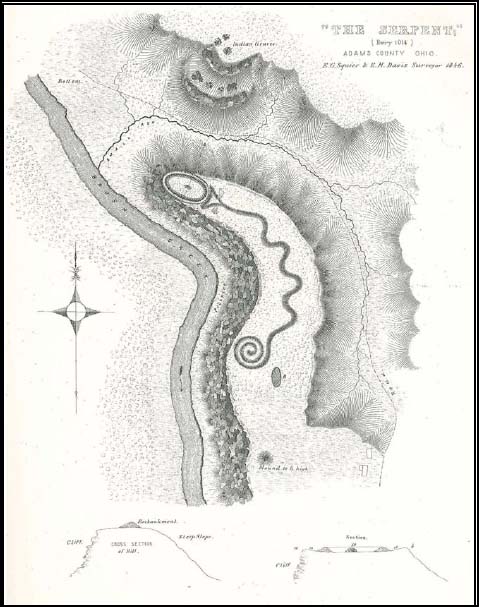
Ancient Monuments of the Mississippi Valley, 1848, Squier and Davis, Plate XXXV
When our production team visited the site of the Serpent Effigy Mound, the park director described it to us as a serpent eating a giant egg. Upon walking the length of it in company with a Semitic scholar and upon taking a closer examination of the surveys and aerial pictures depicting the Serpent, we observed an arrow, which seemed to be pointing out a direction on the head of the serpent, along with an arrow at the end of the “egg.” This raised the question that perhaps the ancient builders of this effigy mound weren’t expressing that the serpent was eating an egg at all, but was instead showing the emerging head of the snake as it was shedding its skin.
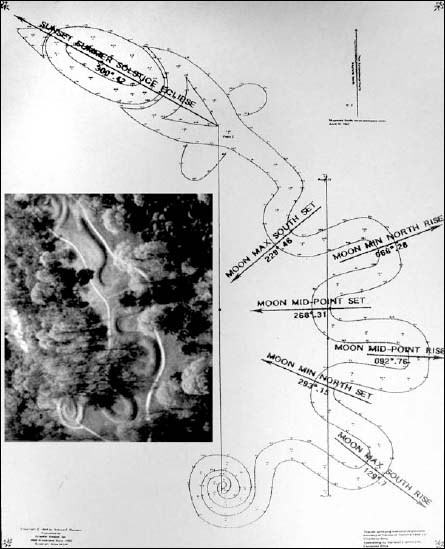
In ancient script the serpent has often been symbolic of Lucifer or fallen man, who is in need of redemption. Many view man as fallen, carnal, sensual and devilish in nature with a need to be born again to be acceptable to God. So could the Serpent Mound be a symbolic representation of something more than just a serpent eating an egg, of a Serpent shedding its skin, being born anew? Could this encrypted message be that man is in a fallen state, carnal, sensual and devilish in nature, and like a serpent is in need, to shed its skin to become more God-like?
These ancient artifacts, earthworks and mounds symbolically communicate a different message to each who observes them, as they provide a way of thinking and a glimpse into the minds of the ancients. Is there still more that we can learn from these ancient cultures about life, liberty and the cosmos? Are there symbolic messages that they were trying to communicate in the construction of these systematic earthwork structures and edifices?
In the Old Testament, the children of Israel placed a serpent on a cross as a symbol of healing. They were commanded to look upon this symbol if they desired to be healed. Because it was so simple, many did not believe and they did not look. In a like manner, is there a lesson to be learned here for the healing of America?
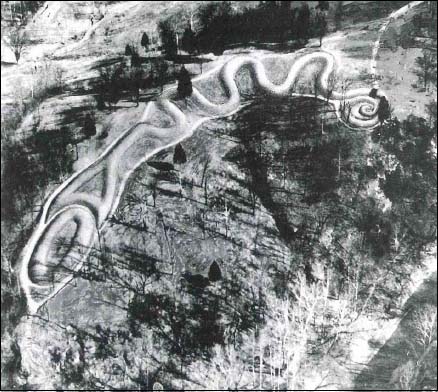
Serpent symbols had initiated a new era in the study of American antiquities and have played heavily in the assessment of anthropological thought. Frederic Ward Putnam, curator of the Peabody Museum of Archaeology and Ethnology at Harvard University visited the site in Madisonville, Ohio in 1881, at a time when there was a significant debate over the real value that the mounds had for historical purposes. The Serpent Mound was looking to be cleared, like many others had been in the past, when the Peabody Museum, led by Putnam, went to work and scrambled to raise $6,000 from private donors to purchase the site in 1886.
Squier’s colleague Gliddon, in a letter to him, “also took interest in ‘that Serpent’s Egg-business,’ but he expressed concern about what Squier would make of it, He regarded it ‘as a very dangerous subject for theorizing upon, lest it should not be a Serpent and the egg! So be cautious, sage advice indeed.”66
Is there more that we can learn from studying the symbolic language of the ancient American mound-building cultures? What messages of these ancient builders were expressed in symbolism, written on the landscape? And is there more empirical data that could be gathered before all traces of these once-great people are totally lost? What were these people trying to convey to us in the configurations of their massive ceremonial and effigy earthworks? Could the many symbolic artifacts give us greater insights into America’s antiquities and into the day-to-day drama of the residents who once lived in these formidable ancient cities?
_______________________
62 Ibid. 187
63 Ibid. 187
64 Ibid.
65 See, Ibid.
66 Ibid. 188.