
CHAPTER 10

E. G. Squier authored three books which would each give a different perspective into the daily lives of these ancient Mound Building cultures. In his 1848 book, Ancient Monuments of the Mississippi Valley, that he co-authored with the help of Dr. Davis, he would become famous, as it was the first publication of the Smithsonian. His second Book, Aboriginal Monuments of New York was a book that Squier had been hired by the Smithsonian to do separate from Davis. Then in 1851, Squier would publish, Antiquities of the State of New York, in which he included, A Supplement on the Antiquities of the West, printed in Buffalo, New York, by Geo H. Derby and Company, without the oversight and the aggressive editing of the Smithsonian. As a result, there is a good number of grammatical errors, as he gives more open, candid and revealing insights into the lives and decline of these ancient cultures.
Drawing on the wealth of knowledge he gained in his research over many years, Squier in his 1851 book gives expanded inferences into the lives of these ancient mound-building cultures. In writing on the strategic locations of these mounds and earthwork structures he states: “In respect of position, a very great uniformity is to be observed throughout. Most occupy high and commanding sites near the bluff edges of the broad terraces by which the country rises from the level of the lakes.”… “In nearly all cases they are placed in close proximity to some unfailing supply of water, near copious springs of running streams. Gateways, opening toward these, are always to be observed, and in some cases guarded passages are also visible.”67

Fortified Embankments
“Those works, which are incontestably defensive, usually occupy strong natural positions. …The natural strength of such positions, and their susceptibility of defenc[s]e would certainly suggest them as the citadels of a rude people, having hostile neighbors or pressed by foreign invaders. Accordingly, we are not surprised at often finding these heights occupied by strong and complicated works, the design of which is indicated no less by their position than by their heights occupied by strong and complicated works, the design of which is indicated no less by their position than by their peculiarities of construction.”68 Many of the fortifications as described by Mr. J. V. H. Clark “had been[e] inclosed with palisades of cedar.”69
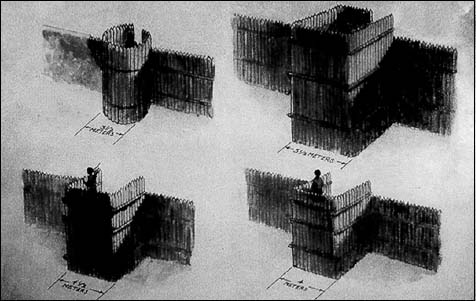
“Occasional works are found on the hill-tops, overlooking the valleys, or at a little distance from them; but these are manifestly, in most instances, works of defen[s]e or last resort, or in some way connected with warlike purposes. And it is worthy of remarks, that the sites selected for settlements, towns, and cities, by the invading Europeans, are often those which were the especial favorites of the mound-builders, and the seats of their heaviest populations. Marietta, Newark, Portsmouth, Chillicothe, Circleville, Cincinnati, in Ohio; Frankfort in Kentucky; and St. Louis in Missouri, may be mentioned in confirmation of the remark. The cent[er] of population are now where they were at the period when the mysterious race of the mounds flourished.”70
A.J. Conant gave an account of a Captain Carver in the Preface of his 1879 book, Foot Prints of Vanished Races in the Mississippi Valley, which he entered according to an act of Congress into the office of the Librarian of Congress in Washington. Speaking of Captain Carver he stated:
His testimony is selected from that of a multitude of early writers, because he could not have been prejudiced by the preconceived opinions or notions of others, and also because he was a man of military training, being a captain in the British army, whose conclusions would not be mere guess-work. The judgment of Brackenridge, Atwater, William Wirt and many distinguished men, is in perfect agreement upon this point, namely: that they [the mounds/cities] could not have been built by the Indians as we know them, nor any people (living) in a like condition.71
Captain Carver, in the account of his travels in the year 1766-78, describes what he was convinced was a military work, which he accidently discovered upon the bank of Lake Pepin. This was long before it was known that America had any antiquities. Concerning it he says that its form was somewhat circular, and its flanks reached the river. Though much defaced by time, every angle was distinguishable, and appeared as regular and fashioned with as much military skill as if planned by Vauban himself.’ Again: ‘I was able to draw certain conclusions of its great antiquity.’ “How a work of this kind could exist in a country that has hitherto (according to generally-received opinion) been the seat of war to untutored Indians alone, whose whole stock of military knowledge has only till within two centuries, amounted to drawing the bow and whose only breastwork, even at present, is the thicket I know not.72
O. Turner in his 1850 book, Pioneer History of the Holland Purchase of Western New York—Embracing Some Account of Ancient Remains, provides an analysis of the lack of knowledge of Native American communities and ancient civilizations. He believed that they were not responsible for the existence of the mound structures, forts, and other artifacts found in western New York. He would go on to say, of the Indians:
If their own history is obscure; if their relations of themselves after they have gone back but little more than a century beyond the period of the first European emigration, degenerates to fable and obscure tradition; they are but poor revelators of a still greater mystery. We are surrounded by evidences that a race preceded them, farther advanced in civilization and the arts, and far more numerous. Here and there upon the brows of our hills, at the head of our ravines, are their fortifications; their locations selected with skill, adapted to refuge, subsistence and defence [sic]. The uprooted trees of our forest, that are the growth of centuries, expose their mouldering [sic] remains; the uncovered mounds masses of their skeletons promiscuously heaped one upon the other, as if they were the gathered and hurriedly entombed of well contested fields. In our vallies [sic] upon our hill sides, the plough and the spade discover their rude implements, adapted to war, the chase, and domestic use. All these are dumb yet eloquent chronicles of by-gone ages.
We ask the red man to tell us from whence they came and whither they went? And he either amuses us with wild and extravagant traditionary legends, or acknowledges himself as ignorant as his interrogators. He and his progenitors have gazed upon these ancient relics for centuries, as we do now,—wondered and consulted their wise men, and yet he is unable to aid our inquires. We invoke the aid of revelation, turn over the pages of history, trace the origin and dispersion of the races of mankind from the earliest period of the world’s existence, and yet we gather only enough to form the basis of vague surmise and conjecture.
Turner then draws in the 1850’s these observations from their findings:
“I believe we may confidently pronounce that all the hypotheses which attribute those works to Europeans are incorrect and fanciful—first, on account of the present number of the works; secondly, on account of their antiquity; having from every appearance, been erected a long time before the discovery of America; and finally, their form and manner are totally variant from European fortifications, either in ancient or modern times.
It is equally clear that they were not the work of the Indians… It is apparent that Turner did not believe the American Indians were responsible, or connected with the ancient civilization that was responsible for the mounds. Would this culture of thinking deny the American Indians their rightful heritage?
What knowledge is left that might enable society to unlock the enigma of the Mound-Builders’ existence? Many of the giant earthworks, temple mounds, and effigy constructions show signs of a central government and of a spiritual and religious turning, built in times of peace and prosperity where ceremonies and religious rituals were shared. In their later constructions are found evidences of a time when the populations were motivated by fear, building hill-top fortifications and defenses. They incorporate ingenious military design and constructions and give signs of a time of ongoing conflicts, where the motivation behind these types of constructions was that of survival.
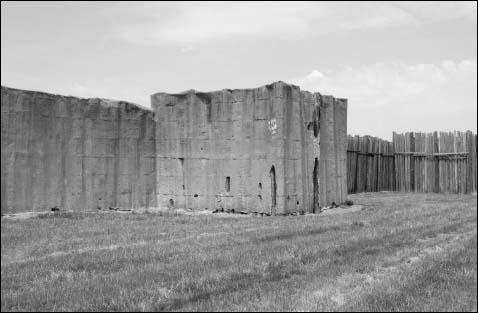
Palisade Fortification Covered with Clay Plaster

Places of Entrance
Advancing and Receiving Armies

Ancient Monuments of the Mississippi Valley, 1848, Squier and Davis, Plate VI
Fortified Hill, Butler County, Ohio three miles below the town of Hamilton

Ancient Monuments of the Mississippi Valley, 1848, Squier and Davis, Plate VII
Fort Ancient is located on the east bank of the Little Miami River
Fort Ancient, an account of this work was first published in a magazine entitled “Port Folio” in Philadelphia in 1809. In 1820 Mr. Atwater included it in his report to the American Antiquarian Society. It was also mapped and described by a Cincinnati Professor, John Locke in 1843.
E. J. Squier went on to write: “The vast amount of labor necessary to the erection of most of these works precludes the notion that they were hastily constructed to check a single or unexpected invasion. On the contrary, there seems to have existed a system of defenc[s]es, extending from the mouth of the Alleghany diagonally across the country, through Ohio to the Wabash. Within this range, those works which are regarded as defensive are large and most numerous.” 74
“It is clear that the contest was a protracted one, and that the race of the mounds were for a long period constantly exposed to attack. This conclusion finds its support in the fact that, in the vicinity of those localities, where, from the amount of remains, it appears the ancient population, was most dense, we almost invariably find one or more works of a defensive character, furnishing ready places of resort in times of danger.”75
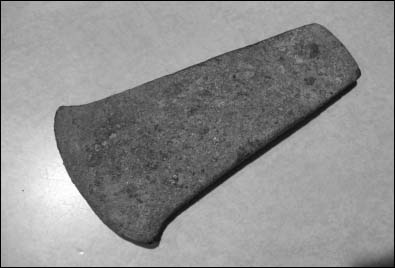
Ancient Hopewell, Copper Celt
Among the implements recovered from the mounds, are several copper axes as shown in Fig. 81 and 82 of chapter XI, Implements of Metal, Squier and Davis, Ancient Monuments.

Fortifications
“There is almost positive evidence that the mound-builders were an agricultural people, considerably advanced in the arts, and possessing great uniformity, throughout the whole territory which they occupied in manners, habits and religion—a uniformity sufficiently marked to identify them as a single people having a common origin, common modes of life and as a consequence, common sympathies, if not a common and consolidated government.”76 Squier’s gave this assessment in his third report, Antiquities of the State of New York, which, unlike the earlier reports, gives a greater insight into the human psychic, giving insight into their motivations and solemn ceremonies, and into their proficiencies in the shaping and hardening of metals. Of there proficiencies in metalworking, Squier said:
“They possessed the secret of hardening the metal […] so as to make it sub serve most of the uses to which iron is applied. Of it they made axes, chisels and knives. The mound-builders also worked it into similar implements, although it is not yet certain that they contrived to give any extraordinary hardness.”… “A specimen found in a mound near Chillicothe, Ohio consists of a solid, well-hammered piece of copper, and weighs two pounds and five ounces.” … “Silver has also been found, but in small quantities, reduced to great thinness and closely wrapped around copper ornaments. The ore of lead, galena, has been found in considerable abundance, and some of the metal itself under circumstances implying a knowledge of its use on the part of the ancient people. The discovery of gold has been vaguely announced, but is not well attested. It is not impossible that articles of that metal have been found.” 77
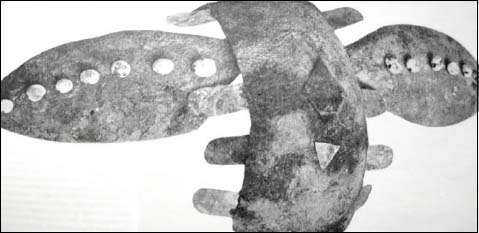
Metal Headplate


“It has already been remarked that the mounds are the principal depositories of ancient art, and that in them we must seek for the only authentic remains of the builders. In the observance of a practice almost universal among barbarous or semi-civilized actions, the mound-builders deposited various articles of use and ornaments with their dead. They also, under the prescriptions of their religion, or in accordance with customs unknown to us, and to which perhaps no direct analogy is afforded by those of any other people, placed upon their alters numerous ornaments and implements-- which remain there to this day, attesting at once the religious zeal of the depositors and their skill in the minor arts.” 78
“In one case which fell under my observation, and in another which I have an account from the person who discovered it, the altar was of stone. … It was a simple elevation of earth packed hard, and was faced, on every side and on top, with slabs of stone of regular form, and nearly uniform thickness. They were laid evenly, and as a mason would say, ‘with close joints.’…This altar bore the marks of fire, and fragments of the mound-builders’ ornaments were found on and around it.”
“The Mounds of this class are most fruitful in relics of builders. On the altars have been found, though much injured and broken up by action of fire, instruments and ornaments of silver, copper, stone and bone; beads of silver, copper, pearls, and shells, galena, sculptures of the human head, and of numerous animals; pottery of various kinds, and a large number of interesting articles, some of which evi[de]nce great skill in art.” 79
In the History of the Holland Purchase (1849), in a location a mile north of Aurora Village, New York, there are several small lakes and ponds, around and between which are knobs of elevations, thickly covered with a tall growth of pine; upon them are several mounds where many human bones have been excavated. There are in the village and vicinity, gardens and fields where relics are found at each successive plowing. Few cellars are excavated without discovering them. In digging a cellar upon the farm of P. Pierson, a skeleton was exhumed, the thighbones of which would indicate great height; exceeding by several inches, that of the tallest of our own race. 80
“The mounds which formerly existed in Erie, Genesee, Monroe, Livingston, St. Lawrence, Oswego, Chenango, and Delaware counties, all appear to have contained human bones, in greater or less quantities, deposited promiscuously, and embracing the Skeletons of individuals of all ages and both sexes. They, probably, all owe their origin to a practice common to many of the North American tribes, of collecting together, at fixed intervals, the bones of their dead, and finally depositing them with many and solemn ceremonies. They were some times heaped together so to constitute mounds.”81
The “bone pits” which occur in some parts of Western New York, Canada and Michigan, etc., have unquestionably a corresponding origin…. They are of various sizes, but usually contain a large number of skeletons. In a few instances the bones appear to have been arranged with some degree of regularity. One of these pits discovered some years ago, in the town of Cambia, Niagara County, was estimated to contain the bones of several thousand individuals. …This locality was visited and examined by Mr. O. Turner, of Buffalo, in 1823. The account of this gentleman is published in his history of the “Holland purchase,” page 27 as follows: “The location commands a view of Lake Ontario and the surrounding country. An area of six acres of level land seems to have been occupied; fronting which, upon the circular verge of the mountain, were the distinct remains of a wall. Nearly in the centre of the area was a depository of the dead. It was a pit excavated to a depth of four or five feet, filled with human bones, over which were piles of sandstone. Hundreds seem to have been thrown in promiscuously, of both sexes and all ages. Numerous barbs or arrow-points were found among the bones and in the vicinity. It has been conjectured that this had been the scene of some sanguinary battle, and that these are the bones of the slain.”82
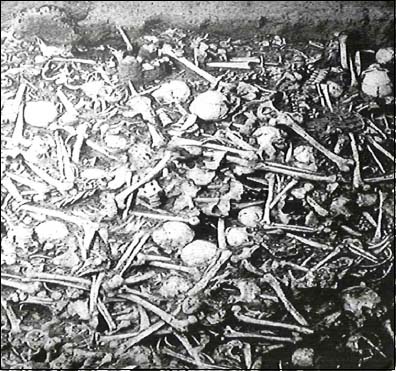
Another which I [Squier] visited in the town of Clarence, Erie County, contained not less than four hundred skeletons. A deposit of bones comprising a large number of skeletons was found, not long since, in making some excavations in the town of Black Rock, situated on Niagara River, in Erie county…In Canada similar deposits are frequent. Accounts of their discovery and character appeared in various English publications, among which may be named the “British Colonial Newspaper” of September 1847, and the “Edinburgh New Philosophical Journal,” for July 1848. From a communication in the latter by Edward W. Bawtree, M.D., the subjoined interesting facts are derived. “A quantity of human bones was found in one spot in 1846 near Barrie, and also a pit containing human bones near St. Vincent’s. Great numbers were found in the latter, with several copper and brass kettles, and various trinkets and ornaments in common use among the Indians.”83
“The large cemeteries which have been discovered in Tennessee, Kentucky, Missouri and Ohio, seem to have resulted from a similar practice.”84 The practice of mounding dirt over their dead or in burying their dead in mounds above the natural terrain of the land, has all served to give evidence of their existence. We now understand that there were large populations found in North America anciently, as evidenced by their ruins, giant earth works structures, artifacts and fortifications. Their bone pits and the abundance of their abandoned ancient ruins also give signs of their rapid demise. As history has shown, most massive and rapid declines in populations are usually associated with the introduction of disease to a culture or the result of devastating wars.

Dickson Mound Excavation
_______________________
67 E. G. Squier: Antiquities of the State of New York: Buffalo, Geo. H. Derby and Co. 1851, 12
68 Ibid. 300, 301
69 Ibid. 38
70 Ibid. 208
71 A. J. Conant, A.M., Foot Prints of the Vanished Races of the Mississippi Valley, (St. Louis: Chancy R. Barns, 1879; reprinted Colfax, WI: Hayriver Press, 2007) Preface, iv, v.
72 Ibid.
73 O. Turner, Pioneer History of the Holland Purchas of Western New York, Jewett, Thomas & Co., Buffalo, N.Y., 1850, 18-22.
74 E. G. Squier: Antiquities of the State of New York: (1851), 303
75 Ibid. 304
76 Ibid. 304
77 Ibid. 328
78 Ibid. 326
79 Ibid. 317, 318
80 See; Fritz Zimmerman; The Nephilim Chronicles, Fallen Angels in the Ohio Valley: 80,81
81 E. G. Squier: Antiquities of the State of New York: (1851), 98
82 Ibid. 99, 100 and included references
83 Ibid. 100
84 Ibid. 99