
CHAPTER 25

In his book, The War That Made America, Dr. Fred Anderson provides an insightful look at the origins, conduct, and outcomes of the French and Indian War. He makes clear that there was a fundamental difference in the way the French and British viewed and treated the Indian tribes of this continent. Men of noble or aristocratic birth led each country’s army, but each held different views of the tribes with which they had to deal. French military leadership recognized the political and military astuteness of tribal leadership and accorded them the respect and deference those skills deserved. Thus, the most powerful tribes aligned themselves with the French. From the outset, however, British leadership viewed all of the tribes as savages and only tolerated their support to the extent it provided them, the British, a tactical or strategic advantage.
The British victory in 1763 removed the French military from North America and, with it, their egalitarian view of the Native American tribes. With the British in control, their view of the tribes as savages became dominant and even after the United States achieved its independence from Britain, the view held. By the mid-1800s, it was easy to apply this long held view to any number of political issues.196
In the late 1820s, conflict between Georgia and the federal government over the pace at which the federal government was extinguishing Indian titles turned Indian land policy into a major national political issue. For the first time the details of Indian land acquisition became enmeshed in national party politics. It makes sense to speak of the years around 1830 as an era of removal simply because the issue of Indian land acquisition received more attention from Congress, the Supreme Court, and the public than at any time before or since.197
“In 1823 Chief Justice John Marshall of the US Supreme Court [opined] that Cherokees had certain rights to their land in Georgia by dint of their ‘occupancy’ but, that whites had superior rights owing to their ‘discovery’.”198 The Court’s 1823 decision, which would later be reinforced by the ideas of Manifest Destiny and evolutionary theories, would help to provide the basis for removal of the Native American tribes from the lands they occupied. Theories that viewed the Indians as “savages,” would help to substantiate the court’s decisions and would provide the necessary justification for the government taking of the land of the Indians without due process.
The larger Indian populations of the east were, at the time, concentrated in a small number of states. “In early 1825 the War Department estimated the Indian population of the United States. Of the approximately 129,000 Indians known to [reside within the then-existing boundaries of the Union], nearly 54,000 lived in Georgia, Tennessee, Alabama and Mississippi.”199 The only other state to have an existing native population of over 5,000 was the state of New York. Many Indian populations, such as the Oneidas, had already in the early 1820s been pushed from New York into Wisconsin and Missouri. The Kickapoos accepted land in Missouri in exchange for their ancestral home in Indiana and Illinois, and the Choctaws traded their native land in Mississippi for land in Arkansas.200
Stuart Banner in his book, How the Indians Lost their Land, pointed out, that there were those who assumed that the Indians were less intelligent than whites. And like children, they needed to be guided, as they may not perceive what would be in their own best interest.
By the 1830s, if not earlier, it became clear that white opinion supported removal. The result was an uncomfortable juxtaposition of outcomes. Most whites agreed that the Indians could not be removed against their will. But most whites also agreed that the Indians ought to exchange their land for land west of the Mississippi. And many within the latter group sincerely believed that such an exchange would be in the Indians’ best interests, even if the Indians themselves had not yet realized as much. Many whites were, thus of the view that they were justified in pressuring the Indians into voluntarily agreeing to remove.201
The debate over the removal of the Indians from their ancestral lands would continue to intensify. “In early 1830, at Jackson’s suggestion, committees of both houses of Congress reported the bills that by May would become the Removal Act of 1830…The Removal Act squeaked through the House by only 5 votes out of the 199 cast. While the nonmonetary parts of the Removal Act were meaningless in a legal sense, they became the focus of the national debate over removal.”202 This debate would continue into the late 1880s, as populations moved westward and new states were added to the Union. Yet the early justification and reasoning used for the removal of the Indians was contrary to Constitutional Law, which gives all citizens equal protection under the law. As such, policy makers were continually looking for innovative ways to rationalize the removal of the Indians. The attempt to find justification would come in many forms:
The House Committee on Indian Affairs concluded in 1830 that the Cherokees were governed by an aristocracy of mixed-blood families that controlled the entire wealth of the tribe and spoke for the tribe in its dealings with the government, despite constituting no more than 5 percent of the tribe’s population.
The remaining nineteen of twenty Cherokees, the Committee found, “are the tenants of the wretched huts and villages in the recesses of the mountains and elsewhere, remote from the highways and the neighborhood of the wealthy and prosperous.”
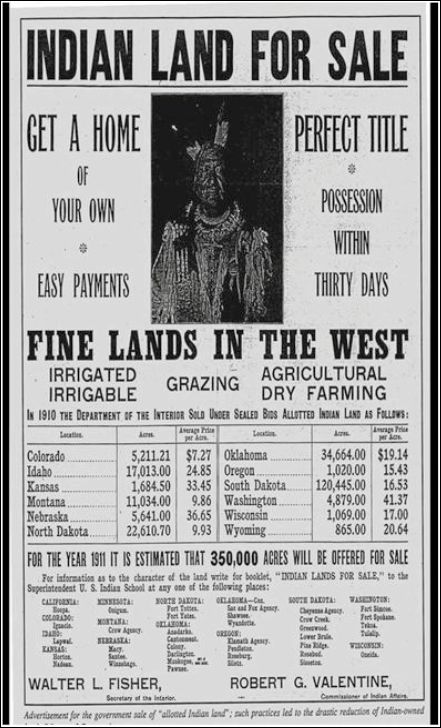
A 1911 Poster Advertising Indian Lands for Sale
These “common Indians” stood to gain from removal, the Committee believed, and would have already accepted the government’s offer to remove, had their voices not been silenced and their preferences as dictated by the Cherokee aristocracy, who stood to lose their wealth and power if the tribe headed west.203
This was the climate of white opinion in the late 1820s when removal first became a major issue. Among those capable of influencing the federal government’s Indian policy, it was generally understood that removal would be in the best interests of whites because it would open up new land to white settlement; that removal would also be in the best interests of the Indians because it was the only measure that would protect them from extinction.” …“This was partly a matter of assumed racial superiority. If Indians were less intelligent than whites, they might not perceive their own self-interest as clearly as whites did. Just as children could not make important decisions without guidance from adults, the Indians’ own preferences about removal might be helped by guidance from whites.204
This removal of the Indians would escalate as the settlers pushed westward. By the end of the 1880s, the federal government had acquired land at an unprecedented speed. “All the land in Iowa, Minnesota, Texas and Kansas had either been ceded to the government or designated as a Reservation…By the end of the 1890s the same was true of Idaho, Washington, Utah, Oregon, Nevada, Wyoming, Nebraska, Colorado, Montana, Arizona and New Mexico.” 205
A feeling of racial superiority was one of the pillars in the justification of Indian land policy. It came about as a legacy belief that was held by British political and military leaders and bolstered by evolutionary thought that some races had not evolved from a savage state over time as rapidly as others. Morgan referred to this as the Stages of Human Evolution. Lewis Henry Morgan, who was an attorney for railroad and mining interests and a politician from Rochester, New York, became heavily embroiled in this ongoing controversy over who had ownership rights to the land.
After spending a little over a year, from July 25, 1870 to August 13, 1871, studying and visiting in England and Europe with some of the most notable anthropologists and evolutionary theorists of history, including the acclaimed Charles Darwin, Morgan came home and went to work writing his most famous work, Ancient Society, which he finished in May of 1875. In it he asserts that the human evolutionary progress can be divided into three phases—which has man evolving from Savagery, through Barbarism, and on to Civilization.206
Morgan’s theories into the stages of human evolution, would view the Indians as “savages” and some fundamentalist religions as “barbaric,” and would become very instrumental in the contest as to who would have the rights to the land. Theories that would be used to foster racial and religious prejudices and atrocities are seldom covered in the pages of today’s early American history textbooks
There are good reasons why there are those who would like to discard certain chapters of history, for written on the pages of some of those chapters of early American history are atrocities that were placed on the Indian populations of America and other race and religious cultures. It is the nature of Nations to want to ignore or to strike from its historical records chapters in their history that may be an embarrassment to them. Yet, how important is it that those atrocities are not lost and forgotten? “For there is no good reason to strike the undesired record from the history books or classroom for the sake of being politically correct or masking historical intolerance. To hide the prejudices of history displays an unscrupulous and immoral concern for the future. Wisdom is a by-product of experience, and experience can only be acquired by personally feeling the pain, and suffering connected to the realities of life. These realities are visible only by recognizing and remembering the successes and failures of our own mortality and of those of history.”207
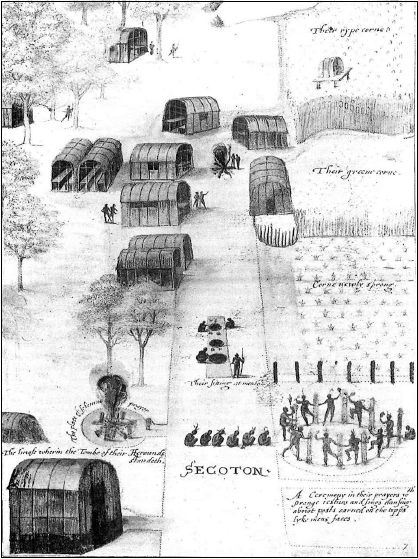
The early inhabitances of North America were more culturally advanced then what is often time portrayed.
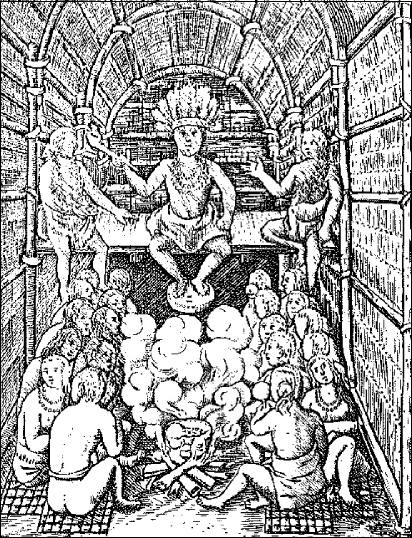
In the 1630’s, William Holes engraved a map decoration depicting John Smith being received in a Kingly manner, by the Powhatan tribe, as shown in the 1631 edition of Smith’s General History of Virginia.
_______________________
196 Fred Anderson, The War That Made America: A Short History of the French and Indian War, (Viking Press, 2006)
197 Stuart Banner, How the Indians Lost their Land: Law and Power on the Frontier, (Cambridge: Harvard University Press, 2005) 192.
198 Faulkner, Robert; Johnson, V. Macintosh, the Jurisprudence of John Marshall, Princeton University; 1968, 53
199 Stuart Banner, How the Indians Lost their Land: Law and Power on the Frontier, (Cambridge: Harvard University Press, 2005) 195
200 Ibid., 196-197.
201 Ibid., 212.
202 Ibid., 216, 218, 219.
203 Ibid., 212, 213, 325.
204 Ibid. 168
205 Ibid. 235
206 Leslie A. White ed., Lewis Henry Morgan: The Indian Journals 1859-62, (Ann Arbor: University of Michigan Press, 1959) 11
207 B.H. Porter, An Everlasting Decree, 2012, Digital Legend Press, 217