
CHAPTER 24

Interwoven into the tapestry of early American history were evolutionary theories that helped pave the way for American expansionism. Evolutionary theories, along with the doctrine of Manifest Destiny, advanced by Lewis Henry Morgan, John Wesley Powell and Otis T. Mason, would become the historical norm for how most American immigrants would view the American Indian, the Mound Builders, and pre-Columbian history of ancient North America.
One of the real issues facing America in the 1800s was the country’s interest in colonization and the expansion of communities westward, which was tied up in the debate over land rights and what to do with the Native Americans who inhabited this land. Did the Indians have land rights or did the U.S. government have a priority right to the land? If it was determined that the government held the right to the land, then one could argue that they had some justification in gathering up the Native Americans and placing them on reservations. With land rights being one of the foremost issues facing lawmakers, having evolutionary theories that labeled the American Indian populations as savages would be seen as a pivotal breakthrough in addressing and advancing a Manifest Destiny agenda, along with a host of other scientific, government, and social ethnological issues.
Morgan observed, while in England, how effective scientific organizations could be used in wielding influence and addressing scientific and social agendas. So, in 1876, in an effort to advance science, he took the lead in bringing together men of common interests at an organizing meeting in Buffalo, New York to form a sub-element of the American Association for the Advancement of the Sciences (AAAS).194
These early contemporaries of western New York, with common interests in the natural sciences, met to organize themselves in an effort to advance concepts that would address some of the political, social and religious issues, altering how societal views have valued the American Indian and the ancient mound-building cultures of North America.
In American history of the 1800s, there were many making claims on the basis of the tens of thousands of artifacts being recovered from the mounds, that these findings were tangible evidence of an advanced civilization, which ran contrary to what was at first believed. These findings and artifacts were raising questions about the origin of these ancient civilizations of America. One of these questions was-could the Mound Builders be of Hebrew descent? Could some of the Native American tribes be of the lost tribes of Israel? And if so, would that make the American Indians more than mere “savages,” thus elevating their claims for equal rights and protection as granted under the Constitution? Were the Indian settlers from some vanished culture that once occupied the lands along the Ohio and Mississippi River Valleys? If so, then who had the rights to those lands? Early English and European settlers held the view that it was their calling, and even divine right, to spread across this vast North American continent in pursuit of their very own piece of land, which, as they saw it, was there for the taking.
This idea was captured in a term that quickly took hold--Manifest Destiny, a phrase that was first coined in 1845, just three years prior to the publication of the Squier and Davis report on the mounds. John L. O’Sullivan used the term in 1845 in an article titled “Annexation” in the United States Magazine and Democratic Review. Manifest Destiny exerted a powerful hold on American thinking and politics. By the time the Squier and Davis report was published in 1848, American politicians and judges were starting to use Manifest Destiny as justification for American expansionism, as was the case in America’s two-year war against Mexico. The idea would be no less influential in the emerging science of archeology, which in America landed squarely with the origins and the exploration of the Mound Builders. “The history of American archeology,” writes Alice Beck Kehoe, “is a remarkable example of post hoc objectification of the doctrine of Manifest Destiny. From its inception, American archeology has been politically charged, legitimating domination of North America by capitalists imbued with British bourgeois culture.”195 The irony is that the discovery as well as the demise of many of these ancient earth works came about as settlers, Government and Industry all wanted to take control of the whole of it.
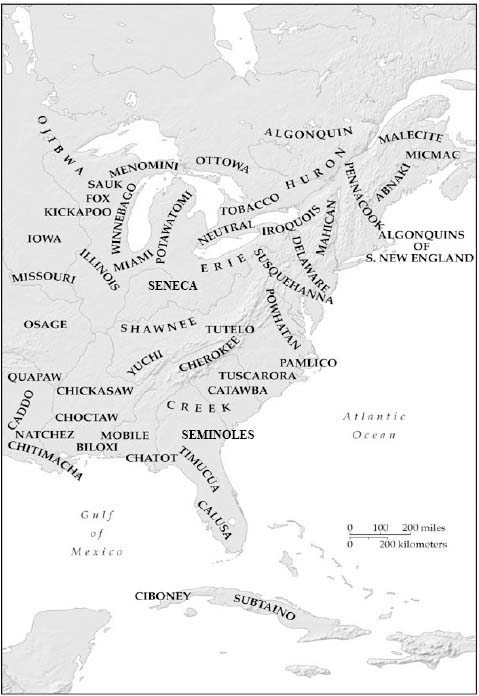
Indian Tribes of the East and of America’s Heartland
Map designed by Paul J. Pugliese, Terra Data
_______________________
194 See: Leslie A. White ed., Lewis Henry Morgan: The Indian Journals 1859-62, (Ann Arbor: University of Michigan Press, 1959) 12.
195 Kehoe, xi.