
CHAPTER 29

In The League of the Iroquois, which was originally published in 1851, Morgan stated: “At the era of Dutch discovery (1609), the Iroquois were found in the possession of the same territories between the Hudson and the Genesee rivers upon which they afterwards continued to reside until near the close of the eighteenth century. At that time, the Five Nations, into which they had become subdivided, were united in a League; but its formation was subsequent to their establishment in the territories out of which the state of New York has since been erected.”
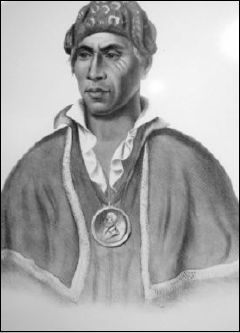
Indians of the Northeast
“Their remote origins, and their history anterior to the discovery, are both enshrouded with obscurity.” Their traditions and political organization “informs us, that prior to their occupation of New York, they resided in the vicinity of Montreal, upon the northern banks of the St. Lawrence, where they lived in subjection to the Adirondacks, a branch of the Algonkin [Algonquin] race, then in possession of the whole country north of that river…The period of their migration from the north can not now be ascertained. Tradition informs us, that having ascended the St. Lawrence to Lake Ontario and coasted its eastern shore to the mouth of the central parts of New York” where “there are now about four thousand Iroquois living in the state of New York. Having for many years been surrounded by civilization, and shut in from all intercourse with the ruder tribes of the wilderness, they have not only lost their native fierceness, but have become quite tractable and humane.” 240
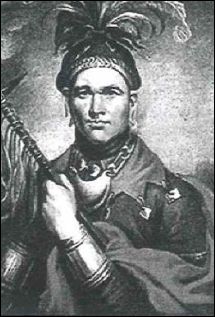
A Seneca
Morgan’s theories on the stages of human evolution, would alter how some would view the Indians, seeing them as possible burdens on society, as possible children of the State, not as teachable with an “aptitude to learn when subjected to systematic discipline.”241…“Under the fostering care of the government, both state and national, and under the still more efficient tutelage of religious societies, great hopes may be justly entertained of the ultimate and permanent civilization of this portion of the Iroquois. It is indeed, a great undertaking to work off the Indian temper of mind and infuse that of another race. It is necessary, to its accomplishment, to commence in infancy, and at the missionary school, where our language is substituted for the Indian language, our religion for the Indian mythology, and our amusements and mode of life for theirs. When this has been affected, and upon a mind thus prepared has been shed the light of a higher knowledge, there is not even then a firm assurance that the Indian nature is forever subdued and submerged in that superior one which civilization creates. In the depths of Indian society there is a spirit and a sentiment to which their minds are attuned by nature; and great must be the power, and constant the influence which can overcome the one, or eradicate the other.”242
A commanding influence on Morgan’s ethnological views would be from the writings and tutoring that he received from a number of the evolutionary theorists of England, as he drank from the same school of thought as Charles Darwin and Thomas Malthus. He came to believe that the Indian populations must be kept in check, as described in Malthus book, entitled: The Principles of Population (1798), in which Malthus warns that if America wanted to advance civilization then they must keep the populations of the Indians in check.243
Another man in the 1800’s that would provide great insights into America’s ancient mound building cultures and into the science of man, would be Constantine Samuel Rafinesque who grew up in Marseilles France, to a German mother and a French father. After a prior visit Rafinesque decided to settle in America in 1815. Rafinesque writes in his Travels, that he explored much of the Ohio valley on “penible foot.” He tells us that while the primary object of his researches was the geology of the region, something else began to attract his interest.“I went on foot thro’ the whole of Ohio by Chillicothe, Lancaster, Zaneville and Steubenville. It was near Chillicothe that I saw the first great pyramids or alters, of the ancient nations of N. America; they struck me with astonishment and induced me to study them.”
Rafinesque a prolific writer, authored a three-volume work, The American Nation, Ancient and Modern, printed by the author in Philadelphia in 1836. In these books written in the 1830’s he stated, “I began to study earnestly American History and Archeology, with the Ethnography and Philology of the American nations. I had seen within a few years the Oneida, Mohigans, [Mohicans] Lanaps, [Lenni-Lanape Tribe] Choctaw…This study led me much further than I expected, it became needful to review the whole of comparative philology and primitive archaeology, in order to obtain satisfactory results.”
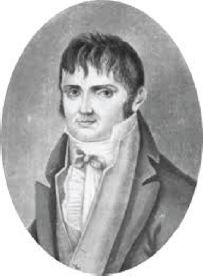
Constantine Samuel Rafinesque
Rafinesque’ surveys, fieldwork and writings on these ancient America monuments and cultures were extensive, as he would cast his shadow of influence on Morgan and these early men of science in the 1800’s. He not only brought the mounds scattered through the Ohio Valley to the notice of the scientific world, but he developed a theory of evolution that predated Charles Darwin by twenty years.
It was Rafinesque who was the first to petition Congress to establish the Smithsonian, which they did, in 1846. In 1836 he claimed to have discovered an ancient document which he called the Walam Olum. It was an ancient text written on Birch bark by early Lenape (Delaware) Indians, that he translated into English. Rafinesque describes the Walam Olum as a collection of “Flat Sticks with unidentified hieroglyphics of Indian design.” The document, which described the peopling of North America, and has been long considered to be a authentic and of historic importance by many.
The authenticity of the translated manuscripts would however be contested by a soon to become enemy, Henry Schoolcraft, superintendent of Indian Affairs in the Northern Department for the U.S. Government, and as self-appointed dean of American Indian studies, “Schoolcraft had forbidden the foreigner Rafinesque to publish anything on Indian topics.”(Algic Researches, Vol. 2, 1839 and Old World Roots of the Cherokee, Donald N. Yates: 60,61,62)
In 1996 the researcher David Oestreicher sought to prove the Walam Olum was a hoax. Based on his examination of Rafinesque's papers, Oestreicher concluded that Rafinesque first translated the text from English into Lenape, rather than from Lenape into English, so that the Lenape document was a forgery.
Towards the end of Rafinesque’s life he moved back to Philadelphia where he continued to author publications and lectured at the Franklin Institute. Upon his death on September 18, 1840, the much-moved contents of his rented quarters were sold at a hastily arranged auction; where much of his literary legacy would be dispersed, or disposed of. Though the prayer sticks were lost, Rafinesque’s Wallam Olum notebooks were purchased by Professor S. S. Haldeman of the University of Pennsylvania. They disappeared until 1844, when they were sold to Bantz Mayer, a serious historian and collector in Baltimore. In 1846, he loaned Rafinesque’s notebooks to E. G. Squier. Squier used Rafinesque’s work in the preparation of Ancient Monuments of the Mississippi Valley, the very first publication of the Smithsonian. Rafinesque’s riddled manuscripts disappeared again for ten years until racist antiquarium Daniel Brinton would transcribe parts of them in his book: The Lenape’ and their Legends (1885).
_______________________
240 Lewis Henry Morgan; The League of the Iroquois, 4, 5, 110
241 See: L. H. Morgan, 117
242 L.H. Morgan, 113
243 Thomas R. Malthus, An Essay on the Principle of Population 1798, (London, Reeves and Turner; Ballantyne Press 1888) 18-32