
CHAPTER 36

Powell’s interest and enthusiasm for his natural world were unique. In the mid-1800s, the nation was in the grip of the westward expansion and the discovery of the continent. Many were exploring the major river valleys of the Midwest, and not the least of those were Squier and Davis. Powell showed a particular interest in the artifacts that were coming out of the mounds as he was curious about what knowledge the Mound Builders might have bequeathed to us?
Powell’s exploration into the mounds were not solely for commercial purposes, unlike most of the explorers who excavated the mounds to see what treasures might be found and sold. Powell’s interest were even unlike Squier and Davis, whose efforts showed signs of mixed motivations, as they amassed a collection of some 6,000 artifacts—pottery, bones, tools, jewelry, armor, and other metal works. They in the 1840s, with only a small crew of men, were on a mission to find treasured artifacts of a forgotten people, buried in mounds spread across the river valleys of Indiana, Michigan, Illinois, Missouri, Minnesota, New York and Ohio.
The summer before heading to Jacksonville’s college, and right after being cooped up in that dreadful Decatur cobbler’s shop, he [Powell] struck out on a bold exploration in the spirit of Lewis and Clark. Purchasing a flat-bottomed skiff at a Mississippi River town, he set off upstream for St. Paul, Minnesota… The immense landscape that Wes was learning slowly and intimately, mile by mile, from a seat in a small wooden boat or afoot overland, was the great interior basin of the country.” [Harper’s Magazine called it] the body of the nation…leaving that vista of urban growth behind, he floated down the Ohio where Lyell had geologized, down the Wabash and up the Wabash, trekking across to the Great Lakes and Michigan. A young man like Wes, who liked to spend his summers rowing on a river and studying natural history, who had no financial means to go East to a more appealing college, seemed to have one choice left to him- teaching in the common schools.302
As they rolled back the face of the earth, they exposed bones and remnants of a lost and epoch period, in an effort to help the naturalist piece together the history of the continent. Wes carefully labeled his artifacts and put them away in bags, lessons that would be learned from those summer excursions would mold his thinking.
His fourth summer excursion occurred in 1857, when he hiked from St. Louis south to Iron Mountain, an important mining area in Missouri. Now he was after minerals, and in his enthusiasm for picking them up he nearly ran out of money and had to pawn a watch to get back to Decatur and Wheaton. No wonder after such experiences that the Institute, and later the next spring Oberlin, seemed so boring. Sitting in classes with younger students, few if any of them experienced as he was in the arts of collecting, navigating, or exploring, not to mention the arts of self-reliance, forced to recite each morning the daily lesson, he grew restless fast. His heart and mind were both outside the window, where he could imagine the sound of a river flowing. While Wes was toiling through those first terms at the Institute, taking on fellow Beltionians in debate, the state teachers’ association met in Decatur and heard a proposal from Professor Cyrus Thomas, a botanist at the new State Normal University, to organize a Natural History Society of Illinois. The proposal stirred up some interest, and in June 1858 the new society came into being in Bloomington, home of the university, with Jonathan Turner chosen as its first president.303
It would be years later, upon becoming director of the Bureau of Ethnology and upon being placed over mound exploration, that Powell would hire his Illinois acquaintance, Cyrus Thomas, as the man to address and to finally put to rest the question as to the origin of the Mound Builders. Powell’s working relationship with Thomas began in 1859 when Powell was selected to the Illinois Natural History Society and was also commissioned as a Major in the Army Corps of Engineers. Powell later took the post, as the Geology Professor at the Illinois Wesleyan University, and while there became one of the founders of the Illinois Museum of Natural History, of which he was appointed curator. This was at a time when questions were being raised about what to do with the artifacts that were coming out of the mounds, which were adding fuel to all those questions about the people who once inhabited those ancient cities. In these leadership positions, Powell quickly became aware of the political, religious and ethnological implications and issues surrounding the origin of the inhabitants of ancient America.304
From 1858 to 1860 he spent much time in and around the mounds of Ohio, Indiana, Illinois, and Missouri. At that time he shared the widely held view that the mounds and other earthworks of the eastern half of the United States were relics of an ancient people far more advanced than the Indians. But the more he dug, the more doubtful of this he grew. In the fall of 1859 Powell excavated some mounds on the shore of Lake Peoria, Illinois, finding in one of them skeletons and artifacts. He wrote many years later: “At the bottom, with some articles of pottery, shells, stone implements, etc., an ornament was found made of copper skillfully cut in imitation of a spread eagle, with head turned to one side. Lying by the side of this were a few glass beads. These challenged attention, and the question was necessarily presented to him [Powell speaking of himself], Did these ancient people have the art of making glass? …If these articles were the work of the mound-builders in pre-Columbian times, then the people must have possessed arts more advanced than those shown by the mound arts previously studied. Thus a suspicion arose as to the correctness of the prevailing opinion…with a sundry of sentiments being offered, as to the origins of the Mound Builders scores of political and religious questions followed. But a lot of his early ethnological investigations would have to be put on hold for these investigations were interrupted by the Civil War. 305
Powell enlisted as a private in the union Army, and rose through the ranks…While in Campaigns in Missouri, Tennessee, and Mississippi, Powell found time to examine many groups of mounds. He reported later that “most of the works of art unearthed were of stone, bone, shell, and pottery, but in excavating a mound with stone graves near Nashville, Tennessee, more glass beads were discovered and also an iron knife, very much rusted… At the time of this find his former suspicion became a hypothesis that the mounds from which the glass, copper, and iron articles were taken were constructed subsequent to the advent of the white man on this continent, and that the contents gave evidence of barter between the civilized and savage races.306
Powell’s excursions and explorations would raise other questions:
What did all those fossils lying along the riverbanks or deeply embedded in the rocks reveal about time? What did they say about the Judeo-Christian theory of Creation? Perhaps humans were not even the special creation of God. The whole edifice of Western Christian thought, which put man at the center of nature, a fallen but redeemable child of God, was beginning to totter under the skepticism of natural history…Private and public, amateur and professional, this remarkable flowering of natural history occurred just as Wes was coming of age, and it overwhelmed the appeal of evangelical religion. Methodism, as far as Wes was concerned, had seen its day. It lacked vibrancy and excitement. After a remarkable success, Methodism was no longer the growing cultural force it had once been. The country was now intent on making progress in a more secular direction, and Wes wanted to be part of that shift.
Wes had to realize that he was entering not only an adventuresome but, a controversial profession, and controversial not merely in his parents’ household but in the broader culture. He left no indication of any inner turmoil over his decision; on thecontrary, he seems to have chosen science with few misgivings. Others, however, expressed plenty of worries. Natural history, they warned, for all of its exuberant optimism might be leading toward dark, troubling conclusions- and those conclusions might be particularly dangerous to evangelical religion.307
It was in these informative years, at a time of great reflection, that Powell would begin to see how his work exploring the mounds would affect his evangelical upbringing. What could be learned in studying the science of man and Natural history?
As science moved from cataloguing species to explaining why and how they existed, it entered sensitive territory. Religion thought it had answered those questions as well as they could be answered. The Reverend John Wesley had proclaimed, at the dawn of modern natural history; “the design and will of the Creator is the only physical cause of the general economy of the world.” He echoed a view that repeatedly tried to assert control over natural history and subordinate it to faith and revelation. Its most widely read exponent was William Paley, author of Natural Theology (1802). Nature, from the bee pollinating a flower to the most devastating flood, Paley insisted, exemplifies the wisdom and benevolence of God. The study of natural history, rightly understood, should lead people to greater devotion.308
Where John Wesley Powell’s father, Joseph, worked with his hands most of his life to provide a living for their family, Wes, after the war, would find that those job opportunities of tilling the earth or tailoring clothes no longer would be an option for him, for in the battle of Shiloh in 1862, Powell suffered a wound which would cost him his arm. Despite this, he quickly returned to duty, and even insisted on taking his bride of six months into the battle zone. This event would have a real influence on his career pursuits and soon after the war he would return home as a war hero and pursued a career as a teacher.
At the end of the war Powell became a professor of geology at Illinois Wesleyan University, and before long he was off on summer field trips to the Rocky Mountains with his classes. These expeditions led to his astonishing river journey in 1869 through the Grand Canyon; the one-armed major, accompanied by students and mountain men, shot the rapids of the turbulent Colorado River with true heroism and successfully carried out one of the most important exploring trips in American history. On the strength of this achievement, Powell became a nationally known figure and was made Director of the United States Geological Survey, with responsibility for supervising the exploration of the entire western half of the continent. Throughout his years of geological study, Major Powell retained his early interest in archaeology and in ethnology, the study of living peoples.”309
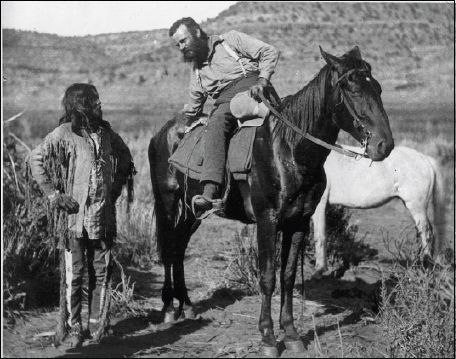
J. W. Powell
“From the way in which Powell loomed larger and larger behind the scenes as the situation developed, the way in which the reformers of the surveys began to incorporate more and more of his “general Plan” for land policy and the way in which the Academy came to sound more and more like his mouthpiece, it is not extravagantly unlikely that the idea of using the (National) Academy (of Science) may have been his.” … Those who have studied this episode most closely, see Powell as the motivating force.310
Even though Powell only stood about 5’6” in stature, he loomed large in political circles, as he became a major force in using the sciences as a platform to address many private and public causes. When Marsh “took over as acting president of the National Academy he brought the Academy for the first time to the place where it might be used in the service of private public causes.”311
Powell would dedicate his life to these public causes, which drama incorporated in it …“a story of a nation struggling with the troubled relations among its several races and cultures, a struggle that always threatened to spoil the promise. Powell not only explored the Colorado River, he explored the native peoples, becoming for a period the nation’s foremost authority on them. His work on Indians helped bring a shift in national policy from one of warfare and removal to one of peaceful integration and assimilation, with all the ethnocentric limitations that such a shift implied.”312
In Powell’s book Seeing Things Whole, editor William deBuys, references the fact that there is great complexity in the origin of things. Powell’s aggressive leadership and the challenge and creativity of his ideas and the task of advancing those ideas past the realm of abstract, led Powell to yet another role- that of master lobbyist and political infighter. His presentations to Congress became legendary.
“If much that he (John Wesley Powell) recommended has come to pass, should we not closely reevaluate the elements of his vision, that remain unimplemented? It is because of the endurance of his vision that Powell is not just a regional curiosity. He stands as a model of holistic thinking, appropriate to any land or era…But Powell did more than think and propound. Having striven to grasp the entirety of the mosaic of his time and place and having captured it with uncommon accuracy, he acted on the knowledge thus earned and never shied from the conflicts and difficulties to which it led.”313
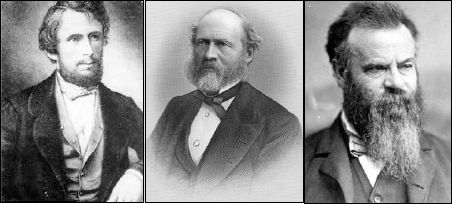
Contemporaries
E. G. Squier
Lewis Henry Morgan
John Wesley Powell
_______________________
302 Ibid., 76-80.
303 Ibid.
304 See: J.W. Powell history, http://www.arlingtoncemetery.net/jwpowell.htmhttp:
305 Silverberg 127,128
306 Ibid.
307 Worster, 62-64.
308 Ibid. 63. Ref. John Wesley, Survey of the Wisdom of God I, 2
309 Silverberg, 128
310 See: Stegner, 233.
311 Ibid. 232.
312 Worster, xii.
313 deBuys, 5, 6.