
CHAPTER 37

William deBuys states further that, “One of the thinkers on whom Powell drew most heavily was Lewis Henry Morgan (1818-1881) a founder of modern anthropology and, like Powell, a native son of western New York.”314 Powell would see Morgan’s unifying theories of social evolution and his efforts to define the origin of the ancient mound building cultures through the use of kinship studies as a way to address other political, religious and social questions facing society in the 1800s.
In 1877 he (Lewis Henry Morgan) published Ancient Society, in which he posited how that evolution proceeded: It began with savagery, and then with acquisition of certain skills and knowledge man developed to a stage of barbarism. With the blessing of further advances in technology and understanding, civilization ultimately blossomed. This theoretically universal sequence of stages –from savagery to barbarism to civilization—became known as anthropology’s classical evolutionary theory, and it dominated anthropological thinking for the decades of Powell’s mature professional life.
Powell had heard of Morgan’s formulation even before Ancient Society was published and began a long and admiring correspondence with him. When the book came out, Powell devoured it, reading it closely several times. Within a matter of months, he reported back to Morgan that the ethnographic information he had collected on the Colorado Plateau fit Morgan’s framework handsomely. Here at last was a unifying theory around which to organize an abundance of information that otherwise seemed chaotically heterogeneous. From the appearance of Ancient Society onward, Powell became one of Morgan’s staunchest allies, not only accepting the classical formulation of social evolution but bending his energy to detailing and fleshing it out.315
Morgan’s and Powell’s writings would promote in society a whole new way of thinking, as their revolutionary ideas would have a profound influence on the whole of society, extending well beyond the borders of North America. These foundational theories would be used in addressing many political, social and racial issues, such as:
•Indians land rights and race legislation
•The establishment of public lands
•Homestead legislation and laws
•American Expansionism/Manifest Destiny
•Draconian actions of closing public domain to future settlements
•Advancing civilization through the building of the railroad, using Eminent Domain
•In the debates of separation of church and state, religion vs. science
•Revelation vs. Nationalism and Intelligent Design vs. Evolution
•In the determination of the curriculum to be taught in public schools
•In addressing Mormonism, their land rights and settlements
•In the establishment of government oversight of Americas’ waterways and water rights.
•In the procurement of government funding for the Advancement of Science and for associated-associations and organizations.
•In the establishment of Malthusian population control measures and sustainability programs.
•In the advancement of a social contract for the betterment of society (Locke vs. Rousseau)
•In the worldwide advancement of Socialism (Marx and Engels)
•In the debate to re-define marriage and family
•In the advancement of conservation and environmental agendas
•In the debate over private property rights
•In the debate on how society should value natural law, which has been America’s foundational basis for constitutional law.
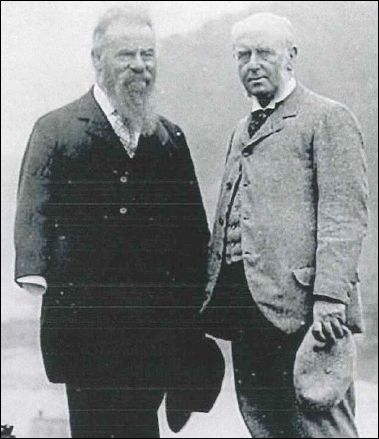
John Wesley Powell and Archibald Geiki on Jefferson Rock, Harpers Ferry, W. Va. 1897
Courtesy Wikimedia Commons
A bureaucrat by day and a club member by night, Powell did not enjoy much leisure for writing. He never learned to write easily with his remaining left hand. His signature remained a jerky scrawl. When he did write it had to be done at the office, where he had a stenographer on duty, and it had to be dictated out of his head. Not surprisingly, he published only two books in his lifetime, neither of them as long as the volumes by Morgan, Ward, or Spencer. All the same, his lifetime output in the form of short essays, addresses, papers, Congressional testimony, and government reports was prodigious. A catalogue of his published writings list 251 titles and is not complete.316
In understanding the thinking of a man, one must first look at what he has chosen to write about. The following is a short list of what John Wesley Powell painstakingly decided to write about:
1880 “Sketch of Lewis H. Morgan, President of the American Association for the Advancement of Science.” Popular Science Monthly 18:114-21
1880. “Anthropology” A Contribution to “General Notes”, The American Naturalist 14:603-5
1881 “Sketch of the Mythology of the North American Indians.” Given in the first Annual Report of the Bureau of American Ethnology, 17-56. Washington D.C. Government Printing Office
1882 “Darwin’s Contributions to Philosophy.” Proceeding of the Biological Society of Washington 1:60-70.
1883 “Human Evolution.” Transactions of the Anthropological Society of Washington 2:176-208.
1884 “The Three Methods of Evolution.” Bulletin of the Philosophical Society of Washington 6: 27-52
1885 “From Savagery to Barbarism.” Transactions of the Anthropological Society of Washington 3:173-96
1888 “From Barbarism to Civilization.” American Anthropology 1:97-123
1888 “Competition as a Factor in Human Evolution.” American Anthropology 1: 297-323.
1890 “Irrigation and Reclamation of Public Lands.” Fifty–First Congress, First Session, Senate Report, 1466.
1893 “Are Indians Becoming Extinct?” Forum, 15:343-54.
1896 “Relation of Primitive Peoples to Environment.” Annual report of the Board of Regents of the Smithsonian Institution, July 1895, 625-37, Washington D.C..
1897 “On Regimentation” Fifteenth Annual Report of the Bureau of American Ethnology, civ-cxxi. Washington, D.C.
1898 “The Evolution of Religion.” The Monit 8: 183-204
1899 “Sociology, or the Science of Institutions.” American Anthropology, 1:475-509, 695-744.
1900.“The Lesson of Folklore.” American Anthropology, New Series 2:1-36.317

A mound photograph on the waters edge entitled “Reflections”
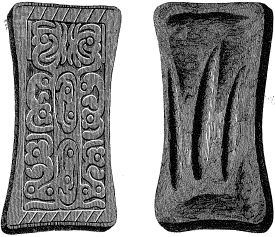
Squier and Davis, Ancient Monuments, Fig. 194 and 195
_______________________
314 Ibid., 318, 319
315 Ibid.
316 Worster, 449.
317 See: deBuys, editor, Powell, Seeing Things Whole: 330-373.