
CHAPTER 41

Ethnology is the study of ethnic groups and their interaction within a given society. It looks at moral tendencies, political interests, religious rituals and social affiliations. Ethnologists evaluate the capability and adeptness of a race or ethnic group to be assimilated into a larger society. Powell made this study of man and the study of ethnology and anthropology his life’s work.
Williams deBuys, editor of Powell’s book Seeing Things Whole, would write: “his belief in the superiority of his own cultural inheritance was adamant and unshakeable. His ethnographic eye is constantly at work, capturing details of the culture and behavior of all whom he encounters, Mormon pioneers no less then Indians, Paiutes no less then Hopis. At every turn he appraises the landscape, quickly drawing conclusions.”340
Another biographer of Powell’s life describes Powell’s assessment of the Mormons in these terms:
Powell’s reading of the strengths and weaknesses of the Numa resembled almost exactly like his reading of the Mormons, the children of Nephi. Like the Indians, the Mormons offered impressive social organization and spirit of community. But also like the Indians, the Mormons were held in the grip of mythology and sorcery that was closed to the challenges of modern science… Mormons may have been receptive to the newest inventions- the railroad or telegraph- but their philosophy was, like the Indians, based on primitive superstitions. America was right to reject that “revelation”- to dismiss the fantastical stories about Lehi and his sons sailing in a wooden boat to a new world, or how the great civilizations of ancient Mexico were built, or how the truth had been revealed to an uneducated farm boy in New York State. Nonetheless, the Mormons, like the Indians, had many virtues when it came to organizing their social life or getting a living together on the land…Most Americans of the time looked on Mormons and Indians alike as outlandish people…His attitude towards them, however, was ambivalent, and often it is hard to know what separates an ambivalence from a contradiction.341
The challenge of modern science has been one of a re-indoctrination of society, from biblical views regarding the origin and evolution of man, to what they see as the liberating ideas of evolutionary thought. The Church of Jesus Christ of Latter-day Saints’ (the Mormons) foundational doctrine affirms the idea of a supreme Creator and of the existence of intelligent design, which has brought about much of the organization that is found in nature. This idea, as attested to in the Bible, says there are supreme beings that played an intrinsic role in the creation of this world and of mankind.
Powell’s assessments regarding the Indians and the Mormon settlers were further confirmed to Powell when in the late 1860’s he set out to explore the mighty Colorado River. He arrived in the arid lands of Southern Utah at a time when there had been ongoing confrontations between Mormon settlers, the Indians, and other pioneers on their way to the gold-rich state of California. Since Powell had jurisdiction over Indian affairs in the intermountain area and was in the process of looking for land for Indian reservations when he decided that he wanted to explore the canyons of the mighty Colorado River.
Powell inquired about who he could get to negotiate with the Indians to insure the safety of his party as they floated the Colorado River basin. He was given the name of Jacob Hamblin, a Mormon leader and missionary who had learned their language and who had developed a relationship of trust with many of the Indian tribes of that region. With that advice, Powell contacted Hamblin and asked him to go and negotiate with the Indians in his behalf for safe passage of his party, as they would be traveling down the canyons of the mighty Colorado River.
As the expedition arrived at what is known as Separation Rapids, three from his party, William Dunn and two Howland brothers, decided to leave the expedition, as they were no longer willing to venture further down this uncharted river. They believed that they would be safer finding their way on foot, than to venture further down the river. However, they were later found dead, with evidence pointing to an ambush by Indians. A confession was later received from some Shivwits Indians of that area. However some of Powell’s biographers still alluded to a possible Mormon connection in the deaths of Powell’s associates.
Jacob Hamblin, to save face, set up a face-to-face meeting with Powell and members of the Shivwits Indian tribe, upon which they admitted the wrongdoing. Powell of that meeting would later write the following:
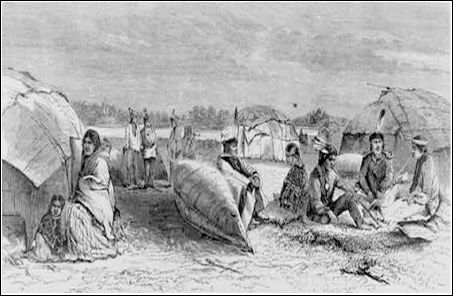
So strangely do virtues and vices grow in the human heart, here savages faithful to trust on one day, who, but a short time before, had been guilty of horrible, though unconsidered crime. He who sees only their crimes, and studies the history of their barbarities as it has been recorded for the past three or four centuries, can see in the Indian race only hordes of demons who stand in the way of the progress of civilization and who must, and ought to be destroyed. He who has a more intimate knowledge of Indian character and life sometimes forgets their baser traits, and sees only their virtues, their truth, their fidelity, their simple and innocent sports, and wonders that a morally degenerate, but powerful civilization should destroy that primitive life.
Powell goes on to state that: “Social problems are so complex that few are willing or able to comprehend all the factors, and so the people are divided into two great parties, one crying for blood and demanding destruction of the Indians, the other begging that he may be left in his aboriginal condition, and that the progress of civilization may be stayed… Whether we desire it or not, the ancient inhabitants of the country must be lost; and we may comfort ourselves with the reflection that they are not destroyed, but are gradually absorbed, and become a part of more civilized communities.”342
_______________________
340 deBuys, 95.
341 Worster, 291.
342 deBuys, [John Wesley Powell] Seeing Things Whole, 105,106