
CHAPTER 42

“One of the earmarks of change in pre-academic anthropology in late 19th century America was the separation of physical anthropology from cultural anthropology as presented by ethnology. Ethnology was the comparative study of social man and his culture. The ethnologist of the nineteenth century thus walked an unstable course between science and assumptions…Ethnology became a means through which both scientists and social scientists sought to estimate the relative value of the races, to help to justify the dynamics of race legislation.”343
“The founder of American ethnology was Jefferson’s Secretary of the Treasury, Albert Gallatin, who gave up the study of monetary policy to collect lists of Indian words and, in 1843, published the most comprehensive collection of native vocabularies to date. Gallatin became the first president of the American Ethnological Society of New York, a private venture that served vaguely as a model for Powell’s Bureau of Ethnology”344
In 1878, in a report to the Secretary of the Interior, John Wesley Powell asked for the creation of a government agency to carry out research on the Indians. Pointing out that because of the rapid change in the Indian population then in progress, all habits, customs, and opinions were fading away, even languages were disappearing, In a very few years it would be impossible to study North American Indians in their primitive condition, except from recorded history. For this reason, according to Powell, ethnologic studies in America should be pushed with the utmost vigor. Powell believed that much of the conflict between white men and Indians in the United States could have been avoided if there had been more knowledge of Indian ways.
The Ethnology department founded by Powell was first seen as the “Science of Man”, exploring the origin and evolution of man along with the origin of the American Indian. Within the science of American Ethnology, the study of man would be the focus, exploring man’s customs, language, monuments, religion and cultural advancements.
The phrase “Science of Man” appeared in these researches and in organizing the Bureau in 1879, “but did not appear in the annual report until 1892.” Among the many facets of what they wanted to explore “was the discovery of the relations among the native American tribes, to the end that amicable groups might be gathered on reservations.” 345
These early men of science…“formed a seamless whole, each depending on the other for understanding. Scholars working in isolation from one another could not see the full picture, or how their specialized research fit into it. But a center for ethnology could bring people together in a common effort. Set up in perpetuity, it could keep them moving toward a single end, generation following generation, slowly closing, in on the ideal of complete knowledge.”346
The ambition of the bureau must be nothing less than founding a ‘Science of Man,’ a phrase that first appeared in the annual report for 1892-93 but was the dream of its director from the beginning. Powell saw no one else in America organizing such a science, so he set out to do so. In the second annual report he marked off four great ‘departments’ in this science: the study of arts, institutions, languages, and opinions.347
Congress placed oversight of the Bureau of Ethnology under the supervision of the Smithsonian Institution. It was directed that all archive records and materials relating to the Indian tribes collected by the survey of the Rocky Mountain region and Interior Department be transferred to the Institution, for use by the Bureau. Prof. Spencer F. Baird, Secretary of the Smithsonian Institution, recognizing the great value of Maj. J. W. Powell's services in initiating research among the western tribes, selected him as the person best qualified to organize and conduct the work.348
The National Government had already recognized the importance of researches among the tribes. As early as 1795 the Secretary of War appointed Leonard S. Shaw deputy agent to the Cherokee with instructions to study their language and home life and to collect materials for an Indian history. President Jefferson, who planned the Lewis and Clark expedition of 1804-06, ‘for the purpose of extending the internal commerce of the United States,’ especially stipulated, in his instructions to Lewis, the observations on the native tribes that should be made by the expedition for the use of the Government. These were to include their names and numbers; the extent and limits of their possessions; their relations with other tribes or nations; their language, traditions, and monuments; their ordinary occupations in agriculture, fishing, hunting, war, arts, and the implements for these; their food, clothing, and domestic accommodations; the diseases prevalent among them and the remedies they use; moral and physical circumstances which distinguish them from known tribes; peculiarities in their laws, customs, and dispositions; and articles of commerce they may need or furnish, and to what extent; ‘and considering the interest which every nation has in extending and strengthening the authority of reason and justice among the people around them, it will be useful to acquire what knowledge you can of the state of morality, religion, and information among them, as it may better enable those who endeavor to civilize and instruct them to adapt their measures to the existing notions and practices of those on whom they are to operate.’ During much of his life Jefferson, like Albert Gallatin later on, manifested his deep interest in the ethnology of the American tribes by publishing accounts of his observations that are of extreme value today. In spite of its limited resources—a scientific and supporting staff never larger than twenty and meager budgets—the bureau became recognized as the foremost center for the study of American Indians. Its publications on linguistics, archaeology, physical anthropology, and Native American history are listed in a 130-page booklet, List of Publications of the Bureau of American Ethnology with Index to Authors and Titles. In 1964 the bureau was merged with the Department of Anthropology of the U.S. National Museum.349
“At no point did Congress explicitly authorize a federally funded Bureau of Ethnology. In the 1879 legislation abolishing the western surveys and establishing the Geological Survey, Powell had modestly asked for and received $20,000 to complete ‘the reports of the Geographical and Geological Survey of the Rocky Mountain Region with the necessary maps and illustrations.”350
In 1881, Powell was given the directorship of the U.S. Geological Surveys when he already had a full-time job as director of the Bureau of Ethnology.
“Apparently, he did not for a moment consider resigning the latter. Self-confident as a rooster, he was certain that he could manage both offices without difficulty. He wanted to see the survey grow- grow far beyond anything King or anyone else had contemplated. At the same time he had lost none of his interest in ethnology and could see enormous potential in its development too. This man of humble origins and limited academic achievement intended once more, as he had on the Colorado, to seize his opportunities and make a name for himself by going where no one had gone before.”351
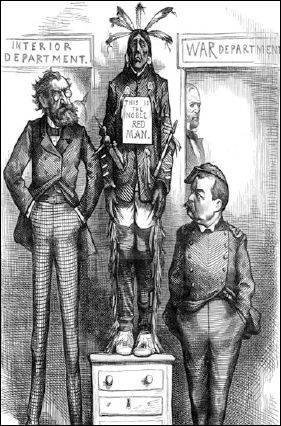
1878 Harper’s Weekly Cartoon, depicting Cal Schurz, Secretary of the Interior and General Philip Sheridan in the debate over Indian Land Policy
“Powell believed that the government should substitute the science of ethnology for the arts of military conquest. It should support scholarly investigation of the social, economic, and cultural systems of the vanquished Indian peoples. Needless to say, not everyone agreed with that peculiar way of treating one’s vanquished enemies. As one southern congressman retorted, Americans preferred to spend their tax revenues on studying the diseases of the horse rather than the superstitions of the Indian.”352
Powell persuaded the first secretary of the Smithsonian, Joseph Henry, to turn over the hundreds of questionnaires that Henry had sent out to solicit information regarding Indian numbers, vocabularies, and lifeway’s. Once these were in hand, he set himself the challenge of turning them into science. Henry had encouraged anthropology because it was popular with the public, but he had no one on his staff to organize and interpret the linguistic material that came in. In 1879 he put all of it in Powell’s charge. However, Powell went where his curiosity and moral passion took him, and he became for a crucial period of time the country’s most important student of the vanishing Indian world.353
“His scheme was long-term and basic. All customs, laws, governments, institutions, mythologies, religions and even arts would be investigated. Since language was the only possible door into Indian ideas and thoughts it must have a priority… These would be keys to unlock the mythic imagination of the native American.”354
“The Indians were a vital natural resource to be mined and transformed into knowledge. Among them the scientist worked to record and interpret, deriving insight into the broader human condition.” But the Indians would see it as an annoyance, for the fact was that most all the investigators weren’t scientists at all, but were unskilled researchers, with no formal education, for it was rare in the 1870s and 1880s. “Powell did not ask the Indians whether this was a role they wanted to play.” 355On the contrary, he took their cooperation for granted, as the Indians were struggling to adjust to the vast changes visited upon them.
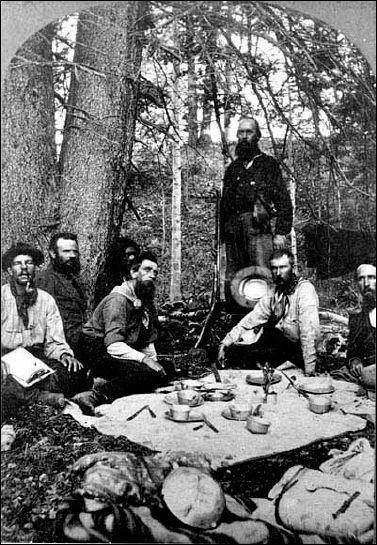
John W. Powell and Associates on one of his many excursions westward
_______________________
343 John S. Haller, Race and American Ethnology; Indiana University Press 710
344 L.C. Mitchell, Witnesses to a Vanishing America 162-63 and Worster, 397.
345 Worster, 600: ref. #27, Fourteenth Annual Report of B.E.: Part 1 xxvii
346 Ibid. 399
347 See: Neil M. Judd, Smithsonian Institution Bureau of American Ethnology: Bibliography…The Bureau of American Ethnology: A Partial History. Norman: University of Oklahoma Press, 1967. —Henry B. Collins/J. H.
348 Ibid
349 Neil M. Judd, Smithsonian Institution Bureau of American Ethnology: Bibliography…The Bureau of American Ethnology: A Partial History. Norman: University of Oklahoma Press, 1967. —Henry B. Collins/J. H., 7
350 Worster, 397, 398. This, mainly, referred to the monograph series he had launched, Contributions to North American Ethnology, whose volumes eventually included: Noelke, “Origin and Early History of the Bureau of American Ethnology (1881).
351 Ibid. 394, 395.
352 Ibid..396. Ref. Congressman Charles Moses (Ga) CR 16 May 1892, 4284
353 See Noelke,: Origin and Early History of the Bureau of American Ethnology, Ph. D. diss., 20 Life of J.W.P., Worster pg.397
354 Worster, 398: First Annual Report of BE, xiv-xv
355 Ibid, 399