
CHAPTER 3

The flat-earth is not history’s only myth concerning Columbus. Was he really the first outsider to sail to and set foot on the shores of the Americas? Did he really discover America, or had there been others before him?
The idea of discovering a “new land,” a place where one could bury his country’s flag in the ground as he laid claim to its resources, was the dream of many early explorers. A school textbook says of Columbus, referring to other would-be discoverers that, “before them all, he took possession of the island[…]for the King, Queen, his Sovereigns.”14
Today there is ample evidence attesting to the arrival in the Americas of numerous pre-Columbian cultures. The question today is not who was here before Columbus, the real question is who wasn’t here before Columbus? Historians and scientists from many parts of the world find it humorous that in America there are still references being made to the idea that Columbus discovered America, as if there were no others here before.
The feasibility of crossing the Atlantic to America even in small craft has been repeatedly demonstrated. Professor Alice Beck Kehoe catalogued some seventeen crossings of small boats since 1968 alone. “Regarding the possibility of trans-oceanic contacts with America before 1492,” notes Kehoe, “only one fact need be stated: every type of boat—nao, junk, vaka, curragh, sailing raft—has been proven capable, in experienced hands, of traversing an ocean. The presumed utter isolation of the Americas before the heroic Columbus defied his seamen and sailed over the edge of the known world is, in a word, implausible.”15 Emerging evidence shows pre-Columbian contacts to be extensive. Yet claims are often discounted or dismissed by academia even as an increasing body of research proves that over the last three to four millennia, travelers from Europe, Western Asia, and Africa have all set sail to explore the Americas.
Many historians of several different foreign lands share their histories of their own pre-Columbian mariners: stories of the Vikings, Assyrians, Phoenicians, Greeks, Egyptians, Jews, Polynesians, Japanese, Chinese, Africans, Welsh, and Carthaginians all had seafaring vessels capable of braving the unknown ocean waters, and being driven by the winds and the prevailing currents. They all could have made it to the shores of the Americas prior to Columbus. As the mariners’ story goes, if you own a boat, the ocean and waterways become a highway.
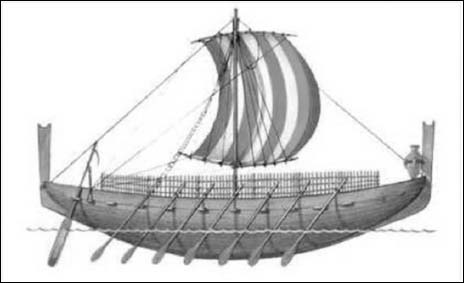
According to Dr. Cyclone Covey, emeritus Professor of History at Wake Forest University, “We may wonder at the vast Egyptian Akkadians in the Americas. Egyptians surely preceded displaced Mycenaeans as well as Phoenicians and Carthaginians as many voyaged into the Atlantic with their respective imperial expansions and metal-searchings.”16
There is recent work, that has looked at the populating of ancient America by way of the seas, “which today’s mainstream archeologists still insist hermetically sealed off one ancient society from another before Columbus—which were in fact superhighways humans rode from place to place, as proved more than once by Dr. Thor Heyerdahl. From the 1940s to the 1970s, the Norwegian archeologist’s faithful recreations of period ships operated by ancient Easter Islanders, Egyptians, Mesopotamians, and Peruvians demonstrated that mariners possessed a technology that enabled them to traverse the seas long before Columbus.”17
All of this exposes as naïve the age-old theory that all or most ancient American populations derived from a handful of families chasing Woolley Mammoths across the Bering Strait some 40,000 years ago.
It is further noted that even though most of the credit for discovering the North American continent is given to Columbus yet, ironically, the land of America derives its name from Amerigo Vespucci and is not referred to as the “land of Columbus.” In reality Columbus never set foot on the mainland, but only on the offshore islands. It was Amerigo Vespucci who convinced the king of Spain to sponsor his voyage to the mainland, to prove that it was a completely separate continent and not just an extension of the Eastern continents as Columbus apparently believed. This new mainland was first named the “Land of Amerigo,” but later evolved into America.18
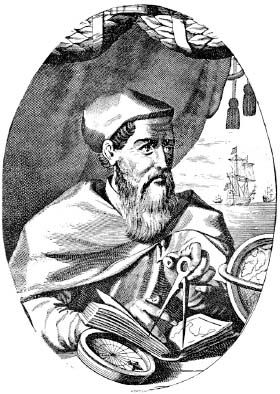
Amerigo Vespucci
Born on March 9, 1454 and died February 22, 1512 Born and raised in Florence, Italy
_______________________
14 See: Reid Mitchell, The Creation of Confederate Loyalties, 93-108
15 Kehoe, The Land of Pre History, 199-202
16 C. Fred Rydholm, Michigan Copper: The Untold Story; A History of Discovery, (Marquette, MI: Winter Cabin Books, 2006) 367.
17 Frank Joseph, Advanced Civilizations of Prehistoric America: The Lost Kingdoms of the Adena, Hopewell, Mississippians, and Anasazi (Rochester, VT: Bear & Company, 2010) 6.
18 Timothy Ballard, The American Covenant (New York, Digital Legend, 2011) 108-110.