
CHAPTER 48

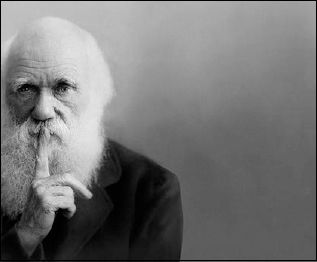
Charles Darwin
While attending meetings in Washington D.C., I was given an invitation to attend a premiere screening of the documentary “Expelled” featuring Ben Stein. This eye opening and intriguing documentary starts out with Stein traveling across America and Europe, interviewing prominent scholars and scientists. As a result of their writings and research, these scholars were ridiculed about raising questions, relating to the legitimacy of how the evolutionary thinking has been handed down to society by Darwin, Huxley and Morgan. The documentary points out that in the academic and scientific communities of today, open discussion and debate does not exist. To explore the theories of creationism or the possibilities of an intelligent designer, who helped to bring order and organization to nature, would put at risk their academic or scientific career. In Stein’s interviews with these scholars, many spoke of their research and writings in exploring this taboo topic. They expressed their frustration regarding what they had experienced, from being denied tenure, to being fired from their institutional jobs. These scientists and accomplished writers were in a very real sense expelled from the academic and scientific community for exploring and advancing the idea that there might be real evidence of “design” in nature.
After interviewing these scholars, Stein interviewed those in the evolutionary sciences who had taken action against them. These colleagues and administrators believed that their actions were justified. As they see it, those who challenge the legitimacy of the evolutionary theory of natural selection are addressing issues that have already been decided. As they would say, the case is closed. There may also be an element of fear associated with allowing such research. As much as the social sciences would like to believe that all of their conclusions are based on reasoned thought and empirical evidence, its acolytes adhere to its dogma, just as tenaciously as the faithful of any religion. So, accepting other views or allowing for their existence challenges prestige, standing, and can even affect livelihood.388
Some today, as evidenced by the film “Expelled”, are challenging the idea that this is an either or question. Do species adapt? I think few would argue the point. Does natural selection, in that the stronger, or more adaptive members of a group tend to survive, take place? Again, the evidence seems clear. Does that necessarily mean that man evolved from some lower life form? Darwin used natural selection to explain differences in the beaks of finches he studied in the Galapagos Islands, believing them caused by climate variations, but what he could not explain was where the whole organism of the finch came into being.389 It is likewise a considerable leap to assume man evolved through a continuous process of natural selection from a single cell to the very complex organism that he is. To prove a cause and effect here is probably what the debate is all about.
In A Short History of Nearly Everything (Broadway Books, 2003), author Bill Bryson, while researching “nearly everything,” addressed the issue of evidence and the evolution of man: “A big part of the problem, paradoxically, is a shortage of evidence…several billion human (or humanlike) beings have lived…the whole of our understanding of human pre-history is based on the remains, often exceedingly fragmentary, of perhaps five thousand individuals.”390 He quotes no less an authority than Ian Tattersall, then curator of anthropology at the American Natural History Museum (New York): “You could fit it all into the back of a pickup truck if you didn’t mind how much you jumbled everything up.”391 Bryson goes on to state: “The shortage wouldn’t be so bad if the bones were distributed evenly through time and space, but of course they are not. They appear randomly […]”392 So, the case is not closed, and there is room for honest inquiry into the question.
Powell, himself, asserted “the Mosaic [of Moses’] biblical account of the creation must reconcile itself to the findings of Geology…[or] Geology must reconcile itself to the Mosaic account of creation.”393 Why is this not possible? A short discussion of the basis of geological interpretation is instructive.
From the mid-eighteenth century through the early twentieth, the dominant basis for interpreting geological observations and other results was the principle of uniformitarianism. This principle was based on four propositions, the one important here being that the earth’s geological rate of change has been constant over time and space —no cataclysms or catastrophes. Uniformitarianism was first proposed by James Hutton in 1785, and later more rigorously codified by Charles Lyell in the early 1830s. Lyell’s multi-volumePrinciples of Geology, which would have been available to Powell, was the most influential geological document of the mid-1800s.
Powell’s view would probably have been that of Lyell and Hutton, which would have made the biblical account of such occurrences as the creation and the flood unsupportable. However, the intervening advances in technology and increased bases of knowledge in the sciences, particularly paleontology, geology, and the earth sciences, have shown that there have been regular (though not uniform in time, duration, or impact) cataclysmic events, throughout the earth’s history. In some cases these events have caused the extinction of entire species. Today, the geological consensus is that our earth’s history has been a slow, gradual process of change, though not uniform over time, which has also been interspersed with occasional cataclysms, with varying degrees of impact on the earth and the species that inhabit it.
So, we ask again, why is it not possible for well meaning individuals to work toward reconciling these two views? How old is the earth? I don’t know, and neither, really, does anyone else. There are estimates, based on well thought out assumptions and much empirical evidence. The problem, with assumptions though is, what happens if the assumption is incorrect?394
The Hubble Telescope has had more impact on the study of astronomy and astrophysics than probably any other technological advance in the history of those scientific disciplines, with the possible exception of Galileo’s first telescope. Some of what astrophysicists have been able to observe has caused them to modify many of their assumptions and abandon others entirely. This, in turn, has opened up numerous avenues of inquiry previously closed because of incorrect assumptions.
A pillar of Christian thought espouses that through patience one can gain a greater insight and understanding into the laws of nature that govern this world. In so doing, one might find an increased level of harmony between archaeological and anthropological findings (if meaningful research is allowed to move forward), and the Mosaic biblical accounts of the Creation, the Flood, and other such occurrences. In the sciences, as in religious circles, perspective changes when our understanding increases.
Unfortunately, since the introduction of Social Darwinism into the American culture by Spencer, Morgan and Powell, the American scientific and academic communities over time have adopted the stance that creationism shouldn’t be allowed to be explored, taught, or discussed in public schools or on university campuses. In their view, before this can be done, creationism must be reconciled to the findings of geology, archeology and anthropology. However, as society has learned in astrophysics, an honest investigation of the underlying assumptions of these disciplines would be worthwhile and possibly very revealing.
One area of compromise may be found in the characterization of the creation and the demarcation of the assumed timeline as given in Biblical accounts. Confusion often comes with one’s interpretation of what is being taught. In the case of the account of the Creation, if one substitutes, ‘He who created this world’ to ‘He who organized this world,’ this simple change helps to change the dynamics of how it is often times considered. For if it is viewed that God didn’t create the elements, but did organize the elements, perhaps this helps to provide an additional level of clarity and understanding. The second assumption that could help to provide clarity is the idea that the creation of the world and when man was placed on this planet are on totally different timelines. In the evolutionary sciences, the idea that is presented is that the earth and man evolved over eons of time. On the other hand, the Biblical account timeline has God placing man (as we know man) on this planet after the earth had been made ready for man, approximately 6,000+years ago. This places man on a totally different time continuum than many of the theoretical evolutionary timelines shared through the sciences. In the sciences of geology, archeology and anthropology, scholars look at the evolution of the earth over eons of time. In the Bible account of the Creations, as interpreted by some, place man on the Earth after it had been made ready: “as a place where man could dwell,” as a place where human life could be sustained.
Considering this perspective as to how the order and organization that is found in nature has taken place, could such a view change some of the conventional worldviews in the debate between evolution and creationism, and alter the perspectives of how archeological findings of dinosaurs and of pre-historic man would be viewed? Where, in the past, some of these issues have been seen by some as a formidable hurdle in their belief of the Biblical accounts of the creation.
Does the understanding that places man’s presence on this planet on a totally different time continuum than that of the evolution of the world, help to change some of the perceived conflicts? Could this make it conceivable that perhaps this planet did evolve over eons of time, until some advanced intelligence in the universe saw fit to make it ready, as a place where man could dwell some 6000+/- years ago? In working together could common grounds be realized in matters that have long separated sciences and religion? Or has the debate over how this world was organized and populated become such a major part of a global agenda that there is no room in the classroom for any further discussion on the foundational topic of the origin and evolution of man?
If this is the case, we are facing a crucial question as to whether the complexity of design that we find in nature was guided or unguided? If guided, then by whom? And if not guided, then what are the odds?
In dealing with the many questions regarding the earth and the origin of man, scholars of both science and religion will continue to find differing views driven by differing agendas, leaving many questions unanswered as to how life was formed. Questions, such as where and how did life first originate? How does one get life from something that has no life? Why shouldn’t these discussions about evolution and the origin of man be discussed more openly?
_______________________
388 Nathan Frankowski, Expelled No Intelligence Allowed; 2008 documentary hosted by Ben Stein
389 Illustra Media, 2003, Where Does the Evidence Lead?www.illustramedia.com
390 Bill Bryson, A Short History of Nearly Everything, (New York: Broadway Books, 2003) 440.
391 Ibid.
392 Ibid.
393 Worster, 224.
394 See appendix for a discussion of validity and correctness.