
CHAPTER 47

In 1999, while attending a World Congress of Families, held at the United Nations Building in Geneva Switzerland, Dr. Rabbi Daniel Lapin shared an interesting insight into the world’s divergent ideologies. He pointed out that in the world today there are fundamentally two conflicting ideologies. The first believes that children are at the very apex of the pyramid of all of God’s creations, divine creatures, created in his image and likeness, touched by the finger of God and placed in a world that was created and organized in such a way as to provide a place wherein man could dwell.
The second viewpoint as to how human life on this planet came about is by way of natural selection, when a few protein molecules came together, by probability and chance, and through the process of natural selection, assembled in a proper fashion to give way to a large variety of creatures. These creatures evolved and ultimately gave way to the likes of a Bach and a Beethoven. These evolutionary world-views were expounded upon by the likes of Darwin, Huxley, Spencer, Morgan, and others, all of which advanced the ideas that human life came about by chance, and by way of natural selection as the materials of the earth aligned. These evolutionary theories into the origin of man are the foundation of a whole secular movement.
Has there been a concerted effort to close the door on Creationism, on the idea that there was a benevolent intelligent designer who directed much of the organization that is found in nature? Today’s evolutionary world-views sees man as just another mammal in the animal kingdom, advancing through the stages of human evolution, making the case that there could be those of differing races on this planet within the human family that could be more or less advanced than others. And as such, different races could be at different levels in the evolutionary process.
This idea that man has evolved and progressed differently has so altered society’s views and perceptions that it has changed how society today views and values children, motherhood, marriage, race and family. As expressed by Friedrich Engels, Morgan’s views into the stages of human evolution would alter his own views, of marriage and family, seeing marriage and family now as a social construct of evolution.384
Engels, in advancing Morgan’s evolutionary theories states; “In this constructing retrospectively the history of the family, Morgan is in complete agreement with the majority of his colleagues, arrived at the primitive stage in which promiscuous intercourse prevailed within a tribe, so that every woman belonged to every man and, similarly, every man belonged to every women.”385
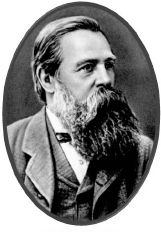
Friedrich Engels
This view of marriage and family would open up a whole new view of morality, surmising that man evolved from savagery to barbarism to civilization, and, as such, marriage and family evolved in a like manner. By following this path, one is led to the logical conclusion that if there was no creation there is no God. And that since man is just another animal in the animal kingdom, why shouldn’t a man be a stallion among mares. After all, marriage and family is not ordained of God, for there is no God and marriage and family, as such, is just a traditional social construct. Using this logic, the gates to a greater social acceptance of sexual promiscuity has become the norm, as it has become the foundational basis in the ongoing effort and debate to redefine gender, marriage and family, and in the elimination of the concept that all mankind is ultimately accountable to a Supreme Being for their actions.
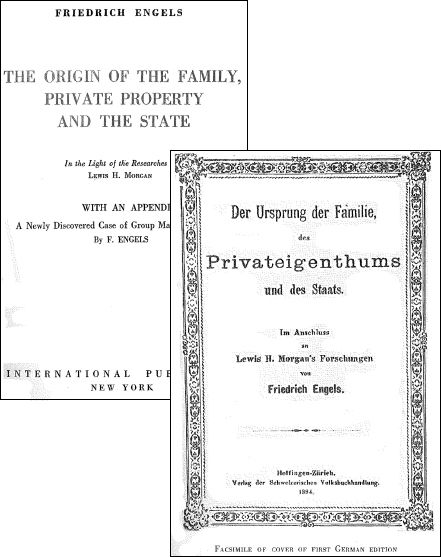
Engels, who co-authored the Communist Manifesto with Karl Marx, would see the family as a human creation, a bourgeois institution that must be done away with. In his book The Origin of the Family, Private Property and the State, Engels gave credit to Lewis H. Morgan in the introduction page of his book, by stating: “In the light of the Researches of Lewis H. Morgan” Engels in his book’s preface, dated June 16, 1891, London England.
Engels writes of his voyage to the Americas in 1888. While in New York, Engels, who had an ardent interest in the writings of Morgan, made an inquiry of a congressman from New York of what he thought of Lewis Henry Morgan. The Congressman knew of Morgan a resident of Rochester, New York, but knew little of his works.386 Engels had more than just a casual interest in Morgan’s writings. He would go on to write his book, crediting it to what he learned from Morgan’s stirring insights.
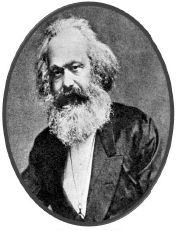
Karl Marx
Engels went on to say “he [Morgan] reconstructed the forms of the family, corresponding thereto and thereby opened up a new path of investigations and a more far reaching retrospect into the pre-history of mankind.” “Morgan’s great merit lies in having discovered and reconstructed this prehistoric foundation of our written history in its main features, and in having found in the groups based on sex of the North American Indians the key to the most important, hitherto insoluble, riddles of the earliest Greek, Roman and German history.”
Engels by his forth edition, however, realized that some of Morgan’s findings were in question and even obsolete and stated: “As a consequence, some of Morgan’s particular hypotheses have been shaken, or have even become obsolete. But nowhere have the newly collected data led to the supplanting of his main conceptions by others. In its main features, the order he introduced into the study of the primitive society holds. [As embraced by those in Institutional science] As stated by Engels in the preface of the fourth edition, 1891 printing of his book; “The Origin of the Family, Private Property and the State,” published and printed in New York, Germany, London and later published in the Union of Soviet Socialist Republic.387
_______________________
384 See: Engels,14-16.
385 Ibid., 27.
386 Ibid., 14-16.
387 See: Friedrich Engels, The Origin of the Family, Private Property and the State.: 1891 edition, (International Publishers, N.Y. Printed in the Union of Soviet Socialist Republics) Referencing: Lewis H. Morgan: Ancient Society or Researches in the lines of Human Progress for Savagery through Barbarism to Civilization, (MacMillan & Co., London, 1877)