
CHAPTER 50

John Wesley Powell, as the director of US Geological Survey and the man who has been referred to as the American Father of Conservation, took upon himself the role as the steward, of the ‘Arid Lands’ of the West. He was as one of the first proponents of sustainable national development, playing a major role in how the western lands of America have been developed.
Powell would follow Morgan and Ward in professing a need for even a more comprehensive role for government in the future. Contrary to what Spencer and his free enterprise disciples maintained, people were demanding more government, not less. Private property must decline, and property in common must return, though on a higher plane than before. The distribution of wealth must become more equitable. As the nation evolved into “one vast body-politic’ in which everyone worked for the common welfare, the old individualism must be ‘transmuted into socialism.”398
In the book, Seeing Things Whole, on the life and writings of John Wesley Powell, book editor William deBuys pointed out, that besides Powell, “another ardent admirer of Lewis Henry Morgan was Karl Marx, who developed a theory of human social evolution that was similarly deterministic. Marx found especially interesting Morgan’s assertion that bourgeois conventions of property ownership (in civilization) had been preceded by communal forms (in barbarism).”399
“For Powell, though he adopted Morgan’s ‘savage-barbarous-civilized’ stages of society and accepted without revision Morgan’s theory of the kinship basis for savage institutions, social evolution was not quite the even stairway that Morgan and some European anthropologists would have it. The diversity of culture among the American Indians made rigid systematization difficult.”400
In a paper Powell wrote in 1888 titled “Arid Lands” he clearly enunciates his utilitarian view of the natural world: “Man cannot change the great laws of nature; but he can take advantage of them and use them for his purposes.”401
“It was clear to Powell that without reform, the nation’s land laws, which enshrined the 160-acre homestead as a cultural ideal, would only obstruct the needed cooperative effort…He held that the course of western development in 1878 was wrong and that it would lead to misuse of resources and enormous human suffering by encouraging people ‘to establish homes where they cannot maintain themselves.”402
In fact as Powell saw it,
…what the land laws mainly guaranteed was suffering for individual families and burgeoning opportunities in real estate speculation for entrepreneurs savvy enough to circumvent the laws…Powell viewed the Homestead Act and related measures as a hoax on aspiring westerners, and his report offered a blueprint for the reforms…To be sure, the report reflected Powell’s personal ambition. It called for the inventory and classification of western lands on a grand scale, a task Powell was hungry to undertake. The report was also a work of extreme idealism, and not just in its appeal to communitarian values. In it Powell laid out his plan for what today might be called the sustainable development of 40 percent of the continental United States.403
“Not only does the report wed his pragmatism to a utopian vision; it also joins Powell’s faith in science to his humanism. As a scientist, he fervently believed that experts must execute the work of survey and land classification on which his plan depended. Until the technical men—his men—accomplished his fundamentally scientific task, he believed that the settlement of the West should be reined in.”404
Powell, and the men with whom he surrounded himself, believed that the ownership and actual management of the lands and the resources of the land should not be left to the untrained masses to control. “In their view, the protection of resources depended on control and regulation by the highest possible level of government.”405
Powell became concerned that the vast arid lands of the west would be swallowed up by settlements if the government didn’t act. Powell, as Director of U.S. Geological Survey, would go on to advance legislation proposing that less than 11% of the arid lands of the West be opened to settlements. Powell even opposed the alignment of the railroad, because he was concerned that it would open up areas of the country to continued future development.
While traveling on many occasions to the west, he became enamored with the unique beauty of these arid lands from the Rocky Mountains of Western Colorado to the grandeur of the Grand Canyon to the Red Rock monuments and cliffs of Southern Utah. Powell’s utopian vision did not include giant reservoirs and the peopling of these mountain and desert valleys. He felt that if he didn’t act that the whole landscape of the west would change. His position was one of control, government control of these arid lands. Much of the survey work he was engaged in was to take control of these western lands. In 1881 he was made director of the department of U.S. Geographical Surveys for the government and Powell’s vision and administration of the arid lands of the west was realized. That is evidenced today by the Federal government control over 67% of the land of the state of Utah, along with having holdings estimated at over 41% of the combined states of Montana, Idaho, Wyoming, Nevada, Arizona, New Mexico and Colorado.
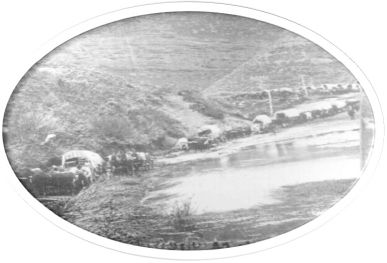
Mormon Wagon Trains Going West
_______________________
398 Worster, 462.
399 deBuys, 319.
400 Stegner, 252.
401 deBuys, 216.
402 Ibid., 146.
403 Ibid., 143.
404 Ibid., 143-144.
405 Ibid., 144.