
CHAPTER 51

Many would see that Powell’s greatest vision related to land conservation was his grasp of the importance of water to the lands of the west. As a Major in the Army Corps of Engineers, Powell believed in the need for government oversight and control of the water ways of the country; that by controlling the water (rivers and streams) of the country, you can also control the development and the expansion of settlements.
Powell’s ideas and agendas would give support to the expanded role of the Army Corps of Engineers. Where at one time they only had jurisdiction over navigable waterways, today their oversight extends to almost all designated neighborhood “wetlands”, which include ponds, marshes and even back yard streams across America. This expanded jurisdictional oversight over America’s wetlands, by the Federal government and enforced by the Army Corps of Engineers is perhaps the most highly contested attack on the use of the powers of Eminent Domain on private lands in America today.
Powell’s utopian vision for government oversight began with the idea that all government lands and survey work be consolidated into a single operation under civil control. “Powell’s address to the Montana Constitutional Convention in August 1889, took place in the course of a lengthy tour of the arid region under the auspices of the Senate Special Committee on the Irrigation and Reclamation of Arid Lands. When Powell gave it, he was at the zenith of his power and influence: [For] the Interior Department’s fateful order [for] closing the public lands was days away.”406 “When asked whether he supported the closure, he honestly replied he thought it was a good idea.”407
Powell began to campaign for legislative reform in 1878 with the publication of his farseeing Report on the Lands of the Arid Region, and he did not cease to battle for change until he suffered political death at the hands of an angry congress. This anger came as the result of the Draconian action of closing the entire public domain to further settlement until the survey of irrigable lands [could be completed.] Far more than obstructing speculators, the closure of the public domain inconvenienced almost every individual involved in the ongoing settlement of the West…by 1891 Powell’s enemies, most of them from the West had gutted his budget and fatally enfeebled the enterprise that he hoped would lead to the reform he had sought for so long.408
William deBuys editor of Powell’s book, Seeing Things Whole, further states that his “ideas keep resurfacing…Currently some of the most radical experiments in western land management essentially embody Powell’s recommendation for federal ownership and local control of western watersheds.”409 Worster would reference that:
Powell could see his maps one day helping America carry out vast undertakings, most of them involving water and the flow of rivers. His interest in topography had grown out of experiencing the West, Powell in his many adventures to the west witnessed how the Mormon settlements were tapping the water resources in reservoirs of the Rocky Mountains and through irrigation making the harsh desert blossom as a rose, with this Powell realized that there would be ‘no practical limit to the amount of food that could be produced.’410
He told the commission…some economic but simple and practical means of learning how the streams of the country could be utilized for irrigation. Now he could see the fuller dimensions of that need—‘the control of great rivers’ everywhere for the country…The survey maps could instruct people living in the lower Mississippi Valley, among the most fertile of agricultural districts but periodically overflowed by floodwaters, on how to solve their problem. Trap those waters near their origins, the melting snowfields of the Rocky Mountains, use them for irrigation, and the lower valley could be saved from destruction.
Powell didn’t believe in the Mormon dogma and was an ongoing obstructionist in the development of their westward settlements. Powell was complimentary of the Mormons’ irrigation techniques and how they could create beautiful farms and settlements out of harsh deserts, through irrigation and a spirit of community.411
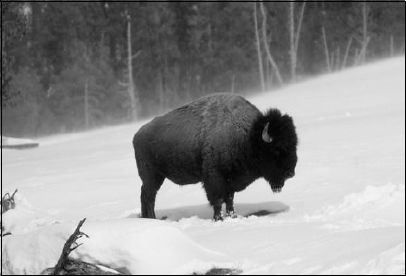
A Dying Breed
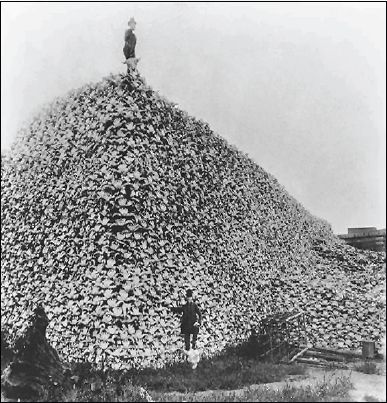
Buffalo Skulls
Buffalo were the primary protein food source for the Indian populations of America’s heartland.
_______________________
406 Ibid., 217.
407 Ibid., 215. See also Worster, 482-483.
408 Ibid., 20. Also 211-218.
409 Ibid., 145.
410 Worster, 532.
411 See: Ibid., 426.