
CHAPTER 54

There are those who would seek to close the history books of man’s experiences—history that shows weakness, shortcomings, prejudices and man’s inhumanity to man, that may be cause for embarrassment. If these things are forgotten, man is destined to repeat the grossest failures of the past that he implacably seeks to forget. It is a guaranteed formula for failure in the prospect to create a better world. How can we avoid the atrocities of the past if a society or nations closes their eyes to what man is capable of?
The full understanding of history must not only include its glory but its depredations if society is to realize the changes needed towards a more beautiful world. That which ignites the kindling is the perpetual flame of a true history, changes that may only take place if real history is allowed to be shared, and understood as America’s liberties are preserved.
The offspring of what Morgan and Powell taught and advanced in the 1800s, as covered in this section “A Larger History,” shows how the “Science of Man” has been used to advance public policy both home and abroad. Whether these men ever intended it or not, their ideas have been effectively used to unravel the underpinnings of Natural and Constitutional law. There are laws which were at one time held to be immutable laws, seen as a gift from God; a gift that does not come free, but at a price that is worth whatever the cost. Unless we as a society are willing to elevate the discussion, and our efforts in the protection of our liberties, they will surely be lost to future generations.
As a boy growing up my interests were focused primarily on any sport which ended with the word ball; primarily Football, Basketball and Baseball. At age ten, I was invited to be part of a youth choir. To me, that wasn’t my idea of fun. Nevertheless, my dear mother, who wanted me to become more well rounded, gave me an ultimatum, which was, if I don’t go to choir practice then she wouldn’t take me to my ball practice. So after being dragged to a few choir practices, I soon learned to enjoy choir as I still find myself humming some of those familiar tunes and reflecting on the lyrics of those youthful choir songs. One well-known song was written by Paul and Ralph Colwell. The lyrics say; “freedom isn’t free, you have to pay the price, you have to sacrifice, for your liberty.”
Too often man seeks to limit man’s liberties for the betterment of society. Limitations placed on agency greatly influences man’s ability to progress. “The exalting power of agency is founded in the law of opposition. Agency of liberty can exist only in the opportunity for doing good, but this is so only when [there] is also an opportunity for doing wrong.”428 Progression is a function of agency as one is given the ability to choose without coercion.
Both in antiquity and in the future, there are those who might seek to sever culture’s foundational roots for the sake of conditional equality. History has shown what will happen to a society when religious liberties are taken by those entrusted to protect them. One sure thing that history teaches, is that “there has never been a society or a nation established without God; but history is cluttered with the wreckage of nations that became indifferent to God, and then died.429
In the 1953 College Edition of Webster’s New World Dictionary, freedom is defined as: “the state or quality of being free; exemption or liberation from the control of some arbitrary power,” stating, that “liberty, [is] often interchangeable with freedom.”430This definition points out that liberty is something more, as it is more closely associated with particular rights granted, such as franchise rights, religious rights, privileges, or immunities.
Throughout the ages there have been those in society who are continually looking for a place where there is absolute freedom, no accountability or rule of law, a place where rules, commandments and laws are non-existent. Those who are still looking for this kind of freedom will soon realize that it cannot be found, even in the most freedom-loving countries of the world. For only in America do you find enshrined in its founding documents such strong language for the preservation of one’s liberties. The Constitution of the United States and the Declaration of Independence contains language, which is given as part of a moral code of conduct with immutable laws which grant liberties with conditions which requires a level of obedience, service and sacrifice.
In putting together America’s founding documents, as described in the Federalist Papers, the founders were striving to strike a balance between anarchy and monarchy, in creating a representative democracy, creating a place where all men would be treated equally under the law, and where all rights and liberties would be protected by the rule of law. In spite of this, America has drifted from those early moorings, which were enshrined in the Declaration of Independence, the Bill of Rights and memorialized in the Constitution; a standard upon which all laws and policies are to be weighed.
Today, we often see the words freedom and liberty being used interchangeably, thus few differentiate between them. Was it really the founders’ intention that man should be left free, free without accountability? Or did they intend, as a God-fearing people, to become subject to the will of God, and by so doing, would be assured the promise and blessings of life, liberty and happiness? Liberty comes with conditions that are based on man’s willingness to respect and to render obedience to laws. As the Preamble to the Constitution points out, we must work to “secure the blessings of liberty.”
The Founders used the Bible as the foundation for the Constitution: “But whoso looketh into the perfect law of liberty, and continueth therein, he being not a forgetful hearer, but a doer of the work, this man shall be blessed in his deed.”431 Then in James 2:12 it goes on to admonish all to “speak the law of liberty.” A benevolent Creator, as described in the Bible, gave these laws for the betterment of man with a promise, that if followed, they would be led towards a greater good.
John Quincy Adams, the son of John Adams, the sixth President of the United States, pointed out that the Declaration of Independence was given in “the spirit of the Constitution” and that the Declaration of Independence implies that a provident hand has guided and blessed this nation. The term, “law of nature” means that the rights granted under the Constitution are based on Godly principles. John Adams put it best when he stated: “Our Constitution was made for a moral and religious people. It is wholly inadequate to the government of any other.” Without the moral foundation developed in a religious society, a free country with liberties like America cannot prosper. A free society is based on having a moral people who will show respect for “the rule of law.” History and statistical findings show that the makeup of the family and religious beliefs are core to the preservation of a country’s freedom. This belief is that there is a God of nature, and that He has brought about the great order that is found in nature, as evidenced in historical findings. These findings show that traditional marriage and family, strengthened by religious worship and scriptural study, are more likely to produce children who will have respect for law and, as such, will be a blessing and not a burden on society.
Accordingly, if we are to be truly free, liberty demands that we are accountable, law abiding and willing to accept the natural consequences of our actions. To be truly free, individuals must accept and deal with life consequences and not constantly look to governments for some sort of absolution. When individuals accept accountability, they learn important life lessons. When society absolves individuals of the consequences of their actions, which is frequently done, it starts society down a very slippery slope, a slope into a hole that is difficult to climb out of.
President John Adam’s admonition about the Constitution and a “moral and religious people,” is worthy of serious consideration, if America is to remain a free nation. The founding documents of America were based on religious imperatives. As a nation, we need to honor and return to them and recognize that the road paved by Morgan and Powell was based on theories and hypotheses, not facts. And, as such, it is not a proven path that leads to a more abundant life, which liberty and justice offers.
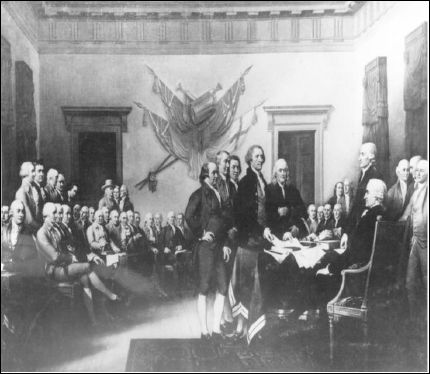
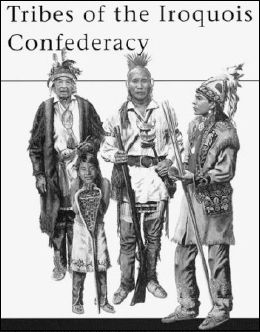
Although disputed by some, there is significant evidence that the Iroquois Confederacy served as a model or at least provided some inspiration in the drafting of the U.S. Constitution and Bill of Rights. Benjamin Franklin and Thomas Paine were well acquainted with the League. John Rutledge, chairman of the committee that participated in writing the first draft of the Constitution, began the process by quoting some passages from the Haudenosaunee Great Law. The Iroquois form of government was based on democracy, righteous living and personal freedoms, and included checks and balances, initiatives, referendums, and recall language. In 1987 Senator Daniel Inouye sponsored a resolution that would commemorate the Iroquois' contributions. In 1988, the United States Congress passed a resolution recognizing the Iroquois Confederacy forefathers guiding influence.
_______________________
428 B. H. Porter, An Everlasting Decree; 218 ref. Edwin J Feulner Jr., The March of Freedom, [Dallas: Spence publishing Company], 1998, 229
429 See; Ibid. Porter, 217: Feulner, 235
430 Webster’s, New World Dictionary, College Edition: “Freedom” “Liberty,” 1953
431 James 1:25, King James Bible