
CHAPTER 53

It was a beautiful March morning in New York, as the sun’s rays were starting to peek around the large buildings of Manhattan, I was walking down a street on my way to attend the United Nations Commission for Social Development and to give an introductory screening at the UN Millennium Plaza of our latest documentary: “The New Economic Reality, Demographic Winter.” In the production of these “Demographic Winter” documentaries, we had interviewed notable scholars who shared their research, which shows, how the decline of the family worldwide is having a huge economic effect on countries around the world. These documentaries give convincing evidence showing that demographic studies are a powerful tool in predicting the fate and future of society, while giving real answers as to what is happening in the world economy. It shows that children and continued growth is necessary for a country’s future economic prosperity. In studying dying civilizations the findings show that when a culture experiences massive population declines, by way of devastating wars, low birthrates or disease, these cultures often revert to become hunter-gatherers as a necessity for survival.
Studies show that the North American Indian populations had become greatly depleted, due to waves of communicable diseases introduced by many explores who visited America over time. These various diseases along with tribal wars, and settler conflicts would take its toll on these ancient civilizations that once inhabited Americas heartland.
When cultures experience drastic changes in populations, there is a loss of what Dr. Gary Becker, a Nobel Price recipient calls “Human Capital.” Becker’s studies show that with massive population declines, the over-all complexion of the culture dramatically changes, as many key skills, knowledge and expertise are also lost.
Phil Longman, a Washington, D.C. demographer, and author of the book, The Empty Cradle stated: “The global decline in human birthrates could be the most powerful force affecting the fate and future of society.”420 With Dr. Gary Becker affirming that “…population reduction enters us into unknown terrain. Adam Smith, the greatest economist ever, stated ‘that economic prosperity comes from population growth, and depression, is associated with declining populations, this could lead to very serious consequences.’421
Since I was scheduled to attend the United Nation’s Commission for Social Development in New York, I decided to do some research on the global agenda that was being advanced on sustainable development. In my research, I found that there were many agendas on sustainability issues, which were pervasive and covered a multitude of initiatives including population control, urban development, and a host of environmental concerns including urban sprawl, global warming and much more. We also found that many of these initiatives were a direct assault on traditional family, marriage and on having children.
In the book Rescuing America, Michael Coffman states: “The concept of sustainable development has evolved into a forty chapter United Nations plan called Agenda 21…It is stunning in its magnitude. Its implementing treaties provide a web of interlocking international laws, that regulate virtually every aspect of human interactions with the environment.”422
“Sustainable by definition, means not only indefinitely prolonged, but nourishing, as the earth is nourishing to life and the self-actualizing of persons and communities. The word development need not be restricted to economic activity, but can mean the evolution, unfolding growth and fulfillment of any and all aspects of life. Thus sustainable development may be defined as the kind of human activity that nourishes and perpetuates the fulfillment of the whole community of life on earth.”423
This 1996 policy document entitled, “Sustainable America” contains sub-documents written by the President’s Council on Sustainable Development (PCSD). This sanitized version of the Earth Charter, was taken to the 2002 World Summit on Sustainable Development, held in Johannesburg, South Africa. In this summit it was referred to as the “Ark of Hope”. Under this call for a sustainable America, the mission of federal agencies would shift. No longer was a federal agency’s mission to serve the citizens, it became “one of protecting nature at all costs.”424
In the United Nations Habitat Conference report which emphasized the importance of environmentalism as the key to justifying the control of property, it references that for the sake of the environment and for the protection of nature, “land…cannot be treated as an ordinary asset, controlled by individuals and subject to the pressures and inefficiencies of the market. Private land ownership is also a principal instrument of accumulation and concentration of wealth and therefore contributes to social injustice. If unchecked, it may become a major obstacle in the planning and implementation of development schemes. The provision of decent dwellings and healthy conditions for the people can only be achieved if land is used in the interests of society as a whole. Public control of land use is therefore indispensable.”425
Social engineers may argue that instead of private property rights the pattern of land use should be determined by looking at the long-term interests of the community, especially since decisions on location of activities, and specific land uses will have a long-lasting effect on the pattern and structure of human settlements. Land is also a primary element of the natural and man-made environment and a crucial link in an often-delicate balance. Public control of land use is therefore, indispensable for the protection as an asset and the achievement of the long-term objectives of human settlement policies and strategies.
As evident in this preamble of the United Nations Habitat Conference report, the right to property can be and is viewed in many different ways. Many of today’s concerns and social agendas addressed at the United Nations are not dissimilar to the political and social issues once debated and advanced by Malthus, Morgan, Powell and Engels. Though they are being advanced under different labels, social engineers at the UN and in the sciences are still continually pressing forward their social vision for society. Many initiatives that relate to preservation of our environment have their roots in Darwinism. Darwin’s evolutionary ideas have been used for the justification and rejection of biblical statements, for they have been seen as coming from a record that is manifestly a false history of the world as described by Himmelfarb. Wherein it was stated that God gave man "dominion over the fish of the sea, and over the fowl of the air, and over the cattle, and over all the earth, and over every creeping thing that creepeth upon the earth." (Gen 1:26)426 Because the sciences have embraced Darwin’s evolutionary thought in creating a new worldview, it has changed man’s view of man. As no better than any other animal of the planet, given no dominion, as the world has been elevated above man.
Powell has been recognized for his contributions to America’s conservation and sustainability effort, but his writings and philosophies encompassed a larger agenda. As one of Powell’s associates stated, “even his friends had to admit that much of what he wrote seemed incomprehensible, but they allowed [that] he still might have been on to something. Said his friend and colleague, Grove Karl Gilbert, ‘Admitting myself to be of those who failed to understand much of his philosophy, I do not therefore condemn it as worthless, for in other fields of his thought events have proved that he was not visionary but merely in advance of his time.”427
Though not all of Powell and Morgan’s early assessments were correct, or even immediately embraced, their ideas are still being advanced and inculcated into domestic government policies and U.N. International programs, which are continuing to change the direction of America. A country, which has, been in the past, the leader around the world in the protection of individual rights, property rights, family rights, right of free speech and to bare-arms and in the protection of religious liberties.

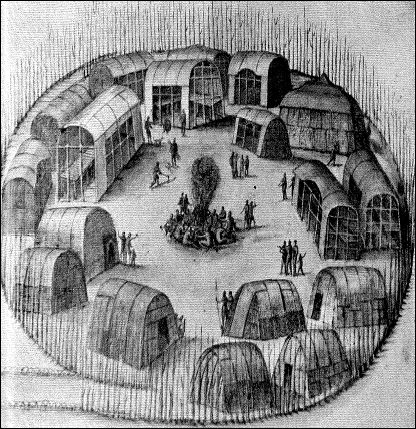
In 1585 John White, painted this Algonquian Pomeioc village, which was built showing community organization and design, surrounded by a defense palisade.
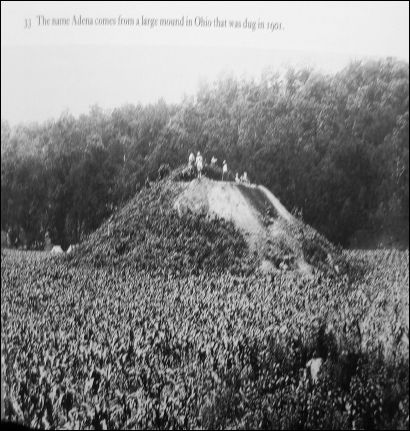
A 1901 excavation of an Adena Mound, located in the State of Ohio.
_______________________
420 Phil Longman; The Empty Cradle; and Interview for the Documentary: Demographic Winter the Decline of the Human Family
421 Rick Stout: Director and Co-Producer of Demographic Winter the Decline of the Human Family, and The New Economic Reality Demographic Winter: from film interview.
422 Coffman, Rescuing, 122.
423 Steven C. Rockefeller and John C. Elder, Spirit and Nature, Why the Environment a Religious Issue, (Boston: Beacon, 1992, 134); Coffman 124
424 See: Coffman, Rescuing, 122.
425 Report of Habitat: United Nations Conference on Human Settlements, Chapter, 11D, Preamble. Vancouver May 31 to June 11, 1976. http:freedom.org/reports/human-settlements/land.html
426 Bible, King James Version. Genesis 1:26
427 deBuys, editor of Powell’s book, Seeing Things Whole, 21