
Chapter 6

It was a misty cool morning as our touring bus arrived at one of the Hopewell Culture National Park sites located in Ross County, Ohio. Our group consisted of our film production team and a group of researchers and scholars, who were sharing their findings and knowledge of the ancient mound-building cultures of North America, and assisting in the production of the documentary, “The Lost Civilizations of North America”. We had arrived on a beautiful spring morning as the mist was still rising off the field of mounds that dotted the landscape. As I strolled down the trail, the sun was starting to peek through the clouds as I was trying to visualize these ancient people laboring to build these eclectic structures. I wondered what motivation would they have had to undertake such a herculean task when it struck me that without these mounds rising above the natural landscape, we might never have known, that these ancient cultures ever existed there.
After contemplating the magnitude of the effort expended and the structural organization required, I began to wonder why so little is known about these innovative and advanced ancient cultures that once thrived on this continent and then mysteriously disappeared. Why do we not find more information regarding the heritage of these ancient Indian cultures in our early American history books? Is there more we could have learned from them?
While visiting the Mound City National Park Visitor Center in Ross County Ohio, I pulled out some of the survey maps from the first publication of the Smithsonian Institution, the survey report by E. G. Squier and Edwin Davis. In the mid-1800s, these two men were commissioned by the fledgling Smithsonian Institution to do a detailed survey of Mound-Builder structures in the Mississippi River valley. Their survey was the first and only exhaustive recording of what existed of these ancient North American structures. Some have been destroyed, this being our only record.
In comparing the Squier and Davis maps with what I was seeing, I asked the park administrator what had happened to other mounds and earthwork structures that had been surveyed. I was told that many of the earthworks, which had been surveyed by Squier and Davis in the mid-1800s, had been lost to farmers clearing their fields, or to government infrastructure constructions.

Ancient Monuments of the Mississippi Valley, 1848, Squier and Davis, Plate XXXIV
One earthwork structure in particular caught our eye; it has been referred to as the Hebrew Earthworks of Milford, Ohio. This giant earthwork was shaped into what looks like an old Hebrew oil lamp along with other recognizable Hebrew symbols as described in the Squier and Davis report. When we inquired about what had happened to these ancient earth works, the reply received was that the Army Corps of Engineers, as part of a government work projects, cleared the land of these earthwork structures. Regardless of whether or not this unconfirmed reference to such an order was true, the idea that they had not been valued enough to be preserved has led us on a very interesting journey. We have asked questions about how such wanton destruction of tens of thousands of artifacts, mounds and earthwork structures could have taken place. Was it due to any political intent, malice or prejudice? If so, who was in a position of power within the government at the time to give such an order?
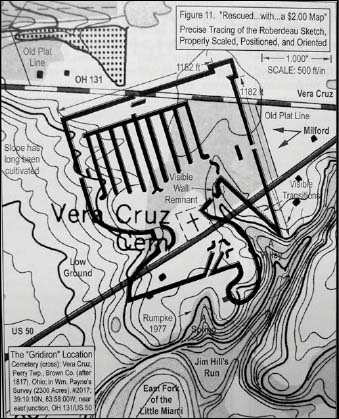
Ancient works located in Milford Ohio
In researching the histories, we found a group of men in the 1800’s who were most closely associated with the exploration of the mounds. Men, who would be in a position of power to exert influence over how the artifacts would be valued, viewed and defined. These same men came together to form a sub-set of the American Association for the Advancement of Science (AAAS). Lewis Henry Morgan, a man who would later be referred to as the American Father of Anthropology along with Powell would wield great influence. Powell as a Major in the Army Corps of Engineers, and as director of the Bureau of Ethnology27 at the Smithsonian, along with those positions Powell would go on to become the director over Mound Building Exploration; with his most influential position as the director over the U.S. Geological Survey Department.
Prior to going east to Virginia to become the first director of the newly formed Bureau of Ethnology John Wesley Powell made a name for himself as the mighty explorer of the Colorado basin. Powell would take an interest in the works of Lewis Henry Morgan and in assisting him in advancing within the sciences of America what Morgan had witnessed had taken place in the science communities of England. He came to understand that science organizations could be created, and used, to address many political and social issues. On August 23, 1876 Lewis Henry Morgan and Frederic Ward Putnam convened a meeting in Buffalo, New York to organize a subset of the American Association for the Advancement of Science, John Wesley later join them and would later go on to follow his associate, Lewis Henry Morgan as president of that organization.28

John Wesley Powell
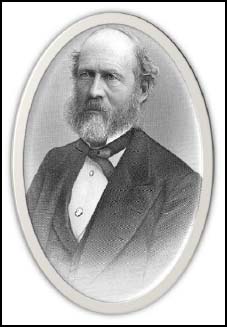
Lewis Henry Morgan
_______________________
27 The Smithsonian Institution’s Bureau of Ethnology was established in 1879. Later called the Bureau of American Ethnology (1897), it was merged (1965) with the Smithsonian’s Department of Anthropology. Throughout this volume it will be referred to as the Bureau of Ethnology
28 See Lewis Henry Morgan et al. To the Ethnologists, Archaeologist and Philologist of America, Printed Circular, n.p. 1876, Brinkerhoff Papers, notes, America Naturalist 9, 10 (Nov. 1876) 694.