
CHAPTER 7

In 1848, the newly-formed Smithsonian Institution—created by an unexpected bequest from a wealthy Englishman to the United States government in the amount of half a million dollars—issued its first publication. That publication was intended to legitimize the Institution’s existence, direction, and value to Congress and to the scientific community. The publication was Ancient Monuments of the Mississippi Valley, which documented the surveys of the ancient Mound Builders’ earthworks, by Ephraim Squier and Edwin Davis.
For the republication of this monumental work on its 150th anniversary in 1998, Dr. David J. Meltzer, Henderson-Morrison professor of Prehistory at Southern Methodist University, and Director of the QUEST Archaeological Research Program, wrote in the introduction:
Ancient Monuments of the Mississippi Valley, by Ephraim Squier and Edwin Davis was the first publication ever issued by the Smithsonian Institution, in any subject. As such, much was riding on it. The fledgling institution’s first publication, in 1848, would send a clear signal to Congress, the scientific community (here and abroad), and especially the Smithsonian’s Board of Regents, all of whom were watching closely to see how Joseph Henry (the institution’s first secretary) would choose to interpret James Smithson’s generous but “enigmatic behest” that the institution he endowed have as its object ‘the increase and diffusion of knowledge.’
On Ancient Monuments, Henry (1797-1878) had staked his vision for the Smithsonian’s future, for that book would, inevitably, set a scholarly and scientific precedent for the institution, launch its Contributions to Knowledge series, and thus help (or hinder) his efforts to establish the Smithsonian’s credibility on the national and international scientific scene. Ancient Monuments would also be the first major work in the still-undisciplined disciplines of anthropology and archeology, and thus unavoidably landmarks in those fields—and, for that matter, in American science in general (which was then often viewed as the poor stepchild of European science). All of this was riding on a book devoted to the questions of the origin, antiquity, and identity of the [Mound Builders].29
Ancient Monuments of the Mississippi Valley is a volume of descriptions and surveys of artifacts of the ancient mound-building cultures of North America. The report describes hundreds of mounds, earthwork structures, roads, fortifications, ceremonial and burial sites, and gives tangible evidence of advanced civilizations in North America, prior to the voyage of Columbus. The study focuses primarily on the ancient Adena and Hopewell cultures, which approximately date from 1000 BCE to 400 CE. Further to the south, in the lower Mississippi Valley, dwelt other populations of Mound Builders. These cities were populated until well after 1200 CE.
In 1847, Squier and Davis turned their report over to the Smithsonian and, after an almost yearlong review of the book, it was published in 1848. In the words of Robert Silverberg, using a metaphor from a sport that was just then becoming popular,30 Squier (who did most of the writing) had “hit a home run.” The work “instantly established itself as a work of commanding importance in American archaeology. As a summary of knowledge in its particular field at that time, it was remarkable; as a model for later work, it was invaluable; as a detailed record of the Ohio mounds as they appeared in 1847, it was and still is unique.”31
Praise poured in, even from abroad. The scientific spirit of the work impressed Swiss archaeologist Aime Nicolas Morot, who credited its authors with discovering the Copper Age in America and calling the report as glorious a monument to American science as Bunker Hill is to American bravery.32 The German naturalist and world traveler Baron Alexander Von Humboldt, perhaps the most respected scientist of his day, reportedly called the book “the most valuable contribution ever made to the archaeology and ethnology of America.”33 For the next four decades, the report would constitute the definitive word on the mounds and the Mound Builders.
So who was the man who had created such a monumental report? Ephraim George Squier was born in Bethlehem, New York in 1821 to a religious family, a son of a Methodist minister who had preached from many of the pulpits of western New York. Young Ephraim worked on a farm while attending and teaching school. His studies focused on engineering, but he pursued a career in literature and journalism. His real passion, however, was his interest in the ancient American mounds and earthworks, which were attracting much interest at the time.

E. G. Squier
While working as a journalist, he found time to pursue this passion, which would soon consume his time and talents as he ventured out to explore and research the ancient mound-building cultures. His 1848 report, Ancient Monuments of the Mississippi Valley,would bring him worldwide acclaim, winning him a medal from the French Geographical Society, which would help him in becoming a U.S. diplomat.
The multitalented Squier would serve as special chargé d’affaires to Central America (where he negotiated treaties with several countries), as U.S. commissioner to Peru (where he studied the Inca ruins), and as consul-general of Honduras in New York. He would also become editor-in-chief of a publishing house and the first president of the Anthropological Institute of New York.
However, in later life his fame and prestige would begin to unravel as he experienced increased criticism of his work. There were men in the scientific community who were questioning his findings and his interpretation of the thousands of artifacts that he, and others, had recovered from the mounds. His life would become marred by tragedy and his relationship with one-time friend and collaborator, Edwin Davis, was severed along with that of his wife, who would divorce him in 1873.
Meltzer, working on the 1998 republication of Ancient Monuments of the Mississippi Valley, explained that with Squier’s exuberance and accomplishments also came unusual personal challenges:
Ephraim Squier…aggressively sought fame, occasionally found notoriety, led a peripatetic life of hard work, travel, and writing—including an extensive correspondence with scholars, scientists, and politicians in this country, Latin America, and Europe—and had highly productive careers in archaeology and journalism, with brief stints in state and national politics. During his productive lifetime, he published nearly a dozen books, many more articles, and countless newspaper pieces. He was honored by learned societies here and abroad, and he represented the United States in archaeological and diplomatic circles. He was lively, energetic and flamboyant at some times, grievously insensitive at others, and as a contemporary recorded, ‘one of the most audacious spirits I have known.34
In the early 1870s, after his personal life took a series of bizarre and sordid turns, his life really began to fall apart as his volatile emotions began to spill over into deep mental illness. “On the advice of a neurologist, a New York Supreme Court Justice ordered that Squier be placed in an insane asylum, where he spent most of the last fourteen years of his life.”35 Such was the sad end of an unusually productive life spurred on by ambition and marred by personal weakness. Biographer Terry A. Barnhart gave this insight into Squier’s life:
Squier’s life was fuller and more celebrated than most, and the force of his personality left an indelible impression on those who knew him. He was vain and ambitious and seldom brooked a rival, but his many friends valued his gregariousness, wit, and charm. He made several enemies in life but far more friends… Squier’s motto; “Ten to One the Feather Beats the Iron,” reflects the literary ambitions and love of writing that sustained him from age nineteen onward as an extraordinarily gifted and prolific writer.36
Of all his writings, the one for which he is most remembered was the one that brought fame to himself and to the Smithsonian--Ancient Monuments of the Mississippi Valley. The lengthy report, notable for its systematic approach to analysis and documentation, contains meticulous descriptions of the sites surveyed, many of which were, Squier concluded, religious centers. Others were forts, whose designs instill in observers the conviction that the race by which these works were erected possessed no inconsiderable knowledge of the science of defense. It was a degree of knowledge much superior to that known to have been possessed, by the hunter tribes of North America previous to the discovery by Columbus.
Included with the descriptions are numerous charts, diagrams, and drawings, some of which are still used to guide visitors to the surviving mounds, earthworks and fortifications of America’s heartland.
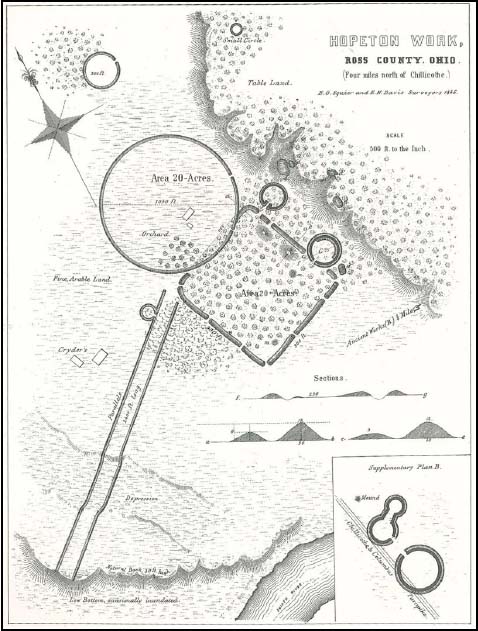
Ancient Monuments of the Mississippi Valley, 1848, Squier and Davis, Plate XVII
Squier marveled at the sheer size of some of the earthworks, whose magnitude “is difficult to comprehend.” Likewise amazing to him was the uncanny precision with which the mounds had been laid out. The Builders possessed a standard of measurement and had some means of determining angles. The most skillful engineer of the day would find it difficult, without the aid of instruments, to lay down an accurate square of the great dimensions of [the mounds]… “But we not only find accurate squares and perfect circles, but also, as we have seen, octagons of great dimensions.”37
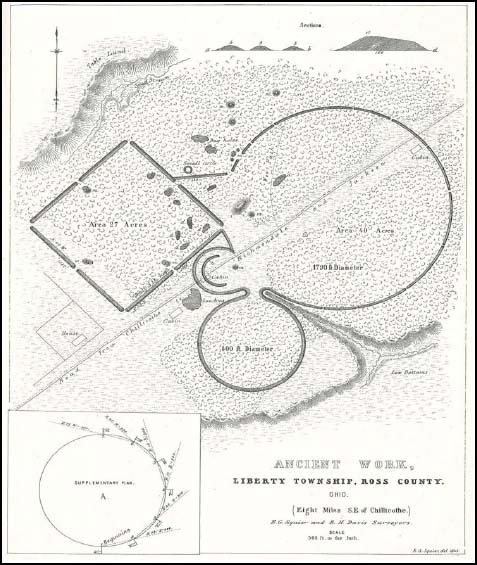
Ancient Monuments of the Mississippi Valley, 1848, Squier and Davis, Plate XX
One of the most original contributions in Squier’s report was an analysis of various styles of art found among the artifacts, such as animal sculptures, pottery, metal implements, ornaments, and weaponry as aptly summarized by Silverberg.
With many fine woodcuts Squier depicts the copper axes, bracelets, and spear points from the mounds; he shows finely wrought weapon points of chipped stone, some so delicate that they must have been purely ornamental pieces; he illustrates the grooved axes of stone, and celts, or polished grooveless hand axes. He shows the odd, attractive stone implements called bannerstones, which he believes might have been the heads of ceremonial hatchets”… In addition to these everyday objects, Squier presented “a large class of remains, comprising sculptural tablets, and heads and figures of animals, which belongs to a higher grade of art. Many of these exhibit a close observance of nature and a minute attention to details, such as we could only expect to find among a people considerably advanced in the minor arts.38
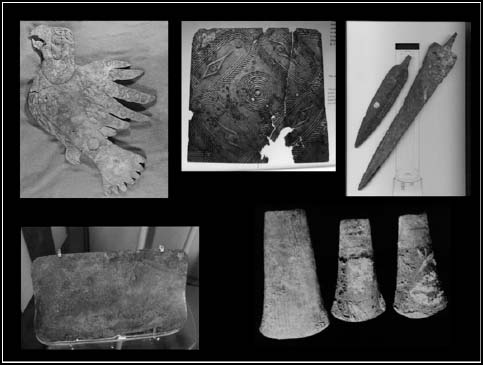
Metal and Stone Artifacts
To Squier’s credit, for all of his extensive research and considered conclusions, he did not pretend to be the last word, looking forward to and even inviting further exploration. In his “Concluding Observations,” he stopped short of opining on the origin of the builders or why they finally disappeared, while simultaneously acknowledging that the subject was of considerable interest and importance. His final statement exudes excitement that further and more extended investigations could shed light on yet-to-be-answered “interesting questions connected with the extinct race, whose name is lost to tradition itself, and whose very existence is left to the sole and silent attestation of the rude but often imposing monuments which throng the valleys of the West.”39
Squier’s study on the Mound Builders was a major leap forward, while looking ahead to yet further advancement that could shed light on what he concluded must have been a highly advanced civilization. Had George Washington still been alive, he would certainly—in his own words referring to “any clue which can lead to a knowledge of these” Mound Builders—have “gratefully received” this new report. Exploring the history of the former civilizations that once occupied this land would be, in Washington’s estimation, “very valuable and may lead to some useful discoveries.”40
This recovered history—a key component of what Alice Beck Kehoe refers to as America’s “larger history,”41 would have been important to America’s Founding Fathers, whose own grasp of history continues to amaze modern historians. “Rarely,” notes James MacGregor Burns, “ …has a generation of activists been so thoroughly schooled in classical political thought…. For them the works of the Greeks and Romans constituted neither dead languages nor dead learning. Many read Montesquieu in his own language. They liked to cite the great English thinkers–Hobbes and Locke and Hume–against English rule itself.42”
Being thus “deeply read in the facts of history,” J. Reuben Clark, Jr. stated that the Founders were intellectually “at home in Rome, in Athens, in Paris, and in London.”43 Such insights into history were by no means peripheral to what the Founders accomplished and what they were convinced future Americans must do to preserve the newly created Republic. “If a nation expects,” wrote Jefferson, “to be ignorant and free, in a state of civilization, it expects what never was and never will be.”44
This was particularly true, he insisted, of the nascent American republic. “I know of no safe repository of the ultimate powers of society but the people themselves; and if we think them not enlightened enough to exercise control with a wholesome discretion, the remedy is not to take it from them, but to inform their discretion by education.”45
Nor was the survival of the Republic, bequeathed by the Founders, a foregone conclusion. When asked at the close of the Constitutional Convention what kind of government had been created, Franklin replied simply, “A republic, if you can keep it.”46 Surely, knowledge of former American civilizations, of both their greatness and their demise, would have been considered by the Founders an essential part of the history that could benefit Americans as they sought to keep their own society from a similar fate. Strikingly, it is the very point made by Roger Kennedy at the end ofHidden Cities: “The Hopewell were in advance of us in many ways; they understood the importance of maintaining a respectful relationship with the cosmos. But for them…matters went awry, something we are beginning to understand with our advanced means of measuring the effects of failure.”47
_______________________
29 Ephraim G. Squier and Edwin H. Davis, David J. Meltzer editor, Ancient Monuments of the Mississippi Valley: Washington, DC: Smithsonian Institution Press 1998, 1
30 Baseball as we know it, began with the game between the “New York Nine” defeating the Knickerbockers in Hoboken, New Jersey, on June 19, 1846. The game mercifully lasted only four innings with the nine prevailing 23-1.
31 Silverberg, The Mound Builders, 84.
32 See: Barnart 100: Ref. A. Morlot, On the Copper Age in the United States, Proceeding of the American Philosophical Society 9, Nov. 1862: 111, 114
33 Ibid. 100: Reference quoted in Seitz, Letters from Parkman to Squier, 12
34 Squier and Davis, 4.
35 Ibid.
36 Terry A. Barnhart, Ephraim George Squier and the Development of American Anthropology (Lincoln, NE: University of Nebraska Press, 2005) 331-332.
37 See Silverberg 88: ref. Squier and Davis, 1848 Report, 16
38 Silverberg. The Mound Builders, 93-94.
39 Squier and Davis, 301-306.
40 Kennedy, Hidden Cities: 246.
41 Kehoe, 1.
42 James MacGregor Burns, The Vineyard of Liberty (New York: Alfred A. Knopf, 1981) 28.
43 J. Reuben Clark, Stand Fast by Our Constitution (Salt Lake City: Deseret Book Company, 1962) 397.
44 Robert A. Marshall, quoted in, The Story of Our Schools: A Short History of Public Education in the United States (Silver Spring, Maryland: The National Council for the Social Studies, 1962) 10
45 Peter Levine, quoted The Future of Democracy: Developing the Next Generation of American Citizens (Lebanon, New Hampshire: Tufts University Press, 2007) 54.
46 Earl Warren, quoted in A Republic, If You Can Keep It (New York: Quadrangle Books, 1972) 11.
47 Kennedy, 287.