
Preface
This book is about the making of the film Tombstone, told in the words of those who were there. It is not supposed to be a detailed historical summation of what actually transpired in history; I suggest that those who are interested in an analysis of the story, browse through the bibliography section of this book. Authors Casey Tefertiller, Gary Roberts, Ben Traywick, Victoria Wilcox, Mary Dora Russell, Jeff Guinn, Paula Mitchell Marks, Bob Boze Bell and many others who are much more astute, informed and articulate than I, have delved into this story’s minutiae. I have a very close friend who, when asked what time it is, will tell you how to build a watch. And that’s great! For those who love history, that’s the level of detail they desire. But for the casual fan, I instead chose to summarize the actual story and put it into some sort of historical context.
Tombstone is a classic tale of the Old West told in black and white and shades of gray. It is set in 1881 Arizona where former lawman Wyatt Earp, joined by his brothers and Doc Holliday, seek their fortune in a lawless silver-mining town. Their efforts are soon thwarted by a renegade band of outlaws know as “The Cowboys,” who resent and resist any form of control. Forced to take matters into their own hands after the local sheriff is murdered, the Earps once again pin on badges and attempt to bring law and order to Tombstone. However, once one brother is ambushed and another murdered after the gunfight at the O.K. Corral, Wyatt forms a vigilante posse and vows to eliminate the outlaws.
It should come as no surprise that Tombstone itself is not 100 percent historically accurate because, after all, it’s entertainment! Some events and the sequences in which they occurred have been condensed and modified for purposes of presentation. Historically, for example, Wyatt, Virgil and Morgan Earp did not accompany their “wives” to Tombstone. Rather, it was just Wyatt, James and Virgil; Morgan and Warren arrived later. Also, Wyatt and Virgil didn’t take Morgan’s coffin to Tucson, James did. Wyatt and his posse accompanied Virgil and Allie several days later. Similarly, Morgan and Virgil were not both attacked on the same night. And the list goes on and on. But for entertainment purposes, it’s not that important, for a very simple reason: They only had two hours to tell a story.
Nor is this a book about why certain characters recite specific lines, how they react to others in a particular scene, or what their psychological makeup is vis-à-vis the surrounding environment. Again, there are a plethora of books out there that discuss film theory, scene development and the role of the auteur. This book addresses none of that but rather, how the film was actually made.
As readers are no doubt aware, films are not usually shot in sequential order. Actor availability, weather, soundstage vs. locations, interior vs. exteriors shots, day vs. night and numerous other factors determine when a specific scene is filmed. To add to that complexity, there were two directors on Tombstone, Kevin Jarre and George Cosmatos, and the latter decided to use hardly any of the former’s footage. Thus many scenes were filmed a second time. Dialogue was changed and, in some cases, a particular scene might have been filmed several times in different locations. Mid–1993 saw the Arizona production crew start filming on the Babocomari Ranch, move to Old Tucson Studios, then to Mescal, back to Old Tucson, and end up back at the Babocomari—and that was just the first unit. Throw in Mt. Lemon, Sabino Canyon and Douglas Dry Lake and, well, one can see just how difficult it was to detail what was what. As I have tried to determine day by day what occurred when, this also complicated matters, and the lack of a final shooting schedule only further exacerbated the situation. I have tried to put the shooting schedule in the proper order; any errors of date and content, while inadvertent, are solely mine.
This book is neither a tabloid-type exposé, nor an uber-fan hearts-and-flowers tribute. Rather, it’s simply the story of how the movie was made as told to me. After the passage of so many years, it makes little sense to try and sully a person’s reputation, although I have to admit in some instances some of the people in this book may not be presented in the most positive light. In many cases, I have been told the same story from several different people, so, even if the stories aren’t true, maybe they should be, because they’re funnier than hell.
There are those—and I am one—who love to pick out a film’s inconsistencies and continuity errors. Not because I’m a perfectionist (which I am), but because I love films. You’ll find many of those “errors” in the pages of this book.
So sit back, pour yourself some Red Eye and, if you love this film as much as I do, you should enjoy this book!
“The researches of many commentators have already thrown much darkness on this subject, and it is probable that, if they continue, we shall soon know nothing at all about it.”—Mark Twain
Wednesday, October 26, 1881. Tombstone, Arizona Territory. Four men—three peace officers and a deputized gambler-cum-dentist—walked defiantly up Fourth Street toward Fremont and a date with destiny. Awaiting them in a small lot next to the Fly house behind the O.K. Corral were two sets of brothers and two other individuals, collectively known as Cowboys. Little did any one of them realize that three of these outlaws would never see another sunrise.
Cowboys (or cow-boys as they were then derisively known) were little more than cattle rustlers and assorted lawbreakers … a loose collection of semi-organized thieves. Robbing a stage or disturbing the peace were the types of activities in which they engaged. The tools of their trade: fear, intimidation and the frequent use of a six-gun. They resented any infringement of their personal freedom and generally were highly prejudiced against Mexicans. To them, stealing cattle south of the border and then selling them in southeast Arizona to local butchers, restaurants and even the military was not only proper, it was their birthright. The Tucson Citizen newspaper minced few words: “The cowboy is a name which has ceased in this Territory to be a term applied to cattle herders. The term is applied to thieves, robbers, cut-throats and the lawless class of the community generally. When a man follows as a legitimate occupation the tending of cattle or other stock he is called a herder and not a cowboy.” The San Francisco Exchange told its readers, “Cowboys [are] the most reckless class of outlaws in that wild country. The cowboy is infinitely worse than the ordinary robber, who generally spares life if he can get money, in that he is utterly reckless of human life. He cares even less for it than money. He glories in being regarded a terror. He rarely cares to steal anything but cattle, but in the company of human beings his revolver is ever brandished, and on the slightest pretext, or fancied pretext, he sends a bullet into a victim’s heart with as little compunction as he would kill a dog. He is worse than the Indians, in that he associates with whites and performs his reckless deeds amid peaceful surroundings.” According to the detailed diary of George Parson, an early Tombstone resident and member of the Committee of Vigilance, “A cowboy is a rustler at times, and a rustler is a synonym for desperado—bandit, outlaw, and horse thief.”1
Peace officers—whether they were U.S. marshals representing the laws of the federal government, local sheriffs protecting the rights of Tombstone’s 2,100 citizens, or Cochise County sheriffs who collected taxes from the mines and railroads—were obligated to follow the law, no matter what. Town ordinance No. 9, published effective April 14, 1880, spelled it out:
Be it ordained by the Common Council of the Village of Tombstone:
Sec. 1: That it shall be unlawful for any person not an officer of the law to have or carry in the Village of Tombstone any fire-arms, knife or other dangerous weapon without a written permit from the Mayor, and anyone violating this provision shall be fined in the sum not to exceed fifty dollars ($50), or to be confined in the village jail for thirty days, or both, in the discretion of the court.
Sec. 2: When travelers, prospectors, miners, or other strangers not resident of the Village of Tombstone enter the limits of the same with any dangerous weapon upon or about their person, it shall be the duty of the Village Marshal to notify them of this ordinance and request them to dispense with those weapons, and if any one so requested neglect to refuse to comply with the same, he shall be deemed guilty of a violation of this ordinance.
This ordinance shall take effect and be in force from and after its passage and publication according to law. Passed by the Common Council of the Village of Tombstone, April 12, a.d. 1880.
This ordinance was revised on April 19, 1881:
Section 1: It is hereby declared unlawful to carry in the hand or upon the person or otherwise any deadly weapon within the limits of said city of Tombstone, without first obtaining a permit in writing.
Section 2: This prohibition does not extend to persons immediately leaving or entering the city, who, with good faith, and within reasonable time are proceeding to deposit, or take from the place of deposit such deadly weapon.
Section 3: All fire-arms of every description, and bowie knives and dirks, are included within the prohibition of this ordinance.2
The five Cowboys waiting next to the Fry house were said to be carrying the aforementioned “fire-arms” within the Tombstone city limits, had not obtained permits to do so, and were loitering on a vacant lot with little intention to leave the city. The peace officers knew this and were obligated to relieve the cowboys of their weapons.
Conflict was inevitable.
Tuesday, March 23, 1993. Hollywood, California. The Midwestern-born, 38-year-old screenwriter had finally completed the fourth revision of his proposed script. After almost 11 months, the first draft had been completed. Later that year, he’d finished the second revision, but it then took another five months before the third revision was wrapped up. The cuts had varied—a tweak here, elimination of a scene there, anything that didn’t move the story forward, scenes that didn’t have any relevance to the new draft. Character biographies were developed, backstories created. The basic premise of good vs. evil was well-developed, augmented with character development, strong motivation and a solid story structure. One hundred fifty-two solid scenes.
The writer knew his craft; years earlier he had written a screenplay for a film that won three Academy Awards. The New York Times had praised it as a “good, lean screenplay.” But this time, not only would he write the script, he’d also be the director. This newest work impressed one former child actor (Kurt Russell) in particular: “[This] screenplay was really the first time anyone has tried to present Wyatt Earp in his entirety. I mean, all of him: his relationship with his brothers, with his first wife, how he took up with Josephine Marcus, the traveling actress that he ended up spending nearly half a century with. You could see the dark side of the man. This [script] is one brilliantly conceived piece…. [It] offers drama, comedy, action [and] romance, not only seen through the shots but told through the characters. There are some tough characterizations that have not been backed away from by anyone. [The writer’s] understanding of the time period is remarkable.”
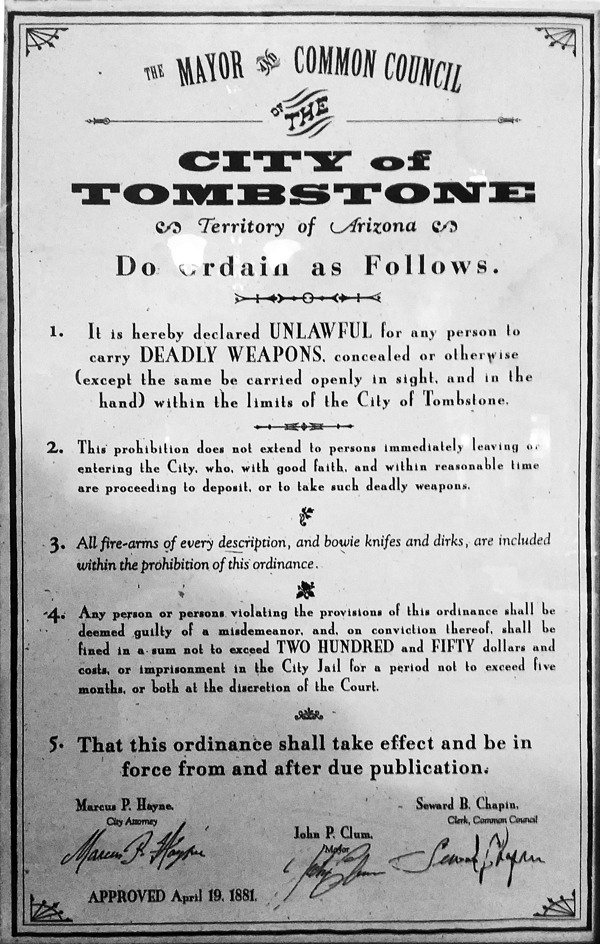
Framed Tombstone gun ordinance posted outside the Mescal set’s Sheriff’s office (courtesy Jerry Crandall).
Little did said writer realize he would develop just a handful of additional screenplays before his death.3