
ONE
In 1877, Pennsylvania-born Edward Lawrence Schieffelin, 29-year-old former U.S. Army scout, began his search for silver ore samples in a desolate and barren area east of the San Pedro River in southeast Arizona Territory. In 1876, he was described by David P. Lansing of Phoenix, Arizona, as “about the queerest specimen of human flesh I ever saw. He was six foot, two inches, and had black hair that hung several inches below his shoulders and a beard that had not been trimmed or combed for so long a time that it was a mass of unkempt knots and mats. He wore clothing pierced and patched from deerskins, corduroy and flannel, and his hat was originally a slouch hat that had been pierced with rabbit skin until very little of the original felt remained. I have never known a prospector more confident of finding a big mining proposition than he was, yet he told me that he has prospected a good part of 11 years with no results, while he had a frightening tough time of it. He was then 27 but he looked like 40.”1
Prospecting in the 20-mile-wide valley at the base of the Huachuca and Dragoon mountains as well as the Mule and Whetstones, just 15 miles north of the Mexican border, was dangerous work for several reasons besides merely being the homeland of Geronimo and the Chiricahua Apaches. With little shelter from the elements, parts of the area were treeless. Opportunities for death were endless—excessive heat, wind, dust, starvation, disease, attack by wild animals, poisonous snakes, Indians … and other prospectors. When fellow army scout Al Sieber heard what Schieffelin was doing, he cautioned his friend, “The only rock you will find out there will be your own tombstone.” Others seconded that opinion: “Better take your coffin with you; you will find your tombstone there, and nothing else.” And still others cautioned, “If you are determined to go, take along a chisel with you and when you get lost among the hills and come to die, chip your name on a stone and we’ll stumble across it someday and put up a tombstone for you there.”
But Schieffelin was nothing if not persistent. He had tried his luck in Coeur d’Alene, Idaho, after silver was discovered there when he was only 12. Then in 1869, he left his home in Oregon and traveled to Surprise Valley and Owens River in California, up to the Great Salt Lake, down to Death Valley, then on to Idaho, always looking for the next big strike. Nevada, Colorado and New Mexico and on and on, with nothing to show for his efforts. In January of ’77, he even tried prospecting the Grand Canyon, but decided the “sedimentary strata and barren schists was enough to convince him to look elsewhere.” When he wasn’t allowed to purchase necessary supplies on credit from the Tucson freight and mercantile operation of Tully & Ochoa, he told a friend, “I am going back [to the San Pedro Valley]. It does not matter to me what these fellows say… I have seen enough to show me that there are mines there.”2
Schieffelin’s interest was understandable. In 1860, Prussian mining engineer Frederick Brunckow had discovered silver near the San Pedro River. Shortly thereafter, he built a cabin along its bank and began mining operations, but he and three other miners were murdered before they could take advantage of the find. It was a cursed site: “[Thirteen] more men were supposed to have been killed at the Brunckow Mine either in quarrels for possession of it or the ever lurking Apaches caught them with their heads in the hole.” However, given the previous mining operations activity, Schieffelin felt there might be opportunity there so he set up operations in the old Brunckow cabin. Months went by with little to show for his efforts. But he found enough evidence of silver deposits to convince him that he wasn’t on a wild goose chase this time. Covered by earth and vegetation, pockets of ore would have to be dug for or found in gullies that may contain “float,” miles away from the mother lode. (Float is debris from an orebody washed downhill and found on the surface of the ground.)
Finally, on August 1, after several months of strenuous effort, he discovered silver ore in a dry wash on a high plateau called Goose Flats. “The [silver] ledges in [the area] were pretty hard to find,” said Schieffelin. “They did not crop boldly out of the ground. All that summer I did not find anything of great importance; I found some good ores and good float and found several croppings. I found enough, however, to satisfy myself that there were good ores there, or ought to be.” Although his ore samples didn’t really impress anyone, on September 3, 1877, a claim was recorded in Tucson by Schieffelin’s fellow prospector William Griffith; it was named Tombstone. (Griffith was one of the men who earlier had employed Schieffelin to stand guard at the Brunckow Mine.)3
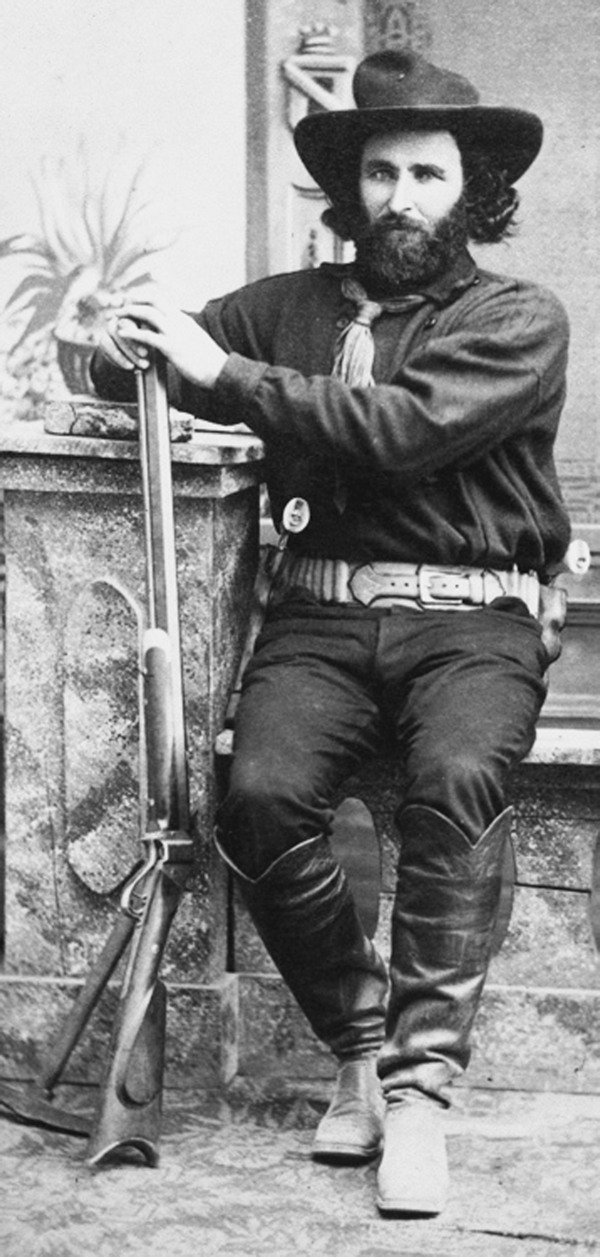
Ed Schieffelin, long-haired and blue-eyed, was 29 when he discovered silver in Arizona. He named his first two claims “Graveyard” and “Tombstone.” His usual appearance included a red flannel shirt and deerskin and corduroy work clothes. This photograph was taken in later years (sometime in the last two decades of the nineteenth century) when Schieffelin was flush with money.
Despite being told his three samples were worthless, Schieffelin still sought out an assessor to evaluate the ore, and was told yet again that it was valueless. Schieffelin’s brother Al eventually contacted Richard Gird, company assayer at McCracken Mines where both brothers worked, and requested an evaluation. Imagine their surprise when the samples were valued at $40 per ton, $600 per ton and $2,000 per ton! After looking at the first two samples, Gird supposedly said, “The best thing you can do is find out where that ore came from, and take me with you and start for the place.” Gird, Al and Ed immediately formed a partnership and, five months later, went back to Brunckow’s cabin to continue prospecting. During the next five months, the trio discovered and filed 16 additional claims. Ed made his biggest strike, a silver vein so rich he would press a coin into it and leave an exact imprint. He later estimated the vein’s dimensions at 50 feet long and 12 inches wide. Gird assayed the sample from this location at $15,000 to the ton, and said, “Ed, you lucky cuss—you have hit it.” Appropriately, the mine was called the Lucky Cuss. Schieffelin later discovered the Tough Nut claim, so named as it took him several days to determine its exact dimensions. On April 5, 1878, the trio submitted bylaws to the Pima County recorder for the establishment of the Tombstone Mining District in the San Pedro Valley. Other prospectors quickly heard about this success and started prospecting for themselves. Wrote John Myers Myers, “Those were two of the three [largest] discoveries [in the area]. The third … was found by another party. Hank Williams and John Oliver had moved into the district. Finding Gird on the scene, they made arrangements with him to assay their findings in return for a split in whatever claims they located. When Williams and Oliver did find something big … they forgot about the agreement. Because of the agreement which took place before they got their rights, Gird and the Schieffelins called their share of the claim the Contention. The part Williams and Oliver kept they [named] the Grand Central.”
Gird may have been his own worst enemy: He shared news of his find in a letter to some of his friends in Signal, over 300 miles away. Soon, most of Signal’s population departed for the area. The race was on.4
Oh, no! Not again! It couldn’t happen a second time. But it did. Screenwriter Kevin Jarre saw his project being sidelined by the influence and clout of another Hollywood wheeler-dealer.
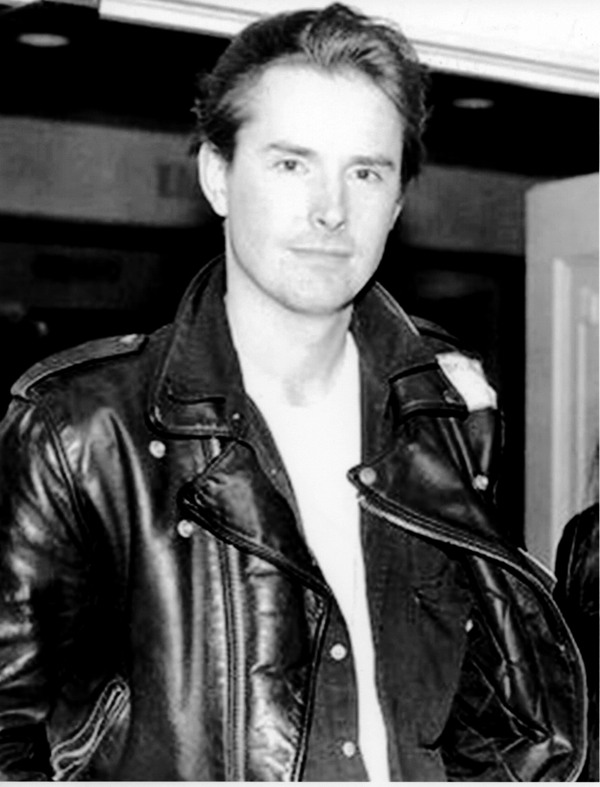
Tombstone’s first screenwriter and director, Kevin Jarre, in his usual black leather jacket.
Jarre was born August 6, 1954, in Grosse Point, Michigan, to actress Laura Devon (aka Mary Lou Briley). He moved with his mother to Los Angeles in the early 1960s as she began to pursue a career in films. After his parents divorced, the boy lived for a time in Wyoming with his father, a “Hemingwayesque [man] who combined ranching and fashion photography.” It was there that Jarre developed his love of horseback riding. But like his mother, he too became involved in the entertainment industry: The young actor landed a small part in the television series Flipper starring Brian Kelly, who was married to Jarre’s mother. Nothing lasts forever; in January 1966, Devon divorced Kelly. She married French composer-conductor Maurice Alexis Jarre on December 30, 1967. His credentials were impressive: The Academy Award–winning maestro was best known for the classic film scores for Lawrence of Arabia, Doctor Zhivago and Ryan’s Daughter, among many others. Maurice soon adopted Kevin and gave him the surname Jarre.
Artistic talent must have run in the family as Kevin eventually became a prolific writer. His first successful effort was in 1985 with the George Cosmatos–directed Rambo: First Blood Part II, screenplay by Sylvester Stallone and James Cameron from a story by Jarre. (Jarre said defensively that almost nothing of his original screenplay was left in the script.) The film won the Golden Raspberry Award for the year’s worst screenplay, but Kevin Jarre continued to write. In 1988, his story The Tracker became a TV movie with Kris Kristofferson.5
During the 1960s, young boys used to play with model cars, rubber toy dinosaurs, cap-guns, electric trains, Play-Doh, Silly Putty and Frisbees, while devouring comic books and collecting baseball cards. They rode their bikes all day, in sunshine and rain, threw footballs and baseballs, and surfed on skateboards. They skated on ice and sledded on snow. Some played with toy soldiers and cowboys and Indians. Others, at least those who could afford them, had knights and horses made from lead. But not everyone. In 1961, the country began to celebrate the centennial of the nation’s Civil War. Books were written, celebrations were held, re-enactments took place and monuments were raised. Kevin Jarre missed little of this. Steeped in American history anyway, he was a self-described “Civil War freak” who had received toy soldiers depicting that era as a Christmas present. Thus began his lifelong fascination with the War Between the States—its successes and failures, triumphs and tragedies. Dedication and sacrifice. Freedom and emancipation. Jarre would use this interest and passion to develop his next screenplay, one that would result in three Academy Awards.6
In 1986, Jarre was in Saratoga for the summer season of the New York City Ballet. Long-time friend Lincoln Kirstein saw a snapshot of Jarre on horseback and was struck by his friend’s resemblance to the Augustus Saint-Gaudens equestrian statue of Col. Robert Gould Shaw, white commander of the all-black 54th Massachusetts Infantry regiment during the Civil War. The statue honoring the regiment had been paid for by public donations and erected opposite the Massachusetts State House in 1897. Stories differ on how Jarre became interested in this unique regiment. One said that his friend Kirstein later wrote the monograph Lay This Laurel (the title from an Emily Dickinson poem) about the regiment. Others said Jarre was inspired one day as he walked across Boston Common and noticed something unusual about a Civil War memorial that had escaped him in the past. The bronze relief sculpture was a “Memorial to Robert Gould Shaw and the Massachusetts Fifty-Fourth Regiment,” and some of the soldiers represented on it were black. It had never occurred to him that blacks had even fought in that war. No matter what the motivation, Jarre and Kirstein subsequently met at Mother Goldsmith’s restaurant (“a Saratoga tradition since 1939”) and soon discovered this mutual interest.
“I knew about the 54th,” Jarre admitted. “[But] Lincoln’s interest was deeper. It related to his whole philosophy about surrendering yourself to something bigger, some larger cause. [I’d] always wanted to make a movie about the 54th.” Encouraged by their conversation, Kevin began reading everything he could find about Shaw and his regiment. What he discovered amazed him. Once his research was complete, he “moved into Room 421 at the Gramercy Park Hotel in New York, opposite the Players Club, and wrote the script in four weeks, on spec. I never thought I could interest anybody in it. A Civil War epic, about black people? But I’d got really attached to the story. I had to kill everybody off [in it] and I’d end up in tears when I got through writing.” In addition to Kirstein’s monograph, Jarre incorporated into his screenplay material from Peter Burchard’s novel One Gallant Rush and Shaw’s personal letters.7
Using his connections, Kirstein brought Jarre’s finished script to Merchant Ivory Productions, but the film company decided the project was way beyond its ability to produce. Jarre felt that Merchant “couldn’t make head or tail of it.” Undeterred, an agent sent it to director Bruce Beresford, who, along with producer Freddie Fields, took it to Columbia. But there it languished. Jarre’s script was the story of one of the first Union regiments made up entirely of African-American enlisted men, led by white officers and told from Shaw’s point of view. But the project quickly was attacked, both from inside and outside the studio. Jarre heard his work called “racist” and “inaccurate.” And how did Jarre, a white historian, dare to have the audacity to write about black soldiers, complete with inappropriate language and non-stereotypical characterizations? A black historian from the University of Virginia “even denied some of the irrefutable facts about the regiment,” complained Jarre. “I was able to punch holes in his attack.” It didn’t matter. Beresford left the project and it was dying a slow death as it remained in Developmental Hell.
But producer Fields finally stepped in and took it to Tri-Star, which had the courage and vision to bring it to fruition. Edward Zwick was named director. With an all-star cast that included Morgan Freeman, Denzel Washington, Matthew Broderick, Cary Elwes, Raymond St. Jacques and Jane Alexander, how could it fail? It didn’t. Nominated for five Academy Awards in 1990, including Best Actor in a Supporting Role (Washington), Best Art Direction, Best Cinematography (Freddie Francis), Best Film Editing and Best Sound, Glory won three: Supporting Actor, Cinematography and Sound. Jarre had an unbilled part in the film as the soldier who picks a fight with Denzel Washington but later sparks the cheers for the black troops as they move to lead the attack on Fort Wagner when he yells, “Give ’em hell, 54th!” And Elwes (the fictional Cabot Forbes) absolutely loved the script: “Yeah, it is a beautiful story. History was one of my favorite subjects at school. Still is, really, so I am often drawn to historical films and scripts that are sent to me, that have historical value to them. I knew the writer … at least I got to know him … [and] when we met, it was like meeting a kindred spirit. He is an avid historian and his attention to detail is phenomenal.”8
Critics were effusive in their praise. Variety wrote, “A stirring and long overdue tribute to the black soldiers who fought for the Union cause in the Civil War, Glory has the sweep and magnificence of a Tolstoy battle tale or a John Ford saga of American history…. Freddie Francis’ masterful photography, eschewing the sepia haze that too often makes period films seem comfortably distant, plunges the audience into the battles with a vividness that is both spectacular and chilling.” Vincent Canby of the New York Times called it a “beautifully acted, pageantlike movie…. [Broderick] gives his most mature and controlled performance to date…. [Washington is] an actor clearly on his way to a major screen career…. The movie unfolds in a succession of often brilliantly realized vignettes tracing the 54th’s organization, training and first experiences below the Mason-Dixon line.”9
Now on his way, Jarre followed Glory with Navy Seals, starring Charlie Sheen, and producer Larry Gordon acquired two more Jarre scripts, Judgment Night and The Devil’s Own. Because of Jarre’s success with Glory, Universal announced in January 1990 that he was working on another spec script he would also direct. By March 5, 1991, he had finished the first draft of a 113-page, 168-scene screenplay based on Bram Stoker’s Dracula. Jarre sent it to author and cinema historian Philip Riley along with a cover letter. Apparently they had spoken previously as Jarre wrote, “Dear Phillip [sic], Here’s the script as promised. Please look it over and let me know what you think. Call collect if you want to. It was a genuine thrill to speak with you on the phone as I’ve admired your work for a long time. The thoroughness and dedication you bring to your work together with your obvious zest and joy in classic pictures have been a source of inspiration to me. I can’t wait until we meet face-to-face for a Chaney-Dracula consultation. Millionaire stuff, hardly seems like work.”
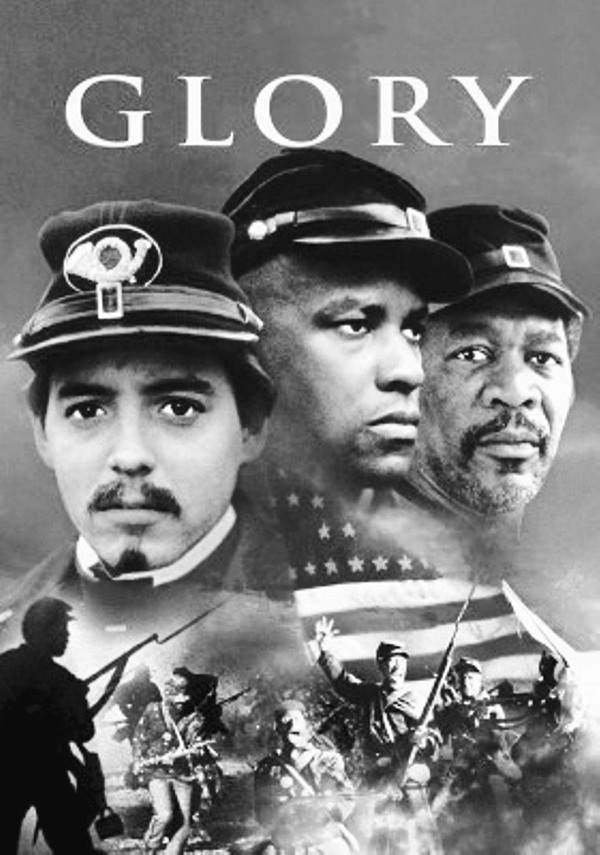
The Academy Award–winning Glory (1989) was nominated in five categories including Best Film Editing and Best Art Direction/Set Direction. It won for Best Sound, Best Cinematography and Best Actor in a Supporting Role (Denzel Washington).
A nice beginning to a tempting project, but unfortunately a common industry roadblock then appeared: another player with the same subject. Originally, Michael Apted was going to direct Stoker’s vampire story as a TV film; actress Winona Ryder’s agent gave her a stack of scripts, one of them entitled Dracula—The Untold Story. And since she’d never before read a Dracula script, she was immediately interested. Thus, after meeting with Francis Ford Coppola to discuss an adaptation of Jack Kerouac’s On the Road, she mentioned the Dracula script in passing. Ryder had previously withdrawn from Coppola’s The Godfather: Part III due to exhaustion and Francis, seeing this as a way to mend fences, so to speak, agreed to make the vampire film. Apted remained on board as the executive producer. Coppola’s screenplay was completed on April 16, just 31 days after Jarre’s. But once Universal learned of the rival version, it shelved Jarre’s project.
Hollywood history is rife with dueling films, or “parallel development,” as it’s known: two motion pictures on the same subject from rival studios. Said former Tri-Star chairman Mike Medavoy, “These races are not always about quality. It’s about getting the first picture out. The first film in the theaters does better at the box office, regardless of quality.” MGM distribution president Larry Gleason agreed: “[T]here’s only one rule to remember when you have competing films in production: Get finished and on screen first. The second film is often artistically superior, but there are very few instances when it out-grosses the first film that goes out in the marketplace.” According to Variety writer John Brodie, “an earnest, well-meaning producer starts developing a tricky, high-concept project that happens to be in the public domain. Soon a rival shop swoops down, produces a knock-off, and takes his chances at the box office with a project based on a lesser script.”
But not always. Witness the case of Harlow. In 1965, Paramount released a color film on the blonde bombshell, produced by Joseph E. Levine and starring Carroll Baker. Meanwhile, producer Bill Sargent and Electronovision, Inc., released a black-and-white Harlow that starred Carol Lynley. The two films opened within weeks of each other to less-than-stellar reactions. Lawsuits and counter-suits flew fast and furious; the only people who made money were the lawyers. Lesson learned? Well, briefly. In 1974, Warner Bros. bought the rights to Richard Martin Stern’s book The Tower, while producer Irwin Allen purchased Thomas Scortia’s and Frank Robinson’s The Glass Inferno for 20th Century–Fox. Rather than produce two competing disaster films, the studios combined forces and jointly released The Towering Inferno, a tremendous success. This proved that studios could go into a partnership and make money. And in 1988, Universal and Warner Bros. agreed to split domestic and foreign receipts on Michael Apted’s Gorillas in the Mist instead of mounting dueling Dian Fossey movies.
Cases of cooperation between studios were few and far between, though. Similar screenplays, hawking a script to several studios, and even industrial espionage produced comparable—and in some cases identical—films being released in the same year: Fail-Safe and Dr. Strangelove (1964), Godspell and Jesus Christ Superstar (1973), The Howling and Wolfen (1981), Day of the Dead and The Return of the Living Dead (1985), The Abyss, Deep Star Six and Leviathan (1989), to name just a few. After all, healthy potential box-office receipts have a way of swaying Hollywood’s most firmly held opinions. But not this time. Universal and Coppola were eyeball to eyeball (on a Dracula film) and the studio blinked.10
The studio still owed Kevin a picture and gave him the option to come up with another project. It was Jarre’s misfortune to actually develop the Dracula film idea, and he was understandably furious at the studio. “Universal didn’t want to race [to bring it to the screen first] and dropped it,” he said. “It was a huge blow.” Others were disappointed as well. According to writer John Fasano, “Kevin Jarre had been screwed on Dracula. He had been working on a very [faithful to the book] script, and somebody mentioned it to Coppola, and they got theirs out first.” Peter Sherayko, fellow actor, film armorer, weapons authority and friend of Jarre, says that Kevin was in Romania and Transylvania scouting locations when he learned that the studio had canceled his Dracula project. “[Kevin] was distraught,” Sherayko recalls. “He paid so much attention to detail, so much attention to [the historical aspects of the story]. That’s why he was over there, to do everything accurately. In my opinion, Kevin was destroyed. He disappeared from us, did not see us, did not answer phone calls for six months.”
Given another chance by the studio, Jarre would do his damnedest to take advantage of it. And this time, he had a great idea of what he would try.11
Recalls Sherayko, “I met Kevin Jarre through [director] John Milius, Kevin’s mentor. I met Kevin after they did Glory. I had been on [a hunting shoot] with John and with Cary Elwes. We were doing that … and then shortly after that, John introduced me to Kevin. This is probably about 1990. Kevin is a great historian; knew his stuff. He had an extensive library on Western [history]. Loved the West … collected Western artifacts. Kevin got a horse, he kept it out at Gary Gang’s ranch and then once or twice a week we would go on our ‘house of men ride.’ So Frank [Trigani], Gary, Kevin, myself, once in a while one or two other people, we’d saddle up our horses about nine o’clock at night, everybody would have at least a pint of whiskey, and everybody would have about a hundred rounds of ammunition, of live ammunition. We’d leave Gary’s ranch and go much into the hills … and we would not come back until all the ammunition or whiskey was gone. We were shooting off horseback, live rounds; ten, eleven o’clock at night and we all had a great time together.”12
Jarre was starting to slowly pull an idea together for a Western—a genre that had been written off, left for dead. It had been over two decades since Westerns ruled the screen. For those enamored with the horse and six-gun, 1969–70 were banner years: The Wild Bunch, True Grit, The Undefeated, 100 Rifles, Once Upon a Time in the West, Support Your Local Sheriff, Little Big Man, Two Mules for Sister Sara, Rio Lobo and The Ballad of Cable Hogue were just a few of the oaters gracing the screen. And according to Variety, Clint Eastwood “deserve[d] a special award for the man who picked up John Wayne’s mantle and kept the Western alive when all others were moving into science-fiction and buddy-cop movies.” Joe Kidd, High Plains Drifter, The Outlaw Josey Wales and Pale Rider were Eastwood’s brilliant efforts to keep the Western on the silver screen.
But in the ’80s, other than the underappreciated Heaven’s Gate, only Silverado, Young Guns, Lonesome Dove and a handful of others attempted to resuscitate this type of entertainment.
However after Young Guns II was released on August 1, 1990, quickly followed by Quigley Down Under on October 17 and Dances with Wolves just two weeks later, Hollywood, as always, was quick to jump on the trend. Nominated for 12 Academy Awards, Kevin Costner’s Dances with Wolves won seven, including Best Picture and Best Director; the only other Western ever to win Best Picture was Cimarron (1931). Said writer-director Burt Kennedy, “What’s important is what happens to the next one. If the first one made without Clint Eastwood made money, then there will be a trend. If the next one goes into the toilet, then there goes the trend. Clint has brought it all around. At least now you can talk [to film executives] about a Western. For a while you’d get thrown out of the office.” Maybe the moviegoing public was ready for another one! And, if you’d ask anyone what major events they recall about the West, inevitably, they would say, “The Alamo, Custer’s Last Stand and the Gunfight at the O.K. Corral.”13
Wyatt Earp historian Jeff Morey says he met Jarre at an Alamo gathering given by famed production illustrator and collector Joe Musso in July 1991. “Someone told me that they’d invited Kevin Jarre,” explained Morey, “and I’d admired [him]. I first noticed his name on the credits on The Tracker…. There was more historical understanding there than usual with movies like that. I had a photograph of a group of men standing in front of the old Tombstone firehouse, and I believed one of the men was Wyatt Earp. So I took a copy of it and Kevin came in. He was only there for maybe 15 minutes and I handed him the photo and that was that.” Jarre later told Morey that he was sitting in his office and looked up and saw the picture, and that is what gave him the idea to do a film on Earp. Morey adds, “[Jarre’s] real dream was to do the [Wild Bill] Hickok story. Earp was just a prelude to doing that.”
Predictably, if Kevin was going to do it, it would be done right. He would be very specific—no glamour, no glitter, with authentic costumes, weapons, scenery. And by doing so, he would correct the inaccuracies of John Ford’s My Darling Clementine and the Hollywoodization of John Sturges’ Gunfight at the O.K. Corral with its larger-than-life superheroes.
Baseball, hot dogs and apple pie. What could be more American than Westerns? Actor Powers Boothe, who eventually played Curly Bill Brocius in Jarre’s film, said it best: “Thematically, men standing up for themselves and making their way in the world is a theme that’s been in movies throughout the world. But it’s particularly an American genre, and it has to do, in my mind, with the development of our nation: You can do anything you’re strong enough to do; right is right, and wrong is wrong. And at least in the movies, right wins out.”14
An avid historian, Jarre defined the original parameters of the project. It must be accurate and it must explain the reasons behind the conflict between the Earps and the Cowboys. To do so, he threw out all the myths and legends from past movies about this shootout, although he would pay homage to some of those older films in his script. He tapped whatever resources he could to assure that what he wrote was correct, constantly asking questions, always trying to correctly interpret facts. Morey didn’t know this, but the Earp historian played an integral part in Jarre’s understanding and development of the story. Following their meeting at the party, the two met again at director John Milius’ Culver City office and spent almost 90 minutes discussing Wyatt Earp and the gunfight with the Cowboys. Morey did not realize he was actually being interviewed for a job; the next day, though, Jarre phoned to say he wanted to hire him as historical consultant: “Kevin contacted me … because he was told I was well-informed about Wyatt Earp. [When informed he wanted to hire me, I was] flabbergasted. I recommended he talk to some other Earp researchers before deciding on a historical advisor. But Kevin wanted me, so I agreed to work with him. He told me that my take on Earp (that Wyatt’s problem in Tombstone actually was that he was very naïve and unaware of the evil around him) was so close to his own that it gave him the shudders. He was surprised by how much my slant on Earp fit in with his own. That became a focal point in Kevin’s script.”
On a trip to Arizona that fall, Jarre and Morey visited historian Jim Dunham in Phoenix. During a four-hour breakfast, Jarre asked Dunham, “Why should I do a Wyatt Earp movie?” Replied the historian, “One of the reasons is that there are five good women’s roles in the story and no one has ever really fleshed out their roles. I don’t know how good the movie’s script is but I bet you could get financing.” Jarre and Morey then continued on to Tombstone. Jeff and Kevin became fast friends. Jarre would invite Morey over for dinner and then use him as a sounding board. “He never had a list of questions, he never took notes, he never worked in a linear or chronological fashion,” says Morey. “He studied enough and read enough of the Old West and Earp literature. He was interested in questions of motivation. ‘Why did the men who went on Wyatt’s vendetta ride take the risk of siding with Earp?’ I told him I didn’t have a ready answer for such a question. They may have been close to Morgan Earp. On the other hand, they may have been paid gunmen. As a historian, I could tell him what happened, but getting into the hearts and minds of those men was his job as a screenwriter. Once, out of the clear blue, I said, ‘I don’t know if you are going to cover the confrontation between Doc Holliday and Johnny Ringo, but if you do, be sure to use the line from Walter Noble Burns’ book Tombstone: ‘I’m [your] huckleberry. That’s just my game.’”
In a January 1992 phone call, Jarre asked Morey why he thought Earp liked Holliday. Explained Jeff, “I believe it was because Doc could make Wyatt laugh.” Through their research, the two discovered “unknown facts” about Earp. “I was never convinced the books and movies told what really happened at the O.K. Corral,” confessed Jarre. “The real truth is far, far, far more romantic than the fiction. It’s almost Biblical, what happened.”
Morey wasn’t the only one Jarre contacted for input. “As Kevin was writing the script,” explained Dunham, “he would mail pages for me to read and then we talked on the phone. One of the things I said was I thought that Ike Clanton was more important and less of an idiot than portrayed in the script. Kevin asked me, ‘At what time does Wyatt Earp kill Ike Clanton?’ I told him that Ike was killed much later by circumstances totally unrelated to the Earp story. Kevin said, ‘That’s right, and the audience will not like it if the main bad guy gets away at the end. Curly Bill and Ringo have to be the heavies.’ Then I called Kevin and said, ‘You have Wyatt upset that Curly Bill was not charged with killing Marshal Fred White. You know from the material Jeff gave you to read that both the dying marshal and Wyatt said it was an accident and that Curly’s gun went off when Fred grabbed it.’ Kevin said, ‘I can’t make Curly Bill a sympathetic figure and then have Wyatt later kill him at Iron Springs. He must stay evil throughout.’ Then we talked about the timing of Virgil’s wounding and the death of Morgan. I said it certainly was not on the same night! The gunfight is in October, the hearing takes all of November, and Virgil gets shot in December and Morgan is killed just before Wyatt’s birthday in March of ’82. Kevin sighed and said, ‘Jim, we’re just making a movie.’”15
Sherayko also remembers Jarre’s effort: “It took him about a year to write the script and during that time, he swore us all to secrecy. [The story is in public domain and Jarre didn’t want anyone to steal it. This was six months after losing the Dracula opportunity.] He said, ‘Okay, I’m back. I’m better now. Now, we’re going to do another movie.’ Well, he took Frank and Gary and me, individually, and said, ‘I want to swear you to secrecy. I’m going to let you know what’s going on but you do not tell anybody else.’ So, all that time, neither Frank or Gary or I spoke to each other what we were doing. We all knew but we would not divulge that.
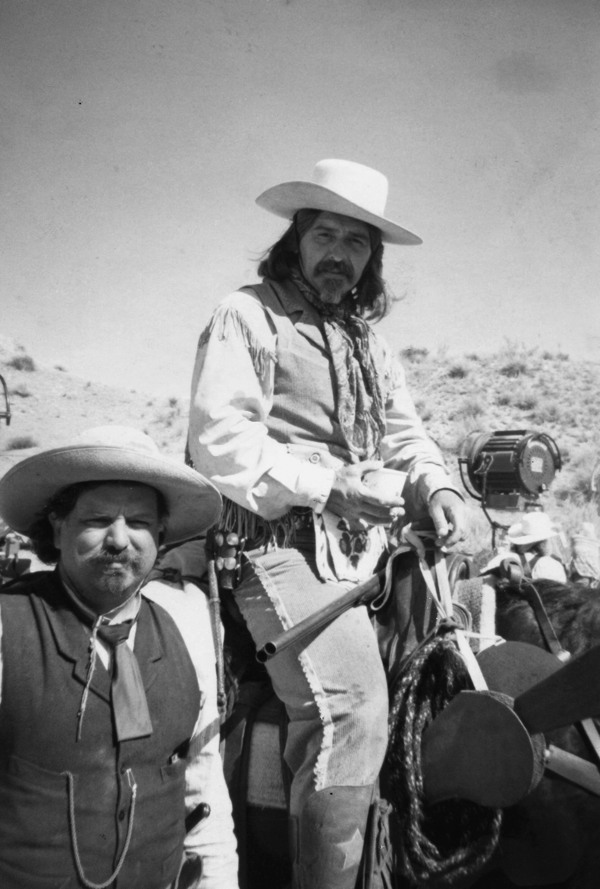
Buckaroo Garrett Roberts and Peter Sherayko, who played Texas Jack Vermillion (courtesy Garrett Roberts).
“Now, he also knows that I’m a blabbermouth and can’t keep a secret. What he told us was, ‘We’re going to do a movie on the California Gold Rush of 1850.’ I started getting every book I could on the [subject] and started making my notes and figuring out what to do, what type of guns to have, what the saddles looked like and everything. Well, it was about six or eight months later and I had done all this research. [Then] he took us all on one of the ‘house of men’ rides, swore us to secrecy, [and] said, ‘What we’re doing is, we’re doing Wyatt Earp, we’re doing the O.K. Corral. We’re making the vendetta ride the premise of the whole movie.’” Gary was going to be the head wrangler, Frank was in charge of the saddles, Peter would be in charge of the guns.16
“As Kevin started writing Tombstone, [Frank, Gary and I] never talked to each other [about the script] but every … at least once a week … we were still going on our ‘house of men’ ride. We would never talk about the movie … because all of us were together. Once a week Kevin would call me up and I’d go down to his house around 11 o’clock at night and he’d give me four or five pages of his script. And he’d say, ‘Okay, look at these characters that are in there and design your guns.’ So I would go home and do that, talk to him the next day or the day after and tell him what I’m thinking about [the] character(s). That’s why I tried to have every character have the exact same type of gun that the real guy had. Kevin would override me on a few things. Doc Holliday had a seven-and-a-half-inch Colt which I wanted him to have but [Jarre] wanted him to do the gun twirling, thinking it would be very good with a four-and-three-quarter-inch gun. Same thing with Johnny Ringo. Johnny Ringo, when he was found dead, he had a seven-and-a-half-inch Colt. And that’s what I wanted but Kevin said, ‘No, I want both he and Doc to have the same type of guns so they could be evenly matched.’ And he wanted the four-and-three-quarters; those are guns that are literally designed for twirling. They’re the best-balanced gun around. So that’s how he overrode me on those things.
“Another time I said, ‘You know, I think [Sheriff Behan] should have a four-inch Sheriff’s model,’ ’cause they just came out on the market. He’s a dapper guy, he has a walking stick, he doesn’t really shoot but he has…. I’d like to give him that. So I went down to Kevin’s house, after he gave me the pages with Behan in it, and he said, ‘No, no, no, no, no. I think he should have a dainty gun or a smaller gun.’ And I said, ‘Okay, no problem.’ So that day I left Kevin, I went down to a place in Orange called Little John’s. They have these gun auctions on all high-end stuff. I went down there purposely to buy a ’76 Winchester, which is the one that Jason Priestley used. So I bought the Winchester and John said to me, ‘Hey. I got an auction coming up in about a month. You ought to come down to it. I’ve got some interesting guns in there.’ So he gave me the catalogue and in there was Johnny Behan’s gun. The original gun. Four-inch Sheriff’s model, the same that I told Kevin that I think he should have. So as soon as I saw that, I immediately drove back to Kevin’s house, knocked on the door, and just held the catalogue open to that page. He looked and he read it and he said, ‘Okay, you can get the four-inch sheriff’s model.’ Kevin knew exactly what he wanted in the film, and I tried my damnedest to give him what he wanted.”17
Eventually, Jarre’s script came together. Future producer Bob Misiorowski recalled that Jarre’s dialogue was quite accurate for the period: “The F bomb word wasn’t used back then (despite how frequently it was used in Deadwood). Kevin researched letters and newspapers. The writing is in the vernacular. He took his language from his sources for very authentic language.” Jarre finalized the first draft of his script on January 22, 1992, but knew it wasn’t quite ready. He continued to work but already was thinking about who should play the lead role of Wyatt Earp.
His first choice was always Kevin Costner. By then, the 37-year-old, married Costner was a powerful Hollywood force, a major star. The one-time truck driver, deep-sea fisherman, Hollywood tour guide bus driver, and Disneyland Jungle Cruise operator had even made a soft-core porn film (Malibu Hot Summer) but had vowed never to work in films again if that was the only work he could get. Costner had appeared in several forgettable films (Frances, Table for Five, Fandango and Stacy’s Knights) but gotten his big break when he portrayed Alex, the corpse in The Big Chill (his scenes were later left on the cutting room floor). But director and friend Lawrence Kasdan never forgot the decision to eliminate him from that film, and eventually included Costner in the cast for Silverado (1985), where Costner played his break-out role. It was quickly followed by The Untouchables, No Way Out, Bull Durham, Field of Dreams, Dances with Wolves, Robin Hood: Prince of Thieves and JFK. His résumé could have been even more impressive: He turned down roles in WarGames, Platoon and The Hunt for Red October.
In July 1992, Jarre, working with Alphaville film producers Sean Daniel and James Jacks at Universal, decided to send a copy of his Earp script to Costner for consideration. According to John Fasano, when Jarre asked Costner to play Earp, Costner told director-writer Kevin Reynolds, “‘Yes, I’ve just read a great script. I’m going to play Wyatt Earp.’ But Reynolds apparently warned him off, saying, ‘Don’t do that one. I’m developing Wyatt Earp as a mini-series. Let’s make that into a movie.’” However, in the October 1994 issue of Film Review, Costner said he’d never even looked at Jarre’s script “because I had worked on my own version of the story for four years. I didn’t even want to look at it. I said [to Jarre], ‘Look, I don’t want to. I have my own. I had it before yours. Mine’s good, yours is okay.’” We thus must wonder … how would Costner know that if he didn’t read the Jarre script? Given that the Earp–O.K. Corral tale already had been told numerous times on screen—Frontier Marshal (1939), Tombstone: The Town Too Tough to Die (1942), My Darling Clementine (1946), Gunfight at the O.K. Corral (1957), Hour of the Gun (1967) and Doc (1971)—it seems logical that Costner was naturally reluctant to tell the story once again. Maybe. But Costner still sounded a bit interested, saying he’d do it “if we can make this thing on the level of complication of The Godfather, if we can realize that his life is interesting before the O.K. Corral.” Apparently writer Dan Gordon was able to accommodate that protracted-version direction: “Kevin [Costner] is the only person I’ve turned a script in to that has one note: ‘Make it longer.’ His original idea was to do two three-hour movies, one for summer and the other for winter, and end the first with a cliffhanger.” And that was after Costner abandoned the idea of making the Wyatt Earp biography into a six-hour major pay-per-view mini-series for cable television. In the fall of 1990, Gordon contacted Jeff Morey about a proposed Wyatt Earp mini-series. According to Morey, “Gordon and I flew out to Arizona, where I introduced him to Bob Palmquist.” Palmquist later recalled that once, “Kevin showed up wearing a bomber jacket, ball cap and carrying a bottle of Stoli’s. And after the ‘Pleased to meet yous,’ were over, the first words out of his mouth were, ‘Gee, I hope you got some orange juice.’ Which we did; screwdriver was his drink of choice. We settled down over one of those and I showed him my library. We sat and talked, not only Earp but I had a bunch of books on the Civil War, and, of course, he authored Glory. Talked quite a bit about that.”
After meeting Gordon, according to Morey, “We spent the day driving around the Tombstone area. While Gordon drove, he had Palmquist and me verbally review the Earp story. At the end of the day, Gordon asked [us] to write a short chronology of Earp’s Dodge City and Tombstone years. Palmquist covered Kansas and I covered Arizona. We only had a few weeks to do this.”
“I committed to television first,” says Costner, “but I soon realized that the anger and violence associated with the story couldn’t be told in an effective way on TV because of the [TV censors] … the ridiculous codes of what you can’t do on TV vs. what you can do.” According to Gordon, Costner’s mandate was to ensure that every part in the picture was so strong that he would have difficulty deciding which one to play.18
Costner’s claims are interesting, but Jarre begged to differ. “[Costner] was the first person I thought of [to play Earp]. After he read the script, he called and respectfully declined. He said he had a mini-series he was developing for pay-per-view on the whole life of Earp and we left it at that.” Apparently, Jarre’s script focused mainly on the O.K. Corral incident and its aftermath, and also surrounded Earp with a wide cast of colorful characters, while Costner wanted a much-expanded version of the lawman’s career, one that followed Earp through the years of his life, rather than centering on his brief, tumultuous time in Tombstone. Says Morey, “Costner took the Stuart Lake slant and Jarre took the Walter Noble Burns slant. He saw that’s where the story was. The problem with [Costner’s approach] is that he has too many people and too many characters. By the time he gets to Tombstone, he doesn’t have enough time to tell the story. Because Costner’s picture was so much bigger, you could argue that it was more accurate. But, if you look at Tombstone, Tombstone’s more authentic because you’ve got the period vernacular; you’ve got the period clothing. You’ve got a time and place that is depicted in the film in a way that is totally missing from the Costner film.” Supposedly, Kasdan subsequently contacted Costner and volunteered to rewrite Gordon’s 500-page script and turn it into a three-hour feature film. Rationalized Costner, “To take something from six hours to three is a terribly difficult job and I was way too close to it…. Larry, in his own way, knew how to go in there and construct the man’s life. What is important is the formation of this man. Larry makes movies about relationships, about people. It stood to reason that’s what was going to happen to [Earp].”19
Disappointed by Costner’s rejection but not dejected, Jarre continued working on his script and early that summer, he invited Jeff Morey to read it. “As I read it, he hovered over me like a nervous and expectant father,” Morey said. “What I read amazed me. It was personal, yet epic. It captured the historical period without losing a contemporary audience. And it had a remarkable driving energy. When I finished reading it, I told Kevin that he had redefined the Western film. While I supplied Kevin with a good deal of information for the film, I never could have [fit] that data into the script that he created. He had the rare power of an alchemist who could transform the harsh noise of life into pure music.” Buoyed by this praise, Jarre was pleased but knew he could do even better. And so, over the summer, he revised his work and finalized the second draft on November 5. And what a marvelous draft it was! Many of the film’s most memorable scenes and dialogue appeared in this draft. Jarre began with a collage of historical photographs and illustrations mixed with silent live-action vignettes, all dark and heavily shadowed. An overly long voiceover narration addressed “the economic explosion that followed the Civil War, which created an unprecedented nationwide market for beef” and its ensuing ramifications. The voiceover then introduced red-sashed Wild Bill Hickok, complete with flowing locks, Prince Albert coat and flashing pistols as he shoots three barroom patrons, quickly followed by Bill’s subsequent demise at the hands of a drifter while playing poker. Earp and Bat Masterson are seen in Dodge City as they face down a group of carousing cowhands by clubbing them with pistols, aka “buffaloing” them. Unaware there was yet another armed drover sneaking up behind, the duo is saved by Doc Holliday (announced as Wyatt’s guardian angel), who thwarts the ambush.
The scene then shifted to the interior of an elegant Victorian home where Josephine Marcus is introduced. The narration continued as Texas Rangers are seen driving out “the absolute dregs of the Texas underworld to the most dangerous, uncivilized … southeast corner of the Arizona Territory.” Next, prospector Ed Schieff[e]lin discovers silver and the founding of Tombstone begins. Although this was a unique, informative way to introduce the plot and characters, none of the preceding narration had appeared in the script’s initial draft. Finally, with “pounding hooves [and] flowing manes, a pack of night-riding horsemen kicking hell-for-leather [ride] across the desert moonscape.” The narrator simply states, “They called themselves the Cowboys.” What a powerful way to start the film!20
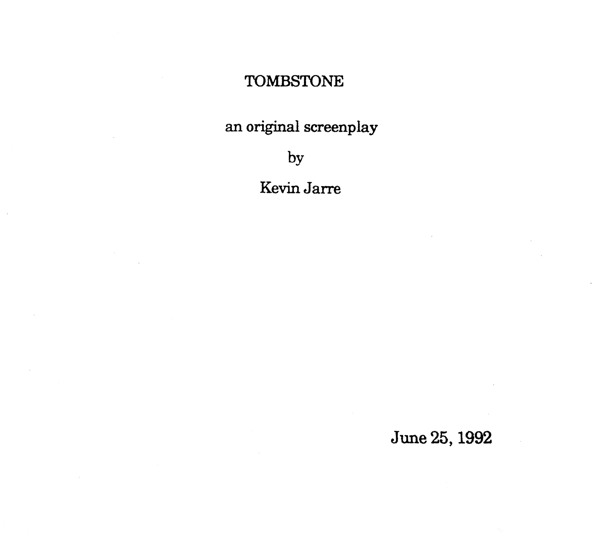
The cover page of Kevin Jarre’s Tombstone draft, dated June 25, 1992. He followed with additional drafts on November 5, 1992, and January 30, March 15 and March 18, 1993 (courtesy Jeff Morey).
Following are just some of the scenes that appeared in that version of the script but aren’t necessarily included in the film in their entirety21:
Scenes 1–7: The film opens with a shot of a squad of Mexican Federales as they come upon a massacre in a small house near the border. Vowing revenge, the soldiers ride across the border and into a dark canyon. Sensing an ambush, they attempt to turn back but are attacked and slaughtered by the Cowboys, including Old Man Clanton, Curley Bill Brocius, Ike and Billy Clanton, Florentino and Johnny Ringo. Only three soldiers survive. The Federale captain warns the Cowboys in Spanish that a rider on a pale horse will seek revenge. Ringo kills the captain and Bill asks what the captain meant; Ringo replies, “It’s from the Bible. Revelations: ‘…behold a pale horse and the one that sat on him was Death and Hell followed with him.’” (This last bit of dialogue was inserted into the film in a different scene.)22
Scenes 11–12: After the Earp brothers and their wives leave Tucson, they embark on a 70-mile trip to Tombstone. While in their wagon, the women engage in jovial banter, with a few semi-risqué comments. Mattie’s issue with laudanum is also touched on. While camped that evening, Morgan turns philosophical and discusses the stars, Heaven and Hell. The dialogue from this conversation was used in a different scene.23
Scene 24: The Earps, their wives, Doc Holliday and his paramour Kate Horony, Mayor John Clum and his wife Mary and Marshal Fred White sit in the upper balcony of Shieffelin Hall. (In the film, this scene takes place in the Bird Cage Theatre, which didn’t actually open until December 1881, two months after the gunfight. Shieffelin Hall, an opera house-theater-recital hall-meeting place, was built by William Harwood and Albert Schieffelin, the brother of the town’s founder. The two-story, 60 × 120-foot adobe structure contained four rooms, a 29 × 61-foot auditorium, a 28 × 59 stage and a 19-foot gallery that ran around the interior of the auditorium. With a 24-foot-high ceiling, the seating area was comprised of “well built back-rest benches 20-feet long,” with a total capacity of 700 patrons. Shieffelin Hall opened on June 8, 1881, six months before the Bird Cage. The main floor of the Bird Cage contained three sections: a saloon, an auditorium and a performance stage, with a basement beneath the stage and auditorium for storage and private card games. A 14-compartment, drapery-enclosed balcony extended along two sides of the auditorium.)24
Scenes 31–37: In the next scene in Jarre’s script, Ike Clanton, Ringo and Curley Bill exit the Oriental Saloon. Curley Bill spots a Chinaman and follows him down the street into an opium den. Later, Morgan and Josephine walk together toward the Grand Hotel as Morgan spouts spiritualism. This whole sequence, albeit in a slightly modified format with different characters, occurs later in the film.
The Oriental, described as “the most elegantly furnished salon this side of the favored city of the Golden Gate,” was established on July 22, 1880, by Milton Joyce, with gambling concessions run by Lou Rickenbaugh. When it opened, the Epitaph wrote, “[T]wenty burners suspended in chandeliers afford illumination of brilliance and the bright rays reflected from the many colored crystals on the bar which is beautifully carved, furnished in white and gilt capped with a handsomely polished mahogany top. The floor is covered with a brilliant body Brussels carpet and suitably furnished in the style of a grand clubroom, with conveniences for the dealers in polished ivory. Milt Joyce displays an exquisite taste in the selection of the furniture and fixtures in his establishment.” The theater burned in the June 22, 1881, fire but was rebuilt by Vizina and Cook. When state prohibition came to Tombstone in 1914, the Oriental became a drug store and remained so for several years. Since then it has had many tenants and purposes but still stands in its original historic location. Currently there are two stores in the old saloon building.
According to the September 9, 1880, edition of The Tombstone Epitaph, the Grand Hotel was “luxuriously furnished, provided thick carpeting and its walls were adorned with costly oil paintings. Providing 16 bedrooms, each with a ‘view,’ they were fitted with solid walnut furnishings, toilet stands, fine fixtures and wallpaper. The lobby was equipped with three elegant chandeliers and more luxurious furnishings, while the kitchen boasted hot and cold running water and facilities to serve some 500 people in the span of a couple of hours.” It was destroyed by a May 25, 1882, fire that left only the adobe walls standing. A new building was then erected; it housed three businesses, two on the first floor and one in the basement. In May 1924, a fire wiped out most of the structure. When it was rebuilt, the old adobe facade became a functional part of the structure. In the 1970s, it became Big Nose Kate’s Saloon.25
Scene 38: In a scene written but not used, Wyatt testifies in court before Judge Spicer: “Then you actually didn’t see it… Can’t have a murder without a witness. Case dismissed for lack of evidence.” This dialogue is referred to in a subsequent scene in the Campbell & Hatch Billiard Hall where the Earps again decline Mayor Clum’s offer to be the town marshal.
The Campbell & Hatch Billiard Hall was opened in 1880 by Bob Hatch and John Campbell. The saloon and billiard parlor burned in the 1882 fire and was one of the first to rebuild. Prohibition closed all the saloons in 1914. As with many other structures, Jarre used the names of the actual 1881 buildings in his script.26
Scenes 44–48: Virgil tells Wyatt that Wyatt’s black stallion was stolen from the O.K. Corral. Wyatt mounts one of his other horses, borrows Virgil’s gun and starts tracking the outlaw. The hoof prints run past Henry Hooker’s ranch where Earp confronts the owner and asks if he’s seen anything. Hooker refuses to identify anyone, saying, “You’re just passing through. Us cattlemen gotta live here. Best I can do is to point you to Galeyville. That’s their roost.” (Galeyville, founded in 1880, was a small mining town about 60 miles due east of Tombstone on the eastern side of the Chiricahua Mountains. Founder John Galey, a Pennsylvania oil man and president of the Texas Consolidated Mining and Smelting Company, had found silver on the site. The town had 30 various establishments and 11 saloons, but like many local mining towns, its tenure was short-lived. Galeyville was completely shut down in 1888 and its buildings reassembled in Paradise, just a short distance to the south.)
In Galeyville, Sherman McMasters tells Wyatt Billy Clanton took the horse. The two ride together as McMasters explains the Cowboy creed. Wyatt enters the Cowboys’ camp, Rustler’s Park, and confronts Clanton. Before the argument can escalate into conflict, Curley Bill intervenes and orders Billy to give the horse back. As Earp rides away, Curley Bill is alongside and they agree to stay out of each other’s way. Again, Brocius reiterates the Cowboy creed: “We all go on one, one on all. Fight one of us, you fight us all.”27
Scenes 50–51: Mexican Federales ambush Old Man Clanton and four cowboys in the Guadaloupe Canyon area of the southern Peloncillo Mountains. (The canyon straddles the modern Arizona–New Mexico state line and connects New Mexico’s Animas Valley with Arizona’s San Bernardino Valley.) All five are killed. Frank Stillwell notifies the Cowboys at Rustler’s Park. Brocius takes command of the outlaws and vows revenge. A humiliated Ike Clanton, denied the leadership role, rides away.28
Scenes 52–55: A shorter version of this scene appears much earlier in the film than it does in the script. Looking to avoid Josephine riding sidesaddle through a cut, Wyatt unsuccessfully attempts to find a shortcut. After their ride, they dismount, Wyatt spreads his duster on the ground and they talk. This romantic interlude is much more passionate than what appears in the film. After they kiss, Wyatt falls to his knees, arms wrapped around her legs, face pressed into the folds of her skirt. “You know this is adultery,” she says. “You burn in Hell for that.”
“Then, let’s make sure we get our money’s worth,” he replies.
Afterwards, Josephine visits Fly’s Photographic Studio and, naked beneath a diaphanous veil that shrouds her from head to toe, she has her picture taken as “I want to remember how I looked this day.” (Camillus Sydney Fly was one of the earliest photographers of the Old West. His first Tombstone studio was in a tent, but in 1880, he built the 12-room boarding house at 312 Fremont Street that housed his studio and gallery in the back. The latter portion of this scene sequence implies that the famous Kaloma veiled photograph, so named because it appeared on the cover of a composition piece titled “Kaloma Valse Hesitante,” is, in fact, Josephine Marcus.)29
Scenes 69–74: The Earps and Holliday head toward the O.K. Corral. Various characters, including Milton Joyce, Frank and Tom McLaury, and Billy and Ike Clanton, all have dialogue. These scenes switch back and forth between the street and the corral. The Cowboys pass a liquor bottle around as Behan notifies them that the Earps are on their way. Several townsfolk have conversations as the lawmen pass. As they walk, the Earps discuss their plans for the arrests and approach the intersection of Fourth and Fremont. Behan tells the Earps that the Cowboys are unarmed, then enters Fly’s gallery. Once the quartet reaches the corral, Wes Fuller and Billy Claiborne also dash into Fly’s gallery. Frank and Billy jerk their pistols and the gunfight begins. Shots are fired, participants are hit. Ike dives toward Wyatt, claims he is unarmed and then flees to the gallery. The fight continues: Virgil, Morgan, Frank, Tom and Billy are all wounded. Inside the gallery, Ike grabs Fuller’s gun and fires at Wyatt through the window. Doc fires toward the shattered window to defend Wyatt. Behan grabs Ike and, along with Fuller and Claiborne, dashes out the gallery’s back door. Outside, Billy and Frank are again hit. Morgan and Doc kill Frank. Billy Clanton, the last Cowboy still alive, leans against the Harwood house. Pistol empty, he piteously asks for someone to load his gun. Fly bends down and takes his gun. The fight is over. Behan unsuccessfully attempts to arrest everyone. Josephine and Wyatt smile at each other as Behan and Mattie fume. The other Earp wives hug their husbands. In the script, the fight lasted 20 seconds and on film, 97 seconds. In reality, it lasted 30 seconds.30
Scene 78: The script then shifts to Rustler’s Park as Curley Bill gives a poetic eulogy for Clanton and the McLaurys, demands Fuller and Claiborne’s red sashes (they ran from the fight) and then counsels the rest of the Cowboys to bide their time. Revenge is best served cold.31
Scenes 82–86: These next several scenes take place in Galeyville, the Sonora desert, Tombstone and Rustler’s Park. A drunken Ringo offers to buy a prospector some gin in a Galeyville saloon. When the old man refuses and asks for a beer instead, Ringo kills him. Curley Bill’s original follow-up line (“I tell you, boys, even I’m worried what’ll happen when Ringo runs this outfit”) is still used in the film but moved to a different scene. The scene switches to an adobe house in the desert. A Mexican family is gathered for dinner when Ringo and Curley Bill burst in with guns drawn. Bill looks at the radiant young wife, licks his lips and nods at Ringo: “Look, son, there is a God after all!” We then quickly switch to Tombstone where lightning flashes across the evening sky as the wind howls. Florentino is inside the Oriental Saloon nursing a drink. We cut to Rustler’s Park where Curley Bill tells the Cowboys, “It’s time to get wooly.”32
Scene 89: After the scene of the attack at Virgil’s house, we switch to Mayor Clum’s house. A shotgun pierces the parlor window and fires at the mayor’s wife Mary, who is sitting in a rocking chair. The mayor dives to protect her.33
Scenes 102–05: In an extended sequence, Wyatt, astride his horse Dick Nailor, and leading four other stallions, rides into a wagon train camp. After a short scene around the campfire, where Wyatt and the wagonmaster discuss the concept of revenge, we next see Holliday, McMasters, Texas Jack Vermillion and Turkey Creek Jack Johnson riding into camp the next morning. Earp throws a wad of money at them, and after some discussion, all agree to form a posse and eliminate the Cowboys. They prepare to leave that evening, each horse saddled and waiting with a rifle in a scabbard and a double-barreled shotgun across each saddle fork. Wyatt swears each one in as a federal deputy. Doc reluctantly agrees but won’t wear a badge. Lucinda, a scarred pioneer woman, runs up to Wyatt and ties a blue and gold silk scarf around his neck. As Wyatt and his posse leave the wagon train’s camp, a young lad jumps up on a wagon and gives a wordy, loquacious and entirely out-of-character toast. Wyatt turns in the saddle and waves his hat in a cavalier’s flourish.34
Scenes 107–21: In the script, Wyatt’s Vendetta Ride is captured through a series of vignettes: Wyatt and the posse ride into Galeyville and burn it to the ground. Wyatt throttles Indian Hank Swilling to within an inch of his life. Then on to Pete Spence’s camp: Florentino attempts to escape, his horse is shot by McMasters, and Florentino is killed by Wyatt after admitting he was paid $15 to be a lookout to Earp’s brother’s murder. Wyatt ropes the dead Cowboy and drags the body back to Spence’s camp. In the next scene, the posse ambushes the Cowboys as they emerge from a cut in a canyon, the same cut that Wyatt and Josephine rode through weeks earlier. The last scene is at Iron Springs, where the posse is ambushed by Curley Bill and 17 Cowboys. Almost surrounded, Wyatt grabs a shotgun and advances on the outlaws. With bullets whizzing around him, he calmly shoots and kills Brocius and several other Cowboys before they scatter.35
Scenes 123–26: In another series of scenes not included in the film, the two lone survivors of the battle at Iron Springs ride into the Cowboys’ camp and describe Wyatt’s superhuman effort. Ringo calmly kills them for their cowardice. Later that evening, while the rest of the Cowboys are asleep, Billy Grounds and Zwing Hunt quit the group and sneak away into the night. The following morning, Ringo meets with Behan in the sheriff’s office. The two then ride back to camp where they are joined by Deputy Breakenridge. Ringo deputizes the Cowboys.36
Scene 132: Several scenes later, while resting atop a hill, Hunt and Grounds spy a stagecoach: “Just what we need. Travelin’ money.”37
Scenes 135–40: The next few scenes, though scripted, are not in the film in any form whatsoever. As Doc lies in bed, Wyatt professes his love for Josephine and tells Doc he’ll love her when he’s dust. Then we switch to Hunt and Grounds’ camp. Deputy Breakenridge walks in to arrest the duo. As Grounds raises his pistol, the deputy stumbles backward in fear and his rifle accidentally fires, killing the outlaw. Hunt draws his weapon but this time the lawman’s aim is true. Another Cowboy is dead. Hooker tells Wyatt that they took a vote: The posse can stay at the ranch as long it wants, Cowboys or not. Ringo and his posse ride up and stop atop a hill overlooking Hooker’s ranch. Hooker and six ranch hands ride out to meet them. After Hooker tells Ringo to get off his property, another five ranch hands arrive. Ringo smiles and tells Hooker he’ll be back.
Scene 144: After a Cowboy brings back McMasters’ body and Wyatt accepts Ringo’s challenge, Vermillion and Johnson discuss with Wyatt his odds of beating Ringo.38
Scenes 157–60: In the film, immediately after Ringo’s death, Wyatt’s Vendetta ride continues. In the script there are several quick cuts. As Wyatt and Doc emerge from a thicket, Vermillion and Johnson almost jump for joy. Texas Jack yells, “Praise Jesus!” Turkey Creek follows with “I’ll be dipped in shit. I will, too.” On the other side of the thicket, Ike and Behan hear the gunshot and believe Ringo has killed Earp. After Doc mounts his horse, they decide to leave Arizona as the Cowboys are waiting to ambush them. Vermillion wants to finish them off, Johnson agrees. Wyatt looks at Doc, who shrugs. Off they go, the last charge of Wyatt Earp and his immortals. As they ride into the Cowboys’ camp, the outlaws panic and scatter. Only Ike remains, then he, too, cuts and runs. As they approach, Deputy Breakenridge remains. As Wyatt passes, he points his finger and gives the deputy a salute.39
Scene 161: Father Feeney, a priest, discusses the mysteries of the Catholic church with an emaciated Doc, who lies in a Denver hospital bed. (The use of the surname “Feeney” is a possible homage to the great Western director John Martin Feeney, aka John Ford. Of course “Pappy,” as he was affectionately known, often gave his name as Sean Aloysius O’Feeny or O’Fearna, so, who knows?) Wyatt visits; he and Doc have an extended conversation. During their talk, Wyatt confesses, “All I wanted was to live a normal life.” Doc replies, “When will you wake up? You wouldn’t know a normal life if it bit you in the ass.” This is a great line, derived from a conversation between Kevin Jarre and Jeff Morey. According to Jeff, while at the writer’s house one day, Jarre asked what Morey wanted out of life. “I just want a normal life,” replied Jeff. Kevin was quick to reply, “There’s no such thing as a normal life.” Morey was just as quick to reply, “Kevin, you live in Hollywood. You wouldn’t know a normal life if it bit you in the ass.” Luckily, this humorous real-life conversation found its way into the scene.40
Scenes 162–65: The script’s four scenes are condensed into just two in the film. We first see the Palace Theater in Denver where H.M.S. Pinafore is being performed. Cut to the stage where Josephine and three chorus girls dance the seaman’s hornpipe. After the performance, the chorines are backstage, chatting and removing makeup. As the door bursts open, the girls scream and Wyatt enters. He falls to his knees and grabs Josephine’s robe. They kiss. In the next scene, a train rushes through a mountain pass as the couple navigates their way through a swarm of reporters in the parlor car. Outside, Wyatt and Josephine, bathed in sunlight, hang onto the rail. The screen turns white. The epilogue, like the prologue, is a series of photos and live-action vignettes. The narrator gives a lengthy explanation of the demise of the Cowboys and Tombstone. Ike Clanton and Behan are seen as well as Wyatt and Josephine, now an elderly couple. Flickering images of actors Tom Mix and William S. Hart appear on the screen and the narrator continues. The images fade to black.41
Most of the above-referenced scenes appeared in all subsequent script revisions in some fashion or another, albeit with slightly different dialogue or characters. Jarre had told a wonderful story full of action, romance, heartbreak, comedy, heroism and atmospheric richness. Those who read the first draft versions were impressed by his storytelling ability, colorful though somewhat anachronistic dialogue, and authentic and accurate historical detail with carefully crafted logic and mise en scène. Morey recalled, “I read it … and was very impressed with it. [Kevin] always said that he wanted to do a period movie and this script had all the period vernacular. I thought it had the potential to be one of the great classic Westerns.” Sherayko loved it, too: “I got home around four o’clock in the morning and literally couldn’t put it down. It’s what we call a page-turner. You wanted to see what was happening next. And I read the whole script. I was done about 5:30, 6:00 in the morning. I really enjoyed it.”
According to Kurt Russell, “Jarre’s screenplay was really the first time anyone has tried to present Wyatt Earp in his entirety. I mean, all of him: his relationship with his brothers, with his first wife, how he took up with Josephine Marcus, the traveling actress that he ended up spending nearly half a century with. You could see the dark side of the man. There’s stuff in that original script that if you were ever to read it, you’d go, ‘Oh ho ho.’” Val Kilmer called it “one of the greatest that he’d ever read.” According to Val, the film’s authenticity came from Jarre’s attention to “how everyone wore their wealth on their bodies. They said who they were by how they turned their hats and what colors they wore.” Dana Delany had an unusual take on the subject, noting, “[Kevin’s] attention to detail was what attracted the wonderful cast of actors. He wanted to tell the true version story of what happened in Tombstone. I certainly didn’t know that ladies wore fashions from Paris at the time.”
Eventual producer Bob Misiorowski was awed: “The original screenplay opposed to the final film was a work of art that leapt off the page. The strength of the script was the relationships between the brothers and Doc. The Earps were vagabonds. The entire family was a family in motion. Wyatt wanted to settle down and have a family in Tombstone and he’d had all sorts of trouble in Dodge. At the same time, I was made an offer to produce Color of Night or do Tombstone. Once I read the first ten pages, I’d made my decision and went with Tombstone.” Writer Henry Cabot Beck may have expressed it best when he wrote, “Jarre was able to reach deep inside that story and turn it into an operatic epic, more colorful and grander than anyone before him, including John Ford. He did it by recognizing and respecting the facts with uncanny accuracy. Like Coppola’s The Godfather, (his script) colors a routine genre with wit and brilliantly realized characters to the extent that it made people who knew the story care about it anew, and attracted those who had never heard of it. His script helped people not only appreciate the history, but also the era, when greed and ambition, chaos and character were intertwined. [But] Jarre’s script does contain a great deal of exposition. Fans of history would have loved it, but filmmakers … who are schooled in disciplined productions can’t help but see such expositions as either indulgent or unnecessary. Determining what should be kept or cut is a thorny issue, because the decision can mean the difference between art and commercial success.”
Makeup artist David Atherton felt that some of the scenes were “too poetic,” in particular the Wagonmaster scene: “I don’t think it would have worked in this movie anyway. I think if we did keep that scene in, people would have just rolled their eyes…. It was, to me, a little over the top … you had this little kid making this speech just coming out of left field, and as Wyatt Earp is riding away, he’s standing on top of a wagon waving at him saying this flowery passage…. It was better they cut those scenes out.” But that was okay. Scenes could be modified, dialogue changed.42
And then, probably predictably, it all hit the fan. Kevin Costner already had rejected Jarre’s request to play Wyatt Earp in this film because the actor was working on his own pay-per-view Earp project. On December 7, Costner and Lawrence Kasdan announced they would do back-to-back Westerns at Warner Bros. once Kasdan finished re-writing Dan Gordon’s script. Paragon Entertainment, a Canadian film and television production company, had originally developed the Earp project through its exclusive arrangement with writer Gordon. Paragon chairman–CEO Jon Slan presented a nine-page outline to the producers that “became a 300-page script.” Explains Gordon, “It was to be two movies, in fact, centering on three families: the Earps and two organized crime families. Kevin and I were visualizing a Western Godfather. Mike Gray, a bizarre image of Earp, managed to get Tombstone, the richest town west of the Mississippi, deeded to his private company. It was a land-grab worth $10 million to $20 million in 1880 dollars—and the only thing between him and that money was Wyatt Earp. That’s what our story was about. Our version put the whole story into the realm of classic tragedy. Earp realized that he had become that which he had been fighting against. And there’s no sign of China Mary, who served as the Greek chorus of the piece, or the whole Tombstone Chinese community.”
Gordon added that Kasdan’s rewrite not only eliminated the villains but tacked on a lengthy, superfluous opening sequence, diluting the love story and substituted an inconclusive flashback for the more satisfying original ending: “[Kasdan] had to put his fingerprints on [the script], and he dicked up a good movie…. They just ruined it. It was boring. He cut out the bad guys. How do you have a Western without villains?” Kasdan wasn’t any more complimentary about Gordon’s work: “I used some elements from that other script, but only the things I really loved, and there weren’t that many.”43
Jim Wilson, partner with Costner in Tig Prods. (Costner’s production company, named after his grandmother), said that while the Earp project came to Tig as a TV long form, “we tossed it back and forth [between TV and feature]. Clearly, you couldn’t do the whole Wyatt Earp biography in a short picture, and pay-per-view was very attractive to us. But, ultimately, our bread and butter at Tig is movies. When Kasdan entered the mix, clearly it became a feature.” Whether it would be one film or a two-part film series would be decided when he finished rewriting and revising the script. Later it was decided when shooting was complete on the first script, production would immediately begin on the second. At the time, the specific format hadn’t yet been decided, but it didn’t take long to figure that out. Four days later, Jarre learned of Tig’s decision: “I got wind that Costner and Kasdan were doing (the Earp project) as a feature. Costner called me … and said, ‘Look, I hope you don’t think we’re trying to squeeze you out. There is room for both movies.’ I said, ‘Would you tell that to [Universal head of production] Casey Silver?’” Jarre said the suddenness with which a TV project became a film project—as Costner read Jarre’s script—“struck me as very odd.”
By that time, studio executive James Jacks and Jarre were already discussing potential casting and filming locations. And what an interesting cast it would have been. After Costner’s rejection, Jarre wanted Liam Neeson to play Wyatt Earp, with David Bowie as a potential Doc Holliday. (In an early version of the script, Wyatt’s love interest Josephine commented on his broken nose. While neither the historical Wyatt nor Kurt Russell sported a broken nose, Liam indeed had had his nose broken.) Jeremy Irons and even the 49-year old Michael Douglas were considered. According to Morey, “[Kevin] liked the idea of echoing or referencing earlier Earp movies and thought Douglas might be intrigued to take a role his father once played.” In fact, The Hollywood Reporter claimed, “Jarre also tried to snare Kirk Douglas for a cameo but that didn’t pan out, so he’s now hoping to lasso Oscar-show ham Jack Palance for it.” Some may recall Palance once performed one-arm pushups on the Academy stage to the amazement of the audience. (Once the film was officially announced, stars such as Brendan Fraser, Timothy Hutton and Michael Madsen were also said to have expressed interest. Jarre once mentioned that Hutton and Tommy Lee Jones were his choices to play the roles of Johnny Behan and Curly Bill, respectively.) One actor who desperately wanted to play Wyatt was Richard Gere who, according to Jarre, just about pestered him to death.
On December 16, a Warner Bros. press release announced that Wilson, Costner and Kasdan would produce their film, which would start shooting in May 1993. “We’re not looking to make one four-hour movie,” explained Wilson, “but we’d love to make two two-hour movies.” This release started a war of words between the two studios. A Universal spokesperson said that the announcement would have “absolutely no impact on our project. They haven’t written theirs and we have a script. We will be tracking it closely.” Replied Wilson, “This is nothing like that. You could do five pictures about Wyatt Earp. Ours is vastly different. It’s not a competitive thing. Whatever time it takes to make our film a good film is what we’ll do.” Other industry insiders weren’t so sure. “I don’t think [Tig] can start in May,” said one. “[The announcement] is just a bluff to try to kill off the Universal project.”44
The whole situation sounded suspiciously like another episode that had occurred just the previous year, and Costner was involved in that one as well. Joe Roth, president of Morgan Creek Productions, had supposedly begun developing a script based on the story of Robin Hood. When he left Morgan Creek and became head of 20th Century–Fox, he took the project along with him and approached Mel Gibson about the starring role. In the wake of Roth’s departure, Morgan Creek then suddenly began looking for its own Robin Hood project. Coincidentally, Tri-Star also entered the fray with yet a third Robin Hood film with Marshall Herskovitz (thirtysomething) directing and Kevin Kline or Alec Baldwin as Robin. Fox bought Mark Allen Smith’s script and John McTiernan (Die Hard) was set to start to direct The Adventures of Robin Hood starting October 22, 1990. Roth was furious, claiming that Morgan and Tri-Star “acted unjustly, if not immorally” by rushing competing projects into production as Fox was “first” to develop such a product. In fact, both of the other two studio planned to begin filming on September 3, almost two months before Fox, even though neither had any commitments for the starring role. According McTiernan, “We finished the script two years ago and made the mistake of letting people know about it.” One of Roth’s major issues was that the William Morris Agency, which represented McTiernan and Smith, also handled Prince of Thieves screenwriters Pen Densham and John Watson, who along with Richard B. Lewis would produce the Morgan Creek project. Clearly, it appeared that the agency knew what it was doing when it engineered the sale of Mike Simpson’s Robin Hood script to Morgan Creek for the tidy sum of $1.2 million. Roth felt Morgan Creek was well aware of the project even before he left the studio for Fox. Tri-Star claimed they had started work on its script in 1985 and it was only a huge coincidence that three studios were developing the same project, although they admitted, “We were aware [of the other projects] but proceeded believing ours is the best.” McTiernan said he had pitched Robin Hood to Warners, Disney and MGM way back in 1983 before “Fox stepped up to it.” And, John Watson claimed, “We initiated the idea out of our own heads. We heard of one other project in the works [at Fox] but we decided to go ahead with ours…. When you’re writing, and you get into the creative process, sometimes you just can’t stop.”45
Hollywood tradition holds that when competing studios try to bring the same story to the screen, the first one out forces stragglers to drop out. Despite the daunting rate of failure, no studio wants to drop out of a race that could yield huge profits at the finish line. “The trouble with racing to get things out,” said one executive, “is that between deal-making and picture-making, picture-making always suffers. It’s physics. No matter how much you scream at the airport or yell at the pilot, you still can’t fly [from LA] to New York in two hours. You have to be a lot better than the other guy if you come in second…. The way we operate between agents, studios and talent, everybody is either so afraid or so full of shit that artists lose perspective and think they don’t need any assistance.”46
Two weeks after Roth’s outburst, Morgan Creek announced that Costner would star in Prince of Thieves, and the ballgame was all but over. (Interestingly, Roth, McTiernan and Costner previously had had several conversations about the Fox project but nothing came of it. Sean Connery was also approached but passed on the project.) Although Roth had previously stated that they would go forward with production “no matter what, and we’re not going to stop until we get this picture made,” they now were rethinking their position. Gibson didn’t want to make the picture and the script’s rewrite wasn’t even ready yet, although Roth disputed that fact. Tri-Star also believed the fate of its project was unclear and that it hinged on retaining an appropriate cast. “We’re proceeding prudently,” admitted producer Mike Medavoy, “and trying to figure out whether we should make it.” And, to pour salt into the wound, Morgan Creek also announced they were moving up its film’s release date from the next summer to spring, in an attempt to beat the other two projects to the theaters. When the dust settled, Fox bowed out and decided that The Adventures of Robin Hood starring Patrick Bergin would be produced as a three-hour telepic for Fox TV as well as be released overseas. Tri-Star dropped out of the picture entirely.47
Now this was happening all over again: rival studios with the same Earp project and Costner in the starring role. If the Tig announcement was a bluff, it surely made Universal and Jarre nervous. They knew the only way to beat Costner to the punch was to start filming their project first. So Jarre continued tweaking—eliminating scenes and characters, consolidating dialogue. The script thus shrunk in both content and size: 165 scenes down to 152, 135 pages reduced to 122. Excluding atmospheric background players (they hate to be called extras), Jarre reduced the number of roles from 88 to 81 and speaking parts from 65 to 64. He also eliminated a potentially controversial rape and murder scene that would show up again in his next draft. But it was to no avail. Explained James Jacks, “Kevin Jarre came to me and said he wanted to make a movie about the real story of Wyatt Earp and Doc Holliday. So we got financing from Universal for him to write the script, but when Kevin Costner announced that he was gonna do Wyatt Earp, Universal decided they did not want to race or get into any kind of battle with Costner and Warner Brothers.” No wonder. Not only was Costner a major star with a proven track record, Universal had its future tied up in Costner’s latest project, Waterworld. (Written in the late ’80s by recent Harvard grad Peter Rader, Waterworld was originally bought by New World Pictures and budgeted at $3 million. In 1993 when Universal took on the project from Largo Entertainment, it was budgeted at $64 million, almost $10 million more than Jurassic Park. Largo’s Japanese joint-venture partner JVC wasn’t willing to commit more than $25 million per film and was fearful of budget over-runs. By the time production started, the cost had risen to nearly $100 million, and with a final cost of over $175 million, the project, known as “Kevin-Gate” and “Fishtar” at the time, was the most expensive film ever made … until Titanic came along in 1997.48)
While Jarre continued working on his Earp script, Universal debated the project’s feasibility and eventually decided the risk was just too great. Why alienate a studio breadwinner, especially one named Costner? Jarre passed the bad news along to his horseback-riding buddies. “We’re not doing this at Universal any more,” he told Sherayko. “They threw us out.” Peter was distraught but even though Jarre felt Costner’s untitled film was “an attempt to crush my picture,” Kevin consoled his friend: “No, no. We have a lot of people backing us and we know it’s going to be good.” Costner maintained “that he personally went to Universal and asked them to release the Jarre version into turnaround and let another studio pick up the project but Jacks said, no, that was incorrect.” The studio cancelled the project after the announcement and would not release it to be shopped around.49
Now the question one must ask is, why would a major movie star, on the top of his game, ask his home studio to put a project into turnaround? Was he fearful of the competition? Turnaround is studio-speak for development purgatory—the place where scripts go when studios want to dump them. There are different reasons why turnaround–development purgatory exists. For instance, a reshuffling of top production executives may spur the desire to start with a clean slate. Or scripts may come in at too high a budget. Or a top actor or director may decide to pull out of the project during pre-production. Genre gridlock can doom a picture or a studio can sour on a particular star. In many instances, the project comes with a unique demand; for example, a screenwriter may want to direct. In any case, when studios place a project “on the shelf,” they might still look for a buyer who is willing to pay the studio all the costs they’ve already incurred, including overhead and interest. In the case of Tombstone, none of the above was applicable: Costner just didn’t want the film to be made.50
Of course, one major issue in getting Jarre’s project off the ground was fairly obvious: Who would appear in it? Costner was represented by Michael Ovitz’s powerful Creative Artists Agency (CAA) and with Ovitz’s backing, Jacks and Daniel couldn’t get a decent-sized studio interested in backing Jarre. Jacks even accused CAA of “telling people our movie won’t happen.” Even Brad Pitt, who at one time agreed to play Earp with Johnny Depp as Doc Holliday, backed out after the rival project was announced. Pitt, also represented by CAA, was dissuaded by his agent. Fortunately, Kurt Russell’s ex-agent at William Morris surreptitiously gave the actor (another CAA client) a copy of the script. Russell, a long-time friend of Cinergi Production’s Andy Vajna, contacted him as Vajna had a distribution deal with Hollywood Pictures, a division of Disney.
“Andy and I had been on a bicycle trip,” explained Russell, “that’s where the relationship came from. A bicycle trip we did a couple of years earlier. He said, ‘If you ever have a project…’ I said, ‘Fine.’ I left my old agent [at William Morris]. I was the last one to leave, actually. My old agent called up one day: ‘There’s a script that I’m aware of, that you should do. But, there’s a lot of politics involved.’ I thought it was a phenomenal script, and I called and said I wanted to do it, and they said ‘Ooh,’ because Costner was at CAA. I went to [Cinergi] and got the money. I went to my brother-in-law Larry Franco, who produced a thousand movies, and I asked, ‘Larry, can I do this for $25 million dollars?’ He looked at it, went through it, semi-budgeted it, and said, ‘Sheee—Just.’ I remember when I read Tombstone and I remember feeling that it was quite unique and I loved the dialogue and I loved the feeling that [Kevin Jarre] just had a style and a complete approach to the western that I had never really read before. I liked it! It was fantastic. It was a movie that needed to be made and I would love to do it.” According to Russell, Costner exerted his influence to try and have Tombstone frozen out: “I got a phone call and it was just before Val was going to come on—we had to have a release. Costner had shut down all avenues of release for the picture except Disney, except for Buena Vista. He was powerful enough at the time, which I always respected. I thought it was good hardball. I was told that by Kevin Jarre. Jarre said, ‘We’re dead in the water any place but Buena Vista.”’51
Universal eventually relented and put the Jim Jacks–Sean Daniel Western Tombstone into turnaround on February 5, 1993. William Morris, which represented Jarre, immediately tried to find the project another home. Once Russell became involved, Cinergi Prods., in competition for the project with Inter-scope Communications and Carolco Pictures, agreed to purchase the package. On February 12, 1993, two days after this announcement, sources indicated that Cinergi was willing to commit $20 to $25 million to the project.52