
SIX
Wednesday, October 26, 1881. Tombstone, Arizona Territory. Four men—three peace officers and a deputized gambler-cum-dentist—walked defiantly up Fourth Street toward Fremont and a date with destiny. Awaiting them in a small lot next to the Fry house behind the O.K. Corral were two sets of brothers and a fifth individual, collectively known as Cowboys. Little did any one of them realize that three of these outlaws would never see another sunrise.
Ike Clanton and Frank McLaury had arrived in Tombstone the previous day with a wagonload of beef for sale. They dropped their wares off at the West End Corral and Clanton headed over to the Alhambra Saloon where he soon ran into Doc Holliday. Due to previous altercations, an argument ensued when Holliday referred to Clanton as “a damned liar” and a “son-of-a-bitch cowboy.” Holliday continued his taunts with a challenge: “You son of a bitch. If you ain’t heeled, go heel yourself.” Morgan Earp, who was in the Alhambra, broke up the argument but stoked the fire by telling Clanton, “Yes, you son of a bitch. You can have all the fight you want, now!” Earp then escorted Holliday out of the saloon, followed by Ike. Later, a still-furious Clanton encountered Wyatt Earp and challenged him to a gunfight, but Earp declined. (“I told him I would fight no one if I could get away from it, because there was no money in it.”) Undaunted, Clanton replied, “I will be ready for you in the morning.” Curiously, though, Clanton, Sheriff John Behan, Virgil Earp and Tom McLaury then retired to the Occidental Saloon for a five-hour poker game, which eventually wrapped up with yet additional threats from Clanton, this time aimed at Holliday. “That damn son of a bitch has got to fight,” he told Virgil Earp. When Earp cautioned Clanton to watch his step, Ike replied, “You may have to fight before you know it.” As a result, over the next 12 hours, Clanton continued to drink and several townspeople reported he endlessly threatened the Earps. The next morning, after searching for Holliday at Fly’s boarding house, Ike retrieved his rifle and revolver from the West End Corral, where he had deposited them the previous day. Warned that Clanton was armed and had threatened them, Morgan and Virgil confronted Clanton outside the Capital Saloon, then buffaloed and disarmed him. Wyatt then escorted Ike before Judge Albert O. Wallace for violating a city ordinance. Clanton was fined $25 plus $2.50 in court costs and released; his weapons were deposited at the Grand Hotel and retrieved several days later. By now, Wyatt, tired of being threatened and believing he and his brothers would be assassinated at the earliest opportunity, challenged Clanton in the courthouse. “You damned dirty cow thief,” he told the Cowboy. “You have been threatening our lives and I know it. I think I would be justified in shooting you down any place I should meet you, but if you are anxious to make a fight, I will go anywhere on earth to make a fight with you, even over to the San Simon among your crowd!” Clanton bravely replied, “I will see you after I get through here. I only want four feet of ground to fight on.” After more threats and provocations, Wyatt left the courthouse and almost bumped into Tom McLaury, who reportedly also challenged Earp. Face to face, they exchanged words when, suddenly, Earp demanded, “Are you heeled or not?” According to Wyatt, McLaury replied, “If you want to make a fight, I will make a fight with you anywhere,” whereupon Earp slapped the Cowboy with his left hand and struck McLaury once on the side of his head with a pistol. McLaury was left lying bleeding in the street. After a sleepless evening of drinking and gambling, neither Clanton nor McLaury was in any mood for forgiveness, particularly after each had been pistol-whipped by an Earp.
By 1:30 p.m. on the 26th, the outlaw duo now had been joined in town by Ike’s brother Billy and Frank’s brother Tom. All were armed and dangerous. By all rights, as per the town’s requirement, they should have left their weapons at the Grand Hotel when they arrived … but no one did. Eventually, the group was joined by Billy Claiborne. The McLaury brothers and Billy Clanton met Ike at Spangenberger’s gun shop, purchased cartridges for their gun belts, and then split up. (Ike Clanton had attempted to buy a revolver in the shop but was refused.) While Ike went to the Occidental Saloon to continue fueling his courage, the others went to the Dexter Corral “to get something (Billy) left there.” Eventually, all gathered at the O.K. Corral where, once again, witnesses heard them threaten the Earps. They then walked out the back of the corral and, along with two horses, turned west and stopped in a small vacant lot, a mere 20 feet wide, that sat between William Harwood’s and C.S. Fly’s boarding houses. The stage was now set: Tensions escalating and confrontation inevitable. All that was missing were the rest of the participants.
Several townspeople had notified Sheriff Behan and Marshal Earp that the Cowboys were armed, and many offered the marshal their help in apprehending the gang. While outside of Hafford’s Saloon, Earp asked Behan for his assistance but was quickly rebuffed. Rather, the sheriff offered to go himself to see if he could disarm the gang. After waiting 20 minutes for Behan’s return, Earp was informed by John L. Fonck of the Cowboys’ actions. Virgil told the local businessman he wouldn’t interfere “as long as they stayed in the corral,” but if they remained armed and walked the streets, then he would “disarm and arrest them.’” Fonck responded, “Why, they are all down on Fremont Street now.”
Behan had quickly located, approached and asked the five outlaws if they were, in fact, armed. According to his subsequent testimony, Behan said Ike Clanton told him he was unarmed, and Tom McLaury pulled open his coat to show the sheriff he wasn’t carrying a weapon. (Behan said he put his arm around Ike’s waist to see if he was armed; he didn’t bother to search McLaury. This, despite the fact that there is no evidence that the Cowboys had ever deposited their weapons anywhere in town in accordance with the local ordinance.) Behan further testified that although Frank McLaury was armed, the Cowboy wouldn’t relinquish possession of his weapon unless the Earps did so as well. The sheriff ignored Claiborne, who said he wasn’t involved in the quarrel, and made no attempt to disarm Billy Clanton, who told Behan that he was on his way out of town. Behan then told the Cowboys he would “disarm the other party” and left to find the Earps and Holliday. When later asked if he had arrested the group before he departed, Behan was his usual ineffective self: “I considered the Clanton party under arrest, but I doubt whether they considered themselves under arrest or not.”
Faced with no alternative but to neutralize the Cowboys himself, Marshal Earp, along with his brothers Wyatt and Morgan, and the deputized Holliday, marched north up Fourth Street. Virgil exchanged his shotgun that he had earlier retrieved from the Wells Fargo office with Holliday’s walking stick and told Doc to conceal the weapon under his long coat. Wyatt and Morgan held their revolvers in their hands. As the four turned west onto Fremont Street’s wooden sidewalk, they passed the Capital Saloon, the Tombstone Nugget newspaper office and the post office before they reached the rear entrance of the O.K. Corral. According to Tombstone housewife Martha J. King, who was shopping inside the butcher shop, the Earps walked four abreast as they passed the Union Market, but, because the sidewalk was too narrow, the two outside men were slightly in front of the two inside men in a bow-like formation. An anxious Behan attempted to detain the foursome in front of Bauer’s and warned, “Gentlemen, I’m the sheriff of the county and am not going to allow any trouble if I can help it.” As the Earps walked on toward the corral, Behan claimed he told them he was down there “for the purpose of arresting and disarming” the Cowboys. However, Wyatt said when he heard Behan say to Virgil, “For God’s sake, don’t go down there or you will be murdered,” Virgil replied, “I am going to disarm them.” Undeterred, the four quickly brushed past the sheriff, moved into the center of the street and continued their dramatic walk as Behan yelled, “I have disarmed them!” If so, then where were the Cowboys’ guns? And why would he warn the Earps of their possible murders if he had already disarmed them?
Nonetheless, the Earps must have somewhat believed Behan as Wyatt put his revolver back in his overcoat pocket and Virgil later testified, “I had a walking stick in my left hand and my hand was on my six-shooter in my waist pants, and when [Behan] had said he had disarmed them, I shoved it clean around to my left hip and changed my walking stick to my right hand.” Imagine the Earps’ surprise when they reached the corral and observed that not only were Frank McLaury and Billy Clanton armed, but rifles also were visible in their horse scabbards. Behan had lied! Looking north toward Fremont Street, the four aligned thus: Wyatt stood on the far right, next to the sidewalk, Virgil was to his right, Morgan stood to Virgil’s right, and Doc Holliday on the far left, still partially on Fremont. The Earps stared back, noting both the McLaurys and Billy Clanton leaning against the Harwood house, Tom holding the reins of a horse, and Ike Clanton, Billy Claiborne and Wes Fuller standing in the middle of the vacant lot. Only a scant six to ten feet separated the two groups as Virgil Earp raised his walking stick and, according to Ike Clanton, exclaimed, “You sons of bitches. You have been looking for a fight, and now you can have it. Throw up your hands.” Wyatt’s recollection of Virgil’s demand was slightly different: “Throw up your hands. I have come to disarm you.” Immediately, Frank McLaury and Billy Clanton both drew and cocked their revolvers. Trying to defuse the situation, Virgil shouted, “Hold on. I don’t want that!” Nevertheless, shooting began within a matter of seconds.
Although who actually fired the first shot is still debated, most historians believe Billy Clanton and Wyatt fired virtually simultaneously—Billy at Wyatt, and Wyatt at Frank. Clanton missed, but Earp, knowing that Frank was the most skilled and dangerous of the Cowboys, shot him in the stomach, the first of two wounds Frank received. Wyatt then turned toward Tom McLaury, who was partially hidden behind the horse he was holding. As Earp fired at the horse’s withers, it partially bolted. Tom, unsuccessful in his attempt to pull his rifle from its scabbard, twice fired his revolver over the horse’s back, but Holliday stepped around the steed and shot McLaury with a double-barrel shotgun at close range. Contrary to popular belief, there is no evidence to suggest that Holliday first fired one barrel of his shotgun into the air to scare the horse before shooting Tom. A witness said he saw Tom stagger down the street and collapse at the foot of a telegraph pole at the corner of Fremont and Third. Holliday then tossed his shotgun aside and pulled out his nickel-plated revolver to continue the fight.
Ike Clanton rushed toward Wyatt, shouted that he was unarmed and didn’t want to fight. Wyatt pushed him away, yelling, “The fight has commenced! Go to fighting, or get away!” Behan, who had followed behind the Earps down Fremont, pulled Claiborne to safety as the cowardly Clanton rushed away through the O.K. Corral, across Allen Street into Kellogg’s saloon, and then onto Toughnut Street where he was arrested. Some witnesses claimed Clanton drew a hidden revolver and fired at the Earps before he disappeared. Morgan Earp then shot Billy Clanton in the right wrist, but the Cowboy shifted his six-shooter to his left hand and continued to fire until he was out of bullets. The gunfight quickly escalated into a wild mêlée. Morgan tripped and fired from the ground. Wyatt shot Frank McLaury a second time; Frank struggled with his horse’s reins as he, too, lurched across Fremont Street, firing his revolver as he went. Morgan, standing once again, and Holliday fired again at Frank McLaury. Frank’s return fire grazed Holliday in his pistol pocket. Though both Frank and Billy had been wounded, they continued to return fire as Clanton hit Virgil in the calf and may have also hit Morgan, who yelled, “I am hit.” The bullet struck both shoulder blades as well as a vertebra. Morgan fell to the ground a second time, then stood once again. Frank fired twice more, then challenged Holliday, “I’ve got you now.” Doc replied, “Blaze away! You’re a daisy if you have.” Both Morgan and Holliday then fired, hitting McLaury in the left breast and in the head below his right ear. The Cowboy finally fell to the ground, mortally wounded.
Billy Clanton, who had been shot in the wrist, chest and abdomen, slumped to the ground. After he ran out of cartridges, he asked for more to no avail. C.S. Fly eventually relieved him of his empty revolver. The shootout lasted between 25 and 30 seconds with 30 total shots being fired. Virgil and Morgan were wounded, Holliday nicked, and both McLaurys and Billy Clanton lie dead or dying. Only Wyatt was unscathed. Morgan and Virgil were carried in hacks to Virgil’s home where they were attended to by their wives. Doc retired to his room in Fly’s boarding house where, according to Kate Elder, he sat on his bed and wept: “Oh, this is awful—just awful.” As Wyatt left the scene, Behan approached the lawman and said, “I will have to arrest you.” Still laced with adrenaline, Earp roared, “I won’t be arrested. You deceived me, Johnny. You told me they were not armed. I won’t be arrested, but I am here to answer [for] what I have done. I am not going to leave town.”
The gunfight was over but the legend had just begun.
Before they began filming in Mescal, Cosmatos had a few scenes to wrap up: Doc’s final confrontation with Ringo, Wyatt and Doc’s conversation about Ringo at Hooker’s ranch, and Wyatt and Josephine’s horseback encounter at Mt. Lemon. Emily Blanton, who stood in for Delany during the horseback-riding sequence, recalls, “I would stand-in in some pretty precarious places. When she was on horseback, right next to the end of the cliff—that was a scary spot…. It’s not always the glamour it’s portrayed [to be]. The hours are ridiculous, but I really love the business, so I was willing to put up with a lot of stuff like that.” Cliff McLaughlin is Russell’s double in both the race through the woods and the downhill ride. Billy Lang says, “That horse popped [Cliff’s] ass right out of the saddle [as they went downhill]. Cliff said, ‘I was gone,’ but his momentum was just right and he sat right back down.”1
At the end of this sequence, Wyatt and Josephine express their love for each other as Wyatt falls to his knees, clutching her in his arms. But the area where the scene was filmed in had to be created as, in the words of Cosmatos, “We came here [to a valley] and it was full of bullshit. So we had to put … those flowers all around to create a more beautiful atmosphere. We arrived there [and] the trees had shed [so] we tried to jazz up the scene by putting flowers in the background. Planting them and then we used pollen, we shot it through the scene and suddenly this cow field became a place where they could meet. The scene went longer and they kiss in the original scene and we thought that it was not a good idea that they kiss. Leave it open. Something happens but don’t show it on the screen, it’s much more powerful. Also, it was too obvious. So it’s just the looks. I cut it because I didn’t want the love story to be consumed so fast.”2
Perhaps they didn’t get adequate coverage or didn’t like what they saw in the dailies, but these scenes were reshot in the final days of filming: McMasters’ meeting and scenes #26 (Holliday and Wyatt inside the Oriental Saloon), #39 (Wyatt’s attempt to retrieve his horse), #81 (Florentino ducks in a shadow as Virgil walks by), #129 (McMasters’ confrontation with Ringo/Ike) and #143 (the aftermath of the Holliday and Ringo gunfight). While Cosmatos was ensconced in Mescal, Terry Leonard was busy on second unit, filming a variety of atmosphere shots that included horse falls and numerous “Vendetta Ride” stunt gags. On some days, they would combine with the first unit as in early July when they filmed the Wedding Massacre scene, or Wyatt and Josie’s wild horse ride at Mt. Lemon. Later that month, Terry filmed the deaths of several Cowboys during the Iron Springs ambush as well as the escape of its two lone survivors. On July 23, he filmed the Earp posse as it rode of out the sunset. Five stunt doubles stood in for the quintet: J.T. Hall, John Hock, Bob Lester, Russell Solberg and Tony Boggs.
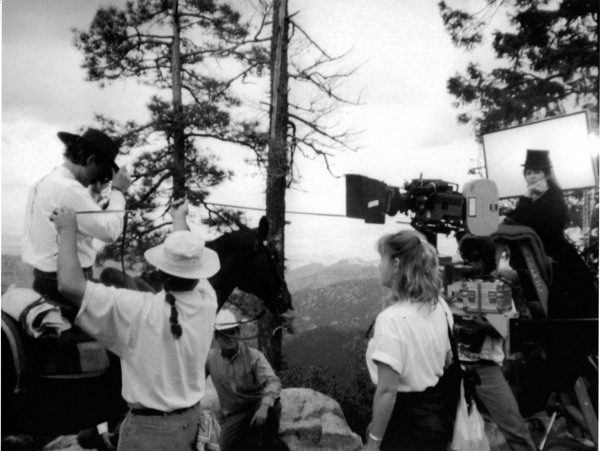
Kurt Russell (Wyatt Earp) adjusts his hat as he and Dana Delany (right; Josephine Marcus) prepare for their scene on Mt. Lemon (courtesy James “Spud” Danicic).

In a sequence that can only be seen in the extended version of the film, Sherm McMasters meets Johnny Ringo and the rest of the Cowboys at Rustler’s Park on the Babocomari. McMasters is subsequently killed and his body is dragged by horseback to Hooker’s ranch house (courtesy Larry Zeug).
On July 30, Leonard filmed a gag where Wyatt rides his horse through the plate-glass window of the Galeyville Saloon. Located on the set around the corner from the Oriental Saloon, the exterior of the building was decorated as Spangenberg’s Gun Shop, while the interior was the saloon. It was a very complex stunt, so preparations had begun immediately after pre-production. Veteran stuntman Leonard explains the process: “What wood are you going to use? What surface are you going to have the horse on so it doesn’t lose its footing jumping in and lose its footing going into the building? What kind of glass were you going to use? How thick is it? What kind of shatter do you want to see? Can we use a three-sixteenth, an eighth- or quarter-inch of candy glass? It’s a polymer material. How do you want to see it break, how do you build it, how much tension is there? There’s all kinds of things you’ve got to think about … but you gotta make sure all your ducks are in [a row]. We’re working those horses for weeks in advance. We’re in charge of construction and how [the building is] built, how it’s put together. We’re the ones that shoot it but I also go to the director and say these are the angles I have in mind. You don’t do anything at the last minute with a horse; it’s all prepped.” In this scene, Cliff McLaughlin doubled for Kurt Russell as the horse jumped through the window. Once inside, Russell took over and finished the scene. Nine stuntmen were involved in that scene including Ben Scott, who was sitting in the barber’s chair when his character was shot.3
Originally, two long-haired Buckaroos, Reggie Byrum and Jerry Tarantino, were supposed to be inside the barber shop. “They asked me to cut my hair,” says Reggie, “and I said, ‘I’m Native American and I really don’t want to cut my hair.’ So when I was a Cowboy [my hair was] up in a little Navaho bun and covered inside my hat. Then, when I wasn’t a Cowboy, I had my hair down to my shoulders. Terry Leonard was directing those scenes and George came in there and said, ‘I see [Jerry] too much.’ He pointed at Jerry and the next thing I know, I’m out, too. The next day when they’re filming that scene, I’m outside [the barber shop wearing] a top hat. They stop [filming] and George is talking to somebody and the guy comes over and asks, ‘Reg, can we see your hat a minute?’ I had a top hat with feathers and an Indian choker around it and they took it and they borrowed it for somebody else and I never saw my hat again.”4
Leonard also shot the 13-second opening scene where 18 Cowboys gallop across Douglas Dry Lake, located just south of Wilcox. The Buckaroos trailered their horses over to the lake from the Babocomari Ranch. The Buckaroos and stuntmen, including Teri Garland dressed as a Cowboy complete with red sash, were located about a mile away from the camera setup. As Reggie Byrum recalls, “When we did the beginning and we’re riding on Douglas Dry Lake, they had us ride way out. One guys said, ‘Hey, we’ve got this big lens, we could count the hairs on your butt.’ So a couple of us mooned him. What was really cool and I thought they should have used it in the scene, we were riding and all of a sudden there was a whirlwind, a devil’s dust bowl come flying up and we came riding out of the middle of that.” Larry Zeug notes, “We started that gallop from a mile out … and they would focus in as we got closer. We could see lightning strike the ground while we were out there and it was pretty scary.” Chris Ramirez hasn’t forgotten that it was hotter than hell out there: “We get out to the dry lake bed and it was probably 116° that day. Obscenely hot and the reflection coming off the dry lake bed was intense. It was burning us, it was so hot. We did that shot over and over and over and over. And the production crew … didn’t bring any water for anybody. We just happened to have water … that we burned through pretty quickly. By the time we finished shooting that scene, there was no shade, so we crawled underneath the horse trailers, which was about 12 feet of clearance. We were just dying.” As the scene was finished, several Buckaroos, including Larry Zeug, Curt Stokes and Kane Rubalcaba, noticed that an Amtrak train had stopped nearby. Someone said, “Let’s go rob the train!” So, in full Cowboy mode, they raced toward the train and rode back and forth for a while. One can only imagine what the train’s passengers were thinking.5
The days were pretty hectic and it seemed the Buckaroos didn’t know from day to day where they would be or what scenes they’d appear in. “Some days our call time was 5:30 in the morning,” recalls Billy Lang. “And we’d get up and shoot a scene and then in the afternoon one of the PAs would come up and say, ‘I need a couple of riders up here to do this today. Do you guys want to go?’ Yeah, okay. So we’d go out to shoot a night scene, work all night. And they’d need someone at five or six or seven o’clock in the morning. A lot of us were doing that. It’s like, ‘Where are you guys going today?’ ‘Oh, we’re going to Dry Lake. Where are you going?’ ‘Oh, we’re going to Old Tucson.’ Depending on what it was, we need four riders for this set. We need five riders for this set. We need five guys for this set and a wagon. The PAs set the things out and made it so they had an adequate amount of people there.” Thus, each Buckaroo had to be available every day, whether used or not. “We’d been in the set a few weeks,” adds John Peel. “The call sheet would say for the next day, 10 Buckaroos or 20 Buckaroos. Any time it said Buckaroos, that meant we had to be at the spot with horses, gear, guns and outfit. One day the call sheet said 30 Buckaroos. Well, what happened was that the call sheet said 20 Buckaroos and we’d all show up and like most movie work, you stand around all day and do nothing. And they wouldn’t use us. Some of the guys started anticipating this and one day they had a call for 20 Buckaroos.”
Reggie Byrum continues: “Well, will 12 do?” “No, we need 20.” “You sure 12 won’t do?” “Why, what do you mean?” “There’s only 12 of us here.” From that day on, everyone had to be there from six to six, regardless. “Whether they used us or not, we were there and ready every day.”6
Everyone had to find ways to blow off a little steam. On some weekends, they took the crews out to one of the Tucson parks to play baseball. Stephen Lang’s team, the Clantonistas, wore black T-shirts with a tombstone on them. Lang once dislocated a finger but medic Chris Swinney reset it. “I got a hold of [the finger],” says Swinney, “and he looked at me and smiled and said, ‘This is going to hurt, isn’t it?’ I reset it with a loud pop!”
“We’d play on Sundays,” says Lang, “and get kinda bombed. We laughed a lot.” “There were people just watching them playing,” added Chris’ son Josh, “and [Kurt] had this giant mustache and sideburns and a baseball cap and you’d never know that it was him. The people in the [stands] would say, ‘He looks like somebody.’ They would say a couple of people looked like somebody they knew, but they had no idea who it was. None of us was supposed to say anything.” The Buckaroos would play poker in the numerous tents that were pitched all over the set, or go out for long trail rides just to keep the horses exercised. For those interested, there was a large screening room at the Holiday Inn where the dailies were shown nightly; pizza and refreshments were available each evening. The crew hung out, hit the bars and on days off, some even visited the real Tombstone. Recalls Michael Walker, “I remember going to Tombstone with my A camera first and film photographer where we met up with [Wyatt Glen Earp]. We hung out with him quite a bit, walked around the O.K. Corral, checked out the city.” Lang, Mitchum, Billy Zane and Stallone hung out at the cowboy camp. Stallone brought along his harmonica, and Terry O’Quinn (John Clum) his guitar for a little entertainment. One Sunday, Lisa Collins visited the camp and wanted to go horseback riding. She said, “There’s no wranglers around. They told me to come out.” Buckaroo Zeug replied, “You want to ride a horse? Just remember, he rears on command and he’ll run the socks off of you.” So she took off and rode him for a couple hours. “Oh, I love this horse,” she exclaimed upon her return. Whereupon she was told, “If you’d been dressing right, you’d have to ride him sidesaddle.” Charles Schneider and several others spent their spare time doing water colors and sketches. Buck Taylor did a numbered self-portrait—one through 400 for the cast and crew. Russell received #1, Sam Elliott #2. And there always were liquid refreshments to lighten the mood including homemade apple pie moonshine.
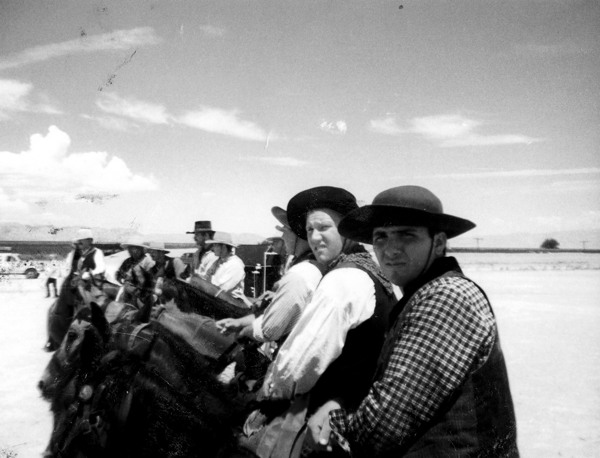
Riders and horses are staged in line on Douglas Dry Lake for the opening sequence, where the narrator says, “Attracted to this atmosphere of greed, exiled outlaws band together to form the ruthless gang recognized by the red sashes they wear. They emerge as the earliest example of organized crime in America. They call themselves ‘The Cowboys’” (courtesy Larry Zeug).
One evening an actor was feeling extremely depressed, so upon his arrival on the set, he immediately headed to his dressing room. A crew member, sensing his mood, asked what was wrong. Informed of the reason, he then talked with the first AD. He then told the actor, “Adam said there’s about 13 set-ups before your scene tonight and they’re damn sure probably not going to get to it. I’m going to run down to the store and get you some beer.” So the crew member went to Mescal, got some beer and a bottle of whiskey, and came back. But by that time, three actresses were in the actor’s dressing room. Says the depressed actor, “We smoked pot and drank whiskey and beer. When they finally realized they weren’t going to use me, I was so intoxicated I could hardly sign out.”7
Meanwhile, back in Mescal, Cosmatos started to pick up the pace. On July 14, he filmed the Earp caravan’s arrival in Tombstone. As the families pass Boot Hill, they continue on to the edge of town where they see Frank Stillwell and Pony Deal throw a family and its belongings out of a small cottage. John Philbin ruefully recalls, “There’s one scene where the [covered wagon] rides into town and [the Earps are] looking at Tombstone and all the crime on the streets. On the corner, just as [the wagon] goes by, there’s a bunch of cowboys just pillaging and terrorizing these homesteaders’ house. We were working so hard in the background, thinking all that was going to get covered (by the cameras)—my best work ever. [But] you can’t even see me when the camera goes by because you’ve got Sam Elliott and Kurt Russell.” As with many other filmed scenes that explain the antagonism between the Earps and the Cowboys, this scene was not included in the final print.8
Earlier in that scene, two horsemen ride past the Earps’ wagon just before it passes Boot Hill. “We were told to ride by them real fast,” explains Rick Terry. “Well, in the street, there’s all these people walking around, so you’re riding your horse trying to avoid hitting everybody. We did that shot a couple of times. There’s some guys off to the right carrying this coffin [into Boot Hill] and as we ride down the street we’re supposed to ride around them. One of the times I did that, they came right out into the middle of the street and I almost ran into them. So, to avoid them, I cut inside between them and the side of the road to get around and to make sure I didn’t run them over. When I came back, the continuity girl just chewed me out. ‘You’re supposed to do the same thing every time. You screwed up that shot!’ Okay, whatever. Well, the next day she was gone, she was fired. She must have been yelled at about something and was taking it out on me but the next day she was gone.” In one of the film’s continuity errors, as the Earp wagon passes the cemetery, viewers can see four individuals carrying a coffin into the cemetery’s entrance, followed by a woman. A second later, in an over-the-shoulder shot from inside the wagon, the coffin procession is still about 30 feet from the entrance. They then cut to a view from inside the cemetery and one can see the aforementioned woman on the far right-hand side of the shot. Two other Buckaroos, Jerry Brown and Reggie Byrum, are seen riding behind the Earps’ wagon.9
Hot-head tech James Danicic recalls there was a great deal of external pressure the day they filmed that scene: “The production manager came to the set and he said, ‘The suits are on the set today. … If anything goes wrong…’ I was fighting, everybody was fighting with their equipment because of the heat. [The production manager] went around to every department, ‘Everything has to go smooth, the suits are here.’ Sure enough, we do the ride into town and reset the crane to pull them into town, and the head goes down. Back then, the old-style head ran on fuses instead of circuit-breakers and there were no backup fuses. So the head goes down just before the big shot and the production manager goes ‘What do we do? Can you fix this?’ ‘I don’t know, I need five minutes.’ So I quickly walked over to craft services and grabbed a pack of gum…. I took the foil and wrapped it around the fuse and set it back in there and said, ‘We’ve got 15 minutes before this goes dead.’ Boom, we got the shot. A cheap fix but it’s a risk of blowing other things up. But [the PM was] freaking out, ‘How much longer, how much longer?’”10
During the next two days, they filmed Behan’s greeting to the Earps, Fred White’s explanation of the town’s criminal dynamics, Holliday’s street conversation with the Earps and Johnny Tyler, Doc’s sickbed conversation with Earp regarding Ringo, and the confrontation Turkey Creek and Texas Jack have with the two drunks outside the Crystal Palace.
Once the Earps arrive in Tombstone, their wagon stops in front of the Grand Hotel where County Sheriff Johnny Behan greets Wyatt. If ever one wondered if Russell truly was a professional, the following story puts that question to rest. Says stuntman Lee McKechnie, who witnessed the scene, “I do remember a little scene with Kurt. He was standing next to a [wagon]. [Sheriff Behan] was talking to him about finding a place to stay. The horse [in the scene] had to go to the bathroom, on camera, and Kurt is standing there trying to be serious. He must have been a farm boy because as the scene was [being filmed], he reached over and took his hand and put it on the horse’s butt. [The horse’s discharge] was going through his fingers and his hand while he was talking. Okay, that was pretty brave. Of course, they didn’t use that take.” And, if you’ve ever ridden a horse for any extended period of time, what’s the first thing you do once you dismount? Stretch your legs, which is exactly what Kurt Russell did once he got off his horse. Tired from a long journey, with cramps in his legs, he twisted his back to loosen his muscles and squatted down to lend a touch of authenticity to the scene.11
As usual, at least according to some, the actresses were nowhere to be found, and Dana Loraine was called on to fill the time: “There was a day in Mescal when we had the huge street scene when the Earps come into town and pass the graveyard. I was sitting at the corner in front of the Birdcage. That day we had 200 extras on the set and we’re just the street scene. All of a sudden I heard a golf cart slam on the brakes. Dust flying. I was just sitting there talking to somebody and I heard, ‘Dana. Get the fuck in this cart now!’ As I get in the cart, I can hear on their walkie-talkies, ‘Where is she? Where is she?’ They were just screaming and yelling. And I got there to the top of the street where they were filming where the Earps got off the wagon. The women weren’t there so they had to have me get in the wagon and practicing getting in and out of the wagon for lighting because the women weren’t there yet.”12
Glen Gold recalls playing the part of a drunk miner in the same scene: “They pull up to the hotel and Sam Elliott gets off the wagon, Russell gets off of that old stud horse and pulls up to the hitching post. Well, I’m the old miner that’s coming down the steps of the hotel and was supposed to be a drunk miner and I walk right in between them and turn to the left and walk down the street. They said, ‘You just struck it rich and everything and you’re celebrating. Stagger a little bit. You’re celebrating.’ Well, [after] about eight or ten takes of that, George said, ‘On this next cut, we’re going to do it one more time. And when I say ‘Cut,’ I want everybody to freeze exactly where they’re at and remember exactly where you’re at and what you’re doing. Because we’ve got the scene but we’ve got to move the cameras for the rest of the scene. We’ve got to reset. So, I want everybody to freeze when I say, ‘Cut,’ because that will be your starting [point] when we get the cameras reset for the rest of the scene.’ So when he hollered, I was standing at the top of those stairs…. I hadn’t started down the stairs yet. I was staggering some, trying to be a nonchalant drunk. When he put us in action on the pick-up, here I come down those stairs and I done it that way I’d been doing it for eight or ten other takes. He said, ‘All right, cut. Back to one.’ When I went back up to the top of the steps, Sam Elliott had gotten off the wagon and was standing there and cocks his head to the side like he does. Then he looked over at George and he walked over there. And the next thing I know, him and George are looking at me. I’m kind of getting antsy. Well, George says something to Adam and they look at me, then Adam comes over [and says], ‘When we start the action on the next take, do not stagger.’ I mean, it hit me right then what was going on. Sam Elliott didn’t want me stealing the scene from him and Kurt Russell because here was this drunk staggering down the steps right between the two of them. Three different ADs run over after Adam told me that. ‘Don’t act, don’t act!’ I just stood there laughing [and telling them], ‘Don’t worry, I won’t.’ I got Sam Elliott to laughing about it. He knew that I knew what he was doing and why, and he got a big kick out of it.”13 In the next scene, Fred White points out several Cowboys to the Earps and calls the Oriental a “slaughterhouse.”
Harry Carey, Jr., had been a key member of director John Ford’s stock company and was well-versed in both Western and cinematic history. Although he wasn’t the first choice to play the part of Marshal Fred White, Carey bridged the Western genre between John Ford’s My Darling Clementine and Tombstone. According to Carey, it wasn’t a very pleasant experience, and he noted one big difference in particular. “I worked on Tombstone and I didn’t find any laughter any more. There always used to be laughter on a movie set. None [now]. None. It was like everybody was going to a lynching or something.” But Carey’s mere presence reminds the audience of Western films of the past, a fact not lost on Sam Elliott. Reflecting on what the veteran character actor Carey meant to him, Elliott simply says, “It’s ‘Dobe’ [Harry’s nickname]. It’s everything he represents, that morality and that character he represents. It was like the antithesis of what Dobe was all about. It’s kind of like the end of an era somehow, even within that little piece. There’s a certain element in making a western film that the filmmakers need to be true to. It’s not about body count. It’s not about whores and cowboys in bed. It’s not about gratuitous anything, whether it’s murder, sex or whatever. You’ve got to be true to those elements that we all know from our childhood. You’ve got to be true that a man’s word is his bond. You got to be true to solid morality. There shouldn’t be too much of a gray area between the good guy and the bad guy.” As the character Fred White, that’s what Carey represented.14
Tucson casting director Holly Hire had used extra Terry McGahey in the past so it was only logical that she would find a role for him in this film. “Originally, they were supposed to hire me to ride for them,” says McGahey, “but it just didn’t work out [because] me and one or two of the wranglers kinda got into an argument. They were laming up horses pretty bad. For every horse you see, they had two or three lamed up. I was standing outside on the street, lying against a post, and these two guys were talking. They couldn’t figure out why so many horses were lamed up. Well, I’m a cowboy. I looked at them and said, ‘Well, I can tell you why.’ They [replied] with kind of a smartass answer, ‘Well, why is that?’ like they knew everything. I said, ‘Well, your hoofs are cut too low in the heel and too long in the toe and you’re bowing their damn tendons [when you shoe the horses].’ They didn’t want to hear that. In fact, that’s one of the reasons I just walked off the set.”
But when McGahey was there, they put him to use. “I was sitting on a pickle barrel across the street from [the Oriental] and [Cosmatos] was looking around. I saw him looking over my way. He said, ‘Hey, you.’ I acted like I didn’t hear him. He hollered, ‘Hey, you’ again. I still acted like I didn’t hear him. The third time he hollered and pointed at me. I pointed at myself and he said, ‘Yeah, you.’ So I walked over there. He said, ‘I’m paying you to sit on a pickle barrel. I don’t think so. You’re going to be in this scene.’”15
The scene referred to was Wyatt’s confrontation with obnoxious faro dealer Johnny Tyler, played by Billy Bob Thornton. McGahey is the cowboy at the table who constantly plays the same card, which upsets Thornton’s character: “You back that queen again, you son of a bitch, I’ll blow you right off that wildcat’s ass. You hear me?” Dickie Stanley is the drunk miner at the bar. Before the scene was shot, Thornton told McGahey, “Now, Terry. Please listen to me. I’m really going to act mad at you. I hope you don’t get angry. I did that to some girl one time and she started to cry.” Terry replied, “Well, I don’t believe I’m going to cry.” It has been rumored that Billy Bob ad-libbed all his dialogue in this scene but that’s not correct. Well, not entirely. All of Thornton’s dialogue up to Russell’s “Just want to let you know you’re sitting in my chair” line was, in fact, ad-libbed except for the “back that queen” line. Everything after that was scripted. According to Cosmatos, “Billy Bob Thornton came as a favor. He didn’t have to say much so I told him to invent, go on, just be a bully. Of course, [Kurt] wasn’t smacking him—an old Hollywood trick. But his face is red for some reason.”16
Russell was to go over to the dealer, slap him a few times, take away his gun and throw it to Pat Brady, who played bartender Milt Joyce. When they were blocking out the scene, Russell asked Cosmatos, “What do I do with the gun? Do you want me to put in into my belt?” They thought about it a few minutes and Cosmatos then said, “Just throw it over to the bartender.” Kurt said, “I want to look cool. I don’t even want to look at the bartender. I just want to throw the gun.” Stanley was standing with his elbows on the bar and noticed it was a real gun. Dickie continues: “I ran out, ‘Hey, hey, hey! What are you doing?’ George said, ‘Why are you leaving the bar?’ I said, ‘That’s a real gun. I’m not going to stand there while he throws a real gun.’ I had my back to him. [Cosmatos] said, ‘No, no. That’s not a real gun. That’s rubber gun.’ He turns to Kurt, ‘Is that a rubber gun?’ ‘No, it’s a real gun.’ Somehow the rubber gun didn’t get shipped, so they [were using an actual] 9½-inch Smith and Wesson. They swapped that out and gave [Kurt] a rubber gun. It was like a Nerf gun, very soft.” They did about 14 takes and Stanley got hit three times. The first two times were good solid hits, right in the back of the head. The third time, it skipped across the top of his head and fell behind the bar. Finally, they moved Stanley a few feet and filmed the scene as planned. At the end of the scene, Russell threw in another ad-lib. “Oh, what do you say, Milt? Twenty-five percent of the house-take sound about right?”17
Historian Jim Dunham was initially asked by Kevin Jarre if he wanted an acting role in the film and Jim agreed. After a successful Tucson audition, Dunham signed a SAG contract to play a high roller in three scenes. His only concern was a two-week, midsummer appearance at Utah State University’s Annual Festival of the American West that he was committed to doing. “No problem,” said Casting. However, upon Jarre’s release, Jim naturally wondered if he was still in the film. “Rest assured,” he was told. “You’re still in but your character has been changed to a miner.” Upon his return from Utah, Dunham’s wife told him, “The movie people have been calling all day.” Jim returned the call to learn that he was no longer in the film. “The director wanted to shoot my scenes [the next day],” says Jim. “They agreed that it was not my fault, but they shot [the scene] with someone else. They paid me per contract and therefore, I am listed in the credits but do not appear in the film.”18
As a general rule, once the Tombstone production set up in a particular location, most sequences were filmed in script or chronological order, especially once they reached the night shoots in August. With some exceptions, many of the night scenes in and around the Oriental and the town’s main intersection were generally shot in the order they appear in the finished film. After the Russell-Thornton street altercation was finished, Cosmatos filmed the confrontation between Texas Jack, Turkey Creek and two drunks outside the Crystal Palace. As the scene ends, Peter Sherayko’s character spins his revolver several times before he holsters it. When Cosmatos asked him why he did so, Peter simply answered, “Because I can.” This trick remains in the film. Sherayko tells an amusing story involving that particular scene: “Val Kilmer and I were good friends on the set. The first day I rode my horse, I saw the prop guy say something to Val. That’s when I said, ‘Your gun’s half cocked.’ Val said, ‘So what?’ I said, ‘In the movie, someone is gonna say you don’t know what you’re doing.’ Val ended the conversation by saying, ‘I find that those who break the rules get ahead.’ I rode away, but within five minutes he had a different gun in his holster. I looked at it in his holster and said, ‘You got a different gun there.’ Val put his head down and said, ‘I broke it.’ I knew then he realized I knew what I was talking about. The scene where we came out of the saloon after drinking all night and playing poker, we actually did that for real, too. We did that scene—where we meet with Doc and Virgil takes our guns. Later, Val kept looking at me when I walked down the boardwalk and he finally said, ‘Hey, Pete, you were drunk in that scene.’ I said, ‘I find those who break the rules get ahead.’ Val laughed.”19
Cosmatos then filmed the arrival of a stagecoach carrying members of a traveling theatrical group. Red Wolverton provided the stagecoach so it was only natural he would drive the team. As simple as it appears, the stagecoach’s arrival was not without its mishaps. Says Red, “They wanted me to come in at a gallop, come right up there hard, and stop right on the money. That’s pretty damn technical. To do that … markers [are placed] so you know where to stop. So I come around the block and they [had] moved several cameras and lights from [where] they said [they] would be. So here it was, all my goddamn markers, I missed the mark by about two feet [and] overshot the cameras. So they said come around again. [This] time the water had run down [the street] and I didn’t have my foot on the brake; I didn’t realize it and picked up a bunch of water on the rear wheels. I had my spot picked out and I hit the brake but because of the mud it didn’t slow the coach down. The horses don’t stop the coach, you have to stop them with the brake on the rear wheels. So I overshot it again. [Cosmatos] got madder than hell: ‘I spent all this goddamn money and here they got some bastard who can’t even drive a goddamn stagecoach.’ Somebody said, ‘Let’s try it one more goddamn time,’ and one of my co-workers bet $20 I wouldn’t miss the mark by two inches. So that time, I come around and kept my foot on the brake to keep the wheels dry, and I stopped right on the goddamn mark. A guy said, ‘He can’t do it again,’ so my partner said, ‘You want to double the bet?’” He didn’t.
Wolverton had to dress in character just like everyone else, which led to an engaging conversation with the wardrobe mistress. Reporting to wardrobe, Wolverton was told to pay a $100 deposit for a hat an old-time actor had worn. As Red was flush, he happened to have a hundred dollar bill in his pocket, so it wasn’t an issue. For whatever reason, though, the scene wasn’t filmed that day, so Red returned the hat. When they were ready to film it several days later, Wolverton was told, “You know, you have to put up $100 to wear this hat again.” “Aw, to hell with it,” Red replied. “I ain’t going to do it.” Thinking that she held the better hand, the wardrobe mistress then challenged Red: “Well, then you won’t have any job.” Of course, she didn’t know who she as talking to as Wolverton had the perfect comeback: “Well, then you won’t have any horses, either, because they belong to me.” (Wolverton had rented 17 wagons and 20 head of harness and saddle horses, not including the six-up.) Not knowing what to do, the girl ran off to get an answer. Five minutes later she came back, literally with hat in hand, and sheepishly asked, “Mr. Wolverton, will you please wear this hat today?” Red had some dialogue: “I did have a speaking role in Tombstone,” laughs Red. “I get to say ‘Whoa’ when I drive the stage into town.”20
During the next several weeks, filming alternated between interior vs. exterior scenes, and day vs. nighttime shooting. Wyatt Earp’s legendary walk to the O.K. Corral was filmed over several days during the week of July 19. As the quartet begins the march into history, a framed structure in the background is seen engulfed in flames. “That was George,” explains Sam Elliott. “We were all looking at it, thinking, ‘Who in the hell lit the fire?’ At the time it didn’t make any sense. And then you see it on film, and it’s evident that the Cowboys lit the fire, as kind of a diversion or whatever it was. Cinematically it was a brilliant decision.” Well, maybe. On June 22, 1881, the first of two fires in Tombstone destroyed 66 buildings in the downtown area that made up the eastern half of the business district. It was reportedly started when a cigar ignited a barrel of whiskey in the Arcade Saloon. Perhaps the film’s flaming building symbolized this historical event. Or it could also be an allegorical combination of the Biblical theme of Death coming and Hell following—an emblematic link between the wedding massacre and the shootout. Four instruments of justice emerging from the fires of redemption to extract vengeance on the unfaithful. During the director’s commentary on the Vista DVD release of Tombstone, Cosmatos claimed, “I wanted them to walk by and everybody’s putting out this fire but they don’t care. They don’t have time for that. People are running. They are disturbed by it but they have no time.”21
Still, movie fires are carefully handled, and this one for Tombstone was no exception. A framed structure built on a skid was relocated from the opposite end of the Mescal set and fitted with flame bars and propane gas to create the blaze. Chris Swinney, set medic and Three Points volunteer firefighter, was on hand to assure its safety, along with Tom Mathews, Alex Dunn, Todd Pierson and George and Andy Swinney. In addition to Three Points, the Derxelle and Mescal fire departments were also represented. After the first day of filming this scene, Cosmatos was upset at the size of the fire and proclaimed, “No, bigger. I want Rambo fire,” which caused laughter all around the set. Second-unit SFX leadman Joe Quinlivan looked back at the firefighters and said, “He didn’t just say that, did he?” Special effects worked to reset the fire and the scene was shot again the next day. While the firefighters wore Nomex protective clothing under their costumes for safety, Chris Swinney is the townsman who bravely throws a bucket of water on the flames.22
After the retake, Cosmatos concentrated on filming various portions of the walk itself: passerby reactions, children playfully “shooting” at the Earps and Morgan’s response, Holliday whistling. The child who goes “Bang! Bang! Bang!” is Chas. Wheeler. That portion of the walk wasn’t in the script but was added to create additional tension. The shootout was to end with the same young boy who, upon seeing the carnage, drops his gun when overcome with emotion. The lawmen start out in front of the sheriff’s office and continue only a short distance down Allen Street before they reach the front of the Oriental Saloon where they turn right onto Fourth Street. In reality, the Oriental and Crystal Palance sit opposite each other at the corner of Fifth and Allen. In 1881, the walk really began in front of Hafford’s Saloon (also known as Hafford’s Corner) at the corner of Fourth and Allen. However, camera placement on the Mescal set makes the walk down Allen seem much longer than it really was. A frustrated Rick Terry stood in the street as the four walked by. “You had to be standing in a certain place and they told me [where to stand]. I’m in the middle of the street, the fire is going on in the background, a couple of guys ride by on horses. The Earps and Holliday are walking down the street and some little kid comes out with a [toy] gun. When they turn and go down the street, I’m standing behind them in the background in the distance. They shot that a couple of times. Cosmatos comes up to me … every time he gives me a different direction. ‘Stand this way.’ Or, ‘Don’t do this. Don’t do that.’ For crying out loud, I don’t think you can even see me in the shot. You got the feeling like whatever you did was wrong.” The original walk was much longer than it appears in the film—people walking, shadows on the ground, numerous angles. But Cosmatos thought it was too long and felt “it was like the end of the movie.” So he took much of the footage he shot and used it in the closing credits.23
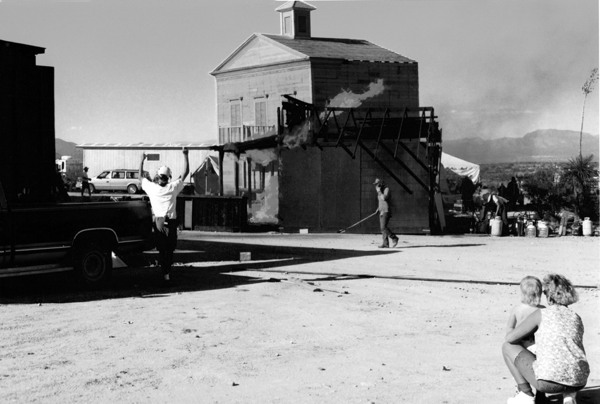
“The flames of Hell!” As the Earps and Holliday begin their walk toward the O.K. Corral, a building burned in the background. Note that the structure is incomplete and gas canisters stored the propane which fueled the fire. Behind the large building is a white tent and single-wide trailer where lunch and dinner were served to cast and crew (courtesy David Russell).
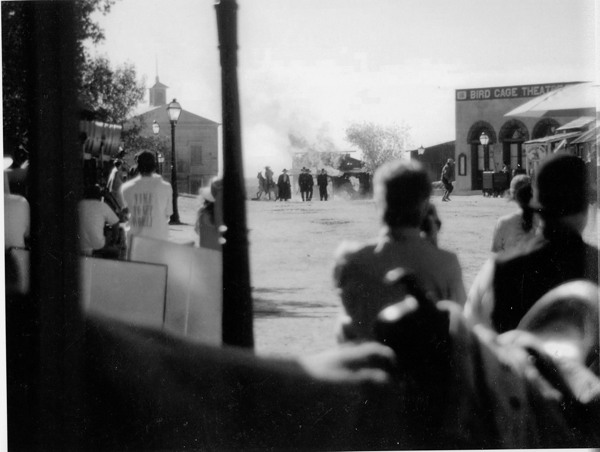
The Earps and Holliday begin their long walk down Allen Street. A crew member stands on the left watching the scene while wearing a T-shirt that reads “Time to get Wooly” (courtesy Larry Zeug).
Filming of the iconic O.K. Corral gunfight took place between July 26 and 28. However, preparations for this climactic scene had begun well before then. Jeff Morey and Jarre had discussed taking all the actors who were to take part in the gunfight to Tombstone to go through how it actually transpired, but when Jarre was dismissed, that plan evaporated. Nevertheless, rehearsals were required the weekend before the scene was filmed. According to John Philbin, “We did [it] over and over again, tirelessly. Over and over and over.” Naturally, they tried to replicate the actions of each character, not only in movement but in the proper historical sequence as well. Philbin continues, “[During] the first master shot, we didn’t know what in the hell was going on. [But the process] eventually got cultivated down into tight and dramatic timing. We rehearsed it a bunch of times and by our last rehearsal, we [timed] it to the second [of the actual gunfight] and to the [correct number of] shots fired and we all felt something very special. Everybody felt something at that point; everybody involved in that scene in that corral, felt something very powerful that day.” Buckaroo Sam Dolan had a similar impression as the rehearsals narrowed down the action to match the intricacies of the actual gunfight: “All of the actors [were] in their regular clothes, shorts, T-shirts, flip-flops, all the six-guns firing blanks. They were working out the beats and kind of timing it out. The way it played out live was very quick like the actual O.K. Corral would have been.”24
Once the rehearsals were finished, the actors adjourned to the Buckaroo camp where targets had been set up. After spending all day firing blanks, the actors predictably felt somewhat complacent. Thell Reed had the answer: The armorer-consultant-stuntman-extra-exhibition shooter extraordinaire wanted the actors to feel the recoil of real revolvers, so he arranged for them to fire live ammo. Everyone fired at cardboard targets with faces drawn upon them, Val Kilmer wisecracking, “One of those guys looks an awful lot like Doc.” Some were better marksmen than others. According to Robert Burke, “I remember hitting everything. Once I hit this beer can and once it was up in the air, I drilled it again. Everybody went nuts because I had played RoboCop prior [to that] and they started screaming, ‘Robo! Robo!’” Russell admits he wasn’t the best shot. “Val Kilmer and Michael Biehn were the standouts. It was amazing how each actor could shoot just like his character. Val was very fast and accurate and so was Michael. I was very deliberate—very accurate, but slow.”25
More fun followed as John Peel describes: “I had a gallon jug of milk I had brought out to blow up with a shotgun, and Kurt wanted to shoot the shotgun. I threw the gallon jug of milk in the air for Kurt to shoot, and he blew that up. Then Val and all the other guys started going, ‘Thell, Thell, Thell.’ So, Thell goes, ‘Okay, fine.’ He puts on his speed rig, loads a pair of guns and at about seven yards he draws, does six rounds, flips a gun into the air, swaps a gun to the main hand and then thumbs six more so quickly that literally everyone stood there with their mouths open. Live ammo, .45 Colt, full loads. He holsters his guns, takes them off and hands them to me, and he was done shooting; very much the professional.” The actors then left for the hotel, amazed at the exhibition they had just witnessed.26
Before filming of the O.K. Corral shootout began, Cosmatos ran one last blocking rehearsal. According to actor Grant James, “If George wanted something different, he would tell the actors. Then they would pull in the stand-ins so they could set the lights, place the cameras, etc.” George numbered each cut in the shootout sequence and gave every actor a detailed list of his specific actions. “I took every actor’s what he had to do,” explained Cosmatos, “and I put it in one column and I gave him the paper. And I gave the other actors [their list] so each actor knew exactly what he had to do at the certain time of the scene. Who came first, who came second, that one came third, so I can put the whole thing together to give it the speed and movement we needed to show everything but to show it fast.”
Local Jay Gammons helped the set dressers prepare the blacksmith shop with 1880s touches: “I showed them how to put up that black hood … and things like that [anvils, tongs, hammers, forge, etc.]. Where to put the lamps, etc. What I try to do, I try to keep it as authentic as possible. ’Cause some of your Hollywood people are not very authentic. They … put in [items] they like from the 1950s and they think it’s from the 1880s and it isn’t, so you have to be careful with them. I had to go tell them.” Catherine Hardwicke had done a marvelous job of compressing the six square blocks of stores, saloons, dwellings and livery stables that surrounded the O.K. Corral into a more compact “downtown” district. According to Washington Times reporter Gary Arnold, “This arrangement helped create a sense of intimate, right-around-the-corner violence missing in some of the earlier films about the subject….” Bill Fraker noted how it previously had been customary to place the O.K. Corral at the edge of town, permitting sky composition while expanding the field of fire for the actors. But now, with the corral placed authentically in the middle of town, in a 10 × 20 yard lot hemmed in by buildings on three sides, one realizes how the gunfight actually had featured a “point-blank decisiveness,” which intensified and concentrated the minds and anxieties of each participant.
The attention to detail in the costumes, weapons, saddles and set-dressing is what made Tombstone so authentic. John Peel, Billy Lang and Jake Johnson assisted Thell Reed with all the guns while the gunfight sequence was filmed. “We cleaned all the guns between each take,” remembers Peel. “Thell assigned us each an actor. He’d say, ‘I’ve got Kurt and Sam, you do Bill and Stephen Lang. You’re in charge of this guy’s gun. As soon as they yell, ‘Cut,’ run in there, grab the guns, run out here and clean them up real quick, load them up and stand by until they’re ready to go.’ Reed didn’t want us to give the actors loaded guns until the last possible second, especially at close quarters where the actors were essentially shooting blanks at each other. So we had a little wooden dowel and before we’d load a gun we checked the bore of the gun to make sure there were no obstructions in the bore that might turn into a projectile.” Jake Johnson also helped modify Val’s shoulder holster and replaced Kurt’s holster, which fell apart early in shooting.27
As a part of his responsibilities, Adam Taylor conducted a safety session before the scene began. He discussed the weapons, how they operated, who was going to be using what, and confirmed that everyone knew how to use them. Every gun was going to be loaded with quarter-load blanks provided by Stembridge Gun Rentals. Full-loads are 28 grains of FFF black powder; 15 grains are used for a three-quarter load, ten for a half-load, and five for a quarter-load. There also are a variety of types of loads for blanks—some for more flash, some for less, some for redder flash, whiter flash, more smoke, less smoke, etc. Noise isn’t really an issue as the sounds of gunshots are later added in during the Foley process. After the safety meeting, Kurt Russell walked up to Taylor, got in his face and said, “Wyatt Earp only uses full loads.” Supposedly, according to some of those present, Buck Taylor went after Russell and said something on the order of, “Don’t you ever speak to my son again like that because he’s in charge of your safety.” A compromise was reached. They would use half-loads.
Given the recent death of Brandon Lee in The Crow, it was critical that all the blanks and loads in the guns were properly checked, but Eddie Perez remembers finding actual bullets on some of the gun belts used in Tombstone. “I mentioned it to Thell Reed,” recalls Perez, “and the next thing you know, I was looking at gun belts for him. He said, ‘Oh, man. You’re really on top of that. Why don’t you look to see if they’re any more of them?’ I think I found five or six more bullets like that left in the gun belts.” And it was a good thing he did. One scene in The Crow called for a close-up of bullets loaded in a revolver. To accomplish this effect, dummy cartridges fitted with bullets but no powder or primer were used to provide a realistic appearance. Rather than purchasing dummy cartridges, though, that film’s prop crew created its own. After pulling the bullet from a live round, the powder charge was removed and the bullet reinserted into the cartridge. Unfortunately, a live primer was left in the rear of one cartridge and, at some point during filming, this bullet was discharged with sufficient force to jam the projectile halfway down the gun’s barrel. Then for a subsequent scene, the dummy cartridges were exchanged for blank rounds—which feature a live powder charge and primer but no bullet—thus allowing the gun to be fired without the risk of an actual projectile. But since the bullet from the dummy round was already jammed in the barrel, pulling the trigger caused the bullet to exit the barrel with virtually the same force as if the gun had been loaded with a live round, resulting in Lee’s death.28
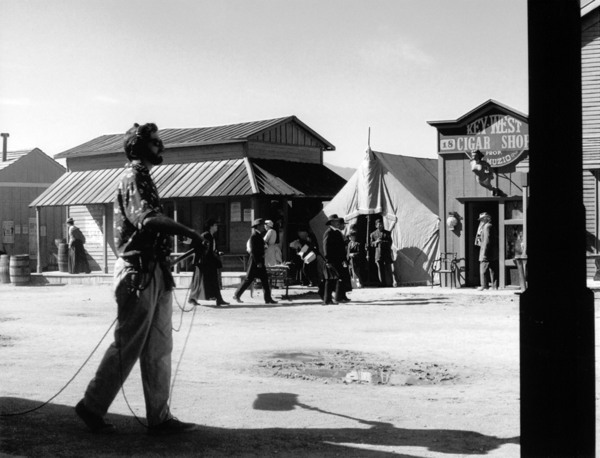
The Earps and Holliday (left to right: Val Kilmer, Bill Paxton, Sam Elliott, Kurt Russell) continue down Allen Street past an opium tent and the Key West Cigar Shop. In the foreground, a crew member holds a boom microphone (courtesy David Russell).
Concept and storyboard artist David Russell illustrated the wedding massacre scene and developed the O.K. Corral sequence, albeit under considerable pressure and time constraints. He consulted with Cosmatos on additional shots and alternate shots and concepts for both scenes. According to the artist, “George really had no vision for the respective sequences. I essentially ‘directed on paper,’ which is quite common in my profession,” so most of those scenes were largely shot as storyboarded. In general, a storyboard artist is drafted during an early stage of pre-production but David wasn’t brought on board until after Cosmatos had arrived. David explains, “The job entails working in collaboration with the director to create a comprehensive visual narrative of the film. The storyboards serve numerous functions: as a budgeting device, shooting guide, stunt and visual effects template, and more. The storyboarding process is usually completed by the time shooting commences, but in the case of Tombstone, Cosmatos urgently required assistance in planning several key sequences.” Obviously, it was a successful collaboration. Others also assisted in the effort. The Buckaroos, for example, observed, “You know, there was a ditch, they were digging a ditch across the vacant lot at the time [of the actual gunfight].” So, production added a ditch.29
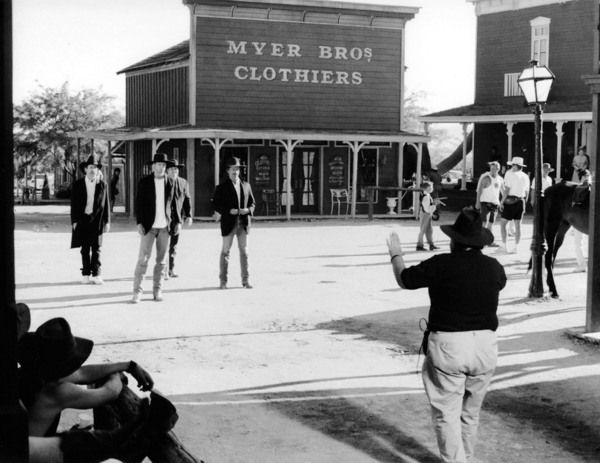
As the party prepares to make a turn down the historical Fourth Street, George Cosmatos instructs the stand-ins. Chas. Wheeler holds a pair of wooden guns in mid-street (courtesy David Russell).
Prior to the start of the shootout, Behan enters Fly’s Gallery after telling the Earps that he had disarmed the Cowboys. Inside, Josephine Marcus is seen having her photograph taken by Fly. This portion of the scene is intended to recreate the famous Kaloma photograph. Supposedly taken by Fly, it represented a 1914 photo of Josephine Marcus. She is naked but covered with a sheer gauze peignoir. When informed that Josie would have been 53 years old in 1914 and this woman looked more like 19, the author of the claim said the photograph was taken back in 1883 but only released in 1914. However, most reputable historians refute this. When the storyboards for this section are reviewed, it is clear that a much-expanded version of this scene was originally planned: Josie disrobes behind a screen, steps from behind it, and to the amazement of the photographer, stands in full-frontal pose, covered only by a transparent veil. She then admires herself in the mirror before the photo is taken. But only the latter portion of this sequence appears in the film.
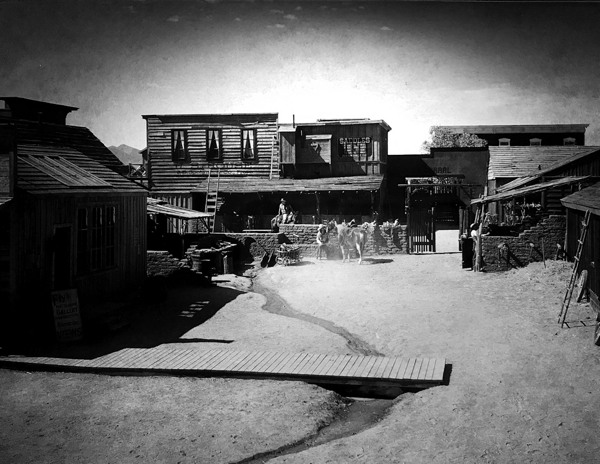
The O.K. Corral set (photograph by Lee Gray/courtesy Catherine Hardwicke).
After the above portions were shot, they finally were ready to begin filming the gunfight. Taylor shouted, “All right, people. Settle down, please! Quiet all around! Stand by! Kill those radios! There will be fire in the hole! We’re using half-rounds!” And finally, filming of this version of the Old West’s most famous gunfight began. Russell recalled, “Just as George said ‘Action!’ there was a large crack of rolling thunder. We began the master and ran through it like clockwork … it worked just right. When it was over, everything went quiet, almost as though a train wreck had just happened, and once again, a long crack of ominous, rolling thunder punctuated the end.”
According to Cosmatos, the Earp-Holliday quartet was intentionally dressed in black hats, coats and vests that conveyed grim intent. “If you look at the dark clothes, they look like undertakers,” observed the director. Even with half-loads, though, the noise was ear-splitting. As no one knows who actually fired the first shot, Cosmatos had to find a way to start the gunfight. According to George, he suggested that Kilmer wink and Thomas Haden Church react. Jake Johnson recalls, “[T]hey shot the gunfight, like it was done, to as many of the [historical] records as they could. This guy shot first, this guy shot second. This guy did this, this guy did that. A lot of their actions are based on what really happened in the gunfight. So we would shoot from the beginning to all the way to the end of the gunfight from all these different angles, depending on the light, who was in the close-up and different things that were documented. So it’s very accurate. [But] it did not get edited that way.” After each take, crew members would run out to collect all the props, pick up the blanks and rearrange the set dressing to go “back to one” if required.” (“Back to one” is a term that means all cast and crew should go back to their initial positions to prepare for another take.) Once Cosmatos was satisfied with the master coverage, different close-ups, over-the-shoulder, POV and atmosphere shots were filmed. All told, it took four days to film the sequence. In take after take, Stephen Lang refreshed himself by ducking his head in a barrel of water and then dramatically flinging his head back.30
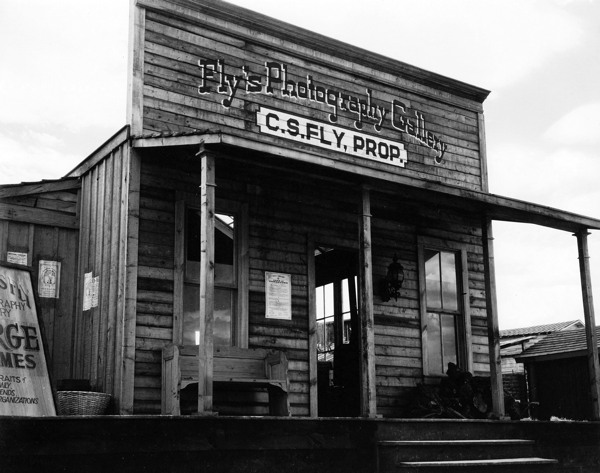
Fly’s Photography Gallery in Mescal (photograph by Lee Gray/courtesy Catherine Hardwicke).
Naturally, the heat caused problems. Remembers Perez, “When they were shooting the candy glass [window panes in Fly’s studio], they’d shoot one [of the panes] and all of them would start [breaking] because of the heat. In fact, you can see broken glass in front of the building, because they had to put the [panes] back together.” This sequence is yet another example of the film’s continuity issues. A careful examination of Ike Clanton’s actions inside Fly’s studio shows that the broken window frames and wooden stiles appear and disappear from shot to shot. After Clanton bursts into the studio, grabs Behan’s gun and breaks out the window, the viewer can clearly see the missing wooden stile on the left side of the center bank of windows. Both upper and lower window panes are shattered. In the portion of the shootout when Wyatt asks Doc to return Clanton’s fire, the entire center window, including glass, minions and stiles, is now gone. However, as Doc starts to advance toward Ike, the window is back and unbroken. After the shootout ends and Wyatt assists a wounded Morgan, the left half of the window, including the stile, is missing. One can clearly see how pieces from the various takes were cleverly, though carelessly, spliced together. Cosmatos says that it wasn’t carelessness, just a lack of material. “We had problems because we blew up some windows in the photographer’s shop, and we didn’t have any more extras. In the film, now when you see it at the end, it has no glass in the frame any more. We took away everything and we just used it without glass. I ran out of glass because they were stupid and they brought me three panes of glass only. With all that shooting, three panes of glass is like nothing.”31
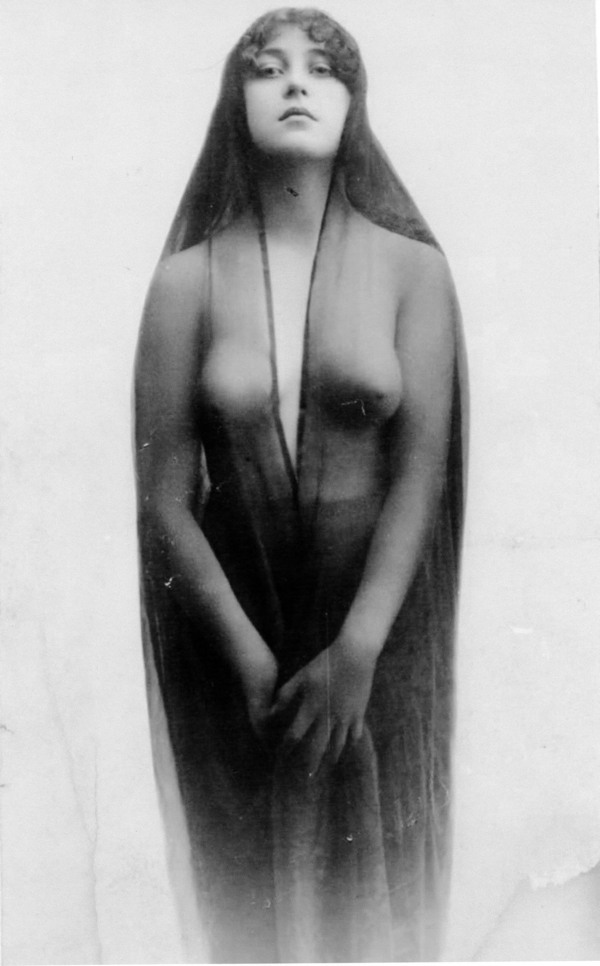
This image of “Kaloma” is believed by some to be Josephine Marcus. The image appeared as an art print and also on the cover of composer Gire Goulineaux’s “Kaloma, Valse Hesitante (Hesitation Waltz).”
Lee McKechnie stood in for both Val Kilmer and Bill Paxton when the shootout was filmed and vividly remembers how long it took to set up each sequence: “Sometimes it takes two hours to set up for that. Lights, camera, sound. Measuring the distance, changing lens. I’m [lying] down [in the street] there for a good 20 minutes or so, and it’s hot and I’m wearing the same type outfit Paxton’s got. Bill walks by, looks at me and pleads, ‘Lee, please get up. You’re making me hot. Can I do that?’” Declining the offer, Lee told him, ‘“Actually, I get paid to do this. It’s cool. Don’t worry about it.’ [But] Paxton got down there [anyway] and he was down there another half hour by himself. That’s the kind of guy he is.” Quite the comedian, Paxton had a great time on location. He would imitate Cosmatos by walking with his chest out, talking with a Greek accent. Everyone thought it was hilarious but you didn’t want to joke too much about George when he was on the set. During the O.K. Corral shootout, Paxton’s character Morgan Earp is shot and falls to the ground. After the take was completed, Bill just laid there and exclaimed, “Game over, man,” a line his character Pvt. Hudson made famous in Aliens (1986).32
Several observers noted that actor Thomas Haden Church added a reflexive kick as his character, Billy Clanton, dies. This surprised Donna Cline: “I was there and I was watching that as he was shot and ‘died,’ falling against the wall and half reclining. He made a jerking motion with his leg…. I was so amazed because it was fairly realistic. I have a medical background—medical illustration. This reflexive kicking represented the waning of the blood pressure, the last semblance of consciousness; it was almost like the last hold on life. It was brilliantly done. (A scrabbling motion with the heel of his right boot, as if struggling to get back up.) I talked with him afterward, saying, ‘Tommy, that was awesome. Very realistic. Where did you [come up with that?]’”
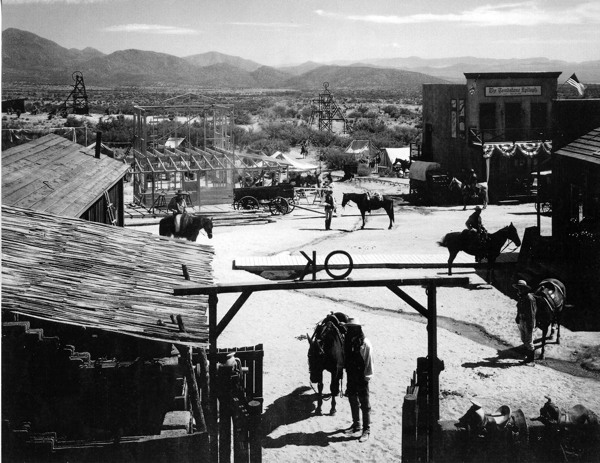
A view from the front of the O.K. Corral looking toward Fremont Street. The two-story Tombstone Epitaph building is on the far right (courtesy Larry Zeug).
“‘I just made it up. I don’t know,” said Church, who told someone else, “[It was] one of those instinctive things that comes to you—everything’s going for Billy and I try to get a little traction as I’m spiraling out of the old mortal coil.” Church also repeatedly cocked and fired his empty revolver while speaking Clanton’s last lines, “I need more cartridges, somebody load my gun.” Neither action is seen in the film.33
Josh Swinney was one of the lucky ones who watched the shootout being filmed. “All the kids went and watched that. I remember the clean-up of the blood so they could re-do the scene. They would even take a blower and blow the dust around [to cover prints]. Re-setting the scene took a long time. Reloading guns, checking all the guns…. The actors would go back to their trailers, and then they’d come back and film it again. [They would] have to go back and look at the camera to make sure that they got everything put back where it was supposed to be. [Filming of the shootout] didn’t happen in little segments; they’d have multiple cameras set up. It took a really long time [to film that scene]. I remember they had [camera dolly tracks] they kept putting down. And then they had to move the tracks, put them down, lock them in place, and that took a really long time.”34
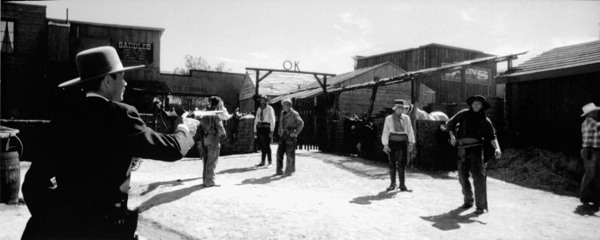
Bill Paxton (Morgan Earp) draws a bead on Robert Burke (Frank McLaury) during rehearsal while other members of the Red Sash Gang contemplate their futures. Burke is on the far right, wearing a dark shirt and hat (courtesy James “Spud” Danicic).
Terry Leonard made an acute observation: Several horses are visible in the gunfight and one rears, turns and accidentally falls after Kilmer fires his shotgun. With cotton in its ears, the horse was protected from the shotgun blast, and the ground had previously been dug up and softened for just such an occurrence. Unfortunately, during that particular take, there wasn’t a camera there to catch the animal’s dramatic action. A frustrated Leonard cried, “What the heck! You guys need more cameras at different angles so you can catch that action!”35
Robert Burke, who played Frank McLaury, recalls a pair of mishaps: “I had a double-loaded squib that’s supposed to be packed on my left shoulder. I’m tucking my head into my right shoulder because I know that thing is just going to let go. You have to agree to have a double load placed above your heart area because it’s so devastating. I had worked with squibs and effects so I knew if I turn my left shoulder way out and hold my head back, it will be fine. Well, the fellow packed it on the wrong shoulder and I took every bit of the blast on the right side of my face and my ear and, rather than doing the scene over, I just kept going. Kurt came out to me; you would have thought his own kid had hurt himself. ‘You all right? You all right? You all right?’ My hearing was just gone on that ear and I had some burn marks under my neck. The joke was, before I hit the ground, the fellow who packed that charge was on a flight home. They took me to the hospital, I had some burns. No big deal. The next day we’re back at the O.K. Corral and I take a bullet and go down but the tip on my shoes gets caught in this hole and I snapped my left ankle like you couldn’t believe. Honest to God, I thought I broke it. [I’m] trying to get my boot off and I can’t because it’s swelling up so bad. Sam Elliott is standing with his back to the set above me and he said, ‘What’s the matter, Bobby?’ ‘My foot’s swollen up,’ and he pulled a Bowie knife out and he cut the boot off of me and I took the sock off. He said, ‘You done just as well to break that thing.’ I had this white patch on my neck, I had this balloon cast on my left foot and I go to the airport to pick up my pregnant wife and she’s like, ‘Are you kidding me?’ ‘No, honey. I’m fucked up.’ Sam says, ‘Oh, hell, Bobby. We’ll [just] put a big boot on ya.’”36
During the last two days of filming the O.K. Corral sequence, the background extras were brought in and placed in the roadway facing the corral. Chickens, dogs, goats and sheep were running wild and the heat was getting to everyone. Dickie Stanley remembers, “One guy was making these goat sounds [while] they were filming. Everybody was laughing but nobody wanted to say who was doing it. Every time they’d go ‘Action,’ he’d go, ‘Baaaahhh.’ George was like, ‘Where is that goat? Somebody find that fucking goat!’ I don’t know how many takes we did, [maybe] six or seven. Finally there were hardly any animals [left] any more, a couple of dogs, maybe a couple of chickens. All the other animals had been removed. [But] nobody pointed at [the culprit]. Everybody was laughing but it also wasted a lot of time.” After the scene was finished, production decided to have a contest: How many shots were fired during the actual filming of that scene, including all the takes? The answer: 1137.37
Although Jarre had taken several historic liberties with the shootout, generally, his script followed actual events. The film’s attention to detail in this scene is extraordinary. For instance, the real Tom McLaury wore a silver hatband and the actual Billy Clanton wore his gun cross-draw–style on his left hip—both examples specifically noted in actual testimony at the Spicer hearing conducted after the gunfight. Robert Burke and Thomas Haden Church did likewise. Val Kilmer whistled a tune as Holliday and the Earps marched toward the shootout, exactly as Stuart Lake wrote in his highly fictionalized, extremely controversial 1931 biography Wyatt Earp: Frontier Marshal. In fact, Jarre always took the opportunity to include several historical-literary-cinematic references in both the script and dialogue, and when faced with conflicting or contentious information, he didn’t hesitate to incorporate it into his screenplay. A case in point is the Buntline Special.
Western mythology has it that Ned Buntline, aka dime novelist Edward Zane Carroll Judson, Sr., commissioned five .45-caliber, single-action Colt revolvers with 12-inch barrels as compensation to renowned lawmen Wyatt Earp, Bat Masterson, Bill Tilghman, Charley Bassett and Neal Brown, for “material for hundreds of yarns.” Supposedly, each revolver came with a hand-tooled holster, a removable rifle stock and the word “NED” carved into the walnut butt of each gun. However, prior to Lake’s inclusion of this event in his book, there was no known historical reference to any such special-commission activity. Colt did manufacture several long-barreled pistols between 1873 and 1876, but all those guns had 16-inch barrels that were left unattached. When someone ordered a shorter-barrel weapon, Colt merely cut off the barrel to the requested length. There are no records to indicate that Colt ever produced a 12-inch-long barrel revolver. Nevertheless, “This is the West, sir. When the legend becomes fact, print the legend.” So Jarre decided to honor the myth and include the Buntline Special. Three specially manufactured EMF Hartford models with 12-inch gun barrels were acquired from Colt Firearms and shortened to ten inches. And because Tombstone bartender and Earp admirer “Buckskin” Frank Leslie once had ordered a ten-inch barreled Colt, Peter Sherayko made the case that Leslie likely would have wanted to carry a gun exactly like Earp did, hence the ten-inch barrel. “Buntline Special” was stamped into the top of each barrel and brass plates were created by John Innes and attached to the guns’ grips. It read, “To Wyatt Earp Peacemaker. From the grateful people of Dodge City. Apr, 1878.” The saga of the Buntline Special may not be true, but if it isn’t, it should be. After filming ended, both Russell and Cosmatos were each given one of the guns.38
It should be noted that in a Guns & Ammo magazine article (December 1997), historian Jeff Morey describes Stuart Lake’s search for the five presentation guns via letters Lake wrote to Josephine Earp, Colt Firearms, Thomas Masterson (Bat’s brother) and the editors of the Wichita Eagle, The Empire (Juneau, Alaska) and The Nugget (Nome, Alaska). Clearly, Lake believed the guns existed.
Some viewers relish the opportunity to point out historical errors in films such as this, and Tombstone is no exception. One inconsistency that is always identified is that there are three discharges from Kilmer’s double-barreled shotgun—an impossibility. One observer noted, “The reason Doc shoots his shotgun three times is because there’s two historical quotes where Doc shoots his shotgun into the O.K. Corral twice. But then there’s another account that says Doc shoots his shotgun up into the air towards them and to scare them. So they covered both versions of that to see what would happen in the editing room and all three of Doc’s shotgun shots end up in the movie. Stretched everyone’s point of view, basically is what they did.” Others have a different explanation. “I tell them [Doc] had a Drilling,” says Reggie Byrum. “Most people don’t know what a Drilling is. It’s a European double-barrel [shotgun] with a rifle barrel in the middle.” Drillings normally consist of two matching smoothbore barrels and a rifled barrel; the triple-barrel shotgun is generally laid out like a side-by-side shotgun, with the third barrel centered and below the other two. The barrels are all the same gauge. Most are break-action guns and use rimmed cartridges. But the film clearly shows that Doc’s shotgun only has two barrels.39
In reality, though, this was simply an editing issue. An undated, handwritten document from the Old Tucson Tombstone files identifies 83 specific cuts in the shootout sequence. Not only does this preliminary document indicate that Wyatt takes the first shot, it clearly states that Holliday only fires his shotgun twice, before he pulls his handgun. Tom McLaury fires over his horse’s neck, Holliday fires once into the air, cut to rearing horse as McLaury lets go of the reins, cut to Holliday who fires a second time, cut to McLaury whose side explodes in a red mist as he falls to the ground, cut back to a shot of Holliday just before he pulls the trigger for the third time and McLaury is still standing but his horse is now falling. The editor wanted to show as much action as possible from as many camera angles as possible and ended up showing the same scene more than once. In fact, Billy Clanton is seen falling to the ground three times!
Bo Gray was supposed to be in the shootout but was replaced by John Corbett. Says a still-fuming Gray, “I went up to Bob Misiorowski and said, ‘Bob, am I cut out of the O.K. Corral?’ ‘Yeah,’ he replied. ‘They wanted John Corbett in there and he’s more of a name and all that.’ I said, ‘Okay, you get me a van to leave. Get me the fuck outta here. I’m off this set. This is bullshit.’” Misiorowski tried to settle him down: “No, you can’t do that. You gotta stick around for the funeral scene. You’re already established.” Gray shot back, “This is such bullshit, Bob.” A sympathetic Misiorowski agreed: “Well, I’m with you but I can’t do anything about it. I really can’t.” In the words of Gray, “I was so pissed off, I couldn’t see.”40
Given the constant action, the number of actors, takes and cameras, it was inevitable that there would be continuity errors embedded within the scene. In addition to the aforementioned windows panes, and the number of times Holliday fires his shotgun, an obvious example of this is Frank McLaury’s hat. When the Earps and Holliday first approach, McLaury strikes a dramatic pose … wearing his hat. There is then a subsequent close-up where he is hatless, and then, when the gunfight starts, he’s wearing his hat once again. No doubt, the hatless edit was shot just before his fatal head wound, by which time his hat was gone. Perhaps they were looking for a nervous close-up before the shooting began, grabbed it and inserted it out of order. Edit issues like this happen all the time.
On July 31, they filmed the death of Doc Holliday. Although the exterior of the building in which this was shot was the Alhambra Saloon, the practical interior set represented the Glenwood Sanitorium. “One of the areas I’m proud of is the last scene with Doc,” Kilmer says. “We had to restructure the ending, because we’d run out of time and money, and I had this beautiful [five-page] monologue that Kevin Jarre had written. But dying of tuberculosis—I can’t talk for five pages! And every time I rehearsed it, I just would start laughing… I mean, they were beautiful words, just not realistic. So I came up with a visual sequence instead, the card game. You know, Doc used to play cards a lot, and it’s one thing he could enjoy that would take his mind off the pain. And it allowed Doc to move along the story points—to urge Wyatt to live life and go find that girl…. They were all ideas that Kevin Jarre had written but at that point we were on our own. And I knew the character well. I never talked to Kevin about it, but I hope he liked what I wrote.”41
The Earps-leaving-Tombstone scene where Curly Bill smugly tells Wyatt, “Well … ’bye,” was filmed next door at the Can Can Restaurant. In another scene filmed outside the same building, Wyatt tied a red sash around the boots of two Cowboys hanging from the Dragoon Saloon sign. One of the stuntmen stated they had to re-shoot the scene as he began to feel pressure around his neck from the hanging rigging. Prior to filming it, wranglers had shoved Kurt Russell’s shotgun into his pommel sling without tying it down and, as a result, the sling flopped around a bit as he rode. Peter Sherayko was also in the scene and remembers it was pretty tight quarters. “When Kurt finished tying the sash, he turned to ride out and we all had to follow him, but he was always first. He got close to me and his shotgun [stock] caught my leg and broke.” Take two!42
Once Cosmatos wrapped up the aforementioned sequence, he began filming several interior and exterior night scenes. One of the first interiors filmed was the Latin-speaking, gun-cup twirling duel between Doc Holliday and Johnny Ringo at Wyatt’s faro table. (Faro was a late 17th-century French gambling card game. Winning or losing occurred when cards turned up by the banker matched those already exposed. The equipment used was a layout table of oil cloth, canvas or felt with one of the suit cards passed or painted on top. An abacus-like casekeeper was used to keep track of the cards that had been pulled by the dealer. A dealer’s box was spring-loaded to hold a deck of cards minus the joker face up.)
When Jarre first spoke to Kilmer about the scene, the actor was a bit apprehensive. Kilmer: “I was very concerned that the whole movie would be in trouble if I didn’t beat [Ringo] in that moment. And so I said to Kevin, ‘You know, what if this isn’t funny—who knows what it will look like, a little tin cup kind of swirling around in these fancy gun moves. What if it’s not funny?’ And he looked at me and said, ‘Yeah, I guess that’s a problem.’ So what I did was, for a couple of months, work the gun routine with both hands.
“I basically taught myself to do all that stuff with the .45 with the right hand, and also with the left hand—I was doing it with the .38 … and it’s really tough to do that stuff. Guns are heavy. And it’s also weird when you mess up—it’s like hitting yourself with a hammer.” So Val often was seen strolling around the Tombstone set with two guns, twirling them every chance he got, determined to make the scene believable—and funny. “I’ve got two guns, one for each of ya,” drawls Holliday. The first was a 43/4 inch nickel-plated, ivory-gripped .38 Colt, 1877 Lightning. The second was a 43/4 inch nickel-plated, one-piece, ivory-gripped .45 Colt of EMF manufacture. Kilmer became extremely proficient in the handling of these weapons; he could twirl one forward and one backward at the same time. As for his lightweight tin cup, a weight was installed in the cup’s bottom to offset the balance and thus help in the twirling motion.
Prior to filming this scene, Kilmer came up with an unusual technique to get into character. “I’m sitting in my cast chair outside the bar,” says Forrie Smith, “and Val comes out and tackles me. We’re wrestling around, we’re in the dirt, and I finally get him in a compromising position. He goes, ‘Okay, okay, okay.’ I said, ‘What the hell was that all about?’ ‘Well, I had to blow some steam off before I do the scene with the damn cup.’ The wardrobe gal was all upset because he had dirt all over [him] and they had to brush him off.” Before they filmed scenes inside the saloon, they would play the opening bars of Warren Zevon’s “Werewolves of London” over and over to get the crowd in the mood, so to speak. “I’m pretty sure that’s the only take we did,” Kilmer recalls, describing his tin cup rebuttal. “And you always know when you’re doing something right, because the crew laughs. They’re usually just waiting for lunch, while the camera’s rolling. But you know it’s funny when you get applause from the extras and the crew and the camera guys and the other actors.”
Michael Biehn worked equally hard at his gun-twirling skills. “The best thing is that I did the gun work myself for the barroom scene,” says Biehn. “[Thell Reed and I] worked together to create a unique gun-twirling routine. I made up a trick here, and Thell made up a trick there, and we put that routine together in a matter of two or three months. I practiced the whole time to get the Colt .45 to do that. It took about two months to get it to that point. I just wanted to get it right. I even put in things that gun wranglers had never seen before! There was so much gun twirling and it all happened so fast, and of course film makes it look faster as well.” Adds Michael, “I get asked to do the gun-spinning from time to time, but it took a lot of practice; you really have to do it over and over to get it right. It was certainly a difficult scene and took months and months of rehearsal and practice. When we did it, my hands started sweating. Those .45s are heavy. Dana Delany and Bill Paxton were sitting right below me. I didn’t want to hurt them with a gun, and that was kind of nerve-wracking, but we did it.” After filming was completed, Kilmer sent one of the cups to Cosmatos, inscribed “To George, from Doc.”43
Jake Johnson recalls that Biehn practiced so much he broke the gun. “I know Michael Biehn worked with the guns a lot,” explains Jake. “So much so that he broke the grips many times on the gun and I was always taking one of his guns to the gunsmith to have him replace the grips. Now, he got really good at it but in the process of getting good at it he dropped the gun quite a bit. He worked really hard to perfect those moves while he was out there. It’s hard to say exactly what moves [Thell] taught him vs. what he wanted to do because I don’t remember the specifics of what coaching took place. Thell wanted Ringo to look more like a showoff outlaw than a Johnny Mack Brown vaudevillian burlesque performance of gun-spinning and I think that’s the difference you see when he’s doing that. [Biehn] looks like he’s serious, knows how to handle a gun. You can see from some of the angles that there were multiple takes but he was capable of doing the entire routine in one take. It was done more than once. I know I saw Michael practice repeatedly.”44
Dana Loraine Goodge usually was dressed as a townsperson, but in this scene she was attired as a lady of the evening. She preferred to call herself “a theatergoer” who had just arrived from the Bird Cage. According to Dana, “I thought [Val] was joking around. I swear to God I didn’t think it was a part of the movie. So, all that laughter, it was just us thinking he was just goofing around.” She also has a vivid memory of a somewhat notorious extra known as the Scene Stealer. “He was one of those extras who wasn’t invited to be in a scene,” says Dana, “but [somehow] he snuck in [anyway]. You see him in the faro table scene. All of a sudden he’s standing against the wall [next to me]. He walks by and tips his hat. I yelled at him when we got out. ‘How did you get in there and why would you do that in the movie?’”45

Michael Biehn (Johnny Ringo) and Powers Boothe (Curly Bill Brocius) during one of the takes in the “Latin duel” sequence (courtesy www.moviestillsdb.com).
Both Biehn and Kilmer had become very proficient in handling their revolvers. It was said that one night they challenged Thell Reed to a quick-draw competition because, in the words of Frank Stallone, “I guess they thought once they’re in their character, they’re some kind of pistoleros. Thell said, ‘No, I don’t want to do this stuff,’ but Val persisted. ‘Ah, come on, come on.’ Thell had a stocked-up, single-action, 43/4", off-the-rack Mexican loop holster. And he said, ‘Okay, guys. You ready?’ They never even cleared their holsters and he was out.” That was the end of who was the fastest.46
Filming then moved outside to Allen Street. On the evening of Saturday, August 7, and continuing on to Monday, August 9, they filmed the scene where, after leaving an opium den, a hopped-up Curly Bill howls at the moon and shoots at passersby. Faced with no alternative but to arrest him, Fred White asks for Bill’s revolvers but is killed in the process. Wyatt quickly rushes out, cold-cocks Bill and takes him into custody. Ike Clanton and several other Cowboys then demand Bill’s release. Unfortunately, someone forgot to fully load one of Curly Bill’s guns, so when he fired at the moon, the gun would go, “Bang! Click. Bang! Click.” Naturally, they had to film the scene again. In Cosmatos’ commentary in the Tombstone director’s cut, he explained, “I had to go up and up and up … and then the camera, I had it going back down towards him again until it came close to the guns but that was cut, so you don’t get it here. It was like a double-crane shot. This was all one shot before and then it was intercut with the interior.”
A gray-bearded extra is seen as a crowd gathers around the fallen marshal. He kept walking up pretty close to Carey, who played Fred White, and Cosmatos thought the extra was being a camera hog. It wasn’t that, the man just didn’t hear the instructions. They had tried to put him in deep background because the hearing aid he usually wore wasn’t period-correct. But when he removed the device, he couldn’t hear.47
Stephen Lang describes his characterization of Clanton: “[Ike] is as hard-bitten and bitter as Ringo, Doc or Wyatt, but he lacks their confidence and self-esteem. I think that Ike was whipped plenty by Old Man Clanton; [he] has something of the whipped cur in him. Vicious, somewhat dangerous, but also kind of sad and pathetic. That’s good, playable stuff, and struck me as both unique within the story and historically plausible, and possibly very accurate. Everything I did as Ike represents a deliberate choice on my part.” As the scene continues, Wyatt faces down Ike, and Virgil and Morgan rush from around the corner of a building, shotguns in hand. Billy Lang and John Peel were behind the building, loading and unloading the weapons, and Thell Reed had given them specific instructions: “Do not hand an actor a loaded gun until the very last possible second. They’re actors, they’re not gunmen. They could blow a blank off in somebody’s face.” After several takes (witnesses estimated as many as 14), Cosmatos called for one more. By now, it was after midnight. Morgan and Virgil had been filmed coming to Wyatt’s aid at least a dozen times. But Sam returned to the side of the building once more and waited for his cue. As the scene played out, Sam dutifully ran around the corner, and … there was dead silence. Then, everyone broke out into a rousing “Happy birthday!” It was Sam’s 49th birthday. Nancy Sykes from craft services had baked a cake and members of the cast and crew signed a huge birthday card for him. Katharine Ross also made an appearance that evening.48
Johnny Ringo wasn’t present in that scene and there’s a good reason why. Although Curly Bill is shown leaving the opium den, he is never seen entering it. Apparently, Ringo also entered the establishment and upon his departure, was supposed to grab a passerby, lift him a foot off the ground, and bodily throw him into a crowd of pedestrians. The scene was rehearsed several times but by the time it came to shoot it, Biehn was too tired, so he merely shoved the person. Though filmed, it wasn’t included in the film.49
On Thursday, August 12, Cosmatos filmed the death of Morgan Earp. Grant James, who played the part of the historical Dr. Goodfellow, clearly remembers that particular scene: “The bloody pool table scene was on the schedule day after day after day in case of bad weather, which is one of the reasons that I was there as long as I was. They kept praying for good weather.” But by the time they were actually ready to shoot, Cosmatos started fuming and yelling about what was wrong. Kurt calmed him down and said, “I’ll lean back, you lean over, we’ll shoot it again.” James adds, “They made a prosthetic back for Billy Paxton with a hole where the bullet had gone in. It was attached to a tube that ran under the pool table where there was a guy with a bag full of blood. So I would jab those long tweezers in and out and squirt the blood. Billy would go, ‘Oh, oh,’ and the guy would squeeze the bag and out would squirt the blood. It [looked realistic] to me and I was there.” Originally, the scene was much longer, to show the bond between the brothers, but it was cut.50

The interior of the Campbell & Hatch Billiard Parlor where Morgan Earp (Bill Paxton) was murdered. The table in the foreground was removed for better camera placement (photograph by Lee Gray/courtesy Catherine Hardwicke).
That weekend, they filmed scene #49, the “Let’s have a spelling contest” altercation between Holliday and Ike Clanton. (In the television movie script The Tracker, released in 1988 as Dead or Alive, starring Kris Kristofferson, Jarre first used the line, “How about a spelling contest?”) John Philbin recalls that was a difficult scene to film: “There’s this horrible poker game where Stephen Lang gets in a fight and bottles are flying all over. We can’t match continuity, he’s just losing it. Val’s at the table, it’s late, it’s smoky. There were some tense moments. That was difficult when there’s a lot of actors and a lot of props, a lot of action. It’s hard to get the same thing to happen twice in an environment like that. And we were shooting in a practical environment, it’s not a studio, it’s a set. Catherine Hardwicke [had] built a bar. It’s not a studio, and we had to match a lot of things over and over and a lot of actors that demanded coverage.”
Stephen Lang admits that he really tried to get into character in that scene. “I don’t know how many takes we did on the poker scene round table, lots of coverage,” he says. “I think I may have knocked back a shot or six during the course of the evening. Not the way I usually work, but sometimes you just got to go with the flow. I won’t speak for Val.” Cosmatos confessed, “[Lang] told me he was most of the time drunk playing that part. I didn’t realize it until after he told me.” There are usually consequences for such behavior, as Lang ruefully recalls: “Immediately after wrapping, I flew to Colorado to work on Tall Tale, but I also played out my own private sequel or epilogue to Tombstone. It’s called Kidney Stone, because I did four rugged days in the hospital in Glenwood Springs, struck down by a galaxy of kidney stones. That’s what happens when you drink tequila instead of water for four months. Of course the great irony is that Doc died and is buried in Glenwood Springs, just a block or so from the hospital. And I don’t think I’ve had tequila since.”
According to Catherine Hardwicke, “One thing that stands out the most is the scene where Val passes out in the saloon and the boys [Kurt and Bill Paxton] carry him out. On the way out of the set, there is a step down [from the saloon doorway to the boardwalk]. They were supposed to carry [Val] onto the dirt street, then let him down—but apparently forgetting the step down, all three of them went tumbling onto the street…. If you look hard, you’ll see Val’s body tip suddenly as he exits. It was funny seeing them all piled up in the middle of the street.”51
Val also imbibed in alcoholic refreshment while in character, perhaps a bit more frequently than others. Property assistant Greg Poulos was his bartender of choice. “I was in charge of that. [Val] would always say, ‘My flask is broken.’ Some of the prop guys would go up and [try to] fix it. He would go, ‘No. the only guy to fix it is Greg.’ That meant he needed his $50 bottle of Scotch in it (which he purchased from Bobby Joe’s Irish Pub in Mescal). He was Doc Holliday, every day. I enjoyed being with him because he was funny at times, hilarious. I’d see him in the hotel and kind of hide because I know he’d be Doc Holliday. He’d call out my name and I’d go like, ‘Oh, no. I work with you for six days and I’ve got to see you on Sunday, too?’ He was always in character, always. [Sam Elliott knew Val could be difficult] and he would give me a kiss on the cheek and then every night he’d say, ‘Well, you made it through another day with Val.’ When they moved to the Holiday Inn, they put [Val] in the room right next to me and he’d beat on my wall. ‘Val, I got get up in three hours and you’ve got the day off.’”52
Eddie Perez recalls, “I remember one night in the saloon … they handed us prop beer. Being a young kid, I remember saying, ‘They’re going to have us working all night and here they are giving us prop beer.’ That’s when Val came over and showed me his flask and said, ‘Well, here. Have some of this.’ So I poured it into the prop beer, I figured, ‘What the heck, if it’s rum or something.’ No, it was peach brandy. Val was drinking on set to get the character of Doc Holliday and he did an awesome job of doing it. That was the night I woke up at the Bell Gas Station because we got off at six in the morning. And we had to take the bus out there; I didn’t want to drive because I was drunk. I woke up at 11 o’clock in the morning, out in my car, sweating my tail off. Knowing I had to be on the set at three o’clock. I had to drive to Tucson, take a shower and drive back. I tell you, that was the worst time of my life. And when Val saw me the next morning, we were still doing the saloon scene; he sat there and laughed at me because he could tell I was hung over. I was a beer drinker; I wasn’t a whiskey drinker at the time.”53
In some cases, liquor was deliberately used to achieve a certain effect. “I was in the opium den scene,” remembers Poulos, “and Kurt’s gun is on the table and I pick it up thinking it’s the opium pipe and put it in my mouth and he shoots me. Val said, ‘Go drink my Scotch so you look drunk.’ Kurt had me drinking a couple of Miller Lights, it was 4 a.m. in the morning. Then they put this stuff on my eyes to make them red like I was wasted and stoned.”54
On August 14, they filmed the scene in which the Earp brothers and their wives leave the Bird Cage after the theatrical performances and discuss spiritualism in the middle of Allen Street. In the June 24, 1993, revised fifth draft of the script, the characters suddenly stop in the midst of their conversation and gaze at the hills surrounding Tombstone, where they spot 15 Apache horsemen watching in silent contemplation. As the wives move closer to their husbands, the Apaches move off into the darkness. Originally, there was more of a pre-roll of this scene, with other characters leaving the theater before Morgan and Wyatt begin their existential talk. The portion with the silent observers was never filmed.55
Next, they filmed scene #23 in which the Earps and their wives gather outside the Birdcage Theater after the evening’s performance. Virgil and Allie bid the group good night and head home. In an unused continuation of that scene, the couple walks past a person cooking dinner in front of a tent. The actor who played the townsman, J. Nathan Simmons, recalls, “It’s cold that evening and I’m making this really nasty stuff in the pot ’cause they said, ‘Well, bring it up. Let it percolate.’ We had boiling water so I started adding all sorts of things to it. Sam walks by and said, ‘What ya got cooking?’ I said, ‘Well, a little bit of this, a little bit of that.’ Replies Sam, ‘It doesn’t smell very good so I think I’ll pass on that one.’”56
On August 10, they filmed scene #47A, where Virgil posts an ordinance forbidding the carrying of weapons within town limits. Although it appears that the decree was posted outside the sheriff’s office, due to the lack of space between the buildings, it actually was nailed up across the street when the scene was filmed. Wyatt then rides into town, dismounts and realizes that Virgil is now wearing a badge. Simmons was also part of this scene: “Actually, we were pretty darn quick on that. I think we might have done it maybe three times. It was a pretty fast scene, very easy done. They made sure we were aware of the horses; some of us hadn’t been around horses before.” Apparently, three extras also were supposed to say lines in that scene but it was not to be. “One guy ended up doing the lines from all three of us,” grumbles Simmons. “I would say that was kind of a bummer for all of us; we wanted to kick his butt afterwards. It’s like, ‘Dude, we’re all assigned a line in this movie and you end up saying them all?’ We didn’t see him much after that. He had basically done his part in the movie and he was done. But he stole our thunder as well.”57
Two days later, Cosmatos filmed the aftermath of Morgan’s death when Wyatt, with blood on his hands both literally and figuratively, staggers outside in the pouring rain. For whatever reason, Russell was in an extremely bad mood that evening and yelled a great deal. In this scene, Wyatt calls Josephine a “Jew whore!”—something later changed to simply “Get away from me!” The lightning was real, the rain wasn’t. Tom Ford coordinated the effect. Three rain-making machines had been rented for the film, but due to budget constraints, one was returned. As a result, they could only simulate rain on a portion of the street. Viewers can clearly see a dry street behind Russell as he stumbles around. A large 8 × 15-foot lighting array made of aluminum pipes in the shape of a cube, and covered with bleached muslin, simulated the moon. It housed four 2500-watt HMIs (hydrogyrum medium arc iodide) and was hoisted 80 to 120 feet in the air by a condor crane to create artificial moonlight. Amusingly, some locals thought they were seeing UFOs and called the police department. It even made the news: “There were UFOs sighted off of I-10. Film at 11.”
The lightning was both dangerous and terrifying. “One night, in the desert, a lightning storm came in around us,” recalls Donna Cline. “We had three 60-foot cranes in the air. Honestly, if it hit one of those cranes, it might have killed us all. It seemed like they waited too long but they finally said, ‘Okay, we’re going to take the cranes down,’ and everybody ran into the saloons and ran into places where we could get away from the cranes. It was frightening, because the storm was on us. I’ve never seen lightning like that before.”58
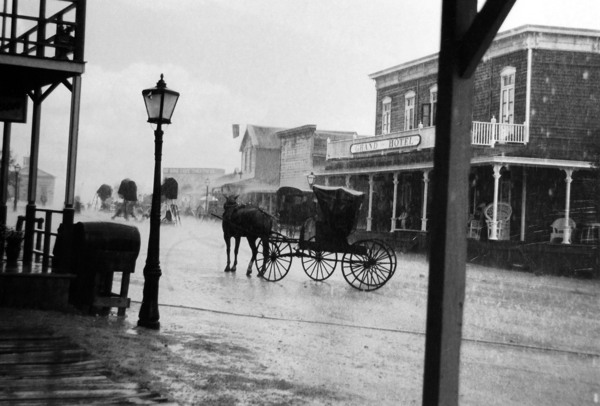
While a horse stands in the middle of the street, rain is pouring in Mescal and bystanders take shelter in the Grand Hotel (courtesy P.J. Lawton, Old Tucson Studio).
During the night shoots at Mescal, the construction and set design team for The Quick and the Dead moved in and started to give the town a complete makeover, something that Sam Dolan woefully recalls: “Honestly, it was a little depressing. The transition signaled to us that our time at Mescal and on the movie itself would be drawing to a close. But there was also the sense that the brightly colored Tombstone that we’d called home for several weeks was being turned into something darker and dirtier. Nothing is really sacred in the business. They built the large fake brick building down the end of the street that served as the main saloon in The Quick and the Dead and very rapidly made a number of other cosmetic changes.”59
During the Vendetta ride sequence, Kilmer and Buck Taylor’s characters burst into a hotel room and kill a Cowboy (stuntman Cody Lee) who’s in bed with two prostitutes. It was filmed inside the Grand Hotel, and Emily Blanton, who played one of the prostitutes, vividly remembers that night. Blanton was told, “Hurry up and go to the wardrobe trailer and grab your wardrobe because they’re going to be blocking for this scene right now.” Blanton says, “So I run over to the wardrobe trailer and they hand me a G-string and a bathrobe and they said, ‘You need to put this on right now.’ [Covered with the robe,] I run out to the set and both Buck and Val are out there. I told them how shocked I was that all I had on was a G-string. I think it kind of perked both of their interests. When they actually did the scene and busted into the room, I had managed to get my hand on a handkerchief—like a little scarf-y thing. So as soon as they busted into the room, I covered up my boobs because I wasn’t prepared to share myself with everybody. George kept saying, ‘We need to react slower.’ I’m like, ‘Okay, sure,’ but I didn’t follow his directions. We did it again. He goes, ‘Emily, we need you to react slower.’ ‘Okay.’ And again I didn’t. I covered up my boobs and that’s probably why that scene stayed in there. I didn’t end up on the cutting room floor because I hid my nipples, pretty much. [As for the other girl in the scene, the first time] she bumped her head because she wasn’t that experienced and she wasn’t used to the squibs and how loud they were. We did three [takes]. Just three, and that’s pretty good.”60
Several other scenes were filmed inside the Grand Hotel, including the night Sheriff Behan confronts Josephine Marcus right before Virgil is ambushed. The interior was fully decorated thanks to Nell Peel, an antique dealer specializing in Victorian furniture (and mother of Buckaroo John Peel). Most of the pieces in the hotel, as well as the Earps’ houses and Holliday’s bedroom at the Hooker ranch, came from her. She also supplied linen and dishware to decorate the sets.61
By now, everyone was virtually exhausted and it seemed that the closer it got to the end of filming, the faster the scenes were being filmed. “I did notice that there was an urgency in the last few weeks,” admits Mark Rainsford. “We were trying to find out when we were going to finish. I left my home April 27 and got home September 3. The last few weeks, there really wasn’t a hard finish date. Then they finally figured it out and … the scenes wore down.” Even so, and perhaps for that very reason, a great many scenes ended up on the cutting room floor. A case in point are the deaths of two Cowboys. In scene #112, Ringo is notified of Curly Bill’s death by Buckaroos Tom and Charley Ward, who played the two lone Iron Springs attack survivors who bring the news. Says Tom, “There was a night shot—filmed around two or three in the morning— and this was supposed to be after Sabino Canyon. Charley and I were part of the group shooting at Kurt’s character. There was a shot … it was supposed to be after Iron Springs [and] we were reporting to Johnny Ringo. We were the only two survivors. They had a camp, there was an old railroad passenger car, it was a night shot. That was kind of the headquarters of the [Cowboys]. We’re standing before the fire, it was about three o’clock in the morning. Biehn’s there, he’s squatting down with his silver pistol. He said, ‘What happened?’ So we went through all that stuff. Then he said, ‘What I want to know is, why are you two back here?’ He pulls his pistol and shoots Charley in the forehead and shoots me in the chest. Well, we really never did any stunts before that, so Terry [Leonard] is right there. He said, ‘Let me give you some kidney pads,’ and he did. He told us how to fall, and makeup put the makeup on Charley’s forehead with the squib there. A squib was set up in my shirt. [Biehn] pulls the gun and shoots us and we fall over dead and they cut the scene. Terry came over [and asked], ‘Are you all right?’ ‘Yeah, was it all right?’ ‘If it wasn’t all right, they’d be doing it again,’ replied Terry.”62
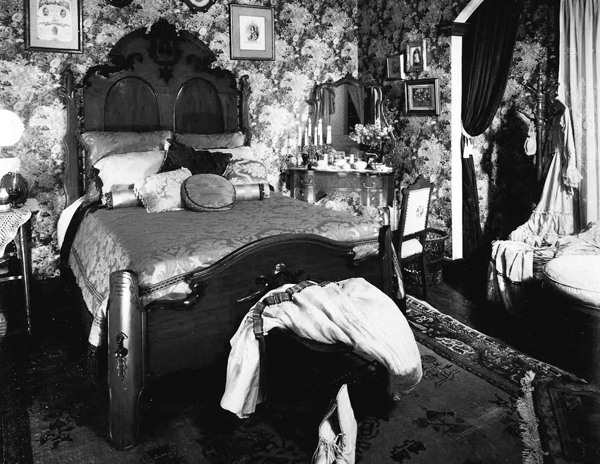
Wyatt and Mattie’s bedroom (photograph by Lee Gray/courtesy Catherine Hardwicke).
Charley has a slightly different memory of that scene. “I was in hair and makeup two or three hours to get that squib on my forehead,” he recalls. “I was really nervous about that. Terry Leonard was instructing us what to do. I said, ‘Terry, I don’t know what to do. I’ve never had a squib on before. I don’t want to screw up the timing on this.’ He said, ‘Don’t worry about it. You’ll know when to fall. You’ll feel a little thump on your forehead. Just fall and look down at your toes as you’re falling. Just let your head whip back and come back up and look at your toes as you’re falling. It’ll be great.’” Not really, as Charley recalls how he felt after the squib went off: “I had an instant headache. I mean right then. I got up, I said, ‘Man, Terry. That was a little bit more than a thump.’ He said, ‘I didn’t want to scare you by telling you actually what it was going to feel like. I thought you were nervous enough. We’ve had guys go unconscious. Stunt guy have a squib on his head, it would knock him flat smooth out. It’s a serious situation but I didn’t want to scare you more than I had to.’”63
Later that month, Leonard filmed a scene on the Babocomari that, again, was omitted from the film’s final version. However, it did serve to set up the death of the actor, Mr. Fabian. In scene #113, cowards Zwing Hunt and Billy Grounds sneak out of the Cowboys’ camp rather than be held accountable for the terror they’ve caused. On their way out of the territory (Scene #120), they spy a stagecoach and attempt a holdup. Extra Kathy Tarantino, Buckaroo Jerry Tarantino’s wife, describes what happened next: “There was a four-up hitch stagecoach and we were running full-blast through the desert and Cowboys, one on each side, were chasing us and shooting into the stagecoach. Of course, they didn’t want to risk Dana [Delany]. So they risked my life. They paid me a whopping … $400 for that day. I just dressed like I normally do because it was far enough away so that nobody would know that it wasn’t [Dana]. They could just see that there was a woman in there with a hat. It was fun and exciting but the stagecoach kept fishtailing. There was myself and two other guys in there, I had on a big satin gown and the seat covers were all velvet. The stagecoach was swerving back and forth and it was slippery and I was having a hard time just staying up. I was just laughing and I was hoping nobody could see that I was laughing. We only did it once. That was quite a thrill.”64
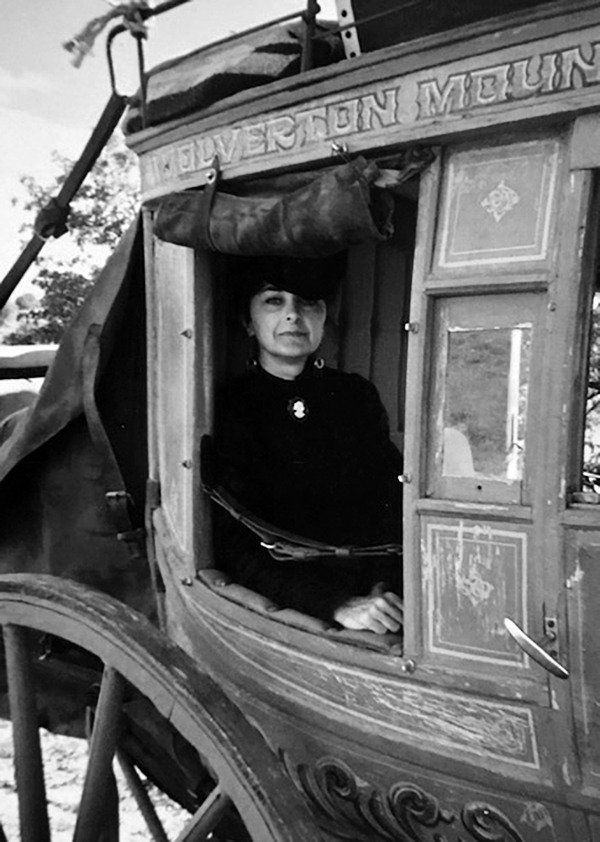
Kathy Tarantino stands in for Dana Delany in the Wolverton Mountain stagecoach (courtesy Jerry Tarantino).
Even though filming was almost complete, several crew members had had enough with the tension and confusion and decided to leave the production. Recalls B camera focus puller Michael Walker, “I left with about ten days left in shooting. There’s a lot of pressure on the A camera first. George [Cosmatos] and Mike Latino were having a lot of problems; the director was crass and didn’t like [Mike], who didn’t put up with a lot of that shit from George. I think they had a lot of issues, personality issues against each other. So [Mike] decided to quit and I had a discussion with Billy [Fraker]. I said, ‘Look, if Mike leaves, I think I should probably leave, too, because [George will] just end up being even worse with me as well. It’s a very stressful job to keep things in focus. It was a very tough show and I think Mike just had enough…. So I’ll probably go with him.’ Bill said, ‘I don’t blame you. I’ll see you guys soon.’ I left about ten days before the end of the shooting. [Later] I heard from a friend of mine that Kurt said, ‘Keep Mike in the credits because he did so much of the movie.’” (Walker: “A camera would normally film wider angles while B camera focuses on tighter close-ups. The cameras may be positioned right next to each other so as to keep the same eye line. Sometime I’m off to the side getting some a different angle or reaction of an actor while the A camera focuses on the primary actor.”)65
After 82 days of filming, the production could finally see light at the end of the tunnel. And everyone was dead tired. Tempers were frayed, actors were sunburned to a crisp, and even the horses were exhausted. If they could only get through the final six days, life again would be good. So, ironically, what scene did they decide to film that last Monday? What else but Wyatt and Josie dancing in the snow. Snow? What snow?
Kathy Tarantino was one of an unusually large numbers of extras used when the scene was filmed that evening. Extras were planted all around the set—inside the theater, in the street on horseback, even building a snowman. However, given the length of the scene and its focus on Russell and Delany, viewers don’t actually get that impression. Most background players were used for general, nondescript activity and even though it was way over 90°, many females were dressed in capes and gowns as if it were cold. Adds her husband Jerry, who was also in the scene, “They had guys on the rooftop of the buildings pouring huge plastic bags full of these tiny plastic flakes. It was very light, very small. We did so many takes on that, the plastic stuff was in our underwear. Every take they had to do, Dana [Delany] had to go inside and they had to take every flake of snow out of her hair so when she came out of the doorway it didn’t look like she had [just] come in from outside. [They were] very meticulous.” And the horses hated the plastic; every time they inhaled, shreds would go up their nostrils. Even a short scene like this (90 seconds) was very costly to create: $26,978, including $3500 to prep, shoot, wrap and strike the set; $2800 for the rental of statue, pedestal, trees, shrubs, park benches and fencing; $12,414 for snow blankets, blown snow, wind machine, tanks and guns, and even $200 for a snowman! If one looks carefully, after Wyatt throws his hat into the air, you can see it catching the wind and flying off into the distance. No doubt that was prearranged. After 10 to 15 takes, and set-up after set-up, everyone was exhausted. Too bad Cosmatos didn’t listen to other suggestions: “I had an argument with some people that wanted to show them at sunset on the beach. I said, ‘Let’s do it in the snow because the snow is a contrast to all the desert we’ve seen.’”66
Over the next five days, another 12 complete or partial scenes were filmed, consisting of 188 set-ups that ultimately produced just 5:40 minutes of footage. Both the first and second units revisited numerous sites, including Old Tucson, Mescal and the Babocomari Ranch, where they filmed additional pick-up shots and did some re-shoots. On some days, they also ran split shifts—filming both night and day—to go easy on the crew and to also avoid various contract penalties. Several set-ups were of scenes Kevin Jarre originally had filmed in the first four weeks. Ironically, much of this new footage was eventually left on the cutting room floor. In one scene, Johnny Ringo was having an evening Cowboy meeting after the death of Curly Bill. It was staged at the end of the railroad tracks at Old Tucson Studios. Buckaroo Jerry Tarantino stood guard in the rain while the outlaws gathered next to a rail car. (This location was also used for Curly Bill’s post–O.K. Corral eulogy.) Cosmatos noticed Jerry’s wedding ring and told him to take it off. “Cowboys. They were never married,” Cosmatos explained. Tarantino’s hand was so tan from the sun that they had to paint the very obvious white, untanned band on his finger. Jerry’s wife Kathy stood behind Cosmatos as they filmed the scene. “They had the camera right on Jerry,” she remembers, “and I’m motioning [Jerry] to go to the left a little bit. No, go right. I was directing Jerry over Cosmatos’ head.”67
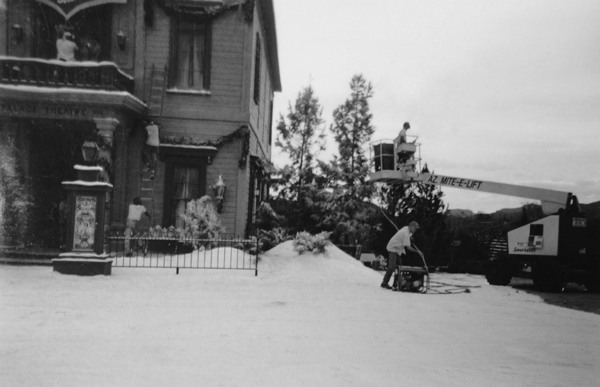
Placement of “snow” in front of and on the Denver Theater in Old Tucson. Shredded plastic, snow blankets and wind machines created the wintry conditions (courtesy P.J. Lawton, Old Tucson Studio).
Known for staging complex aerial shots, Cosmatos wrapped up production with one that was both climactic and stunning. Usually, this type of shot is accomplished through the use of airborne devices like airplanes, cranes, drones or, as in this case, a helicopter. By definition, an aerial shot is an exterior shot taken high in the air and used to establish a sense of geography or scale. In Tombstone, it was used at the conclusion of the dramatic and violent Vendetta ride. Unfortunately, money was tight and as the production already was over-budget, several actors gave up their overages (an additional portion of their salary for every day the production ran over). In addition, one actor went so far as to ask his pilot friend to fly the helicopter needed for the aerial shots … and the actor paid for the pilot to come to the location out of his own pocket. Inclement weather caused the helicopter to be grounded that morning, but the weather broke shortly before lunch and the shots were completed. Cosmatos clarified, “I had them only for a few hours so I tried to [film] as many shots as possible with the helicopters.” Russell, Kilmer, Buck Taylor and Sherayko are seen in this striking shot, riding their magnificent steeds as the camera dramatically rises away. Sherayko explains an amusing aspect of the scene: “There’s a scene where we’re riding the horses at the end of the movie with the helicopter shot watching us ride. Buck and I are always on the outside. We’re on the outside because Kurt and Val weren’t as good riders as Buck or I, so we had to keep them in to make sure they wouldn’t run away. But Kurt also wanted to lead, he had to lead. Buck and I were on very fast horses, and Kurt and Val were on slower horses. And as much as they were getting them to go, we had to be pulling back. So if you look at that scene, you’ll see they are trying to go fast and Buck and I are holding the horses back. ’Cause we can’t have them in front of us. Buck kind of looks over at me and he says something, but it’s all M.O.S. [without sound]. What he’s doing is he’s yelling to me, ‘Slow down, Peter. We’ll get fired.’”68
There is yet a continuity error within this Vendetta ride sequence. As the Earp posse chases Ike Clanton just before he discards his red sash, one clearly sees four posse members. Yet, three seconds earlier, five posse members, including Sherm McMasters, are seen silhouetted against the overcast sky. The McMasters character had been killed off earlier in the film. Sam Dolan details how that scene was filmed: “They lined up the doubles for Earp, Holliday, Johnson, Texas Jack, etc., and then sent me, my dad and some other crew people out every 50 yards or so with walkie-talkies and gave us each a number. As the posse rode right at camera, we were supposed to radio the camera team our number, so that they could pull focus. ‘Approaching four … four…’—that kinda thing. It made for a long day, but when I saw the film on Christmas Day, 1993, I was proud of myself for having helped with that shot.”
In the same Clanton-sash sequence, we also see Sheriff Behan, along with several Cowboys, scattering to the four winds. Jarre’s original script had better-defined this relationship yet virtually all the scenes that addressed the Behan-Cowboy association were missing from the final release. To let them know when the shot began and ended, they also used a walkie-talkie in the wide establishing shot of several duster-wearing Cowboys riding into Tombstone. In the words of Larry Zeug, “It was lightning all around us and we were the tallest thing out there and wet.” Although it wasn’t raining at that exact moment, “we were in a rush for them to get the shot done.” Buckaroo Bill Weddle was able to get a deal on yellow reproduction period rain slickers and many still have them. This second-unit shot was edited into the sequence just before the Clantons ride into town for the gunfight. A casual observer may think that these are the Clantons and McLaurys riding into town, as that was the way the scene was inserted, but it was really just a transition shot.69