
FIVE
John Henry Holliday was born August 14, 1851, in Griffin, Spalding County, Georgia, the only son of Major Henry Burroughs Holliday and Alice Jane McKey. The latter died of tuberculosis when John Henry was 15. Just three months after Alice’s demise, his father married 23-year-old Rachel Martin. Since his mother’s bacterial infection was highly contagious, John Henry was later diagnosed with pulmonary tuberculosis as well. Holliday was also born with a cleft palate that was surgically repaired by his uncle, John Stiles Holliday. The youngster had speech therapy as well as piano lessons, both to help him overcome his shyness. A Southern aristocrat, Holliday earned a Doctor of Dental Surgery degree from the Pennsylvania College of Dental Surgery in 1872 when he was but 20, and shortly thereafter began his practice in the Atlanta office of Dr. Arthur C. Ford. After an alleged incident where Holliday may have shot and killed a Negro in a whites-only swimming hole, and in the hope that the Southwest’s dry desert air might prove an effective remedy for his poor health, Holliday boarded a Western & Atlantic train in September 1873 and traveled west to Dallas. After a short stint there as a dentist, his continued poor health and subsequent lack of patients forced Holliday to find another source of income. Given his education, intelligence, dapper appearance and refined manners (he looked and sounded like a gentleman), he gravitated toward a profession where such assets could be put to good use: professional gambling. To protect himself from unhappy patrons, he carried a gun in his shoulder holster and another on his hip, and a knife as well. Professional gambling was a dangerous, unsavory trade, and over the next several years, Holliday built his reputation and was said to leave a trail of bodies in cow towns from Texas to the Kansas Territory, and from Wyoming to New Mexico. Virgil Earp once stated, “Tales were told that he had murdered men in different parts of the country; that he had robbed and committed all manner of crimes, and yet when persons were asked how they knew it, they could only admit that it was hearsay, and that nothing of the kind could really be traced up to Doc’s account.” A book written by distant relative Karen Holliday Tanner states that while Holliday had been arrested 17 times before the O.K. Corral shootout, only once was it for murder … and he was acquitted.
In Fort Griffin, Texas, Holliday met an attractive dance hall girl and prostitute who had a rather large proboscis—the Hungarian-born Mária Katalin Horony, better known as “Big Nose Kate.” Fort Griffin also is where Holliday supposedly killed fellow gambler Ed Bailey. In a story attributed to Wyatt, Bailey and Holiday were playing cards and Bailey continually looked at the discard pile, which was against the rules. After warning Bailey several times to no avail, Holliday took the pot without showing his cards, which was also within the rules. A furious Bailey went for his pistol but Holliday was quicker and stabbed him with a knife. Bailey died and Holliday was detained in his hotel room. The resourceful Horony started a fire in a shed behind the hotel as a diversion, and while everyone ran to put out the flames, she walked into Doc’s room, gave him a revolver and the duo calmly left for Dodge City. Great story, full of intrigue, death and romance, but unfortunately, it’s not true. There is no evidence in any newspaper articles or court records of this incident, although Holliday was held under guard in his hotel room for “illegal gambling.” Horony did set a fire, however, and the couple did escape to Dodge.
While Wyatt tried to maintain the peace in Dodge, older brother Virgil and wife Allie were living a prosperous life in the Arizona Territory. Virgil was busy—stagecoach driver, night watchman, owner of a sawmill, Prescott constable—and in November 1879 even became a deputy U.S. marshal for the area that included Tombstone. According to Wyatt, by 1879 Dodge City “was beginning to lose much of the snap which had given it charm to men of restless blood.” So in September he resigned his position and, along with Mattie, his brother James and wife Bessie, left for New Mexico to take advantage of the area’s silver-mining boom. Holliday and Elder joined the foursome in Las Vegas, New Mexico, and after a short stop in Prescott where they met Virgil, the Earps continued on to Tombstone. While James found employment there as a bartender, Wyatt staked several mining claims. He’d even brought along 15 horses and planned to start a stagecoach service, but when he got there, he found that there were two stage lines and sold his outfit to one of the other companies. Wyatt eventually found work as a Wells Fargo security guard. Brothers Warren and Morgan arrived in the summer of 1880 (as did Holliday). For the first time in a long time, all the Earp brothers, save Newton, were together again. Shortly thereafter, Wyatt joined Virgil as a deputy U.S. marshal only to resign three months later. But before he did, Wyatt was involved in the arrest of Curly Bill Brocius for the murder of Marshal Fred White.
Liked and well-respected by the Cowboys, White was considered far removed from the complex business, personal and political rivalries that involved so many Tombstone residents. On the night of October 28, 1880, White successfully disarmed numerous Cowboys who had entered Tombstone and began drinking and shooting into the air—“disrupting the peace.” Confronting the drunken Curly Bill, White demanded his weapon. Brocius obliged, handing the half-cocked six-shooter to White barrel first. When White grabbed and pulled the gun, it discharged, the bullet striking White in the groin. Wyatt, coming upon the scene, didn’t realize that Brocius had dropped his weapon, and so pistol-whipped the outlaw, knocking him unconscious. At this point, he and Morgan arrested him. Curly Bill was taken to Tucson and held in protective custody. Before he died, White testified that the shooting was an accident and Brocius was subsequently acquitted. However, hostility was brewing, and Earp’s treatment of Brocius only increased the tension between the Cowboys and the lawmen.
This increasing animosity was at once both complex and elementary. The Earps represented law and order, and were sworn to uphold the peace in an increasingly violent town. The Cowboys, unaccustomed to being told what they could or could not do, resented any authority over affairs conducted outside city limits. On September 18, 1881, the Tombstone Epitaph bluntly told its readers, “It has come to pass in this county that life and personal property are unsafe; even in the town of Tombstone it seems as if one of the leading industries is to be destroyed. There is not a teamster today who is not in fear and dread of the cow-boys, or so-styled “rustlers” depriving him of his hard earnings…. How must such men feel to be robbed by a hand of thieves and cutthroats, who take pride in announcing to the public that they are ‘rustlers!’ These chaps seem to have no difficulty in evading the law, while others, not inclined to work, daily join the band and they are increasing fast in numbers.” But this was more than just a matter of authority vs. free will. It was politics. The creation and settlement of Tombstone had brought along with it Northern (i.e., Republican) sympathizers, carpetbaggers and industrialists who sought to civilize the West. The result was a fundamental conflict over resources and land, and development vs. agrarianism. As these citizens increasingly dominated local law and politics, ranchers and those who supported them (i.e., Democrats) felt their tenuous control of the wide-open ranges slipping through their fingers. However, the latter found a friend in corrupt Cochise County sheriff Johnny Behan, who tended to side with the Cowboys and ranch owners in all matters—the sheriff allowed them free rein as long as they paid him a ten percent tax on their stolen cattle. As a result, Behan casually ignored horse thieves and cattle rustlers, which further intensified ill will with the law-and-order factions. As Georgetown University assistant history professor Katherine Benton-Cohen says, “Federal officials in the U.S. and Mexico … wanted the Cowboy violence contained to avoid an international controversy with Mexico. Cowboys were going into Mexico, stealing cattle and murdering their Mexican owners. Officials were calling for a Border patrol—not to stop Mexican migrants coming north, but to apprehend American criminals going south.” Monies and cattle “procured” from these nefarious enterprises naturally found their way into the hands of Tombstone’s saloon owners and local businessmen, who of course supported the Cowboys’ generous spending habits. In a May 27, 1882, interview with the San Francisco Examiner, Virgil Earp stated, “Concerning the fights between the Cowboys and myself and brothers, it has been stated over and over again that there was an old feud between us and some of our enemies, and that we were fighting only to revenge personal wrongs and gratify personal hatred. All such statements are false. We went into Tombstone to do our duty as officers. To do that we were put in conflict with a band of desperados, and it resolved itself into a question of which side could first drive the other out of the country, or kill them in it.”
Upon Wyatt Earp’s resignation, Johnny Behan in November 1880 was appointed undersheriff of Pima County. Behan had held numerous governmental positions that included sheriff of Yavapai County, delegate to the Arizona Territorial Legislature, census marshal, sergeant-at-arms and Mohave County deputy sheriff. He’d also been a saloon keeper and livery stable owner. While in Prescott in 1875, Behan had divorced his wife Victoria Zaff when he’d begun a liaison with prostitute-courtesan Sadie Marcus-Sada Mansfield-Josephine Marcus. After a brief return to her family in San Francisco, Josephine may or may not have arrived in Tombstone on December 1, 1879, as a part of the Pauline Markham troupe, and performed in the stage production H.M.S. Pinafore. Eventually, she and Behan lived together as husband and wife although no marriage record has been found.
In February 1881, the eastern portion of Pima County, which included the area around Tombstone, was split off to form Cochise County, and Behan was appointed county sheriff. It seems Wyatt and Behan entered into some sort of deal—if Wyatt agreed not to oppose Behan’s appointment, Johnny agreed to name Earp the new undersheriff. Once appointed, however, Behan reneged on his promise and instead named prominent Democrat Harry Woods to the post. Naturally, Earp was furious and vowed revenge. At some point that same year, Josephine found Behan in bed with the wife of a friend and kicked him out of their house. Shortly thereafter, she may have begun a relationship with Wyatt.
During the period between July 1880 and October 26, 1881, Earp held several positions, including U.S. deputy marshal, Pima County deputy sheriff and Tombstone deputy city marshal. During those same 15 months, he was also involved in a series of altercations with Behan and Cowboys: the return of his race horse after Billy Clanton had stolen it … stolen government mules … the court’s repeated failure to convict Cowboys … and constant death threats. Other events fueled the fire: That July, Behan arrested Holliday for alleged involvement in the murder of a stagecoach driver, and in September, Virgil arrested Frank Stillwell, one of Behan’s deputies, and Pete Spence for another robbery. The tensions all came to a head at the O.K. Corral.
With that portion of the filming complete, Cosmatos moved back to the Hooker Ranch set on the Babocomari, where during the week of June 21, several additional scenes were filmed: scenes 118, 135 and a reshoot of scene 121 (all later eliminated from the script); scenes 122 (Wyatt bids farewell to Josephine), 133 (Earp, Johnson and Vermillion ride off from Hooker’s Ranch), both reshoots of Jarre’s footage; and scenes 124 (Fuller and Claiborne are killed by Breakenridge), 125 (Breakenridge brings their bodies to the Hooker Ranch), 128 (Cowboy gives message to McMasters from Ringo), and 130 (McMasters’ body is dumped near the Hooker Ranch house). Interestingly, these last two scenes were filmed several different times. On Monday, May 24, Jarre filmed four takes of Buckaroo Bob Vincent riding down a rather long, steep hill. Once he reached its base, Vincent dropped McMasters’ dead body from across his saddle. Each time they did a countdown to the drop zone so when Rooker was pulled off the saddle, he could land on his feet, then drop and roll. Cosmatos later replaced Vincent as he thought the Buckaroo looked too much like Sam Elliott and it might confuse the audience. Cosmatos then re-filmed this last scene; Buckaroo Frank Castanza originally delivered the message to Kurt Russell, but when it was later reshot by Terry Leonard in mid–August, Castanza had already departed the set to work on Geronimo, so Matt Feitshans was used instead. But by now the grass in the original scene had turned from green to brown, so a neutral background was used when Feitshans delivered his lines.1
On Saturday, June 26, the shooting schedule moved production to Old Tucson where the first few days were dedicated to soundstage filming. While the studio was closed to the general public when production filmed outside, tourists were allowed on the grounds when filming took place inside on the soundstage. Extras accessed the set through the use of special passes. A portion of its massive 12,800-square-foot interior had been configured to represent the opulent, gilt-edged Bird Cage Theater, complete with raised stage and the balcony’s “entertainment” partitions. The set decorators took pains to assure that the stage curtain accurately advertised period-authentic stores: G.F. Spangenberg Gunsmith, J. Myer(s) & Bro. Clothiers and J.A. Hoff, Assayer. The curtain was decorated with a replica of the famous portrait of Fatima (Farida Mazar Spyropoulos), the belly dancer who performed at the Bird Cage in 1881. Bordering the bottom of the curtain was the town motto: “Pure Water. Wonderful Climate. Good Schools.” Hand-painted murals lined the outer facings of the balcony while red velvet curtains bordered the partitions. Even though the soundstage contained adequate modern lighting, the scenes filmed there required period gas lamps, candles and stage footlights, all of which added to the overall ambiance but also created an almost unbearable heat. Buckaroo Kane Rubalcaba: “We’re sitting there, it’s like 110° outside, and 120° inside and we’re dying. And Harry Carey, Jr., kept screwing his lines up. I swear I lost 30 pounds just sweating my ass off for this thing. Of course, we’re sitting there smoking cigar after cigar after cigar, drinking whiskey [that] was apple juice, [and it started to get sour]. And we kept going, ‘Back to one. Back to one.’” Eventually, they decided to continue filming the scene but shot Carey’s segment separately. A small orchestra, complete with timpani drums and bass, provided musical entertainment while benches and chairs for the patrons were strategically arranged on the floor.2
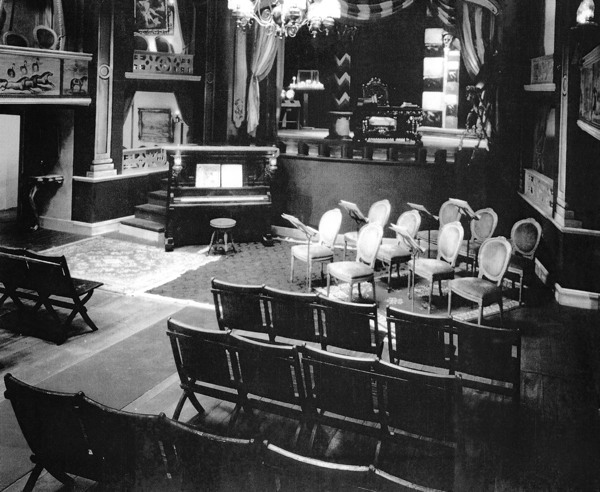
The interior of the Bird Cage Theater, constructed on the Old Tucson soundstage and ready for the Faust sequence (courtesy Larry Zeug).
The etymology of the name “Bird Cage” is both interesting and entertaining. One version explains that the balcony containing the private “entertainment” sections appeared like a bird cage suspended from the ceiling. Another version suggests that the “percentage girls” (prostitutes) who served drinks to the compartment patrons were always cheerful and sang like birds while they worked. Drinks were sold for a dollar each, the waitresses received 20¢. Still others said the name was given to the theater after entertainer Eddie Foy played the venue and had a conversation at the bar with songwriter Arthur Lamb. Lamb asked Foy, “What do you think of Tombstone, Eddie?” Foy replied, “They should have called it a coffin, long and narrow.” Lamb laughed as he pointed to the cribs overhanging the casino and said, “This place reminds me of a bird cage, you can see those girls with the feathers in their hair, serving kisses and champagne and giving other favors. Those women are like birds in a gilded cage.” Foy replied, “Sounds like a title to a song.” Lamb began writing the words on a napkin and when Foy read the lyrics, he insisted, “That’s a song that only a woman should sing.” Lamb gave the lyrics of “She’s Only a Bird in a Gilded Cage” to Harry Von Tilzer for musical arrangement. Von Tilzer insisted that he would not write the music unless Lamb made it clear that the girl in the song was a rich man’s wife, not his mistress. Later, the famous singer Lillian Russell made “She’s Only a Bird in a Gilded Cage” one of the most popular songs in 1900 when it was published; the theater then changed its name to the famous moniker. However, newspaper articles at the time clearly show that the theater was known as the Bird Cage Opera House on December 27, 1881, the day of its grand opening. Built on 30 × 120-foot Lot 9, Block 5, on the south side of Allen Street, the theater was first known as the Hutchinson Variety Combination, then the Hutchinson Variety Theater, and the Bird Cage Opera rooms before it finally became the Bird Cage Theater.3
Even though it is only seen on the screen for a second, a great deal of effort went into creating an eight-page prop program for the evening’s show. Titled Pinafore on Wheels Presents the Pauline Markham Pinnafore Troupe, the presentation consisted of three performances: “Prof. Gillman and his Ballet of Gravity,” “Selections from the Bard by Mr. Romulus Fabian Tragedian in Excelsis” and “Faust—Or the Devil’s Bargain.” The meticulously detailed program featured advertisements for such period-correct products as Robert Bacon cigars, Dr. Price’s Cream baking powder and Magic starch, as well as a full-page ad for an “Improved High Arm Sewing Machine.” Apparently, a three-act, six-scene play was also planned for the evening as a list of the stage show’s “actors” and the characters they played was included in the program, which even contained a plan of theater exits in the event of a fire. In all, it was quite a brochure for something that no one would ever see.
As scene #20 in Tombstone begins, the houselights dim, the curtain lifts and a spotlight illuminates an easel announcing “Prof. Gillman.” A slender man in top hat and tails appears, holding three objects, but before he can begin his act, it is disrupted by gunfire. Initially, actor Charles Schneider had been hired by Kevin Jarre but by the time the juggler arrived for his scene, Jarre had long since departed. Despite having practiced for weeks, Charles had neglected to ask Jarre one important question: “What will I juggle in this scene?” Imagine his surprise when he learned the answer. “The morning I arrive on the set, I’m in my costume, everything’s beautiful, I look pretty cool,” admits Schneider. “The prop department approached me and … handed me my juggling clubs. They are much smaller, authentic 19th century juggling pins, and worst of all, much heavier than I dreamed they would have been. One of them has an explosive charge in it.
“I’m no master of juggling clubs, much less balls. In fact, I’ve just acquired this skill and was barely able to get two or three revolutions of the plastic larger clubs you might find in any hobby shop. These wooden clubs were a whole new ballgame to me and I immediately tried to juggle the three no-gimmick props … and could not do it. I pulled an assistant director aside and said, ‘I cannot believe this. I can’t deal with these things. I don’t think I can really pull off juggling these fully. Maybe just one spin.’ The assistant said, ‘Just wing it. Hopefully, it will work out, man. It’s going to be a little bit brutal but we’ll see what happens.’ I remember kind of having a panic attack and freaking out. I ran up to Billy Zane. He was a true trooper and he took me aside and said, ‘It’s going to be okay, take some deep breaths.’”
Even though they wouldn’t appear in the scene, several actors, including Boothe and Lang, were on the sidelines watching the filming. A special effects assistant walked up to Schneider with a harrowing warning: “Charles, I’ve got to give you specific advice that nobody else is telling you. We’re going to blow up a fake pin with a charge of gunpowder. You’re not wearing any protective goggles, you’re not wearing anything. This is going to be about a foot or two over your head. Try to aim it in this direction but those shards are going to be flying all over the place. Keep your eyes shut. Turn your head away at that moment, no matter what they say. We want you to be protected … no matter what they tell you, keep your eyes away. We don’t want you to get hurt.” Stunned, Schneider desperately replied, “No. I don’t think I can juggle these pins.” Suddenly, Cosmatos bellowed out of the darkness: “What?! The fucking juggler can’t juggle? What the fuck… Who fucking hired you? Who cast you in this?” Without missing a beat, the terrified juggler replied, “Kevin Jarre.” There was a collective gasp.4
Powers Boothe, holding a copy of the pink-paged script, stood up and interrupted the tirade. “Excuse me, George,” he said. “There’s really no reference directly here in this currently re-written scene of Prof. Gillman actually juggling.” An earlier draft had suggested he toss a pin up in the air with a few revolutions. Added Boothe, “Looks like the current draft suggests he could come out, do a little something, toss that pin up and it’s blown up out of the air right away.” Boothe then winked at Schneider, who immediately took his lead and said, “Exactly, George. Check this out. I’ll come out, do a really Victorian frilly bow and curtsy and how-do-you-do. And with a great flourish, I’ll make a couple of revolutions and just lob that little pin up over my head and whammo! If I can, I’ll give it a revolution. I’ll try it the best I can. I deeply apologize. I’ll just come out and do that.” Schneider then glanced at Boothe with great appreciation and a look that said, “Thank you, man. You save an actor’s ass.” An exasperated George said, “Just fucking do it.” Five takes later it was over.
After the scene was completed, a large, rather tall grip approached Schneider and said, “You’re not alone, Charles. You did a good job. He’s been screaming at all of us for days. He’s a screamer. A lot of us aren’t crazy about this guy and I know you need a hug.” And she hugged him.5
The scene continues as Gillman races from the stage and yells, “They’re shooting at us, they’re shooting at us!” Shakespearean actor Romulus Fabian, played by Billy Zane, then mutters, “We won’t have to wait for our notices,” walks onstage and delivers the St. Crispin’s speech from Henry V, Act IV, scene iii 18–67. Upon its completion, the audience erupts in cheers and wild applause, firing six-guns at the ceiling. (Portions of this sequence were completed at the Mescal location in early August.) Scene 21, where Fabian discusses the audience’s reaction with an actress before he goes onstage, was eliminated.
The final portion of the film’s evening entertainment sequence is a rendering of Faust—Or the Devil’s Bargain. Set choreographer Lisa Zane explains the concept: “I said [to Kevin], ‘Let’s set it to Saint-Saëns’ ‘Danse Macabre’ and let me choreograph it,’ and he said, ‘Great!’ He often said, ‘Great!’ So I created this ballet to one of my favorite pieces; it was humorous, elegant and quirky, a little Ballet Russe in flavor.” The orchestra whirls into the music as the rising curtain reveals a black and red, wild-painted backdrop, covered with images of death and damnation. An ancient white-bearded scholar sits alone with his books while Satan dances across the stage, tempting him with images of wealth and youth in the form of a shimmering blonde ballerina. As the curtain falls, Satan, exultant and triumphant, is ready to collect the debt. Cosmatos admitted, “This piece was very long and I had to cut it because it went on and on and all we had to do was establish different people and that [Wyatt] sees [Josephine] again and he’s interested.” Set dresser Matt Marich created the flame effect with silk cloth and fans. Cindy Wykes played the part of the first monkey holding a scroll and clearly remembers rehearsals with Zane, who informed the dancers that Jarre had been let go. Naturally, when Kevin was fired, Lisa was released, and her brother Billy was furious. “That night Kevin and I spoke on the phone,” says Lisa. “He was already back in L.A. I said I wanted to walk, I was done. He said, ‘Don’t. Stay on, represent.’ He was adamant. Everything felt so moribund that the word Tombstone had become like a joke. I was firmly in Kevin’s camp, and they were cleaning house. Within a week, Bint [her dog] and I were out of there.”6
“The [Faust] scene was shot during the day,” says Cindy. “It was really, really hot. They wanted all the smoke in the theater to remain still, so no fans were blowing.” Along with the Faust mask, Marich also created two monkey masks with fiberglass. There is a section in this scene where a Bird Cage employee (Buckaroo Art Craffords) tries to replicate a psychedelic effect by passing jars of colored liquid in front of a leather-wrapped, yellow spot projector. For filming purposes, the lens mount actually was a Home Depot plastic toilet flange. A brass trim piece was supposed to cover the lens. Marich: “When they came and got that piece, I wasn’t in the shop, I was out dressing sets. We made [the trim piece] in brass like a lace doily with a hole in it that was supposed to sit over [the lens] so it looked very Victorian and fancy. [Unfortunately], it never got put on, [and you see the flange] in the film. My fault.”
There were several other Buckaroos in the Bird Cage scene, including Red Sash members John Peel, Reggie Byrum, Rick Terry, Jerry Tarantino and Bill Weddle, the bartender who serves Curly Bill. And there was a hidden cameo as Mrs. Sam Elliott—actress Katharine Ross—was also in that scene. According to background player J. Nathan Simmons, “She kinda mingled in the back, she kind of snuck in the background like we did. Very cool. We didn’t realize who we were talking to, of course, We thought she was one of us. She was in costume and we thought she was one of us.”7
As filming of this scene began, Stephen Lang, still in costume, and maybe even still in character as Ike Clanton, stood in a corner of the soundstage, looking on. Recalls Schneider, “I looked over … and he was acting like he was a conductor. So there he was looking like he was red-faced, shit-faced, drunk out of his mind with his eyes all bleary-eyed, all crazy, and he was acting like he was a fancy man directing an orchestra, with his nose in the air and his hand [waving in movement to the music]. Like he was waving a baton, all aloof and funny … and no one saw it but me…. I don’t know how his eyes got that bloodshot and yellowed at the edges, and his face so lazy and engorged unless he was truly in his cups. It was a magical moment—he may as well have been on screen. It’s the way his character would have reacted if he had seen some fancy orchestra. Wow, I’m watching Stephen Lang being that guy totally in the moment having fun.”8
Obviously, from the aforementioned recollections, Cosmatos was a great action-oriented director—talented, passionate, creative and enthusiastic. But he was also extremely vulgar, peppering his language with F-bombs as naturally as other people would breathe. Disney Studios had warned the production company, “Watch your language. Children are present on the set.” Recalls Zeug, “There’s a scene out in front of the hotel and George, unfortunately, his language was unreal. Everything was ‘Fuck this, fuck that. Where’s my fucking Cowboys?’ We were upset about it because we don’t use that kind of language. There were memos that came out from Disney, saying that we have children on the set and there will be no swearing. Well, we weren’t swearing anyway but that didn’t stop him. It never stopped [him].”
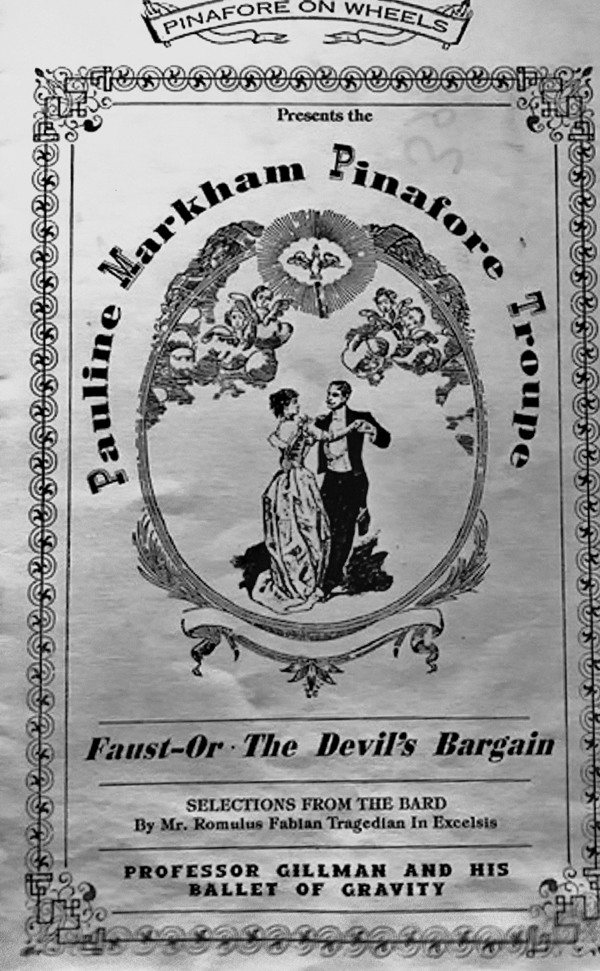
The cover of the eight-page prop program used during filming of the Bird Cage sequences (courtesy Jerry Tarantino).
Sam Elliott was perhaps the most easygoing, professional, likable actor on the set, but sometimes even Elliott reached his limit with Cosmatos. On one occasion, the actor was outside a saloon going over his lines when George yelled, “Sam! Where the fuck’s my Sam? Sam? Where the fuck are you?” Enough already! Sam threw the script down, opened the door, stuck his head in and hit George with, “George, I fucking hear you, George!” He then slammed the door and backed out. George was very quiet after that scene, Elliott then admitting, “In all the years that I shot, I never had to deal with this kind of shit.” According to Zeug, Kilmer was not immune to George’s nonsense, either. One day, out in the middle of the street in front of the Grand Hotel, Val was getting prepared to film a scene when suddenly, the first AD got into it with George. They were going back and forth, yelling at each other. As Zeug recalls, “Finally, Val gets fed up with this, takes the script, throws it on the ground and says, ‘Fuck it. I’m out of here.’ With that, everything stopped, they told us, ‘Go on home. We’ll be here tomorrow morning.’” The next day, the AD was gone.9
Donna Cline vividly recalls, “I heard a rumor that someone in the Pima County Sheriff’s Department was stalking George because they had heard that he had a habit of peeing on the set in broad daylight. No bush, no hiding anything and he would just turn around and pee. One [night] we were filming at Mescal, and we were doing close-ups of Kurt. Half of the crew had already gone to lunch as it was one in the morning. George calls ‘Action,’ and the boom operator soon intervened, saying, ‘Wait a minute. Hold on. What’s that sound?’ Apparently, [George] had turned around and was taking a whiz and yelled, ‘Action’ over his shoulder. [The boom mic picked up the sound.] Even Kurt said, ‘George, come on, man.’”10
And it wasn’t just that. The director had a penchant for soft-shelled nuts and subsequently ruined more than one shot by cracking the nuts and eating pistachios. He’d also go to craft services, get cans of Cheez Whiz, and squirt it into this mouth. Then he’d yell, “Action!” or “Cut!” and it would fly everywhere. One day he was eating a sandwich and yelling at script supervisor Faith Conroy, spitting food at her. Finally, she said, “I’ve had enough. I’m gone!”
Donna Cline: “One night I went out to show him some storyboards. I had been up since five in the morning working, almost 24 hours, and I was so tired. George was in a foul mood. They were filming and I saw unit production manager Terry Collis and asked, ‘Do you think maybe I can [show this to] him? I really need this for the editors.’ Collis said, ‘Just stand here for a minute. Let me talk to him.’ So Terry says to George, ‘Hey, Donna really needs to show you these boards.’ [George] went off on me … he screamed and screamed at me. I don’t take that so I just walked [away]. He saw me leaving and yells at me, ‘Oh, that’s a good job.’ Yeah, right. I went to the shuttle and was told, ‘Welcome to the club.’”11
After many hours of hard work, it became almost comical to hear one of George’s invective-laced tirades. If you didn’t already have a harsh vocabulary, you could certainly learn new ways of swearing just being around him. But not everyone believed the director was an uncouth lout. One evening, actor Pat Brady witnessed a typical outburst. When someone asked him, “Man, can you believe what you just heard?” Brady replied, “Well, I know George and he’s a friend of mine. In private life, he’s actually very charming.” Cosmatos was an avid collector of classical English literature and had amassed quite a library of original signed works. Why he chose to act the way he did while on the set was anyone’s guess.12
By now, everybody was aware of Cosmatos’ presence, and actors weren’t the only people frustrated with the new director. According to B-camera focus puller Michael Walker, cinematographer William Fraker had warned the camera crew of Cosmatos’ reputation: “The party’s over. We got another director coming and he’s a bit of a ball-buster. It’s going to be different now. Get ready.” No doubt the change of directors relieved him of all the frustrations and obstacles Jarre had caused. Fraker admitted, though, that the only reason he’d signed on in the first place was because Kevin was an inexperienced director and Bill thus felt he (Fraker) would have more control over the project. Fraker always felt that “the most exciting part of walking on the set in the morning is that it’s really inspirational. It’s completely black, and I strike my first light for what I’m going to do and that becomes my first brushstroke. Then I add other brushstrokes along the way, different lights and so forth, until I come up with a complete picture. Then I look at it and say, ‘Okay, let’s do it.’ The look of a picture is inherent in the material. I read the script and say, ‘This is what I feel this picture should look like.’ Basically, I have an idea of what I want my picture to look like—I call it mine because I’m working on it—and I talk with the director. It’s usually me and the director who find a bond and form a marriage.” However, when Cosmatos was hired, that bond quickly vanished. Said Billy Getzwiller, “We were watching dailies one night and Cosmatos is yelling, ‘What is this piece of shit? Out of focus! Out of focus!’ Bill Fraker got up, threw his glass at the screen, and said, ‘I’m outta here. I can’t deal with this guy.’” Actor Sal Cardile recalled there was constant tension between Fraker and Cosmatos: “George wanted things done a certain way and Bill would tell him you can’t do that, or it wouldn’t look right, [but] George would press the issue.” After one particularly loud exchange, Fraker said, “When you figure out what the hell you are doing, I’ll be in my trailer. You let me know and when I’m ready to come out, I’ll come back.” He then stormed off the set. One day, they even came close to fisticuffs. The two men were driving around the set in individual golf carts when they came face to face on the same road. Neither would budge so they came up with a safe, sensible solution: They crashed into each other. Bragged Fraker, “George fell out of his cart. I didn’t.” According to some, a fistfight then ensued. Fraker threatened to quit so many times, they made him an associate producer and gave him additional points just to keep him on location.13
Fraker had been given a modified Panavision lens case that held a bottle of liquor and it was hot-head technician James Danicic’s responsibility to assure it was always Chivas. “There were times when we were doing the night shoot that I would go to the camera truck,” explains Danicic. “There were plenty of shelves that were cleared and I would put a [furniture] pad over the shelf above, down across the front of me, and I would just lie there with the radio next to me, waiting for my name to be called, trying to catch a couple of winks. I would hear a golf cart pull up outside, [someone would] run in the truck, click, click, case opens, pour a drink, and then be gone. ‘Uh, oh. Bill’s up to no good. He’s getting stressed out.’ One night I hear the guy stomp up, make another Chivas, the footsteps stomp off, then they come back and [my cover] drops. It’s Fraker. He goes, ‘You little shit. I knew you were hiding somewhere.’ ‘Bill, I didn’t hear my name. I don’t know what’s going on. I’ve got the walkie-talkie right here. I missed it. I’m sorry.’ ‘No, no, no. I don’t need your ass. Get up and make a drink. Let’s sit down.’ They were calling for Bill on the radio. ‘Just tell them I’m in the can. Bill’s 10–1, still 10–1.’ So we sat there and had a couple of cocktails before we went back to the set.”14
Language admonishments were not the only restrictions the studio attempted to put in place. “Tombstone is a CLOSED SET. Our caterers are NOT PREPARED to feed visitors.” “No photographs allowed.” Naturally, these warnings didn’t stop those who were prepared to incur the wrath of location security. Back in the day, iPhones with numerous apps, features and built-in cameras weren’t yet available, so many folks took photos with Pentax, Nikon, Kodak and Canon SLR cameras. And those who couldn’t afford such luxuries used the Olympus 35mm point-and-shoot, or maybe a Polaroid One-Step or the old Kodak 110 standby. Because not every extra appeared in every scene, there was an active “bootleg” market where extras shared their photos. Sneaky extras would peek around a corner, make sure no one was looking, and take a shot or two. And although they were cautioned about not bothering stars for photos, many stars like Sam Elliott were more than happy to pose with anyone who asked. One day some of the ladies who were extras bravely brought their cameras to the set and asked Sam if they could get picture with him. He was very discreet and told them if they would go down to the far west side of Mescal that, well, maybe … he could wander off and meet with them in about 30 minutes or so. He did and when he got there about 20 women were waiting. Gracious as always, Elliott took a photo with each and every one. Stuntman Lee McKechnie remembers that while the “no photographs” policy wasn’t all that unusual, the Tombstone set was locked down tight: “You could get kicked off the set if they saw you taking pictures. Even if you knew the actors well enough to get a picture, or [if] the actors said, ‘Hey, let’s get a picture.’ You’d have to sneak down an alley with them and say, ‘Come here a second but don’t let George see ya.’”15
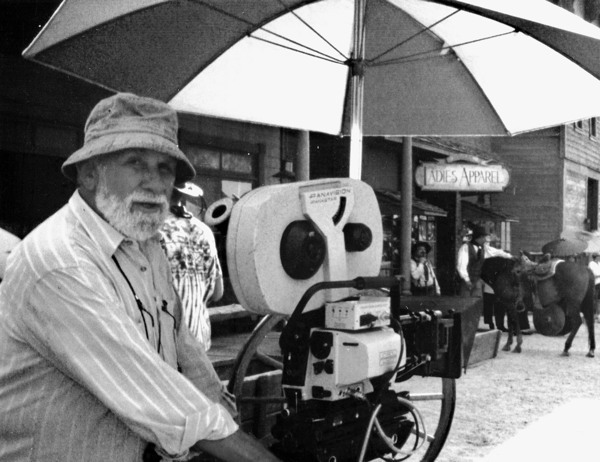
Director of photography William Fraker (known also for Bullitt, Rosemary’s Baby, WarGames, Looking for Mr. Goodbar, Honeymoon in Vegas, and more) (courtesy James “Spud” Danicic).
But, these surreptitious photo-op tactics didn’t always work for extras seeking autographs, as extra Glen Gold relates. Smiling, Gold recalls chasing an autograph from a visiting actress who wasn’t even in Tombstone. “Dobie [Carey] and Buck [Taylor] baited me,” says Gold, “and I went along with it. [We were] standing around talking [and] Kurt Russell went down the street headed for the set; right behind him [walked] Goldie. I said to Buck, ‘That’s Goldie, ain’t it?’ He said, ‘Yeah, that’s Goldie.’ I said, ‘I wonder if she’ll give me her autograph.’ Dobie kinda grinned. He said, ‘Why, sure. Go get it.’” So he did. The only thing Gold had for her to sign was a business card with his name on it. “I said, ‘Goldie, can I have your autograph?’ And I was putting a little ham on it; I was being a little overboard. And she started laughing, that crazy laugh of hers. She broke out laughing and she said, ‘Why, you sure can.’ And I handed her that card.” After signing, Hawn, still laughing, handed it back and took off across the street. When Gold rejoined Buck and Dobie, another young extra said, “That was Goldie Hawn, wasn’t?” Yeah, he was told. He said, “I didn’t know she was here. I’m going to get her autograph.” Ever helpful, Gold said, “Well, there she goes. Go get it.” The young extra took off out in the middle of the street and stopped Hawn to get her autograph. About five minutes later, there was an announcement over the PA system: “All extras assemble in the tent in the holding area. Immediately!” When they arrived, they were instructed, “We already told you there won’t be any pictures. And there won’t be any more of this autograph-seeking, either.”16
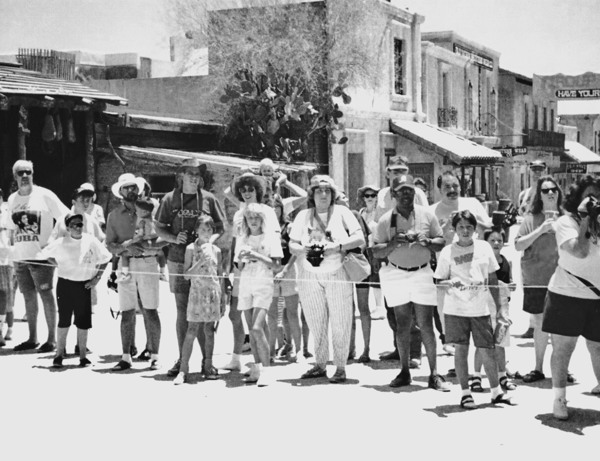
Tourists with cameras in hand stand behind a security rope on Kansas Street in Old Tucson and watch a scene being filmed. No photographs were allowed, although one tourist is using a video camera (courtesy Larry Zeug).
Of course, the opportunity to interact with a Hollywood celebrity sometimes was just too enticing. Several actors had brought to the set wives, girlfriends and children, many of whom were actors or aspiring actors in their own right. One day a hotel housekeeper saw one actor’s wife racing along the hallway toward the elevator. Throwing caution to the wind, she stopped the actress and politely asked for an autograph. Irritated at being interrupted, the actress grabbed a piece of paper, scribbled her name on it and, adding a few choice words, shoved it back at the employee and rushed down the hallway. The housekeeper looked at the actress, looked at the autograph, tore it in two and threw it on the floor. In another instance, Kurt Russell decided to take matters into his own hands. While he was prepping for a scene, a still photographer kept taking shots of him while the crew was putting on Kurt’s makeup and trimming his hair. Russell waved his gun at the photographer, telling him, “No, don’t take pictures right now. No pictures.” The guy wouldn’t leave so Kurt literally shot his .45 in his direction. Scared the hell out of everybody, but the photographer stopped shooting. When a girl asked Kurt for an autograph when they weren’t filming, she was promptly escorted off the set.17
And then there were those non-movie folks who just didn’t care about celebrities. As Buckaroo Bobby Vincent recalls, “Down in Mescal, there’s a local store owned by some people; we took a break and Bill Paxton wanted to go [there] with us. So we go in and order some stuff and Bill [started] joking with the gal behind the counter. ‘You know who I am?’ goes Bill. This girl looks at him and says, ‘No.’ He says, ‘I’m the famous actor Bill Paxton.’ She turns around and says, ‘So?’ I laughingly told him, ‘I’d like you to know, Bill, you’re getting an ego there, bud. She wasn’t impressed at all.’”18
After Cosmatos wrapped up the Bird Cage scenes, he began to film Wyatt Earp’s arrival at the Tucson train depot. Visual and weather-related continuity issues were a constant problem on the set: first- and second-unit shooting, geography, the level of ambient light, shadows, pick-up shots, and the effect of a four-month filming schedule all contributed to mismatched backgrounds and, just like Sabino Canyon, it was the same with the train depot sequence. A close examination of the ever-changing sky shows that parts of this sequence were filmed at several different times over the summer. In the film, as Wyatt’s train arrives in Tucson, he steps off the passenger car, notices someone abusing one of his horses and confronts the man. U.S. Marshal Crawley Dake and his deputy observe this scene and even before they can offer a law enforcement position to Earp, he declines. Wyatt then passes the horse’s reins to a young boy and hears a familiar voice in the distance: “Boy, I’d know that sour face anywhere.” It’s his brothers, Virgil and Morgan. Wyatt turns, grins and hugs them.
The train upon which Wyatt arrived was #11, the historic 1872 standard-gauge Virginia & Truckee Railroad line steam locomotive Reno (4–4–0), that had been purchased at auction from MGM in 1970, along with a tender and passenger car. (The designation 4–4–0 means the engine had four unpowered lead wheels, four powered driving wheels, and no trailing wheels.) At various times over the years the train appeared in such films as The Cheyenne Social Club, Support Your Local Gunfighter, How the West Was Won and Joe Kidd, and had had either a straight cap smokestack or, as seen in Tombstone, a diamond stack with a sheet metal extension. The engine was pulling V&T Baggage Car #1, V&T Coach #19 and a 40-foot flatcar first used in the 1975 film Posse. Its window-sided, boxcar-type prop body was later removed. The locomotive, baggage car, and coach were left painted and lettered exactly as they had appeared in the 1993 Mario Van Peebles film Posse. Perhaps someone in the art department thought Western Pacific Rail Road (W.P.R.R.) looked appropriate on the rolling stock but that line never actually serviced Tucson; Southern Pacific did.
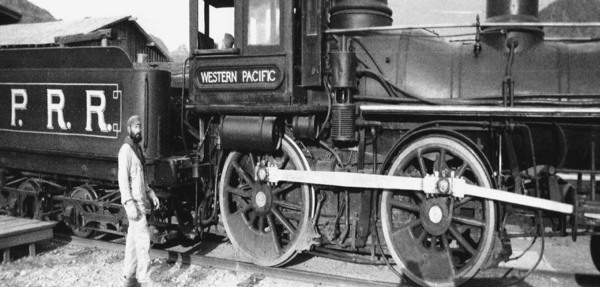
The Reno at Old Tucson Studios (courtesy Chris Swinney).
Since the Reno had first been a wood, then a coal, and then an oil-burner, its boiler had deteriorated, which is why a large air compressor was installed in the baggage car in the winter of 1988–1989 to provide movement for the locomotive. Compressed air was piped forward to the cylinders which in turn pushed side rods allowing the engine to move, and the fuel tank was removed to lighten the load. Steam and smoke effects completed the visual illusion with sounds effects added in post-production. As the Old Tucson Studio track was only 1000 feet long, it wasn’t possible or practical to film the train’s arrival in Tucson in a wide-angle shot. According to Old Tucson historian Paul Lawton, “Distance combined with a long-lens camera made the train appear farther away than it actually was. It was partially screened by brush, and a cut in the land made it appear as if was steaming under full throttle.”19
Portions of this arrival scene were filmed at different times. The conversation between Dake and Earp, as well as the segment when Wyatt turns over the reins to a young boy, were both filmed during the last week of June, but Earp’s arrival and his confrontation over the horses were filmed on August 23, hence the differing appearance of the sky. Thirteen-year-old Sam Dolan, son of Buckaroo Jeff Dolan, played the boy. Sam was eventually hired as a full-time Buckaroo in addition to being a member of the Red Sash gang. He and 15-year-old Charley Ward were the youngest Buckaroos on location. (Belonging to the Red Sash gang earned Sam the moniker of “the sweetest little outlaw,” courtesy of Stephen Lang.) The fellow Earp hits with the quirt was wrangler Byron Wilkerson. Sam recalls, “[There were] not too many [takes of my scene]. It seems like we started shooting that dialogue before lunch and a lot of it was shot in the afternoon hours, right after lunch because the sun was real high and hot.”20
Originally, the scene was to be much more intense than what appears on film. Wrangler Gary Gang, a member of the “House of Men” rides, says, “I was supposed to have a part in the train scene. I had trained this horse to rear, which ended up not being used in the final cut because the head wrangler didn’t want me on set, and they wouldn’t let me rehearse the horse on the flatbed train car. The horse goes up there cold [but] wouldn’t rear at first because I wasn’t rearing him. The horse looked great but they didn’t use the gag the way it was written in the screenplay. I [had] taught this horse to fight—when he goes up in the air, his feet are striking out. You gotta know where to stand. They had Kurt working the horse when he was rearing [and] the horse was in his face. It wasn’t the way the scene was supposed to go. That was all Kurt needed was that horse slashing his face. So he got pissed and said he wouldn’t do it. ‘I’m not doing this shit.’” At the conclusion of this scene, they filmed the remainder of the arrival sequence where Wyatt guides the family to a train station house window and gazes upon the group’s reflection. As the three brothers walk along the station platform, Bill Paxton throws a half-eaten apple in the air. “Bill Paxton wanted to eat eggs, hard-boiled eggs,” says Greg Poulos. “And we told him you’d get sicker than a dog if you start eating eggs. [But] he wanted eggs. After about the fifth egg, we had to switch to an apple so he could throw it. The eggs started getting to him. The heat was too much.” For the Earps-and-wives-group-pose-reflected-in-the-window scene, Dana Loraine Goodge was one of the ladies’ reflection stand-ins, and recalls that some of the actors were less than pleased by having to wait and wait. “The women were late to the set all the time,” remembers Dana. “They were late getting to Mescal or Old Tucson; they were late getting to the set. That particular day, we stood out there so many times. We thought the women were supposed to be there and they kept me having to stand out there [and each time they had to] redo the lighting because the women hadn’t shown up yet. I was sitting in the train at one point and I heard Sam Elliott talking to George: ‘These fucking so-called actresses … these extras and stand-ins are more fucking professional than these so-called actresses. Get these girls out here.’ There was anger at the women.” No doubt it had to do with the heat and everyone getting tired and frustrated. As the week progressed, Cosmatos filmed scene #90, Doc’s departure from Kate at the Grand Hotel. In this scene there is a reference to the Frankie Laine song “Gunfight at the O.K. Corral” from the 1957 film of the same name. Doc asks Kate, “Have you no kind word for me before I ride away”—a direct homage to Dimitri Tiomkin’s song. This scene was not included in the film’s original release but later was added to the Director’s Cut.21
One reason fans are so enamored by Tombstone is its vibrant, authentic detail. Using archival photographs, the filmmakers recreated specific buildings of the actual western town, and although the gambling halls and theaters had a gilt-edged Victorian glamour, structures alone were not sufficient to create this effect. So each scene was also filled with a great deal of atmospheric richness and activity. If one disregards all foreground movement and dialogue, and instead concentrates on the background, it’s amazing to discover what is happening in the town. For example, we see suffragettes actively advocating for women’s rights: a woman carrying a placard asking for the vote for women marches through the frame at one point, and later, a wagonload of women crosses the screen, all carrying signs, “Equal Pay for Equal Work.” What helps such scenes work even better is that everyone was in period-correct clothing.
Joseph Porro had discovered a cache of calicos and linen dresses that had been purchased in the U.S. during the film’s actual time period. They had never been worn, and were sitting in a warehouse for 120 years. But the proper appearance wasn’t only limited to the female gender. Although the Buckaroos wore period-correct Western clothing, there were also those who specialized in military apparel and Civil War apparel. Known as “stitch-counters,” they had a responsibility to accurately portray history in everything they do, from the buttons on their coats to the buckles on their shoes. Re-enactors who sew almost always do so by hand, and try to replicate the sewing methods and techniques that were used in the time period they are portraying, not just the overall look of the finished piece of apparel. Two such individuals were Kane Rubalcaba and Curt Stokes. In the train station sequence, they wore sky-blue trousers, civilian shirts without their military jackets, either 1872 Andrew campaign or common slouch hats, and were getting their boots shined by a shoeshine boy.22
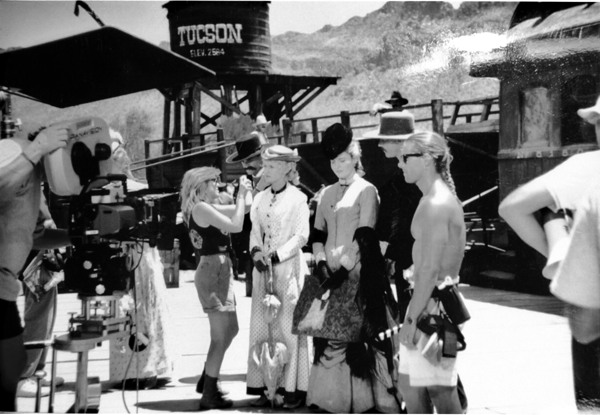
The Earp brothers and their wives await the beginning of a scene at the railway station on the Old Tucson set. In costume, left to right: Kurt Russell, Dana Wheeler-Nicholson, Lisa Collins, and Bill Paxton (courtesy P.J. Lawton, Old Tucson Studio).
Usually, the first assistant director or key set production assistant organizes these background activities. In this case, it was James Alan Hensz, who came up with the vignettes that seem so innocuous but add so much realism to the film. As a result, you can almost feel the blazing heat, taste the grit in your teeth, smell the sweat of the cowboys and the stink of manure in the streets. Often, Hensz was just told, “I want to see some action over there,” and he would create whatever came to mind. Sometimes it works, sometimes it doesn’t. Explained Rubalcaba, “We were doing a night scene in town and Jim asked, ‘Do you guys have any other looks?’ We had brought our military uniforms so we switched out all our saddles and tack, put on our McClellans Saddles, all our military tack on. Polished up our saber belts, had our kepis. We’re riding into town and over the radio we hear, ‘Cut!’ It was Cosmatos. ‘Where [did] these fucking soldiers come from? I’m making a western, not a war movie.’ It was hilarious. So we do a quick change [but said], ‘Here’s Tombstone. You got Cochise and all these guys raiding around southern Arizona. You got black folks, you got Chinese, you got Indians in town. Fort Huachuca ain’t that far and there’s no soldiers on leave in town? Come on.’ But they wrote that right out and re-did it with something else.”23
The street altercation between Holliday and a drunken Ringo was filmed over a two-day period at the end of the same week. Although it appears it was shot on the Mescal set, it was actually staged on Kansas Street in Old Tucson. This scene, with different characters, was based on an episode described in Walter Noble Burns’ 1927 novel Tombstone: The Iliad of the Southwest. In Burns’ book, Wyatt, Virgil, Morgan, Doc and Mayor Charles Thomas are chatting in front of the Campbell & Hatch Billiard Parlor while Ringo, the McLaurys and the three Clanton brothers lounge in front of the Grand Hotel. After Ringo confronts Wyatt and is rebuffed, he turns to Holliday, who utters the iconic line, “I’m your huckleberry. That’s just my game.” Sam Dolan also appeared in the background of this scene when he ran, grabbed two young boys and pulled them to safety as they sat watching the action. (What’s a huckleberry? In answer to a challenge, it meant, “I’m your man.” Then again, in Aurthurian lore, garlands made of huckleberry were given to Knights of the Roundtable for rescuing damsels in distress—a medal of gratitude, as it were. So the line could be translated into “I’m your hero.” There are also those who believe that as the handle on a coffin used to be called a huckle and that the pallbearers were called huckle bearers, Holliday must have instead said, “I’m your huckle bearer.” A huckle bearer was also known as one who sat near the gravesite in the event a bell rang. (A grave bell was used as a precaution to prevent someone from accidentally being buried alive. Thus it’s possible the line is really a threat: “I’ll put you in your grave.” However, none of those explanations hold water as every draft of the script clearly reads huckleberry.)24
The first day was a long shot of the Earps walking up the street. As the scene ends, Ringo stumbles and falls into a stack of coffins in front of the undertaker’s building. In later years, this structure was turned into a funeral-embalming museum at Old Tucson. For years, Mark Tovsen and his business partner had been accumulating mortuary-related items from numerous Tucson funeral homes and really didn’t know what to do with them until they decided to donate the collection to Old Tucson where they could be displayed; in the meantime, they were used in the film. Although several of these items were peppered throughout the set, the only ones that appear in the film are the clothes Frank and Tom McLaury and Billy Clanton wear during the funeral procession and the glass-faced coffin they lie in. Made in Mexico in the 1980s, the coffin’s style replicated those used in the United States in the 1800s. Tovsen had provided two such items but since the second one wasn’t quite as elaborate, only one coffin was used, each actor taking turns lying in it for his close-up and each actor quickly regretting the lack of air inside. Tovsen also provided a fiberglass-and-wood replica of the famous Black Moriah curved-glass funeral hearse that transported the deceased to Boot Hill Cemetery. With sterling silver and gold leaf trim, the actual Black Moriah had been built by Cunningham Bros. of Rochester, New York, for $8000 in 1881, and was owned by the Watt and Tarbell Undertaking Parlor. Unfortunately, as the replica’s front axle broke, wagons were instead used in the film.25
The next day, they shot Kilmer’s huckleberry sequence and Jason Priestley’s defiance of the Earps. Priestley, star of television’s 90210, was then at the height of his popularity and appeared in the prelude to the huckleberry scene. Throngs of 20-year-old female extras hovered around him, asking for autographs or photographs. Priestley appeared as Deputy Billy “Sister Boy” Breakenridge; the diminished nature of the role must have rankled him. Jarre’s earlier drafts had a much larger role for Breakenridge, but most of Priestley’s efforts ended up on the cutting room floor. But overall, he considered it a worthwhile experience. “Working on Tombstone changed my life,” admits Priestley. “It was one of the greatest times I ever had, sitting around listening to these actors tell stories. I had no stories of my own to tell. They reminded me of what it is to be an actor.”26
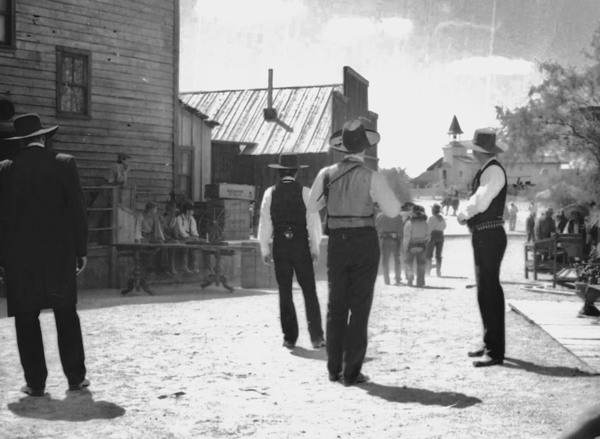
“I’m your huckleberry.” Kansas Street, Old Tucson Studios. The Earps and Holliday (left to right: Kurt Russell, Sam Elliott, Val Kilmer and Bill Paxton) watch as Curly Bill Brocius (Powers Boothe) and the other Cowboys walk away from a confrontation (courtesy P.J. Lawton, Old Tucson Studio).
As filming continued at Old Tucson, the production crew was putting the finishing touches on the Tombstone set in Mescal as the construction team, set decorators, greensmen and painters were still getting the town ready. An example of the emphasis on authenticity: One afternoon, two Buckaroos were asked to fire live ammo into the Tombstone sign for a rustic, weathered, violent look. Crew members constantly dressed and undressed the various buildings, and tents and unfinished frame structures were everywhere along with false-front buildings that filled in the gaps between other structures. As the historical Tombstone was still relatively new in the early 1880s, framed and unfinished structures would not be out of the ordinary for filming. The overall effect depicted a fresh, up-and-coming town in the process of being constructed. Through the use of numerous creative camera angles, the town appeared much larger than it actually was. And once Cosmatos came aboard, the size of the Mescal set increased substantially. According to set dresser Matt Marich, “They built more of the background behind the O.K. Corral—they built an Oriental area back there. That whole area got huge. They built more of the entire background and part of [Allen Street]. Campbell & Hatch … was going to be a separate set; [it] was actually in the space next to [the Oriental] but there was a dividing wall. Well, when Cosmatos came on, they made them tear that wall down and build a second half of the bar, so it was now a giant U-shape and it was [as] if the Oriental spilled into Campbell & Hatch. Technically a flaw, not accurate at all. And that’s why if you look carefully in the background, you can see all the taxidermy on the walls. That’s supposed to be Campbell & Hatch. That was supposed to be a separate set but [Cosmatos] merged them together.” In addition to the sets used at Old Tucson, more than 82 structures were either constructed or renovated at Mescal, including buildings, tents and unfinished, framed dwellings.
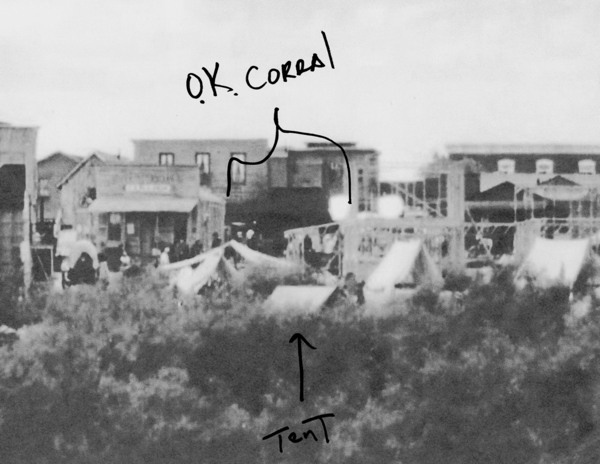
Rear view of Fremont Street on the Mescal set. Note that many of the buildings are just false fronts or incomplete wooden structures. The O.K. Corral is located directly above the middle tent (arrow) (courtesy Larry Zeug).
“I want the Chinatown, there was a Chinatown here! I want the Chinatown!” Cosmatos was screaming again. “I want you to build me a Chinatown today!” Hardwicke agreed to create a drawing and when she returned with it, she asked, “Do you want something like this?” The director’s response was predictable, as Catherine relates: “He goes, ‘What is this hen scratch? That is the worst drawing I’ve ever seen in my life.’ I said, ‘Okay, if you don’t like it, I’m sorry. My art director drew it. If you don’t like it, I’ll draw you another drawing.’ ‘Oh, your art director drew it. Then you don’t know how to draw, do you?’ Then he started dancing around like Rumplestiltskin. ‘She doesn’t know how to draw.’ He gets a megaphone, ‘She doesn’t know how to draw.’ He’s saying this to everybody on the set. So I didn’t say anything. I went and got my drafting board and my pencil and I put it down on the desk, right next to him by the monitor, and started drawing. I drew this big elaborate drawing of Chinatown right in front of him. He looked at me, and steam was coming out of his ears. He was just so mad that I could [actually] draw. I said, ‘Do you like this?’ He said, ‘Yes, I guess I like it. Now, let’s see if you can build it.’ I got some telephone poles … within two hours I had poles standing up, it was half-built. He drives by in a golf cart with a megaphone and I’m standing there and he yells into the megaphone, ‘Hardwicke! Hardwicke! It looks like shit! You’re doing a very bad job!’ Then he steps on the gas and roared away.”27
Apparently, there wasn’t anything Hardwicke could do that satisfied the director, as two more stories illustrate: “One time, I’m building something on the set and I get called on the radio: ‘Catherine, come down to the sheriff’s office.’ They were filming a scene in the sheriff’s office, and I see all these actors just staring at him, and they’re not filming. I walk in there [and say], ‘What’s going on?’ George said, ‘What … is … this … deer … head … doing … here?’ He pointed to a wall-mounted deer head that was above the doorway. ‘Well, it’s decorating,’ she said. ‘There are photographs that show that there were those type things in the office.’ ‘What … is … this … deer … head … doing … here?’ ‘Like I said, it’s set dressing. The set dresser just put it up there because he thought it looked very interesting.’ And everybody is just staring at me, I’m staring at him, too. ‘Bring me the set decorator, I’m going to fire him.’ ‘Oh, he’s not here. He’s in Tucson, so you can’t fire him. You’re just going to have to talk to me.”
‘“What … is … this … deer … head … doing … here?’ I was trying to figure out what was going on. Has he turned into a robot, is he stupid? Nobody knew what to say. I finally looked at him and I saw him looking further toward the lens. I said, ‘Oh, are you saying that maybe it’s too high? It’s not in your shot. Do you want me to move it down?’ ‘That’s it. It’s out of the shot. We’re shooting with an anamorphic lens. You are an idiot. Why would you put it up there? It’s out of my shot. You’re a complete idiot.’ He was yelling in front of Kurt and everybody. When he stopped his little tantrum, I said, ‘George, you told me you liked to have low angles, cool wide-angle shots, all these different angles. So, I dressed every inch of the set so you could put your camera with whatever lens you want and shoot and there will be something interesting in your framework.’ And he looks at me and goes, ‘Oh … good idea. Okay. Let’s roll.’
“Another time we’re at the church, ‘Why are these five crosses here?’ I had five giant crosses. ‘If you don’t like them, I’ll take a couple of them down. They’re just in the deep background. They fill up the shot.’ And then he started screaming, ‘It’s the fucking crucifixion. I only want three crosses!’ He looked like he was going to kill me. A stuntman came up and jumped in between us because he thought he was going to punch me. He just couldn’t articulate that he only wanted three crosses, instead of five. They wouldn’t let him fire me because I was doing a good job … but, oh, he wanted to.”28
While most of the town’s buildings were historically correct, some were given the names of the crew’s family members. Across the street from the Oriental Saloon is the Key West Cigar Shop. Although you don’t see it in the film, set dresser Matt Marich’s father’s name “P. Marich” is painted on the front of the building as proprietor. This tongue-in-cheek approach even extended to the names on some of the Boot Hill tombstones, the most famous of which was Lester Moore. “Here lies Lester Moore, Four slugs from a .44, No Les No more.” Had a Lester Moore actually existed? Supposedly, Moore worked as a Wells Fargo stage agent in the border town of Naco, Arizona. When Harry Dunstan arrived to claim a package, he found it badly damaged. After an argument, both men went for their guns and in a blaze of gunfire, Moore fell from four slugs from a .44. Dunstan also died from just one of Moore’s shots. Moore, a harmless, inoffensive man, became world-famous with his epitaph, while no one knows what happened to Dunstan. In the film, Moore’s name on the headstone is spelled “Moor.”29
After Cosmatos completed filming Ringo’s attempt at a street shootout with Holliday, the production broke for a well-deserved July 4 celebration weekend. Upon their return the following Tuesday, they moved on to scene #9, Doc’s altercation with gambler Ed Bailey in the Prescott saloon. Frank Stallone, who played Bailey, arrived that day and immediately met Kilmer. “[Val] was terrific with me,” says Stallone. “We sat down and he said, ‘Let’s go eat, man.’ So we went over to a table by ourselves, I had a beer and we started running lines. It was just terrific. He was very, very helpful to me. [We] went over the lines and stuff like that and then we started shooting.” Always in character, Val would sometimes listen to his Southern-accented dialogue on a tape recorder before filming a scene. He was worried he would lose the character and the accent if he dropped it even for a second. He was “Doc” the entire film. Explains Kilmer, “Southern aristocrats have a different dialect than even upper class and a real serious aristocrat has a very distinct style that you can tell if you’re a Southerner. I called a friend of mine (Tim Monich) who was my speech teacher at Juilliard where I went to school. He now does movies and he’s got an extensive library of sounds and voices. And I said, can you give me a Southern aristocrat, a contemporary guy but, you know, I want to have it seem like it doesn’t exist anymore. So that was kind of what he did for me. Except the guy that he sent me (on tape) was so, you know, was sooo slow, it would have taken about five hours to say it. It just lulls on the voice, it went on for hours. I sort of adjusted it. I tortured just about everybody with this tape; he was a very entertaining character. The tape that the dialect coach gave me was too extreme. If I had done that, I wouldn’t have felt comfortable even if it was more accurate. But he was from Georgia. But it’s also strange in the Tombstone stories or O.K. Corral stories, [Doc is] very rarely done as a real Southerner, which is a real part of his character.”30
Including master shots and POVs, they did ten takes, and in each take, Stallone would get stabbed. “One time when Val stabbed me, the knife didn’t quite go back into the handle,” explains Frank. “It was kind of like a dirk, dagger. Didn’t quite go back into the handle so well. But that was okay.” The curly-haired Stallone is a fairly good-sized fellow, and Kilmer thought it would be a good idea to grab Frank and flip him in the air, but he could never figure out how to manage it. The third gambler at the table was Bobby Joe McFadden, owner of Bobby Joe’s Irish Pub in Mescal, where Buckaroos and PAs would hang out after a day’s filming. Every day or so, Kilmer would send an assistant to the pub for a bottle of Scotch … no doubt so he could stay in character. (McFadden’s wife Elly was the director of marketing at the Tucson Holiday Inn.) Later that day, they filmed scene #152 where Wyatt meets Josephine in her dressing room of the Denver Theater.31
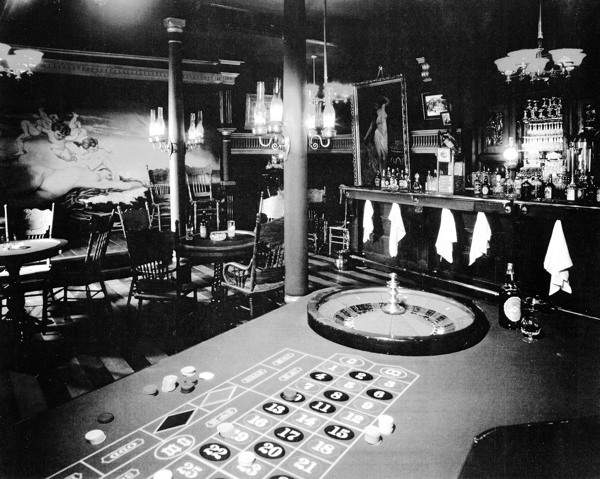
The Prescott Saloon at Old Tucson Studio where Doc Holliday (Val Kilmer) stabs and kills Ed Bailey (Frank Stallone).
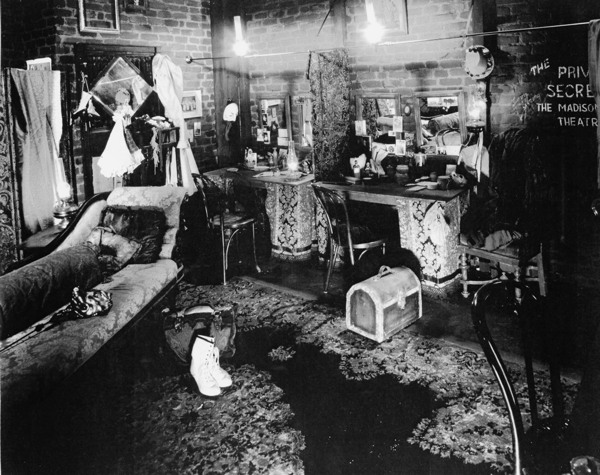
Interior of Josephine Marcus’ dressing room on the Denver Theater soundstage at Old Tucson (both photographs by Lee Gray/courtesy Catherine Hardwicke).
Property assistant Greg Poulos was under the poker table and gave Kilmer a knife to stab Stallone’s character. “You do so many takes,” explained Poulos, “and [each take] you have to reset the table. It was 3 a.m., 4 a.m., and [first assistant director] Adam Taylor was kind of yelling; he wanted to get it done. ‘Come on, Greg. Hurry up, hurry up and set the table.’ Val took all the poker chips and threw them at him and said, ‘If you can do it faster, go ahead.’” Taylor was under a tremendous amount of stress working for Cosmatos. After many scenes, Adam could be seen sitting dejectedly with his head lowered while his father Buck rubbed his shoulders, saying, “Take some breaths. You’ll get through it.” You could just see the migraine starting. Many were the times when Adam would say, “It’s going to be a little rough. Would he just please stop yelling?” The way Cosmatos treated Taylor was absolutely brutal. “Adam! Adam! I want this done now, Adam!” Adam would just say, “Yes, sir,” and do what he was told. One evening Taylor was sitting by the hotel pool, beer in hand, and he told Buckaroos John Peel and Billy Lang, “You know, George apologizes to me every night. He apologizes every night for being hard on me.” Even so, Cosmatos fired poor Adam over and over again.
On June 14, Adam started his first day as an official first AD. By June 21, Brian Cook arrived on the set to take Taylor’s place. Adam moved to the second unit with Terry Leonard. On Friday, July 16, while staging a scene, Cosmatos yelled at Cook, “Cookie! What are these shadows doing on my set? Get these shadows off my set.” Replied Brian, “You moron, George. The sun is setting. It is creating shadows. I cannot change the sun.” Of course, Cosmatos lost his temper. “Then you’re fired! Fired! Understand? You’re fired!” Brian Cook, who literally reeked of alcohol every single day, went right to the bar, ran up a huge tab, borrowed somebody’s credit card and didn’t pay it back. Production eventually had had enough of Cook’s behavior and put him off on a plane as quickly as possible. By the time George got up the next morning, he had changed his mind. “I don’t want to fire [Cook]. I need him back,” he realized, as Cook was probably George’s only ally. George wanted to un-fire him, but it was too late. Taylor was back on first unit and Cook was gone.32
“One night we’re doing town stuff and they brought [in] 200 extras from Tucson and they costumed all these women,” remembers John Peel. “And George was looking at some of the girls and said, ‘I don’t like those girls. Get rid of those girls. I want blonde with big tits! Lots of blondes with very big tits.’” Eventually, he must have been satisfied with the subsequent results as one female extra in particular seemed to be one he always chose to be in a scene. However, he never called her by name. Rather than just say, “Can I have that girl over there?” he would instead go to his first AD and say, “Hey, give me the girl with the big tits.” And he’d say it loud enough so that everyone heard. Then he would command, “Okay, action. When camera roll, you, big tits, you come close and we shoot.” The girl was humiliated. After numerous embarrassments, she had had enough and demanded that Cosmatos treat her with proper respect, telling him, “Look, this is my name. Would you please stop saying that? I take offense to that and it’s very insulting.” Despite her mortification, George refused. After filming was completed, the extra filed a sexual harassment lawsuit that was settled out of court.33
The shootout between Ringo and Holliday was filmed at the Oak Grove set on the Babocomari ranch in mid–July. Kevin Jarre had previously scheduled this scene to be completed the first week of June, but as with many other scenes, Cosmatos decided to re-film it. Due to inclement weather, the crew had to re-visit the site three times before the scene was completed. Michael Biehn remembers that he and Val spent a great deal of time preparing for their duel. “Val and I went out the day before we shot that scene, and we choreographed that scene together,” recalls Biehn. “It was Val and I who decided that we weren’t going to be walking ten paces, turning and shooting, like they’ve done in a million other movies. We thought, ‘Well, wouldn’t it be fun if we did it kind of close, where we’re just, like, two or three feet apart from each other?’ We went out and rehearsed that, and we spent six or eight hours rehearsing it, kind of doing that thing where we’d walk around each other, sizing each other up, and then how I got shot and how I still continued to pull the trigger even though I had a bullet through the brain. All of that stuff, Val and I rehearsed the day before we shot, and that’s the kind of actor that I know Val Kilmer is. I mean, he is passionate and he wants to get it right, and he is like me … and like a lot of people who are like, ‘I’m making a movie here. I’m going to do the best I can, and if you’re not with me, then get out of the way.’”
The scene is one of the climaxes in the film, and Biehn justifiably is extremely proud of his work in it: “Well, I always thought Johnny Ringo had a little bit of a ‘suicide by police’ mentality,” the actor said in an interview. “There was nothing to live for, and he’s smarter than everybody else and I think he was just jaded and wanted out…. There’s a part in that movie, which I think is one of my greatest moments on film, and I don’t sit around and look for it, but whenever I see it, I always think, ‘Yeah, that’s what I was trying to do, and that’s what I got.’ I have the line, ‘All right, lunger. Let’s do it.’ And there’s something that’s like a twinkle in my eye, which is almost like because back then the only fun things to do were drink, whore, but [the prospect of the duel] was really exciting. That was really living on the edge, that was really life and death, and it was the only thing that really turned Johnny on. That was the height for him, like when guys skydive, or why people go to horror movies to get that scary feeling, that adrenalin rush.” Kilmer’s cigarette was about an inch and a half long and the scene had to be filmed several times from a variety of different angles. After each take, an assistant would cut a new cigarette to the correct length, light it and hand it to Val before they hollered “Action!” again. According to those present, they went through at least 20 cigarettes. And Greg Poulos found himself responsible for rolling Val’s as he was the only one who could do it right. Says Steve Melton, “Val would literally roll it wrong—just tear it in two and throw it on the ground. Greg always did it better.”34
“George really liked us because we worked hard and didn’t give him any flak,” explains Greg. “We would finish a scene on the set and George would call for me. He’d say, ‘I want this, I want that.’ He’d want all these props and set dressing [for his own personal use] and I kept putting them aside and I’d tell the producer, ‘George wants this chair. Just put it aside and we’ll figure it out at the end.’ Every set, he’d want something from it and I became the guy that would just store it for him.” Who knows where it all ended up; Cosmatos was given his personalized director chair.35
Cosmatos spent the remainder of that week filming the wedding massacre scene, one of the most complicated scenes in the film, in front of the Old Tucson mission. Shooting it took several days with both first and second unit involvement as well as 111 principal actors, stuntmen, Buckaroos, children and extras. Initially, the scene was much longer and more extensive than what appears in the film; it included numerous stunt gags, including several Cowboys being killed and a stuntman falling into the plaza’s fountain. Many wedding guests also hurriedly departed the area when the Cowboys first arrived in town but it doesn’t play that way on the screen. (The mission was originally constructed in 1939 for the film Arizona and, over the years, had appeared in numerous films with a variety of different facades. It underwent an extensive $750,000 facelift in 1986 for the film 1Three Amigos! and had kept that new appearance until it was destroyed in the 1995 fire.) Although the first unit moved to Mescal on Thursday, July 8, the second unit remained through Saturday to film the final stunt sequences. Written on July 1, the wedding massacre scene was not in any version of Jarre’s script but was used by John Fasano as a substitute for the Old Man Clanton–Cowboy assault on the Mexican Rurales. However, much of Jarre’s dialogue was included in this revised scene, including a portion of Revelation 6:7–8. “…behold, a pale horse: and his name that sat on him was Death, and hell followed with him.” Wardrobe crew member Michelle Beauchamp played the part of the Mexican bride and Michael Garcia was the groom. Garcia also filled the role of a Rurale captain in several scenes that never made the final cut. In later interviews, Michael Biehn admitted he was particularly upset with that scene: “What they did, which I never liked, is that after Kevin left the show, they added the scene [where] Johnny Ringo shoots the priest at the beginning of the movie. Well, Johnny Ringo never shot any priest. That never happened. I always found it difficult to play and I fought against it hard, but I’m a nobody when it comes to that argument against Disney. It always hurt me that I had to play a character that was based on a true-life character and he was portrayed as somebody who would shoot a priest between the eyes. Disney wanted good guys and bad guys … with Kevin, it was a much grayer script.” Biehn publicly apologized for his portrayal in that scene at a Texas panel discussion in 2012. Stephen Lang was none too pleased, either, admitting, “I hated the Mexican wedding massacre myself. The Skeleton Canyon ambush is a matter of record, and would have been a great opening scene. But it just wasn’t going to happen.”36
Prior to the addition of and subsequent filming of the wedding scene, the film originally was to begin with a confrontation between Old Man Clanton, Curly Bill, Johnny Ringo, several Cowboys and a squad of Mexican Rurales. (Several Buckaroos were dressed in Mexican uniforms and, made up with dark faces and mustaches, rode as a squad through the desert. Veteran actor Pedro Armendariz, Jr., filled the role of the Rurale captain. This scene was filmed, but it wasn’t included in the final print. Armendariz then played the part of the priest in the wedding scene.) Wranglers and stuntman filling the roles of the Rurale soldiers included J.T. Hall, Kip Farnsworth, Jeff Ramsey, Hal Burton, Joe Getzweiler, Jerry Wills, Tommy Rosales and Richard Duran. Glenn Ford, Kirk Douglas and even Gregory Peck were contacted for the part of Clanton, but eventually Robert Mitchum filled the role. However, by the time they were ready to film the scene, Cinergi decided it couldn’t afford it, so Mitchum neither appeared on location nor was ever fitted for his wardrobe. And rather than explain the financial issues, the studio’s publicity machine instead announced that Mitchum had suffered a back injury after a few hours on horseback and thus had been written out of the film. In an interview he gave to Trail Dust magazine, Mitchum said, “I was to play Old Man Clanton, but I was having trouble with my back. I had it X-rayed and the doctor forbade me to do it because of the second scene. I’m lying there with a horse on top of me. So I had to beg off…. [T]hen they asked me to narrate it.” And that was partially true. In August 1993, spurred on by genuine interest from George Cosmatos, Mitchum was approached to do the voiceover work for the prologue and epilogue “especially since [he] was unable to appear in the picture.” This was literally months after Mitchum’s scenes were to have been filmed. Interestingly, on the same day Cosmatos made this suggestion, Bob Misiorowski notified Andy Vajna that Hugh O’Brian was interested in doing the voiceover. Adam Taylor’s wife Anne Lockhart Taylor explains how this offer was made to Mitchum: “As far as I recall, they said to [Mitchum], ‘Look. This part is basically not going to be there any more. But we’ll pay you the same money if you come in and do an hour’s worth of looping.’” And the late-addition wedding scene? Hot-head tech James Danicic says the wedding scene was written just a few days before it was filmed, revealing, “I was told, the scene was based on them seeing [wardrobe assistant] Michelle Beauchamp. ‘Let’s make it a wedding scene. She’s got to be the bride.’” Other than the footage with Charlton Heston, the only other scene Jarre directed that remained in the film was an insert of the food-laden wedding table. A mariachi band is present in this scene. Terry Leonard even used the band as background music while he set up the next shot.37
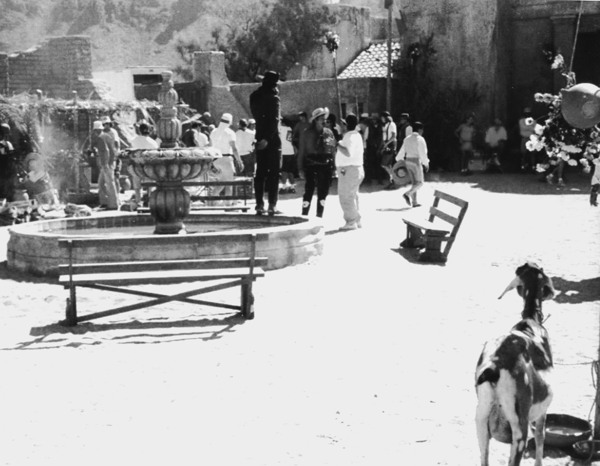
Old Tucson Studios. As a hat-wearing George Cosmatos gives Powers Boothe (Curly Bill Brocius) last-minute instructions for the wedding scene massacre and Michael Biehn (Johnny Ringo) balances himself on the plaza fountain, a goat watches the proceedings (courtesy Larry Zeug).
Stuntman Jeff Ramsey has bittersweet memories of playing one of the Rurales in that scene. “There’s a shootout in front of the church which involves the Red Sash crowd,” says Ramsey, “and I was there to get killed. But I worked out all the time, and in the hotel where we were, there was a small gym setup, so I’d work out. I remember doing curls with a cable and a bar, a weighted machine, and I blew out L3 (a lumbar vertebra), because I had fused my back earlier in ’89, 4 and 5. While doing these curls, typically too much heavy weight and I blew out L3, which is a painful situation. So the next day I’m praying that Leonard doesn’t have me do another stunt in this sequence because I didn’t have any Percodan with me, which I normally took on the job in case I got hurt. The fellas found out. I said, ‘Do you have any pain killers?’ One fella says, ‘Well, I have some Vicadin.’ I never took that before. He said, ‘You better take two.’ So, I took two and it really knocked me down. We were inside one of those sets at Old Tucson, and I’m lying on a crash pad and I’m thinking to myself, ‘Oh, my God. If Leonard calls me, I can’t do anything. I’m almost paralyzed from these drugs.’ I get up and drink coffee and I didn’t know that coffee makes it even worse.” Ramsey was there for just the one scene and then left the set for Los Angeles where he had surgery to take care of his issue.38
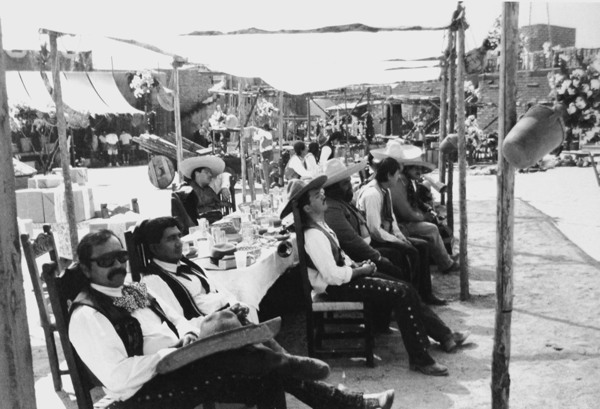
The Rurale wedding party and the mariachi band await the beginning of a scene on the Old Tucson wedding set (courtesy P.J. Lawton, Old Tucson Studio).
That weekend, the production moved its base camp to Mescal—the Buckaroos called it “Stalag 13”—and Sam Dolan remembers, “We were setting up our camp [at] the main ranch set for the old Young Riders TV show, about 200 yards from town. It was a little white ranch house with a barn and outbuildings, and we set up corrals down there and our tents around those buildings. There was a little bit of down time as filming wouldn’t begin in Mescal until July 14. A typical day that July and August started out at sunrise. We would wake up, climb into our wardrobe—most of it pretty filthy unless we’d gone to the laundromat in Benson—and even then they wanted our clothes to look dirty and so they got pretty nasty. Then we’d feed and water the horses. While they ate, we walked over to the set and got breakfast with the crew. Then we’d go back and saddle our mounts for the day, get our guns, and ride back to set. Half the day was spent sitting around, waiting. Then, one of the ADs would place us in the street for a scene, but mainly we sat around under the shade of the awnings waiting or napping. At lunch we would water the horses, loosen their cinches and line up at the catering truck. The Buckaroos were allowed to have lunch most days with the crew and principal cast. There was a separate line for the regular extras.”
Jeff Dolan explains how the Buckaroos scammed the system: “At lunch, we’d always get a couple extra lunches. We’d say, ‘Hey, we gotta get a lunch for Bill back in the camp.’ And the cook would go, ‘Sure, fine.’ Of course, we ate like kings and they put together a nice lunch and that would be the basis for sort of Mulligan stew–kind of dinner. They would add beans and somebody else would pull out something and we had the basis of the two lunches and we’d make a small dinner for half a dozen of us. It was really fun.”39
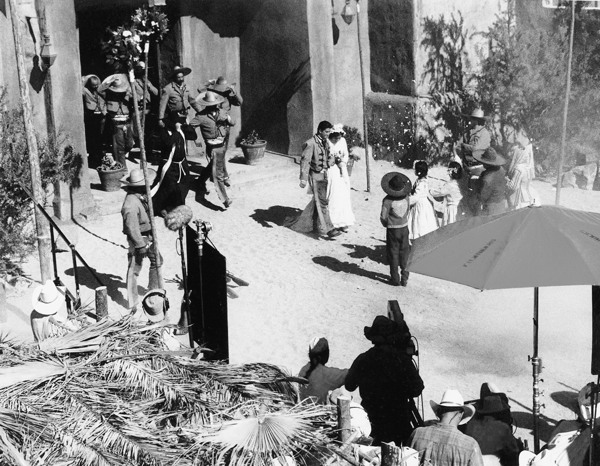
Michael Garcia (Rurale captain and groom) and Michelle Beauchamp (bride) leave the church as Pedro Armendariz, Jr. (priest), follows with a group of stuntmen dressed as Rurale soldiers.
July in Cochise County that year was brutal. The horses all lost weight and the afternoons could be really unpleasant. The air around the set was filled with smoke from the bee gum smoke pots the FX crew burned all day. Flies were constantly all over everything, man and beast.
According to J. Nathan Simmons, “Sam [Elliott] was very cool about sitting with the background players. One time Kurt yelled towards Sam, ‘You don’t have to eat with those extras.’ Sam said, ‘Put my pants on the same way they do, one leg at a time.’ Sam was a stand-up guy.” Simmons recalls another Elliott incident that impressed him: “Kurt Russell was trying to fire a five-year-old kid for asking for an autograph. He didn’t know any better. He’s a five-year-old kid. If I remember correctly, Sam Elliott stood up for him. ‘He’s a five-year-old kid. If you fire him, I’m walking off the set. And the only stipulation is that you leave him and his family alone for the rest of the movie. And you don’t speak to the background [players]. You don’t need to speak to the background. That’s not your job.’ I remember that. That’s one of the things I admired about him. He knew we were there to work just as hard as he did.”40
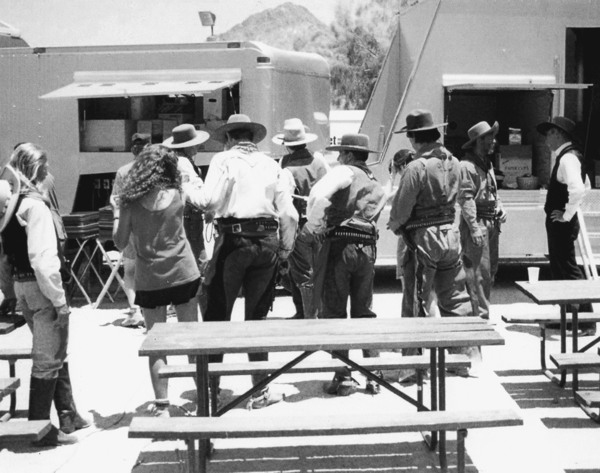
Red Sash gang members await their turns at the catering wagons (courtesy Larry Zeug).
Donna Cline was also impressed with Elliott’s behavior. “All of the women, every one of them—we were in love with Sam Elliott,” she gushed. “He was a cowboy and a gentlemen and he absolutely had his priorities right. One night we were shooting all night long and George was acting up. It was about five in the morning. Finally, Sam said, ‘George, stop this right now. We have all been up all night. You are tired. So are we. We’re trying our best, so stop yelling.’ I was so happy and proud of him—he stood up to George. [Another time, Sam] was in the production office and apparently George made him angry. He was wearing that big old cowboy hat and he was mad as hell. He was cussing and we were all surprised by this unusual display of temper. Sam turned around as he was leaving the office. There was a small dog gate stretching across the door because we always had animals in the production office. He stepped over it, turned around, took off his big hat and said, ‘Ladies, please forgive my language.’ We did, of course.”41
One day on the set, Cosmatos told property master Steve Melton, “I need flies. I want flies on these dead people.” So they had to figure out how to catch some flies. There are ways, as Melton explains, “We found out if you put a fly into a freeze for 30 minutes, it sort of stuns it and numbs it and then you pour Gatorade on the actor’s face and literally set these flies on the actor’s face, roll camera and then the fly sort of comes to life and starts to move and buzz around and there you go. You’ve got your shot. George told us how to do that and the flies weren’t moving and he’s screaming, we’re ruining his movie and why aren’t the flies doing anything. He was just really bizarre; basically he just screamed and spit a lot.”42
As the shooting schedule extended into mid–July, the days on the set became longer and both temperature and tempers began to rise. People were fired left and right for little or no reason and in some cases just because they could be. One night, for instance, Cosmatos told production assistant James Alan Hensz to pick up a granola bar wrapper lying in the street. Egos being what they were, he refused to do so and was fired. All the other ADs and PAs liked Hensz, so for several days people wore granola bar wrappers pinned to their jackets and shirts as a silent protest. It didn’t last very long but they made their point. It was said that over 100 people were fired from the project. Of course, many were swept away when Cosmatos cleaned house after he arrived on the set. Property assistant Greg Poulos’ experience sounds fairly typical: “I was asked by Michael Courville to go down there with him and Jim Falkenstein to do the movie. [John Sanders, the] first prop master, had been fired and Michael replaced him. [When the first property master left,] his whole crew went with him. If the prop master leaves, usually the crew will go with him. They’re pretty dedicated to who they work with. They keep their crews, they know they can trust them. They know what their job is and they do it. So it’s pretty normal.” Later, Courville and Falkenstein left to do sitcoms, and Steve Melton took over as first property master. Other crew members left due to Cosmatos’ abrasive personality and general lack of directorial skills. Some remaining crew members began wearing Tombstone T-shirts with the names of those fired listed on the backs with a line drawn through their names. When Cosmatos would offend or fire someone, Stephen Lang admits that he (Lang) would “just start to laugh and sing, ‘And another one bites the dust….’”43
According to James Danicic, hot-head technician for the film, “Cosmatos decided he wanted a remote-head guy for cranes. When you’re filming with horses and stuff like that, you like to have the camera [higher] up and get more dynamic shots. He wanted a crane for every set; a small one, a long one, medium in between. [Sometimes] I had a long 70-foot crane, high with a wide-angle lens. It was interesting that so many people were let go so quickly over a lot of little things. People cycled through so quickly. It got to the point with camera people that I just stopped introducing myself…. [F]ocus pullers would be there a day or two days and then [be] gone. It was a big movie with several cameras and people missed shots from time to time, but you could have one bad night and you were gone. I know at some point there were at least two crew members who put their names on the tombstones at Boot Hill. There was also a rumor … that we had extra camera people at other hotels … just standing by that if you pulled a bad shot, they’d take you off the set that night and have someone on the way to replace you.”44
Animosity on the set wasn’t confined to just Cosmatos and the cast and crew. Many of the wranglers and stuntmen hated the Buckaroos because, in their opinion, the re-enactors were taking their jobs. Some of the wranglers drove wagons in the background and cut off the Buckaroos just for spite. Chris Ramirez recalls, “We’d ride by the wranglers in their jeans and jacket and modern cowboy hat and they’d look at us and go, ‘Scab. Why don’t you fuckers go home?’ And we’d just ride by. Really uncomfortable.”
“I argued with those wranglers every day,” says an exasperated Sherayko. “We almost had a fistfight a couple of times because they wanted to get their buddies in to ride instead of the Buckaroos. They hated the Buckaroos. They said, ‘These guys, they haven’t been on [a movie set,] they can’t ride.’ That’s what (the wranglers) want to do. That’s what 90 percent of them do. They’re good cowboys, they’re good horsemen, but they’re rodeo ropers. The wranglers are a close group of people that bring their own friends in [as well as] their own saddles, which were modern roping saddles. We (Buckaroos) kept saying, ‘No. We have to use Sam Stagg–rigged, half-seat slick forks. You can’t use [a modern] saddle.’ I remember one of the guys … was taking a Boss of the Plains hat and he was creasing it and crushing it and curling up the sides, and I kept saying, ‘Don’t do that. Don’t make it look like a modern rodeo hat. It’s not.’ They said, ‘Well, that’s the way a cowboy’s hat supposed to look.’ They just got so mad at me. (The Boss of the Plains is a high-crown, stiff-brimmed cowboy hat designed by John Stetson in 1865.) One of the assistant wranglers challenged me. He said, ‘Oh, the Buckaroos can’t ride. Your guys are no good.’ I said, ‘Look, you guys are (the) roping cowboys.’ Every wrangler I know is a rodeo cowboy. I had three or four guys that were real live rodeo cowboys. So I challenged [the wranglers]. I said, ‘Okay, let’s put $5000 down. We’ll have a contest. You take the best three of your guys for roping, I’ll take the best three of my guys for roping. You take the best three for shooting from horseback at targets, I’ll take the best three of my guys, $5000 each and winner take all.’ I knew that even though they were good ropers, they were lousy with a gun on a horse. So I knew we’d win three out of those and I knew at least one of my ropers would win out of the three. So, I’d be four to two ahead and we’d win. They wouldn’t take me up on it. ‘No, fuck you…’ So we had arguments all the time.”45
Frayed tempers and excessive heat made filming almost unbearable. On many days, the cast would leave the hotel at six a.m., with the first shot of the day scheduled for 9:00 a.m. They would have lunch at 1:30 p.m., and would be back filming again by 3:00 p.m. The day concluded around 7:00 p.m. If night shooting was planned, the schedule was even tougher: Leave at 5:00 p.m., first shot at 7:00 p.m., lunch at midnight, start filming again at 1:00 a.m., and wrap up the evening at 6:00 a.m. One Buckaroo spoke for everyone when he said, “During the last month or so, you learned to keep your head down. You talked to the cast members you developed friendly relationships with, but you stayed away from George and the first-team people unless spoken to. Our horses were tired. We were tired. Those last few weeks were tough. Our tempers were short and sadly, we were not always at our best…. [T]he truth is we were worn out and ready for it to be over.” And Southern Arizona’s summertime heat was unbelievable. Not only would the call sheets detail what scenes were to be filmed, who was present, leave and crew call times and special instructions, they also identified sunrise and sunset times and the temperature. And it was damn hot. Temperatures were always in the very low 100s and on June 28, it reached 114°. “I found it a little inconvenient that Jarre insisted on our wearing real wool,” complained Kilmer. “‘It has to be wool. You can tell the difference,’ he said. Well, you can’t, Kevin Jarre. You can’t tell the difference between real wool and any blend, even in a macro close-up, okay? When it’s 134° inside the studio … you didn’t really have to think about diet much…. It really was that hot. Someone put a thermometer in the theater scene—it was 134. In a wool suit, being Doc was easy to do. That was my theory about why Doc killed so many people. It’s just like he wore wool, in the summer, in the Arizona territory and that made him mad.”
When they filmed in the evenings, it was usually in the mid–80s—tolerable but still warm when dressed in period costumes and acting under the hot lights. As a result, staying hydrated became mandatory because failure to do so resulted in dire circumstances. When asked what the greatest challenges were from a production standpoint, producer Bob Misiorowski said, “Heat and horse manure. Moving the horses, shading the horses, watering the horses, cleaning up after the horses. Flies, water, ice and salt tablets. All the cast and crew were constantly reminded to drink plenty of water.” The heat even cut down the director, according to at least three witnesses: Buckaroo Jeff Dolan: “[George] passed out one day from the heat. He fell over [while] overcome with heat exhaustion working hard out there in the sun, trying to get it done.” Property master Steve Melton: “I remember him falling over one day from heat exhaustion and literally no one, the crew was just walking right by him. He fell over in a chair. Finally a medic came and they had to give him water.” Bobby Vincent: “Cosmatos was a pretty hefty guy. It was so hot, they had a 15-passenger van that they ended up taking the seats out of it because he overheated. They poured a bunch of water on that poor guy and ended up turning the air conditioning on and finally got him cooled off.” (Extras and crew members would humorously call the director “George Comatose” or “The Screaming Greek” or “Zorba the Hut.”) Adds Vincent, “I was sitting on my horse talking to a production assistant one day, and I said something and she didn’t respond; she’d fallen over flat on her back. So I yelled out and somebody came over and took care of her. There was a lot of that. I drank Gatorade and water like it was going out of style. You’d never go to the bathroom—you drank water all day long and never have to pee because it just came out of your pores: 112, 113, 114°. It was really hot for a while there, really hot. I had a black horse but he lost a lot of weight, partially because he was dark. And it was so hot and having the saddle on him all day long. He literally got sunburned.” Even the Buckaroos, who were sleeping in their tents and should have been fully acclimated to the temperature, found it difficult.
Cosmatos didn’t make it any better. One day he looked around and said, “This is supposed to be October, why is nobody wearing coats?” And, of course, it’s the middle of August outside of Benson. The next thing you know, everybody’s wearing coats. They were told, “Wear a coat. Wear winter clothing.” No wonder everyone couldn’t wait until filming was over. Focus puller Michael Walker humorously remembers, “You can just see [the actors] start to wobble. ‘Oh God. There goes another one.’ Back then we were burning 18Ks to get the lights, the shadow underneath the hat and exteriors. We have five or six 18Ks burning just to get the exposure for underneath the hats with the sun beating down on them, the backlight. It was a very hot set, especially wearing wool, it was brutal. It was brutal for me lugging camera gear around. It was a tough location.”46
The excessive temperatures not only affected the actors, the production equipment also began to broil under the heat’s wrath. Trailers began to flex, shrink and expand, and “problems [occurred] with the electrical outlets—several meltdowns happened.” But as usual, creative minds resolved the issues. Says James Danicic, “When they did the interior shots, they had these big trailers with AC units on them and they’d run these big pipes right by my truck into the set. They had all these sections they put together and I would open up a section and take a couple of space blankets and attach an offshoot tube and throw it into my truck so I had some air conditioning because they wouldn’t let me idle the truck and run AC all day. But I’d sit there with a [walkie-talkie] and wait for my name to be called on the camera channel.”47
Many actresses wore big, heavy petticoats and the wardrobe department warned the medics that “some of these dresses are five to ten thousand dollars so if something happens, don’t cut them off.” It was fortunate that medic Chris Swinney had a motor home with two air-conditioning units parked on the set in case somebody needed attention. “I once went to check on [actress] Lisa Collins,” says Chris, “who said she was fine. I told her, ‘You’re crawling on the ground. You’re not fine.’ So I got her in the motor home. Wardrobe ran over to help me with the petticoat.”
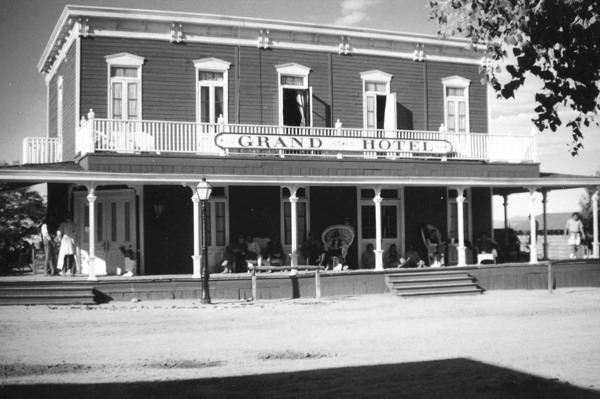
Lounging on the porch of the Grand Hotel, Mescal. With temperatures in excess of 110°, any shade was a welcome relief. The porch roof collapsed from the excessive weight of camera and lighting equipment and crew when filming Lightning Jack (photograph by Lee Gray/courtesy Catherine Hardwicke).
Special effects coordinator Dale Martin wasn’t as fortunate. According to Swinney, “He was having some problems. I don’t know if it was just the hours or the weather or the stress. There was a day that I checked him out and his vitals were all over the place. The producers and I got together and they ended up sending him home; he later passed away.”48
As would be expected, in addition to all the conflict and tension, the production seemed to have more than its share of incidents:
• Cows gave birth to calves while others died of natural causes.
• Meryle Sellinger’s German shepherd bit prop master Michael Courville on the arm.
• Several cast and crew members, including Michael Biehn, transportation coordinator Jon Carpenter and wardrobe assistant Amber Dunn were involved in deer-related car accidents.
• A vehicle was deliberately scratched in the hotel parking lot.
• Carpenter John Ashley received an eight-inch laceration on his leg from a power saw.
• A mule died.
Of course, such misfortunes didn’t affect just crew members. Stephen Lang joined first assistant director Conte Matal in battling a flu bug. PA Donald Murphy slipped and twisted a knee, as did George Cosmatos. Actor Michael Rooker received a cut on his cheek. Extra John Wayne Galloway suffered cuts on his hands and arms after he went through a plate-glass window. And on top of all that, some of the film actors felt that the television actors weren’t taking the project seriously—joking around, having too good a time.49
Expecting something different was pointless, so for many, humor was the only solution. In addition to the aforementioned “termination” T-shirt, Catherine Hardwicke created another, more eloquent version that made the rounds. This one listed numerous memorable comments the director had made during filming:
That ain’t bad. You’re biting me! SPAK, NOT GAK. What exactly is it I’m supposed to be doing? How do you expect me to do THAT? Madga and Shannon Finch will be handling that. I’m on a higher moral ground than you are. I think that was the oil pan back there. Just hire a couple of Rons. Could I leave early today to see my parole officer? He’s a stripper, Gene. He’s hired. Anybody seen the Oriental foo-foo? That job should take two minutes. Anybody seen Eddie? Love on the rocks—ain’t no big surprise. It’s made of people! I know 100 people in LA who would come out here and work on a moment’s notice. Rob, you can strike Hooker’s today. I’m absolutely exhausted. I’ve been Partying all night with Jason Priestley. Rob, we’re shooting Hooker’s tomorrow. Hel-loo! Put this in the I don’t even want to see it on any planet file. LET ME SHUT UP. The movie is over. Rob, you can strike Hooker’s today. You better work. Why don’t you lick it? Rob, we’re shooting Hooker’s tomorrow. YOU are the so-called Production Designer? Carla, your lover Tino called. Who hired these people? I don’t know what a phone instrument is, but I’ll find out and I’ll have one there tomorrow. Underwater bridge? Fine, I’ll send 20 guys with a truckload of shit and they’ll stand around and go Duh? You want ME to be there? You want Me to go to the set? If you can see me on the set, you know something’s wrong. Would Stanley Kubrick have this in his movie? This is the Crucifixion, don’t you see it? I can’t do that, I’m sun sensitive. Who do you think you are, Patrizia Van Brandenstein? Mara? She’s absolutely worthless but compared to your other incompetents, maybe she’s not so bad. KAAAATE!! YOU’RE DOING A VERY BAD JOB! THIS LOOKS LIKE SHIT. Equal sex for equal pay regardless of work. I can paint that whole fucking wagon in 20 minutes. Okay, I’m timing you. Brian, do something about these shadows. If I see anyone standing around watching filming, they’re fired. If anyone parks in town, they’re fired. If anyone buys anything at Payless without an approval, they’re fired. If anyone walks into the shot, they’re fired. You’re fired. Do you know what that means? (Just put on a different t-shirt and go back in.) Who is this Serdena? Is he Italian? Maybe you’ll get to know me better and know why I drive women crazy. I’m taking antibiotics. I’m just not healthy. There is no construction coordinator on this film. Day players don’t get lunch. THIS SHOW IS OVER. I could buy this chair at Wal-Mart for ten dollars. Sir, that chair is worth more than you’ll make on this entire movie. Where’s Eddie? I made Bambi’s list? I’ve never been so abused in my life. I can’t even go out partying. Of course, you did see me having one drink last night. Rob, you can strike Hooker’s today. How’s YOUR movie going? Rob, we’re shooting Hooker’s again tomorrow. I’m all over it. What was it that I was all over? MR. THING. Who put this deer head up here? Bring the man here right now! You get an “F” today. Yeah… Right! You look like you need a Corvette. You get a spanking. Anybody got a screw for their old man? Is anybody on the radio? … This is Seth… I’m in the O.K. Corral… Does anybody need me? 10–4. I’m on it. Get the FUCK out of the shot! Everything’s in the fucking shot! A-DAM! I’ve been begging people to do this for weeks. I asked you 100 times three weeks ago to fix that board. Where the fuck is David Solomon? Gene, could we just finish Virgil’s? I’m not an infant. You dress terrible. You should wear a long black dress and carry a cigarette holder and call yourself “von Hardwicke.” That is SWEET! KILL IT!
Laughing, Catherine confesses, “I made 25 T-shirts for my art department and it was all the most outrageous quotes that [Cosmatos] said. I was handing them out to people and [George] came up and said, ‘What the hell is this?’ ‘These are all your crazy quotes, George. It’s kind a tribute to all your poetry.’ ‘Oh, it’s all about me? I want five of these in each size.’ And he demanded that I send him five of the T-shirts.” Later, when he heard that she had a professional photographer take photos of the set, he also demanded 8 × 10s of them, and insisted that Hardwicke pay for it!50
For others, the classic rubber chicken was enough to break the tension. The origin of the gag is unknown but it never fails to get a laugh. Some of the Buckaroos would ride around with a rubber chicken on their saddle and they’d pass it back and forth. Many would stuff the chicken in a saddle bag with the feet sticking out, or in a rifle scabbard, or just hang it from a saddle horn. It was even hung from balconies and railings. The trick was to insert it into a scene unbeknownst to anyone and then hope no one would catch it. Although Reggie Byrum wasn’t in the O.K. Corral gunfight scene, he still wanted his chicken included. “[I] wasn’t involved in the [scene] but I was going to play a joke when they were filming it. I was going to throw the rubber chicken in the middle of the gunfight. But every place I was going to do it, there was somebody there filming so I [couldn’t]. [On another occasion] we put the chicken inside the saloon where [Kurt] jumps through the window, but it disappeared. I had it in my saddle [and was] using it for a horse quirt. One guy had it sticking out of his bedroll. We’d take turns carrying it around [but, if it was ever filmed in a scene], they cut it out. Sometimes, they even used rubber snakes.”51
There were several kids around, including Norman Ritter and Cassandra Swinney, and they had a great time being on the set. Josh Swinney recalls, “There was a bunch of abandoned buildings we would play around in. I just remember hanging out with all the kids; it was a big jungle-gym to us. Sometimes we’d go in a building and watch them film a scene from up on the second floor, looking through the curtains. I always wondered if we were going to get in the scene. They didn’t keep track of us as much because we didn’t listen to them very well from what they told us to do when we were out there. But, when we weren’t on the set, we were running around…. [One day] they made a call over the radio looking for kids to be in a scene.” Cosmatos had approached Chris Swinney and asked if Swinney’s kids were on location that day. “We have no children in this scene,” Cosmatos told him. “I want children in this scene. Will you go get the kids and take them to wardrobe and have them dressed and bring them to me?” Swinney recalls, “I went over and got Yanez, Tomas Arana’s son, Wyatt (Russell), my son Christopher and my stepson Michael (Ritter), sent them to wardrobe, and he put them in the scene.” Josh Swinney: “My dad came and found us, we were playing around in this old barn. Every day I would come in, we’d be playing and then they’d say, ‘Okay, go get dressed.’ We would get dressed and we would play in all the other barns and everything we would do normally, and then when they needed us, they’d come find us. We were already dressed up. It really didn’t matter how dirty you got because it was kind of the thing. They didn’t want us tearing the clothes, but at the same time it didn’t really matter how filthy we got. I guess the filthier, the better. They even sprayed dirt on us for one scene. There was dirt in the little pump cans that they sprayed—it was kind of like mud. Just kind of mist it on you because you come in and I had blond hair, blue eyes and fair skin. I’d come in, I was kind of glowing. Knock you down with some dirt, put some makeup on your face.”52
Goldie Hawn visited Kurt on the set a number of times, with their son Wyatt and her daughter Kate Hudson. Wyatt would pick up his father in a golf cart and drive hell-bent for leather to wherever he was going. Val Kilmer’s wife and children came to the set at least once, as did Michael Rooker’s children. On one occasion, Rooker grabbed one of the sugar glass bottles from the prop table and smashed it over his head in front of the kids, who were horrified. “Don’t worry,” he said, “it’s just a movie bottle.” Rick Terry recalls another humorous incident: “There’s a scene where Val plays the piano in the saloon. He was rehearsing, it was during the day and he was inside, practicing [on] the piano what he was going to play. We were outside sitting in the shade, listening to it, not thinking much of it. He had on this cape that he wears in the shootout, and the makeup that he had on kind of made him look pale—it was kind of white. And I remember one of these extras, a young kid, maybe 10 or 12, a couple of them [were] hanging around. So he gets done and Val comes walking out onto the boardwalk where we are sitting and this kid looks at him and says, ‘Who are you supposed to be?’ And staying in his Doc Holliday character, Val said, ‘What’s it to you?’ It made the kid kind of embarrassed. So Val walks away and the kid says, ‘I think we oughta start calling him Count Docula.’ And then it got around. People started calling him Count Docula.”
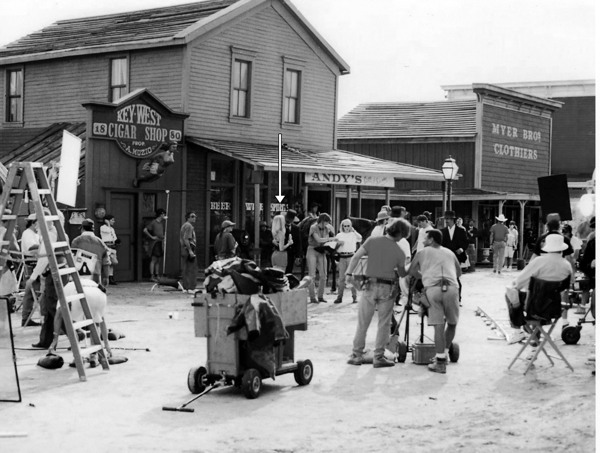
Cast and crew members patiently wait the setup for the scene in which Fred White (Harry Carey, Jr.) introduces the Earp brothers to the political aspects in the town of Tombstone. Kurt Russell stands with his arm around Goldie Hawn (see arrow) in front of the Key West Cigar Shop on the Mescal set (courtesy Larry Zeug).
Kilmer wasn’t happy with his piano-playing performance. “I’m musical,” he admits, “but I’m no pianist. Learning a nocturne for Tombstone was a real bitch! It took four months and then they blew the edit. I can play one minute of Chopin and Chop-sticks. That’s my entire piano repertoire.”53