
In 1994, Australian Aboriginal artist Eddie Burrup began putting his paintings on public display. They were entered in exhibitions and received favorable reviews by people knowledgeable about Indigenous art, and the paintings began to sell. The images, which would be described in the terminology of Western art as “abstract,” were in the fashion of the “Dreaming” patterns (representing cultural values and beliefs) of other Aboriginal works (see Figure 2.4). The artist provided a biography that told of his life and artistic endeavors. As Burrup’s professional trajectory carried to the point where more sales were imminent and he would be in demand for interviews, he revealed in 1997 that his identity was not as advertised. He was actually Elizabeth Durack, an elderly white woman from a prominent family in Western Australia who was an artist with a long career of accomplishment and reputation. When the story circulated as a major news item throughout the country and drew attention internationally, the artist faced condemnation from many parties, although less from those who knew her, and she was supported by others. She never renounced her deception, but explained it (through print media, several videotaped interviews, and her website), and continued to paint as Eddie Burrup until the end of her life in 2000 at age eighty-five.
Durack’s case is a provocative example of what is often described as “cultural appropriation.” In its broad sense, the term refers to the transfer of anything of cultural significance from the culture where it originated to another culture. In art, examples include tangible objects such as the Elgin Marbles and American Indian headdresses purchased for European collections. Depending on the circumstances in which they occur, acquisitions of this sort may cause controversy, but of a different sort than in the present discussion. In a more restricted sense, which is the way the term is used here, “cultural appropriation” refers to the intangible factor of a style, icon, or theme. Ideas are acquired from another culture by outsiders and replicated in making new artworks. The production of those works often brings accusations of theft and questions about authenticity.
Similar to the appropriation practiced by Koons and others, in cultural appropriation what already exists is taken for use in a new artwork. However, appropriation art involves taking from an individual artist, whereas the cul
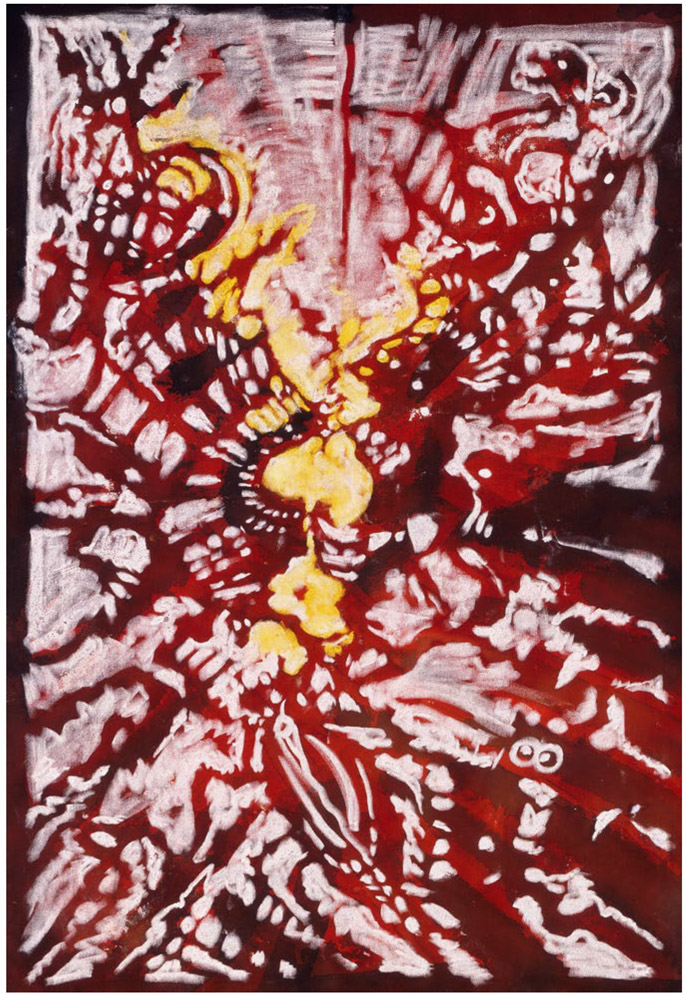
Figure 2.4. Crested Ibis Landed at Low Tide on Karacumbi Bar. The Mission Boat Picked Him Up. From The Art of Eddie Burrup by Elizabeth Durack, mixed media on linen, 133 × 92 cm. Courtesy of Perpetua A. Clancy and Michael F. Clancy
tural version involves a group. The appropriation may target a particular artist within the group, but the concern is about the artist’s group identity. Offense occurs when a dominant group takes from a minority group, as with white artists fashioning works that appear like those of Indigenous artists. The basis for controversy is that the minority group’s culture is being exploited, and as a result, their identity is usurped and a source of their income threatened.
Instances of cultural appropriation have drawn condemnation from members of the targeted groups. One of Durack’s critics declared of Aboriginal art, “It’s the last thing you could possibly take away other than the rest of our lives or just shoot us all.”157 Other artists, too, have been mistakenly thought to be cultural insiders only to be eventually unmasked. Farley French, originally from Calcutta, took the name Sakshi Anmatyerre and for six years in the 1990s painted Australian Aboriginal works.158 In the United States, Jimmie Durham’s long and distinguished career as a Cherokee artist and political activist has transpired amid confusion over claims that he is not of American Indian heritage. The artist has admitted this to be true while asserting that he learned the Cherokee language at home as a boy.159 On the other hand are cultural outsiders who work in the fashion of insiders but with no misunderstanding over their identity. In Canada, for instance, Amanda PL found her 2017 exhibition of Indigenous-inspired paintings (styled much like the works of noted Canadian artist Norval Morrisseau) to be offensive to Indigenous artists,160 and in New Zealand the following year, Sally Anderson, married to a man of Māori descent, was denounced for inappropriately wearing a facial tattoo of a Māori symbol.161 Further, beyond styles adopted from minority groups, the offense of cultural appropriation has extended to themes that characterize those groups. In 2017, Dana Schutz’s painting Open Casket (a semiabstract depiction of an African American teenager who was murdered) at the Whitney Museum of American Art evoked artist Hannah Black’s response that
The painting should not be acceptable to anyone who cares or pretends to care about Black people because it is not acceptable for a white person to transmute Black suffering into profit and fun. . . . The subject matter is not Schutz’s; white free speech and white creative freedom have been founded on the constraint of others, and are not natural rights.162
In the same year, Sam Durant’s monumental sculpture Scaffold (depicting several historical gallows in the United States) drew condemnation from the Dakota tribe when it was displayed in Minneapolis. The work was designed to protest unfair executions, including the mass hanging of American Indians in 1862. Durant was told the portrayal could not be carried out appropriately by a non-native artist.163
In some instances, cultural appropriation is prosecutable under the law. Indigenous groups have applied fraud statutes against deceptive practices when items were sold by falsely claiming them to be Indigenous products. In Australia, the Trade Protection Act (1974) is applicable in civil cases and was the basis for the key case of Australian Competition and Consumer Commission v. Australian Dreamtime Creations in 2009. The defendant was found guilty of misleading consumers about the nature of many items sold as Indigenous products, including paintings, prints, carvings, and decorated objects such as boomerangs and didgeridoos. The artwork was said to have been made by Aboriginal hands, in particular by a fictitious artist named Ubanoo Brown. Two factors are highlighted in the case. The penalty meted out required the defendant to pay the prosecutor’s court costs, and for a period of three years to refrain from selling artworks designated as Aboriginal without first making inquiries as to their authenticity. The second factor is a stipulation that the term “Aboriginal art” refers to the person producing a work and not to the style in which it is made. What counts when determining fraud versus authenticity is whether the artist comes from an Aboriginal bloodline.164
Legal redress in the United States against falsely designated American Indian artworks also lies with the identity of the artist rather than with the visual features of the works themselves. Determining the status of a work to be genuine requires that the maker be a member of an American Indian tribe or certified by an American Indian tribe as an American Indian artisan.165 By this definition, only American Indians can produce American Indian works. Claims that works have been faked can be dealt with as fraud generally or through the Indian Arts and Crafts Act (IACA) of 1990, which is applicable in both criminal and civil litigation. The first version of the act in 1935 carried a maximum penalty of six months imprisonment and $2,000 fine, while in the present version a first-time offender faces prison time of five years maximum with a fine of up to $250,000 and a repeat offender up to fifteen years imprisonment and $5 million.166 The IACA was the law applied in a notable case that concluded in 2018 over the sale of inauthentic American Indian jewelry,167 the market for which by some estimates is 80 percent fraudulent.168 While the overall fraud under investigation was high-volume and widespread, the principal defendant pled guilty to two felony charges and was sentenced to six months imprisonment, with $9,000 to be paid in restitution.169 A related case involving jewelry was brought in 2017 and will take time to proceed through the legal system.170 Critics have denounced lax enforcement against fake American Indian-made artworks including, besides jewelry, such forms as blankets, baskets, and bone carvings, noting that from 1996 to 2017 more than seventeen hundred complaints of alleged fraud in five states (New Mexico, Alaska, Utah, South Dakota, and Missouri) resulted in only twenty-two prosecutions.171 In Canada and Australia, too, prosecutions have been few and lawmakers have been lobbied to create new legislation with strong penalties targeted specifically at scams on Indigenous art.172
Cultural appropriation is prosecutable when there has been a false claim of Indigenous identity. But the law does not apply when a non-Indigenous artist makes no such claim and creates a work that is seen as culturally Indigenous, or when what is appropriated is from a minority group that is not Indigenous, such as African Americans. In such instances, other actions have been taken. Shaming and physical protests have sometimes been effective reprimands. Amanda PL’s exhibition of Norval Morrisseau look-alikes was canceled by the sponsoring gallery due to negative publicity,173 and Durant’s Scaffold was removed from exhibition after protesters appeared and an activist curator called for a peaceful occupation of the park where it stood. The artist issued an apologetic statement.174 On the other hand is Durham, who, despite confusion about his heritage, was honored with a major retrospective in 2017–18.175 He is still often identified as an American Indian artist, with his works discussed in that context.176 And the display of Schutz’s Open Casket, although subjected to protesters blocking its view from spectators, was defended by the Whitney Museum and by Schutz as legitimately addressing an emotional topic in a controversial way supported by the spirit of artistic freedom and interpretation.177
Although cultural appropriation has drawn much public attention as well as increased prosecution under the law, philosophers and legal scholars have often found objections against it to be problematic. With a version of “essentialism” as its basis, it assumes each group due for protection has its own cultural essence that establishes separation from other groups. Distinguishing insiders from outsiders is a key aspect of this essentialism. As explained by Bruce Ziff and Pratima Rao in Borrowed Culture,
The need to describe a community of insiders and outsiders is implicit in most of what has been said about the practice of appropriation . . . certain divisions among cultural groups will be amorphous. Nevertheless, some test of group belonging seems required in discussions about cultural appropriation.178
Intruders are seen to fail the cultural test in aesthetic terms and moral terms. Aesthetically, they lack an insider’s understanding of unique beliefs, customs, and artistic techniques, and therefore create works that are inferior substitutes. Morally, they violate the rights of insiders by taking what is not rightfully theirs, which links appropriation to theft and conceives of the cultural material taken as property. The appropriation is objectionable whether or not it is found to be illegal.179
In legal terms, however, an understanding of the nature of the victimized group—its essence—is necessary. Legal scholar Naomi Mezey explains, “The problem with certifying authentic Indian stuff is that it requires certifying authentic Indians.” Again, “The broader presumptions of the law . . . assumes that we always know what Indian stuff is and who Indians are.”180 This difficulty is faced in Australia, Canada, and other countries where Indigenous people are recognized for their art. Considerable confusion arises over who fits within a particular group and who does not. In some situations, as with the IACA in the United States, tribal membership is the key: an insider—someone legally empowered to make American Indian art—is a certified member of a tribe. Membership is based on “blood quantum” requirements and other determining factors. A minimum of proven native blood is stipulated, which leaves out many people who unofficially claim to have Indigenous heritage. Even if there is a traceable bloodline, the matter of what it takes to be legitimized as American Indian varies considerably from one tribe to another. The Shawnee Tribe requires one-thirtieth blood heritage for membership, whereas for the Fort Sill Apache Tribe it is one-sixteenth, with one-eighth for the Comanche Nation of Oklahoma, one-quarter for the Hopi of Arizona, and one-half for the Miccosukee of Florida.181 In other countries, too, the same issue applies, as Indigenous status generally is determined by a requirement of blood heritage that may vary from one Indigenous community to another and among political entities (i.e., state, province).182 While eliminating pretenders, legal definitions of what constitutes Indigenous status are highly inconsistent.
Beyond the matter of membership in Indigenous groups are questions about the capability of members and nonmembers to produce artworks in the manner of those groups. Are members producing works that are authentic by tradition, or are they creating products of a new sort? Are outsiders producing works that appear to be as traditionally authentic as those of insiders? As with the mixing of bloodlines, cultural ideas, values, and practices, too, have become mixed through assimilation. While Indigenous groups have been appropriated from, they also have adopted the ways of the dominant culture. To what extent do they or can they step back from their assimilated lives and create art that is different or better than that of outsiders who learn about the minority culture and then adopt its ways? Much of the Indigenous art in Australia that attracts imitations is a hybrid form developed in the 1970s using acrylic paint (a mid-twentieth-century Western invention) on canvas, whereas earlier works were made with traditional materials. Even the idea of producing “fine art” has been adopted from the dominant culture. Prior to incorporating Western ways, the purpose of Aboriginal art was decorative, and it fulfilled the practical objectives of enhancing ceremonies and adorning functional objects. It can be argued that the Dreaming themes (often pointed to as distinctly Aboriginal) remain traditional, but they are filtered through minds conditioned by recent times and cultural assimilation.183 This is not to say that assimilation has entirely erased connections with the past and traditional Aboriginal ways, but that it has had an inevitable effect. There are artists such as John Mawurndjul, who uses traditional materials (working on bark and grinding his own pigments), has spent much time at remote outstations and is attuned to his Indigenous history. Still, he embraces the present, with a promotional statement for a 2018 exhibition saying, “The old ways of doing things have changed into the new ways. The new generation does things differently. But me, I have two ways. I am the old and the new.”184
Elizabeth Durack, too, regarded her artwork as resisting a singular classification. She spent most of her life in Western Australia, where, as a child, she often played with Aboriginal children and as an adult went on journeys of sometimes two weeks’ duration where she was included in the men’s ceremonies. (She said the men seemed to think of her as sexless because she was white, whereas Aboriginal women were excluded from the ceremonies.) From the 1950s onward, her art featured Aboriginal subjects, and sometimes alluded to the Dreaming. She studied with a respected Aboriginal painter, and herself mentored an Aboriginal boy, her “classificatory son,” who remained close in adulthood. She knew the Kriol language (a version of pidgin English) and wrote a promotional piece in it attributed to Eddie Burrup. The Burrup paintings, Durack felt, were part and parcel of her life. She saw herself as participating in an arena where she belonged rather than appropriating from it. She explained her alter ego as a natural extension of her career, a next phase that had been inside of her for many years and finally reached self-expression. Whereas her earlier paintings depicted mainly graphic images of Aboriginal life over time, her work evolved into a “morphological” stage where shadowy forms and shapes reflected an expression of the Dreaming.
Durack saw her career against the backdrop of her own personal history and the history of Aboriginal art in Australia. In the artist’s words, she believed in
the right to gain a legitimate place for Eddie Burrup in the extremely complex and inter-wed world of contemporary “Aboriginal Art.”. . . Eddie Burrup asserts his right to his place in the scheme of things via an intellectual and psychic connection with this country’s ancient culture and via knowledge which has been donated first-hand and accumulated over a life-time of learning.185
This perspective invokes questions about the essentialism that supports Indigenous art. Are Durack’s paintings less Aboriginal than those of an artist who was born of Aboriginal parents, grew up in Sydney, and pursued Western art as well as Aboriginal art along the way to creating a series of Dreaming paintings? Or change the artist’s background to having grown up in rural Australia but late in the twentieth century so as not to see the sort of rural life Durack was privy to several decades earlier and that now had died out. These hypothetical artists are Aboriginal by bloodline, but how culturally Aboriginal are the works they produce? This point holds for any minority group: the creative productions of insiders may be rivaled in cultural authenticity by serious outsiders who study, live in or around the group, and follow its practices.
A further question, however, is whether what outsiders produce is qualitatively good enough to be worthy of recognition. Is there something that at least many insiders have to a greater degree and that accounts for quality if not outright authenticity in artistic practice? Philosopher James Young speaks of the “aesthetic handicap” thesis, which claims such an advantage for insiders over outsiders. He concludes against it, asserting that artists who engage in cultural appropriation can produce works that are “in any aesthetically important sense of the word, authentic. Outsiders who appropriate artistic content from other cultures may very well produce masterpieces.”186 Young holds this view for the arts in general, including music where he cites, among others, Charlie Musselwhite, Stevie Ray Vaughan, and particularly Eric Clapton as having successful careers performing the blues although they are not African American, the culture from which that form of music derives. In the visual arts Young notes collaborative efforts of Australian Aboriginal artists such as those already mentioned. Clifford Possum has on various occasions employed non-Aboriginal assistants in making his highly regarded paintings. Kathleen Petyarre’s white husband, Ray Beamish, is reported to have done significant work on her Storm in Atnangkere County II, a painting that won the prestigious Telstra Award for Aboriginal art. And one of Durack’s Burrup paintings was nominated for the same award.187 If there is an aesthetic handicap for outsiders making artworks that are thought of as the province of a minority cultural group, it seems not to apply to certain artists whose works have been recognized for their excellence.
Beyond questions about what constitutes cultural essentialism, with its emphasis on insider status, the concept faces a liability in the political arena. The danger is in reinforcing the detrimental side of identity politics. In a positive sense, identity politics emphasizes the worth of minority groups that is often glossed over when their accomplishments are appropriated. When those groups defend certain cultural productions as their own creations—Indigenous painters and their designs, African Americans and blues music, and so on—they draw attention and respect that is deserved. But the downside is that the groups may become separated from the dominant culture while striving for fair treatment from it. Prominent minority intellectuals have raised this point, cautioning that cultural identity is important but should not be emphasized to the extent of estrangement from the larger whole within which it exists. Social activist bell hooks warns that subordinated peoples should “eschew essentialist notions of identity and fashion selves that emerge from diverse epistemologies, habits of being, concrete class locations, and radical political commitments.”188 Philosopher Kwame Anthony Appiah sees cultural mixing as both natural and advantageous.189 He describes the fruitlessness of trying to preserve traditional cultures against the inertia of assimilation, and notes that the Western notion of “culture,” along with the word itself, is a Western invention exported to other societies and used to support colonialism. The fundamental unit of society, he stresses, is the individual, who fashions a way of life amid changing beliefs and practices.190 And one of the foremost critics of postcolonialism, Edward Said, cautions about groups being boxed in when they are defined through stereotyped images. Rather, he says, it is important to
acknowledge the massively knotted and complex histories of special but nevertheless overlapping and interconnected experiences—of women, of Westerners, of Blacks, of national states and cultures—there is no particular intellectual reason for granting each and all of them an ideal and essentially separate status.191
For all of the pride an essentialist approach to culture offers, it necessarily resists assimilation and carries harmful ramifications in the process.
The harm is that the effect of essentialist claims hinders more than advances the cause of minority groups. It reifies notions of what groups are like, and thus pushes them toward marginalization. They become known for their insider identities, holding them back from recognition beyond that limited scope. Culture as a whole is seen as divided among bastions here and there, with Indigenous groups often cast as backward and simplistic. As art critic Benjamin Genocchio describes this circumstance at its worst,
Whether we like it or not, much of the desire for Aboriginal art crystallizes around . . . a cocktail of exoticism, primitivism, redemption and innocence, which in turn perpetuates derogatory ideas of Aboriginal art as a racial curio fetishised as the production of an authentic spirit.192
Authenticity for Indigenous art, then, comes at the price of preserving a condescending attitude toward the groups from which it originates.
In spite of the negative stereotyping that accompanies the popularity of Indigenous art, the works produced provide an important source of income for the artists. This is especially so in Australia, where it has been estimated that as many as half of all Aboriginal Australians are employed in the visual arts and crafts sector (while for the non-Indigenous population the figure is less than 10 percent)193 and that the value of the country’s Aboriginal art market annually is several hundred million dollars.194 Individual Aboriginal works have sold for more than $2 million, although most artists struggle to make a living.195 For many of them, the aura of primitivism is accepted as a condition of doing business, but some living in urban areas have challenged the notion that for art to be considered authentically Aboriginal it must be traditional in style and be made in rural locations that reflect a past environment in the bush. Urban Aboriginal art developed in the latter twentieth century through diverse styles that combined traditional Aboriginal art and Western forms such as Expressionism and Pop Art with themes that critique changes in traditional culture brought on by colonialism.196 The thrust is to protest social abuse and reclaim Aboriginal identity.
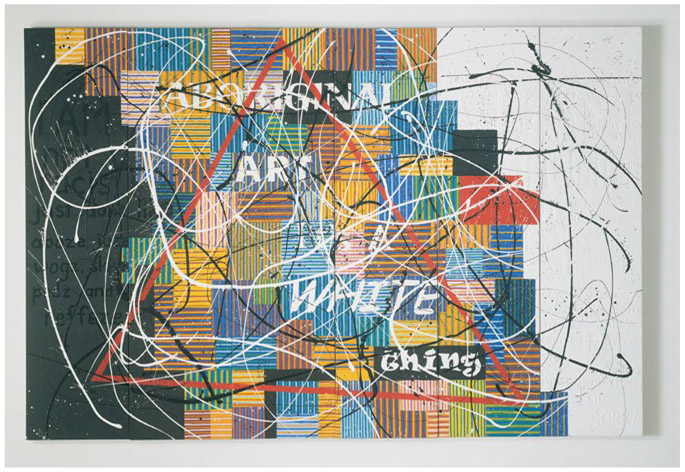
Figure 2.5. Scientia e Metaphysica (Bell’s Theorem) by Richard Bell, acrylic on canvas, 240 × 540 cm. Courtesy of Richard Bell and Milani Gallery, Brisbane
One of the key figures in Urban Aboriginal art is Richard Bell, who was selected in 2004 for the Telstra Award for his painting Scientia e Metaphysica (see Figure 2.5). The image consists of blocks of color with stripes, overlain by Pollock-like swirls along with the printed message in large capital letters, “Aboriginal Art It’s a White Thing.”197 Accompanying the painting was an essay titled “Bell’s Theorem,” a manifesto decrying mistreatment of Aboriginal artists and misunderstanding of their works. Bell emphasizes the fetishizing of Aboriginal art, calling it “a product of the time. A commodity. The result of a concerted and sustained marketing strategy.”198 And he protests the effects of assimilation on contemporary life. But he holds also that there is still something unique for Aboriginal artists to express in the context of the present.
Consider the classification of “Urban Aboriginal Art.” This is the work of people descended from the original owners of the heavily populated areas of the continent. Through a brutal colonization process much of the culture has disappeared. However, what has survived is important. The “Dreamtime” is the past, the present and the future. The Urban Artists are still telling their “Dreamtime” stories, albeit contemporary ones.199
Bell has continued his political message in other works, including a series of paintings bearing statements such as “Australian Art Does Not Exist,” “Western Art Does Not Exist,” “I See You As My Equal,” and “We Were Here First.” Other Aboriginal artists, particularly ones associated with the proppaNOW collective,200 have proclaimed similar themes and spoken about oppression as experienced by Indigenous Australians. Underlying their efforts is the conception that what they portray is something Aboriginal artists have experienced personally and non-Aboriginal artists have not. Despite the effects of assimilation, there is still this distinctly Aboriginal cultural factor. Here is a revision of essentialism located within the climate of contemporary times. What will its place be as Aboriginal art continues to evolve? If the political edge that has been introduced into Australian Aboriginal art is recognized as drawing on the essence of Aboriginal culture today, will its message be popular among collectors? That is, if the consciousness-raising Bell and others are attempting is successful, will art aficionados come to see traditional Aboriginal art as less desirable than before, that is, will recognition of its fetishized status make a difference? Could it be seen as old-fashioned? On the other hand, will it be respected as historically iconic and still valuable both aesthetically and commercially? Will Urban Aboriginal identity be subject to controversy when outsiders produce works like that of insiders, as with Durack in traditional Aboriginal art and Durham following American Indian culture? Is the message of Urban Aboriginal art exclusive enough that it cannot be expressed well and genuinely by an outsider, at least one closely familiar with it?
The Urban Aboriginal movement presents a counterpoint to the stereotypical style and content of Aboriginal art, while continuing the understanding that Aboriginal works are made by Aboriginal people. In contrast stands Du-rack, who supported the traditional perception of what Aboriginal paintings should look like while threatening the exclusive right of artists of Aboriginal bloodlines to produce it. The difference between them exemplifies the challenges, not only in Australia but also in other countries, that Indigenous artists and their works face over authenticity as considered in terms of aesthetic and social theory. Both the what and the who of productions designated as exclusively Indigenous are in question: which artworks, and which artists, do and do not fit the category so as to be genuine? The essentialism that underlies attempts to make those judgments is an indeterminate concept, and it bears the additional liability of conceiving of certain peoples and cultures in a limited and condescending way. On the other hand, many producers of Indigenous art accept this liability and welcome strict limits that designate them as insiders and their works as carrying a uniqueness. They are backed up by laws defining what Indigenous art consists of, which are supported by a sense of social justice for minority groups. The thrust begins with group pride but is steeped largely in the economics of providing a livelihood for those groups that would otherwise be threatened. Here, concern arises over a lack of legal enforcement, and an underemphasis in respecting Indigenous art, whereas critics working from a different perspective have found an overemphasis. All of this—the web of incompatible forces in art, philosophy, social thought, and politics—leaves Indigenous art with an ambiguous standing.