
• III •
When I woke up the next morning there on my easel was a self-portrait of Degas. I know I must have done it . . . .when the spirit of a long-dead artist comes into my hands the images flow out onto the canvas without the slightest effort on my part.
—Tom Keating, master forger, 1977
I had lots of offers from dealers. . . . Some offered up to a million dollars to buy these prints so they could sell them as the “famous fakes.”
—Jack Ellis, lead US Postal Inspector for Operation Bogart, which resulted in the 1991 seizure of eighty thousand fake prints
The most tantalizing question of all: If a fake is so expert that even after the most thorough and trustworthy examination its authenticity is still open to doubt, is it or is it not as satisfactory a work of art as if it were unequivocally genuine?
—Aline Saarinen, art critic, 1961
The conventional attitude toward art forgery is that it conflicts with moral and aesthetic values, and is deserving of censure both philosophically and in the practical realm of the law. That is, by its nature, forgery inhabits the dark side. However, there are other perspectives that consider forgery outside of this context. Shades of gray are evident not only when asking, as part II does, what distinguishes forgery from legitimate art, but also in making judgments about the wrongness of fake art and its practitioners as well as about the significance of an excellently rendered fake. Not surprisingly, forgers and their accomplices, who have an obvious reason for wanting to justify what others see as fraudulent behavior, hold views beyond the mainstream. But besides these insiders are other parties whose vantage point lies on the outside. Critics of the high-minded and well-heeled may see art forgery as a leveling agent. Considered in terms of psychology, forgers are human subjects exhibiting certain emotional and mental traits, while an economic analysis may think in terms of cost versus benefit in asking whose lives are harmed by fake art and by how much, as well as whose lives are enriched. And in philosophy, when aesthetics addresses false art, a question emerges as to whether an outstanding forgery bears a level of authenticity and legitimacy that is worthy of respect.
An analysis of psychological profiles reveals a combination of motives and attitudes among forgers along with a penchant for rationalization. Troubled psyches are prevalent and recidivism not uncommon. Although society punishes art forgery through legal action, prosecution can be difficult due to the nature of the crime, and prison sentences are sometimes brief. A few forgers whose stories have made them public figures have managed to parlay their notoriety into book deals, television contracts, and gallery exhibitions. Beyond seeing forgers through their mentalities and their post-forgery lives, the nature of what they do is such that it is often considered less reprehensible than other criminal activities. It has been portrayed as a victimless crime in which wealthy collectors can afford to lose money on a bad purchase. The artists who make forgeries have appeared as likable rogues who have battled and exposed corrupt forces in the art establishment: their culpability has been mitigated as they demonstrate attributes popular with the public. Then, surpassing apologetics that soften the harm done by forgery, a case has been made for the collective enterprise as constituting a beneficial market force. When forgeries are intermingled with genuine art, more people than otherwise can take delight in owning or viewing works respected as originals by notable masters, while business flourishes. And aesthetics, too, confronts a face-off of competing perspectives on forgery. Much has been made by philosophers about the notion of a “perfect fake.” One concern questions the possibility of such a thing on the grounds that differences will always exist between originals and fakes, and that even if those differences are imperceptible in the present, they are subject to discovery in the future. Practically speaking, however, unidentified fakes may become accepted as part of an artist’s output and then enter public and private collections, while their defining features are included in an understanding of what constitutes an authentic work. Finally, assuming there are fakes that are perfect in the sense that they are as good technically in their composition as originals, what aesthetic value should they be accorded when exposed? Although fakes are denounced as a threat to our understanding of art history, some theorists see excellent ones as exceptions.
The impulse toward art forgery derives from an assortment of motivations. Determining which ones pertain for any individual forger is complicated by their tendency toward misleading self-reporting that is due to self-deception and conscious lying. What forgers say about themselves is important in understanding their mindset, but it has to be recognized as coming from perpetrators of fraud. Claims they make about their motivations may mask an agenda that is not acceptable to society, especially in a court of law. In particular, they may minimize the goal of earning money illicitly, even if that is their primary purpose.
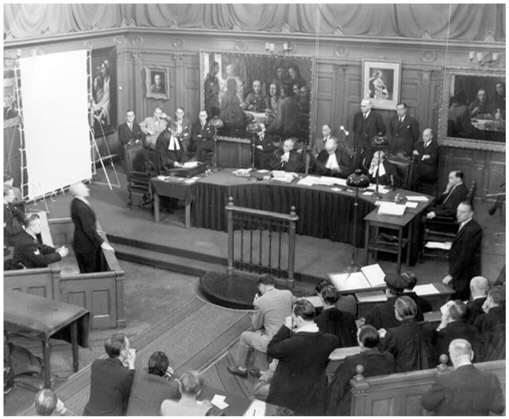
Figure 3.1. Han van Meegeren’s trial in Amsterdam, 1947. Van Meegeren is standing in the box on the left. Behind the panel of jurists are two of his Vermeer forgeries: The Last Supper (left) and The Supper at Emmaus (right). Licensed under Creative Commons
Psychologists explain that regardless of the type of fraud, perpetrators create justifications for their actions that avoid the perception of wrongdoing.1 When Han van Meegeren admitted to painting a series of false Vermeers that sold for enormous sums, the defense presented at his trial was that he wanted revenge on the art world for not respecting his talent. His own testimony laid this claim (see Figure 3.1). When asked by the judge why he persisted in a life of forgery, he answered that his motivation was not financial gain, and when asked pointedly if it had at least some influence, he doubled down by saying he did not do it for the money but only to carry on as a painter using the technique he had developed.2 The forger’s attorney provided further support for deflecting suspicion of a financial motive by reading from a court-ordered psychiatric report that found the subject to have a “special vulnerability” to criticism and “an abnormal need to avenge himself.”3 Hidden was that Van Meegeren’s turn toward fraud came at the age of twenty-four when he was short on finances but well respected for his talent and confident that he was on a path to success. He had won a gold medal for his intricate rendering of a church interior and then made a duplicate that he arranged to sell to a collector who thought it was the singular original. After his wife argued with him and talked him into telling the truth, the buyer offered a small fraction of the initial price.4 Van Meegeren’s start as a professional artist included the offer of a professorship at the Hague Academy (which he declined as a waste of his talent), a first exhibition that drew sales and critical acclaim, and a sketch of a deer that became the most reproduced image in the Netherlands.5 It was only when his second exhibition failed and was labeled as lacking originality that he became embittered. The inclination within him that led to forgery was present early and connected directly to a desire to earn money. His hostility toward the art establishment was real, but was not his only or initial motivation toward a life of fraud.
Van Meegeren was advised by gallery owners that to be successful he should embrace current trends that were selling well such as Impressionism, Pointillism, and Fauvism.6 Instead, he defended traditionalism and took the route of forgery. Tom Keating was another devotee of Old Masters, although he faked new masters as well. Never having developed his own distinctive style, he claimed in his memoir that he was not motivated by money.7 He said he turned to forgery out of disgust for the poor treatment the French Impressionists received at the hands of their art dealers: “I was determined to do what I could to avenge my brothers and it was to this end that I decided to turn my hand to Sexton Blaking” (his Cockney term for “faking”).8 In fact, Keating held a strong disdain for dealers, but as a full reading of his book makes clear, it derived from his own business transactions with them rather than sympathy for figures from art history.
Perhaps no forger is known to speak ill of the art establishment more than Eric Hebborn, although he made his living as an art dealer for many years. His life of fraud was not a reaction against rejection of his own works. He had exhibitions of them on occasion, and in one exhibition displayed a unique and provocative idea of multiple images of the same subjects in single sculptures.9 Rather than lacking a knack for originality, he was inspired by historical tendencies in art and chose to follow them while characterizing twentieth-century art as “neurotic, desperately extrovert and egocentric.”10 Hebborn’s motivation as a forger was not revenge so much as competition. He believed dealers (nearly all of them) to be “deep into the ungentlemanly muck and mire”11 and considered experts to be his opponents. He engaged in forgery to joust with art experts and earn a better living than he would have anticipated from works done under his own name. He learned forgery as a young man while working for a crooked restorer and decided to remain in his illicit career even after doing graduate study in a prestigious program in Rome and securing high-level connections. Hebborn was confident of his great talent, and considered himself “not a dropout, I’m a stand aside.”12 He drew inspiration from his accomplishment at duping many experts.
Hebborn was proud of his career of deception. Other forgers have expressed this emotion as well: a feeling of gratification that comes from a performance so skillful that it mimics what respected artists do, demonstrated when their false creations are marveled at and purchased by collectors and institutions. When he was exposed and felt dismayed at facing prosecution, Tony Tetro found his spirit buoyed by a newfound respect for his talent:
For well over 10 years, every cop in the valley and many people who didn’t know me personally, were certain I was a drug dealer. . . . So there was some satisfaction . . . even some pride when I was arrested . . . that finally these idiots knew that I was an artist.13
The pride that recognition brings, however, comes at a steep price when it is connected to public exposure of a forger’s identity because that means legal trouble and the end of the career that is worthy of the recognition. But there is also pride of a quieter sort that is consistent with being anonymous. It lies with knowing the artworks that have been created are drawing respect even if their creator is not. Geert Jan Jansen has said about his output of counterfeits,
I think maybe one percent has been discovered as work by myself, but the rest is all circulating in the art market. . . . there are a few paintings in museums and yes, I like that very much. They are hanging there in a nice place . . . and the more time they spend in a museum the more real they become.
If a painting comes up in an auction, the catalog is sent all over the world and examined by all the experts and collectors. On the viewing day they come together and discuss the work and everybody says it’s an original . . . it’s fantastic. Yes, I enjoyed it very much.14
The pride forgers feel comes in variations, such as Mark Landis’s drive to be philanthropic. As a shy twelve-year-old seeking friends and a stronger self-image, he forged cancellations on stamps that increased their value for collectors and then gave them to other boys. Later, as an artist who did poorly selling his own art, he was uplifted by the donations he made of his forgeries to museums, sensing what it would be like to be wealthy and powerful. And he believed he was making his mother (who did not know his donations were forgeries) proud.15 In contrast is the hubris of Ken Perenyi, who like Heb-born enjoyed jousting with experts, sometimes acting as his own front man: “I miss the addictive thrill of fooling the experts. It was great sport for me.”16 His pride shows through in supreme confidence: “I’m convinced that if these artists were alive today, they would thank me. . . . I’m sure Herring himself would be proud to put his name on this painting.”17
Although revenge and pride are significant motivational factors that may influence the minds of art forgers, neither is likely to be the primary one. Foremost in drawing artists to forgery, and holding them there, is the desire to make money. Regardless of other inducements, this is what keeps them going in the face of being caught in a criminal activity. If they were directed by animosity toward the art establishment or a desire to gain approval, they would at some point announce their exploits to the world and enjoy the embarrassment caused to the experts they fooled and the financial havoc wrought in the art market, and bask in the esteem of being recognized as an equal talent to the artists they imitated. Most forgers do not do this, with the historical exceptions of Giovanni Bastianini, Alceo Dossena, and Lothar Malskat. Rather, the common practice is to maintain secrecy about their production of fakes until they are caught. The drive to make money is not necessarily for large sums and may be constrained by limited artistic skills or sales connections, and a desire simply to live the life of an artist. This observation about the pursuit of financial gain, of course, is based only on those forgers who have been exposed. How many there may be who pursued forgery silently and gave it up without being found out is an open question, but however extensive this phenomenon is, it lends credence to the supposition that their motivation was not egoistic but monetary.
Some forgers have used their earnings to finance a luxurious lifestyle. Van Meegeren lived in an elegant villa where he hosted lavish parties, had an expensive addiction to morphine, and owned numerous nightclubs, hotels, and country homes (with secret cash boxes hidden on many of the properties to avoid banks and not declare income).18 Tetro, although not as wealthy as Van Meegeren, decorated his home with custom wallpaper of lizard skin and suede, owned a Rolls Royce, two Ferraris, and a Lamborghini, spent time in Paris and Rome, and liked to gamble in Monte Carlo.19 Guy Ribes, too, was a lavish spender, proclaiming the millions of dollars he paid to live glamorously.20 Wolfgang and Helene Beltracchi purchased magnificent homes where they held extravagant social affairs through which they advertised their cover as owners of a major collection of artworks by twentieth-century masters (all forgeries).21 John Re, who earned nearly $2 million from his fake Jackson Pollock paintings, spent $700,000 of it to indulge his fantasy of owning a submarine that he fitted with luxury accommodations and used for day trips.22 Elmyr de Hory was another forger with expensive taste that he satisfied to the extent he was able, but he was constrained by the financial arrangement contrived by his front men, Fernand Legros and Réal Lessard, in which they kept most of the profits from selling his fakes and lived a jet-setting lifestyle as successful art dealers.23
On the other hand are notorious forgers who did not make large sums of money or live conspicuously. In his memoir, Keating claims to have given away many fakes and to have sold many more for small sums.24 With documents to prove it, William Blundell testified in court that he routinely received $100 to $200 each for hundreds of fake paintings that the art dealer who purchased them sold at prices in the thousands.25 Pei-Shen Qian insisted that he received no more than a few thousand dollars each for the paintings he made that sold for many millions, and was backed up by an unassuming lifestyle in what has been called a “shabby house” in New York.26 John Myatt’s ten years of illicit labors netted him less than $200,000, much of it spent on schooling for his children and donations to his church and the Salvation Army.27 Shaun Greenhalgh and his family had ample money from his career of making fakes, but continued the lifestyle they were accustomed to as welfare recipients even after the Amarna Princess sold for the better part of a million dollars. When questioned by police about why he did not spend from his large bank accounts, Greenhalgh replied, “I have five brand new pairs of socks in my dresser. What more could I want?”28
Greenhalgh, perhaps more than any other forger, represents the desire to pursue a career doing what he was good at and enjoyed: he was a copy-ist from an early age and began selling his forgeries while still a teenager. His motivation involved a desire to make a living while engaging in his chosen profession. Although police investigators labeled him as resentful and bent on retaliating against an art elite, he opens his memoir with a repudiation of this notion:
I’ve been described as some kind of class warrior . . . the little man against the Establishment. Others have me down as a disgruntled artist out for revenge. But having never been to art school or ever been interested in an artistic career, revenge against whom?29
With many other forgers, it may be suspected that the inducement leading them to fraud is similar to Greenhalgh’s, even if they are not as prolific or successful as he was. For artists who want to earn money from their creative activity, making fakes may be their best chance, and some of them turn in that direction. Vocationalism adds to revenge, pride, and money as a motivational force behind forgery.
Different from motivation but related to it is the mental state that psychology terms “neutralization,” meaning the overcoming of moral concerns about what is generally understood to be socially unacceptable behavior.30 Beyond the impetus to commit a criminal act lies the attitude forgers hold that allows them to justify that act. Rather than feeling remorse for their behavior, they develop various pretexts for vindication that smooth the way for continuing with fraud. An expression of remorse, if it occurs at all, is likely to be at their trial to avoid a guilty verdict or to angle for a light sentence, and its sincerity is suspect. Myatt expressed remorse at his trial and was believed, but he felt differently when he began his illegal career. In a 2017 conference presentation, he said, “It didn’t occur to me at the time that it was a bad thing. . . . I really believed there were no victims. Not true, of course, but people do like to delude themselves that this is a victimless crime. Well, it isn’t, but you think it is!”31 Tetro, too, experienced a change of heart. As he explained in a 2014 interview, long after his court-ordered sentence was completed,
I went through life thinking I did a victimless crime . . . until about five years ago. There’s a program on American television called American Greed and it showed it from the victim’s point of view.
My point is, eventually someday, somebody’s gonna be hurt. They’re gonna think they have a multi-million dollar painting then find out that it’s not. And I only came to this conclusion about five years ago.32
Without focusing on a victim, a forger’s conscience can believe no crime is being committed. Other perspectives recognize the nature of the criminal act but mitigate its consequence for victims or transfer blame to them, effectively saying they can afford it or they deserve it. Perenyi expressed the attitude that his victims could afford a loss: “Do I feel guilty about taking money from auction houses? The idea is laughable. . . . These were not poor people. This was a world of glamour and money, and plenty of it.”33 Robert Driessen’s disdain was more pointed and harsher about the people fooled by his fake sculptures: “Anyone who believes he can buy a real Giacometti for 20,000 euros deserves to be duped. The art world is rotten.”34
Hebborn’s method of neutralization was more complicated and high-minded, expressed in a code of ethics. In his books he professed three principles for art forgers to follow so their activity would avoid wrongdoing. His thinking can be summarized as follows.
1. Do not sell to novices or collectors, but only to dealers. Professionals are a fair target and ought to be responsible enough to take care of themselves; if not, they are in the wrong business.
2. Let the client be the one to establish whether what you are selling is genuine, rather than making an assertion about it yourself. You have not misled anyone if you simply offer a professional an opportunity to make a judgment.
3. Sell your fakes for the same price you would ask for works signed with your own name. That way you are not taking advantage of anyone.35
Hebborn’s reasoning may appeal to people inclined toward fraud, but others will see his instructions as misguided. He assumes the world of dealers is not worthy of the respect offered to other members of society and ignores the damage done to the victims of dealers who sell his forgeries either knowingly or unknowingly. And his advice about pricing assumes that someone who buys a fake of a recognized artist unknowingly at a low price would want to buy a genuine work by an artist of little or no standing at that same price. Moreover, it is unlikely that Hebborn followed his own advice. As a gallery owner, he mixed his fakes with legitimate works, and it is difficult to imagine that he disallowed collectors from purchasing fakes when they visited his gallery. Still, he found a way not only to harness his own conscience but also to try to convince his readers of his vindication and, by extension, their potential for the same if they chose a path of forgery and followed his directions.
The psyche of a forger engages in neutralization to soothe pangs of conscience from telling lies about the authenticity of false artworks. In this sense forgers are habitual liars. In extreme cases, their lies have gone beyond misrepresenting art and encompass their personal identity and accomplishments, an indication of severe personality disorder. John Drewe’s persona was an elaborate fabrication, reaching proportions that clinicians might describe as pseudologia fantastica. Fact and fiction are blurred and woven together, and when untruths are spotted by other people, the story is amended or a new one is created.36 After John Cockett (Drewe’s real name), an unusually bright teenager with a passion for physics, dropped out of high school and worked as a clerk for the Atomic Energy Authority, he disappeared for fifteen years before turning up to identify himself as a PhD physicist who flew helicopters, had connections to Russian, South American, and Chinese officials, and was a military weapons expert who had served in the British special forces, all in addition to being an art collector. He lived for a decade with a physician who believed he was an advisor to the Atomic Energy Authority and on the boards of several companies, gained control of her finances, and eventually left her while taking their two children with him. Later, when a New York art dealer questioned the authenticity of a Giacometti painting (a fake painted by Drewe’s partner, Myatt) and tracked it to one of Drewe’s associates, Drewe managed to have him steered to a consulting firm he had created and met the man in London at the archives of the Victoria and Albert Museum. There, he showed the dealer “irrefutable” evidence in the form of exhibition catalogs (fakes planted by Drewe during his extensive seeding of the archives with false documents) picturing the painting, after which he presented the man a bill for his expert services.37 At his trial, although his partner admitted to the forgery scheme, Drewe spun an extraordinary tale about being a pawn in an international art fraud conspiracy involving MI6 and the CIA.38 All that is known of Drewe’s adult life are a series of elaborate and sometimes interwoven confidence games. Having served his sentence for art fraud, he later swindled an elderly widow for more than a million dollars. Following the death of her husband, whom Drewe had befriended, he gained control of her finances, sold her properties, and after spending the money, took several thousand dollars more that he convinced her to borrow from a friend. The judge who sentenced him to eight years for that offense stated, “In my view, you are about the most dishonest and devious person I have ever dealt with, even through the trial you were fabricating documents.”39
De Hory, too, lived his life as an extended lie, although a consistent one. The story he told when selling his fakes to dealers for fifteen years (later he worked with front men) was of a Hungarian aristocrat with Jewish heritage who narrowly escaped the Nazis during World War II. He managed to save the family’s art collection, but his family perished: his brother in a racing accident driving a Bugatti, his diplomat father in Auschwitz, and his mother shot by a Russian soldier for her fur coat. He added embellishments of studying as a young man at a respected art school in Hungary and with Fernand Léger in Paris and personally knowing various celebrities. De Hory’s accent, along with a suave manner including wearing a stylish suit and a monocle, enhanced the dignified air he presented. While he used a variety of aliases in different locations, his modus operandi remained the same. It differed from the temporary persona a con artist would typically assume in that De Hory continued the story with his friends and con artist associates and did so throughout his lifetime.
Little of De Hory’s self-styled biography is true, with the exception of his art training and possibly some of the Paris connections, although later in life he did know several Hollywood stars. Facts about his family history were discovered in 2011. He was born Elemér Hoffmann to a middle-class family, and his mother and brother survived the war. His most prized claim to aristocracy, a portrait of himself and his brother as children supposedly painted by a famous artist, was painted by someone else (perhaps himself). The elaborate charade answered a desperate need for respect encapsulated a favorite aphorism of his that “Image is everything.” In his later years, after being exposed as a forger and achieving folk hero status, the lie became even more important to maintain, and De Hory took with him to his grave many hidden truths he retained after decades of deceit and rationalization.40
Habitual lying is often associated with “antisocial personality disorder,” a common condition among criminals. For researchers and clinicians, this term has replaced the traditional terms of “psychopath” and “sociopath,” although those labels still appear in ordinary language. The extent of deceit involved may not be at the level of Drewe and De Hory but still may be significant. It relates to other factors including a lack of remorse and an emphasis on self-gratification. Other people are held at an emotional distance, although there may be an outward display of friendliness and sympathetic behavior, and occasionally strong attachments can be formed although they may not last.41
Comments made by some of the most notorious forgers indicate an antisocial makeup. In his documentary, Ribes shows a hard edge as he describes taking up forgery as a game and then using it to fund his extravagant spending habits. About art dealers he disliked doing business with, he says, “If a guy complained, I said it’s my job dickhead. It’s a choice.” When asked questions about his personal relationships, he reveals a striking misogyny.
I’ve never been in love. Lila, like all the others, some great times, but no. They’re not on the street but they’re still whores. When you hang out with pimps and whores—But I loved my cat, my dogs. I remember my dogs better than my women.42
Ribes’s jaded attitude reflects his early life when he spent several years of his boyhood living in a brothel owned by his father.
Perenyi’s disregard for society is announced in the title of a series of videotapes he made (available on YouTube): How to Fool the Experts and Laugh Your Way to the Bank.43 When asked in an interview if people are harmed by the presence of his fakes in the art world, he responded, “I don’t think so. I think that I’ve made a contribution to the art world.” As for his success in fooling experts: “I wouldn’t characterize it as gloating. I’m just being honest.”44 This mentality of glossing over the detriment he caused to the world around him dovetails with a brash confidence in his ability that surpasses what forgers typically have expressed. Beltracchi, however, professes supreme self-assurance. During his trial, he put on a theatrical air with a rambling confession that described his youthful passion for “drugs and rock ‘n’ roll,” an admission that his art fraud had been “great fun,” and boastfulness about spending only a few hours each in creating his multimillion-dollar forgeries. A journalist who covered the case for two years stated, “It was an incredibly vain performance. The guy is a total egomaniac.”45 In an interview with Der Spiegel, he was described as having “the self-confidence and hubris of a man who believes he is a genius.”46 And in the documentary made about him, Beltracchi’s exchange with his interviewer claims, “There’s nothing I couldn’t paint. I think I could paint anything.” When challenged on this declaration he responded,
But I can. Anything.
(interviewer) Vermeer?
Him too.
Rembrandt?
Any of his.
Leonardo?
Of course. I don’t find him difficult. Not at all. Sure, I could paint a new Leonardo.47
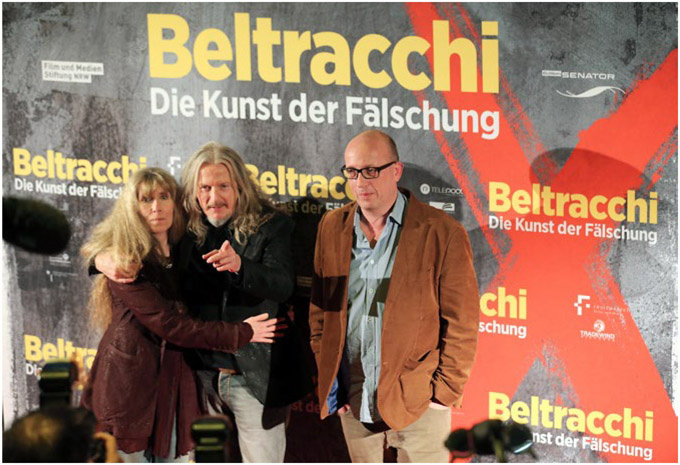
Figure 3.2. Wolfgang Beltracchi and Helene Beltracchi with director Arne Birkenstock at the screening of the documentary film Beltracchi: Die Kunst des Fälschung. dpa pictures/Alamy Stock Photo
Beltracchi’s tendency for showmanship traces to his youth, when he delighted in dressing in Italian robes and a full-length fur coat and sported waist-length hair as he posed for photographs by tourists.48 His personality pattern might fit a clinical classification as narcissism, although other medically relevant factors may be at work as well. He says proudly about a pathology professor who knows him well, “He would like to examine my brain. He believes he would find something completely different there.”49
Separate from factors of personality and pathology among forgers is another sort of question regarding their mindset: what goes on in their minds as they prepare for and produce works in the manner of other artists? Although the process may be like legitimate copying, forgers have a particularly strong incentive to be as convincing as possible. At a minimum, it is necessary to study the works of target artists, after which comes practice and likely many false starts. But beyond careful and conscious emulation, there are cases where it has been suggested that more is involved: that a forger has formed a special bond or made an unusual connection with the artist being copied.
In The Art of the Faker, Frank Arnau discusses the process by which Alceo Dossena worked in fashioning sculptures like those from the ancient world to the Renaissance that fooled many experts. Arnau’s explanation hints that the sculptor engaged the past through a paranormal means: “Is it so improbable to suggest that Dossena, activated by forces of a metaphysical nature, worked from inner compulsion in a manner which was at once his own and that of others?”50 Hans Cürlis, director of the Institute of Cultural Research in Berlin and maker of a film on Dossena, spent much time watching the sculptor in his studio and marveled at the way in which he worked quickly and easily. His actions seemed so natural that
It only later occurred to us that we had witnessed the reincarnation of a Renaissance master and Attic sculptor. . . . One of the fundamental laws governing our attitude seems to have lost its meaning. . . . it is as though causality has been suspended and its dogmas cut adrift from the safe anchorage of experience. . . . Nor is the matter sufficiently explained by the fashionable “state of trance” theory.51
There was nothing about the way Dossena worked in front of viewers that suggested a trance, but a similar way of explaining how a temporal gap that covers more than a millennium can be bridged was offered in an interview by a twentieth-century Egyptian copyist and antiquities forger. He disclosed that when producing important items, he shut himself away in a tomb for a period of days and induced a hashish haze that continued until he was finished.52
Tom Keating makes bold and repeated claims in his memoir that some of his forgeries were done by the guiding hand of the artist he was simulating. He differentiates those works from his typical fakes that he calls “Sexton Blakes” and says they were always done at night. Vowing no other bond with spiritualism than his artwork, and asserting that people he told about his psychic connections did not believe him, he describes having a fitful sleep after which
When I woke up the next morning there on my easel was a self-portrait of Degas. I know I must have done it, but I had no memory of it. The only van Gogh that I ever painted happened in a similar way. I couldn’t paint a Goya, Rembrandt or even a Samuel Palmer for a million pounds or to save my life. But when the spirit of a long-dead artist comes into my hands the images flow out onto the canvas without the slightest effort on my part.53
He also tells of a spiritually inspired self-portrait of Goya that he worked on long into the night, of a particular Samuel Palmer landscape, and mentions Gainsborough, Turner, Constable, Munch, Nolde, and Pechstein as others he channeled, although he faked many more artists without that special connection.54 While Keating’s recounting sounds sincere, he was known for his colorful personality and flair as an anecdotalist. And he admits in his book to periodic spells of heavy drinking, although without relating this factor to his transcendental encounters with dead artists.
A milder hint of a special bond between a forger and the artists he faked is found with David Stein. While out on bail after his arrest, he stated in an interview,
You go into the soul and mind of the artist. It’s like a Dr. Jekyll and Mr. Hyde thing. You become someone else. When I painted a Matisse, I became Matisse. When I painted a Chagall I became Chagall, I was Chagall. When I painted a Picasso, I was Picasso.55
His wife, Anne-Marie Stein, described this state as a “mood,” saying that he would put himself in the frame of mind to work like a particular artist and then often do several pieces, during which time he was unable to imitate any other artist. He could acquire moods quickly, however, and then worked in rapid fashion.56 De Hory seized on Stein’s depiction of “soul and mind,” saying he had read about it, and he ridiculed the notion: “I personally think that’s all the worst sort of nonsense. . . . it’s a terribly vulgar and romantic explanation . . . though I’m sure the public eats it up. What I did was study—very carefully—the man’s work. That’s all there is to it.”57 De Hory was quick to criticize his competitor, but Stein’s language could be understood metaphorically rather than literally, as describing a physical rather than metaphysical occurrence. In that sense, he would be relating an unusual closeness that a copyist who has studied and practiced extensively feels toward the subject artist. With this background, the experience of working like the subject seems natural, as with an actor preparing long and hard to play a part and then acting it out. Other forgers have described an experience of this sort through metaphorical language, including De Hory himself. In one of the notebooks he kept and considered publishing, he declared, “I am continuing their work. Modigliani is dead. Matisse is dead. I sometimes feel their souls were transplanted in me. I have a mission to fulfill.”58
Comparing a forger with an actor is a rhetorical strategy used by Hebborn to explain how he could establish an unusual link to long-dead artists without introducing the paranormal. He notes that only after learning someone’s speech and their movements is it possible to give a convincing portrayal. But Hebborn goes further with his analogy to language by asserting the theoretical position that art is subject to an ahistorical foundation, so “the art of drawing is seen as an ancient and alas almost dead language, the grammar of which had remained largely unchanged since man’s appearance on earth.”59 The idea is that in all eras what is most fundamental in art is the same: styles are variations on a never-changing foundation. All artists, then, are related in a way that makes it possible to hearken back to their particular approaches—to how they employed the universal grammar of art—and come to a clear understanding of what they were doing. With this understanding it is possible to create just as they did without guesswork. The key is to break into their movements as a linguist would into a language, and then translate.60
If one truly understands the marks of a drawing and more particularly the meaningful relationships between those marks, one is in mental contact with their author, no matter how remote in time and space. This requires great knowledge and sensibility, not clairvoyance. It is no more than can be reasonably expected of a connoisseur.61
In empowering connoisseurs, Hebborn is giving broad range to the capability of understanding the processes employed by artists from the past, which is in keeping with his encouragement for artists to become forgers. He was not an egalitarian, however, but confident of his own elevated status from which he instigated others to act against the art establishment.
The various ways in which forgers have explained having a special connection with their target artists provide a common takeaway. They differentiate themselves from copyists in general and even from other forgers. They set themselves up in a manner in which it appears they hold a privileged status that might mitigate negative judgments about their actions and potentially challenge an attitude of hostility toward forgery in general. Whether the appeal is to a paranormal force, a theory of foundationalism, or the lesser implication of metaphorical description, the forgers mentioned here claim an access that is not generally recognized. This access allows them to “be” another artist in a sense, to delve inside the other artist’s works and way of fashioning them rather than merely observe from the outside. To the extent they become one with the other artist, they blur the line between legitimacy and illegitimacy in artistic production. They lessen the tension between fake and real in a way that enables the psychological process of neutralization, and that through their published words presents a justification for their actions.