
• I •
In the decade and a half that I was with the Metropolitan Museum of Art I must have examined fifty thousand works in all fields. Fully 40 percent were either phonies or so hypocritically restored or so misattributed that they were just the same as forgeries.
—Thomas Hoving, Director of the Metropolitan Museum of Art, 1996
Picture dealers, like horse dealers, well versed in trickery, palm off worthless trash and copies on young and inexperienced collectors as valuable originals.
—Justus van Effen, Dutch journalist, 1736
Just as some statuaries do in our day, who obtain a much greater price for their productions, if they inscribe the name of Praxiteles on their marbles, and Myron on their polished silver . . . Carping envy more readily favors the works of antiquity than those of the present day.
—Phaedrus, Roman fabulist, first century AD
Forgery is a major presence in the art world. As the preceding commentary suggests, fake art is widespread and has a long history. That history, however, is not coextensive with the history of art per se. Forgery is not found universally throughout humanity, as art is, but it is far reaching: once certain social and economic conditions arise, the counterfeiting of beautiful objects follows. The combination of artists who are revered for their originality, collectors who want their works, and a market for buying and selling those works invites devious practices. In the Western world this happened notably in ancient Rome, and after a pause during medieval times (although occasionally medieval faking was done for the purpose of enhancing ecclesiastical authority), reappeared in Europe with the Renaissance and continued from then on without interruption.1
The continuation still unfolding today consists of enlarged markets and sophisticated marketing techniques, increasing wealth allowing more people to buy more art, and the production of fakes in great abundance. Materially speaking, the expanse of fake art has advanced far beyond its roots. But that evolutionary view of history has sometimes been broadened to encompass the human mindset, and the result is a distorted interpretation. A follow-up sentence in Thomas Hoving’s epigraph for this chapter, which appears in the introduction to his best-selling book False Impressions: The Hunt for Big-Time Art Fakes, asserts, “What few art professionals seem to want to admit is that the art world we are living in today is a new, highly active, unprincipled one of fakery.” He cites the “get-rich-quick attitude of the times and the raw commercialism of so much of contemporary life” as a main reason for the plight of perverse activity affecting art.2 Working from a different perspective toward locating a new mentality about forgery is art theorist Thierry Lenain, who in Art Forgery: The History of a Modern Obsession, holds that the notion of fake art as offensive has emerged from a less harsh view of it only as a trend of late modernity.3 Both of these theories fail to recognize that opinions about forgery seem to be more recurring than changing over time. The impetus to create fake art is indeed largely financial gain, but that circumstance is as old as the beginnings of forgery. And the notion of forgery as offensive also dates to the origins of the practice, although a simultaneous undercurrent has accepted it as a form of freethinking mischief or antiestablishment protest. Once a threshold of prerequisite conditions has been met and forgery arises, basic attitudes toward it seem to be a function of fundamental human nature rather than of a dynamic system. Where a true difference in outlook lies is between an absence of the conditions that give rise to forgery and the presence of those conditions. Without them not only is there no practice of forgery, but even a conception of it is also lacking. Here is where an understanding of the history of art forgery begins.
Observing tribal societies in current and recent times makes this point. Not even the first of the conditions occurs, as personal inventiveness by artists is severely limited by conventions. Thinking, in overall terms, is founded on a demand for order,4 and creative expression is institutional rather than individual. Typical of such societies are the Kwoma of Papua New Guinea, who, although they have experienced acculturation in many ways, today continue the beliefs of their ancestors concerning artistic creativity. The making of art thereby consists of copying prototypes, with their source believed to be supernatural rather than human.5 Artists are not seen as presenting new perspectives on the world but as reproducing what has existed before them. Although respected and even celebrated during their lifetime for their skill as copyists, they fade into anonymity a generation or two after their death. The significance of an art object, then, is not in who made it but in what is represented by its image. It is understood that a new construction of the image may vary slightly from a previous one, but that circumstance is accepted as an aberration rather than as evidence of praiseworthy ingenuity. Similarly with the historical tradition of the Māori of New Zealand, newly made artwork is based on institutional models. Apprentice sculptors memorized complex patterns to execute on various objects through carving. Master craftsmen might earn prestige, but the ultimate source for the act of carving was believed to derive from the gods.6 When, in societies such as the Kwoma and Māori, artistic achievement is seen to consist of copying in which a replica holds as much cultural value as a previous occurrence of an image, there is no inducement to present a replica as something other than what it is, and forgery is unknown.
Following a somewhat different tradition, some tribal societies have made room for individuation of images by their artists, although with careful restrictions. The Sioux tribes of North America painted the exterior of their tepees with representations devised by their owners. Each owner portrayed his own experiences, but only experiences from dreams were allowed, and then only after the dream was approved by a shaman and determined to fit within certain cultural patterns. Although dreaming was the source, the ideas derived may have been induced from preapproved myths.7 In other cases, dreams have been recognized to be the vehicle through which myths and their prototype images first emerge and enter mainstream cultural representation. According to Tsimshian (Pacific Northwest) lore, the bear totem began with an ancestor’s dream of what seemed like an actual event, after which a ritual painting was made that became the model for future reproductions of it.8 Thus, even with the contributions of individuals from their dreaming, the creation of images is highly controlled. Artistic achievement is accepted as divinely inspired and as constituting communal knowledge rather than singular genius. The idea of a virtuoso artist, whose unique works have value that might encourage copying them with fraudulent intent, is absent.
It is in the more advanced societies of the ancient world that dealings in fake art are said to have begun, although claims about Egypt, Phoenicia, Babylonia, and Greece have scant evidence in support.9 Rome occupies the center of attention, with various writings attesting to the necessary conditions for forgery and reveal a public concern about art fraud. Recognition of individual artists for their accomplishments and particular styles was a carryover to Rome from Greece, where the practice of signing artworks (at least some of them) began in the sixth century BC. Phidias, Myron, Praxiteles, and others were held in high regard by the public for their unique creations. When Roman armies defeated the Greeks in the third and second centuries BC, confiscation of artworks was a common occurrence, and many boatloads were sent to Rome, exposing the population there to cultural treasures superior to what they had ever seen. Public displays encouraged a reverence for the “Old Masters,” whose works were now several hundred years old, and aristocrats eagerly established private collections that would show off their stylishness. Caesar, Lucullus, Lucius Crassus, and other prominent figures were avid collectors, sometimes paying exorbitant prices as a market developed complete with dealers specializing in art and auctions devoted to it.10 Roman authors wrote books describing the styles of the great artists and cataloging their works, following several earlier ones (that do not survive today) written by Greeks.11 Art criticism was popular and often presented through the medium of ekphrastic poetry.12 As public connoisseurship grew, the demand for Greek works available to purchase outstripped the supply, and artisans obliged by producing large numbers of copies fashioned after Greek masters.
As historians have described the situation, some of the copies were passed off as originals. This finding is backed up by comments from Roman authors about forgery done in the fashion of Greek artists. Phaedrus’s quoted remark points out the practice of artists signing their works with famous names from the past so as to command higher prices.13 Satirical writers provided social commentary by mocking the notion that the historical works popular with Roman art enthusiasts were all truly genuine, as in Martial’s quip about a collector, “You alone have the productions of Phidias’ graver, and the labors of Mentor. . . . Yet, amidst all your silver, I wonder Charnus, that you possess none pure,”14 and Petronius through his narrator in The Satyricon on observing a public picture gallery where supposed antiques appeared in perfect condition and poor imitations were accepted as the works of masters: “I beheld works from the hand of Zeuxis, still undimmed by the passage of years, and . . . the crude drawings of Protogenes, which equaled the reality of nature herself.”15
Beyond literary commentary is physical evidence in the form of artworks connected to the Roman period that bear the inscribed signatures of famous Greek artists from prior centuries. The sheer volume of these works is suspicious, as well as the fact that multiple artists produced works under the same name: at least five sculptors fashioned works by “Myron,”16 and several more claimed the label “Phidias.”17 Further, many of the works carrying prominent names exhibit stylistic features that are incompatible with those names, such as a “Praxiteles” sculpture in the Louvre bearing a Roman Imperial look18 and the “Callimachus” relief at the Capitoline Museum in Rome that displays a mannerist design consistent with late Hellenistic times.19 More instances of incompatibility are found with gems bearing the names of Greek masters such as Pheidias, Skopas, and Polykleitos, who are not known to have worked in that medium.20 Examples like these raise red flags about authenticity: works carrying the names of famous artists who did not create them suggest fraud.
Although many scholars have accepted that ancient Rome was the first point in history where art fraud featured prominently in the fabric of the culture, a skeptical view has emerged that urges caution about viewing the past in terms of modern thinking. Accordingly, the “old master” names inscribed on Roman sculptural copies are not thought to have given the appearance of originals, but instead to have designated the particular artists who were being copied.21 Rather than being forgeries, then, those works would have been legitimate reproductions with helpful labels. Another interpretation suggests a complicated system of patronymics in which multiple artists turning out works in the name of a deceased master were slaves or other workers who were legally bestowed with the name they signed on their artworks, or they were members of the master’s family continuing the famous workshop through multiple generations.22 The challenge to the assumption of fraud continues by noting that Roman law had no provisions for dealing with art forgery, while there were specific prohibitions against counterfeit documents and currency. The implication is that counterfeit art was not a significant concern. And while the literature of the day offers fictional examples and sarcastic statements about phony artworks being passed off as authentic, there is an absence of reported real-life instances to match them.23
Taking account of the skeptical view, it is still reasonable to conclude that art forgery was present in ancient Rome, although the extent of that presence is a matter for speculation. An art industry abundant in legitimate copying does not preclude the creation or marketing of certain works as forgeries. Even if “old master” names were inscribed on certain works merely as labels, or if they were the legitimate signatures of multiple artists with the same name, the demand for originals (evident in the enormous sums collectors sometimes paid) encouraged the presentation of at least some newly made works as genuine antiques. And having famous artists’ names attached to styles and mediums they never worked in is not answered by the theory of patronymics. The absence of recorded instances of forgery may be due to the scarcity of documents remaining after two thousand years, as well as the Romans’ lack of means for detection available today through scientific testing and an advanced level of connoisseurship. As for Roman law lacking any provisions for art forgery, it should be noted that even today art forgery is not named as a crime in highly developed legal systems such as in the United States, the United Kingdom, Australia, and Germany.24 Art forgers are prosecuted for fraud and other crimes such as (in the United States) tax evasion. (This point is discussed in part II.) The overriding takeaway here is that Roman society harbored a concern about false artworks that is difficult to explain without their physical presence. Statements by various Roman writers about forgeries in their midst, coupled with the existence of the necessary social and economic conditions, signal the presence of art forgery as a feature of the cultural landscape.25
In addition to outright forgery, the Roman milieu included another dubious tradition that foreshadowed an attitude toward art restoration in the future and relates to questions of authenticity. Artworks were repurposed and reused, sometimes with restoration, constituting what today is considered a variety of spolia. The reuse of building materials such as foundations and pillars was generally accepted as long as they were taken from abandoned sites, but artworks were more problematic. Artistic spolia often appeared in the form of portraits, usually sculptures and occasionally paintings. The emperor Claudius had the faces of two portrait paintings of Alexander the Great redone as Augustus,26 the features of the Colossus of Nero were changed three times,27 and Mark Antony had two large statues relabeled in his own name.28 Tribute likenesses of family members were common in private homes, and were sometimes recycled by reconfiguring and renaming them or by renaming without alteration. Use of spolia for portraits was accepted by some Romans and disparaged by others, with Cicero declaring, “I detest deceitful inscriptions on other people’s statues”29 and Livy, “I am inclined to think that history has been much corrupted by means of funeral panegyrics and false inscriptions on statues.”30 The practice was not illegal, did not cause devaluation in the commercial value of an art object, and was an open secret rather than hidden, but it was offensive for being deceitful. The significance of this use of spolia lies in the attitude it represents about authenticity in refashioning artworks for further use: an openness to altering images beyond restoring their original appearance.
With the passage from Roman times into the medieval era, appropriating spolia for use in artworks was common. Works from the past were plentiful and respected for their beauty and workmanship, and depending on their imagery, denounced as pagan. Some that were considered unacceptable were destroyed, others were put on display, and many were refashioned, such as a figure bearing a toga made into a tonsured priest31 and a Madonna that was given a new head and located to a fountain.32 As with their predecessors in the ancient world, the people of the Middle Ages were accustomed to liberality in changing the image of an existing artwork, a feature that would be common in the practice of art restoration for centuries to come and, at times, blur the distinction between forgery and authenticity.
Although art objects from antiquity were often admired in medieval times, the activity of forging them for material gain ceased. The necessary condition of a market with collectors wanting to purchase scarce artworks was lacking. Fraud was a common occurrence, but the objects of attention were documents such as deeds and wills and, more famously, religious relics such as fragments of saints’ bones, particles of their clothing, dust collected from their tombs, and so on. Medieval artists did not achieve fame like that of their predecessors. The works they created were sometimes signed, with the practice varying widely by location and medium—Spanish tenth- and eleventh-century manuscript illuminations, for instance, were signed regularly, whereas French Gothic sculptures rarely were33—but artists who identified themselves on their productions were in the minority, and their names were easily forgotten over time. Artists did have latitude for innovation in their work, but the notion of originality as a respected accomplishment was missing and would appear again only with the Renaissance.34 An affinity for possessing artworks outside of devotion to religious objects, and regarded in terms of worldly acquisitiveness and monetary value, was missing in the medieval mindset.
While this characterization of the medieval period holds generally, certain exceptions can be cited. Charlemagne amassed numerous works of art that included carefully selected pieces imported from Italy to his palace in Aachen, and he sponsored workshops of artists in various locations to produce new works that often were styled after classical antiquity. The holdings he accounted for at his palace alone, no less other locations, can be described as a collection, although the habit of assembling a grouping of art objects separate from a variety of other items would not gain traction for several centuries. When in the twelfth century Henry of Blois, brother of King Stephen of England, traveled to Rome on a political mission and left for home with an assemblage of classical sculptures he had selected, his behavior was considered eccentric even in a preeminent center of culture. A member of the papal curia mocked the project as a throwback to ancient times, quoting from a satire by Horace about an art dealer with a dubious reputation, “Damisippus has gone mad buying ancient statues.”35
Late in the medieval period, a few collectors followed Charlemagne’s example and began to amass groups of art objects. Collecting gained popularity gradually among monarchs and the nobility, although records of early activity are available only for isolated cases. In the early thirteenth century, Emperor Frederick II Hohenstaufen signified the coming trend as he compiled a collection of classical sculptures along with antique coins and carved gems.36 Oliviero Forzetta, who amassed a library of classical manuscripts in the fourteenth century, is said to have had considerable holdings in the same mediums as Frederick II,37 and Jean Duc de Berry in the fourteenth century established an extensive collection that specialized in illuminated manuscripts but included many other objects as well, with an unusual emphasis on medieval rather than classical art forms.38
Although during the medieval period collecting did not spur the making of deceptive artworks, another motive accounted for the presence of a few of them. In the city of Venice, culminating in the thirteenth century but beginning earlier, stone carvings were fabricated that, in conjunction with phony documents, would give the city an appearance of greater age. In particular, works were created to make the Basilica of San Marco trace to several hundred years older than when its construction began in the ninth century. A story emerged of a predecessor building, the remains of which would have displayed artistic features common to an earlier period and which were preserved and incorporated into the succeeding structure. Included among other deceptive objects are a façade depicting the Labors of Hercules and another with the miracles of Christ, both styled as sixth-century Byzantine, along with a pair of marble columns long mistaken as fourth or fifth century.39 Although archaism in the making of medieval art is not in itself a sign of deceitful intention, the degree to which it is found in Venice is unusual, and points to the city’s desire to connect with an early Christian heritage that would rival what other cities possessed legitimately or at least claimed to possess. Ecclesiastical prestige and the power it bestowed were the ultimate prize.40
Further cases of deceptive medieval artworks turn up in two groups of twelfth-century thrones: a Roman group and a Southern Italian group. Several scholars have weighed in on individual works that are said to evoke the tradition of the past for the purpose of bolstering ecclesiastical and political stature.41 The Throne of Urso at Canosa di Puglia (see Figure 1.1) bears oddly unfunctional qualities for a construction designed to be used by the bishop for whom it was named, suggesting it was made later as a connection to past ecclesiastical glory. The throne at the Salerno Cathedral is also deceptive, with lions characteristic of the third or fourth century. In Rome, the Basilica of San Lorenzo, the Basilica of San Clemente, and the Basilica of Santa Maria in Cosmedin all bear inscriptions that belie their date of construction. These examples are among others that pose puzzling anachronistic features from antiquity, with some of the work consisting of spolia highlighted within a newly created whole. These various features might be explained as innocently paying homage to the past, and many viewers astute enough to recognize their archaic appearance have made this assumption. However, as with the artificial aging of Venice, finding an unusual pattern of artworks that simulate earlier times
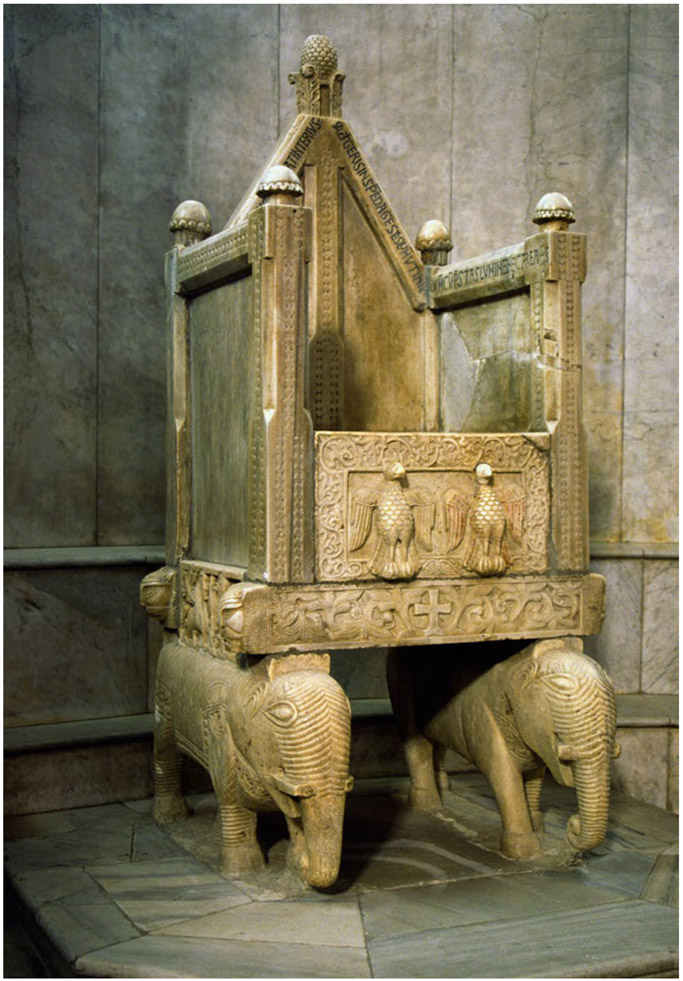
Figure 1.1. Throne of Urso, Canosa di Puglia, Italy. Scholarship questions the claim that it was made in the eleventh century for the bishop whose name it bears. John Heseltine/Alamy Stock Photo
arouses attention. It is not difficult to suspect fraudulent intent with works created in conditions where deceitfulness is known to have been widespread with documents and relics, especially once a motive for falsifying history is recognized. As art historian Lawrence Nees has asserted about the thrones,
Such works were created as documents inscribing memories of the past, but improving upon the historical record, in effect forgeries. They should be considered at least at one level as analogous to the many forged charters and other documents so particularly characteristic of the eleventh and twelfth centuries.42
For this sort of deception with artwork to have been present in medieval culture, complete secrecy was not necessary. Rather, it could have been known to an inner circle of clerics, artisans, and local residents yet not to other people, and carried out the intended effect of seeping into historical consciousness. Over time, traces of insider knowledge would diminish and eventually vanish, and even if recorded, might go undiscovered later.