
Art collecting grew in popularity during the Renaissance, losing its image of eccentricity, and by the sixteenth century it had become fashionable. Notable collections were amassed by monarchs Francis I of France and Holy Roman Emperor Rudolf II, and the Gonzaga family in Italy, where Isabella d’Este and her sister-in-law Elisabetta Gonzaga represented the role of cultured women in collecting. Above all, the Medici family led the way. When Lorenzo the Magnificent died in 1492, an inventory of his vast holdings showed the ancient works to be valued at many times those of contemporary artists.43 This price differential was typical of the time. Coupled with works by talented contemporary artists that were available at a more reasonable cost, it gradually brought Renaissance artists into popularity with collectors.
Art dealers came on the scene at least as early as the early fifteenth century,44 although at first not dealing exclusively in art, and were a part of the cultural landscape by the sixteenth century. High-end marketers served monarchs and others of wealth. Among them, Giovanni Battista della Palla acted as a procurer for Francis I as well as other clients. Jacopo Strada, who did much of his business from Venice but also lived in Nuremberg and Vienna, counted Holy Roman Emperors among his clientele along with nobility from several countries.45 The rest of the market, too, included international trade, as merchants specializing in art sold antiquities, copies of antiquities they commissioned, and works by Renaissance masters that owners were willing to part with. Artists often represented themselves from their studios, and sometimes functioned as dealers in selling the works of others. The guild system required that art sellers be members of the artists guild, but strictness in enforcement varied by location. Guild control was typically suspended during special auctions and fairs sponsored by municipalities, and over time, variations on this loophole grew into year-round marketing possibilities.46
The studio system of the day tended to blur the identity of original artworks as opposed to legitimate copies, collaborations, or outright fakes. Many works were collaborative efforts in which assistants performed much of the workmanship. Other pieces were copies of an original done by the master or by an assistant. El Greco employed many assistants and sometimes produced four or five duplicates of the same painting in various sizes. However, his inventory list distinguished his autograph originals from versions involving his studio employees.47 Raphael, too, had a large studio with talented assistants whose contributions leave questions as to who the principal artist was for various works.48 And in addition to their own works, artists often took commissions for exact copies of paintings by other artists. It has been estimated that as many as half of all commissions for paintings in the late fifteenth and early sixteenth centuries in Northern Europe were for copies. Originals were still the most prized pieces, selling for two and a half times the price of an autograph copy. Artists sometimes found it profitable to keep originals for display in their studios while they built up their value by selling copies.49
The studio system was subject to manipulation by artists and their assistants, who sometimes gave clients less than the degree of originality they bargained for. But it was later in history that much confusion arose over which pieces were authentic one-offs by a master and which were collaborations or copies by employees. As centuries passed, recognizing a genuine Rubens or El Greco or works by other masters became more difficult: something that was old and well executed, and perhaps with a signature that was added later, looked good to many authenticators and was attractive to dealers who were unknowledgeable or unscrupulous. This, however, is only part of the problem of mistaken identity that can be traced to the Renaissance. Besides studio works with a questionable pedigree, some artists performed restoration to an extent that compromised authenticity, and others made entirely new forgeries.
Restoring artworks was done with an attitude of liberality that carried over from the Middle Ages and continued until the nineteenth century. Typical of the time was a statement by painter Neri di Bicci about the work he did to renovate a panel painting: “altered the cusps of the arches, repainted four new cherubs, retouched and repainted almost all of the old figures, and turned San Frediano into Saint Margaret.”50 Substantial alteration of an image was acceptable as long as it was in good taste, judged by its fulfilling the principle of “grace.”51 A graceful painting or sculpture that resulted from reworking it was a desirable product, and inventiveness could be part of the process. The famed Laocoön sculpture from antiquity, for instance, was unearthed in 1506 in Rome with several missing pieces, most notably the right arm of the main figure, which was restored in 1520 to an awkward position consistent with the figure’s physical predicament and tortured look. The arm was later replaced with an outstretched version that seemed more aesthetically pleasing. Benvenuto Cellini, an accomplished sculptor, restored many pieces while working for Cosimo de’ Medici, including a torso for which he produced arms, feet, and a head, and added an eagle to turn the figure into Ganymede.52 On rare occasions, however, the principle of grace could be invoked to justify non-intervention on a damaged work such as the Belvedere Torso, which awed even Michelangelo to the extent that he recommended it remain untouched.53
Despite this liberal attitude, deceptive practices occurred that were considered to be either on the borderline of unethical or outright fraud. Practitioners devised more advanced means of creative restoration for existing works and production of new ones with artificial aging.54 Lorenzetto di Lodovico ran a large workshop in which sculptural pastiches were sometimes assembled using fragments from several different works that were combined into one and smoothed and polished to appear as carved from a single block. Whether these products were presented as pastiches or as originals may have varied according to the occasion,55 and determined their designation as acceptable restorations or forgeries. And taking the restoration process even further were artisans who created and damaged new works so they could restore them to look old. Pietro Maria de la Brescia, an engraver of precious stones, worked on the side creating porphyry vases and heads that he buried in the ground and subjected to cracking before making the necessary repairs to simulate antiques.56 Bronze sculptors are known in one case to have cast a statuette with arm stumps to give the appearance of damage, and in another case, to have broken off the arms intentionally from a cast that had gone awry and left it disfigured.57
At least in the early Renaissance, attitudes about forgery varied among the people who made art, collectors, and the general public. A tolerant approach appreciated faking as a talent and saw practitioners as picaresque figures who wanted to show off as they tricked connoisseurs in a spirit of gamesmanship. Giorgio Vasari in his famous Lives of the Artists relates several stories in this vein that have been recounted often. Michelangelo, we learn, gained fame at an early age when he borrowed original drawings to use as models, made copies that were indistinguishable from them, smoked the copies to simulate age, and then handed them back while he kept the originals.58 He also tried his hand at sculpture by making a life-size Cupid figure that two of his mentors suggested could be passed off as ancient, and one of them sold it to Cardinal San Giorgio in Rome. After the cardinal learned the truth, he hired the brilliant young artist to work for him.59
Another story from Vasari features Andrea del Sarto early in the sixteenth century. An Italian duke was smitten by a portrait by Raphael that he saw in the Medici collection, and contrived a way to own it by convincing the pope (a senior member of the House of Medici) to tell Ottaviano de’ Medici to present it as a gift. Ottaviano agreed but secretly had Del Sarto paint a duplicate of the portrait and put it in the original frame, which is what the duke received. After the work was verified by the duke’s expert, Giulio Romano, Vasari revealed the hoax, which he had been aware of from the start. Romano defended himself by declaring that he valued the painting he possessed, which seemed good enough to be authentic, as if it were by Raphael’s own hand.60
Tales like these portray forgery in a lighthearted way as a tribute to the forger and with indifference to right and wrong. But there is a counterpoint, the perspective of the victim, that disapproves of artistic duplicity on moral and economic grounds. That perspective is evident in the background with Michelangelo and Del Sarto. Although the cardinal who was tricked by the Cupid sculpture offered its maker a job, he was not amused about being swindled. He demanded that the sale of the sculpture be voided, and his money returned. With the Raphael portrait, too, there is another interpretation: the owner who commissioned the fake did it because he valued the original enough to engineer a sham that would keep it in his possession, and the duke who ended up with the fake was in a financial position to be indifferent because he had paid nothing for it. To whatever extent forgery as mischievous gamesmanship was appreciated, it was not a match for the economic hazard that resulted from it. In some instances, the practice was undertaken for the challenge and the glory, but in the main, it became a business enterprise.
There are many accounts of false art appearing in the Renaissance. Tommaso della Porta specialized in marble busts of Roman emperors. He was praised by Vasari, who owned one that was often mistaken for an antique.61 Whether the artist sold his sculptures as deceptions, or honestly as a copyist to other people who sold them as deceptions, is unclear, but his work contributed to the large number of fake Roman busts on the market that may have outnumbered the genuine pieces.62 Another artist whose works were sold as ancient originals, although historians tend to give him the benefit of the doubt about his intention, was Giovanni da Cavino.63 As a skilled craftsman, he made bronze medallions of Roman figures during a longtime collaboration with the humanist scholar Alessandro Bassiano, who provided information for historical accuracy.
Although the prices commanded by Renaissance masters were less than for antiques, forgeries of their works were also prevalent. Denis Calvaert produced drawings in the manner of Michelangelo and Raphael, giving them the appearance of being prototypes for elements found in their later works, including The Last Supper and The School of Athens. Calvaert passed his creations on to an art dealer who doctored the paper to show signs of age and rough handling and then sold them to collectors as originals.64 Many other artists of the sixteenth century were targeted by forgers, with varied reactions from the victims. Some accepted their fate and hoped the publicity brought by having their names spread widely would make their commissioned works more valuable. Another answer was to create works of a type that forgers would have difficulty copying. Hans Bol, an accomplished landscape painter who was victimized by forgers, devoted himself to a popular line of miniatures that required special expertise and touch.65
Perhaps the most victimized artist of the time was Albrecht Dürer. He complained bitterly about the flood of counterfeit pieces that were damaging his business and announced on the title page of a series of woodcut prints, “Be cursed, plunderers and imitators of the work and talent of others. Beware of laying your audacious hand on this work.”66 Most Dürer fakes were prints, although there were oil paintings as well. In some instances, the forgers developed pastiches, such as Virgin at the Gates, which copied and reversed the images of the Madonna from one woodcut, God the Father from another, the landscape from a third, and a plant in the foreground from an engraving. A phony self-portrait copied the head from one painting and the arms and legs from another.67 Many counterfeit works, however, were exact copies in full. They were sold in direct competition with the pieces turned out by Dürer himself and often were indistinguishable from them without close examination.
In what is sometimes described as the first attempt to prosecute copyright infringement in art, as related by Vasari, Dürer went to Venice in 1506 to lodge a complaint against printmaker Marcantonio Raimondi for selling copies of his prints there. As a skilled copyist, Raimondi is remembered for working collaboratively with Raphael but for running afoul of Dürer for unauthorized copying of his prints and reproducing the famous Dürer monogram (see Figures 1.2a and 1.2b). The ruling was that Dürer’s monogram was off-limits and Raimondi must cease using it. However, copyists were allowed to appropriate his images.68 Raimondi went on to produce several dozen more works by Dürer, and a number of other artists added to the output throughout the sixteenth century and later. Dürer also brought a claim against a copyist in his home city of Nuremberg in 1512, where the decision was similar to what he received in Venice.69
Hieronymus Bosch, too, was a widely faked artist of the time. The public was fascinated with his grotesque fantasy scenes portraying moral themes about folly and sin. A large output of fake wood-panel paintings was produced in Spain, which, although they were smoked to give the appearance of age and included Bosch’s monogram, were of poor quality. To unknowledgeable Spanish buyers of Dutch art, a low price and the name of a famous artist would have made these works attractive.70 Counterfeit works claimed to be by Bosch also appeared in other locations throughout Europe. In a double deception, noted printmaker Hieronymus Cock copied a drawing titled Big Fishes Eat Little Ones by Pieter Brueghel, before Brueghel achieved fame, and marketed it in 1557 as an engraved print under Bosch’s name in the city of Antwerp, where Brueghel was then living. When Brueghel’s reputation grew, the same image was copied again by an opportunist who put Brueghel’s name on it.71
As the Renaissance drew to a close, various factors were in place that prefigured the presence of art forgery in future centuries. There were revered artists, avid collectors, and a lively market for art. Newly made works that simulated the ancients were sold as long-lost originals. Recent and contemporary artists were copied as well, often with confusion regarding the difference between legitimate and illegitimate use of existing images, and sometimes with collaborators in the background. The perpetrators of forgery were known or suspected artists whose names and techniques often were public knowledge. Attitudes toward forgery ranged from respect for skilled workmanship to an outcry over the harmfulness of commercial fraud, and the rudimentary state of prosecution against forgery under the law acknowledged an element of wrongdoing but often allowed blatant actions to occur with impunity.
During the seventeenth century, the cultural factors underlying art forgery developed further. In a historic sale, art dealer Daniel Nys arranged for King Charles I of England to purchase the massive collection of the Duke of Mantua, for which he is estimated to have received a personal profit of more than 30 percent, all the while negotiating secretly but unsuccessfully to keep certain key pieces for himself.72 Also noteworthy was the personal collection Abbé Michel de Marolles amassed in France of 123,000 prints that he sold to King Louis XIV, which he followed up with a new collection of more than one hundred thousand works over the next decade, including ten thousand original drawings.73 The king’s fame as a collector was preceded by that of his advisor Cardinal Mazarin, who also assembled two large collections, the first of which was confiscated and sold when he was forced to leave France during a time of political turmoil. Two years later, he returned to his post, and at his death, left more than five hundred paintings (by Raphael, Titian, Tintoretto, and other Renaissance masters) and 250 statues.74
Beyond this grand scale, collecting art was recognized as a form of investment75 as well as a means of entertainment. Publications in several coun-
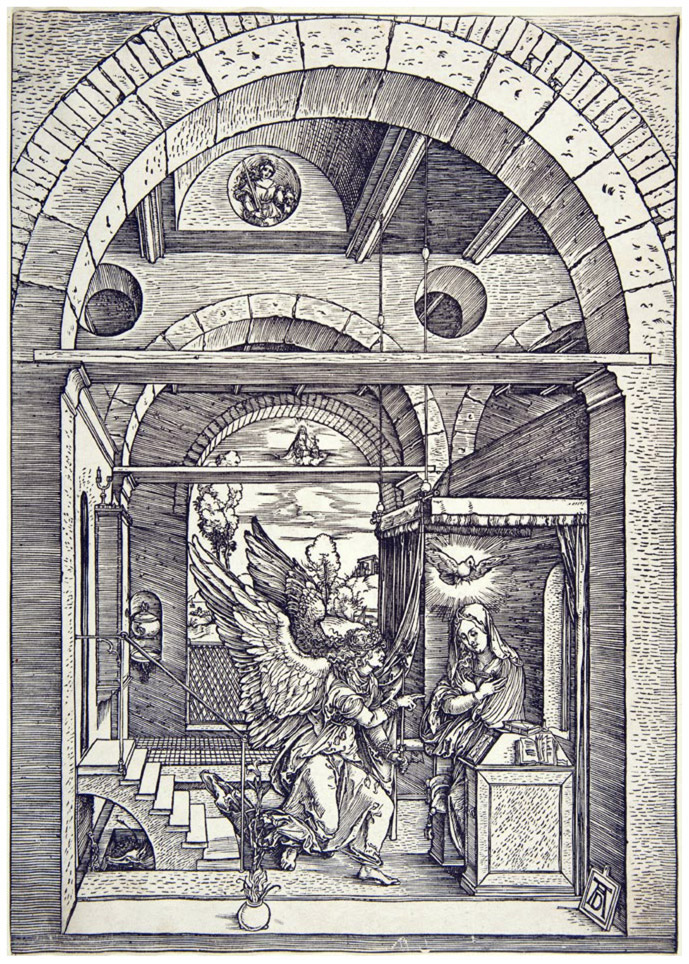
Figure 1.2a. The Annunciation by Albrecht Dürer, 1503, woodcut, 29.7 × 21 cm. Courtesy of the Metropolitan Museum, New York
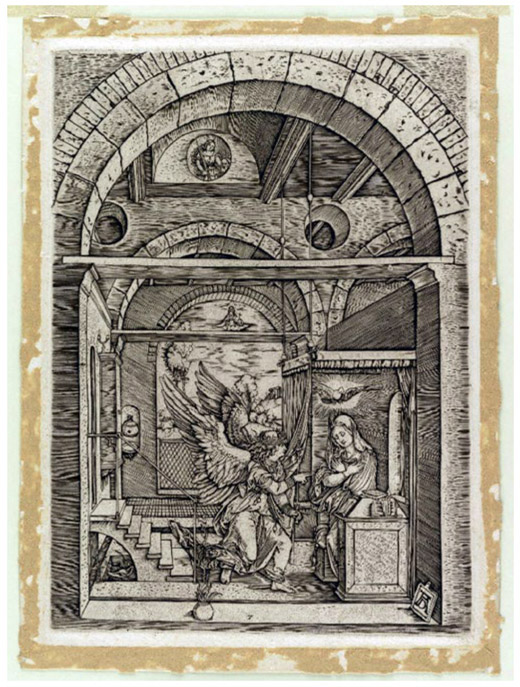
Figure 1.2b. The Annunciation by Marcantonio Raimondi, 1510, engraving, 33 × 24 cm. Bears Albrecht Dürer’s monogram. The Trustees of the Chester Beatty Library, Dublin
tries listed many private collections whose owners proudly opened them for viewing on request, and paintings from that era that are in existence today present images of collectors receiving visitors.76 The possession of artworks for enjoyment was common among the general population and reached substantial proportions in some locales. During English diarist John Evelyn’s travels on the Continent, he remarked in an entry at Rotterdam about farmhouses filled with pictures,77 and public records show that in the city of Delft during the mid-seventeenth century, paintings could be found in two-thirds of the households, with an average of seven or eight in each, including landscapes, biblical subjects, still lifes, portraits, marine scenes, and genre scenes.78
The studio system continued practices that were confusing for buyers who wanted original works by a master. Rubens employed many assistants, and astute clients who commissioned him knew enough to specify in their contracts exactly which parts of the paintings they were purchasing were to be done by the master.79 Rembrandt had a large studio where he had collaborators on many of the works his inventory listed under his name. Determining which works are his alone has led to many disagreements among experts over time.80
Forgery of renowned artists grew during the seventeenth century. Rubens was prolifically faked. His paintings and prints were copied during his lifetime, and the practice continued in later decades with production numbering in the thousands. He took legal action by petitioning the Netherlands States General. In 1620 it was declared that for a period of seven years duplications of his works would carry the penalty of a fine along with confiscation of the copperplates used for making prints. Later, Rubens took his case to a French court, which issued a similar decision, and in 1634, he sought action against a forger of his works in Germany. The verdict was in his favor, but the accused appealed to a higher court, with the final verdict unknown.81
Typical forgers were copyists who supplemented their legitimate business with the production of outright fakes. Pietro della Vecchia imitated Giorgione, Titian, and other noted artists with such skill that his paintings appeared in royal collections as originals.82 Sébastien Bourdon in France had a reputation for forgery, as did Jean Michelin. They imitated the styles of well-known painters, put chimney soot into their paints for a darkening effect to mimic age, and rolled the finished canvases to create craquelure.83 Terenzio da Urbino, said to have been a gifted painter who turned to forgery early on instead of pursuing a legitimate career, used deceptive varnishes, painted on old canvases, sought out old frames complete with wormholes, and treated the finished products with smoke. His downfall came when he tried to pass off a false Raphael to his patron, Cardinal Montalto. The cardinal admired the painting, but some of his knowledgeable friends informed him that, despite the artist’s impressive execution, it was a forgery—a “pastichio” of elements from several of Raphael’s works. As the story has been told, the cardinal took the situation in stride and maintained the dignity of his office. On learning he had been victimized, he replied (playing on the double meaning of the word as also “pie” or “pasta dish”) that if he wanted a pastichio, he would order one from his cook.84
Still another strategy prevalent in the seventeenth century was the practice of signature forgery. Dürer suffered this fate often when his monogram was copied on many works done by other artists. Andrea Mantegna’s name appeared on many works that were not his, and Johannes Vermeer’s The Painter in His Studio was signed “Pieter de Hoogh” by an enterprising signature forger who took advantage of an artist whose works sold for higher prices at the time. Some signature specialists removed part of the lettering from an existing name and filled in the blank space with a more valuable name that bore similarity. Thus, for example, Hans Schäuffelein’s “HS” became Hans Holbein’s “HH,” and Reynier van Gherwen’s (a student of Rembrandt’s) signature transformed into Rembrandt’s own.85 A particularly ingenious ploy with signatures was contrived by Neapolitan artist Luca Giordano, who painted a fake Dürer but also included his own signature written small at the extreme edge of the painting where it was covered by the frame. After experts authenticated the piece as an original Dürer, and it was sold, the forger told the buyer the truth. The buyer sued but lost when the judge said the painter could not be blamed for being able to paint as well as a famous master. Having established his modus operandi and gained legal support, Giordano went on to use the same ploy for fakes of many artists, among them Tintoretto, Rubens, Rembrandt, Veronese, and Caravaggio.86
With copyright protection under the law limited to signatures, and even then subject to inconsistent enforcement, artists and collectors were on the defensive, and forgers were emboldened. When questions of attribution arose, general practice followed the tradition of consulting experienced artists rather than seeking the expertise of collectors and connoisseurs of art, which would become customary later. The artist-experts often disagreed with one another. In a major scandal, more than fifty artists gave opinions about the authenticity of a collection of thirteen paintings (mostly bearing the names of Italian artists) that was offered for sale by dealer Gerrit Uylenburgh in Amsterdam in 1671. Painter Hendrik de Fromantiou, who was a veteran of the “painters’ gallies” (copy shops) and formerly employed by Uylenburgh, declared the paintings to be copies and specified where the originals could be found. Fromantiou found experts who agreed with him, and Uylenburgh countered with a larger number who disagreed. The dispute continued until the dealer auctioned the paintings with great fanfare in 1673.87 Uylenburgh represented a gradual trend toward the pursuit of dealing art as a full-time profession, while sales were often conducted by people from various backgrounds who worked the art market as a sideline. Rubens had a reputation not only for his skill as a painter but as a major collector and shrewd seller, and his countryman Balthazar Gerbier was an accomplished collector-agent-dealer. Diplomats often became opportunistic go-betweens through their travels and personal connections.88